The winter light of the seventh of January 1937 fell cold on The Hague as carriages rattled through streets draped in orange. Crowds pressed against the barricades, breath steaming, waiting for a glimpse of a foreign prince who within hours would bind himself to Juliana, heir to the Dutch throne. To the public it was a royal wedding, a pageant of tradition and romance. It was also, read more closely, a repositioning, a small country quietly attaching itself to a larger web of dynasties, industries, and intelligence services through the person of one well-connected man.
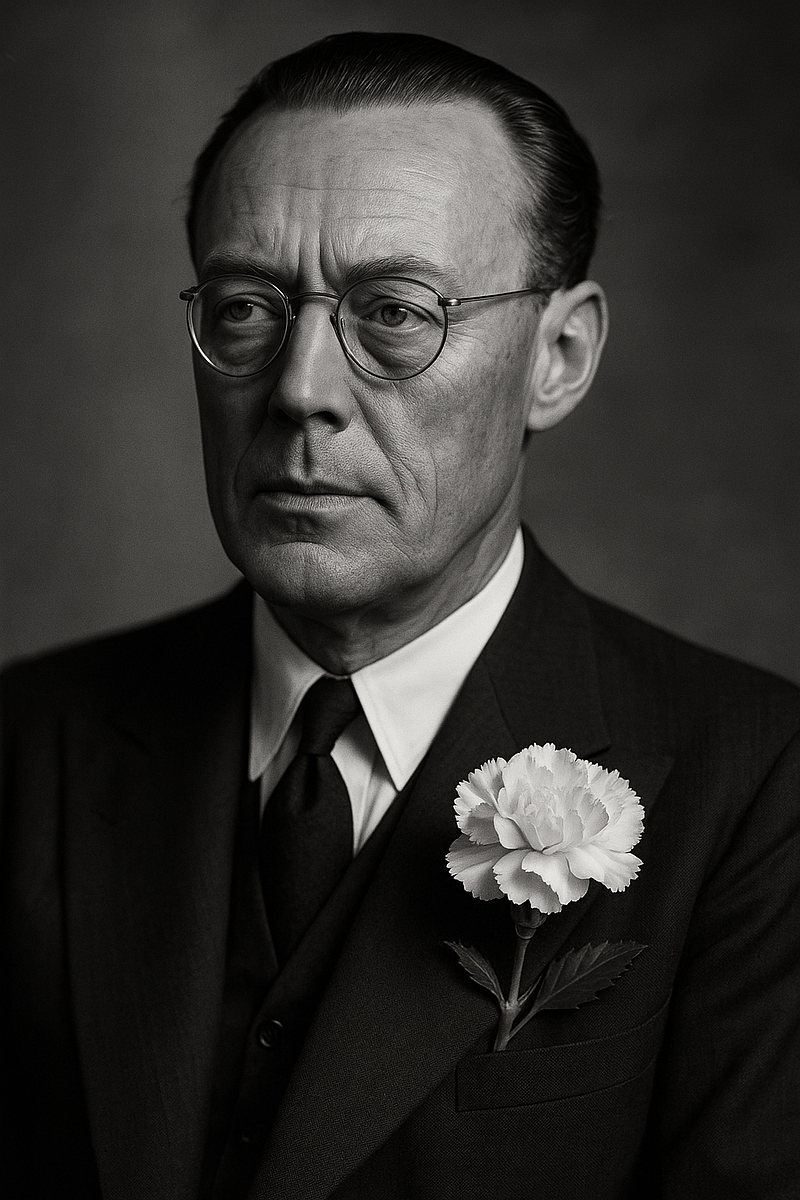
Prince Bernhard of Lippe-Biesterfeld never wore the Dutch crown. Yet for half a century, in salons from Washington to London, in Shell boardrooms in The Hague and conference hotels in the Dutch woods, he wielded the authority of someone who had. The interesting thing about Bernhard is not the scandals, though there were many. It is what he reveals about how a small nation acquires power disproportionate to its size. The determining variable was never territory or armies. It was position in a network, and Bernhard's particular genius was for occupying the one seat in any room that connects all the others. He did not rule the Netherlands. He turned it into a node.
The marriage was a merger
The morning of the wedding was a geopolitical act dressed as a family celebration. Europe in 1937 was tense, Germany rearming under Hitler, Britain watching warily, the Netherlands small, wealthy, and exposed. Queen Wilhelmina, who had ruled since the late nineteenth century, had one child, Juliana, who was shy, devout, and unworldly. Bernhard was the opposite, multilingual, confident, at ease in any society. Wilhelmina's calculation was that a German son-in-law might ease pressure from Berlin and tie the Dutch dynasty into the aristocratic networks of the continent, and that a worldly consort might stabilize a monarchy resting on a fragile heir.
There was a detail the pageantry did not advertise. When Bernhard met Juliana in 1936 he was working in Paris for IG Farben, the German chemical conglomerate that would become inseparable from the Nazi war economy. He was not a stray romantic prince. He was a young man already inside the machinery of German industry, and the marriage moved him from one network into another, from the apparatus of a rising Reich into the household of a neutral Protestant crown. The Netherlands did not import only a decoration; it imported a connector. How clearly the court understood that at the time is uncertain, and the claim here is not that anyone planned it. The point is structural: the effect did not depend on the intention.
A practice older than the prince
Bernhard did not invent the Dutch habit of leverage through connection. He inherited it. The House of Orange and the country it came to represent had been practising network power for four centuries, and that inheritance is the reason a German aristocrat slotted into it so naturally. The Dutch Golden Age was not built on territory, of which the republic had little, but on position: Amsterdam as the financial clearing house of seventeenth-century Europe, the Dutch East India Company as the first great multinational, a merchant fleet that made a small wet country the hinge of global trade. The stadtholders practised marriage diplomacy across the Protestant courts of Europe, and in 1688 a Dutch prince, William of Orange, crossed to England by both invitation and armed landing and took its throne, a small-state ruler placed at the centre of a larger kingdom as much by the networks he had cultivated as by force.
This is the deep grammar Bernhard stepped into. The Netherlands had always known that a small nation survives and prospers not by mass but by being the place other powers have to pass through, the port, the bank, the broker, the neutral ground where rivals can meet. Bernhard's contribution was to translate that centuries-old logic into the idiom of the twentieth century, swapping spice routes and dynastic marriages for defence contracts, oil majors, and transatlantic conferences. The instrument changed. The principle, that a small country wins by being a crossing point, was already old when he arrived to renew it.
The man who could be rewritten
Bernhard was born in 1911 in Jena, into a line of minor German nobility with prestige but little fortune. For an ambitious aristocrat in Weimar and then Nazi Germany, affiliation was the price of advancement, and Bernhard paid it. He belonged to the National Socialist Motor Corps and to the Reiter-SS, the mounted branch of Hitler's black-uniformed elite. His own later explanation was banal and probably honest: membership smoothed his law exams and came with the use of a garage. His party membership ended in early 1937, around the time of his marriage. Whether the affiliation was belief or convenience almost does not matter. What matters is the pattern it began.
Because the same man would, within a few years, be refashioned completely. He renounced his German citizenship, swore loyalty to the Netherlands, and was remade as Prins der Nederlanden. A figure once photographed in SS regalia became the glamorous consort of Europe's most Protestant monarchy. This was not hypocrisy so much as a method. When Germany dominated, he wore its insignia. When the Allies triumphed, he wore their wings. When scandal struck, he smiled until it faded. Bernhard's defining talent was not loyalty to any side but the capacity to be rewritten by events without ever losing his footing, and a man who can be rewritten can be placed anywhere a network needs a node.
This is worth pausing on, because the rewritability was not a flaw in the connector. It was the qualification. A node has to be legible to everyone it links, trusted enough by each side to be admitted, owned by none of them. A man with fixed, public loyalties can bind two parties only if they already agree. A man who can credibly present a different face to each, the German who understood Berlin, the airman who fought for the Allies, the Dutch consort who answered to neither, can sit between parties who do not agree at all, and that is the rarer and more valuable position. Bernhard's lack of a fixed self, which a moralist reads as emptiness, was precisely the property that let him occupy the empty centre of a network. The connector cannot belong to what it connects.
The war that laundered the past
When Germany invaded the Netherlands in May 1940, the royal family fled to London, and exile became Bernhard's making. The German aristocrat with the SS card reappeared as the fearless prince of the resistance. He trained as a pilot, wore the uniform of the Royal Dutch air arm, spoke over Radio Oranje, and was photographed beside Allied commanders. The war that should have buried a former party member instead cleansed him, and it did so because of what he could offer that others could not.
His real contribution in London was not combat. It was connection. The wartime capital was the densest network the world had ever assembled in one place, governments-in-exile, Allied commands, intelligence services, the industrialists who built the war machine and the financiers who paid for it, all crowded into a single besieged city and forced to cooperate. For a man whose talent was occupying the space between parties, it was an unrepeatable opportunity, and Bernhard used it. He moved among Allied command, charmed Churchill, dined with Eisenhower, and built relationships with the bankers, industrialists, and intelligence officers who orbited the war effort. The friendships formed in those years, between people who had shared the experience of the war from the inside, became the raw material of the postwar elite, and the man who had been present at the formation of those bonds was positioned to convene them afterward. London did not just rehabilitate Bernhard. It introduced him to everyone who would matter, at the one moment they were all in the same place and disposed to trust one another, and a decade later he would gather a version of that same circle in a Dutch hotel. His German background, once a liability, became an asset, the proof that not every German aristocrat had bent to Hitler, and the bridge to a culture the Allies needed to understand. By 1945 he returned in uniform to cheering crowds, his earlier affiliations dissolved into the image of the liberator. The war had not interrupted his network. It had upgraded it, swapping a German web for a transatlantic one, and the transatlantic web was the one that would matter for the rest of the century.
The invisible monarch
When Juliana took the throne in 1948, Bernhard became consort, a role the Dutch constitution drains of formal power. He filled it anyway. Juliana was gentle, devout, and often indecisive; Bernhard was assertive and worldly, and ministers, generals, and businessmen frequently found it easier to deal with him than with the queen. He held no constitutional authority and behaved as though he held a great deal.
The strain showed. Juliana's reliance in the 1950s on the faith healer Greet Hofmans produced a genuine crisis in the royal household, with the queen drawn toward pacifism and moralism while Bernhard sided with the military and political pragmatists. For a period the Netherlands seemed to carry two monarchs, one ceremonial and inward, one operational and outward-facing, and the Dutch press, deferential by habit, largely kept the rift from public view. This is the first appearance of the mechanism in its mature form. In a system designed to limit royal power, Bernhard expanded his through charm and connection rather than constitutional right, becoming something the designers had not anticipated, an unelected, unaccountable operator at the heart of a constitutional state.
A court without a crown
The clearest instrument of that operation was built in a Dutch hotel in the spring of 1954. Picture the scene, because it is the whole method in miniature. A comfortable hotel set among the trees of Oosterbeek, a quiet town better known for the failed Arnhem landings a decade earlier than for anything that would happen that weekend. No press conference, no public list of who had come or why. Inside, from the twenty-ninth to the thirty-first of May, around sixty figures, roughly fifty from eleven Western European countries and eleven from the United States, politicians, bankers, industrialists, a few trusted journalists, sat down together with the understanding that nothing said would leave the room. At the centre, neither chairing a state nor running a company, was a prince, making introductions. The most consequential thing about the gathering was that, officially, nothing happened at it at all. The idea had been conceived by the Polish exile Józef Retinger, the American end organized through Eisenhower-era figures such as the intelligence chief Walter Bedell Smith and the White House adviser C.D. Jackson, but the host, the chair, and the name's source was Bernhard, who presided over the group from its founding until 1976. The hotel gave the gathering its lasting name.
What makes Bilderberg worth understanding is not secrecy in the conspiratorial sense but its mechanism, which is subtler and more durable. The meeting passes no resolutions, issues no declarations, binds no one to anything. It only convenes. And the informality is not a limitation on its power; it is the source of it. The conversations are held under a strict off-the-record rule, no minutes, no attribution, nothing a participant says traceable back to him. That rule is usually read as secrecy. It is better read as a candour engine. Officials who would never speak freely in front of a parliament or a journalist speak freely when nothing can be quoted, and freedom to speak is what produces convergence. A meeting that kept minutes would produce caution. A meeting that keeps none produces alignment, and alignment among the people who hold real offices is worth more than any communiqué.
The membership rotates, which compounds the effect over time, drawing each year's rising politicians and executives into the same room as the established ones, so that a shared way of seeing the world is transmitted across a whole generation of the powerful without anyone ever voting on it.
The honest claim has to be drawn precisely here, because this is where the subject usually loses its discipline. What the evidence supports is alignment, the formation of a shared frame among people who already hold power, and that is a real and documented effect. What the evidence does not support is causation, the idea that policy is dictated in the room and handed down. Bilderberg issues no orders and can be shown to have decreed nothing. The weaker claim is also the sturdier one, and it is enough: a forum that aligns how the powerful understand a problem shapes what they will later each decide in their own capitals, without ever needing to decide it collectively. Critics call this a shadow government; defenders call it a harmless dinner. Both miss the structure between those poles. It is neither a government nor harmless. It is a coordination mechanism with no accountability, which is precisely the combination that makes it effective and impossible to pin down. Generals, chief executives, and ministers who would never otherwise share a table sit together off the record, and out of that conversation comes alignment, a rough convergence of how the powerful understand a problem, arrived at without a vote and attributable to no one. That is the quiet genius of the form. A body that decides nothing formally cannot be held responsible for anything, yet a body that aligns the people who do decide shapes outcomes more reliably than many parliaments. Bernhard's role required no mandate and no office. As a consort he could convene without threatening; as a prince he could confer status without demanding it; as a German-born Dutchman he bridged the two halves of the Atlantic by biography alone. He was not the most powerful person in the room. He was the person who made the room, and in a network the one who convenes outranks the ones who merely attend.
The room and the continent
There is a documented through-line in what the room was for, and it sharpens the mechanism without overstating it. From its first meetings in the early 1950s, Bilderberg pursued two declared purposes: trans-Atlantic cooperation and European integration. These were not hidden agendas decoded by critics; they were the forum's own stated reasons for existing, and they were discussed, year after year, among precisely the European and American figures who held or would soon hold real office. One of the early conferences fell only months before the signing of the Treaties of Rome in 1957, the agreements that created the European Economic Community, and the later records show participants returning repeatedly to the project of the Common Market and to questions such as Britain's eventual entry into it.
The temptation here is to draw a straight line and say the room built the union, and that line must be refused, because it is exactly the overreach the subject invites. Bilderberg did not draft the Treaties of Rome; sovereign governments did, through public institutions, for reasons of their own. What the forum did was the thing it was built to do, and the only thing the evidence supports: it aligned the way an influential trans-Atlantic elite understood the European project, in the years that project was being decided, so that when the same people acted later in their own capitals and boardrooms they acted from a shared frame. That is not causation and it is not nothing. It is the precise middle term the whole subject usually skips, and it is the clearest available illustration of why a forum that decides nothing can still matter: the continent's integration was a public, governmental act, and the private convening ran alongside it, shaping the disposition of the people who would carry it out. The room did not rule the continent. It tuned the people who did.
The node, not the size
Step back from Bernhard and the structural point comes into focus, because it outlasts him and reaches far beyond one prince. The Netherlands is small, and by the ordinary measures of power, population, territory, army, it should be peripheral. It is not, and the reason is that it sits at an unusual number of crossing points. The Anglo-Dutch structure of Royal Dutch Shell tied a Dutch institution into the center of the global energy industry. The port of Rotterdam became the largest in Europe, the physical funnel through which a continent's trade passes. The Hague became host to the International Court of Justice and later the International Criminal Court, the place where the world brings its gravest legal disputes. KLM, the diplomatic service, NATO infrastructure, and in our own time ASML, the single company on which the entire advanced semiconductor industry depends, all sit inside or pass through this small country.
None of these is Bernhard's personal creation, and it would be absurd to claim so. The point is the pattern they share, which Bernhard happened to embody rather than design: a state's influence is set by its position in the networks of money, law, energy, and trade, not by its size on the map. A small country that occupies enough crossing points becomes structurally indispensable, present in disputes and decisions out of all proportion to its weight. Bernhard did not build that architecture, and he was more its facilitator and accelerator than its author. What he added was the one kind of crossing point that does not appear on any map, the personal network, the convening power, the court without a crown, and in doing so he made himself a human node connecting the Dutch institutional nodes to the wider world. The institutions were the structure. He was a particularly well-placed conductor running along it.
The crossing points, named
It is worth making the crossing points concrete, because together they show that the network logic is built into Dutch institutions, not just into one prince's address book. Take the corporate form first. Royal Dutch Shell and Unilever were both deliberately Anglo-Dutch, single enterprises with two national parents, a structure that let them belong to two states at once and be fully captured by neither. The Netherlands went further and engineered itself into a jurisdiction through which global capital prefers to pass, with holding-company regimes and treaty networks that made Amsterdam a routing point for cross-border investment far larger than the domestic economy. A small country became, by legal design, a place multinational money flows through, and a conduit is a node whether or not it produces anything itself.
Then the law. The Hague hosts the International Court of Justice, the International Criminal Court, and the Permanent Court of Arbitration, the body through which the largest investment-treaty disputes in the world are decided, including awards in the tens of billions against sovereign states. A small city became the place humanity brings its gravest legal quarrels, which means the Netherlands sits at the crossing point not of trade or money but of international legitimacy itself, the venue where the lawful and the unlawful are formally sorted. Energy and capital and law are three crossing points already, each older than the prince who personified them, and the small country sits on all three. The newest and sharpest of them, the one that now sits at the very center of the contest between the two largest powers on earth, is worth giving its own dates.
The choke point, dated
The newest crossing point can be given exact dates, which is what makes it the strongest current proof of the thesis. In January 2023 the Netherlands and the United States reached an agreement to restrict the sale of ASML's most advanced lithography machines to China, and on the thirtieth of June that year the Dutch government issued formal export controls, effective from the first of September 2023. The restriction, initially aimed at the cutting-edge extreme-ultraviolet systems, was extended to the older deep-ultraviolet machines as well, with the tightening implemented fully from January 2024. The decisions were driven by American pressure, and they turned a Dutch licensing question into one of the central instruments of the contest between the world's two largest powers over who can manufacture the most advanced semiconductors.
Read against Bernhard, the continuity is almost uncanny. A single company in a small Dutch town holds a position no army can replicate, the sole maker of the machines without which the leading edge of the chip industry cannot exist, and the question of who may buy those machines is now decided in The Hague under the weight of Washington. The instrument has changed entirely, from a prince's address book to a lithography machine, but the grammar is identical: the Netherlands matters because the world has to pass through it. And the convening did not end with the founder either. His daughter, Queen Beatrix, attended Bilderberg meetings during her reign, the host's role continuing inside the dynasty he had married into, the court without a crown still keeping its table set a lifetime after the man who built it had gone.
The scandal that proved the rule
In the early months of 1976 the disclosures reached the Netherlands from an American hearing room. A United States Senate inquiry into the Lockheed corporation, then unspooling a global trail of bribes paid to win aircraft contracts, named the Dutch prince consort among the recipients, around 1.1 million dollars by the figure most often cited, paid to gain leverage over the Dutch government's purchase of military jets. Lockheed had needed a channel into The Hague, and it had found one in the man with the uniforms and the access. The cabinet did not dare let the crown investigate itself, so it appointed three eminent outsiders to do it, and through that spring the prince who had worn German insignia, then Allied wings, then the decorations of a dozen states, waited to learn which of his uniforms he would be allowed to keep. The verdict, delivered in late summer, was that his conduct had been unacceptable, though it stopped short of finding that he had pocketed the money himself. He gave up his military rank, his inspector-generalship, his hundreds of patronages, and the chairmanship of Bilderberg, and the uniforms he had worn all his life he now, for the most part, set aside. A man whose entire method had been the wearing of the right colors was, for a season, stripped of all of them. And then nothing further happened to him. He was never prosecuted. In interviews published after his death in December 2004 he gave an equivocal account, acknowledging that Lockheed money had reached a Swiss account while insisting it had been meant for someone else.
The instructive part is not the corruption but the survival, because it demonstrates the protective property of the position he occupied. A cabinet minister or a banker caught taking a foreign arms bribe is finished, prosecuted, erased. Bernhard was scolded, demoted, and absorbed back into national life as a flawed elder statesman. The difference is not the act but the shield, the way royalty and a dense web of elite relationships convert a crime into a scandal and a scandal into a footnote. The same network that gave him his influence also insulated him from its consequences.
This is not a quirk of Dutch deference; it is a structural feature of being a node, and the contrast with an ordinary official is the whole lesson. An ordinary administrator is fungible: the system has many like him, so it can dispose of one to protect itself, and frequently does, because the cost of removal is low and the gain in legitimacy is high. A node is the opposite. It is load-bearing, the point through which other things connect, so the system cannot dispose of it without damaging itself. The same act that ends a replaceable man is survivable for an indispensable one, not because he is more virtuous or better defended in any personal sense, but because cutting him out severs connections the institution needs intact. Removing a node cannot be cheap, because removing it damages everything attached to it. To prosecute Bernhard would have meant putting the Dutch crown, the country's defence relationships, and a web of transatlantic figures on trial alongside him, and the system that depended on those connections had every incentive to find a smaller remedy. The investigation that followed, led by senior establishment figures, produced a report that criticized him and spared the institution. The position protects its occupant precisely in proportion to how much else runs through it. A peripheral man pays the full price of his crimes. A central one is too entangled to be cut out without cost to everyone holding the other ends of the threads, and so he is, instead, quietly absorbed. (Older claims that he inspired Ian Fleming's James Bond, or fathered secret children, circulated for decades and remain unverified rumor; they belong to the mythology, not the record, and the documented mechanism is more interesting than the gossip.)
The network outlived the man
Bernhard died in 2004, and the most telling fact about his kind of power is that almost none of it died with him. Bilderberg continued, and continues, its annual convening of the aligned. The Dutch monarchy endured. The crossing points multiplied, and the most important one, the lithography choke point now decided in The Hague, barely existed in his lifetime. The courts there kept judging the world's wars, Rotterdam kept funneling its trade, and the small country kept finding itself, decade after decade, holding a crossing point in whatever the era's central struggle happened to be. The crossing points were not Bernhard's, and the newest of them postdates him, which is exactly the point: the position renews itself in new forms while the men who occupy it come and go. When a Dutch king met an American president the day after a recent Bilderberg meeting and no one publicly connected the two events, the old pattern was simply running again, the convening and the access flowing on without the man who had personified them.
This is what marks a structural power rather than a personal one. A personal power dies with its holder. A structural power is a position that outlives whoever occupies it, and the network Bernhard helped weave was always a position, not a possession. A possession can be seized, sold, or buried with the man who held it; a position can only be vacated and filled again, which is why the throne behind the throne never needed an heir of its own, only an occupant. He was the vehicle through which a small state learned the lesson; the lesson, once learned, no longer needed him. The court without a crown still meets. The throne behind the throne was never a person at all. It was the architecture of connection that any sufficiently well-placed person could inhabit, and that the Netherlands, having once acquired it, has never given back.
The portable finding is simple, and it travels far past The Hague: to locate real power, do not measure the size of an actor; find the crossing point it sits on, and ask who is positioned to convene the rest. The convener outranks the crown, and the crossing point outranks the country.
The honest objection
The strongest case against this reading is that it inflates a charming operator into an architect. Bernhard, a skeptic would say, was a vain, corrupt, well-connected playboy who hosted a talking shop, and the Netherlands' outsized position owes to centuries of trade, the accidents of geography, the Anglo-Dutch corporate inheritance, and the postwar settlement, none of which he created. Bilderberg, on this view, is an overrated dinner club that conspiracy culture has mistaken for a world government, and crediting it, or him, with shaping Western policy is exactly the kind of pattern-seeing that should be resisted.
The objection is largely right about Bernhard the man, and that is why this is not a story about him. He did not build the Dutch crossing points and Bilderberg passes no laws. The claim is narrower and survives the objection: that influence in the modern world runs through network position, that convening power is real even when it is informal and unaccountable, and that a small state densely woven into the networks of energy, law, trade, and elite coordination wields leverage far beyond its size. Bernhard is the legible illustration of a mechanism that does not depend on him, and the proof is precisely that the mechanism kept working after he was gone. Strip away every exaggeration about the prince and the structural fact remains: the Netherlands matters more than its map says, because of where it sits in other people's networks.
The prince who never ruled
Bernhard was a man of contradictions, German by birth and Dutch by destiny, a war hero with an SS past, a champion of the democratic West who took an arms bribe, a consort who behaved like a head of state. He was neither the saint his liberation image painted nor the cartoon villain of the conspiracy literature. He was an operator, a survivor, a weaver of threads, and his life is useful mainly as a window onto how power actually arranges itself when it no longer wishes to appear as command.
It arranges itself as connection. The loud forms of power take territory and issue orders. The durable forms take a seat at the crossing point and let the network do the rest. Bernhard never wore the crown; he built the court. He was not the king the Netherlands crowned, but the king it sometimes followed, and the kingdom he ruled was never the country on the map. It was the invisible one made of who sits next to whom, which is the only kingdom that a small nation, or a well-placed prince, ever really needs.
Evidence Map
Facts, interpretations, forecasts, and disconfirming signals.
Core claim. The Netherlands wields influence out of proportion to its size because it occupies an unusual number of network crossing points (energy via Shell, trade via Rotterdam, law via The Hague's courts, semiconductors via ASML, elite coordination via Bilderberg), and Prince Bernhard is the clearest illustration of the underlying mechanism: in the modern order, network position and convening power, not territory or armies, are the determining variable of a small state's leverage. Bernhard is the vehicle, not the cause.
Evidence level. Facts (high): Bernhard's Reiter-SS / NSKK membership and IG Farben employment; the 1937 marriage to Juliana; his founding-era role as host and chair of Bilderberg (1954 Oosterbeek, conceived by Retinger, US end via Bedell Smith and C.D. Jackson), chairing until 1976; the 1976 Lockheed affair (the often-cited $1.1 million Lockheed channelled toward him, which the commission did not establish he personally received) and his forced resignations; his December 2004 death and equivocal posthumous account; the Dutch institutional crossing points (Shell, Rotterdam, ICJ/ICC, ASML). Interpretation (marked): that these constitute a coherent "network position over size" mechanism and that convening power is a real if informal form of influence. The James Bond and secret-children claims are flagged as unverified rumor and excluded from the argument.
What would confirm this. Continued evidence that Dutch institutional centrality (legal, energy, semiconductor, logistical) drives its diplomatic weight more than its size does; continued informal elite convening (Bilderberg and successors) tracking with policy alignment.
What would disprove this. A demonstration that the Netherlands' influence tracks conventional power metrics rather than network position; or that informal convening bodies like Bilderberg have no measurable effect on alignment or policy, reducing the mechanism to coincidence.
Watchlist. ASML's role as a semiconductor choke point in the US-China contest; the standing of The Hague's courts in live international disputes; the continuity of elite convening institutions and their overlap with policy.
Related from The Manifest Archive
- Inside the Secret Club That Shapes the World
- Willem-Alexander Met Trump the Day After Bilderberg Ended. No One Mentioned Bilderberg
- What Is the Black Nobility in Rome? History, Origins, and Context
- NATO Encirclement: How Three Rational Decisions Locked Eighty Years Into Place
Jerry van der Laan writes The Manifest Archive. He traces the structures beneath the events.