Introduction, a hotel in the woods
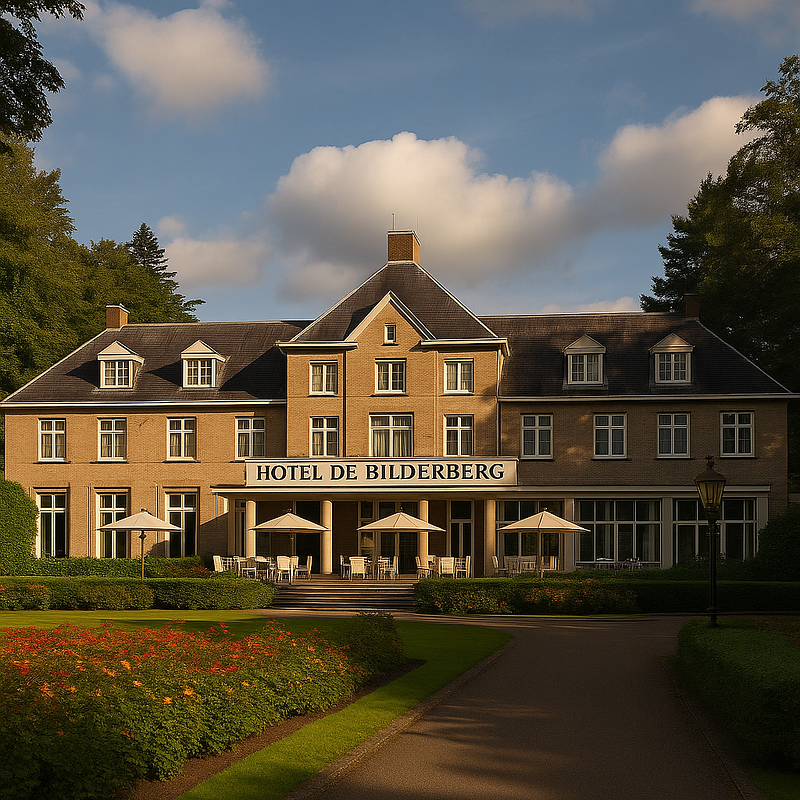
On a spring morning in May 1954, the quiet Dutch village of Oosterbeek stirred with unusual traffic. Black cars rolled up the drive of the Hotel de Bilderberg. Behind their tinted windows sat ministers, generals, bankers, and editors. They checked in discreetly, accompanied by aides and protected by silence. No reporters were admitted. No minutes would ever be published.
That weekend marked the first of what became known as the Bilderberg Meetings: an annual invitation-only gathering of the most powerful figures in politics, business, finance, and media. They do not vote, they do not sign treaties, they do not publish declarations. What they do is meet in secret, exchange candid views, and weave the networks that quietly shape the direction of the West.
For seventy years Bilderberg has been the hidden calendar entry of presidents, prime ministers, CEOs, central bankers, NATO commanders, and newspaper editors. Every year the guest list reads like a map of power. What is discussed never leaves the room, yet the effects echo in markets, wars, and policies.
“Bilderberg’s reputation is built on a paradox: it denies making decisions, yet it gathers only those who make them.”
To admirers, Bilderberg is a rare forum where leaders can speak freely without cameras or slogans. To critics, it is proof that democracy is a stage while decisions are aligned in private. Its reputation as the world’s most secretive elite gathering has made it the subject of both serious scrutiny and endless conspiracy theories.
The Netherlands was not only the birthplace of Bilderberg but also its heartbeat. Prince Bernhard of Lippe-Biesterfeld, consort to Queen Juliana, founded the first meeting and acted as host. Later, Dutch prime ministers, including Mark Rutte, would quietly attend, year after year, while at home speaking of transparency and democracy.
This is the story of what Bilderberg really is, how it grew from a Dutch hotel into a global institution of secrecy, and why the Netherlands still holds a privileged seat at the table.
The prince and the plan
Bernhard’s vision
The architect of the first Bilderberg Meeting was Prince Bernhard of Lippe-Biesterfeld, consort to Queen Juliana of the Netherlands. By 1954 he was already known as a war hero, a networker, and a man who could move effortlessly between salons of royalty and boardrooms of industry. Bernhard understood something that most politicians of his time did not: the Cold War was not only a contest of armies, it was a contest of narratives and alignments.
Bernhard’s idea was simple yet revolutionary. Bring together leaders of Western Europe and the United States, not in the glare of summits or parliaments, but in private, where conversation could be candid, where trust could be built, and where differences could be smoothed out before they erupted into crises.
Oosterbeek, May 1954
The first meeting at Hotel de Bilderberg in Oosterbeek gathered fifty delegates: prime ministers, finance ministers, former generals, and rising political stars. They came from both sides of the Atlantic. Americans worried that Europe was drifting toward neutralism. Europeans feared that America was too dominant, too brash.
The official agenda was transatlantic unity. But the unofficial purpose was subtler: to create a safe space for the West’s elite to coordinate their worldview away from public scrutiny.
“Bilderberg was not created to decide. It was created to align.”
The secrecy rule
From the start, Bernhard insisted on one principle: secrecy. There would be no press, no public minutes, no votes. Participants could use the information they heard, but never attribute it. This became known as the Chatham House Rule.
Secrecy served two purposes. It allowed honesty, ministers could speak without fearing headlines the next morning. And it protected the institution itself, without transparency, no one could prove what was or was not decided.
Secrecy was not an accident. It was the foundation.
The immediate reputation
Almost immediately, whispers began. Why did such powerful people need to meet in secret? Why were journalists invited only as participants, never as reporters? Why were oil executives and defense ministers seated at the same table as newspaper editors?
To insiders, Bilderberg was a pragmatic solution to Cold War fragmentation. To outsiders, it looked like the embryo of a shadow government. And in truth, both views contained elements of reality.
Bilderberg did not draft laws or command armies. But it created personal bonds that smoothed NATO’s strategies, harmonized economic policies, and accelerated European integration. Bernhard’s gamble worked: the meetings became indispensable, and so did the secrecy.
The structure of secrecy
The rule of silence
From its first weekend, Bilderberg established the principle that would define its identity: no press, no minutes, no resolutions. Participants could speak freely, but nothing could be quoted or attributed outside the room. This became the Chatham House Rule, borrowed from London’s elite policy club.
The effect was immediate. Bilderberg became a space where presidents could admit doubts, CEOs could float ideas, and generals could sketch strategies without fear of tomorrow’s headlines. In parliaments they spoke in slogans. In Oosterbeek they spoke in candor.
“Secrecy was not a byproduct of Bilderberg. It was its operating system.”
Who sits at the table
Each year, around 120 people are invited. The guest list blends politics and business in a way that would be unthinkable in public. Prime ministers sit beside bankers. NATO commanders beside oil executives. Media editors beside tech founders. The mix is deliberate: Bilderberg is where public power meets private capital.
Some attend once. Others return year after year, becoming part of an inner circle. Names like Henry Kissinger, David Rockefeller, and Peter Thiel are as familiar to Bilderberg as presidents and monarchs. And always, among them, Dutch figures: Shell executives, ING bankers, Philips directors, and prime ministers from The Hague.
The paradox of invisibility
Because nothing is published, Bilderberg lives in a paradox. It denies making decisions, yet its participants are the very people who make them once they leave. The absence of evidence is both shield and magnet.
Critics accuse Bilderberg of plotting global domination. Defenders insist it is just talk. Both miss the point. The real power of Bilderberg is subtler. It is not where policy is made, but where alignment is rehearsed.
“Bilderberg is not a parliament of elites. It is their rehearsal room.”
The reputation it carries
For seventy years, this formula has given Bilderberg a reputation unlike any other gathering. The World Economic Forum in Davos stages its glamour in public. The G7 publishes communiqués. The United Nations holds televised debates. Bilderberg does none of these, and yet its influence endures.
Its reputation rests on secrecy. It attracts the most powerful precisely because it promises silence. And it attracts suspicion for the same reason. The question that hovers each year is not what was decided? but why are we not allowed to know?
The guests of Bilderberg
A map of power
Every spring, a new guest list is quietly released, and every spring it reads like a map of power. Presidents and prime ministers mingle with bankers, CEOs, central bankers, NATO commanders, intelligence chiefs, and editors-in-chief. Technology titans sit beside monarchs, oil executives beside foreign ministers. It is the architecture of the West in miniature, condensed into a single hotel ballroom.
Unlike Davos, there are no panels on stage, no cameras, no applause. The meetings unfold around tables, over dinners, in corridors. The power of Bilderberg lies not in speeches but in conversations, unguarded, unrecorded, and unrepeatable outside the room.
“Bilderberg is not a spectacle of power. It is its rehearsal in silence.”
The Dutch connection
From its first meeting, the Netherlands has held a privileged seat. Prince Bernhard was not just the founder, he was the host, the spider in the web who invited presidents and tycoons to a small Dutch village and gave them a stage to trust one another. Dutch companies, Shell, Philips, Unilever, ING, were regular fixtures. Their interests were global, their executives fluent in the language of empire.
Over the decades, Dutch prime ministers followed Bernhard’s path. Ruud Lubbers, Wim Kok, Jan Peter Balkenende, all passed through Bilderberg. But no Dutch politician has been as frequent a guest as Mark Rutte.
The Rutte pattern
Mark Rutte, prime minister since 2010, appears on Bilderberg’s lists again and again. Brussels may be his public stage, but each year he takes time to sit in the closed circles of Bilderberg. While he speaks of transparency at home, abroad he dines with CEOs of Google, Microsoft, Shell, and with secretaries-general of NATO.
The Dutch media mention it briefly, if at all. No one asks what he discusses, or why he returns so often. Yet his presence signals continuity. The Dutch chair at Bilderberg has never been empty. From Bernhard to Rutte, from monarchy to cabinet, from 1954 to today.
“Nations rise and fall in public. Networks endure in private.”
Why it matters
The guest list tells us what Bilderberg is: a forum where public power and private capital meet without witnesses. The participants are those who will later approve treaties, command armies, shape economies, or edit front pages. What they share in the hotel cannot be traced, yet it shapes the world outside.
For seventy years, Bilderberg’s reputation has rested on this paradox. It is dismissed as “just talk.” Yet the people who attend are those who decide what talk becomes policy.
The critics and the myth
The shadow suspicion
From the very first meeting in 1954, Bilderberg drew suspicion. Why should prime ministers and generals dine with bankers and oil executives in secret? Why invite newspaper editors only as participants, never as reporters? Why hold annual gatherings without minutes, votes, or communiqués?
The secrecy was the fuel. If nothing was decided, why the silence? If nothing was hidden, why the guards at the doors? The absence of transparency became its own evidence.
“Bilderberg denies making decisions. Yet it gathers only those who make them.”
Conspiracy magnet
By the 1970s, Bilderberg had become a magnet for conspiracy theories. Writers spoke of a “shadow world government” orchestrating wars, coups, and market crashes. To critics, Bilderberg was the embryo of a New World Order, a cabal that planned globalization from the shadows.
The reality was more ambiguous. Bilderberg did not draft laws, but it hosted those who would. It did not order invasions, but it gathered those who commanded armies. It did not write constitutions, but it convened those who shaped them.
Its power lay not in decisions made in the room, but in the trust built between those who sat there.
The defenders’ argument
Defenders of Bilderberg argue the opposite. They insist it is only a forum, a chance for leaders to speak without the theater of cameras and parliaments. Without secrecy, they say, candor dies. Better to have presidents and CEOs align privately than to shout past one another in public.
There is truth in this defense. Yet it is also selective. Because what Bilderberg creates is not just conversation. It creates consensus, an alignment of elite interests that later appears in policy, without voters ever seeing the rehearsal.
The enduring paradox
This is the myth of Bilderberg: it is not a parliament of elites, nor is it a conspiracy of puppeteers. It is something subtler, more resilient. It is the normalization of elite coordination, disguised as casual conversation.
“Bilderberg is not where power conspires. It is where power rehearses.”
And this paradox is precisely what makes Bilderberg endure. The secrecy protects it. The myth amplifies it. The meetings go on, year after year, untouched by criticism, immune to exposure, because they offer the one thing elites need most: a room without witnesses.
Bilderberg through the decades
The Cold War crucible
In its first decades, Bilderberg was framed as a shield against division. The Cold War had split the globe, and Washington feared that Western Europe might drift toward neutrality or worse, toward Moscow. Bilderberg’s early meetings focused on NATO, nuclear strategy, and the need for American leadership.
American officials, some in office, others soon to be, spoke candidly to European ministers. Generals debated strategy with oil executives, who in turn calculated supply chains in the event of war. The lines between state and market blurred into a single network of Western survival.
“Bilderberg’s birth was not an accident of diplomacy. It was a rehearsal of the Cold War.”
The 1970s | oil and crisis
The 1973 oil shock shook the West, and Bilderberg became a forum for panic and planning. Energy executives from Shell and BP sat beside finance ministers, discussing how to stabilize economies as prices quadrupled.
At the same time, political crises unfolded. The Watergate scandal in the United States, the rise of terrorism in Europe, and the reshaping of the Middle East were all whispered through Bilderberg corridors.
It was during these years that conspiracy theories about Bilderberg deepened. How could the same men who owned the oil also be advising the governments who set policy on it? Why were the players and the referees seated at the same table?
The 1990s | the new globalization
With the fall of the Soviet Union, Bilderberg entered a new phase. The agenda shifted from survival of the West to the design of globalization. The European Union was expanding, the euro was in preparation, and American hegemony was uncontested.
Bilderberg gatherings included EU architects, IMF officials, central bankers, and corporate chiefs. They discussed not whether globalization should happen, but how to manage its pace. What appeared later as inevitability was rehearsed first as consensus.
The 2000s | war on terror
After the attacks of 11 September 2001, Bilderberg’s focus shifted again. Counterterrorism, surveillance, the invasion of Iraq, these themes surfaced on the agendas. Intelligence chiefs and defense ministers sat beside tech executives, anticipating a new century where digital infrastructure would merge with military security.
Critics noted the pattern. In the years that followed, Western states rolled out surveillance laws and launched wars, policies aligned with the conversations insiders admitted had taken place at Bilderberg.
The 2010s and 2020s | digital power and Ukraine
In recent years, the topics reflect a world in transition. Climate change, artificial intelligence, digital currencies, and above all, the confrontation with Russia in Ukraine. Bilderberg remains a rehearsal stage where presidents, generals, and CEOs of Silicon Valley explore strategies long before voters hear them.
And among the familiar names is still a Dutchman: Mark Rutte, appearing again and again on the lists, seated beside NATO commanders, EU presidents, and big tech executives. The cycle continues. The Netherlands remains at the heart of the world’s most secretive conversation.
The Dutch connection
Bernhard’s legacy
The very name of the meetings comes from a Dutch hotel. The architecture of the gatherings comes from a Dutch prince. Prince Bernhard of Lippe-Biesterfeld was not only the initiator of the first Bilderberg conference, he became its spirit, the host whose charm drew presidents and bankers into the same room. Bilderberg is Dutch in origin, but global in reach.
For Bernhard, Bilderberg was more than a project. It was a stage where his unique talent for networking could find permanence. After his scandals, after his battles with reputation, Bilderberg endured. The Dutch crown may have been ceremonial, but Bernhard’s invention built something lasting: a monarchy of networks.
“The king who never reigned founded the meeting that never ended.”
Beatrix takes the chair
When Bernhard fell from grace in the Lockheed scandal of 1976, many assumed his creation would collapse with him. But Bilderberg did not end, it adapted. In 1981 his daughter, Princess Beatrix, stepped forward. For nearly a decade, through the last years of the Cold War, she chaired the Bilderberg meetings.
Her presence ensured continuity. Presidents, ministers, and bankers who once sat with Bernhard now gathered under Beatrix. The Dutch hand remained firmly on the tiller of the most secretive conference of the West.
“When Bernhard fell in scandal, Beatrix took the chair. Bilderberg never left Dutch hands.”
As future queen, Beatrix gave Bilderberg legitimacy at a moment when its reputation was fragile. She presided over sessions that dealt with nuclear standoffs, NATO unity, and the first tremors of Eastern Europe’s collapse. Her tenure is rarely mentioned, yet it underlines the dynasty’s enduring role in Bilderberg’s story.
Dutch corporations at the table
Alongside the royals, Dutch companies became fixtures in Bilderberg’s guest lists. Shell executives, with their control of global oil flows, were nearly permanent participants. Philips, Unilever, ING, all carried Dutch names into the private corridors of power.
For these corporations, Bilderberg was not spectacle but strategy. Deals were not signed, but relationships were forged. Energy ministers could hear Shell’s perspective directly. Finance ministers could sit beside ING’s directors. The Dutch corporate presence ensured that even a small nation shaped global conversations.
The prime ministers’ chair
Successive Dutch leaders also claimed their place. Ruud Lubbers, Wim Kok, Jan Peter Balkenende, all appeared as guests. Each carried Dutch perspectives into the transatlantic rehearsal room.
But no one has been more consistent than Mark Rutte. Year after year, his name appears on Bilderberg lists. At home he speaks of parliamentary debate and transparency. Abroad he dines with tech magnates, NATO generals, and EU presidents in a hotel guarded by silence.
The Dutch chair at Bilderberg has never been empty. From Bernhard to Beatrix, from Shell to Rutte, the Netherlands has played a role far greater than its size would suggest.
The paradox of Bilderberg
The meeting that decides nothing
Each year, Bilderberg insists it makes no decisions. There are no votes, no communiqués, no binding resolutions. And strictly speaking, this is true. The participants leave with no signed treaties, no new laws.
Yet the absence of formal decisions does not mean the absence of influence. When presidents, prime ministers, bankers, and generals spend a weekend in private, what emerges is not policy but alignment. They leave with shared language, common frames, and personal trust. Later, when the decisions are made in parliaments or boardrooms, the groundwork is already laid.
“Bilderberg is not where power decides. It is where power rehearses.”
The architecture of consensus
The real product of Bilderberg is not documents but relationships. A finance minister may arrive skeptical of a policy and leave reassured after private talks with central bankers. A CEO may come with anxieties about regulation and leave confident that ministers understand. A prime minister may float an idea informally, test reactions, and later present it as inevitable.
This is how consensus is engineered, not imposed, but rehearsed until it feels natural.
The illusion of democracy
To defenders, this is harmless. No binding decisions, just open dialogue. To critics, it is precisely the problem. If consensus is forged in secret, democracy is reduced to theater. The public sees only the performance, never the rehearsal.
This is the paradox of Bilderberg. It is not a conspiracy of puppeteers dictating the world. Nor is it a harmless dinner party. It is something subtler, and perhaps more effective: a forum where elites align privately and present the result publicly as organic consensus.
The durability of secrecy
That paradox explains Bilderberg’s endurance. Because nothing is published, it is immune to accountability. Because nothing is decided, it is shielded from blame. And because the most powerful keep attending, year after year, it remains indispensable.
Its influence is invisible, yet its continuity undeniable.
“Bilderberg is not the parliament of the elite. It is their invisible stage.”
Closing reflection,the room behind the curtain
Between myth and mechanism
Bilderberg has endured for seventy years because it lives in the space between myth and mechanism. It is not a secret world government, yet it gathers those who govern. It does not pass resolutions, yet its conversations echo in policies. It denies power, yet power never denies its invitation.
Bilderberg is not about decisions. It is about rehearsal, the quiet engineering of consensus.
“If democracy is theatre, Bilderberg is the rehearsal behind the curtain.”
The Dutch thread
From Prince Bernhard in 1954 to Mark Rutte in the 2020s, the Netherlands has been more than a host. It has been a thread of continuity. Dutch companies, Dutch ministers, Dutch prime ministers, they remind us that small nations can play outsized roles if they master networks.
Oosterbeek gave the world Bilderberg, and Bilderberg became the symbol of power in silence. The Netherlands is not only a stage for international courts and trade. It is also the birthplace of the most secretive gathering of the West.
The lesson of secrecy
The story of Bilderberg is not about plots but about paradox. Elites meet in secret not because they are conspiring to dominate the world, but because secrecy is the only condition under which they can truly align. And yet the result is the same: the public sees decisions appear as if inevitable, never knowing they were rehearsed in a quiet room far from cameras.
The lesson is simple, unsettling, and enduring: transparency is the language of democracy, but secrecy is the grammar of power.
“Power does not always need to decide. Sometimes it only needs to meet.”
Related from The Manifest Archive