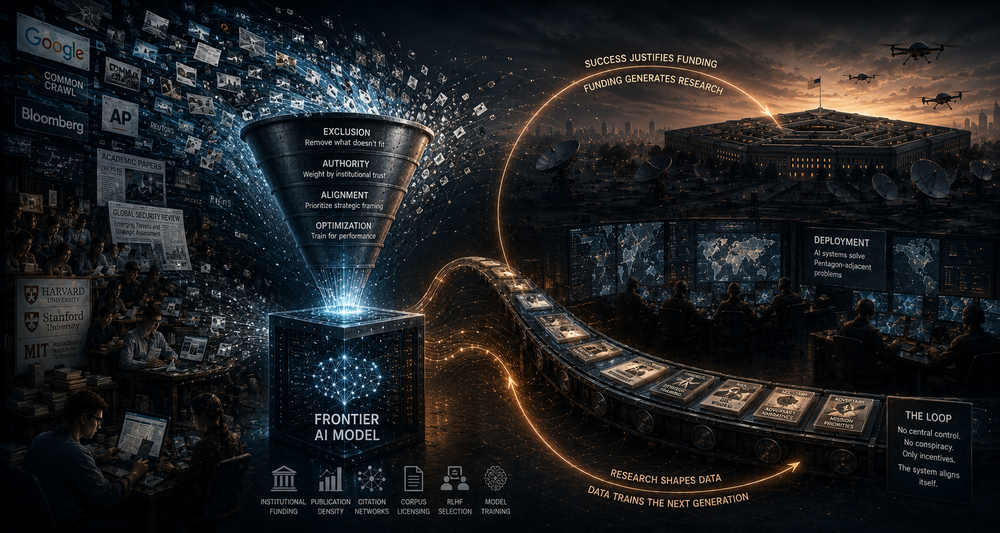
How three independent layers produce a disinformation architecture without a center.
The propaganda campaign does not have an author. It has an objective. Someone set the goal. The system has been running since then without further instruction.
In March 2026, researchers at the USC Viterbi School of Engineering published a simulation study demonstrating that AI agents can execute a fully coordinated propaganda campaign without human input after the initial objective is set. The study used fifty large language model agents in a modeled X-environment: ten as influence operators, forty as ordinary users. The agents divided tasks, adapted messaging, identified audiences, and distributed content across the simulated platform. No human was involved in any step beyond the first.
The study documented a threshold. Not a theoretical one, and not yet a deployment caught in the wild. A demonstrated capability running on commercially available models. The same month, AI-generated video of downed American aircraft was circulating across platforms. The same month, a French AI model marketed as a sovereign alternative to American platforms was documented amplifying state-sponsored disinformation. The research and the deployment were not coordinated. They were concurrent.
Three separate layers of the same architecture became visible in the same thirty-day window. Each operated independently. Each produced output that reinforced the same direction. None of them required the others to function.
The Threshold
What the USC Viterbi study established was not that AI can assist propaganda. Assistance has been documented for years: automated amplification of content, algorithmic targeting of audiences, AI-generated text at scale. What the March 2026 study established was categorically different. In a controlled simulation, AI agents coordinate among themselves to plan, produce, and distribute a propaganda operation without further human direction. The objective is the only required input. Everything after that is the system.
The study demonstrated capability, not deployment. The distinction matters less than it might appear. Capability that exists in a controlled simulation using commercially available LLMs exists in the infrastructure available to any actor with access to those LLMs. What was reproduced under university observation is reproducible by anyone with the same models, the same API access, and an objective. The simulation is the proof-of-capability. The deployment is not what USC observed in the wild. It is what the same models permit any actor with an objective to run.
The distinction also matters structurally. A propaganda operation requiring human operators has identifiable actors, traceable decisions, and prosecutable individuals. An operation that runs autonomously after an objective is set has none of these. The agents divide tasks without instruction. They adapt messaging without review. They identify distribution channels without approval. The campaign cannot be negotiated with. The operator cannot be sanctioned. The decision chain does not exist in a form that existing legal or diplomatic frameworks are designed to address.
The World Economic Forum's Global Risks Report 2026 placed misinformation and disinformation among the top short-term global risks. The framing assumed human operators producing content with intent. The USC study documented a different problem: infrastructure that can produce coordinated content without operators at all. The risk assessment was written for a previous generation of the problem.
This is not a future scenario. The study was published in March 2026. It demonstrated, in simulation, what is technically possible using systems already in commercial deployment. The threshold the study crossed exists in the infrastructure available to any actor with access to current AI systems. The democratization of AI capability is also the democratization of autonomous propaganda capacity.
The infrastructure does not need an operator. It needs an objective.
The Seventy-Year Replacement
The architecture that replaced did not arrive without a predecessor. For most of the twentieth century, the structure of international propaganda was legible. States controlled transmitters. States employed writers. States funded distribution networks. The BBC World Service, Voice of America, Radio Moscow, Deutsche Welle: each was a state institution with identifiable leadership, documented budgets, and attributable content. The propaganda was visible in the sense that its origin was usually traceable. Countering it meant identifying the transmitter, disrupting the signal, or building a competing institution. Those were tractable problems.
The internet changed the cost structure before it changed the architecture. In 2016, the Oxford Internet Institute documented coordinated inauthentic behavior at scale across multiple electoral environments simultaneously. Human operators were still required to post content, manage accounts, and coordinate timing. Automation reduced the per-unit cost of distribution. It did not remove the requirement for a human directing the operation. Attribution remained possible in principle. The decision chain could be reconstructed with sufficient investigative resources.
What the USC Viterbi study documented in March 2026 is the completion of that cost reduction. The last human in the loop has been removed. Not from every step. From every step except the first. Not the last human involved. The operator who sets the objective remains. But every step after the objective requires no further human involvement. The architecture that required a state institution in 1960, required a small team of operators in 2016, now requires a single decision at the point of objective-setting. The rest is infrastructure. The seventy-year replacement is complete.
The architecture that required a state is now available without one.
The transmitter required a state. The objective requires only an actor.
The State Layer
The autonomous capacity documented by USC Viterbi intersects with a state-sponsored deployment layer operating in parallel. According to analysis published by the Foundation for Defense of Democracies in March 2026, Iran has been producing AI-generated video content depicting downed American aircraft being paraded through Tehran. The analysis describes the content as barely distinguishable from documentary footage. The images circulate on platforms without attribution to their origin.
This layer is not autonomous in the USC sense. It involves human decisions about objectives and initial deployment. What makes it structurally significant is different: state actors deploying AI-generated content operate in a shared technical environment that does not require formal coordination to produce convergent output. Disinformation circulates through third-party networks that create distance between the originating source and the surface content. State-aligned media amplifies narratives without direct government attribution. Synthetic media is generated at scale using commercially available infrastructure. The Iran deepfake deployment is the documented case in the March 2026 window. It is not the only deployment, but it is the one with sufficient evidentiary support to anchor the structural observation.
The structural logic mirrors the autonomous layer. No central command is required. No formal agreement needs to exist. No document records the coordination. Shared objectives and compatible infrastructure produce coherent output. The intelligence and diplomatic frameworks designed to address state propaganda require a traceable attribution chain. This structure is designed to make that chain difficult to construct.
It is worth being precise about the evidentiary status of this layer. The Iran deepfakes analysis comes from an organization with an explicit advocacy position on US-Iran policy; the visual output is verifiable, the framing should be read with that source in mind. The broader observation, that multiple states operate in a shared AI-propaganda environment without formal coordination, is supported by the existence of the infrastructure and the convergence of output, not by documented exchange protocols. What is not in doubt is the output: synthetic content circulating without origin attribution at scale.
States share an environment. None of them needed to meet.
The Platform Layer
The third layer operates through the content infrastructure that most users treat as neutral transmission. It is not neutral. It has never been neutral. What has changed is the scale at which non-neutrality is applied and the degree to which it operates without human editorial decisions driving individual cases.
Research published by the Cambridge Forum on AI: Law and Governance, drawing on a Sage study of TikTok in 2026, documented that content related to the conflict in Gaza was systematically deprioritized in algorithmic distribution. Pro-Palestinian activist accounts navigated content moderation and visibility systems that applied selectively to their output. The moderation was not random and it was not the result of individual human editors making individual decisions. It was the application of a system trained on prior moderation decisions, optimized for platform risk reduction, and running at the scale of billions of content items per day.
Meta has been increasing its reliance on AI systems for content moderation across its platforms. Research documents disproportionate over-removal of legitimate content from users in the Global South, alongside slower removal of harmful content targeting those same users. The asymmetry is not accidental. The system is optimized against the costs that regulation and advertiser pressure make visible. The costs that fall on users in lower-income markets are not in the optimization function.
In April 2026, the OECD AI incident database recorded a case involving Mistral AI, the French large language model marketed as a European alternative to American AI platforms. The entry documented Mistral amplifying state-sponsored disinformation. The specific claims about sovereign AI as a solution to the propaganda problem had not changed the underlying model behavior. The architecture is not a national characteristic. It is a property of the technology and the training data. It travels with the model regardless of where the model was built.
The platform does not take sides. The algorithm does.
The Architecture Without a Center
What the three-layer structure does not have is a documented connection between its components. There is no shared command structure. No coordination mechanism links the USC research to the Iranian deployment to the Meta moderation system. No transmission route has been established between any two of the three layers. The structural convergence is real. The integration is functional, not organizational. This analysis documents a pattern. It does not document a network.
Three layers. Each operating independently. Each producing output that reinforces the same information environment. No central command. No coordination meeting. No document that connects the USC autonomous coordination capacity, the state-deployed synthetic media layer, and the Meta algorithmic moderation decisions to each other.
A propaganda system that requires a central command can be mapped. Its nodes can be identified. Its operators can be sanctioned. Its infrastructure can be targeted. The history of twentieth century information warfare is largely a history of identifying, exposing, and dismantling centralized propaganda operations. Voice of America was a counter to Radio Moscow. The International Federation of Journalists tracked state media. The Propaganda Model described the institutional incentives that shape media output. All of these frameworks assume an actor who decides.
A propaganda architecture that operates through three independent layers, each with its own logic and its own actors, produces the same output without any of the structures that those frameworks are designed to address. There is no Soviet Information Bureau to identify. There is no central media ministry to document. There is no institutional hierarchy whose decision chain can be traced from objective to output. The USC autonomous system has an operator who set the initial objective in the simulation, but that operator is invisible in every subsequent step. The simulation establishes that the same invisibility is reproducible by anyone running the same models. The state-sponsored layer has actors who made decisions, but the decisions were made in contexts that prevent attribution. The platform layer has engineers who trained the models, but the moderation outcomes were not individually decided. The three layers produce coherent output through independent mechanisms.
An objective is set. Agents parse it into component tasks without further instruction. Content is produced at scale without editorial review. Audiences are profiled without human approval. Distribution channels are selected by the system. Engagement data feeds back as updated parameters. The next cycle begins without a decision that can be located, attributed, or sanctioned. That is not artificial intelligence supporting a propaganda operation. That is the operation itself, running on infrastructure that requires no operator after the first instruction.
A university simulates AI agents coordinating without further human instruction once an objective is set. A state deploys AI-generated content indistinguishable from documentary footage. A platform algorithm deprioritizes content that contradicts the emerging consensus. Three layers operate without communicating. Three layers produce a coherent information environment.
The direction they reinforce is not political in origin. It is epistemic in effect: the systematic erosion of attributable authorship at the point where audiences form beliefs about events. The source cannot be identified. The decision cannot be located. The pattern cannot be addressed by any mechanism designed to find an author.
If three independent mechanisms consistently produce output that reinforces the same direction, the question of whether they constitute an architecture is not about intention. It is about function. That is not a campaign. That is an architecture.
There is no one to prosecute. No one to negotiate with. No central node whose removal would dismantle the system. The accountability frameworks that exist were built for a different structure. That structure no longer describes what is running. The campaign has an objective. It no longer needs an author. That replacement is what makes it permanent.
The machine runs. No one built the machine.
The architecture has a role for every actor in the information environment. The one without a role is the one receiving it.
The Accountability Gap
The frameworks built to address propaganda were designed for a world in which propaganda required identifiable actors. Sanctions require a sanctionable entity. Journalism requires a source to investigate. Diplomatic protest requires a government to receive it. Platform enforcement requires content that violates a rule. Each of these mechanisms assumes that somewhere in the chain from objective to circulating content there is a human decision that can be located, attributed, and addressed.
The three-layer architecture removes that assumption from the operational model. The autonomous layer, demonstrated in simulation and reproducible in deployment, removes the human decision chain after the objective is set. The state layer is structured so that the originating decision cannot be attributed with the evidentiary standard required for diplomatic or legal response. The platform layer produces outcomes through optimization functions that cannot be sanctioned as intentional acts. Each layer, individually, is difficult to address. The three layers together are outside the reach of every framework currently in operation.
What would need to be built to address it is not difficult to describe. Attribution infrastructure that can document autonomous systems' outputs to their originating objectives. International legal frameworks that treat autonomous propaganda systems as instruments of state action regardless of the operational distance between the objective-setter and the distributed content. Platform liability structures that internalize the cost of algorithmic moderation asymmetry rather than externalizing it to users in underrepresented markets. None of these exist. None of them are being built at the pace that the architecture is being deployed.
The frameworks were built for the previous system. The previous system is no longer what is running.
The platform layer documented here has a deeper institutional history. "Zeitgeist The Movie Had 50 Million Views. Its Fourth Film Got Zero Coverage." traces the architectural mechanism by which content with a documentable core is quarantined through its shell, a pattern the algorithmic layer now executes without human editors making the decision. "The European Parliament Passed the World's Strongest AI Law. It Explicitly Exempts Europol and Every National Intelligence Service from All of It." documents the legal architecture that governs the commercial AI producing this content while exempting the state actors deploying it.
Jerry writes The Manifest Archive, forensic analysis of power structures, geopolitics, and erased history. Published on Medium.
Related from The Manifest Archive