A dying rocket engineer is said to have named the sequence of enemies that would justify the next century of weapons. The story cannot be verified. The pattern it describes is documented across seventy years.
Wernher von Braun's career spanned two regimes, two wars, and two continents. He was an SS officer who signed the paperwork that sent concentration-camp prisoners to build his rockets, and he was also the man NASA called the father of the American space program. The United States government classified his SS membership for more than a decade after it brought him over, because the program needed him and the optics did not matter. From inside thirty years of defense procurement, first for Germany and then for the United States, he understood something simple about how that machinery sustains itself. It always needs an enemy, and when one enemy becomes unavailable, another is found. This article is about that mechanism, about the one uncorroborated story that names it, and about the long documentary record that does not need the story to be true.
What Operation Paperclip actually was
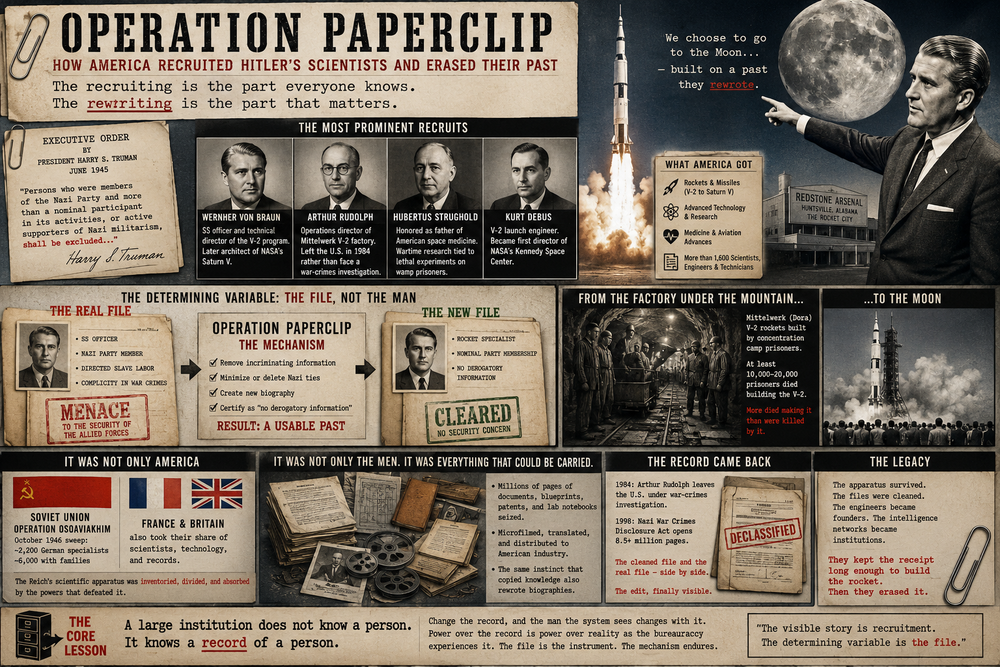
In the summer of 1945 the United States authorized the transfer of German scientists, engineers, and technicians to American soil, the program that would come to be known as Operation Paperclip, and over the following decade more than sixteen hundred individuals were processed through it. Von Braun's first group reached the United States on 20 September 1945, and he himself arrived at Fort Bliss, Texas, that November. His SS membership was in his captured personnel file; he had held the rank of SS-Sturmbannführer, equivalent to major, since 1940. The Army knew, the State Department knew, and the relevant files were reclassified rather than destroyed. They sit in the National Archives today.
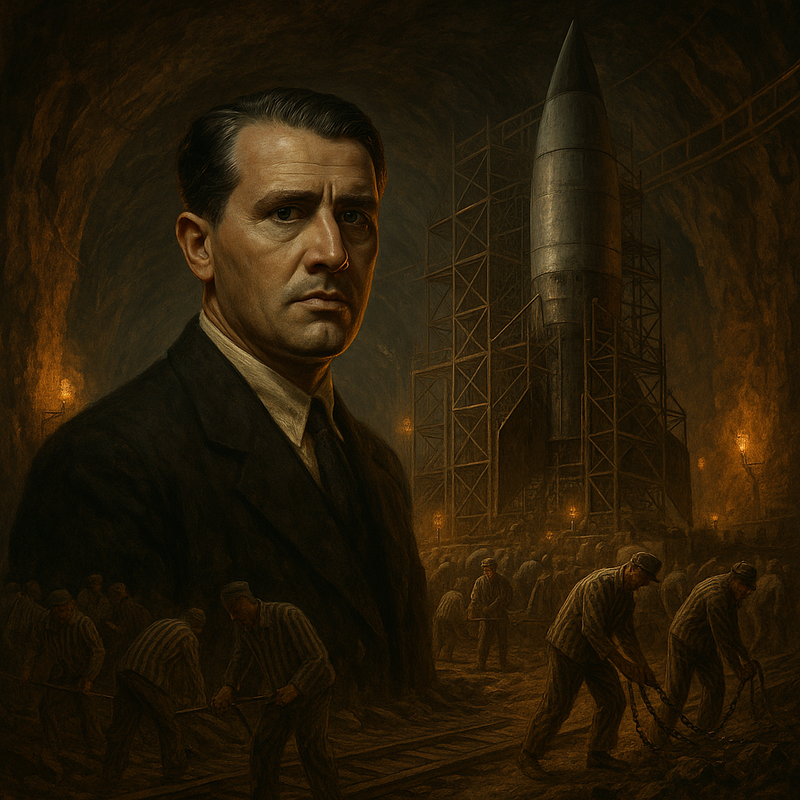
The V-2 rockets that made von Braun valuable were built at Mittelwerk, an underground factory carved into a mountain and worked by prisoners from the Dora concentration camp. Conservative estimates put the death toll at twenty thousand. More people died building the V-2 than died from every V-2 that ever struck London or Antwerp. Von Braun visited Mittelwerk at least twice and requested prisoner labor through the SS procurement chain. He became director of NASA's Marshall Space Flight Center in 1960 and received the National Medal of Science in 1975. The architecture of his rehabilitation was not an accident; it was deliberate and operationally rational. The United States needed the knowledge, and the knowledge required the man. The paperwork was inconvenient, so the paperwork was reclassified.
The rehabilitation went further than silence. In 1955 von Braun appeared on national television as a genial on-screen narrator of Walt Disney's Man in Space, presenting the future of spaceflight to American families, the same man who eleven years earlier had requisitioned slave labor now selling the promise of the Saturn V. The SS major became a beloved television scientist. The transformation was not a cover-up so much as a demonstration of how completely an institution can launder a past it has decided it needs. This is the same mechanism examined at length elsewhere in this archive: the engine of Operation Paperclip was never the recruiting but the rewriting of the record, the production of a clean file that let a forbidden man become an allowed one. Von Braun is that mechanism's most successful product. His genuine brilliance is exactly what made the laundered record stick, because a useful man is the one an institution most wants to re-file. The point here is narrower and stranger: the same man whose past was edited to make him usable spent his last years describing how the institution that edited him manufactures its enemies. He had been on the receiving end of the file-rewriting, and from inside he watched the same machinery do to threats what it had done to his biography.
What he sold was not a fantasy. The Saturn V that von Braun's team built remained, for half a century, the most powerful rocket ever flown, the machine that carried Apollo to the Moon. His expertise was genuine, which is exactly why his rehabilitation worked and why his reading of the system that employed him is worth taking seriously. He was not an outside critic of the defense machine. He was one of its most successful instruments, across three governments and forty years, and a man in that position learns how the machine actually runs.
What Carol Rosin said
Carol Rosin worked as a corporate executive at Fairchild Industries, an American aerospace and defense company, in the 1970s, where she came to know von Braun in the last years of his life. He was already ill when they met, dying of the cancer that would kill him in 1977, and by her account he spent those final years pressing a single warning on her with the urgency of a man running out of time. He described, she says, the sequence of future enemies that would be used to justify the continued militarization of space: after the Soviets would come terrorists, then nations of concern, then asteroids, and finally extraterrestrials. Each of these threats would be manufactured, he told her, the sequence was already understood, and she should spend her own life trying to prevent its last step. It is, in her telling, a dying man's confession, which is part of why the story has traveled as far as it has.
This is testimonial evidence and nothing more. There is no recording, no memo, no second witness. Rosin has repeated the account publicly since the 1980s, and her consistency is real, but consistency is not corroboration. The whole story rests on one person's memory of private conversations with a man who has been dead since 1977, and it must be held exactly there, as a claim that cannot be checked and is therefore not offered here as fact. Its value is not as prophecy. Its value is that it points at a mechanism, and the mechanism, unlike the conversation, has a paper trail of its own.
The first enemy was inflated on the record
Begin with the Soviets, the first name in the sequence, because the documented history of that threat already contains the whole pattern in miniature. Twice during the Cold War the United States convinced itself of a dangerous Soviet lead that did not exist. In the mid-1950s it was the bomber gap, the conviction that the Soviet Union was racing ahead in long-range bombers; U-2 reconnaissance flights established by 1960 that the gap was fictional. Then it was the missile gap, pushed by the Gaither Committee in 1957 and by Air Force estimates and made a centerpiece of the 1960 election, the belief that the Soviets had pulled ahead in ballistic missiles. The same surveillance proved that gap fictional too. In reality the United States was ahead in both cases. The fear was not. There was a device behind the fear, and it recurred. When the Soviet Union launched Sputnik on 4 October 1957, a genuine technical achievement was metabolized into a national panic, and within weeks a panel of largely defense-adjacent experts, the Gaither Committee, delivered a secret report warning that the United States was falling fatally behind and must spend enormously to catch up. The report was wrong about the gap and right about the budget; leaked to the press, it became a pillar of the missile-gap scare. The same instrument reappeared as Team B in 1976 and as the revived Committee on the Present Danger that staffed the Reagan buildup. A threat panel, drawn from the people who would build the answer, is convened to read the danger as graver than the career analysts do, and its alarming reading is handed to the people who set the budget. The panel is the mechanism by which a real signal is reliably converted into an inflated one. And Sputnik is also where von Braun himself rose: the panic that followed it put his rocket team at the center of the new space and missile establishment. The man who would later name the machine had been lifted into prominence by one of its clearest cycles.
The clearest documented instance came in 1976, and it was institutional rather than accidental. President Gerald Ford authorized an exercise called Team B, a panel of outside hawks, approved by the director of central intelligence, George H. W. Bush, and invited to re-examine the same classified data the CIA's own analysts used and to reach more alarming conclusions about Soviet intentions and capabilities. They did. Their estimates were later judged grossly wrong; a 1989 internal CIA review of the threat assessments from 1974 to 1986 concluded that the Soviet threat had been substantially overestimated, year after year. Team B did not discover a hidden danger. It manufactured a more frightening reading of the available facts and handed it to the people who set the budget. And the reading did not stay on paper: Team B's conclusions helped justify the largest peacetime military buildup in American history under Reagan, hundreds of billions of dollars committed through the 1980s against a Soviet capability that the agency's own later review judged to have been overstated all along. The inflated estimate produced a real budget, and the real budget outlived the estimate. The first card in the sequence did not need to be invented. It only needed to be inflated, and the record shows it repeatedly was.
The fabrication apparatus, documented
Sometimes the threat was not merely inflated but built outright, and here too the documents exist. In 1962 the Joint Chiefs of Staff approved a plan called Operation Northwoods, a proposal to stage terrorist incidents on American soil, including attacks on Americans, and attribute them to Cuba in order to manufacture public support for war. The Joint Chiefs signed it. President Kennedy rejected it. The document is declassified and sits in the National Security Archive, which means the willingness to fabricate a casus belli is not a theory about the American security state; it is a memo with signatures on it.
Forty years later the apparatus produced a subtler version. On 5 February 2003 Secretary of State Colin Powell presented to the United Nations Security Council an intelligence case for Iraqi weapons of mass destruction that proved to be false. That case was not an improvisation by one man; it required analysts, speechwriters, graphic designers, and institutional sign-off at every level of the intelligence community, and the weapons were never there. No stockpile was ever found, the formal inquiries confirmed there had been none, and the war proceeded regardless and ground on for years after the pretext had collapsed. The fabrication failed as a fact and succeeded as a war, which is the only test the mechanism applies. Northwoods shows the apparatus willing to invent an enemy. The Iraq case shows it willing to dress an absent one in borrowed evidence. Between those two cases sits the war the apparatus actually got. In August 1964, after a real clash between American and North Vietnamese vessels in the Gulf of Tonkin, the Johnson administration reported a second attack two days later and used it to win the Gulf of Tonkin Resolution, the blank check for the Vietnam War. The second attack almost certainly never happened; a National Security Agency historian's study, declassified in 2005, concluded that the evidence had been misread and, in part, skewed to support the conclusion Washington wanted. A real incident was inflated, a phantom one was reported, and the two together were turned into a decade of war. The mechanism was operational in 1962, in 1964, and in 2003, and the gap between them is filled, not empty.
Each card has a date
Lay Rosin's remembered sequence against the documented calendar and the alignment is striking, though it proves a pattern rather than a prophecy. After the Soviets came terrorism, elevated to the organizing threat of American policy after 2001. In his State of the Union address on 29 January 2002, months after the September attacks, President Bush named an axis of evil, Iraq, Iran, and North Korea, and the doctrine of preventive war against rogue states, the nations of concern in Rosin's telling, became the justification for the next decade of spending and the invasion of one of the three. The Costs of War project at Brown University later put the direct cost of the post-2001 wars at roughly eight trillion dollars and more than nine hundred thousand deaths, a price the size of the threat it was said to answer. Those are not abstractions. The eight trillion dollars is hospitals not built and teachers not hired; the nine hundred thousand dead include the civilians of three countries who never sat on any committee and never saw the file that named them a threat. The inflated estimate is written by people in safe rooms. The bill is paid, every time, by people who had no part in writing it. That asymmetry, the threat manufactured in one place and the cost absorbed in another, is the human face of the same compartmentalization the rest of the machine runs on. Each step matches a real political era, and the match does not require anyone to have planned the steps in advance. It requires only that each institution, facing each new environment, reach for the available threat, build the budget around it, and defend the line.
From here the argument must shift from documentation to pattern, and the language has to soften with it. What can be shown about the later items in Rosin's sequence is not that they were dealt in a planned order, only that each new security domain has taken the same institutional shape as the one before it. Asteroid defense is now a funded reality: NASA established a Planetary Defense Coordination Office in 2016, and on 26 September 2022 its DART spacecraft deliberately struck the asteroid Dimorphos and measurably altered its orbit, the first time humanity changed the motion of a celestial body. The danger is genuine and the science is real, which is exactly the point; a true risk and a budget justification are not mutually exclusive, and the institutional response to the two is hard to tell apart. A domain is identified, an office is created, a budget line is defended, and the work proceeds, and none of that requires anyone to have planned the order in which the domains would arrive.
The peace dividend that wasn't
The single clearest proof that the spending drives the threat rather than the other way around is what happened when the threat vanished. In 1991 the Soviet Union, the enemy that had justified the American defense budget for forty years, simply ceased to exist. By the logic that the budget answers the danger, spending should have collapsed. It declined, but only for a decade and only partway. Defense outlays fell from around five to six percent of national output at the end of the 1980s to roughly 3.5 percent by 2001, the so-called peace dividend, and even that modest dip drew warnings of unilateral disarmament. Then the towers fell, and the machine found its next enemy. Spending climbed back through the 2000s until, by the end of the decade, the United States was spending more on defense in real terms than it had at the height of the Cold War under Reagan, now against scattered terrorist networks a tiny fraction of the size of the superpower it had replaced. The enemy shrank by orders of magnitude. The budget grew. The structure survived every enemy it was built to fight, and each new enemy arrived to justify a structure that had already become permanent.
Why the budget cannot shrink
The constant has a mechanism, and it is worth naming, because "the spending stays" is an observation, not an explanation. The reason the defense budget survives the disappearance of its enemies is that it was built to be unkillable, by being spread. Major weapons programs are engineered, from the outset, to place their subcontracts across as many states and congressional districts as possible. The F-35 fighter, the most expensive weapons program in history at a lifetime cost now projected above two trillion dollars, is built across more than forty states. To cancel it, a member of Congress would have to vote to destroy jobs in their own district. This is not an accident of procurement; it is the design. A program distributed across a majority of the legislature that funds it cannot be cancelled by that legislature, whatever happened to the threat it was built to counter.
Above the districts sits the revolving door. Retired generals and senior officials move into the contractors whose programs they oversaw; the contractors fund the institutes that assess the threats; the institutes staff the panels, like Team B, that recommend the budgets. The people who name the enemy, the people who build against it, and the people who profit are, across a career, often the same people in different chairs. No conspiracy is needed for this to produce a permanent upward pressure on spending and a permanent demand for justifying threats. It is simply what the structure rewards.
One man named it from the inside, and the scene is worth holding. On the evening of 17 January 1961, three days before he left office, a former five-star general who had commanded the largest war in history sat before a television camera in the Oval Office and warned his own country not against any foreign enemy but against the thing he had helped build. The military-industrial complex, Dwight Eisenhower said, now carried an "unwarranted influence" that the nation would have to guard against for as long as it existed. It was the most unusual farewell a commander ever gave: a warning, from the architect, about the architecture. Von Braun would spend the rest of the decade working inside exactly the machine Eisenhower described, and would reach, by Carol Rosin's account, the same conclusion about it. Two men who ran the apparatus arrived at the same verdict. The apparatus does not need an enemy that is real. It needs an enemy that is fundable.
Star Wars and the constant
Above all the individual cards sits the structure that outlasts every one of them, and von Braun's own field is where it is most visible. In March 1983 President Reagan announced the Strategic Defense Initiative, the space-based missile shield the press named Star Wars, and the militarization of space became a permanent line of American defense policy regardless of which enemy justified it in a given decade. The shield itself was never built. Across the following decades the program and its successors consumed tens of billions of dollars without ever deploying a working space-based defense, and still the budget line did not close, because the funding was never really about the weapon. The line simply changed names as the decades passed, from the Strategic Defense Initiative to the Ballistic Missile Defense Organization to the Missile Defense Agency, and the cumulative spending on missile defense since 1983 now runs into the hundreds of billions of dollars, for a capability that has never been demonstrated against a realistic attack. The weapon failed every technical test that mattered and survived every budget cycle that did, which is the clearest possible proof of which one it was built to pass. All of it proceeded, moreover, against a standing commitment to the opposite. The 1967 Outer Space Treaty, which the United States signed and ratified, declares space the province of all mankind and bars weapons of mass destruction from orbit. The treaty was never repealed. The appropriation simply grew up beside it, because a norm written on paper is no match for a line item that is renewed every single year and that no enemy's disappearance has ever managed to shrink. In December 2019 the United States established the Space Force, its first new armed service since the Air Force in 1947, a permanent military branch for a domain in which no shot has ever been fired in anger. Its budget has since climbed toward thirty billion dollars a year, funding the satellites, the missile-warning systems, and the orbital infrastructure that the rest of the military now depends on, and by 2022 the investigation of unidentified aerial phenomena had been folded into its mandate. This is the constant in its purest documented form: a standing service and a rising budget for a theater of war that does not yet exist, built and renewed regardless of whether any adversary is there to meet it. The same congressional committees that authorize missile defense authorize the study of the unknown in the sky. The same contractors build for both. The incentive structure does not change when the threat changes, which is the machine Eisenhower had warned, on his way out the door, would outlive every enemy it was built to fight. That machine is today the largest discretionary item in the federal budget, an annual outlay well above eight hundred billion dollars, larger than the military spending of the next several nations combined, and it is sustained at that level across every administration of both parties whatever enemy happens to occupy the headlines.
The unknown in the sky is only the newest line in the same ledger, and it deserves no more weight than its evidence carries. Over the past few years the unexplained has begun to acquire what every prior threat acquired before it: a congressional intelligence assessment in 2021, a dedicated Pentagon office in 2022, a budget, and a bureaucracy with a reason to continue, whatever is or is not actually up there. That is as far as the documentation goes, and it is far enough, because the point was never the phenomenon. The point is that a new domain reliably grows the same institutional skeleton as the last one, before anyone has established there is anything to fight. Set the speculation aside; the structure is the finding. The architecture does not change based on what fills it.
The architecture that needs no architects
It is essential to say plainly what this does and does not claim, because the subject attracts exactly the kind of certainty it should resist. The documented claim is narrow and strong: across seventy years, American defense spending has repeatedly been justified by threats that were inflated, fabricated, or simply selected from whatever the moment offered, and the budget and the industry behind it have remained constant while the named enemy rotated. That claim rests on the bomber and missile gaps, on Team B, on Northwoods, on the Iraq case, on the open history of the defense budget. It needs no conspiracy and names no cabal.
What this does not claim is that any of it was planned in advance by von Braun or anyone else, or that a fake alien invasion is printed and waiting to be played. Each step in the sequence has an ordinary institutional explanation that requires no master plan. Terrorism became the priority after real attacks. Rogue states followed from real proliferation. Asteroid defense follows from a real astronomical risk. The unidentified-phenomena programs follow from decades of classified aviation work, genuine sensor gaps, and congressional pressure to account for black-budget spending. The mechanism is not a script written by a dying genius; it is what a permanent war economy does on its own, which is to find, in every era, the enemy its weapons require. This is why the absence of a conspiracy makes the pattern more troubling, not less. A plot can be exposed and stopped; the people behind it can be named and removed. An emergent order has no one to remove. No single actor decides that the budget must find a new enemy when the old one dies; the outcome is produced by thousands of separate actors each behaving rationally inside the incentives in front of them, the contractor protecting a product line, the congressman protecting a district, the analyst protecting a career, the panel protecting its mandate. Add them together and the system behaves as if it were following a plan that no one wrote. That is the hardest kind of power to see, because there is no author to point at, only an architecture that produces the same result whoever happens to be standing in it. The machine needs no architects because it has become the kind of structure that builds itself. The Rosin account is unverifiable and is treated as such. The non-human-craft testimony is unproven and is treated as such. The threat-inflation pattern beneath both is documented, and it is the only part of this that needs to be.
So the honest answer to the question in the title is no, and also that the question is the wrong one. Von Braun almost certainly did not predict anything, and the story that he did cannot be confirmed. But the machine he spent his life inside does not require prediction. It requires only a budget, a committee, and a threat, and it has never once failed to find the third. The enemy is the variable. The spending is the constant. Every era is handed the adversary its arsenal was already built to need, and the card that matters is never the one on the table but the hand that keeps dealing.
If the last card is ever played, it will not arrive as a revelation. It will arrive as a budget line, a classified program, a press conference with a retired general, and a congressional authorization, which is how every card before it arrived.
Evidence Map
Facts, interpretations, forecasts, and disconfirming signals.
Core claim. A permanent war economy with a fixed budget and industrial base needs a justifying enemy, so each era inflates, fabricates, or selects one; the named threat rotates while the spending and institutions stay constant.
Evidence level. Facts: high (von Braun's SS rank and Paperclip transfer, the Mittelwerk death toll, the bomber and missile gaps, Team B in 1976 and the 1989 CIA overestimation finding, Operation Northwoods in 1962, the 2003 Iraq WMD case, the Planetary Defense office and the 2022 DART impact, SDI in 1983, the 2019 Space Force and its 2022 UAP mandate). Interpretation: medium (the documented cases as one threat-construction mechanism). Forecast: speculative; the Carol Rosin account and the non-human-craft claims are named and explicitly not asserted.
What would confirm this. Each emerging domain (space, the unidentified-phenomena field, asteroid defense) acquiring a dedicated budget line and bureaucracy regardless of underlying reality; defense spending staying roughly constant or growing across changes of named enemy; new threat framings mapping onto pre-existing capabilities and contractors.
What would disprove this. Defense spending tracking independently assessed threat levels rather than staying constant; a major threat framing arising with no pre-existing budgetary or industrial beneficiary; or the structure contracting when a named enemy disappears rather than finding a replacement.
Watchlist. Structural and ongoing, tested at each shift of the dominant threat narrative and each new defense domain.
Jerry van der Laan writes The Manifest Archive, a continuous investigation into how institutions, language, and systems shape what people are permitted to see as reality. He does not report events. He traces the structures beneath them.
Related from The Manifest Archive
- The Reich After the Reich
- Hitler Lost the War. Von Braun, Gehlen and Dulles Won the Peace.
- Hiroshima: The Bomb That Warned Russia, Not Japan
- The Deep State: The System That Never Stands for Election
- Operation Paperclip: How America Recruited Hitler's Scientists
- After the Führer
- Tesla's Papers Were Declared Worthless in 1943.
- Peteano 1972: The NATO Bomb Hidden for Twelve Years
- The Empire That Never Fell