The convergence of chemistry, strategy, and September 15
Mojtaba Khamenei became Supreme Leader on March 9, 2026, following his father Ali Khamenei's assassination on February 28, 2026, in an Israeli airstrike. Mojtaba was wounded in that attack. Since his appointment, he has not appeared in public. His only statement came by broadcast on March 12, voice only.
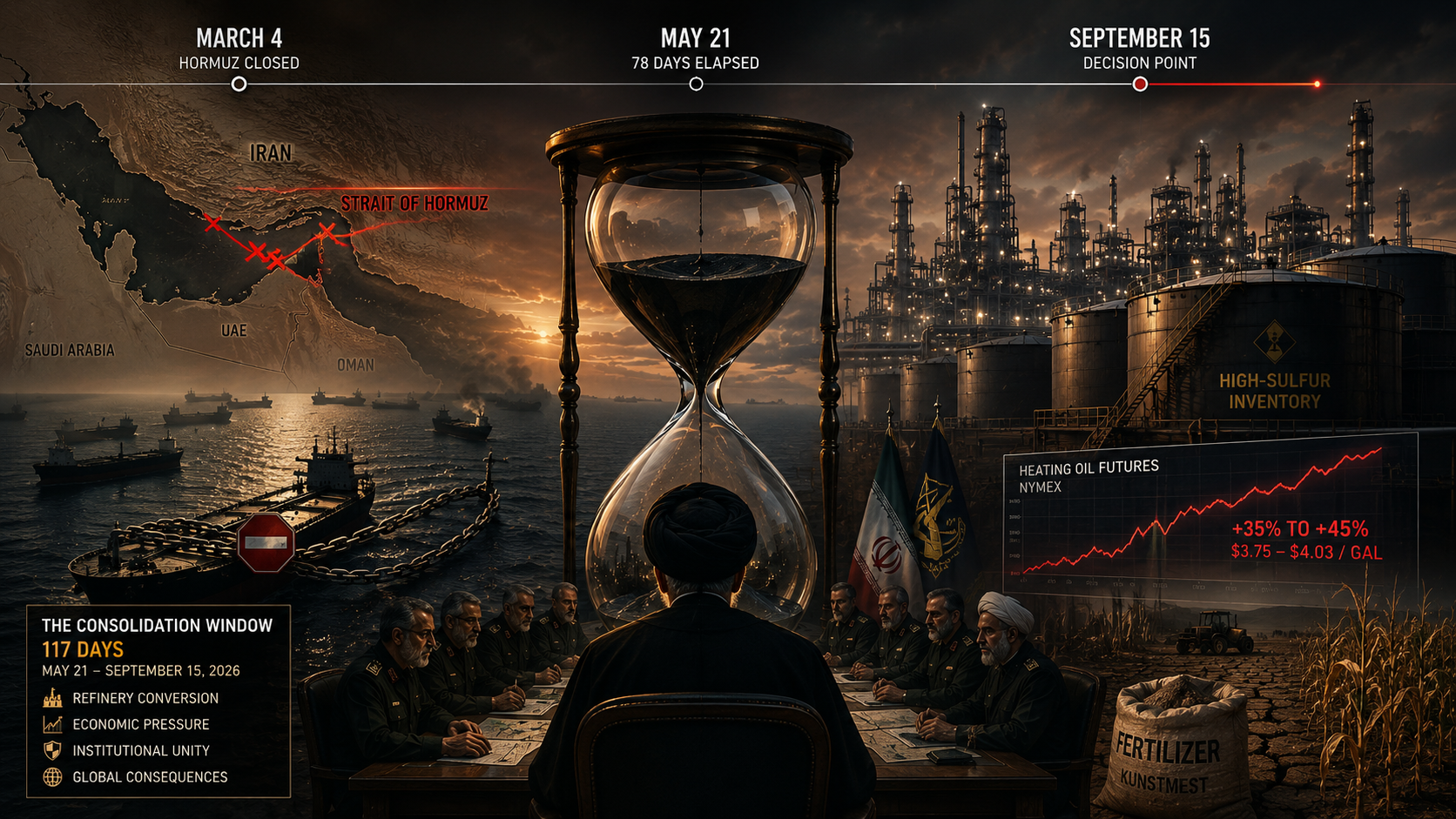
The institutional crisis that defines his consolidation window did not begin with his succession. It began five days before, on March 4, 2026, when Iran closed the Strait of Hormuz. One of the world's four critical chokepoints went silent. An estimated 21 percent of global oil transit flows through that 54-kilometer channel. No vessel has passed through since. The closure was not suspended, not negotiated, not temporary.
Mojtaba did not close Hormuz. He inherited a closure already five days old. What he inherited was worse: an inventory crisis, a consolidation window that measures in months, and a structural trap that binds every actor to the same breaking point.
The Refinery Constraint
Iran's crude splits between two grades. High-sulfur crude is cheaper to produce and extract, but more difficult to refine. The catalytic equipment that processes high-sulfur feedstock operates at specific hydrogen partial pressures and temperature ranges. That same equipment cannot, without modification, process low-sulfur crude. The conversion is a hardware intervention.
Refinery catalytic processes require precise chemical environments. Moving from high-sulfur to low-sulfur crude demands reconfiguring catalyst beds, adjusting hydrogen partial pressure, and retuning equipment designed for heavier hydrocarbon chains. These are mechanical interventions on machinery built for specific load ranges. Industry estimates place the reconfiguration timeline at three to six months. During that window, a refinery cannot process at full capacity. It cannot switch feedstock mid-operation without risking equipment degradation.
With Hormuz closed, Iranian crude cannot be exported. High-sulfur crude now accumulates in inventory. Refinery tanks fill. Processing capacity becomes the binding constraint. The choice is immediate: halt production entirely, which collapses state revenue, or reconfigure the catalytic systems to process what remains available.
Mojtaba inherited a state choosing the second option. That choice commits the refinery base to a timeline. The timeline is not flexible. It is determined by the chemistry of the equipment itself.
The Economic Cascade
If the mechanism operates as described, the following cascade should follow.
As of May 21, 2026, heating oil prices on NYMEX futures stand at approximately $2.78 per gallon. A 35 to 45 percent increase would elevate that to $3.75 to $4.03 per gallon. This range reflects the 1973 Arab Oil Embargo, which lasted five months and saw global heating oil costs rise 40 to 50 percent before stabilizing as alternative supplies came online.
Pape's analysis of blockade dynamics documents the pattern: economic pressure on core security issues produces escalation rather than capitulation. Competing blockades exist. Persian Gulf closure in one direction, Western sanctions in another. Pain does not compress decision-making toward compromise. Pain accelerates it toward resistance.
What differs in 2026 is the duration margin. Alternative crude from non-Persian Gulf sources requires 6 to 12 months to ramp to meaningful volumes. Refinery conversion demands another 3 to 6 months. The overlap window during which pricing pressure compounds is narrower and steeper.
The economic damage cascades beyond heating oil. fertilizer (fossil fuel-derived fertilizer) underpins global grain production and depends on natural gas and crude oil as feedstock. When energy prices spike, fertilizer production contracts. When fertilizer becomes scarce, agricultural input costs rise 25 to 35 percent globally. Food price inflation follows. By summer 2026, the economic pressure moves from energy markets into food production and consumer purchasing power in every developed economy.
The institutional actors watching this mechanism know the timeline. Alternative supplies will not flow before autumn. Refinery conversion will not complete before mid-September. The pressure will persist until one of three things occurs: the crisis resolves, the system adapts, or the system breaks.
Mojtaba's Consolidation Window
Mojtaba inherited not a stable state in transition but a nation at war with a closure five days old and a refinery base unable to shift feedstock for months. His consolidation window is not a peaceful interregnum. It is a kinetic-conflict interregnum: 117 days from May 21, 2026, to September 15, 2026. In this interval, every actor in the institutional architecture faces the same ticking constraint.
For Mojtaba, the consolidation challenge is institutional: Can he unify the siloviki, the Revolutionary Guards, the Qods Force, and the economic apparatus around a single decision-making structure while in conflict and under economic stress? The answer is conditional on whether the system can afford to wait.
By March 12, when Mojtaba issued his first broadcast statement, the refinery inventory clock was already running nine days into the closure. The economic cascade was not theoretical. It was operational. His first decision as Supreme Leader was not a succession speech but succession under fire, in a window measured in months, with every actor constrained by the same deadline.
His consolidation was not a choice before him. It was the consequence of a situation that precedes choice. The question is not whether he can escape this structure. The question is not whether the mechanism allows him options. The question is whether his consolidation as Supreme Leader will hold long enough for the mechanism to resolve while he is still standing. The institutional actors do not control when the waiting state breaks. Rather, the breaking of the waiting state controls when the institutional actors move. This is the structural inversion that the mechanism creates. Mojtaba does not decide when to resolve. The refinery constraint decides.
Three Stages of the Breaking Point
Stage One: Refinery Constraint (March 4 - September 15)
Hormuz closure forces Iranian refineries to process available crude reserves. High-sulfur inventory depletes. Reconfiguration of catalytic systems begins. No meaningful domestic crude products until approximately September 15. The window is not optional.
Stage Two: Global Price Discovery (May 21 - September 15)
Heating oil prices reflecting Hormuz closure and refinery constraints move through market signals. Fertilizer production cascades downward. Agricultural input costs rise 25 to 35 percent globally. Food price inflation follows. The pressure is structural, not speculative.
Stage Three: Actor Decision Point (September 15)
By mid-September, refinery reconfiguration either succeeds or does not. If it succeeds, Iranian crude products flow and global prices stabilize. If it does not (if reconfiguration fails, if alternative supplies do not materialize, if refinery equipment degrades) then the consolidation window closes with institutional failure or forced escalation.
The stalemate is not that Mojtaba cannot move. It is that Mojtaba cannot choose to wait. Neither can any actor dependent on his decision.
Historical Pattern and Future
The 1973 Arab Oil Embargo lasted five months. The current Hormuz closure will have lasted five and a half months by September 15, 2026. Historical pattern suggests relief comes through negotiated settlement, unilateral action by a dominant power, or institutional collapse. In 1973, it came through negotiated settlement.
In 2026, the parties are not positioned for negotiation. Israel continues strikes. Iran continues proxy operations. The United States positions naval assets. No negotiation framework exists. What happened after 1973 is instructive: OPEC maintained production discipline for approximately two years. Prices remained elevated. Global inflation accelerated. Developed economies entered recession. The effects persisted longer than the embargo itself.
The Hormuz closure carries similar structural characteristics: constrained supply, no near-term relief, and economic pressure that will outlast any immediate resolution. The question is whether the institutional actors can manage the transition to a new price level before the system breaks. Mojtaba determines whether Iran's institutional architecture can function as a unified actor while the outcome unfolds. That is his consolidation window. That is what he cannot defer.
Testing the Thesis: The Counter-Mechanisms
This analysis rests on a single binding constraint: the refinery conversion timeline. Three alternative mechanisms could break this lock and alter the institutional calculus. Each is plausible. Each is currently dormant.
First counter-mechanism: Early refinery success. What if Iranian engineers succeed ahead of schedule? What if catalyst-bed reconfiguration completes by late August rather than mid-September? This would advance the decision point by three to four weeks. It would compress Mojtaba's consolidation window. The margin narrows. The precision required of Mojtaba's institutional management becomes tighter.
Second counter-mechanism: Negotiated back-channel settlement. What if Israel and Iran discover a back-channel route to ceasefire terms? Pape's work on blockade dynamics shows that such pathways rarely materialize under economic pressure, but they remain structurally possible. If negotiation succeeds, the closure could end before refinery constraint forces it. The September 15 deadline would cease to be binding. Mojtaba would inherit a different institutional landscape entirely. This remains the lowest-probability outcome as of May 21, 2026.
Third counter-mechanism: External supply breakthrough. What if non-Persian Gulf crude sources ramp faster than current estimates? What if alternative refineries (in Asia, for example) begin processing Iranian crude through proxies before the six-to-twelve month timeline expires? These mechanisms would weaken the binding constraint not through resolution but through circumvention. The refinery would no longer be the bottleneck if revenue could flow through parallel channels.
The thesis does not require that all actors remain passive. It requires that the refinery constraint holds firm. Until that constraint is violated by one of these counter-mechanisms, every institutional actor including Mojtaba remains bound to the September 15 deadline. The mechanism is valid only as long as the constraint is binding.
The Structural Inversion
Here the analysis moves from documented constraint to structural hypothesis. The waiting state does not break when actors choose to break it. Rather, the breaking of the waiting state determines when actors can choose to move. This is the structural inversion that the mechanism creates. Working at Niveau 2.5 (systemic causality), the claim is this: the actors are not free. They are constrained.
When actors control the constraint, the constraint is negotiable. When the constraint controls the actors, actors become inevitable. The first is politics. The second is physics.
The actors are constrained. The constraint is the refinery. The constraint is September 15. The constraint is the chemistry: crude stock cannot be processed with this equipment before this date. You cannot move the date. You cannot negotiate it.
Mojtaba understands this. His consolidation is not a choice. It is a consequence. His window is not open until the refinery window closes. When September 15 arrives, his window closes. What emerges on that date is not predetermined. But the date itself is. The actors will move on September 15 because they have no choice.
Ask not when Mojtaba will move, but what will make him move. Ask not what makes the deadline, but what the deadline makes. The question controls the answer. The constraint controls the time.
May 21, 2026
It is May 21, 2026. The countdown from Hormuz closure stands at 78 days elapsed. The countdown to the refinery constraint window's resolution stands at 117 days remaining. Mojtaba's consolidation window will close when the refinery transformation either succeeds or fails. The refinery holds the timeline. The timeline holds the actors. Neither is negotiable.
The world is not watching this mechanism. The world is watching the war, the price of heating oil, the fertilizer shortage, the electoral calendar in Washington. But the mechanism is the war's administrative condition. Until September 15, every institutional actor moves within the bounds it sets.
Mojtaba did not create this trap. Mojtaba inherited it. But from March 9 forward, the trap is his to manage. The waiting state will break by September 15, not before. What emerges on the other side (a unified Iran, a fractured state, an escalated conflict, or a managed transition) depends on whether Mojtaba can hold the institutional apparatus together while the mechanism runs its course.
That is his window. That is his inheritance. That is what he cannot defer.
Related from The Manifest Archive


