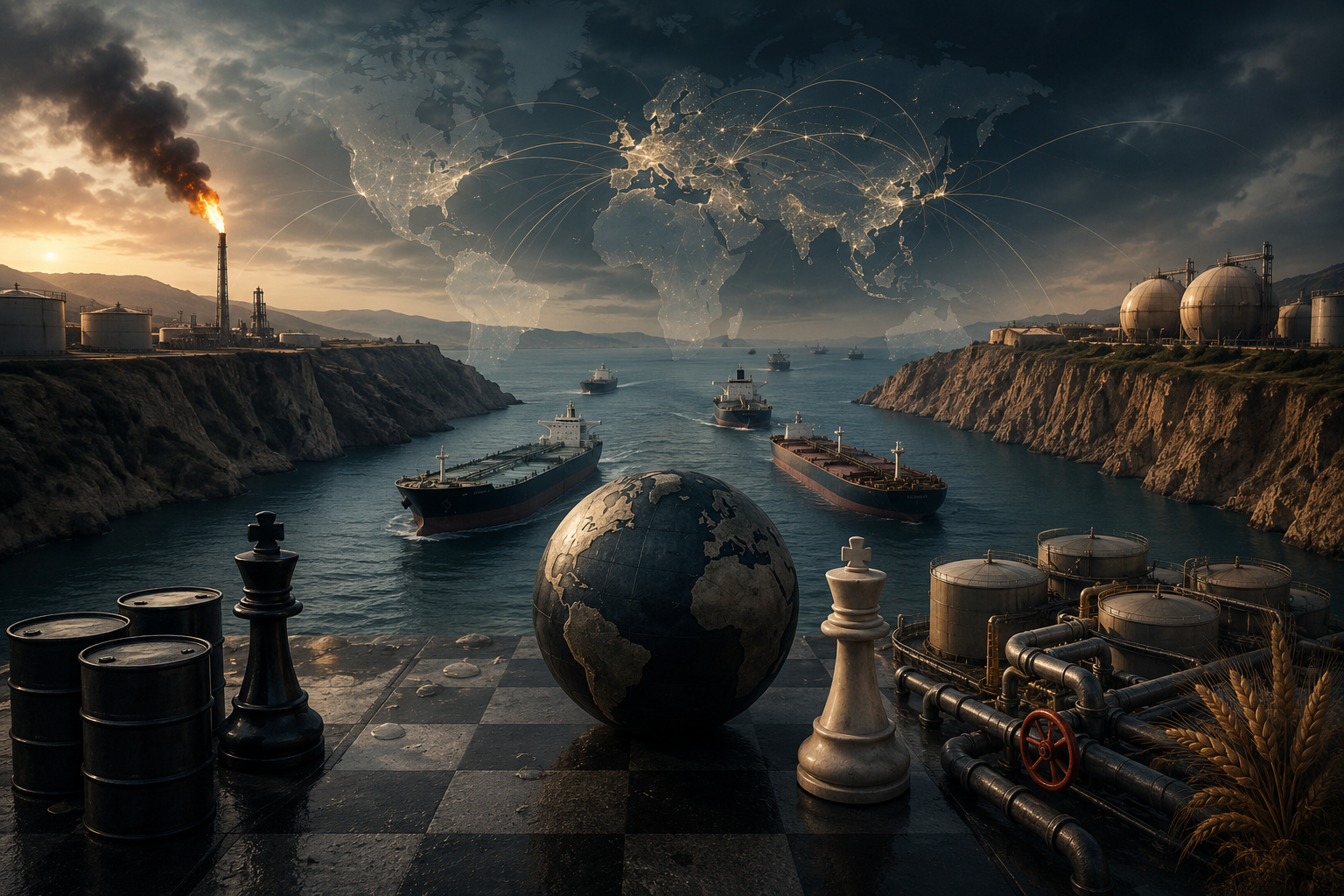
The cameras are pointed at a strait. The decision that matters is being signed in a Treasury office a continent away, and it has almost nothing to do with Iran.
Through the spring of 2026 the world learned a new daily ritual. Each morning brought fresh footage from the Strait of Hormuz: a tanker idling at the mouth of the Gulf, an Iranian patrol boat shadowing a tug, a satellite image of vessels clustered like cattle that will not cross a river. The story had a clear shape. Iran had closed the most important oil passage on earth, the price of everything was climbing, and the United States was trying, and failing, to force the waterway back open. That is the story everyone followed.
Underneath it, a quieter sequence was unfolding, and it pointed in an unexpected direction. While Washington pressed Tehran in public, it was reaching for Moscow in private. In early March the Treasury issued the first waiver allowing a foreign buyer to take Russian crude that sanctions were supposed to keep off the market. By June, senior officials were saying out loud that more Russian oil might be freed. The sanctions architecture that had been built, brick by brick, to punish Russia for its war in Ukraine was being quietly disassembled, not because anyone in Washington had changed their mind about Russia, but because the math of the strait left no other option.
This is the part the footage never shows. The closure of one strait did not only remove oil from the market. It revealed that the world keeps almost no spare oil anywhere else, and that the little it does keep sits behind the very chokepoint now sealed shut. When the buffer and the breakdown share the same geography, a sanction stops being a tool of policy and becomes a luxury the system can no longer afford.
What the strait actually carries
Begin with the scale, because the scale is the whole argument. In an ordinary year roughly twenty million barrels of crude, condensate, and refined product move through the Strait of Hormuz every single day, close to a fifth of the oil the planet consumes. There is no second route. The pipelines that bypass the strait, across Saudi Arabia and the Emirates, can carry only a fraction of that volume. For practical purposes, the Gulf reaches the world through one narrow gate, and that gate is twenty-one miles wide at its narrowest point, with shipping lanes narrower still.
On the twenty-eighth of February 2026, that gate began to close. In the opening hours of the air war that the United States and Israel launched against Iran, a war whose first days included the death of Iran's supreme leader, the Islamic Revolutionary Guard Corps did what it had threatened to do for a generation. It declared the strait unsafe, warned merchant vessels away, boarded and struck ships, and laid mines in the approaches. Traffic did not stop on a single day the way a door slams. It strangled over weeks, as insurers withdrew cover, as crews refused the transit, as owners diverted hulls that could not be insured into a war zone. The effect was the same as a closure, achieved without a single official decree the rest of the world was obliged to recognize.
The price did what physics demands when a fifth of supply is threatened with disappearance. Brent crude, trading near seventy dollars before the war, ran to well above a hundred within days and touched somewhere around a hundred and twenty dollars a barrel at its intraday peak in March, the steepest monthly jump the benchmark has ever recorded. That number is not the story. The number is the symptom. The story is what the number was measuring, which was the sudden discovery that the world had no slack.
The strait was closed by paper, not only by mines
It is worth pausing on how a waterway closes, because the method matters more than it appears. Iran laid mines and the Revolutionary Guard menaced shipping, and those acts were real. But mines did not empty the strait. Underwriters did.
A supertanker does not sail into a war zone on courage. It sails on a war-risk insurance policy, written in London or Singapore or Oslo, that promises to cover the hull and the cargo if something goes wrong. The instant the strait became a declared theater of conflict, those policies became unwritable at any sane premium, and where they were offered at all, the cost ran to millions of dollars per voyage. An owner facing a premium that erases the profit of the cargo simply does not sail. The oil stays in the ground or in the tank. The strait closes not with an explosion but with a declined quote.
This is the detail that connects the two halves of the story, and it is easy to miss. The same financial plumbing that throttled Hormuz is the plumbing through which Western sanctions on Russia were enforced. Sanctions do not work by stopping ships at sea. They work by denying access to insurance, to dollar clearing, to the banks and brokers and registries without which a cargo cannot move or be paid for. Power over oil, in the modern world, is rarely the power of the navy. It is the power of the paperwork.
So the crisis ran along a single set of rails in both directions. The withdrawal of insurance shut the Gulf. The withdrawal of insurance, financial access, and clearing was what had isolated Russia. And when Washington needed Russian oil to flow again, it did not send a tanker or a diplomat first. It sent a waiver, an instrument that reaches back into that same plumbing and switches one valve from off to on. The strait and the sanction are governed by the same system, which is why a problem in one could only be solved by a concession in the other. The wound and the cure shared not just a geography but a mechanism.
Once you see that the determining layer is financial rather than physical, the rest of the crisis reads differently. Iran did not need to sink a single ship. It needed only to make the strait uninsurable, which is a far lower bar, and to leave the world's insurers to do the rest. A state with a modest navy reached through the global insurance market and turned off a fifth of the world's oil. That is leverage of an entirely different kind from firepower, and it is the kind the Manifest keeps finding underneath the loud events: the decisive force is almost never the one on camera.
The buffer that lives behind the gate
Here is the fact that almost no headline carried, and the one on which everything turns.
The world is supposed to be protected against exactly this kind of shock. The protection has a name: spare capacity. It is the volume of oil that producers can bring online quickly when supply is lost elsewhere, the shock absorber built into the global system after the price crises of the 1970s taught every importing nation what a sudden shortage feels like. In the spring of 2026 that cushion was officially put at something on the order of five million barrels a day. On paper, a meaningful answer to a Gulf disruption, though independent analysts judged the volume that could actually be delivered quickly to be far smaller, perhaps half that figure, which only sharpens what follows.
Now look at where it sits. Saudi Arabia holds roughly three million barrels of that spare capacity. The United Arab Emirates holds about a million. Kuwait holds a few hundred thousand, Iraq a little more that it struggles to deliver. Add it up and you find that virtually all of the planet's emergency oil, the entire designed response to a Gulf crisis, is located inside the Gulf, and must leave the same way every other Gulf barrel leaves. Through Hormuz.
Read that again, because it is the mechanism. The cure is stored behind the wound, and the wound now seals the cure. The spare capacity that exists to absorb a Hormuz shock cannot escape a Hormuz shock. The moment the strait closes, the world does not merely lose the oil that was flowing. It loses access to the reserve that was meant to replace it. A fire department whose trucks are parked inside the burning building is not a fire department. It is more fuel.
This is why the 2026 crisis behaved so differently from the oil scares of recent memory. In a normal disruption, Saudi Arabia opens the taps and the price settles. In this one, opening the taps changed nothing, because the taps emptied into a closed strait. The five million barrels of insurance the world told itself it held turned out to be stranded the instant they were needed. The buffer and the breakdown were the same place.
So the question the system faced was not the question the cameras were asking. It was not "how do we reopen Hormuz." It was colder and more immediate. Where on earth are there spare barrels that do not have to pass through the Strait of Hormuz to reach a buyer?
There is essentially one answer.
The cushion was built for the last war
The spare capacity that failed in 2026 was not an accident of geology. It was a deliberate design, and understanding when it was designed explains why it failed.
The idea of holding emergency oil in reserve was born from the shocks of the 1970s, when an Arab embargo and then the Iranian revolution taught the importing world what a sudden loss of Gulf oil does to an industrial economy. The wealthy consumers founded the International Energy Agency in 1974 and began stockpiling strategic reserves. The Gulf producers, for their part, came to hold spare production capacity that could be opened to calm a panic. For half a century this two-part cushion, reserves in the consuming nations and spare capacity in the producing ones, was the quiet architecture that kept oil shocks from becoming oil catastrophes.
But look at the threat it was built to answer. The fear of the 1970s was that Gulf producers would choose to withhold oil, a political embargo, a deliberate turning of the tap. The cushion was designed for a supply that was being denied at the source. It was never designed for a supply that was physically trapped, with willing sellers on one side of a sealed strait and desperate buyers on the other. Saudi Arabia in 2026 did not want to withhold its oil. It could not deliver it. The cushion answered the wrong question, because it was built for the war before this one.
This is the deeper pattern, the one that sits beneath the headlines on a slower clock. Defensive systems are almost always built to refight the last crisis, and the next crisis almost always arrives through the gap the last one left open. The world spent fifty years insuring against an embargo and woke up to a blockade, which is the same loss of oil arriving through a door nobody had bolted.
The cushion was also fraying at exactly the wrong moment. In April 2026, in the middle of the crisis, the United Arab Emirates moved to exit OPEC, the sharpest crack in the cartel's cohesion in years. The institution that was supposed to coordinate the spare-capacity response was losing a member holding a fifth of that capacity, just as the response was needed most. An emergency system is only as strong as the coordination behind it, and that coordination was visibly thinning. The buffer was not only in the wrong place. It was coming apart in the hands that were supposed to deploy it.
The only valve outside the strait
Russia produces around nine to ten million barrels of crude a day, and it exports the bulk of it by routes that never touch the Gulf. Baltic ports. Black Sea terminals. Pacific loadings at Kozmino. Pipelines running east into China. Russian oil is the single large pool of supply on the planet that is both substantial and geographically independent of Hormuz. In a crisis defined by the strait, that independence is worth more than any quantity of stranded Gulf spare capacity. It is, quite literally, the only valve outside the burning building.
The trouble was that the United States and its allies had spent the previous years welding that valve shut. The sanctions regime imposed after the invasion of Ukraine, the price caps, the shipping and insurance restrictions, the secondary threats against buyers, existed precisely to keep Russian barrels from earning Russia money. The architecture worked by making Russian oil radioactive to the global financial system. And now the same financial system needed those exact barrels to keep the price of everything from breaking the world economy.
So Washington began, carefully and with euphemism, to unweld the valve. The first move came in early March, when the Treasury offered India a thirty-day waiver to buy Russian crude already stranded at sea, oil whose normal routes had been closed or made too dangerous by the Gulf war. Treasury Secretary Scott Bessent framed it as a narrow, temporary fix that "will not provide significant financial benefit to the Russian government," a sentence that did a great deal of work. Then the framing began to widen. Bessent told an interviewer that the United States "may unsanction other Russian oil." What had been sold as an emergency carve-out for stranded cargoes was becoming a policy direction.
By June the direction was unmistakable. Reporting described the United States easing sanctions on Russian crude even as prices stayed high, with officials signaling that further relief was on the table to bring more supply to a starved market. The logic was never hidden. Global energy prices had surged because of Iran, and the only large supply that could be added without waiting on the strait was Russian. The sanctions were not lifted because Russia had earned forgiveness. They were lifted because the strait had removed every alternative.
Ukraine understood exactly what it was watching. President Volodymyr Zelensky warned that the easing was "a serious blow," and estimated that the relief from the United States alone could hand Russia something like ten billion dollars to fund its war. He was not raising a hypothetical. During the months of the Gulf crisis, Russia's oil revenue rose by more than fifteen billion dollars, as a barrel it could still ship freely sold into a panicked market at a war premium. The chokepoint in the Gulf was, in effect, transferring money to Moscow, and the sanctions relief was widening the channel.
Who the open valve actually rewards
Picture the cargoes the first waiver was written for. In the weeks after the strait closed, tankers loaded with Russian crude sat at anchor across the world's oceans, oil that had buyers willing to pay a war premium and no legal way to complete the sale. The barrels existed. The ships existed. The demand was frantic. Between them stood nothing but a sanction, a line of financial code that made the cargo untouchable. Then, in the first week of March, the Treasury signed a thirty-day waiver, and the same oil that had been contraband at dawn was a legitimate purchase by dusk, sailing for a refinery in India. Nothing physical changed. A permission changed.
Follow where that permission points and a second beneficiary comes into view, one the war was even less about than Russia. For three years, as Western sanctions pushed Russian oil out of European ports, Russia rebuilt its export geography to the east, toward Pacific loadings and pipelines running into China, and toward the refiners of India who would buy at a discount. The infrastructure of evasion became permanent infrastructure. When Washington eased the sanctions to flood the market in 2026, it was not opening a dormant valve. It was validating, and enriching, the very eastward system that had been built to defeat the sanctions in the first place. The relief did not restore the old order. It ratified the new one.
So the open valve rewards more than Moscow. It rewards every party that had bet, years earlier, that the sanctions could not hold forever, and had built the pipes and the buyers and the shadow fleet to be ready when they cracked. China, which had quietly become the anchor customer for Russian crude, found its position blessed by the same United States that had tried to isolate it. The structural winner of a Gulf crisis turned out to be the power that had spent the previous decade building an oil relationship immune to Western pressure. The strait closed in the Middle East, and the leverage migrated to Beijing.
This is the part that should unsettle the architects of the sanctions most, because it is not a temporary loss. A price spike fades. A refill happens. But an export system rerouted east, with new refineries tuned to Russian grades and new payment channels outside the dollar, does not un-build itself when Hormuz reopens. The crisis will pass. The plumbing it rewarded will remain. The waiver was framed as a moment of weakness in an emergency. It may prove to have been a permanent transfer of position, dressed as a temporary fix.
The clock is the weapon
Now add the dimension that the price charts flatten out of view: time. Every day the strait stays throttled does not hold the crisis steady. It deepens it, because the three things standing between the world and the Russian valve are all draining at once.
The first is the stranded Gulf spare capacity, which is not a stock that waits patiently but a position that erodes. The longer the strait is unusable, the longer those five million barrels remain theoretical, and the more the market prices their absence as permanent rather than temporary.
The second is the strategic reserve, the deliberate stockpile that importing nations built for exactly this emergency. The United States drained it hard. In March the Energy Department ordered the release of a hundred and seventy-two million barrels over roughly a hundred and twenty days, and thirty-two countries together announced the largest coordinated release in history, around four hundred million barrels poured into the market over four months. By the middle of June the American Strategic Petroleum Reserve had fallen to its lowest level since 1983, around three hundred and thirty million barrels, under half of the tanks' capacity. A reserve is a one-time card. Once it is played, it is gone, and refilling it later only competes for the same scarce barrels and pushes the price back up. The world spent its emergency savings in a single season.
The third is patience itself, political and economic. A government facing a sustained oil shock does not hold the line on a foreign-policy principle indefinitely. Political tolerance for hundred-dollar oil is its own depleting reserve, and it empties faster than any tank. They reach for the nearest barrel.
So the clock runs only one way. As the stranded buffer stays stranded, as the reserves empty, as the political tolerance for hundred-dollar oil thins, the pressure to open the Russian valve does not stay constant. It compounds. Each day of closure is a small additional push toward the same destination, and toward the larger damage that arrives with it. This is what makes the standoff so dangerous and so easy to misread. Nothing dramatic has to happen for the sanctions to fall. They fall simply because the strait stays shut and the calendar keeps turning. Delay is not neutral. Delay is the mechanism.
The damage that does not trade on an exchange
Oil is the headline. It is not the deepest wound. The Strait of Hormuz carries something the price tickers do not track and the public rarely connects to a tanker: the chemistry of the world's food.
Roughly a third of the planet's seaborne fertilizer trade moves through the same strait, out of the gas-rich Gulf states that turn cheap natural gas into nitrogen. When Hormuz strangled, fertilizer traffic through it collapsed by more than ninety percent. Something like twenty-one million tonnes of annual urea export capacity and several million tonnes of phosphate capacity sat behind the closed gate, three to four million tonnes a month of plant nutrient that could not reach a field. Through the spring, world urea prices roughly doubled and phosphate prices climbed by more than a third.
A doubled fertilizer price is not a line on a commodities screen. It is a decision made by a farmer in Iowa or the Punjab or the Nile delta about how much nitrogen to spread on this season's crop, and that decision is made during a planting window that does not reopen because a diplomat asks it to. Fertilizer applied in spring becomes food in autumn becomes price in the winter after. The harm done to the 2026 planting season will surface as food inflation deep into 2027, long after the cameras have left the strait. This is the related damage, the second wave, and it travels on a delay that makes it almost invisible while it is happening and undeniable once it arrives.
Set the whole cascade beside the strait and the asymmetry comes into focus. A twenty-one-mile gate, throttled by a state whose entire economy is smaller than that of a mid-sized European country, reaches through the price of oil into the price of fertilizer into the price of bread, and from there into the political stability of every importing nation on earth. Estimates of the global output at risk from the crisis ran into the trillions of dollars, several percent of world economic activity, with one central-bank model putting the hit to global growth at nearly three percentage points in a single quarter. The cause is narrow almost to the point of absurdity. The effect is civilizational. That gap between the size of the lever and the size of what it moves is the signature of a chokepoint, and it is exactly the kind of structure that decides outcomes long before any politician speaks.
Why there is no other answer
It is tempting to look for a villain in all this, or at least a blunder. Surely a superpower has options. Surely it could lean harder on Saudi Arabia, drill faster at home, escort the tankers through by force. Each of these is real, and each runs into the same wall.
Leaning on the Gulf producers does nothing, because their spare barrels are the ones trapped behind the strait. American shale is enormous but slow; new wells answer in many months, not in the days a price spike demands, and the oil they produce is the wrong grade for many of the world's refineries. Forcing the strait open militarily means minesweeping under fire in the world's most congested tanker lane, against an adversary that needs only to create enough uncertainty to keep insurers away, which is a far lower bar than winning. Every fast option routes back through Hormuz. Only one fast option does not, and it has a Russian flag on it.
This is the steelman, and it is strong, so it deserves to be stated at full strength rather than waved away. A defender of the sanctions reversal would say there was no real choice at all, that a government's first duty is to keep its people fed and its economy intact, that a temporary, partial, reversible easing of Russian oil restrictions during a genuine supply emergency is simply prudent crisis management, and that the relief can be rewound the moment the strait reopens. On its own terms, that argument is almost airtight. A leader who let bread prices spike and growth collapse in order to keep a sanction pure would not survive, and arguably should not.
But notice what the argument concedes. It concedes the entire thesis. It admits that the sanction was never an unconditional expression of principle. It was a policy the system could afford only while the system had slack. The strongest defense of lifting the sanctions is also the clearest proof that the sanctions were always contingent on a surplus of oil that no longer exists. You cannot argue "we had to free Russian oil to save the economy" without also admitting "our ability to punish Russia was a function of how much spare oil the world happened to be holding." The defense does not refute the mechanism. It is the mechanism, spoken in the voice of necessity.
What the reversal reveals
Strip away the war coverage and a structure stands exposed that was always there, only invisible while the oil was flowing.
A sanction is not a wall. It is a wager that you can do without something the other party sells. That wager is cheap to make when the thing is abundant and there are many other sellers. It becomes ruinous the instant the thing is scarce and the sanctioned party is one of the last who can still supply it. The Russia sanctions felt like a fixed feature of the moral landscape, a line the democracies had drawn and would hold. They were in fact a position that depended, silently, on the Strait of Hormuz staying open. The sanction was a luxury of surplus, and the day the surplus vanished, the sanction was the first thing the system spent.
It had happened before, in miniature. When the sanctioning of Russia in 2022 helped push prices higher, Washington quietly eased the restrictions it had spent years tightening on Venezuelan crude, licensing the oil of one pariah to soften the cost of isolating another. The principle bent to the barrel then too. The strait of 2026 only made the lesson impossible to miss, and impossible to undo, because this time the barrel that had to be freed belonged to the largest sanctioned producer on earth.
This is the determining variable the spotlight missed. The visible drama was a contest of wills between Washington and Tehran over a waterway. The actual decider was a question of inventory: how many barrels of slack does the world hold, and where are they kept. Iran did not need to defeat the United States. It only needed to demonstrate that the world's entire oil buffer shared an address with the crisis, and that the one exit not behind the strait wore a flag the West had spent years trying to isolate. Once that was clear, the sanctions relief was not a concession Tehran won. It was an outcome the geography had already written.
An ordinary sanction punishes a country. This one revealed a dependency. The deepest secret of the Strait of Hormuz crisis was never what Iran might do to the world's oil. It was what the world's lack of any other oil would force it to do to its own principles.
Where this could be wrong
A claim this clean owes the reader its breaking point, the specific condition under which it would not hold.
If the world had built meaningful spare capacity outside the Gulf, the mechanism would dissolve. Suppose American shale could ramp by several million barrels a day within weeks rather than months, or that a large producer outside the Hormuz basin, somewhere in the Atlantic or West Africa or the Americas, sat on idle capacity comparable to Saudi Arabia's. Then the closure of the strait would have been painful but not decisive, the price would have found a non-Russian answer, and the sanctions could have held. The reason they could not hold is not a law of nature. It is a contingent fact about where the world chose to keep its insurance, and it would change the day that choice changed.
And the falsification is observable. Watch what happens when the strait reopens. If the thesis is right, the Russian sanctions relief should prove sticky, harder to reverse than the emergency framing promised, because reimposing it means voluntarily removing barrels from a market still nervous about the next closure. If instead the waivers snap shut cleanly the moment Hormuz traffic normalizes, then the easing really was the narrow, reversible crisis measure its defenders described, and the dependency was shallower than this analysis claims. The reopening is the test. The next year will run it.
For now the gate stays half shut. Tankers move under Iranian sufferance, on routes Tehran approves, while the Revolutionary Guard warns the rest away. Washington keeps its eyes, and its cameras, on the strait. And in an office far from any coastline, a different document does the real work, freeing the barrels of the one country the war was never about, because the strait left no other barrels to free.
The crisis everyone is watching is in the water. The decision that will outlast it is on paper, and it has Russia's name on it.
Evidence Map
Facts, interpretations, forecasts, and disconfirming signals.
Core claim. The world's entire oil shock-absorber, OPEC spare capacity, sits behind the Strait of Hormuz, so closing the strait both removes supply and strands the cure. The only large spare supply outside Hormuz is Russian, which is why a Gulf crisis forced the United States to ease Russia oil sanctions. A sanction is contingent on surplus; when the buffer is gone, the sanction is the first thing spent.
Evidence level. Facts (high): ~20 million barrels/day through Hormuz (~20% of world oil); Brent ~$70 to ~$110-120 in March 2026; OPEC+ spare capacity ~5 million b/d concentrated in Saudi Arabia (~3M), UAE (~1M), Kuwait, Iraq, all behind Hormuz; US SPR at its lowest since 1983 (~331M barrels, ~46% of capacity) after a 172M-barrel release, plus a coordinated ~400M-barrel IEA release; Treasury's India waiver for stranded Russian crude (March) and Bessent's "we may unsanction other Russian oil"; ~1/3 of seaborne fertilizer trade via Hormuz, urea roughly doubling. Interpretation (medium, marked): that the sanctions easing is driven by the buffer's geography rather than a policy change toward Russia. Forecast (speculative): that the relief proves sticky after the strait reopens.
What would confirm this. Russian sanctions relief persists or widens even as Hormuz traffic recovers; officials continue to frame Russian barrels as a supply necessity; spare-capacity additions remain concentrated in the Gulf.
What would disprove this. The Russian waivers are cleanly and fully reversed once the strait normalizes; or meaningful non-Gulf spare capacity (rapid US shale ramp, an Atlantic-basin producer) emerges and answers the next shock without Russian oil.
Watchlist. The reopening of Hormuz and the fate of the Russian waivers over the following twelve months; SPR refill pace and its price effect; fertilizer and food-price inflation carrying into 2027.