For eight years, fifteen cargo ships sat marooned in a lake in the middle of the Suez Canal, slowly turning yellow under the desert sand. They had been passing through in June 1967 when war sealed the canal at both ends, and there they stayed until 1975, their crews holding mock Olympic Games on the decks while the world's shipping was forced the long way around Africa. By the time the canal reopened, only two of the fifteen could still move under their own power.
That is what a chokepoint can do. The modern world can be brought to its knees by a few narrow passages of water.
That is the vulnerability hidden beneath the language of globalization. Behind the talk of resilience, diversification, and seamless connectivity lies a harsher reality: a remarkable share of the world economy still depends on a handful of maritime corridors that can be threatened, disrupted, or rendered unusable with alarming speed. They do not have to be conquered. They only have to be made dangerous, or shallow, or briefly blocked, and the whole system feels it within days.
The Strait of Hormuz and the Suez Canal are the two most decisive. But they are not alone, and the deeper lesson only appears when you set them beside the others: the Bab-el-Mandeb at the foot of the Red Sea, the Panama Canal, and the Strait of Malacca in the East. Together these passages are the silent infrastructure of global power. On a map they look like afterthoughts. In practice they decide whether the modern economy runs or stalls. And what moves through them is no longer only oil and cargo; it is, increasingly, the data the world runs on, laid in cables along the same narrow seabeds.
What a chokepoint actually is
A chokepoint is a place where a vast flow is forced through a narrow gap. The flow can be oil, gas, containers, grain, or military logistics, and the gap can be natural, like a strait between two coasts, or man made, like a canal cut through a desert. What matters is the ratio: enormous volume, minimal width. The wider world treats these corridors as plumbing, invisible until it backs up. They are in fact the load-bearing walls of the global system, and like load-bearing walls, you only discover how much rests on them at the moment one fails.
There is no second set of them. The routes that bypass a chokepoint can carry only a fraction of its volume, and they cost more time, more fuel, and more risk. For practical purposes the world reaches itself through a small number of gates, each one narrow enough to be watched, mined, blockaded, or simply priced out of use by an insurer who decides the water is no longer safe. The geography is fixed. The vulnerability is permanent. Only the headline changes.
Hormuz, the oil valve
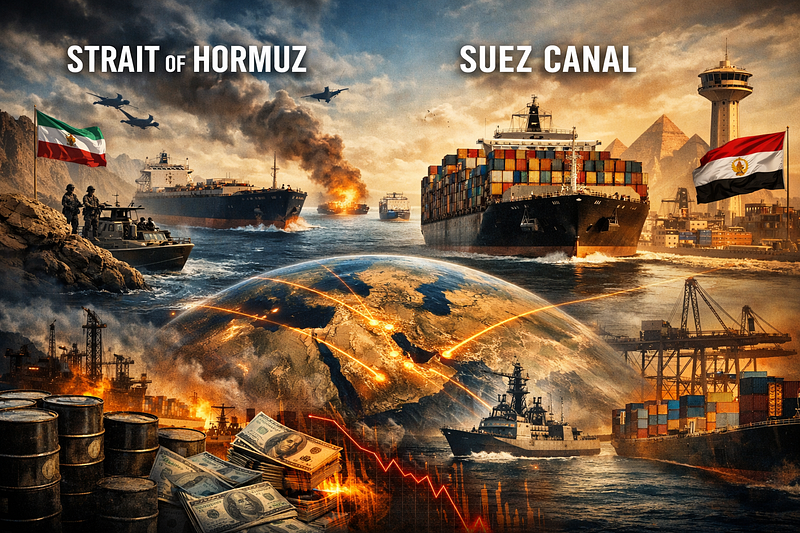
Begin with the most concentrated of them. Roughly a fifth of the world's traded oil, on the order of twenty-one million barrels a day, moves through the Strait of Hormuz, the thin corridor between Iran and Oman, along with major flows of liquefied natural gas from the Gulf. There is no meaningful overland alternative. The pipelines that bypass the strait, across Saudi Arabia and the Emirates, can carry only a slice of the volume, which means that when Hormuz is threatened, the oil does not simply find another road. It waits, and the price of waiting is paid by every importing nation on earth.
What makes Hormuz so dangerous is not only the volume but the asymmetry. The strait is twenty-one miles wide at its narrowest, and the shipping lanes within it are narrower still. A state with a modest navy and a supply of mines does not need to defeat the world to close it. It needs only to make the passage uninsurable, which is a far lower bar. The 2026 Gulf crisis demonstrated exactly this, when the strait was throttled for months and the entire global oil buffer, the spare capacity meant to absorb such a shock, turned out to sit behind the same gate. That story has its own full account in the archive. What matters here is the structural point it proves: the most important oil route in the world is also one of the easiest to disrupt, and the two facts are the same fact.
Suez, the shortcut the world cannot do without
If Hormuz is the oil valve, Suez is the conveyor belt. The canal is a man made cut through the Egyptian desert linking the Mediterranean to the Red Sea, and it carries on the order of twelve percent of global trade and close to thirty percent of the world's container traffic, well over a trillion dollars of goods a year. Around fifty ships pass through on an average day. It is not a background route. It is one of the main arteries between Europe and Asia, and the alternative, the long haul around the southern tip of Africa, adds thousands of miles and many days to every voyage.
The world learned how much rests on it in March 2021, when a single container ship, the Ever Given, wedged itself across the channel and stuck. The canal is barreled through open desert; there was no detour. For six days more than four hundred ships queued at both ends while an estimated nine and a half billion dollars of trade backed up each day. One vessel, lodged at the wrong angle, was enough to seize a main artery of the global economy. No enemy was involved. No strategy. Just wind, a sandbank, and the brutal arithmetic of a system with no slack.
For crude oil there is a partial relief valve, and it is worth knowing because it shows how narrow the margins are. The SUMED pipeline runs from Ain Sokhna on the Gulf of Suez to Sidi Kerir near Alexandria on the Mediterranean, carrying up to two and a half million barrels a day overland so that the largest tankers, too big to transit the canal fully laden, can offload, send their oil across Egypt by pipe, and reload on the far side. It is an ingenious workaround, and it is also an admission: the canal is so indispensable that an entire pipeline exists simply to relieve the pressure on it for one category of cargo.
The canal has been a weapon before
Suez is not only vulnerable to accident. It has been used, deliberately, as an instrument of power, and twice in living memory it changed the fate of nations.
The canal opened in 1869 and quickly became the jugular of the British Empire, the fast route to India that London could not afford to lose. In 1956 the Egyptian president Gamal Abdel Nasser nationalized it, seizing the waterway from its Anglo-French owners. Britain, France, and Israel invaded to take it back. They won militarily and lost everything else: the United States, unwilling to bankroll a colonial adventure, forced a humiliating withdrawal, and the Suez Crisis became the moment the world understood that the old European empires were finished. A canal had drawn the line between one era and the next.
Eleven years later the canal did not merely change hands; it vanished from the map of usable routes entirely. When the Six-Day War broke out in June 1967, Egypt blocked both ends and kept the canal shut for eight years, until 1975. That was the closure that stranded the fifteen ships of the Yellow Fleet described at the start of this essay, marooned from eight countries in the Great Bitter Lake. The detail worth holding onto is the duration. A chokepoint does not reopen the next season because the disruption is inconvenient. It can stay shut for the better part of a decade.
The lesson hides inside the absurdity. A chokepoint, once closed, does not inconvenience the world for an afternoon; it forces global trade around an entire continent and strands whatever happened to be inside when the gate came down. That eight-year closure pushed the world's shipping around the Cape of Good Hope and helped drive the rise of supertankers too large for the canal in the first place. The disruption rewired the very system that outlived it.
The Red Sea proves the deeper point
The most instructive chokepoint failure of recent years did not happen at Hormuz or in the canal itself, but at the southern entrance to the Red Sea, the Bab-el-Mandeb, the narrow gate between the Horn of Africa and the Arabian Peninsula through which everything bound for Suez must first pass.
From late 2023, Houthi forces in Yemen began attacking ships in those waters, and by late 2024 they had launched well over a hundred and ninety strikes. They did not close the strait. They did something cheaper and almost as effective: they made it frightening. War risk insurance climbed, crews balked, and the great shipping lines began to divert their vessels away from the Red Sea altogether, around the Cape of Good Hope. That detour adds roughly eleven thousand nautical miles, about ten extra days, and on the order of a million dollars in additional fuel to a single voyage. A large container run from Shanghai to Rotterdam came to cost around a third more and take more than a week longer than the Red Sea route it replaced.
The effect was immediate and severe. Container traffic through the Red Sea fell by about ninety percent in the first months of the crisis, and daily transit tonnage through the Bab-el-Mandeb roughly halved. And here is the lesson, the one that generalizes to every chokepoint on the list: the strait was never actually sealed. Ships could still physically sail it. What changed was the risk, and risk alone was enough to reroute a meaningful share of world trade around an entire continent. A chokepoint does not need to be blocked to bite. It needs only to become a place no one is willing to insure. The decisive weapon at a chokepoint is rarely the mine or the missile. It is the underwriter's refusal to write the policy.
It is worth seeing how that switch actually works, because it is the quiet machinery behind every chokepoint crisis. Marine war risk is priced separately from ordinary hull cover, and when a body like the Lloyd's Joint War Committee adds a stretch of water to its list of high-risk areas, the premium to insure a passage through it can jump from a small fraction of a percent of a ship's value to several percent, payable per voyage. On a vessel and cargo worth hundreds of millions of dollars, that is a surcharge large enough to wipe out the profit of the trip. The owner does not need to be ordered to stay away. The arithmetic does it. This is how a chokepoint can be effectively closed without a single shot landing on a single hull: the danger raises the premium, the premium erases the margin, and the ships simply stop coming.
Panama shows a chokepoint can fail without an enemy
If the Red Sea shows that a chokepoint can be neutralized by fear, the Panama Canal shows that one can be throttled with no human adversary at all.
The Panama Canal is not a sea level cut like Suez. It lifts ships over the isthmus through a system of locks, and those locks run on fresh water drawn from Gatun Lake. Every transit spills millions of gallons of that water into the sea. The canal therefore depends not on geopolitics but on rainfall, and in 2023 and 2024 the rain did not come. A severe drought dropped the lake so low that the canal authority was forced to cut the number of ships it allowed through. Daily transits fell from around thirty-six or thirty-eight at normal capacity to roughly eighteen at the worst of it in early 2024. Across the 2024 fiscal year, transits dropped by nearly thirty percent. Queues stretched to two weeks. Full capacity was not restored until the latter half of 2024.
It is worth remembering who built that vulnerability. The canal was an American project, opened in 1914 and run by the United States until it was handed to Panama in 1999. The engineering conquered the isthmus. It could not conquer the weather.
No mines, no missiles, no blockade. A weather pattern was enough to constrict one of the two great canals of the world. This is the failure mode the strategic literature tends to forget, because it has no villain to name. A chokepoint can be closed by war, by accident, or by the sky, and the system feels all three the same way: as a sudden shortage of a route it had quietly assumed would always be there.
Malacca, the artery of the East
One more belongs on the map, because it carries the weight of the world's most populous region. The Strait of Malacca, the long narrow channel between the Malay Peninsula and the Indonesian island of Sumatra, is the main passage between the Indian and Pacific Oceans. Through it moves much of the oil that fuels China, Japan, and South Korea, and a large share of the manufactured goods flowing the other way. By volume it is, in fact, the single largest oil chokepoint on earth, larger even than Hormuz: on the order of twenty-three million barrels a day, close to thirty percent of all seaborne oil trade, against Hormuz's roughly twenty-one million. The strait the headlines watch is not even the biggest one.
Its importance is so well understood in Beijing that strategists there have a name for the anxiety it produces, the Malacca dilemma: the fear that in a confrontation, a rival navy could sever the strait and starve the Chinese economy of imported energy at a stroke. Much of China's infrastructure ambition over the past two decades, the pipelines through Central Asia and Myanmar, the rail corridors, the courtship of ports across the Indian Ocean, can be read as an attempt to build a back door around a single vulnerable strait. The largest construction program in modern history is, in part, a chokepoint anxiety rendered in concrete.
The gate that decides whether people eat
Oil and containers dominate the chokepoint conversation, but the most direct way a strait reaches an ordinary life is through food.
The clearest recent case was not in the Gulf or the Red Sea but in the Black Sea. Ukraine is one of the world's great breadbaskets, a leading exporter of wheat, corn, and sunflower oil, and almost all of it leaves by sea, out through the Bosphorus past Istanbul, the narrow channel that is itself one of the oldest chokepoints in history. When Russia invaded in 2022 and effectively blockaded the Ukrainian ports, the grain stopped moving. Tens of millions of tonnes sat in silos while import-dependent countries across North Africa and the Middle East faced surging bread prices and the real prospect of hunger. A war on one shore of an inland sea became a food crisis on three continents, transmitted through a single maritime corridor.
It took a specially negotiated arrangement, the Black Sea Grain Initiative brokered by Turkey and the United Nations in mid-2022, to reopen a protected lane and let the grain sail, and when Russia abandoned that deal a year later the anxiety returned at once. The episode made the chokepoint's human meaning impossible to miss. A strait is not an abstraction on a trade map. It is, in a bad year, the difference between a full market and an empty one in a country that grows too little of its own food. And the same Gulf that ships the oil also ships roughly a third of the world's traded nitrogen fertilizer, which means one region's corridors touch both ends of the food chain at once: the nutrient that grows the crop and, elsewhere, the grain the crop becomes. Hold the narrow water and you hold a hand at the dinner table of nations that will never see it.
The newest chokepoint is made of glass
Everything so far has been about things that float. But the chokepoint logic has quietly extended to something that does not: data.
More than ninety-five percent of all intercontinental data traffic, by some measures closer to ninety-nine percent, travels not by satellite but through submarine cables, fibre-optic threads no thicker than a garden hose lying on the ocean floor. Those cables follow the same geography as the ships, because they are laid along the same shortest routes, which means they crowd through the same narrow seas. The Red Sea is the starkest case. A dense bundle of cables runs down it carrying roughly ninety percent of the data exchanged between Europe and Asia, on the order of a fifth of the world's internet traffic, through the very strait where the Houthis were attacking ships.
In February 2024 the point stopped being theoretical. Three cables in the Red Sea were severed, and an estimated quarter of the data traffic between Europe and Asia was disrupted, rerouted the long way around at the speed of light but with measurable lag for cloud services across the Middle East and South Asia. The internet did not go dark, because there was just enough redundancy to absorb the loss. But the lesson was the one the tankers teach: the modern world runs through a handful of narrow places, and now the things passing through them include the nervous system of the global economy itself, the transactions, the cloud, the calls. The corridor that carries the oil also carries the bandwidth. Cut the water and you slow the ships. Cut the floor beneath it and you slow the data. The same chokepoint, two layers deep.
Sea power was always chokepoint power
None of this is new. It is the oldest logic of empire, only updated.
For four centuries the great maritime powers understood that you did not need to own the oceans, which is impossible, only the narrow places that commanded them. Britain built the largest empire in history on exactly this insight. It did not garrison the seas; it held the gates: Gibraltar at the mouth of the Mediterranean, Malta at its center, Suez and Aden on the road to India, Singapore commanding the passage to the Pacific, the Cape at the foot of Africa. String the dots together and the empire looks less like a collection of territories than like a chain of chokepoints with ocean in between, each one at once a coaling station, a fortress, and a tollgate. The naval theorist Alfred Thayer Mahan turned the practice into doctrine: command of the sea is won not by holding water but by holding the narrow places and the bases that command them.
What has changed since is only the cargo and the flag. The gates are the same gates. Gibraltar, Suez, Aden, Hormuz, Malacca, Panama were the pressure points of the age of sail and steam, and they are the pressure points of the age of the container and the LNG carrier. The empire that held them is gone; the geography it exploited is not. The role Britain once played, guaranteeing passage through the world's chokepoints with a navy too large to challenge, has largely passed to the United States, whose carrier groups and Gulf-based fleet now sit astride the same straits. Power has always flowed to whoever could stand in the narrow places. The flags change. The map does not.
Why the world built its own trap
Step back from the individual gates and the real question appears. Why does a system as vast and sophisticated as the global economy rest on so few narrow points? Why was the trap not designed out?
Because it was not a trap when it was built. It was an optimization. Every shipping line, every trader, every government chasing growth made the same rational choice over and over: take the shortest route, the cheapest passage, the fastest turnaround. The shortest route between Europe and Asia runs through Suez. The cheapest way to move Gulf oil runs through Hormuz. Multiply that logic across millions of voyages and decades of investment, and the flows of the world concentrate, by the sheer gravity of efficiency, into a handful of corridors. Nobody decided to make the world fragile. Everybody decided to make it efficient, and fragility was the unbilled cost.
This is the portable law underneath the whole subject, and it reaches far beyond shipping. Efficiency is resilience converted into throughput. Every gram of slack the system removes in the name of cost becomes another ton of capacity squeezed through the same narrow gate, and the gate does not widen. A supply chain optimized to the last cent, a grid run at the edge of its capacity, a hospital with no spare beds, a just in time factory with no buffer stock, all share the architecture of the chokepoint: maximum flow, minimum margin, and a single point at which the whole thing can be stopped. The chokepoint is not an accident of geography. It is the visible form of a choice the modern world makes everywhere, to trade the ability to absorb a shock for the ability to move more, faster, cheaper, right up until the shock arrives.
It is worth stating the strongest objection to this, because it is real. A defender of the system would say that concentration is simply how scale works, that the gains from these corridors over the centuries vastly outweigh the occasional disruption, and that the world reroutes, absorbs the cost, and recovers every time, as it did after the Ever Given and is doing around the Red Sea. That is true, and it is the point rather than a rebuttal. The system does recover, but it recovers by passing the cost down the line, to the importer, the manufacturer, the household paying more for fuel and goods, and by drawing on a tolerance for disruption that is itself a finite resource. Each shock is survived. What erodes is the margin to survive the next one.
Who holds the doors
If the chokepoints are the doors, the question of power becomes simple: who decides whether they open. The answer is rarely a single hand, and that is what makes it interesting.
Egypt holds Suez and earns billions a year in transit fees, which is why the canal's security is a matter of state survival, not just commerce. Hormuz is bounded by Iran and Oman, which gives Tehran a lever it has brandished for a generation without ever needing to fully pull it. Panama runs its own canal now, but the history of who built and held it is a history of American power, and the strait of Malacca sits among Singapore, Malaysia, and Indonesia while the navy that effectively guarantees its passage flies a foreign flag. Above all of them sits a quieter authority, the one the Red Sea crisis exposed: the insurers and reinsurers, mostly in London, whose willingness to cover a voyage is the real switch. A government can threaten a strait. An insurer can close it, simply by declining to write the policy, and reopen it by agreeing to. Power at a chokepoint is the power to set the price of risk at the gate.
The race to escape the gates
If a chokepoint is a vulnerability, the obvious response is to build around it, and much of the world's grandest infrastructure is exactly that: an attempt to escape a strait.
China has spent more than a decade and on the order of a trillion dollars trying to reduce its exposure to the Strait of Malacca, the gate through which most of its imported oil must pass and which a rival navy could in theory close. The pipelines through Central Asia and Myanmar, the rail corridors across Eurasia, the ports acquired around the Indian Ocean, the whole architecture of the Belt and Road, can be read as one long hedge against a single vulnerable strait. India, the Gulf, and Europe announced their own answer in 2023, a proposed India-Middle East-Europe Economic Corridor of rail and shipping meant to lean less on Suez. And as the Arctic ice retreats, the Northern Sea Route along the top of Russia is opening for part of the year, a path between Asia and Europe that touches none of the classic chokepoints at all, which is precisely why Moscow and Beijing are so interested in it.
None of these has yet replaced the gates, and most never fully will. A pipeline carries oil but not containers. An Arctic route is seasonal and thinly served. A new corridor takes decades and crosses borders that can close. The chokepoints endure not because no one has tried to escape them but because the economics that created them, shortest route and lowest cost, keep pulling the traffic back. The world keeps trying to build its way out, and keeps failing, because the trap is only efficiency wearing the face of geography.
The chokepoint acquires a price list
Everything above describes chokepoints as leverage: places that can be closed, threatened, or held at risk. In July 2026, at Hormuz, the logic took a step that this map had never formally recorded. A chokepoint acquired an explicit rate card.
On the thirteenth of July, the American president announced that the United States would act as guardian of the Strait of Hormuz and be reimbursed, in his words, at the rate of twenty percent on all cargo shipped through it, in exchange for protection. The next afternoon, a naval blockade of ships moving to and from Iranian ports came into force. The International Maritime Organization responded that a transit charge of that kind has no basis in law. Tehran, which had spent months insisting that it alone is the strait’s guardian and had established its own authority charging vessels fees reported to run as high as around two million dollars, rejected the American claim within hours. Two powers now assert custody over the same water, and each assertion arrives with a price attached.
Notice what makes such a charge collectable at all, because it is not the warships. No fleet boards each tanker to demand payment. The collection runs through the same quiet machinery this chapter has traced at the Red Sea: the insurance and pricing layer. War-risk premiums reprice within hours of a strike; the oil benchmark transmits the fear worldwide the same morning; and whatever charge attaches to the passage arrives in wholesale prices and freight rates, not on any invoice a household ever sees. A toll on a chokepoint does not need a toll booth. It needs a market that prices risk, and the market has never been better at it. The proof was already on the record before any toll was announced: when the fighting began, it was not a fleet that emptied the strait but a committee of underwriters in London, redesignating the water and repricing every passage within hours. The premium had already established that transit here carries a price. The toll merely changes the question from whether passage is priced to who collects the proceeds.
The deeper significance is the precedent, and it reaches every gate on this map. Once one chokepoint carries a rate card, every chokepoint acquires a business model: demonstrate that you can close the passage, then price the promise not to. Malacca, Suez, Gibraltar, Panama, the cables of glass on the seabed that the modern economy runs through. None of these needed a business model before, because the post-war order treated passage as a public good, kept open by the same power that has now, at Hormuz, begun to charge for it. Whether the demonstration is allowed to stand is therefore not a regional question. It is one of the variables that will decide what this entire map means for the next decade.
The honest marker belongs here as elsewhere: the charge is announced and contested, not settled. The IMO has rejected its legal basis, allies have not endorsed it, and it may yet be dropped, unenforced and uncopied, in which case it was a bluff and this section records a threshold approached but not crossed. But if it is enforced, and above all if it is copied, then the map of gates in this chapter becomes something else: a map of tariffs, each narrow place on earth converted from a passage the world uses into a subscription the world pays. The difference between those two futures is the difference between geography as a constraint and geography as a landlord, and it is being decided now, at the narrowest twenty-one miles of water on the planet.
What this means
The chokepoint is the clearest example of a truth the modern world prefers not to dwell on: that systems of staggering complexity often rest on a few simple, physical, vulnerable things. We talk about the global economy as if it were a cloud, weightless and everywhere. It is not. It is ships in a narrow channel, water in a lake, a policy written by an underwriter who has decided the odds. Remove any one of those and the cloud turns out to have been a corridor all along.
None of this is hidden. The maps are public, the volumes are published, the histories are written. And yet the chokepoints stay out of the conversation until the day one of them closes, at which point everyone discovers at once what a small number of narrow places the whole arrangement depends on. That is the strange property of this kind of power. It is not secret. It is merely unexamined, sitting in plain sight on every map, waiting for the morning the route is gone. The breakthrough always gets the attention. The bottleneck always decides the outcome.
Evidence Map
Facts, interpretations, forecasts, and disconfirming signals.
Core claim. A small number of maritime chokepoints, Hormuz, Suez, the Bab-el-Mandeb, Panama, and Malacca, carry a disproportionate share of world trade and energy, and can be disrupted by war, accident, or climate with effects felt globally within days. The same narrow corridors increasingly carry the world's data as well as its goods. The deeper mechanism is that a chokepoint need not be physically closed to bite; raising the risk, and so the insurance cost, is enough to reroute trade. The structural cause is that efficiency concentrates flows into a few corridors, converting resilience into throughput.
Evidence level. Facts: high. Documented: roughly a fifth of the world's traded oil (about 21 million barrels a day) transits Hormuz, while the Strait of Malacca carries more still, around 23 million barrels a day or close to thirty percent of seaborne oil; the Suez Canal carries about twelve percent of global trade and close to thirty percent of container traffic; the canal was closed for eight years (1967-1975) after the Six-Day War, stranding the fifteen ships of the Yellow Fleet; the 2021 Ever Given blockage delayed over four hundred ships at an estimated 9.6 billion dollars a day; the SUMED pipeline's 2.5 million barrel-a-day bypass capacity; the post-2023 Houthi attacks and the Cape of Good Hope reroute adding about 11,000 nautical miles, ten days, and a million dollars per voyage, with Red Sea container traffic down roughly ninety percent; the Panama Canal (US-built, opened 1914, handed to Panama in 1999) drought cutting daily transits from about 36 to roughly 18 and FY2024 transits by nearly thirty percent; the 2022 Black Sea blockade of Ukrainian grain and the UN-and-Turkey-brokered Black Sea Grain Initiative that briefly reopened it; more than ninety-five percent of intercontinental data traveling by submarine cable, with the Red Sea carrying about ninety percent of Europe-Asia data and the February 2024 cable cuts disrupting an estimated quarter of it. Interpretation: medium, and marked as such. The framing of insurance and risk (rather than blockade) as the operative mechanism, and of efficiency as the structural cause of fragility, is an analytical conclusion drawn from the documented disruptions.
What would confirm this. Further disruptions in which trade reroutes in response to risk and cost rather than physical closure; continued absence of high-capacity alternatives to the major corridors.
What would disprove this. The emergence of genuinely redundant routes or transport modes that let global trade absorb the loss of a major chokepoint without significant cost or delay, which would dissolve the fragility the claim rests on.
Watchlist. The durability of Red Sea rerouting; the frequency of climate-driven constraints at Panama; the build-out of overland alternatives (Chinese pipelines and rail) that would reduce Malacca and Hormuz dependence.
Frequently Asked Questions About Global Chokepoints
What are the world's most important shipping chokepoints?
The most critical are the Strait of Hormuz (Gulf oil), the Suez Canal and the Bab-el-Mandeb at the Red Sea (Europe-Asia trade), the Panama Canal (the Americas), and the Strait of Malacca (East Asian energy and goods). A disproportionate share of global oil and trade passes through these few narrow passages.
How much trade passes through the Suez Canal?
The Suez Canal carries on the order of twelve percent of global trade and close to thirty percent of the world's container traffic, well over a trillion dollars of goods a year, with around fifty ships transiting on an average day.
How much oil passes through the Strait of Hormuz?
Roughly a fifth of the world's traded oil, along with major flows of liquefied natural gas from the Gulf, passes through Hormuz. There is no overland route that can carry more than a fraction of that volume.
What happens when a chokepoint is blocked or disrupted?
Trade reroutes along longer paths, which raises shipping times, fuel costs, and insurance premiums, and pushes up the price of oil and goods. The 2021 Ever Given blockage of Suez and the 2023-2024 Red Sea rerouting around the Cape of Good Hope both showed how quickly a single chokepoint disruption ripples through the global economy.
Why is global trade so dependent on so few routes?
Because the system was optimized for cost and speed. Shipping naturally concentrates on the shortest, cheapest corridors, which over decades funnels the world's flows through a handful of gates. The efficiency that makes those routes attractive is the same thing that makes their loss so painful.