In 2022 a customer bought a used Tesla Model S, and some time later the car quietly lost about eighty miles of its range. Nothing had broken. No part had worn out. A previous owner had paid for a software unlock that the company decided did not transfer with the car, so it reached across the network and switched the capability off, then offered to sell it back for roughly four and a half thousand dollars. When the story spread, the company reversed it. But the reversal is not the point. The point is that it was possible at all: that a thing a person had bought, parked in their own driveway, could be reached into and diminished from a distance, by a company that no longer owned it, without anyone touching the car.
Hold that next to an old Mercedes diesel of the kind that still rumbles through European cities thirty and forty years after it was built. Whatever else is true of that car, no one can reach into it. It cannot be updated. It cannot be throttled. It cannot be made slower overnight, or have a feature you paid for switched off because a subscription lapsed, or report where it has been. It can only run, or fail to run, on its own mechanical terms. The difference between those two machines is not really about emissions, or speed, or even age. It is about a quiet and almost unremarked change in what it means to own a thing, and that change is the subject here.
The provocation in the title is deliberate, but the real argument underneath it is not a culture-war point about electric cars. It is this: the car has been the last large, expensive object that ordinary people genuinely owned, in the old sense of the word, a thing they controlled completely once they had paid for it. Consider what else a household holds. The house is usually mortgaged, owned in name while the bank holds the deed and the real power for decades. The phone is owned outright but is too cheap, too disposable, too obviously a window onto someone else's servers to feel like property at all. The car sat alone in the middle: expensive enough to matter, durable enough to keep, and, once paid off, genuinely and completely yours. It was the last redoubt of full popular ownership, and it has just fallen. The determining variable is not the engine. It is the shift from ownership to permission, and the law beneath it is simple: what you can fully own, the seller cannot keep selling you; what the seller can keep selling you, you do not fully own.
What ownership used to mean
To own a thing, in the sense the word carried for most of its history, was to have final authority over it. You could use it, modify it, repair it, lend it, sell it, neglect it, or destroy it, and no one could reach across a wire and change those terms after the fact. A house, a tool, a book, a car: once it was yours, the seller's relationship to it was over. They had your money; you had the thing; the transaction was complete and closed.
Lawyers describe ownership as a bundle of rights: the right to use a thing, to exclude others from it, to alter it, to profit from it, and to dispose of it. What made the car the most democratic form of full ownership most people ever held was that an ordinary buyer held the whole bundle at once. The principle that once you have bought a copy of something the maker's control over that particular copy is exhausted applied to the physical machine completely. You did not need the manufacturer's permission to drive to a different city, to fit a new stereo, to take it to any mechanic, or to sell it to a stranger. The bundle was yours, entire and final, and that was the ordinary, unremarkable condition of owning a car for most of the twentieth century.
The connected car breaks that completeness, and it does so in a way that is easy to miss because the car still looks like the old kind of property. It sits in your driveway. The registration is in your name. You can wash it and lend it to your sister. But the most important capabilities of the machine now live in software the manufacturer continues to control after the sale, which means the transaction is no longer closed. It has become a relationship, ongoing and asymmetric, in which the maker retains powers over the object that the owner does not have, and can exercise them remotely, unilaterally, and after the money has changed hands. You have bought the hardware. You are renting the use of it, on terms the seller can revise. The bundle of rights has been quietly unbundled, and the maker has kept the strands that matter most.
This is the determining variable, and everything that follows is evidence of it. Not the carbon, not the horsepower, not the brand. The question of who, after the sale, still holds the switch.
The car subscription: features you already paid for, locked behind a paywall
The clearest proof is the feature that is physically present in the car and withheld by software until you pay again. In 2022 Mercedes-Benz introduced, on its EQ electric models, a subscription of around twelve hundred dollars a year to unlock faster acceleration, improving the zero-to-sixty time by roughly a second. The crucial detail is that the car requires no physical change to do this. The motor is already capable; the hardware is already installed and already paid for; Mercedes has simply placed a software lock between the owner and the performance of the machine they bought, and rented them the key.
The same year, BMW began offering heated seats by subscription in several markets, around fifteen pounds a month in the United Kingdom, for seats whose heating elements were already built into the car. The backlash was severe enough that BMW suspended the heated-seat version in 2023, but the company was explicit that it remained committed to selling software-gated features, because the model is too lucrative to abandon. The practice has become widespread enough that legislators in New Jersey and New York moved to ban charging subscriptions for hardware already installed in the vehicle, a practice critics have likened to extortion.
Notice what these examples establish, beneath the irritation. The owner possesses the physical capability. They have paid for the steel, the motor, the heating element, the silicon. And they still cannot use it, because the maker has reserved the right to decide, continuously and after the sale, what the object they own is permitted to do. Ownership of the hardware has been separated from authority over its function, and the second is the one that matters. A thing you have fully paid for but cannot fully use is not, in the old sense, a thing you own. It is a thing you license.
The switch the maker keeps
The Mercedes paywall is the polite version. The Tesla range removal is the blunt one, and it reveals the capability that the subscription model rests on: the maker can reach the car. Over-the-air software, the same mechanism that delivers a useful update overnight, is also a permanent channel of control that runs in only one direction. It can add a feature; it can remove one; it can improve the car or, as that customer discovered, worsen it; and it does all of this without the owner's hand on anything. The convenience and the control are the same wire. You cannot have the overnight improvement without also granting the overnight diminishment, because they travel the identical path.
There is a sharper version of the same story, and it is worth telling slowly, because it happened to one person. In December 2019 a man named Alec bought a used Tesla Model S. The window sticker in his hand listed Enhanced Autopilot and Full Self-Driving Capability, options the original owner had paid eight thousand dollars to add. He drove it home. What he did not know was that a few weeks earlier, three days after the dealer had bought the car at a Tesla auction, Tesla had run a routine audit of its fleet, found the used car in it, and quietly reached across the network to remove Enhanced Autopilot; the dependent Full Self-Driving fell away in a later update. The dealer never knew. Alec found out weeks into ownership, when an envelope arrived from a Tesla service centre. He opened it. Inside was an invoice with a line itemising what had been taken out of the car he had already bought. Eight thousand dollars of capability, fully paid for, physically present in the machine, had evaporated in transit between two owners because the maker had decided that what one buyer paid for did not travel to the next. After the story spread, Tesla restored it. But the restoration is not the point. The point is the envelope. The most basic strand of ownership there is, the right to sell your property with everything you paid for intact, now passes through a switch the maker holds, and an owner can learn it only after the fact, by mail.
This is not unique to one company; it is the architecture of the connected car as such. And it scales beyond the manufacturer. By 2014, lenders financing cars to buyers with poor credit had wired starter-interrupt devices into roughly two million vehicles, letting them disable a car remotely, by GPS, when a payment ran late. The documented results were not abstract. Borrowers reported cars shut down while idling at a stoplight, or a few days past due, leaving them stranded; parents could not reach a school or a doctor; in one case a lender used the device to track and repossess the car of a woman who had fled an abusive husband to a shelter, who then feared the tow company would reveal where she was. The emergency restart codes meant to prevent the worst often did not work. Whatever one thinks of the lending, the mechanism is the thing to see: a car that someone far away can switch off, on their schedule, for their reasons, with the owner reduced to a person hoping the machine in their own driveway will agree to start. Regulators have separately moved to require anti-impaired-driving technology in new vehicles, which by design means a capacity, built into every car, to prevent it from being driven. Each of these has a reasonable justification taken alone. Together they describe a machine that has acquired, from several directions at once, the property of being remotely disablable, and a thing that someone else can switch off is a thing you do not fully control, however clear the title in your name.
The old diesel has none of this, and that absence is its quiet significance. It cannot be reached because there is nothing in it to reach. Its incapacity to be networked, updated, paywalled, or disabled is not a deficiency. It is the last form of a freedom that the newer machine has traded away for convenience, and that most buyers did not notice they were trading because the trade was never presented as one.
The car that watches
There is a second power the connected car gives the maker, and it runs in the other direction along the same wire: not control over the machine, but knowledge of the driver. In 2023 the Mozilla Foundation reviewed the privacy practices of twenty-five car brands and concluded that cars were the worst product category it had ever examined. Every brand failed. The vehicles collected not only the obvious data, location, routes, driving habits, but in some cases far more, and the manufacturers reserved broad rights to share or sell what they gathered. The car had become, in addition to a means of transport, a sensor that travels everywhere its owner goes and reports back.
This is not a hypothetical harm, and the clearest case attaches a price to it. Over several years General Motors collected detailed driving data, hard braking, sharp acceleration, speed, trips, from hundreds of thousands of cars through its OnStar service, and sold it to the data brokers LexisNexis Risk Solutions and Verisk, who packaged it into driver-risk scores and sold those on to insurers. Drivers found their premiums rising, or their applications refused, without understanding why, because their own cars had been quietly reporting on how they drove to companies that priced their insurance. Investigators concluded GM had given owners no meaningful notice; in May 2026 the company agreed to a settlement with California of around twelve and three-quarter million dollars and accepted a five-year bar on selling driver data to consumer-reporting agencies. The whole nationwide trade had earned GM roughly twenty million dollars. That is the concrete shape of the watching: a person who bought a car discovered that the car had informed on them, and that the report had cost them money, and that they had agreed to none of it in any sense they would recognise as agreement.
This matters to the ownership question because surveillance and control are two faces of the same architecture. A machine that can be reached to remove a feature can be reached to read a log. The same connection that lets the maker switch the car off lets it record where the car has been, and the owner has, in practice, little ability to inspect, limit, or end either flow, because both live in the software layer the maker controls and the owner merely uses. The old object sat inert and private; the new object participates, continuously, in a relationship that watches it. You do not just fail to fully control the connected car. The connected car, to a meaningful degree, monitors you, and sells what it sees.
The plan, said out loud
It would be easy to read all of this as a series of accidents and overreaches, each one corrected when the public complained, as several were. But the most important evidence is not the incidents. It is that the industry has described, openly and to its own investors, the destination these incidents point toward. In 2021 General Motors told investors it expected software and related services, subscriptions, feature unlocks, data, to generate as much as twenty-five billion dollars a year by 2030, and compared the ambition directly to Netflix; its research, it said, suggested customers were willing to spend around a hundred and thirty-five dollars a month. The same year, Stellantis set a target of roughly twenty billion euros in incremental annual revenue from software-enabled vehicles by the end of the decade. Industry analysts put the total incremental value of the software-defined vehicle at several hundred billion dollars by 2030.
These figures are the mechanism stated as strategy. A subscription business of that size cannot be built on a product the customer fully owns and can use without further payment, because a thing fully owned generates no recurring revenue. It can only be built on a product whose use the seller continues to meter after the sale, which is to say on the conversion of the car from a thing you buy into a service you rent. The paywalled acceleration, the heated-seat subscription, the data sold to insurers, the feature stripped on resale: these are not glitches in a model that intends to sell you a car and step away. They are the early, clumsy, partially-retracted first drafts of a model that intends, by its own account, never to step away at all. The incentive is not inferred. It is published in the annual report.
The honest objection
The strongest case against all of this is not weak, and in its best form it is a defence of genuinely good things. Connected features, the argument runs, deliver real value: over-the-air updates fix safety defects without a recall, improve the car for free over its life, and add capabilities the buyer never expected; remote access lets owners find a stolen car or unlock it when they have lost the key; data collection enables crash-avoidance, better navigation, and maintenance warnings that prevent breakdowns. The electric car, separately, offers real reductions in local pollution and, over a full lifetime in most grids, in carbon emissions; treating it as a surveillance plot rather than a transport improvement is conspiratorial. And subscriptions, however annoying, can lower the up-front price by letting buyers pay only for what they use. To frame the modern car as a loss of freedom, on this account, is to romanticise an old machine that was simply worse, and to mistake the ordinary inconvenience of new technology for a sinister design.
There is a deeper version of the objection, and it is the one that actually threatens the thesis, because it attacks the binary the whole argument rests on. You never fully owned a modern car anyway. You could not legally modify its emissions; you could not service its engine computer without the maker's diagnostic codes; the state could tax it, recall it, impound it, and, as the closing scene of this essay concedes, forbid the old diesel from entering a city at all. Ownership of a complex machine was always partial, always hedged by the dealer's monopoly on diagnostics and the state's authority over the road. On this account there was never a golden age of total control to lose, and "permission" is simply the honest name for a constraint that was always present. The connected car has not abolished an ownership that existed; it has only made visible a dependence that was there all along.
Both versions of the objection are largely correct on their own terms, and the response is not to deny them but to draw the distinction they blur. Take the deeper one first, because conceding it actually sharpens the thesis. It is true that you never held total control, and that a switch always existed. But whose switch, and of what kind, is the entire question. The state's switch is slow, public, written into law, applied to everyone alike, and appealable, and you can vote out the people who hold it. The dealer's diagnostic monopoly was an annoyance you could route around with an independent mechanic and an aftermarket tool. The new switch is different in every one of those respects: it is instant, private, remote, unilateral, applied to you specifically, and answerable to no vote and no appeal. The thesis was never that ownership had once been total. It is that the switch has moved, from parties that are slow and accountable to a party that is fast and accountable to no one, and that the move happened without anyone being asked. A constraint you can vote against is a different kind of thing from a constraint a company can apply to your driveway overnight.
Now the everyday version. The benefits are real. Over-the-air safety fixes genuinely save lives; stolen-car recovery genuinely helps; the lifetime climate case for electric vehicles is, in most conditions, genuinely sound, and nothing here disputes it. But every one of those benefits is delivered by the same capability, the maker's retained, remote, post-sale authority over the object, and that capability does not come with a guarantee that it will only ever be used for the owner's benefit. The Mercedes paywall and the range removed from Alec's car are not abuses of a system designed for safety; they are ordinary uses of a system designed for control, pointed at revenue instead of at the recall. None of this makes Tesla the villain; it is simply the most vivid case, because it moved first and fastest, and the same architecture now runs through Mercedes, BMW, GM, Toyota, and the rest. The argument is not that the features are bad. It is that accepting them means accepting that someone else now holds a permanent switch on your property, and that the same switch that pushes the safety fix can withhold the horsepower, read the log, or, in the lender's version, strand the car. You cannot keep the benefit and refuse the architecture, because they are the same architecture. The question is not whether the connected car is convenient. It plainly is. The question is who is in charge of it after you have paid, and the honest answer is: not, finally, you.
What would falsify this reading? If owners held genuine, enforceable final authority over the connected car, the legal and technical right to refuse an update, to disable the data collection, to unlock the hardware they had bought, to prevent remote disablement, then the claim that ownership has become permission would collapse, and the optimistic account would stand. The mechanism predicts the opposite: that the switch will remain on the maker's side, that the data will keep flowing, and that the features you paid for will keep arriving gated. Watch where the switch lives. The thesis lives or dies on who can reach the car.
The environmental argument, kept in its place
The original provocation leaned on a second claim, the environmental one, and it deserves a careful word precisely because it is the part most likely to mislead. There is a legitimate core to it: the greenest car is very often the one that already exists, because a vehicle already built has had its considerable manufacturing emissions, the mining, the smelting, the battery production, paid in the past, while a new vehicle, electric or not, incurs a fresh manufacturing debt the moment it is made. Lifecycle analysis genuinely supports the idea that keeping and maintaining a serviceable old car can, for a low-mileage driver, beat scrapping it for a new one, and that the environmental accounting of the electric transition is more complicated than the showroom suggests.
But that legitimate core has a dishonest extension, and the discipline of this argument requires refusing it. It is not true that the electric car is a fraud, that its emissions are merely hidden rather than reduced, or that the energy transition is nothing but a branding exercise serving secret agendas. Over a full life, in most of the world's grids, an electric car does emit less than its combustion equivalent, and that is a real gain, not a staged one. The embodied-cost point is a reason to keep a good old car you already have; it is not a reason to believe the transition is a hoax. Conflating the two is exactly the overreach that lets a sound observation, keep what works, be dismissed along with the nonsense it gets bundled with. So the environmental argument stays where it belongs: as a modest, true point about endurance over replacement, and not as the spine of the case. The spine is ownership, and ownership is the part that survives every objection the environmental argument invites.
The agreement that is not one
A defender of all this will reach, eventually, for consent. The buyer agreed. The terms were in the contract, the privacy policy, the connected-services enrolment; the subscription was disclosed; nobody was forced. And in the narrow legal sense this is usually true. But it is worth looking at what the consent actually consists of, because the shape of it is the final piece of the mechanism. The GM case is instructive precisely because the company maintained it had permission, while investigators concluded owners had been given no meaningful notice that their driving data would be scored and sold to insurers, and that the consent had been buried in the enrolment for a service people understood as roadside assistance. The agreement existed on paper and was absent in fact.
This is the ordinary condition of the modern purchase, not an exception. The terms are presented after the decision to buy, in language few read and fewer can evaluate, on a take-it-or-leave-it basis, with no power to negotiate a single clause. And the leave-it option is steadily closing, because the practices are converging across the industry: if every maker reserves the same remote powers, collects the same data, and gates the same features, then declining them means declining to own a car built in the last decade at all. A choice that exists only in theory, between options that are all the same, and that most people cannot realistically refuse, is consent in the way a turnstile is a choice about whether to enter the station. The loss of ownership is not imposed against the buyer's will. It is arranged so that the buyer's will is never quite engaged, which is more durable than imposition, because a thing you believe you agreed to is a thing you do not resist.
That is why the shift has been so quiet. Nobody announced that the car would stop being yours. The change arrived feature by feature, each one convenient, each one disclosed, each one defensible, and the sum of them, the conversion of an owned object into a metered relationship, was never put to anyone as a question. This is how a structure replaces a freedom: not by confiscating it, but by making its surrender feel like a software update you clicked through on a screen in the driver's seat.
The same pattern: software, tractors, and the right to repair
None of this began with cars, which is how you know it is a structure and not a quirk of one industry. The same shift, from owning a thing to licensing the use of a thing the seller still controls, has already happened almost everywhere software touches. Software itself stopped being something you bought and became something you subscribe to. The film you "buy" on a streaming service can vanish from your library when a licensing deal lapses. The phone, the thermostat, the doorbell, the games console: each is sold as a purchase and operated as a relationship, with the seller retaining a remote hand long after the money is gone.
The clearest precedent, because it is the one that produced an organised revolt, is the tractor. A modern John Deere combine can cost the better part of half a million dollars, and yet for years a farmer who bought one found that the manufacturer's software would not permit an independent mechanic, or the farmer, to complete many repairs, because the diagnostic tools needed to clear a fault code and authorise a fixed part were held by the dealer network. A farmer with the skill, the time, and a paid-for machine sitting idle in a field at harvest could be made to wait for an authorised technician, because the right to repair the thing he owned had been retained by the company that sold it. The grievance built the right-to-repair movement. In 2023 Deere signed a memorandum of understanding with the American Farm Bureau, promising to make tools, software, and documentation available; in exchange the Farm Bureau agreed not to back right-to-repair legislation. Two years later the Federal Trade Commission and several states sued Deere anyway, alleging the promise had not been kept and that repair costs and delays remained inflated. The detail to hold is the trade itself: a private agreement in which the right of owners to fix their own machines was negotiated between two organisations, neither of which was the owner. Ownership had become something granted and bargained over rather than simply held.
The car is now retracing the tractor's path, and sometimes the example is almost comic in its smallness. In 2018 and later Toyotas, the remote-start button on the physical key fob, a button in the owner's hand, operating hardware in the owner's car, stopped working unless the owner kept up a connected-services subscription costing around eight dollars a month. Toyota said the requirement was an inadvertent consequence of the car's architecture and that it was reviewing it, which may well be true. But that is precisely the point: the architecture now defaults to the subscription. When even the key in your pocket routes its command through a service the maker can switch off, the gravitational pull of the whole system is toward permission, and away from ownership, without anyone needing to intend it.
Seen across all these cases at once, a general rule comes into view, and it is worth stating plainly because it travels far beyond cars. What you can fully own, the seller cannot keep selling you; what the seller can keep selling you, you do not fully own. The two are mirror images of a single fact about where value now lives. For most of the industrial era a manufacturer made money by selling you a finished object and then losing contact with it; the sale was the event, and the relationship ended there. The connected product inverts that. The sale becomes the beginning of the relationship, the moment the metering starts, and the manufacturer's profit shifts from the one-time transaction to the permanent stream. Ownership, in the old complete sense, is simply incompatible with that stream, because a customer who fully owns a thing has stopped paying. So the thing must be redesigned, quietly, so that full ownership is no longer on offer, and what is sold instead is access on a meter, dressed in the familiar costume of a purchase. This is the law underneath the tractor, the phone, the streaming library, and now the car: wherever a maker captures a recurring revenue stream from a product, the customer's ownership of that product is being hollowed out to make room for it, whether or not anyone says so.
The car is the latest and the most consequential object to make this passage, because it is the most expensive thing most people own and the one most bound up with the plain idea of freedom, the ability to get in and go, answerable to no one. When that object becomes a node, the freedom it symbolised quietly changes character. You do not ask a road for permission to drive on it. You are beginning, without quite being told, to ask the car, and behind the car the company, and behind the company the network. When movement depends on a system someone else controls, movement has become a permission, and a permission is the kind of thing that can be revised, priced, throttled, or withdrawn, which is precisely what ownership existed to prevent.
What the old diesel knows
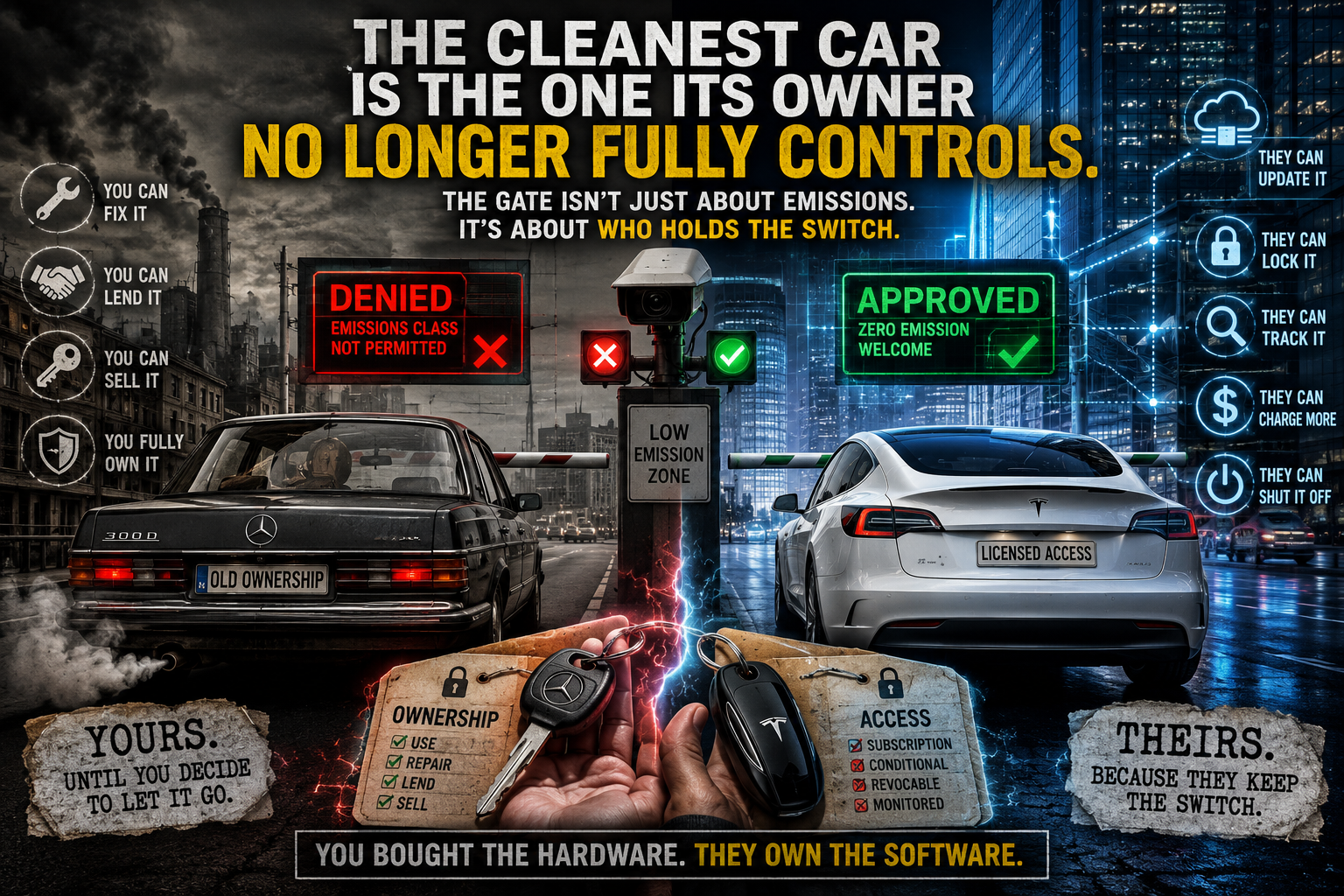
Picture the scene that the low-emission zones of European cities now stage every day. An old diesel approaches the camera-controlled boundary, the kind of decades-old Mercedes that has outlived three recessions and two owners, and the sign turns it away: its emissions class is no longer permitted. Behind it an electric car is read by the same camera and waved through, clean, silent, approved. From a distance it looks like the future overtaking the past. Up close, something quieter is happening at that line. The car being turned away is the one its owner fully controls. The car being admitted is the one that, in the senses that have been described here, its owner does not. The gate is sorting cars by emissions. It is also, without meaning to, sorting them by who holds the switch.
So the recommendation in the title is not nostalgia, and it is not really about diesel. It is about choosing, while you still can, the version of an object over which the relationship ends at the sale. The old Mercedes is not cleaner, not faster, not safer, and not more convenient than the car that glides silently past it through the gate. It is, in one specific and increasingly rare sense, more fully yours: a thing you can use, fix, lend, and keep without a distant party reserving the right to change the terms. Its mechanical stubbornness, the very thing that makes it feel obsolete, is the last expression of a kind of ownership that the connected world is steadily retiring.
The deeper point is not that you should refuse the new machine, which for most people is neither possible nor sensible. It is that you should see clearly what the new machine is, and what is being exchanged for its convenience, because the exchange is happening whether or not it is noticed, and the things traded away in silence are the hardest ever to get back. Somewhere tonight an envelope like the one Alec opened is arriving for someone who does not yet know that the car in their driveway has quietly changed terms. The car was the last large object that ordinary people fully owned. Its conversion into a licensed, monitored, remotely governed node is not a story about transport. It is a story about the disappearance of ownership itself, told in the one object where almost everyone still expected to find it. The old diesel cannot be reached. That, now, is its rarest feature, and it is the whole of what it has to teach: it is the last witness, rumbling and unwelcome outside the gate, to what owning a thing used to mean.
Frequently Asked Questions
Does BMW charge a subscription for heated seats?
Yes. In 2022 BMW began charging a monthly fee to switch on heated seats that were already installed in the car and paid for in the purchase price. After public backlash it walked parts of the plan back, but the capability and the business model remain across the industry.
Can a car company disable or limit your car remotely?
Yes. Over-the-air software gives the maker a permanent one-way channel into the car that can add or remove features after the sale. Subprime lenders went further, wiring starter-interrupt devices into roughly two million vehicles by 2014 to shut a car down remotely when a payment ran late.
What is a software-defined vehicle or car subscription?
A car sold less like a product than like a subscription: capabilities built into the hardware are unlocked for recurring fees switched on from a server. General Motors told investors it expected up to twenty-five billion dollars a year from such software and services by 2030, comparing the ambition to Netflix.
Do paid car features transfer to the next owner?
Not always. Options tied to an account rather than the car may not transfer on resale. In one documented case a used Tesla had features the first owner had paid for removed after the sale, because the maker, not the car, controlled them, which means part of what you paid for cannot be resold.
Is it better to own an old car than a connected one?
On ownership and control, an old mechanical car cannot be remotely disabled, metered, or made to report on its driver. The trade-off is real: connected cars deliver genuine safety and convenience through the same channel that paywalls features and sells driving data. The question is who holds the switch after you have paid.
Evidence Map
Facts, interpretations, forecasts, and disconfirming signals.
Core claim. The connected car marks the end of the car as a fully owned object and its conversion into a licensed, remotely governed node: the maker retains, after the sale, the ability to paywall installed features, alter or disable the car over the air, and collect its data. The determining variable is the shift from ownership (final authority over a thing) to permission (use on terms the seller can revise). The claim concerns the structure of control, not the merits of electric propulsion, which are not disputed.
Evidence level. Facts (high): Mercedes-Benz's ~$1,200/year subscription to unlock already-installed EQ acceleration (2022); BMW's heated-seat subscription (2022) for built-in hardware, suspended 2023 after backlash; Toyota's connected-services subscription (~$8/month) required for key-fob remote start on 2018+ models; New Jersey and New York legislative moves against charging for installed hardware; Tesla's over-the-air removal of ~80 miles of range from a used Model S with a ~$4,500 charge to restore, later reversed (2022); Tesla's removal of $8,000 of paid-for Enhanced Autopilot/Full Self-Driving from a used Model S between owners (2019-20), later restored; General Motors' sale of OnStar driving data to LexisNexis and Verisk for insurer risk-scoring, ~$20M nationwide, ending in a ~$12.75M California settlement and a five-year data-sale bar (2026); the Mozilla Foundation's 2023 finding that all 25 reviewed car brands failed its privacy tests, rating cars the worst product category; starter-interrupt devices wired into ~2 million subprime-financed cars by 2014 with documented stranding harms; GM's stated target of up to ~$25B/year in software and services revenue by 2030 and Stellantis's ~€20B target. Interpretation (medium, marked): the synthesis into a single "ownership-to-permission" shift, and the reading of these as one architecture of retained control, are analytical conclusions; the incentive, however, is documented in the makers' own investor targets, not merely inferred. The environmental point is held to its modest, defensible core; the "transition is a hoax" framing is explicitly rejected.
What would confirm this. Continued spread of software-gated installed features and post-sale remote control; data collection remaining broad and hard to refuse; the maker's switch staying on the maker's side.
What would disprove this. Owners gaining enforceable final authority, a legal and technical right to refuse updates, disable data collection, unlock paid-for hardware, and prevent remote disablement. That would restore ownership and defeat the permission reading.
Watchlist. The fate of "subscription extortion" bans; right-to-repair rulings extending to cars; whether OTA and data-collection opt-outs become real and enforceable.
Jerry van der Laan writes The Manifest Archive, where he traces the structures beneath the headlines. He traces the structures beneath them.