Everyone is watching AI chatbots argue with each other, summarize documents, and hallucinate case law. Nobody is watching the company that has been running the actual data infrastructure of American state power since the mid-2000s.
Palantir Technologies was founded in 2003. Most of its early money, about $30 million, came from Peter Thiel and his fund; in the mid-2000s it added about $2 million from In-Q-Tel, the CIA's venture capital arm. When the company went public in September 2020, its S-1 filing put the debt plainly: "Our early days with the U.S. intelligence community informed our development approach." Since its founding, Palantir has expanded from a handful of intelligence customers to become the data integration architecture for the Department of Defense, the Department of Homeland Security, the Internal Revenue Service, the Department of Agriculture, the British National Health Service, and the IRS data project that the Department of Government Efficiency pursued in 2025.
This expansion did not happen through competitive procurement alone. It happened through a sequence of sole-source and follow-on contracts, intelligence-community exemptions from standard acquisition rules, a federal court ruling that enforced the law requiring agencies to consider commercial products first, and an operational dependency that accumulated year by year until the switching cost exceeded any realistic procurement alternative. Congressional questions about Palantir's IRS work came after press reports about the project, not before the work began. The question that critics in several jurisdictions keep asking is the same: how does a private company, founded with intelligence-community seed money, become the operational backbone of state functions that democracies have historically kept inside government?
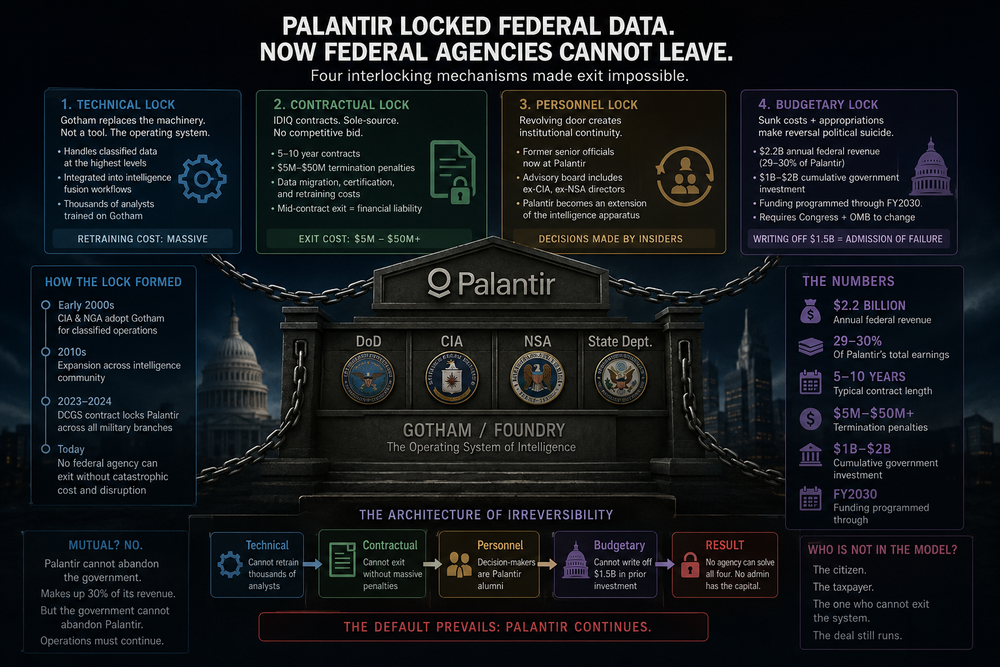
Palantir's federal business kept growing in 2025 while DOGE was terminating contracts with other major federal IT vendors. The Treasury Department canceled 31 Booz Allen Hamilton contracts worth about $21 million, citing a data security breach. The GSA directed agencies to review the top ten consulting firms for potential termination. Consulting firms can be fired. Palantir was not. What distinguishes Palantir is the combination that makes separation structurally different from termination: intelligence-community origin, a judicial precedent that enforced evaluation of commercial products, and a cross-agency data integration role that no other contractor holds simultaneously.
How the Lock Was Built
The In-Q-Tel model is straightforward. The CIA identifies a technology need, funds a private company developing a relevant product, and that company gains the intelligence community as its first reference customer before any public market exists. Palantir's founding chairman Peter Thiel remains one of its best-known shareholders, in a company that took about 55 percent of its 2024 revenue, $1.57 billion of $2.87 billion, from government customers. That gives him a direct financial interest in each contract renewal. That interest was not incidental to the founding. It was built into the structure from the start.
In 2016, Palantir took the Army to court. After the GAO rejected its protest, Palantir sued in the U.S. Court of Federal Claims, arguing that the Army had failed to consider its commercially available battlefield data system before deciding to build a competing system of its own. Palantir won. On September 13, 2018, the Federal Circuit unanimously upheld the ruling, finding that the Army had "excluded commercial items from consideration in a conclusory fashion." The ruling created no Palantir-specific obligation. It enforced a 1994 statute requiring agencies to look at commercial products first. But the cost and delay of litigation create a structural incentive to include Palantir in every relevant procurement. In March 2019, Palantir beat Raytheon for the Army's DCGS-A intelligence contract, valued at $876 million. In March 2024, the Army awarded Palantir the TITAN targeting ground station prototype, worth $178.4 million. Palantir had sued the Army, won, and then won the Army's business in the domain the lawsuit had been about. The switching cost created by the ruling is not only technical. It is judicial.
In 2020, at the start of the pandemic, NHS England brought Palantir in to build its COVID-19 data store, first for £1, then in December 2020 under a £23 million contract awarded without competitive tender. Only the threat of a legal challenge produced a promise not to extend it without consultation. In November 2023, after a formal tender, Palantir won the seven-year, £330 million Federated Data Platform as the incumbent whose software already ran the use cases. Critics argued the competition could not be level. The public-tender requirement exists to prevent exactly this outcome. The emergency exemption from tender in 2020 built the head start that the tender of 2023 did not undo.
The pattern repeats across jurisdictions because the mechanism does not depend on any single contract clause. ICE awarded Palantir a $41 million contract for its Investigative Case Management system in 2014, and the system became part of the operational architecture of immigration enforcement. Each renewal extended the integration. Each extension increased the switching cost. The lock is not written into any contract. It accumulates between them.
Palantir did not only win contracts. It accumulated dependencies that made the next competition harder to lose.
The IRS, DOGE, and Immigration Operating System
In April 2025, Palantir employees were embedded at the IRS alongside DOGE staff to build what internal communications described as a "mega API": a single access point to all IRS databases, consolidating taxpayer names, Social Security numbers, tax returns, employment records, and bank information into one queryable layer. On June 17, 2025, ten congressional Democrats wrote formally to Palantir arguing that the project "blatantly violates the notice, transparency, and procedural requirements of the Privacy Act" and likely violates post-Watergate statutes specifically enacted to prevent the weaponization of taxpayer data. Palantir rejected what it called "myriad false accusations" and denied building a master database. The congressional questions came after press reports about the project, not before the work began.
"Blatantly violates the notice, transparency, and procedural requirements of the Privacy Act.", Ten congressional Democrats, letter to Palantir, June 17, 2025
Peter Thiel gave $1.25 million to support Donald Trump in 2016 and spoke at that year's Republican convention; in 2023 he said he would not fund candidates in the 2024 election. DOGE was created by executive order on January 20, 2025. It operates as an advisory body inside the executive branch, and its data-access arrangements have not been explained in any public document reviewed as of the time of this writing. The company at the center of its IRS data project is the one whose founding chairman was an early and prominent backer of Trump.
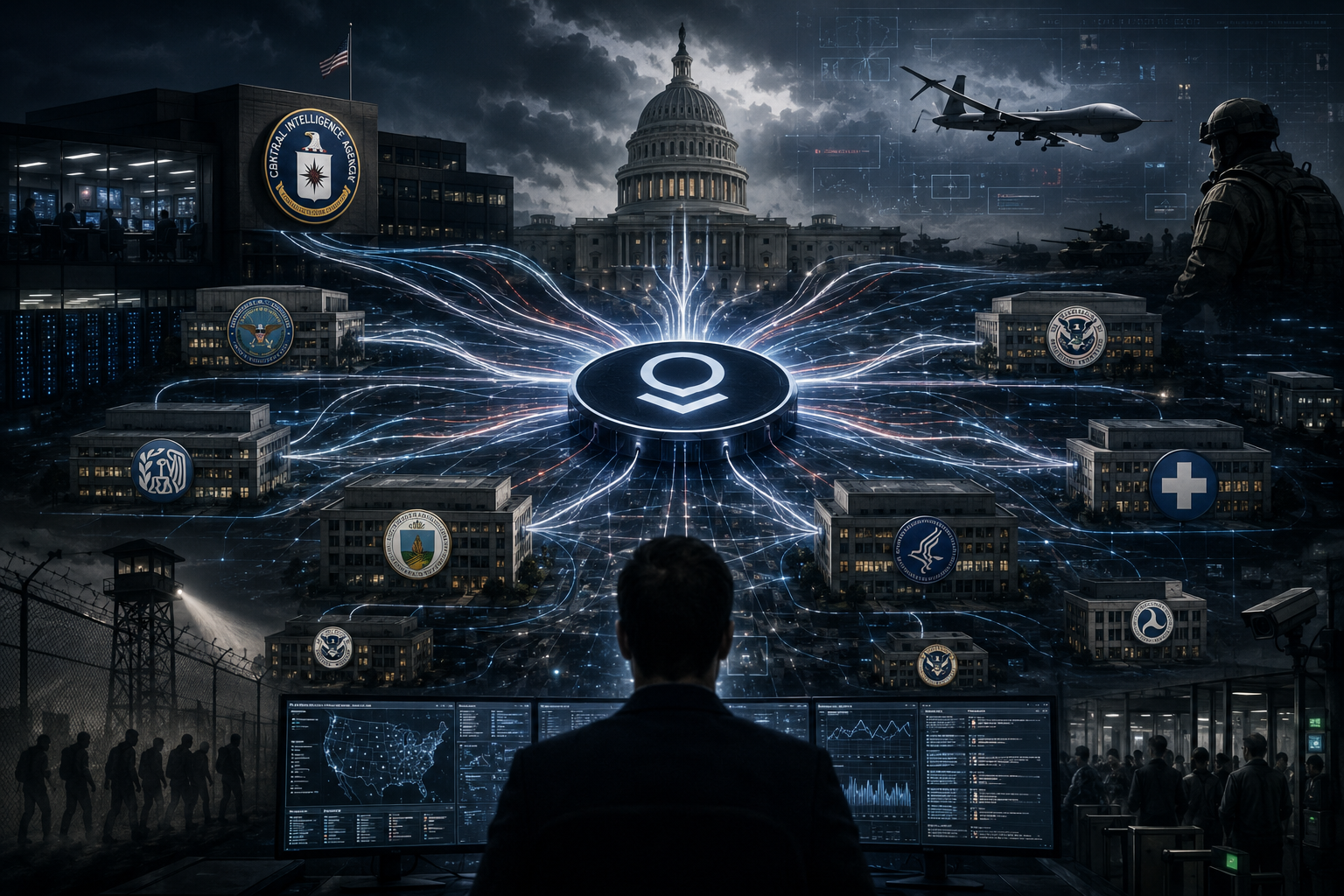
ICE awarded Palantir $30 million to build the Immigration Lifecycle Operating System, ImmigrationOS, designed to track self-deportations, select arrest targets, and process deportation pipelines. In February 2026, the Department of Homeland Security issued a five-year blanket purchase agreement worth up to $1 billion that lets CBP, ICE, FEMA, and CISA order Palantir deployments without a separate competition for each. In April 2026, the Department of Agriculture added a $300 million contract for its farm data and food security program. Palantir is now part of the federal data architecture for immigration enforcement, military targeting, taxpayer records, health data, and agricultural policy simultaneously.
The company that would be hardest to remove from the federal data infrastructure now provides the infrastructure for the effort to restructure the federal government.
What the Language Conceals
"Data integration." "Predictive analytics." "AI-enabled targeting." "Immigration lifecycle management." Each phrase is technically accurate. None describes what the function is built on, who owns it, or what the outputs determine. Palantir's immigration systems help decide whom enforcement pursues. The software is proprietary. An individual flagged by it has no legal mechanism to examine the algorithm, challenge the data inputs, or determine whether the algorithm has been audited for bias. ImmigrationOS extends the same architecture to the next generation of enforcement decisions. The New Orleans predictive policing deployment ran for six years without public disclosure before The Verge uncovered it in 2018. It had been set up through the mayor's office as a pro bono arrangement, and city council members said they had not known what it involved.
The scrutiny that does exist arrives late. In Britain, the COVID contract was challenged only after it had been signed, and by the time of the 2023 tender the incumbent's software already held the use cases. At the IRS, the questions came after the press reports. The audits arrive after the dependency is established. The dependency does not dissolve when the audit identifies it.
The semantic substitution runs in both directions. "Data analytics" replaces "surveillance." "Government efficiency" replaces "private ownership of state decision infrastructure." "Immigration lifecycle management" replaces "algorithmic arrest selection with no public audit mechanism." The language that describes what Palantir does is consistently less precise than the contracts that govern how it does it. The contracts are specific. The language is general. That asymmetry is not accidental.
This is not data analytics. This is the private ownership of the infrastructure that generates government decisions about individuals.
The S-1 filing that Palantir submitted in 2020 described its government clients as the foundation of its business model. Its commercial clients, including BP, Airbus, Ferrari, and Morgan Stanley, purchase a version of the same infrastructure built for and proven by government use. The government built the architecture. The public funded its construction through contracts whose oversight has repeatedly trailed the deployment. Palantir owns the infrastructure. The critics identify the same pattern. The pattern continues.
Everyone is still watching the chatbots. The company running the infrastructure that processes the people watching them does not argue, does not summarize, and does not hallucinate. It integrates. It accumulates. It does not stop when an auditor identifies what it has built.
The architecture accounts for every actor in this system. The public is not one of them.
What you just read documents one mechanism. The architecture it belongs to spans three years of forensic research, 261 interconnected pieces, and a cross-referenced evidence trail that makes the pattern increasingly difficult to dismiss. The further in you go, the harder it becomes to look away. The full archive is at themanifestarchive.com.
Related from The Manifest Archive