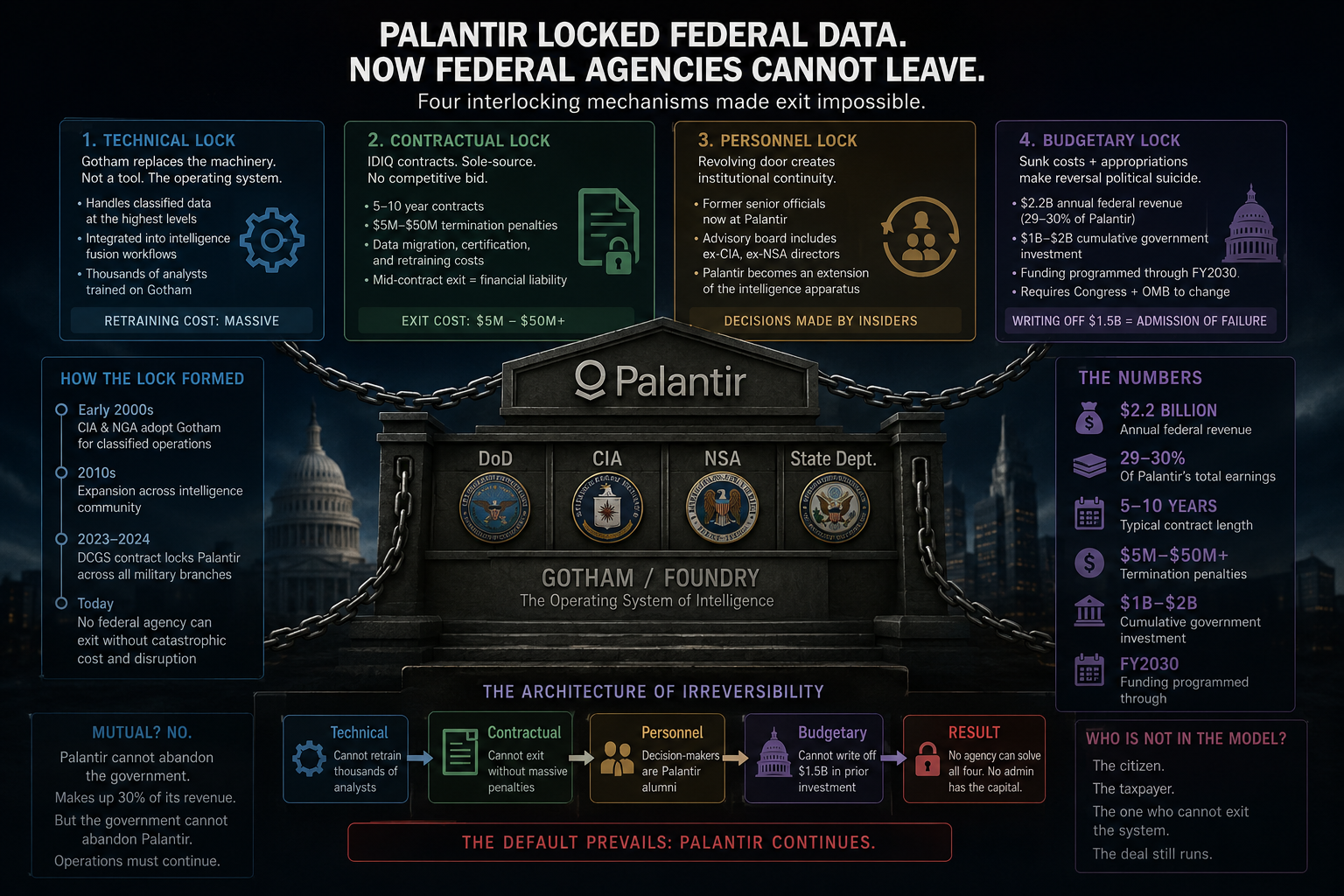
Somewhere in a federal acquisition office, a contracting officer is doing a calculation that never appears in any budget document. The question is not whether a competing platform exists. Competing platforms exist. The question is what it would cost to leave the one the agency already runs on. Retrain the analysts who have spent years inside it. Migrate the datasets configured to its architecture. Re-accredit a new system for classified work, a process measured in years. Absorb the gap while intelligence still has to flow. The officer runs the numbers, and the recommendation writes itself, not as a choice but as an admission of failure. So the renewal goes through. Nobody decided to stay. Leaving simply cost too much to propose.
This is the part of the Palantir story that gets missed, because attention goes to the wrong variable. Most coverage asks what Palantir can do: the surveillance, the data fusion, the artificial intelligence, the contracts with the agencies that watch people. These are real and worth asking about. But capability is not what determines the outcome. The determining variable is exit cost. Palantir's position inside the American state did not become formidable because the software is powerful. It became formidable because leaving got expensive, and then kept getting more expensive, until for the systems that matter most the option to leave quietly stopped being an option anyone could afford to choose.
There is a name for what happens to a relationship when one party loses the ability to walk away. The economist Albert Hirschman described every member of any organization or customer of any supplier as holding three possible responses to decline: exit, voice, and loyalty. You can leave. You can stay and complain. Or you can stay and comply. The three are not equal, because the first one disciplines the other two. Voice is only powerful when exit is credible. A customer who can leave is courted. A customer who cannot leave is managed. The entire question of Palantir's relationship with the federal government comes down to what has happened, slowly and legally and in plain view, to the government's exit.
The Option That Disappears
Begin with what exit cost actually is, because it is the hinge of the whole argument and it is widely misunderstood as a technical detail.
When a company adopts ordinary business software, an accounting package, an email system, a customer database, the data and the tool stay separate. The tool changes; the data remains and moves to the next tool. Switching is annoying and expensive, but it is a project with an end. This is the normal condition of a market. Suppliers compete because customers can defect, and the permanent possibility of defection is what keeps a supplier honest about price and quality.
Now change one thing. Make the tool and the data inseparable. Build the analysts' workflows, their training, their daily habits of seeing, into the platform itself, so that the platform is not where the work is stored but how the work is done. Configure the datasets to the platform's architecture so deeply that extracting them is no longer a copy operation but a reconstruction. Do this for classified systems, where any replacement must be certified for security from scratch before it can touch live intelligence. Now switching is not a project with an end. It is a multi-year reconstruction of the machinery of analysis, undertaken while the analysis cannot stop. The exit did not close. It became too expensive to use, which for practical purposes is the same thing.
Ivan Illich had a phrase for the moment a tool crosses this threshold. He called it a radical monopoly: not the familiar monopoly of one brand beating its rivals, but the deeper condition in which a particular way of doing something becomes the only conceivable way, so that people no longer choose it, they simply depend on it. A radical monopoly does not need to forbid alternatives. It only needs to make the alternative unthinkable in practice, and it achieves that not by being banned but by being woven so far into the routine that removing it would mean rebuilding the routine. Palantir's federal platform, for the systems built around it, has crossed into exactly this condition. The competitors are not forbidden. They are simply no longer reachable from where the government now stands.
The vendor that wins a contract gains influence. The vendor that raises the cost of leaving gains something more durable than influence, and it does not even require winning every year. It requires only that the cost of the alternative stay higher than the discomfort of staying.
Watch what happens to the other two options once exit is gone. The government still has voice. It can audit, complain, demand better terms, threaten, hold hearings, commission reports. But voice is only as strong as the exit standing behind it, and a customer who cannot credibly walk away is negotiating with an empty hand. The complaint that cannot become a departure is just a complaint. So the relationship slides, quietly, from the first of Hirschman's options to the third. What remains when exit is priced out and voice is hollow is loyalty, which in this context is not affection but the absence of any alternative dressed up as a settled preference. The agency stays, renews, defends the choice, and calls it the rational thing to do, because at the point where it is standing, it is. The cage does not feel like a cage from inside. It feels like good judgment.
How a Tool Becomes the Only Tool
The story did not begin with dominance. It began with a two-million-dollar bet by the Central Intelligence Agency.
In the years after the September 11 attacks, the CIA's venture-capital arm, In-Q-Tel, invested roughly two million dollars in a young company building data-integration software, and for a period the agency was effectively the company's only customer. This origin matters less as a tale of secret beginnings, which is how it is usually told, than as the first turn of the mechanism. The platform was shaped, from the start, around the specific problem of fusing classified intelligence streams that no commercial product was built to touch. It grew up inside the agencies, learning their data and teaching them its workflows at the same time. By the time anyone might have asked whether there should be a competitive market for this function, the function had already been built around one tool.
Inside the Defense Department, the clearest case is the Army's intelligence system, the Distributed Common Ground System-Army. After years of dispute, including a lawsuit the company brought against the Army in 2016 to force it to consider commercial options at all, Palantir won a place in that system through competition: a first increment with a ceiling near 876 million dollars in 2018, a second worth around 823 million dollars in the following years, with its Gotham platform deployed as the analytical core. Note that these were competitions, and the company won them. That fact will matter later, because it is the strongest argument against the thesis of this chapter, and an honest argument has to meet its strongest opponent rather than its weakest.
But winning a competition to be adopted is not the same as remaining escapable after adoption. The two are different events separated by years, and the second is where exit cost does its work. Once Gotham becomes the system through which an organization's analysts see, the analysts' competence is now partly competence in Gotham. Their training is Gotham training. The institutional muscle memory, the years of accumulated fluency in one interface and one logic of analysis, is not portable. A rival platform might be better and cheaper and still lose, because the cost of switching is paid in retraining and disruption and risk, while the cost of staying is paid in nothing the budget can see. The tool became the only tool not by defeating the others but by becoming the thing the people already knew.
The Contract as Corset
The legal form of the relationship deepens the same pattern, and here it is important to stay strictly with what the public record supports, because this is the terrain where confident-sounding invention is easiest and most tempting.
Palantir's federal work typically runs through multi-year, single-award contracts, often awarded sole-source for specialized or classified functions on the justification that only one contractor can deliver the required integration. The phrase that recurs in the procurement record is telling. When Immigration and Customs Enforcement awarded Palantir a thirty-million-dollar contract in April 2025 to build a system it called ImmigrationOS, the award was sole-source, justified on the ground that Palantir was the only source able to deliver it in the time required. Read that justification as what it is: an official statement that, for this function, the market has already narrowed to one. The sole-source finding is not a scandal. It is the government writing down, in its own procurement language, that exit no longer exists for this task.
The structure of the purchase reinforces it. The government does not buy the software. It buys access to it, a license or subscription to use a platform whose code and intellectual property remain the vendor's. It cannot take the code, modify it freely, or carry it to another provider. The practical switching costs that follow, the retraining, the data migration, the re-accreditation of any replacement for secure work, are real and large, and they do not need to be inflated with invented penalty figures to be decisive. They are decisive at their true size. A contracting officer does not need a fifty-million-dollar termination clause to choose continuity. The ordinary, documented friction of replacing an integrated classified platform is already more than any single officer's budget or career can absorb in a single year.
The contract is not secretly punitive. It is openly binding. Every constraint in it is visible to anyone who reads it. That visibility is precisely why the lock is so effective: there is nothing hidden to expose, no clause to strike down, only a structure that everyone can see and no one can individually move.
The Consolidation
In the summer of 2025 the pattern stopped being implicit and became, briefly, legible in a single document.
The Army announced an enterprise agreement with Palantir with a ceiling of up to ten billion dollars over ten years, and its central feature was not the size but the consolidation. The agreement folded roughly seventy-five separate contracts into one. Dozens of distinct procurement relationships, each in principle a separate decision with its own renewal and its own possibility of going a different way, were collapsed into a single channel through a single vendor. Each of those seventy-five contracts had been, however theoretically, a place where the government could have chosen differently. After consolidation there is one place, and it does not lead anywhere else.
This is the structure the engineer Nassim Taleb would recognize as a single point of failure: a system reorganized for efficiency in a way that quietly removes its own redundancy. Seventy-five contracts are clumsy and expensive to manage, and folding them into one is, on the spreadsheet, simple good sense. It is also the act of building a system with one load-bearing column. The efficiency is real. So is the fragility it creates, and the dependence, because a hundred small relationships can each be exited one at a time, while a single consolidated one cannot be exited at all without bringing down everything that was folded into it. Consolidation converts many reversible decisions into one irreversible one. That is the moment exit cost stops being a friction and becomes a wall.
Efficiency is the most respectable way to build a dependency, because no one in the chain is doing anything wrong. They are each removing waste. The wall assembles itself out of sensible decisions.
The Data Layer
The deepest version of the mechanism is not about any single agency's software. It is about the data itself, and here the record must be read carefully, because the strongest claims are contested.
In March 2025 the administration issued an executive order directing the elimination of data silos between federal agencies, the walls that have long kept the Internal Revenue Service's information separate from the Social Security Administration's, and both separate from the immigration and security agencies. Reporting in the months that followed, most prominently by The New York Times at the end of May 2025, described Palantir as the contractor being turned to for the work of integrating that data across agencies, with new federal engagements reported in the range of a hundred and thirteen million dollars and discussions underway with the tax and social-security agencies. The company responded forcefully, denying that it was building any single master database of Americans and calling the characterization untrue.
Both the reporting and the denial belong on the page, because the mechanism does not actually depend on resolving the dispute. The structural point holds regardless of intent. Whoever performs the integration of a state's data becomes, by that act, the layer through which the state's information flows, and an integration layer is the single hardest thing in any system to remove, because everything downstream has been rebuilt to assume it. You can replace an application. You cannot easily replace the connective tissue into which a hundred applications now feed. The question of whether anyone intends a master database is a question about motive. The question of exit cost is a question about structure, and the structure of an integration layer is that it raises the cost of its own removal toward infinity as more systems come to depend on it. That is true whether the integrator is benevolent, neutral, or something else. Intent is not the variable. Position is.
The Layer That Learns
There is a newer turn of the mechanism that makes every earlier turn deeper, and it arrived with artificial intelligence.
Palantir's platform now includes a layer built to apply machine-learning models to the data flowing through it, marketed since 2023 as its artificial-intelligence platform. Set aside the question of how capable these models are, which is contested and beside the point. Consider only what they do to exit cost. A model is not shipped finished. It is trained, and it improves by being trained on the specific data of the specific organization that runs it, learning that agency's patterns, that agency's history, that agency's particular world. The longer it runs, the more it is shaped by the data it has seen, and the more it is shaped, the less any replacement can match it without seeing the same data over the same years. The value is not in the model. It is in the accumulated training, and the accumulated training is the single least portable thing yet devised.
This is the integration trap raised to a higher power. With an ordinary platform, leaving meant migrating data and retraining people. With a model trained on years of an agency's own data, leaving means abandoning the accumulated learning itself, which cannot be exported to a competitor because it is not a file. It is a history. A rival could be handed the same raw data and would still arrive years behind, because it would have to live through the same training the incumbent has already completed. Each day the model runs, the gap a challenger would have to close grows by a day. Exit cost, which integration made high and consolidation made structural, the learning layer now makes self-deepening, rising automatically with the mere passage of time, without anyone lifting a finger to raise it.
The Revolving Door, Without the Myth
There is a human channel that runs alongside the technical and contractual ones, and it has to be described precisely, because it is the part of the Palantir story most often inflated into fantasy.
The inflated version populates the company with named spies and secret directors, a shadow government in corporate dress. That version collapses on contact with the record, and reaching for it is a mistake, not because it is too bold but because it is false and unnecessary. The real pattern needs no invented personnel. The company's co-founder has held repeated high-level access to incoming administrations through transition roles, which is documented and public. More importantly, an ordinary career incentive runs in a loop that requires no conspiracy at all. An analyst at an intelligence agency advances by mastering the platform the agency runs on. That mastery becomes a credential. The credential has an obvious market, which is the company that makes the platform, and which values former government specialists precisely because they understand the classified workflows and speak the bureaucratic language of the agencies that buy the product. People move along that gradient because the gradient is there, not because anyone is corrupt.
The effect, accumulated over two decades, is that the people most fluent in the platform and the people responsible for deciding whether to keep it are drawn from the same pool, formed by the same tool, fluent in the same assumptions. No one has to be bribed. No oath has to break. The alignment is produced by career structure, the way water is shaped by the riverbed. This is the banality that the conspiracy version cannot see, because it is looking for villains, and the actual mechanism has none. It has incentives, and incentives do not need to meet in a room.
Why This Is Not a Conspiracy
It is worth saying plainly, because the subject attracts the opposite claim like almost no other. There is no secret hand here, and the absence of one is the whole point.
Friedrich Hayek spent his career on the distinction between what is designed and what merely emerges, and warned against the reflex of seeing a designing mind behind every ordered outcome. Most of the structures that govern us were not planned by anyone; they grew, decision by decision, each step locally reasonable, into an order no one chose as a whole. Palantir's position is an emergent order of exactly this kind. No one sat down and designed a cage. An agency adopted a tool because it solved a real problem. Analysts trained on it because it was what they had. Contracts consolidated because consolidation saved money. Careers cycled because the incentives pointed one way. Each step was defensible on its own terms, and the sum of the defensible steps is a dependence that no one defends because no one chose it. To call this a conspiracy is to credit it with an intention it never required. It is worse than a conspiracy, in a sense, because a conspiracy can be exposed and broken, and an emergent structure has nothing to expose. It is all surface. The contracts are public, the personnel moves are observable, the budgets are appropriated in the open. The capture is visible, and visibility has not loosened it at all.
The Mechanism Is Older Than the Software
None of this is new in kind. It is new only in what it has reached.
The state has always become dependent on whoever supplies its means of power. The monarch who relied on a particular gunsmith, the navy that relied on a particular yard to build its ships, the air force that came to rely on a handful of aircraft manufacturers, each was bound to its supplier by the same logic that binds an agency to its software today. The modern American defense base is a small number of prime contractors, and for many major systems there is effectively one source, because the knowledge and tooling required to build a given platform exist in only one firm. Sole-source dependence on a prime is the ordinary condition of defense procurement, not an aberration. The government has spent two centuries learning that the supplier of its most complex instruments acquires a hold over it that no contract clause fully captures.
What has changed is the location of the dependence. The older versions bound the state to the makers of its hardware: the hull, the airframe, the engine, things that at least sit in an inventory and can be counted, mothballed, or in principle rebuilt by someone else given time. The dependence has now moved up a layer, from the instruments of force to the cognition that directs them, from the machine to the system through which the machine is understood and tasked. A warship can be decommissioned. The analytical platform through which a generation of analysts learned to see cannot be decommissioned without decommissioning the seeing itself. The longue durée pattern is the same, the supplier of the decisive instrument acquires power over the buyer, but the decisive instrument is no longer a thing. It is a way of processing the world, and a way of processing the world is far harder to replace than any object, because it has no spare part and no salvage value. It exists only as long as the people trained in it keep using it, which means replacing it requires replacing them, or retraining them, which is the most expensive substitution of all.
The Same Logic Outside Government
Lift the case out of Washington for a moment, because the mechanism is general, and seeing it elsewhere is what proves it is structural rather than a story about one company's character.
A hospital that has run its records on a dominant electronic health system finds, after a few years, that it cannot change. The clinicians are trained on it, the workflows are built around it, the historical patient data is configured to it, and switching would mean retraining every doctor and nurse and migrating decades of records while care continues without pause. The cost is not the software license. It is the reconstruction of how an entire institution works. A corporation that has built itself on a single enterprise-resource-planning system finds the same wall when it contemplates leaving, which is why those systems, once installed, are kept for decades regardless of dissatisfaction. A company that has moved its operations into one cloud provider discovers that the data it can put in cheaply is expensive and slow to take out, and that the convenience of integration was also the construction of a wall. In every case the pattern is identical. Adoption is a market choice, made among competitors. Exit, a few years later, is not, because the thing that was adopted has become the thing everything else now depends on.
This is why the Palantir case is not an indictment of one firm but an instance of a law. Exit cost is how durable power is built in an information economy, by every sufficiently embedded platform, in hospitals and corporations and governments alike. But the government instance is the sharpest, for a reason the commercial cases lack. A dissatisfied corporation can, at great cost, still choose to leave, and it bears its own costs when it stays. A hospital answers, in the end, to patients who can sometimes go elsewhere. The government is different on both counts. Its exit costs are paid by the public, not by the officials who incur them, and behind the government stands a party with no exit of any kind. A citizen cannot switch states the way a company switches vendors. When the state's dependence is contracted, the dependence is contracted on behalf of people who were never party to it and cannot leave it. The general mechanism is the same everywhere. Only in the government case does it reach all the way down to someone who has no say and no door.
The Steelman
The strongest objection to everything above does not dispute a single fact. It disputes the word irreversible, and it has the record on its side, which is why it has to be taken seriously rather than waved off.
Palantir, the objection runs, is not a vendor that was handed a captive government. It is a vendor that had to fight its way in. It sued the Army in 2016 for the right to compete at all, and won. Its major defense contracts were competitions, and it won them against established rivals. As recently as 2025, when a different agency proposed to award a system sole-source to a competitor, it was Palantir that filed the challenge, demanding that the work be opened to competition. A company that repeatedly goes to law to force markets open is a strange villain for a story about closed exits. And if Palantir holds its position because its product is genuinely the best available, then the moment a better product appears, the government can switch, and the supposed cage was never a cage but simply the rational preference for the leading tool. Superiority, on this reading, explains everything, and exit cost explains nothing.
This objection is correct about more than it is wrong about, and the honest response is to narrow the claim rather than defend an overstatement. Palantir's adoption was largely earned, and superiority does explain why it was chosen. But being chosen and being escapable are different properties, established at different times, and the second does not follow from the first. A tool can be adopted on its merits and then become hard to leave for reasons that have nothing to do with merit, because exit cost is built by integration and consolidation and training and accreditation, not by quality. The right word is therefore not irreversible. It is entrenched, and entrenching, with the exit cost rising as each new system folds in. The claim of this chapter is the narrower and more defensible one: that the government's ability to leave has been shrinking, deliberately in some cases and accidentally in most, and that for the consolidated and classified systems it has shrunk close to the vanishing point. The claim is not that exit is impossible. It is that exit is being priced out of reach, and that the pricing, not the capability, is what to watch.
This also names the condition under which the chapter would be wrong. If a future re-competition displaced Palantir from a flagship system, if an agency successfully migrated off the platform and proved the exit real, the thesis would be falsified, and it should be. The argument is testable, and the test is exactly the kind of event the procurement record will or will not produce in the coming years.
Mutual Imprisonment, Made of Asymmetry
There is a temptation to soften all this by noting that the dependence runs both ways, and it does, but the symmetry is an illusion worth dismantling.
Palantir is now bound to the federal government as tightly as the government is bound to it. The government segment is the larger share of the company's revenue, which reached roughly four and a half billion dollars in 2025, with the government portion above two billion and growing faster than the commercial side. Losing the federal relationship would gut the company. So the two are locked together, and it is tempting to call this a balance of dependence, a mutual hostage situation in which neither can afford to harm the other.
But look at where each party can go. Palantir can diversify, and is visibly doing so, expanding into commercial markets, allied governments, new sectors, building other places to stand. The government has no such move. Its intelligence cannot pause. Its data cannot un-integrate. Its analysts cannot un-learn the platform on which they were trained. One party to this marriage is building exits in every direction. The other has been folding its exits into a single channel and calling it efficiency. The dependence is mutual. The capacity to escape it is not. That asymmetry, not the dependence itself, is the actual distribution of power in the relationship, and it runs the opposite way from what the word vendor implies.
What Runs Without Anyone Choosing It
Return to the contracting officer at the start, running the calculation that always comes out the same way. Notice that no one in this story is the villain, and the outcome arrives anyway. The agency that adopted the tool was solving a problem. The analyst who mastered it was building a career. The official who consolidated the contracts was saving money. The company that fought to compete was, on the record, fighting to compete. Every actor behaved reasonably, and the sum of the reasonable behavior is a state that has quietly mortgaged its own ability to choose differently, in the systems that matter most, to a single private firm, in full public view, with no one having decided that this should be so.
The deepest form of power is not the power to make others act. It is the power to make the alternative too expensive to reach, so that others keep choosing you without ever feeling chosen. A vendor with that power does not need to win every argument or even most of them. It needs only to keep the cost of leaving higher than the discomfort of staying, and to let consolidation and integration and time do the rest.
The architecture accounts for every actor in it. There is one it does not account for. The citizen whose data moves through the integration layer did not choose the vendor, cannot read the classified terms, and has no exit of any kind from a dependence contracted on their behalf. The agencies at least had an exit once, before they priced it away. The public never had one. The deal runs without end, and it runs without them. They are not in the model.
Evidence Map
Facts, interpretations, forecasts, and disconfirming signals.
Core claim. The federal government's dependence on Palantir is best explained not by the platform's capability but by exit cost: through technical integration, sole-source contracting, contract consolidation, and data-layer integration, the cost of leaving has risen until, for the most critical systems, the option to exit has been priced close to out of reach. This is Hirschman's loss of exit, not an irreversible cage.
Evidence level. Facts: high. Documented: In-Q-Tel's early investment in Palantir (circa 2005); the Army DCGS-A awards (a roughly 876 million dollar first increment in 2018, a roughly 823 million dollar second) won competitively, including after Palantir's 2016 lawsuit against the Army; the April 2025 sole-source ICE ImmigrationOS contract (about 30 million dollars), justified on an only-source basis; the 2025 Army enterprise agreement with a ceiling up to 10 billion dollars consolidating roughly 75 contracts; the March 2025 executive order on federal data silos and the subsequent reporting (New York Times, May 2025) on Palantir's data-integration role, alongside Palantir's explicit denial of building a master database; FY2025 revenue near 4.5 billion dollars with government the larger and faster-growing share. Interpretation: medium. Reading exit cost as the determining variable, and integration/consolidation as the mechanism that prices out exit, is an analytical conclusion drawn from these facts.
What would confirm this. Further sole-source justifications citing single-source necessity; additional consolidations of multiple contracts into single vendor channels; agencies reporting inability to migrate off the platform within a budget cycle.
What would disprove this. A successful re-competition that displaces Palantir from a flagship system, or an agency that migrates off the platform and demonstrates that exit remains practically available. Such an event would show the position is entrenched but not exit-proof, and would falsify the strong form of the claim.
Watchlist. Whether contract consolidation continues or reverses; the outcome of any future re-competition of a Palantir-run system; whether the federal data-integration effort expands across additional agencies. Review over the coming years as these procurements come up for renewal.
Related from The Manifest Archive