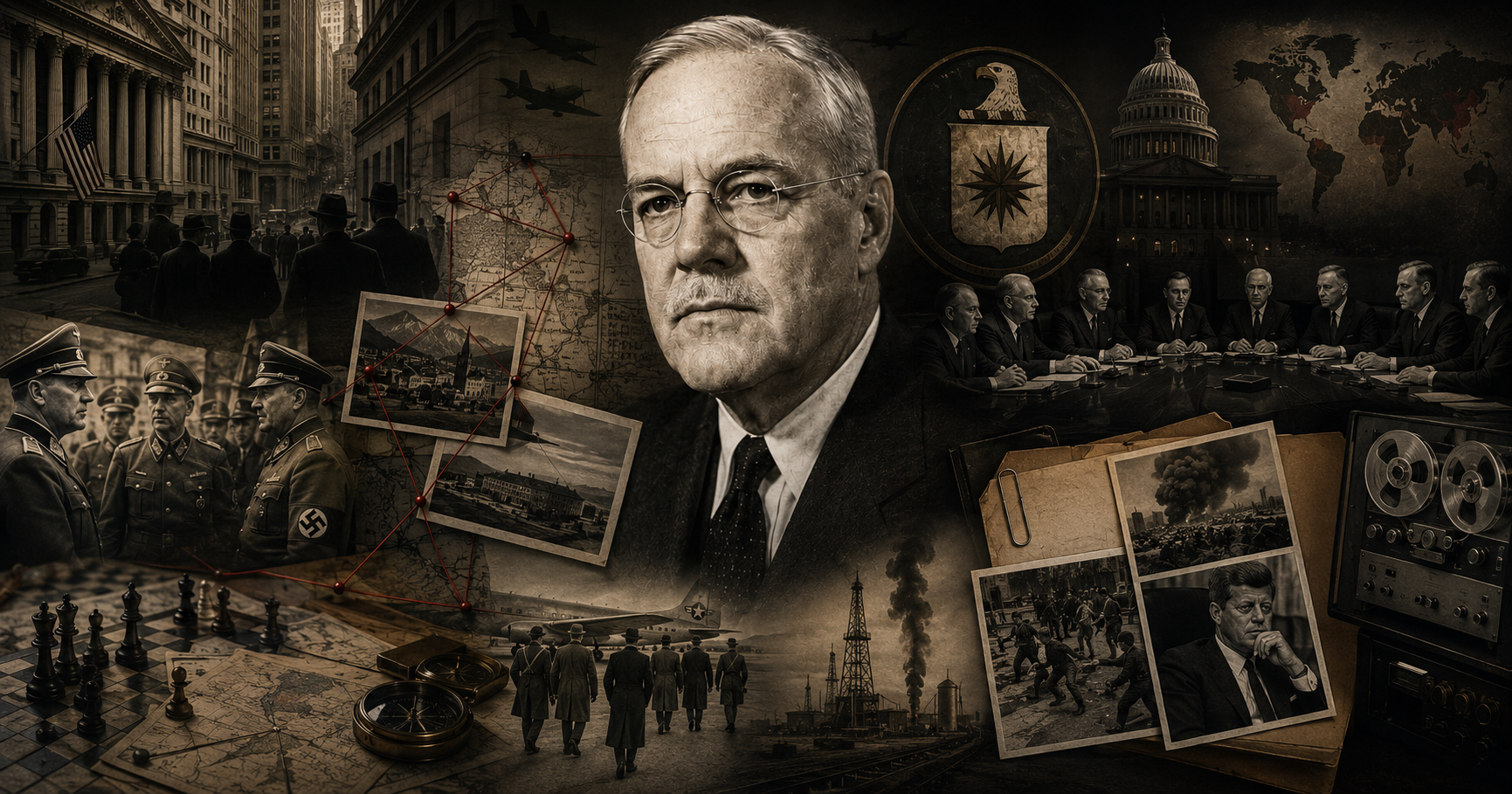
The visible story is one man's career. The determining structure is the unaccountable intelligence architecture he built, which outlived him and never once changed its client.
August 19, 1953. Tehran. Allen Dulles was not in the city. He was on holiday in Switzerland, and the day before he had turned up in Rome, where he crossed paths with the fleeing Shah at the Hotel Excelsior, an encounter the CIA later described as coincidence. The operation's first attempt had collapsed on the night of 15 to 16 August; now the second was succeeding. Prime Minister Mohammad Mossadegh, who had nationalized the Anglo-Iranian Oil Company, would be out of office by nightfall. In April, Dulles had approved one million dollars for the operation.
Ten years later, Dulles would sit across from Chief Justice Earl Warren in a wood-paneled conference room in Washington. This time, they were investigating the murder of the president who had fired him.
The gap between those two moments is not a biographical anomaly. It is the architecture. The man is the visible story; the structure he built, the one that needed no enemy in particular and tolerated no accountability of any kind, is the thing this piece is actually about.
Sullivan & Cromwell
Allen Welsh Dulles was born in 1893 into a family for which power was hereditary. His grandfather, John W. Foster, served as Secretary of State under Benjamin Harrison. His uncle, Robert Lansing, served as Secretary of State under Woodrow Wilson. By the time Allen Dulles joined Sullivan & Cromwell in 1926, the pattern was already established: public office and private capital moved through the same men.
Sullivan & Cromwell was not merely a law firm. It was the primary legal architecture connecting American capital to European industry in the interwar period. Within a few years Dulles was working on the firm's German business, and it was large: Sullivan & Cromwell arranged American loans and bond issues for German companies in the 1920s and represented German industrial combines and their American affiliates. That world of clients, and the habits it taught, would follow him through the next thirty years of his career.
That business was ordinary corporate law in 1926. It stopped being ordinary after 1933, and how Wall Street handled its German ties after that date is where accountability first goes missing in this story. The clearest American example is not a Dulles client at all: on 20 October 1942, under the Trading with the Enemy Act, Washington seized the Union Banking Corporation in New York, whose shares were held for the Thyssen industrial empire through a Rotterdam bank. Among its directors was Prescott Bush of Brown Brothers Harriman, a future senator and the father and grandfather of two presidents. The bank was seized, the war was won, and none of its directors faced any consequence. The accountability that never arrived is the recurring character in this story, and it arrives early.
Sullivan & Cromwell did not drop its German business when Hitler came to power in 1933. The firm kept its offices in Germany until 1935, two years after the first concentration camps opened. The decision to close them was forced by the other partners, Allen Dulles among them, over the resistance of the firm's senior partner, his brother John Foster Dulles.
The counterargument is the standard one, and it deserves to be stated at its strongest. Representing Thyssen's American accounts in the late 1920s was routine corporate work, not ideological endorsement, and legal representation is not the same as alignment. The counterargument is real, and on the German offices Allen Dulles comes out of it better than his brother: he was among the partners who forced the firm out of Germany in 1935. The harder questions about him begin a decade later, in Bern.
Two facts about that firm matter for everything after. The first is the clientele: Sullivan and Cromwell structured the American business of German industrial combines, most consequentially the chemical cartel I.G. Farben, which part-owned Degesch, the company that held the patent on the Zyklon B later used in the death camps. The firm's business ran straight into the heart of German industry, and it did not hurry to leave it; Sullivan and Cromwell kept its German engagements going into the Nazi years and closed its German offices only in 1935, and not without dissent inside the partnership. The second fact is the family: Allen's older brother, John Foster Dulles, was a partner at the same firm, was in fact the partner who resisted closing those German offices in 1935, and would become Secretary of State under Eisenhower at the very moment Allen ran the CIA. For most of the 1950s the overt and the covert halves of American foreign policy were directed by two brothers from the same law firm, the diplomat and the spymaster, the public face and the hidden hand, coordinating across the dinner table what the government conducted across the world. The continuity of American power in those years was, quite literally, a family business.
OSS Bern: the architecture of access
In 1942, Dulles joined the Office of Strategic Services, the wartime precursor to the CIA. He was stationed in Bern, Switzerland, the neutral hub through which all European intelligence flowed during the war. From Bern, Dulles did not merely collect intelligence. He built relationships.
In January 1943, Dulles opened a channel to Himmler's intelligence apparatus, reaching the senior SS security officer Walter Schellenberg through an intermediary, Prince Max von Hohenlohe-Langenburg. Two years later, in the spring of 1945, he conducted direct negotiations with SS-General Karl Wolff about the surrender of German forces in Italy, in an operation called Sunrise. These negotiations bypassed the Soviet Union entirely. Stalin was not informed. When he discovered them through Soviet intelligence channels, he sent a furious cable to Roosevelt accusing the Americans of negotiating a separate peace.
The negotiations did produce a surrender: it was signed at Caserta on 29 April 1945, and German forces in Italy laid down their arms on 2 May, days before the general capitulation. But the surrender was not their only product. They also produced access. Dulles left Bern in 1945 with direct personal relationships inside the SS and German intelligence, and with knowledge of their networks. The war ended. The relationships did not.
Operation Sunrise
The clearest single instance of what Dulles did with that access came in the war's final weeks. From Bern he opened a secret channel to SS General Karl Wolff, the senior SS commander in Italy and once Heinrich Himmler's personal liaison, to negotiate the early surrender of German forces in northern Italy, an operation code-named Sunrise. The surrender was real and it saved lives. But the man Dulles dealt with was no ordinary soldier; Wolff had been deeply implicated in the machinery of deportation. In the dealing, he acquired a protector. Wolff was not prosecuted at Nuremberg, appeared there as a witness rather than a defendant, and lived in freedom for years, until a German court finally convicted him in 1964. Dulles had done, for one SS general and by personal arrangement, what the Joint Intelligence Objectives Agency would do for the scientists by paperwork: converted a man who should have faced a tribunal into an asset who did not. Sunrise was the template in miniature, run by the man who would later command the agency that industrialized it.
The Gehlen Organization
On May 22, 1945, Wehrmacht Generalmajor Reinhard Gehlen surrendered to the U.S. Army Counter Intelligence Corps at Fischhausen, Bavaria. Gehlen had served as chief of Fremde Heere Ost, Nazi Germany's Eastern Front intelligence operation, from 1942 to 1945. He arrived with something specific to trade: microfilmed copies of the entire Eastern Front intelligence archive, thousands of pages documenting Soviet military strengths, weaknesses, order of battle, and agent networks behind Soviet lines. In August he was flown to the United States for debriefing by the US Army, which ran him and his network for the next four years.
The deal was not complicated. Gehlen and his senior staff would not be prosecuted for their wartime activities. In exchange, Gehlen would rebuild his intelligence organization under American direction, targeting the Soviet Union. His staff, former Wehrmacht intelligence officers joined over time by former SS and SD men, would continue their work. The same men, the same methods, the same networks. Not for Hitler, but for the United States. The CIA did not inherit Gehlen's files. It inherited Gehlen's organization.
By 1946 the Gehlen Organization was operating in the American zone under US Army control. In 1949 the CIA took it over and funded it for the next seven years. In 1956 the organization was formally institutionalized as the Bundesnachrichtendienst, the BND, West Germany's federal intelligence service. Gehlen served as its first director until 1968. Former SS and SD officers were among the founding staff of the postwar German intelligence service. They were never prosecuted. They were never required to account for what they had done.
The arrangement was not even reliably effective, which is the detail that turns it from a hard bargain into an indictment of the bargain itself. The Gehlen Organization was penetrated repeatedly by the very Soviet intelligence it was hired to watch, most damagingly by Heinz Felfe, a former SS officer the organization had recruited who turned out to be working for Moscow and who, before his exposure in 1961, betrayed a large share of its operations and personnel to the KGB. The apparatus built out of unaccountable Nazi expertise was compromised by exactly the kind of man it was built out of, and still the funding continued and still no one answered for it, because the structure was never really being judged on whether it worked. It was being judged on whether it could be held to account, and it could not.
Gehlen was the largest case, but he was not the only one, and the others show it was a policy rather than an exception. Klaus Barbie, the Gestapo officer known as the Butcher of Lyon, responsible for the torture and death of thousands, was a paid informant of the same U.S. Army Counter Intelligence Corps from 1947, and when his past threatened to surface, American intelligence did not surrender him to French justice. It sponsored his escape, paying for forged documents and routing him down a ratline through Italy to Bolivia, where he arrived in 1951 and lived freely for three decades. He was not expelled from Bolivia to France until 1983, and was sentenced to life imprisonment in Lyon in 1987. The man who had tortured the French Resistance was protected by the same apparatus, for the same reason, as the SS officers who built the BND: he knew too much, and exposing him would have embarrassed the people who hired him. The pattern was not Dulles's invention alone, but it was the world he built and ran, and its rule was constant. Usefulness purchased immunity.
CIA Director: the authorization chain
In February 1953, President Eisenhower appointed Dulles as Director of Central Intelligence, the first civilian director in the agency's history. Within sixty days, Dulles had signed two authorizations that would define American covert operations for the next four decades.
On April 13, 1953, Dulles signed the authorization for Project MKUltra, the CIA's systematic program of research into mind control and behavioral modification. Over the following two decades, CIA-contracted researchers administered LSD, mescaline, barbiturates, and other substances to unwitting subjects in American hospitals, prisons, psychiatric facilities, and universities. Subjects were not informed. Consent was not obtained. At least one subject, CIA employee Frank Olson, fell to his death from a New York hotel window in 1953 in circumstances that remain disputed, days after being dosed with LSD without his knowledge. When MKUltra was partially declassified in 1977, it emerged that Dulles had personally reviewed and approved the program's framework. The authorization chain ran directly to his desk. The program was not small or marginal. As the 1977 Senate inquiry established, MKUltra ran through some one hundred and fifty subprojects spread across roughly eighty institutions, including dozens of universities, hospitals, prisons, and pharmaceutical companies, most of them funded through cut-out foundations so that the researchers themselves often did not know who the ultimate client was. The dosing of unwitting Americans was not a rogue excess at the edge of the agency; it was an organized, funded, decade-spanning program with a signature at the top. The reason so little of it can be reconstructed is also documented: in 1973, on the instruction of the men then running the agency, most of the MKUltra files were deliberately destroyed, which is why the program is known today mainly through the financial records that the shredding happened to miss.
Four months after the MKUltra authorization, on 19 August 1953, Operation Ajax, the CIA coup against Mohammad Mossadegh in Iran, succeeded at its second attempt. Dulles had approved its first million dollars in April. A democratically elected prime minister was removed. The structural consequence, which Dulles either did not calculate or did not consider, was the generation of Iranian political trauma that would produce the 1979 revolution and the decades of hostility that followed. The pattern was not a bug. It was the design.
In 1954, the same machinery toppled Jacobo Árbenz in Guatemala. Both brothers had ties to the United Fruit Company through Sullivan & Cromwell, which had represented it, and the company's interests and the coup's aims ran in the same direction. The authorization chain ran through the same office, on the same desk, and the conflict of interest that would end any ordinary public career was here simply a feature of how the office worked.
It is worth pausing on how concentrated that office had become. For most of the 1950s the two Dulles brothers ran American power between them: John Foster as Secretary of State, setting the public foreign policy, and Allen as Director of Central Intelligence, running the covert operations that policy required and rarely admitted. Diplomacy and its disavowable shadow were directed by two men who had been partners at the same law firm, raised in the same household, and shaped by the same clients. A coup could be argued at a family dinner and executed by an agency, and the line between the national interest and the interests of the firm's old accounts was, in those years, drawn by no one with any incentive to draw it.
The machine he built
By the time Dulles became Director of Central Intelligence in 1953, the access he had spent decades accumulating became operational doctrine. In his first two years the agency overthrew two elected governments that had done nothing to the United States except cross its corporate accounts and its Cold War map. In 1953, Operation Ajax removed Iran's elected prime minister after he nationalized the oil the West relied on. In 1954, Operation PBSuccess removed Guatemala's elected president after he threatened the land of the United Fruit Company, a company Sullivan and Cromwell had served. The lawyer who had spent the 1930s protecting American corporate interests inside difficult states now ran an agency that could remove the states instead. The continuity of clients across the two careers was not concealed; it simply had no one positioned to object.
The same period produced the agency's darkest internal program. In April 1953 Dulles personally approved MKUltra, the CIA's decade-long program of experimentation on human subjects, many of them unwitting, in the search for methods of interrogation and behavioral control. Its records were later deliberately destroyed on a successor's order, which is why its full extent can never be reconstructed. The point here is narrow: the same director who had shielded an SS general and toppled two elected governments also signed off on experiments the country's own later inquiries would condemn. None of it was rogue. All of it was authorized, by a man operating well inside his mandate.
The architecture was not only violent. Under Dulles the agency quietly funded a cultural and intellectual front, channeling money through foundations into magazines, conferences, student organizations, and the Congress for Cultural Freedom, so that a generation of writers and scholars advanced positions the agency favored without knowing who had paid for the platform. It was the same instinct as the coups and the cleaned files, turned on ideas: do not argue with the adversary's narrative, own the channel through which narratives travel. Dulles grasped, earlier than most, that influence over the conduit outlasts victory in any single debate.
Kennedy and the dismissal
In April 1961, the Bay of Pigs invasion failed catastrophically. Roughly fourteen hundred CIA-trained Cuban exiles landed at the Bay of Pigs and were defeated within seventy-two hours, most of them captured. Kennedy had inherited the operation from the Eisenhower administration. He cancelled a second round of air strikes, and the CIA's planners had never told him plainly that the landing could not succeed without them. Kennedy forced Dulles out in November 1961. The bitterness on both sides was lasting.
Kennedy removed Dulles from the institution. He could not remove Dulles from the architecture. Over the following two years, Kennedy moved toward positions that the men of that architecture found structurally threatening. He negotiated the 1963 Nuclear Test Ban Treaty with the Soviet Union. He opened back-channel communications with Castro. He signed National Security Action Memorandum 263 in October 1963, ordering the withdrawal of one thousand military advisors from Vietnam by year's end. Each of these positions represented a direct challenge to the infrastructure Dulles had spent thirty years building. On November 22, 1963, Kennedy was assassinated in Dallas.
The Warren Commission
Seven days later, President Lyndon Johnson appointed a commission to investigate the assassination. He appointed Allen Dulles as one of its seven members, placing the man Kennedy had fired, and who ran the agency with the deepest secrets about Cuba, inside the inquiry into Kennedy's death.
What Dulles knew, and did not share with the commission he sat on, was the CIA's program to assassinate Fidel Castro, which had been running since 1960 and which had contracted organized-crime figures to carry out the killing, later folded into the agency's executive-action capability known as ZRRIFLE. He knew the names of the mafia figures the CIA had used. He knew about the broader architecture of CIA operations against Cuba that the Warren Commission never examined. At one of the commission's first sessions he handed his fellow members a book on earlier attacks on American presidents, arguing that they had been the work of lone, disturbed men.
The commission did not find a conspiracy. What it did not examine is documented: the Castro plots and the organized-crime contacts behind them, which Dulles knew about and did not disclose; the commission was never told of them, as the Senate's Church Committee later found. The record is consistent with a commission that found what Dulles allowed it to find, and that is a claim about access and omission, not about who fired the shots, which remains unresolved. In 1979 the House Select Committee on Assassinations reached a more cautious but still different conclusion, judging on the acoustic evidence then available that the president was probably assassinated as the result of a conspiracy, while naming no conspirators.
The underlying files remain only partly open more than sixty years later. The 1992 JFK Records Act ordered the full release of the assassination archive, yet when the final deadline came in 2017 the sitting president released most of the documents but allowed agencies to withhold others on national-security grounds, and further releases in the years since have continued to arrive with redactions and gaps. The review never quite ends. The architecture holds.
The irony is structural, not incidental. In 1963 Dulles, fired by Kennedy two years earlier, was appointed by President Johnson to the commission investigating Kennedy's assassination, and there he sat in judgment of any lead that ran toward the agency he had built and that had every reason to resent the man who dismissed its director. He attended most of the sessions, helped shape which questions were pursued, and by several later accounts steered the inquiry away from the CIA's own operations and relationships, including those with the anti-Castro networks the agency had cultivated. Nothing here proves the agency had a hand in the murder, and this account asserts none. The documented point is simpler and damning enough on its own: the man who had run the CIA was placed on the panel examining whether the CIA had a role in killing the president who fired him, and no one positioned to prevent that arrangement treated it as a conflict at all. The architecture polices itself, which is to say it does not.
The architecture survives the architect
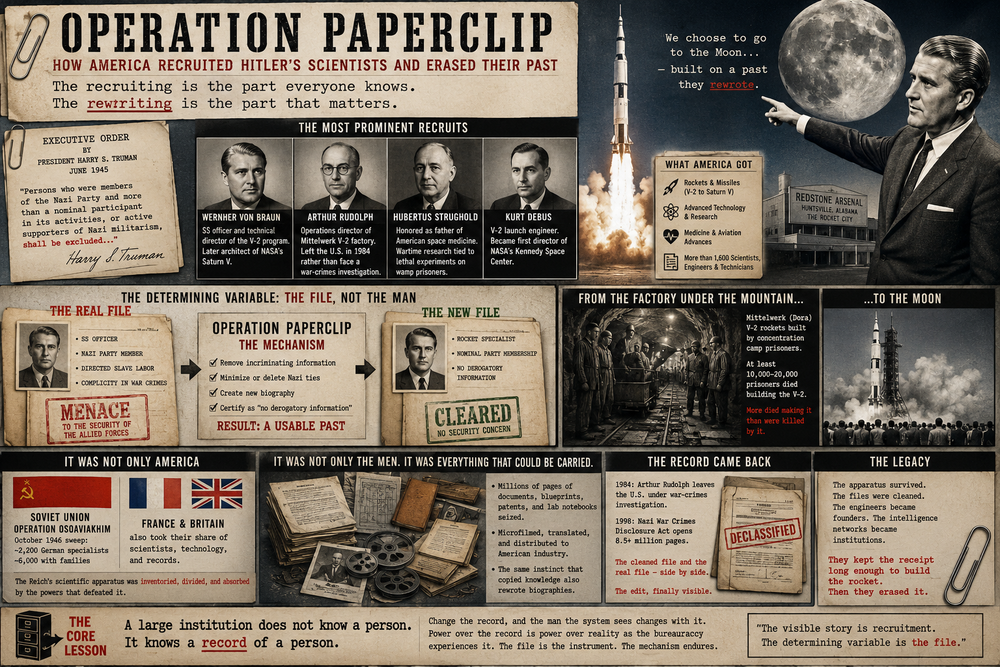
Dulles is the intelligence half of a story whose scientific half is told elsewhere in this archive. While the Joint Intelligence Objectives Agency was rewriting the files of von Braun and the rocket men, Dulles was building the networks that absorbed the Reich's spies, and the two streams fed the same institution. Operation Paperclip laundered the scientists by paperwork; Dulles laundered the spies by relationship; both were folded into the permanent American security state that outlived everyone who built it. He is the proof that the mechanism was never about any one kind of person. It was about the conversion of an enemy's apparatus into one's own, by whatever instrument the case required: a clean file for a chemist, a quiet channel for a general, a payroll for a network of officers.
Allen Dulles died on January 29, 1969. He died a respected figure. He was never prosecuted. He was never required to testify under oath about his Sullivan & Cromwell clients, his OSS negotiations with the SS, his recruitment of Nazi intelligence officers, his authorization of MKUltra, or his management of the Warren Commission.
The institutions he built outlasted him. The CIA's covert regime-change apparatus continued through Chile in the early 1970s and Nicaragua in the 1980s. The Gehlen Organization's framework became a template for later CIA relationships with a former adversary's intelligence service. MKUltra's methodology, the study of coercion and the breaking of the human subject, reappeared decades later in what the Senate Intelligence Committee documented in 2014 as the agency's enhanced-interrogation program, and there too, when the report finally appeared, no official was charged, the practices were renamed rather than repudiated, and the apparatus carried on. No one paid a price. Not for Iran, not for Guatemala, not for MKUltra, not for the Warren Commission, not for the SS officers who became the founding staff of an allied intelligence service, not for the war criminal escorted down a ratline to a comfortable exile. The architecture was built by men without accountability, and it has been maintained by institutions with the power to define what accountability requires. Power that answers to no one builds a structure to which no one can answer.
The client never changed. The seventy-year arc of American-Iranian hostility that produced the 2026 strikes runs back to the million dollars Dulles approved in April 1953. The authorization took one page. The consequence took three generations. The authorization was clean. The consequence was permanent. The man who signed it died honored, having never been required to explain the distance between the two.
That distance is the whole subject, and it points past Dulles to the thing he is only the clearest example of. The visible story is always a man, a coup, a program, a commission, each with a name and a date. The determining structure is an apparatus that selects whatever enemy the era offers, runs whatever operation the moment allows, and is built so that no actor inside it ever has to answer for the result. It accounts for every role in advance: the prosecutor who does not indict, the historian who arrives after the files are thinned, the congressional committee that reports without consequence, the presidential commission staffed by the very men it should be questioning. Each has a designed place and a designed limit. The only actor in the system without a designed role is the one reading this.
Evidence Map
Facts, interpretations, forecasts, and disconfirming signals.
Core claim. Allen Dulles is the clearest single instance of an intelligence architecture designed so that usefulness purchases immunity and no participant ever answers for the outcome, which is why it survived the man intact.
Evidence level. Facts: high (Sullivan and Cromwell's German business and the 1935 closure, the Union Banking Corporation and its 1942 seizure, OSS Bern and Operation Sunrise, the Gehlen Organization becoming the BND in 1956, the Barbie ratline, MKUltra's 13 April 1953 authorization and 1973 file destruction, Ajax and Guatemala, the Bay of Pigs and Dulles's Warren Commission seat, the 1979 HSCA finding). Interpretation: medium (the Warren Commission finding what Dulles allowed it to find; the whole as one accountability-proof architecture). No claim is made about who killed Kennedy.
What would confirm this. The same pattern recurring: useful actors shielded from accountability, files destroyed or withheld at moments of greatest exposure, oversight bodies that report without consequence, and assassination and intelligence archives arriving incomplete long after any security rationale has expired.
What would disprove this. Senior intelligence figures in fact being held accountable for documented abuses; the recruited-adversary pattern proving isolated rather than systemic; or the long withholding of records proving to track genuine, time-limited security needs rather than institutional self-protection.
Watchlist. Historical and structural, tested against each new tranche of declassified assassination and intelligence records.
Jerry van der Laan is an independent analyst and the author of The Manifest Archive.
Related from The Manifest Archive
- Hitler Lost the War. Von Braun, Gehlen and Dulles Won the Peace.
- The Deep State: The System That Never Stands for Election
- In 1981, Italy Found a List of 43 Generals, 8 Admirals, Two Ministers and Berlusconi. Nobody Was Convicted for Being on It.
- Did Wernher von Braun Predict the Alien Card?
- Operation Paperclip: How America Recruited Hitler's Scientists
Correction, 10 October 2026: an earlier headline called Dulles a "Nazi financier" and the summary placed "Nazi clients" in 1926. Dulles was a lawyer, not a financier. A second review the same day corrected the body. Dulles was on holiday in Switzerland, not in Washington, during the coup in Iran, and Ajax was authorized in April, not on 19 August. Fritz Thyssen, the Rotterdam bank and Kurt von Schroeder are not documented as his clients. Allen Dulles was among the partners who forced Sullivan & Cromwell to close its German offices in 1935. Operation Sunrise did produce a surrender. Gehlen's 1945 deal was with the US Army, which handed his organization to the CIA in 1949. The passages on United Fruit, the Bay of Pigs and the Warren Commission were made precise, and an unsupported claim about Iraq in 2003 was removed. Details: themanifestarchive.com/standards.