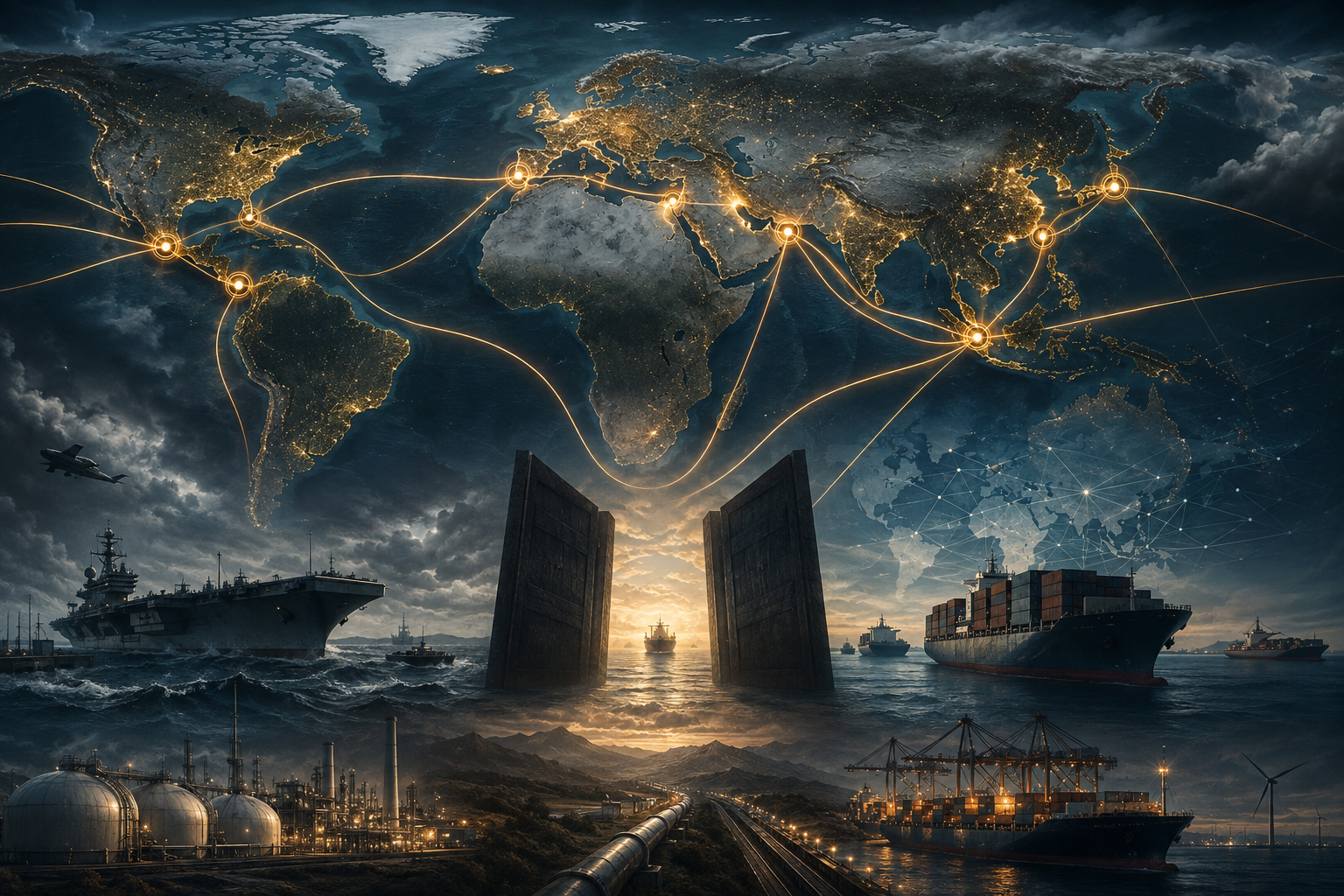
The map of the world lies.
It shows oceans as vast blue emptiness. Open. Free. Endless. It suggests that trade can sail anywhere, that any disruption can be routed around, that the world's commercial geography is as flexible as it appears on a schoolroom globe.
In reality, the trade that keeps the global economy physically alive is concentrated through a handful of narrow passages. Hormuz. Bab el-Mandeb. Suez. Malacca. Bosporus. Panama. Six passages, some no wider than a river, through which most of what the world buys, burns, eats, and builds must pass.
One ship can block them. A few drones can make them prohibitively expensive. An insurance classification can redirect thousands of vessels without a single shot fired.
The ocean is not wide. It is surprisingly narrow.
And that narrowness is where the world order is being rewritten.
The Myth of the Open Ocean
The economic logic of globalization rested on a geographic assumption that was never stated explicitly: that the oceans were effectively infinite. That any disruption to any route would be absorbed by the system's redundancy. That when one passage closed, another would open.
This assumption was not arbitrary. For most of the postwar era, it was correct.
When the Suez Canal closed in 1956 after the British-French-Israeli invasion, oil tankers rerouted around the Cape of Good Hope. The route was longer and more expensive, but it worked. When the canal closed again in 1967 following the Six-Day War and remained closed until 1975, the global economy adapted. Supertankers were built specifically to make the Cape route economical at scale.
When the Tanker War of 1984 to 1988 saw Iraq and Iran attack more than 450 commercial vessels in the Persian Gulf, shipping continued. Insurance premiums rose. Routes shifted. Some shipments were delayed. The global oil market remained functional.
The system absorbed each disruption because each disruption was isolated. When one passage was threatened, the others remained open. When one buffer was depleted, others remained intact. The ocean's apparent infinity was, in practice, the redundancy of its alternatives.
Alfred Thayer Mahan understood this in 1890, when he published The Influence of Sea Power upon History. His central argument was that nations controlling the seas control global commerce, and that sea control flows from concentrated naval power capable of winning decisive fleet engagements. Mahan's framework became the organizing doctrine of the United States Navy and, by extension, the postwar maritime order.
But Mahan wrote in an era when the number of critical passages was smaller, the number of actors capable of threatening them was fewer, and the redundancy of alternative routes was greater. His framework described a world that no longer exists in the form he observed.
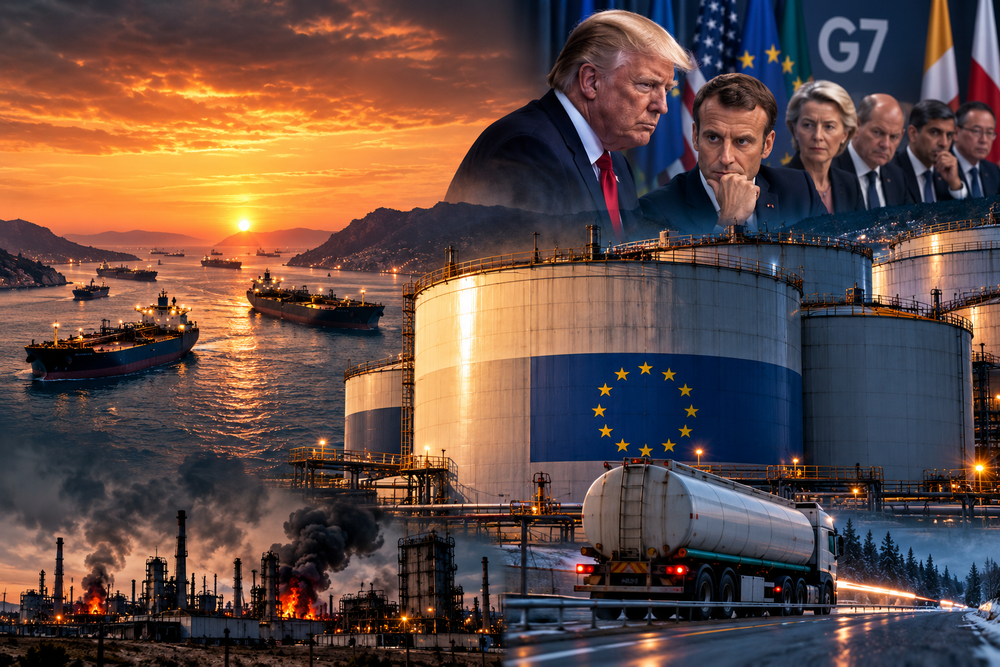
Between 2023 and 2026, four of the world's six critical maritime chokepoints came under simultaneous pressure. The Red Sea became commercially untenable for most major carriers following Houthi drone and missile attacks, with approximately 30% of Asia-Europe container traffic rerouting around the Cape of Good Hope. Hormuz was effectively closed following the March 2026 disruption, with throughput falling from 88 vessels per day to fewer than 10 on some days in July. The Panama Canal reduced throughput by 36% in 2023 and 2024 due to historically low water levels caused by the El Nino drought. The Black Sea remained a contested zone following Russia's 2022 invasion of Ukraine, with grain exports requiring military escort through waters that had been reliably commercial for decades.
No single closure was fatal. Together, they eliminated the redundancy that had made each individual closure manageable.
The ocean did not shrink. The backup routes filled up at the same time the primary routes broke down.
The End of the Backup World
Every resilient network is defined not by its primary routes but by its alternatives. The electrical grid's strength is not in its largest power plant but in the backup capacity that covers when the primary fails. The internet's resilience is not in its largest server farm but in the routing protocols that direct traffic around damaged nodes.
Maritime trade operated on the same principle. The primary routes carried most of the traffic. The secondary routes, more expensive and slower, provided a structural buffer against disruption.
In March 2021, the container ship Ever Given became lodged across the width of the Suez Canal for six days. An estimated $9.6 billion in daily trade was blocked. The global response was instructive: some shipments rerouted around the Cape of Good Hope, some waited, some were diverted to air freight. The world economy registered the disruption and continued functioning. The backup routes absorbed the shock.
The Ever Given blockage was a proof of concept, not a proof of resilience. It worked because it was isolated in time, in geography, and in duration. The backup routes had capacity. The primary route reopened in six days.
Neither condition applies to the current configuration.
When Houthi attacks on Red Sea shipping began in late 2023, the Cape of Good Hope route absorbed the rerouted traffic. But the Cape route was not built for the volume it received. Port congestion increased at Cape Town, Durban, and Algoa Bay. Vessel waiting times rose. The route that was the backup to Suez became, for the first time since the 1970s, a primary route under structural stress.
When Hormuz was disrupted in March 2026, the alternative routes that existed, including passages around the Arabian Peninsula, through Oman's Duqm port, and via overland pipelines, were operating at a fraction of their theoretical capacity. Saudi Arabia's East-West Pipeline, designed to carry crude oil across the Kingdom and bypass Hormuz entirely, had suffered damage in a 2019 drone attack and carried a fraction of Aramco's peak export capacity. The alternatives existed on maps and in emergency planning documents. Their throughput was inadequate when called upon simultaneously.
The backup world is not gone. But it is no longer available when the primary routes fail simultaneously.
What the world lost was not a route. It lost its reserve.
Geography Becomes Power Again
The twentieth century organized power around production. Industrial capacity determined military strength, which determined territorial control, which determined political influence. The nation that produced more steel, more engines, more aircraft, more ships, more electronics commanded the field.
The early twenty-first century appeared to shift that logic toward technology and capital. Financial networks, software platforms, and data infrastructure made geography seem secondary. Capital moved at the speed of electronic signals. The physical location of production appeared to matter less than the speed of connection.
Geopolitics disagreed.
Iran does not produce significant quantities of finished goods. It does not operate a global financial system. It does not manufacture the chips, the aircraft, or the industrial machinery that define technological power in the twenty-first century. Yet Iran controls the geography through which 20% of the world's seaborne petroleum must pass. That geographic position gave Iran leverage in the spring of 2026 that its GDP, its military capability measured in conventional terms, and its technological base would not have predicted.
Turkey does not produce the world's shipping. It does not set the terms of global trade. But without the Bosporus, the Black Sea becomes a closed body of water. That geographic fact gave Turkey negotiating leverage with both Russia and NATO during the Ukraine conflict that its military strength alone could not have generated. Turkey's management of the grain corridor, its drone exports, and its parallel relationships with competing powers all derived from the same structural source: Turkey sits between two seas.
Singapore's GDP per capita is among the highest in the world. But Singapore's wealth was not primarily built on manufacturing, on natural resources, or on domestic consumption. It was built on geography. The Malacca Strait, through which roughly one-third of global maritime trade passes, runs along Singapore's coastline. The city-state understood before almost anyone else that in a globalized economy, controlling the passage matters more than controlling the production.
The pattern repeats. Egypt controls Suez. Indonesia controls the alternative passages to Malacca. Oman controls the southern exit from the Gulf. Panama controls the Atlantic-Pacific connection.
None of these states are among the world's largest economies. None possess the military capacity of great powers. All of them hold structural leverage over the movement of goods that no amount of production capacity can substitute.
Power is shifting from those who possess the most to those who sit between everyone else.
Call this gatekeeper power: control not of production, not of capital, not of technology, but of passage. The gatekeeper does not need to match the military or economic weight of the powers whose commerce it interrupts. It needs only to make passage sufficiently costly that disruption becomes leverage.
The new geography of power is not about territory. It is about passage. Not who owns the ocean, but who controls the door.
The Burden of the Fleet
Mahan's doctrine produced the largest navy in human history. Eleven aircraft carrier strike groups. Hundreds of surface combatants, submarines, and support vessels. A global network of forward bases, from Bahrain to Guam to Rota to Yokosuka. An infrastructure of satellites, communications networks, and logistical chains spanning every ocean.
By Mahan's own logic, this fleet represents the apex of maritime power.
There is a different way to measure what that fleet represents.
A carrier strike group requires approximately 6,000 personnel to operate. It consumes roughly 800,000 gallons of fuel daily when underway. It requires a support chain of supply ships, fuel tankers, ammunition vessels, and maintenance facilities. It needs satellite coverage, communication networks, and intelligence support. When deployed, it draws on forward bases that themselves require security, contracts, diplomatic agreements, and the sustained goodwill of host nations that have their own interests and elections.
The fleet is not power. The fleet is a permanent logistical obligation.
Every ship requires a port. Every port requires a relationship. Every relationship requires maintenance. Every deployment requires replacement. The largest navy in the world is also, by definition, the largest maritime infrastructure maintenance project in the world.
Paul Kennedy identified the structural dynamic in The Rise and Fall of the Great Powers in 1987, calling it imperial overstretch: the point at which a power's strategic commitments exceed the economic base available to sustain them. Kennedy's insight was that empires do not fail because they grow too weak. They fail because their obligations grow faster than their capacity to meet them.
The maritime version of this dynamic has a specific mechanism that Kennedy did not fully develop: asymmetric disruption costs.
A drone attack costing tens of thousands of dollars can require an escort response costing millions per day. A sea mine laid for a few thousand dollars can force vessels to reroute hundreds of nautical miles, adding fuel costs, time costs, and insurance costs across every affected voyage. A Lloyd's Joint War Committee redesignation of a shipping zone as a war risk area can redirect global commerce without a single naval engagement, because when insurers stop writing policies, vessels stop sailing regardless of what the navy does.
In December 2023, the Joint War Committee expanded its listed high-risk area to cover the Gulf of Aden and southern Red Sea following Houthi attacks. Within days, major shipping companies including Maersk, MSC, CMA CGM, and Hapag-Lloyd suspended Red Sea transits. The US Navy's Operation Prosperity Guardian, launched in December 2023 to protect commercial shipping, succeeded in intercepting numerous drones and missiles. It did not reverse the insurance classification. The ships continued to reroute.
The asymmetry is not between large navies and small navies. It is between the cost of disruption and the cost of maintaining the order that disruption targets. The cost of disruption is set by the disruptor, who can calibrate it to remain below the threshold that triggers decisive response while remaining above the threshold that makes the route uneconomical for commercial use.
The US Navy cannot solve this problem by building more ships. More ships require more fuel, more maintenance, more personnel, more bases. The obligation grows with the fleet.
A fleet is not power. A fleet is a maintenance obligation. The larger the fleet, the larger the obligation it must service.
The hegemon is trapped by its own success. The maritime architecture it built to guarantee global commerce now requires permanent defense. Every passage it promised to keep open is a commitment it must honor. Every ally it acquired is a relationship it must maintain. Every base it established is a logistical liability it must supply.
America's Impossible Mission
The United States made an implicit promise after the Second World War: the oceans would remain open. Not in a formal treaty, not in a UN resolution, but in the structure of the postwar order itself. American carrier groups would patrol the key passages. American diplomatic pressure would keep chokepoints accessible. American financial infrastructure would underwrite the insurance markets that made global commerce possible.
That promise became the foundation of globalization.
For fifty years, it held. Through the Tanker War. Through multiple Suez crises. Through the Iraqi invasion of Kuwait and the coalition response. Through the rise of Somali piracy. The US Navy maintained what strategists called sea control: not the ability to fight and win every naval engagement, but the demonstrated willingness to intervene that made intervention largely unnecessary.
The problem is not that the US Navy has become weaker. The problem is that the network it must protect has become more complex than any single power can monitor simultaneously.
Hormuz requires permanent presence. Bab el-Mandeb requires active escort operations. The South China Sea requires credible deterrence against Chinese island fortifications. The Taiwan Strait requires demonstrated commitment in the face of sustained Chinese military pressure. Malacca requires coordination with Singapore, Indonesia, and Malaysia. The Black Sea requires working with Turkey, whose interests have diverged increasingly from those of NATO. The Arctic, now open to Russian commercial and military traffic for the first time in recorded history, requires investment in icebreakers and northern infrastructure that the United States has consistently underfunded.
No single power can maintain decisive presence in all of these theaters simultaneously at the level required to credibly deter all potential disruptors.
The three carrier strike group deployment to the Gulf in May 2026, the largest concentration since the 2003 Iraq invasion, represented an operational commitment that drew resources from other theaters. The South China Sea deployments continued, but at reduced frequency. The Baltic rotations continued, but with longer intervals. The presence remained. The density thinned.
This is the operational expression of Kennedy's overstretch, not in the abstract but in the specific deployment schedules of specific ships that can only be in one place at a time.
The United States is not running out of ships. It is running out of passages it can monitor simultaneously at the level its commitments require.
China Faces the Same Trap
China appears to be the beneficiary of American maritime overextension. Its navy is expanding rapidly, with more new hulls commissioned in the past decade than most navies possess in total. Its Belt and Road Initiative has established port relationships from Gwadar to Hambantota to Djibouti. Its economic relationships give it influence over states that control critical passages.
But China faces a structural vulnerability that mirrors America's, located at different coordinates.
China imports roughly 70% of the oil it consumes, and a significant share of that comes from Middle Eastern suppliers whose crude must transit the Strait of Hormuz. That supply chain passed through a corridor effectively closed in March 2026. China's dependence on Gulf energy is not a temporary condition. It is embedded in the structure of China's industrial economy, which has no domestic alternative at the scale required.
A large share of China's maritime trade passes through the Malacca Strait, the narrow passage between Malaysia and Indonesia that carries roughly one-third of global maritime trade. The Malacca Strait is not under Chinese control. Its governance involves Singapore, Indonesia, and Malaysia, all of whom maintain independent relationships with both Beijing and Washington. A sustained disruption to Malacca, through military conflict, political instability, or environmental crisis, would damage China's export economy more severely than it would damage the United States, which has significant Pacific coast ports that can route around Malacca.
China's strategic response has been the construction of overland alternatives: pipelines through Pakistan reaching the Arabian Sea at Gwadar, rail connections through Central Asia, the China-Pakistan Economic Corridor as a land bridge to bypass the Malacca Strait. These alternatives exist. Their combined throughput capacity is a fraction of what the maritime routes carry at full operation. They serve as supplements, not substitutes.
The world's second-largest economy is dependent on passages it does not control, through waters it does not dominate, with alternatives that cannot substitute at scale.
China and the United States are not two powers competing for control of the sea lanes. They are two powers whose fundamental economic requirements depend on the same sea lanes remaining open, and neither of whom can guarantee that openness unilaterally.
Two great powers, trapped in the same network, each capable of disrupting the other and each incapable of replacing what disruption would destroy.
The Multiplication of Vetoes
The classical model of hegemonic stability held that global order requires a dominant power willing and able to enforce the rules of international commerce. The hegemon keeps the lanes open, maintains the reserve currency, underwrites the insurance markets, and provides the military backstop that makes trade finance possible.
This model assumed that the number of actors capable of threatening the system was small, and that the hegemon's resources exceeded the combined disruption capacity of potential challengers.
Both assumptions are now structurally questionable.
The Houthis are not a great power. They do not possess a traditional navy. They do not control a significant economy. They do not have the military capacity to engage the US Navy in a sustained exchange and survive. Yet through a combination of anti-ship missiles, drones, and the credible threat of mining operations, they imposed sufficient costs on Red Sea shipping to effectively close the route for commercial purposes for more than a year. The mechanism was asymmetric costs, not military superiority.
The Ever Given blockage of 2021 required no military actor at all. A single vessel, caught by a wind gust on a narrow channel, blocked $9.6 billion in daily trade for six days. The vulnerability was structural, embedded in the geometry of a canal that has no passing lanes and no room for error.
The Panama drought of 2023 and 2024 required no ships, no weapons, and no hostile actor. Reduced rainfall reduced water levels in the Gatun Lake reservoir that feeds the canal locks. The Panama Canal Authority reduced daily transits from a typical 36-38 vessels to as few as 18, and auctioned premium slots that reached $4 million per vessel above normal fees. A weather system reorganized global shipping patterns without anyone's permission.
The Lloyd's Joint War Committee's war risk classification represents a fourth category of veto: financial. When insurers stop writing policies for a zone, vessels stop entering that zone regardless of military conditions on the water. The insurance market holds a structural veto over global commerce that no naval presence can override. If the risk cannot be priced, the voyage cannot be financed.
Cyberattacks on port management systems represent a fifth category. The NotPetya attack of 2017, which infected Maersk's global network and cost the company approximately $300 million, disrupted operations at 76 ports across 45 countries. No ship was touched. No sailor was harmed. The logistics infrastructure itself was the attack surface.
The actors with the ability to disrupt the global maritime system are multiplying across every category: military, environmental, financial, digital, and structural. The actors with the capacity to resolve any given disruption are not increasing at the same rate. The US Navy can intercept missiles. It cannot change weather patterns, restructure insurance markets, defend every port management system, or guarantee that no single vessel will ever ground itself sideways across a critical channel.
The world's sea lanes are governed by an expanding set of actors who can close them and a shrinking capacity for any single power to keep them open.
The Return of Physical Reality
For three decades, the dominant story of the global economy was dematerialization. Capital moved at the speed of electronic signals. The most valuable companies produced no physical goods and required no physical infrastructure beyond server farms and fiber cables. The economy appeared to be becoming weightless.
This story was true in a limited sense. Financial flows dematerialized. Information dematerialized. The most visible transactions were increasingly weightless.
But food does not dematerialize. Gas does not. Oil does not. Grain does not. Pharmaceuticals do not. The physical substrate of the digital economy, the rare earth minerals in every battery, the silicon in every chip, the copper in every cable, the fuel in every data center generator, moves by ship.
The global economy discovered in 2021, when pandemic-disrupted supply chains caused semiconductor shortages that shut down automotive production in countries with no visible connection to semiconductor manufacturing, that its apparent weightlessness rested on a physical infrastructure it had not examined carefully in thirty years.
The maritime chokepoint crises of 2023 to 2026 completed that education.
Every supply chain optimization that had reduced inventory to zero to improve return on capital became a liability when the ship carrying the replenishment was delayed by twenty-eight additional days rerouting around the Cape of Good Hope. Every pharmaceutical cold chain that had been calibrated for 48-hour Dubai routing faced 19-day Jeddah routing with additional temperature exposure and validation requirements. Every European heating season target that had been modeled on Qatari LNG arriving through Hormuz on schedule faced a reality in which the schedule no longer existed.
The logistics was not the detail. The logistics was the economy.
The digital century discovered that it was still, underneath everything, a physical century. The servers required cooling. The cooling required water. The water required treatment chemicals. The treatment chemicals required shipping. The shipping required fuel. The fuel came through Hormuz.
The digital economy does not end in a cloud. It ends in a port.
What If Adaptation Outpaces Disruption?
The strongest counterargument to this analysis does not dispute the mechanisms described above. It accepts that chokepoints have become more contested, that redundancy has decreased, and that the asymmetry between disruption costs and maintenance costs has widened. It argues that these trends have not yet produced the systemic breakdown the analysis implies, and may not, because human adaptive capacity has consistently exceeded pessimistic projections.
The historical record supports this counterargument seriously.
The 1973 oil embargo was projected by serious analysts to trigger a structural realignment of the global economy. It produced a recession, elevated oil prices for a decade, and significant political disruption. The global economy eventually adapted through conservation, alternative supplier development, and strategic reserve construction. The structural collapse did not materialize.
The 1979 Iranian Revolution and subsequent Tanker War were projected to threaten global energy security on a permanent basis. Markets adapted through demand reduction, development of North Sea and Alaskan oil, and eventually the US naval presence that constrained the worst of the tanker attacks. Global oil supply continued.
On this evidence, the adaptive capacity of market economies operating across multiple nations, technologies, and geographies has consistently exceeded what disruption-era analysis projected. Shortages create incentives for substitution. High prices attract new supply. New routes emerge when old ones close.
This counterargument is structurally serious. It has been right more often than the catastrophists.
The reading offered here does not claim that the current configuration will produce irreversible collapse. The claim is narrower: the current configuration has simultaneously depleted the adaptive buffers that made historical recovery manageable.
The IEA emergency reserves were deployed in March 2026 at an unprecedented scale, a draw equivalent to more than a third of government-held emergency stocks in a single intervention. The alternative routes are operating near capacity. The insurance markets are pricing war risk at levels that make marginal routes uneconomical before any additional disruption occurs. The financial capacity of states most vulnerable to supply disruption is weaker than at any point since the 1980s debt crisis, with more than 75 countries carrying sovereign debt in distress or near-distress conditions according to IMF assessments.
Previous disruptions were absorbed because the buffers existed before the crisis. The reserves were full. The alternative routes had capacity. The insurance markets had appetite. The state balance sheets had room.
Adaptation will occur. It always has. The question is what the cost of adaptation is, and who absorbs it, when the buffers that historically absorbed adaptation costs are already depleted before the adaptation begins.
The system will adapt. The question is what it looks like when it has.
The map of the world will not show this shift. It will continue to display the oceans as vast blue emptiness. Open. Free. Endless.
But the geography of power has always been more specific than maps show. The Roman Empire was not built on the size of the Mediterranean. It was built on the network of ports, roads, and depots that connected it. The British Empire was not built on the size of the Atlantic. It was built on Suez, Gibraltar, Aden, Singapore, and the coaling stations that gave its navy range beyond what the ocean's size alone allowed.
Every hegemonic order has rested on control not of the ocean but of the narrow places where the ocean can be interrupted. What has changed is not the existence of those narrow places. What has changed is the number of actors who understand they exist, the number of mechanisms through which they can be threatened, and the declining capacity of any single power to keep them all open simultaneously.
The twentieth century was built on the assumption of open oceans. The twenty-first is discovering how few passages actually kept them open.
The map still shows the ocean as wide. The ocean is not.
Empires once fought to control continents. The twenty-first century is discovering that continents matter less than the doors between them.
Evidence Map
Core claim: The global maritime system's chokepoint geography has become the primary determinant of geopolitical leverage, as simultaneous pressure on multiple passages has eliminated the redundancy that previously made individual closures manageable, creating a structural shift from hegemonic sea control to distributed gatekeeper power.
Observed conditions (high confidence, directly documented)
Simultaneous chokepoint pressure 2023 to 2026: Red Sea commercially untenable for most major carriers following Houthi attacks (Joint War Committee high-risk area expansion to Gulf of Aden and southern Red Sea, December 2023; Maersk, MSC, CMA CGM, Hapag-Lloyd suspension of Red Sea transits, December 2023). Hormuz throughput reduced from 88 vessels daily to fewer than 10 on multiple days in July 2026 following March 2026 disruption. Panama Canal throughput reduced 36% in 2023 and 2024 due to Gatun Lake water level reduction (Panama Canal Authority transit data). Black Sea contested since February 2022.
Cape of Good Hope route stress: container shipping rerouting increased Cape Town, Durban, and Algoa Bay port congestion. Drewry World Container Index at 22-month high as of late June 2026.
Ever Given, Suez Canal, March 2021: $9.6 billion daily trade blocked for six days (Lloyd's List estimate). Canal reopened day six. Prior backup routes absorbed shock due to availability.
Lloyd's JWC war risk classification mechanism: insurance veto demonstrated as effective route closure mechanism independent of military action.
Panama drought 2023 to 2024: daily transits reduced to 18 from typical 36 to 38. Premium slot auction prices reached $4 million above standard fees (Panama Canal Authority).
IEA emergency reserve deployment, March 2026: 400 million barrels released, largest in IEA history, a draw equivalent to more than one third of government-held emergency stocks.
Documented structural dependencies (medium-high confidence)
US carrier strike group operational costs: approximately 6,000 personnel per group, approximately 800,000 gallons fuel daily underway. Three simultaneous Gulf deployments May 2026 = largest concentration since 2003.
China energy dependency: China imports roughly 70% of the oil it consumes, with a significant share of Middle Eastern crude transiting Hormuz. A large share of China's maritime trade depends on the Malacca corridor. The Strait of Malacca carries roughly one-third of global maritime trade.
Petrodollar arrangement (1974): documented in declassified US Treasury records and Bloomberg FOIA reporting (2016). Creates structural US commitment to Gulf security.
Paul Kennedy, The Rise and Fall of the Great Powers (1987): imperial overstretch framework. Strategic commitments exceeding economic base to sustain them.
Alfred Thayer Mahan, The Influence of Sea Power upon History (1890): foundational US naval doctrine of concentrated fleet power as basis for sea control.
Analytical inferences (medium confidence)
Gatekeeper power as structural category: states controlling passages exercise leverage disproportionate to their GDP or military capacity. Supported by Turkey/Bosporus, Singapore/Malacca, Egypt/Suez, Iran/Hormuz patterns.
Fleet as maintenance obligation: the inverse of Mahan. As number of contested passages increases faster than fleet capacity, the maintenance obligation exceeds the power projection benefit. Direction of inference supported by deployment pattern evidence; magnitude not precisely measurable.
Redundancy elimination as systemic threshold: the simultaneous nature of 2023 to 2026 disruptions represents a qualitative shift from historical pattern of isolated closures. Whether this constitutes a permanent threshold or a temporary confluence requires longer observation.
What would confirm this
Additional simultaneous chokepoint disruptions in a single calendar year without recovery of buffer capacity. Evidence of China or the US declining to respond to a third-theater disruption due to resource constraints from existing commitments. Insurance market refusing to write new policies for a previously open passage due to generalized war risk rather than specific incident.
What would disprove this
Rapid buffer reconstruction: IEA member reserves rebuilt to pre-2026 levels within 18 months without further depletion events. Alternative route capacity investment that materially increases throughput on Cape and overland routes within five years. A new security architecture that distributes chokepoint maintenance across multiple powers rather than concentrating it in the United States.
Watchlist
FSRU deployment rates in Northern Europe through Q4 2026. EU gas storage trajectory toward November 1 target. China-Pakistan Economic Corridor throughput expansion schedule. Saudi Arabia East-West Pipeline repair timeline. Lloyd's war risk zone classifications through Q1 2027. US Navy deployment patterns in South China Sea versus Gulf ratio.
Confidence assessment
Chokepoint simultaneous pressure (observed): High. Documented across multiple independent sources. Redundancy elimination thesis: Medium-high. Directional evidence strong; threshold determination requires longer observation. Gatekeeper power structural shift: Medium. Pattern consistent; causal mechanism documented; long-term stability of shift not yet testable. Fleet as maintenance obligation inversion of Mahan: Medium. Logical structure sound; empirical validation limited to current deployment cycle.
The chokepoint architecture documented here connects to three other investigations in this archive. Hormuz, Houthis, Yanbu: No Backup traced what happens when the bypass routes entered the target set. The Caspian Strike documented how two wars share one corridor. The Iran War Has No Off Switch mapped the IEA buffer depletion timeline running underneath.
Jerry writes The Manifest Archive — forensic analysis of the institutional structures that shape geopolitics, history, and power.