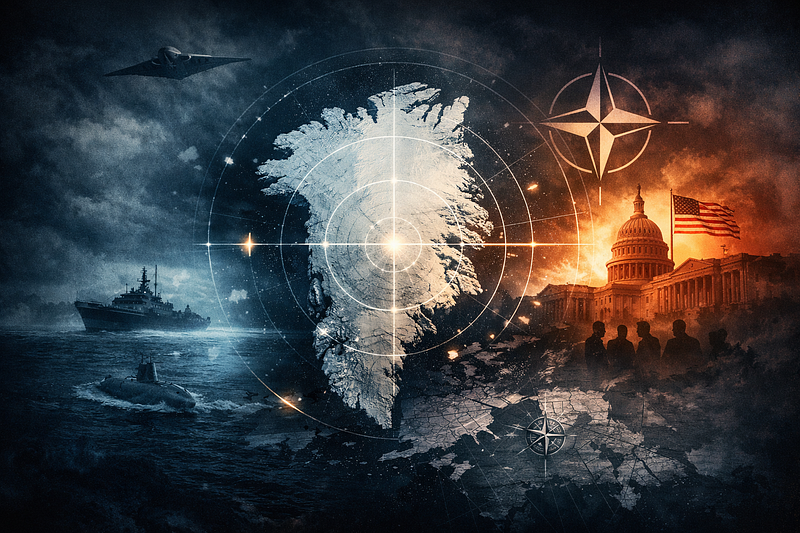
Why an island of fifty-seven thousand people became the fault line of the West, and what it revealed about the alliance built to prevent exactly this.
The declaration did not arrive with sirens. There was no emergency session, no locked doors, no visible rupture. It appeared as text. A joint statement, carefully worded, calm, reaffirming principles that were never supposed to need repeating. Sovereignty. Territorial integrity. The inviolability of borders. Several European leaders felt compelled to say, publicly and together, that Greenland does not belong to the United States.
Not because it had been taken. Because it had been spoken about. When leaders restate what was once simply assumed, the assumption has already failed. An alliance built to defend its members against an outside enemy found itself addressing a pressure coming from inside it, from the partner strong enough to ignore the rules it had written. NATO did not discover an enemy that winter. It discovered a blind spot it had always carried and had never before needed to name. The alliance had a rule for an attack from outside and no rule at all for pressure from within, and the gap had stayed invisible only because the strongest member had never before been the one applying the pressure. That is the finding beneath the Greenland crisis, and the rest of this is the explanation of how a small Arctic island brought it to the surface.
Greenland Is Not Territory. It Is Function.
Greenland is usually described as a place. Ice, rock, silence, an island three times the size of Texas with fewer than sixty thousand inhabitants, an autonomous territory of Denmark on the far edge of the map. That framing is the first mistake, because it invites the question of whether the island is worth the trouble, and the island, as real estate, plainly is not. Greenland matters not as territory but as function, and its function changed because the world around it changed.
It sits at the intersection of four systems that were dormant for most of the modern era and are now waking at once. The first is missile defense. At the island's northwest tip sits Pituffik Space Base, formerly Thule, the northernmost installation of the United States military and a cornerstone of ballistic missile early warning and space surveillance since the Cold War. It is now the only American base left in Greenland, staffed by roughly a hundred and fifty people, and it watches the polar approach over which intercontinental missiles between the northern hemisphere's powers would fly. The second system is the sea. The maritime corridor between Greenland, Iceland, and the United Kingdom, the GIUK gap, is the chokepoint through which Russia's Northern Fleet must pass to reach the open Atlantic, and through which NATO has listened for Soviet and Russian submarines for seventy years. The third is minerals. Greenland holds some of the largest rare earth deposits outside China, at Kvanefjeld and Tanbreez, the elements that modern weapons and electronics depend on. The fourth is the shipping itself. As the ice retreats, routes that were theoretical become navigable, and the distance between Asia and Europe over the top of the world begins to compete with the Suez Canal.
None of these is new. What is new is that all four became operational at the same time, because the ice that made the Arctic irrelevant is melting. Greenland did not become important. The world moved until it could no longer afford to ignore it, and a place that had been background for a century became, almost overnight, foreground.
The Geography That Woke Up
There is a principle worth stating plainly, because it governs the whole episode. Geography does not change, but its value does, and when a dormant geography becomes operational, the infrastructure sitting on it becomes contested whether or not anyone planned it.
For most of the twentieth century the Arctic was a wall. The ice made the northern routes impassable, the submarine corridors were a Cold War specialty, and Greenland's only real job was to host the radar that watched for missiles coming over the pole. The wall is now a door. A melting Arctic opens the Northern Sea Route along Russia's coast, which Moscow promotes as a shortcut between Europe and Asia, and in 2025 a container ship completed the first direct run between China and the United Kingdom over the Arctic in roughly twenty days, far faster than the Suez passage. As the routes open, the points that command them gain value the way a bridge gains value when a river floods every other crossing. The GIUK gap, a piece of empty ocean, becomes a toll booth on the Atlantic. Pituffik, a remote radar station, becomes the eye over the shortest path between the great powers. The determining variable in the Greenland crisis was never the island's soil or even its minerals. It was the sudden activation of a geography that had been asleep, and the recognition by every Arctic power at once that whoever holds the chokepoints holds the century's newest theater.
This is why the stated motive does not quite hold, and the gap is instructive. The rare earths were offered as the reason the United States needed Greenland, and yet industry analysts called the rare-earth case close to absurd. The deposits are low grade, the weather is punishing, the mines do not exist at scale, and even if they did, the processing capacity that turns ore into usable material still sits overwhelmingly in China, which no amount of Arctic mining changes. The minerals are real but they are not the lever. When the publicly offered reason for an action does not survive its own technical scrutiny, the real reason is usually the one no one has to argue, and here the real reason is position. Greenland is the platform from which the Arctic is watched and, if it comes to that, controlled. That is a thing you take, or hold, regardless of whether the mines ever open.
The Shortest Path Runs Over the Pole
The reason Pituffik cannot simply be moved, and the reason Greenland's missile-defense function is not interchangeable with any other site, is a fact of the globe that most maps hide. On the flat projections people grow up with, the United States and Russia sit at opposite edges, an ocean and a continent apart. On a globe they are neighbors across the top, and the shortest path between them, the route a ballistic missile would actually fly, arcs over the North Pole. The great-circle line between the missile fields of the northern hemisphere's powers passes almost directly over the Arctic, which is why the radar built to see an attack coming was placed in the far north in the first place.
Greenland's northwest tip sits astride that arc. From Pituffik, the United States watches the polar approach for the launch it hopes never comes, and feeds the space-surveillance network that tracks what orbits overhead. As the major powers invest again in missiles that fly faster and lower, and in the defenses meant to catch them, the value of a sensor at the top of the world rises rather than falls. This is the part of Greenland's function that no mine and no shipping lane explains, and the part least likely to be surrendered. A country can lose interest in Arctic ore if the economics sour. It does not lose interest in the ground from which it watches for the end of the world. The island is not valuable because of what is under it. It is valuable because of what passes over it.
The Declaration as Symptom
Joint statements are mistaken for strength. They are a late-stage instrument. States speak in chorus only when acting alone no longer suffices and acting decisively is no longer possible. The European declaration that Greenland belongs to Denmark and the Greenlanders introduced no policy, altered no military posture, established no consequence. It restated first principles, and that restatement was the entire signal, because in a functioning system the foundational rules stay implicit. Borders are not defended by press release. Sovereignty does not require reaffirmation unless it has come to be seen as negotiable.
When language steps in to do the work of enforcement, enforcement has already weakened. The leaders knew this instinctively, and their words were aimed less at Washington than at their own publics, their own institutions, and perhaps themselves. It was reassurance offered as governance, the calm tone covering the fact that there was no mechanism behind the words. And language has a second, quieter function in moments like this. Repeated declarations do not merely fail to stop an action. They suspend decision. They produce the appearance of engagement while postponing consequence, each statement resetting the clock without changing the direction of the hands. The chorus of sovereignty was not a wall against the pressure. It was a holding pattern, absorbing the tension without resolving it, letting the institutions appear present while remaining inert.
What Washington Actually Did
The pressure itself was not subtle, and it escalated across a year in a way that is worth setting down in sequence, because the sequence is the evidence.
It began as language that drifted from alliance into entitlement, talk of strategic necessity, of options, of a Greenland the United States needed rather than wanted. In March 2025 the Vice President of the United States, with his wife beside him, flew to Pituffik Space Base and told Greenlanders to their faces that they would be better off under the American security umbrella than the Danish one. The visit had been scaled down after Danish and Greenlandic leaders objected to not being consulted, and within weeks the American commander of the base was removed from her post after she circulated a message distancing the garrison from the Vice President's pitch. In May the President, asked directly whether he would use military force to take Greenland, said he ruled nothing out. Through the following months the leverage hardened into economics, a threat of tariffs rising toward twenty-five percent against a list of European states unless Denmark agreed to hand the island over. Then, in January 2026, at the World Economic Forum in Davos, the President reversed, pledging not to use force or tariffs after all, reportedly under pressure from his own advisers and after a framework understanding reached with NATO's secretary general. The correction, worth noting, came from inside the American camp and from a personal deal, not from any collective act of the alliance.
Read forward, the sequence shows a probe rather than a plan. The objective was never, in all likelihood, to seize Greenland by landing troops. It was to test how elastic the alliance's norms were, how much pressure a member could apply to other members before coordinated resistance formed, and how quickly outrage would resolve into management. The answer the probe returned was the finding. Europe objected in words and hesitated in substance. Denmark reaffirmed sovereignty and announced more Arctic patrols. Greenland's new government, led after the March 2025 election by a prime minister who told Washington to stop the disrespect, asked for calm. NATO, as an institution, said almost nothing. The pressure was applied, absorbed, and then partly withdrawn, and at the end of it the conversation had moved. A demand that would have been unthinkable to voice a year earlier had been voiced, survived, and entered the range of things that can be discussed.
The First Move That Disappeared
There is a mechanism in how this kind of pressure is remembered, and it favors the powerful. Power rarely announces its intentions outright, because ambiguity is more useful than clarity. A statement that can later be reframed is worth more than one that has to be defended. The early American language on Greenland was not a policy declaration. It was a calibration, a probe of how much could be said before the system pushed back, and once the system declined to push back, the first move no longer needed repeating. It had already done its work.
What follows is a quiet inversion that the speed of news makes almost automatic. By the time Europe responded at all, the response became the story. Headlines fixed on the latest utterance, the conditional threat spoken today, while the unconditional provocation spoken weeks earlier dissolved into background. News prioritizes what is newest, not what was first, and so the last visible action is mistaken for the beginning. Initiative is relabeled as reaction. Any European countermeasure, had one come, would have been pre-labeled escalation against an American position that was itself the original move. This is not manipulation by any single hand. It is sequence control, the oldest advantage in the book, and it works because whoever controls the order in which events are allowed to register can decide the meaning of those events without changing a single fact. The discipline that defeats it is unglamorous and almost never applied in real time. It is memory. The insistence on asking what preceded what, who moved first, and which alternatives existed and were not taken.
Ukraine is the larger case where this same logic already hardened into the way an entire war is remembered. Public discourse fixes the beginning in February 2022, and everything before that date, the years of alliance expansion, military integration, training missions, and political alignment, is treated as background rather than as part of the sequence. Once the beginning is fixed at the invasion, the moral geometry simplifies, and every later step reads cleanly as response. This does not excuse the invasion, which was a choice and a crime. It illustrates the mechanism. Whoever fixes the starting point of the story wins most of the argument before the argument begins, because the starting point decides which acts count as provocation and which count as defense. Greenland showed the same technique attempted in miniature and in real time, the first move drifting into background while the response was pre-labeled as the escalation. The only defense, in Ukraine and in the Arctic alike, is the refusal to let the beginning be quietly relocated.
The Offer in 1946
The idea that the United States might own Greenland is not a recent eccentricity. It is nearly as old as American power itself, and its history is the proof that the 2025 crisis was a structural impulse surfacing rather than a personal whim.
The first American interest dates to the 1860s, the era when the same Secretary of State who bought Alaska looked north and saw the same logic. In 1946, with the Second World War just over and the Cold War forming, the Truman administration secretly offered Denmark one hundred million dollars in gold for Greenland. Denmark declined, but the substance of the demand was met another way. In 1951 a defense agreement gave the United States broad latitude on the island, and out of that agreement came Thule Air Base in the far northwest, built into the permafrost as the forward edge of American early warning. The base did not ask the people who lived there. On a day in late May 1953, twenty-seven Inughuit families, some hundred and sixteen people, were told they had four days to leave the hunting grounds their families had worked for generations. They were taken roughly a hundred and fifty kilometers north, to Qaanaaq, where the dark lasts longer and the sea ice closes in earlier, and there they rebuilt their lives on ground chosen for them by a foreign air force. Half a century later, in 2003, Denmark's Supreme Court found the removal had been unlawful. The runway it cleared the way for is still in operation today. In 1968 a B-52 carrying four hydrogen bombs crashed on the ice near the base, scattering radioactive material across the bay in an accident that took months to clean and years to fully admit.
This is the documented past beneath the present crisis. American strategic interest in Greenland has been constant for eighty years, expressed through purchase offers, treaties, a nuclear-armed bomber fleet, and a base built over the home of the people who were moved aside for it. What changed in 2025 was not the appetite. It was that the appetite was finally spoken in the open, by a head of state, as a demand rather than an arrangement. The history is what tells you the impulse is structural, lodged in the geography and the strategic logic, and not the property of any one administration.
The Board Around the Island
Greenland is one square on a board that the whole world has begun to contest, and the crisis makes no sense without the other players. The Arctic is not warming into a vacuum. It is warming into a competition that Russia leads and China has joined.
Russia has spent two decades rebuilding its Arctic military presence, reopening Soviet-era bases along its northern coast, expanding the Northern Fleet whose submarines must pass the GIUK gap to reach the Atlantic, and promoting the Northern Sea Route along its shoreline as a national asset and a future toll road between Europe and Asia. China, which has no Arctic coastline at all, declared itself a near-Arctic state in a 2018 white paper and announced a Polar Silk Road, investing in Arctic shipping, research stations, and resource projects, and sending the container traffic that in 2025 ran the first direct China-to-Britain voyage over the top of the world. The Arctic that was a frozen margin is becoming a third great trade and military theater alongside the Atlantic and the Pacific, and the powers are positioning now, while the ice is still deciding how far to retreat.
Seen from that board, the American move on Greenland reads less as expansion than as a scramble for a square that suddenly matters, the largest, best-placed platform in the western Arctic, held loosely by a small ally inside an alliance with no rule for what was about to happen. The pressure was not the opening of a game. It was a late and ungraceful entry into one already underway.
Trump Is Not the Anomaly
It would be comforting to file this under personality, to locate the rupture in one man's temperament and conclude that the system is sound and merely badly driven. That comfort is misplaced. American interest in Greenland is old. The United States offered to buy it in 1946 and built Thule in the 1950s without asking the Greenlanders. What changed in 2025 was not the intent but the exposure, the willingness to say the quiet strategic logic out loud, and blunt speech functions as a stress test. It strips a system of its decorum and reveals what it can and cannot correct.
What this stress test revealed was not American excess so much as allied incapacity. When a behavior persists across administrations, the explanation has to move upward, from the individual to the structure, because structures outlast the people who staff them. Fixating on the personality performs a familiar and consoling function. It localizes the problem in a figure who will eventually leave, and it relieves the institution of scrutiny. If the trouble is only a style, the architecture is fine and patience is the cure. But the architecture was the trouble, and patience is what it exploits.
The Blind Spot Is Structural
Blind spots are not oversights. They are design choices. NATO was built to aggregate force against an external enemy, to pool the military weight of its members and point it outward at the Soviet Union and then at Russia. Its entire architecture assumes alignment at the center and discipline at the edges. It has elaborate machinery for collective defense against an outside attack, the famous commitment that an attack on one is an attack on all. It has nothing at all for the opposite case, the pressure that originates at the center and runs outward toward a member. There is no protocol for internal asymmetry, no corrective mechanism for the moment the strongest member turns its weight against a weaker one. There is no internal appeal.
This omission was invisible for as long as American leadership and American restraint coincided, for as long as the most powerful member was also the guarantor of the rules. The instant those two things came apart, the gap surfaced, and because the gap sits at the structural core of the alliance rather than at its policy surface, it cannot be patched by a communique or a renewed pledge of unity. An alliance designed only to project force outward has no way to restrain force that comes from inside it. The blind spot was not a failure of attention. It was written into the blueprint, the necessary cost of building a machine to do one thing supremely well, and it stayed hidden precisely because the thing it could not handle had never before occurred.
When the Protector Becomes a Variable
For decades Europe treated the United States as a protective constant. Not selfless, not flawless, but stabilizing, a power that absorbed risk, imposed limits, and kept escalation from drifting out of control. That belief was practical. It let Europe outsource hard security and spend its attention on integration, markets, and internal peace. What has become visible is not the collapse of that role but its transformation. American power still dominates, its military reach unmatched, its economic gravity still bending outcomes. What changed is that it no longer functions as a limiter. It functions as a variable.
This is the sentence the Greenland episode wrote into the open, and it generalizes well beyond one island. When the guarantor becomes unpredictable, every assumption built on the guarantor's steadiness turns from a foundation into a liability. The same logic that made Greenland suddenly contestable makes other concentrations of value contestable too, because a power that has stopped acting as a limiter begins to apply pressure wherever something matters and control feels uncertain, a strait, a supply chain, a mineral deposit, a strategically placed ally. The behavior tracks importance rather than threat. This reading should be held as interpretation rather than asserted as plan, but the pattern is consistent. Power under strain rarely retreats. It reaches, not always out of confidence, often out of the fear of losing relevance before others move, and what looks like aggression frequently begins as anxiety translated into motion.
Fifty-Seven Thousand People
Lost in the talk of chokepoints and rare earths and alliance architecture are the people who actually live on the island, and their position is the moral center of the whole episode. Greenland is home to roughly fifty-seven thousand people, most of them Inuit, spread along a coastline of small towns connected by sea and air because there are almost no roads between them. They have governed their own domestic affairs since the Self-Government Act of 2009, and many of them want eventual independence from Denmark. What almost none of them want is to be transferred from one distant capital to another like a deed changing hands.
The defining experience of the crisis, from inside Greenland, was being talked about rather than talked to. The great powers debated the island's strategic value, its minerals, its position, its future, in the grammar of property, and the people on it appeared in that grammar as a detail. When the American Vice President stood at Pituffik and told them they would be better off under his country's protection, he was speaking on their soil without having been invited by their government, and the islanders heard, correctly, a pitch made over their heads. Their prime minister's response, that Greenland is open to dialogue but will not accept pressure or disrespect, was the response of a people insisting on being subjects rather than objects, parties to their own future rather than terrain.
This is the part the strategic analysis tends to omit, and it should not, because it is where the abstraction touches ground. A chokepoint has no opinion. A radar station has no children. But the function that makes Greenland valuable to the powers sits on top of a society of fifty-seven thousand human beings who were moved once already, in the 1950s, to make room for a runway, and who can see in the current crisis the same logic returning in a louder voice. The determining variable is the geography. The cost of contesting it falls on the people standing on it.
The Honest Objection
The strongest case against this reading deserves to be put at full strength, because it is reasonable. Perhaps there is no pathology here at all, only legitimate Arctic security policy delivered in an ugly register. Russia is genuinely militarizing the Arctic and China is genuinely pushing into it. Greenland's defense is genuinely under-resourced, and the warming really is opening routes and exposing the GIUK gap to new pressure. The United States already carries the burden of defending the island under a treaty seventy years old, so wanting a firmer hold on a place it is already obligated to protect is not madness but prudence. And the Davos reversal, on this account, is proof the system worked. Advisers pushed back, allies held their line, no force was used, the tariffs were dropped. The alliance absorbed a shock and the shock passed. Where is the blind spot, if the blind spot self-corrected?
The objection is serious, and the security interest it names is real. But it does not survive two facts. First, the correction did not come from the alliance. It came from inside the American executive, from aides reportedly talking a president out of a course, and from a bilateral understanding with the secretary general, neither of which is a structural safeguard. One is a contingency of personnel, and personnel change. The other is a deal, and deals are unmade. The allies, for their part, could produce only statements, which is exactly the incapacity the episode exposed. Second, and more telling, a genuine security interest does not require the coercion that was actually applied. The United States already had a treaty granting it military latitude in Greenland. If the goal were security, the treaty supplied it. The demand was not for access, which existed, but for ownership and for a member's compliance under threat of tariffs, and that surplus, the gap between what security required and what was demanded, is the thing the security rationale cannot explain. The interest is real. It does not account for the coercion, and the coercion is what revealed the blind spot, whatever the security situation that surrounded it.
What Greenland Revealed
Greenland did not expose a territorial dispute. It exposed a dependency that no longer guarantees stability. The crisis cooled, the tariffs were withdrawn, the force was never used, and the temptation now is to conclude that the system held. It did not hold. It drifted, and then the pressure relented for its own reasons, and a new baseline was left behind that would have been unthinkable a year before. The real danger in episodes like this is never the dramatic escalation that gets the headlines. It is normalization, the moment when the language moderates and the crisis is declared managed and a thing that was once outside the boundary of the sayable is quietly inside it.
An alliance that cannot correct its own center does not collapse. It drifts. And drift, in geopolitics, is how accidents are made, because a structure that has lost the ability to restrain its strongest member has not solved the problem of that member. It has only agreed to stop noticing it. The blind spot remains exactly where it always was, at the core, and the next time the geography wakes up, or the guarantor reaches for something that matters, the alliance will reach for the same instrument it reached for over Greenland. A carefully worded statement, restating principles that were never meant to need restating, calm on the surface, with nothing behind it.
Evidence Map
Facts, interpretations, forecasts, and disconfirming signals.
Core claim. Greenland's value is functional, not territorial: the simultaneous activation of four dormant Arctic systems (Pituffik missile-warning, the GIUK submarine gap, opening shipping routes, rare-earth deposits) made it contested, and the resulting crisis exposed NATO's structural blind spot, an alliance built to project force outward with no mechanism to restrain force originating at its own center.
Evidence level. Facts (high): Pituffik as the sole remaining US base and its missile-warning role; the GIUK gap as the Northern Fleet chokepoint; Greenland's Kvanefjeld/Tanbreez rare-earth deposits and the expert assessment that the US rare-earth rationale is weak given grade, climate, and Chinese processing dominance; the Vance Pituffik visit (March 2025) and the base commander's removal; the May 2025 force remark; the tariff threats; the January 2026 Davos reversal; the 2025 Greenland and 2026 Danish elections. Interpretation (medium, marked): that the campaign was a probe of alliance elasticity rather than a literal seizure plan; that the protector has shifted from limiter to variable; that pressure now tracks importance rather than threat. Forecast (speculative): that the same blind spot recurs wherever the guarantor reaches for a member's strategic asset.
What would confirm this. Continued contest over Arctic chokepoints as routes open; recurrence of center-on-member pressure within NATO with no institutional remedy; further Danish and European Arctic militarization framed against an ally rather than only against Russia.
What would disprove this. A durable NATO mechanism for internal dispute that actually constrains the strongest member; or evidence that the Greenland push was idiosyncratic to one administration and leaves no lowered baseline once it passes.
Watchlist. The status of Pituffik and any expansion of US presence; Arctic shipping volumes on the Northern Sea Route; Greenlandic independence politics; whether the lowered baseline on alliance-internal pressure holds.