How the United States took a country's wealth without an invasion, and how the seizure finished in plain sight.
There is a point at which power stops hiding. Not because it has become reckless, but because it has become confident. Venezuela is where that point became visible, and then, in the first days of 2026, where it stopped being an argument at all.
For years the story was told in the language of dysfunction. Corruption, mismanagement, criminality, drugs. Each word arrived after the damage, never before it, and each explained an outcome that was already irreversible. Strip the language away and a single fact remains. Control of a nation's wealth changed hands, and almost no one had to fire a shot to make it happen. The determining variable was never the oil in the ground. It was who controlled the gates the oil had to pass through.
A Tanker That Never Sails
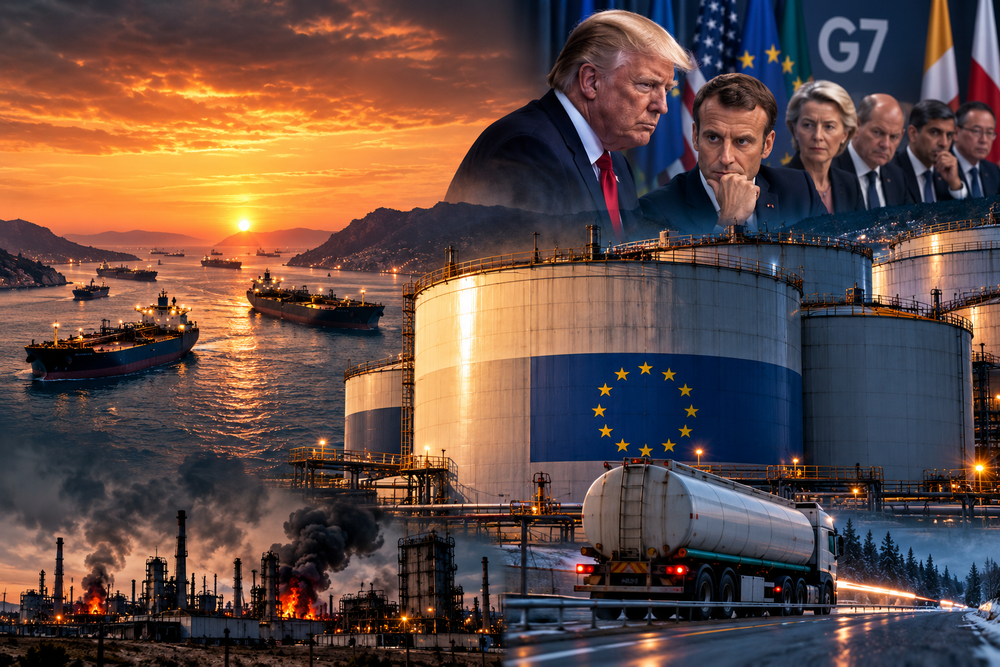
In the port of José, on Venezuela's eastern coast, a tanker waits. The vessel is fuelled. The crew is aboard. The crude is loaded. There are buyers at the other end. On paper the voyage is ready in every respect. The ship does not leave.
Not because of weather. Not because of any mechanical fault. Because the insurance was withdrawn. No underwriter will cover the voyage, not because Venezuelan crude is unsellable, but because insuring it risks exclusion from the wider financial system. One policy, one compliance failure, and an entire firm becomes untouchable. So the tanker stays at the dock, the oil stays in the tanker, and the revenue never arrives. No soldier blocks the port. No gun is raised. If a cargo cannot move and the payment for it cannot land, ownership has quietly stopped being operational.
This is the whole mechanism in a single image, and it explains why the country with the largest proven oil reserves on earth, more than Saudi Arabia, more than Iran, could be starved of the wealth beneath its own soil. Venezuela never suffered from a lack of oil. It suffered from an excess of it, inside a system where the right to sell, to insure, to ship, and to be paid is held by institutions located somewhere else. Possession sat in Caracas. Permission did not.
Oil Is Not the Motive. It Is the Mechanism.
Venezuela did not suffer from scarcity. It suffered from abundance. Beyond the oil it holds gold, coltan, iron ore, bauxite, natural gas, and freshwater, the full inventory of a continent's resource base concentrated in one jurisdiction, and it sits astride the geography between the producing south and the consuming north. These were never theoretical assets. They existed, and they still do. What destabilised the country was not the absence of material or the absence of capacity. It was exposure. The wealth was real, the contracts governing it were coming up for review, and the inherited architecture of extraction and settlement suddenly became visible as architecture, which is to say it became something that could be inspected, contested, and taken.
The robbery does not begin at the wellhead. It begins at access. Who may sell the oil. Who may insure the voyage. Who may transport the cargo. Who may receive the payment. Control those four gates and the barrel in the ground becomes inert, a number on a ledger that cannot be turned into money. The oil can stay underground while its value is neutralised. The country can keep its flag while losing its future.
Call it sanctions if the word is comfortable. What matters is the function. Sanctions are described, almost always, as nonviolent pressure, a humane alternative to war. That description is false. They do not strike at a government. They strike at the systems that keep a society alive, the banking, the logistics, the insurance, the credit, the spare parts, the invisible infrastructure that lets a modern state function at all. Hospitals do not fail because a president is corrupt. They fail because the transactions that buy medicine are blocked. Food does not vanish because an ideology failed. It vanishes because the payment channels disappeared. The cause is then quietly lifted out of the frame, and what remains is presented as proof of internal rot. Cut the oxygen and blame the breathing, and the conclusion writes itself.
When Negotiation Became the Threat
It is worth asking what Venezuela actually did to earn the machinery, because the answer is not what the dysfunction narrative implies. The pressure did not intensify when the country became chaotic. It intensified when the country began treating its own ownership as real.
For decades the architecture of extraction, shipping, insurance, and settlement around Venezuelan oil was inherited rather than examined. Terms were ceremonial. Access was assumed. Then the terms started to be reviewed, contracts that had been treated as permanent were reopened, and the country began behaving as though the wealth beneath it was genuinely its own to direct. That is the moment the tone changed. Not when ideology hardened, but when paperwork did. Real ownership is disruptive precisely because it introduces friction into systems built on predictability, and the systems that move global oil prize predictability above almost everything. Stability, in this vocabulary, does not mean peace. It means compliance without friction. A government that asserts genuine control over its resources is, by definition, a source of friction, and friction is the thing the architecture is designed to remove. Venezuela was not punished for failing. It was pressured for the moment it stopped being reliably compliant, and the punishment was dressed, afterward, as a response to the collapse the pressure produced.
The Siege With No Word for Siege
The genius of the method is that no order is ever given. The Office of Foreign Assets Control, the sanctions arm of the United States Treasury, does not telephone a bank and issue a command. It updates a list. It publishes guidance. It issues an advisory worded so carefully it could never be accused of intent. Banks are reminded of obligations they already understood. Insurers are invited to consider their exposure. Compliance departments are asked to reassess risk. Nothing is forbidden. Everything is understood.
What follows is not enforcement but withdrawal, and withdrawal spreads on its own. A bank steps back. Another follows. An insurer reassesses. A shipping line reroutes. Soon the economy is not sanctioned by decree. It is abandoned by consensus, each actor retreating one prudent inch further than required, every step defensible in isolation, the aggregate indistinguishable from a blockade. This is the part worth holding onto. A bank that processes a Venezuelan payment does not break the law. It invites attention, and attention has cost, and cost is enough. No sanction is required when hesitation does the work.
Money is imagined as something passive, a neutral medium that simply moves. It is nothing of the kind. It is the quietest weapon in the system because it never has to threaten. It only has to refuse. Most countries do not hold their wealth where they spend it. International trade runs on correspondent banking, a chain in which local banks depend on globally connected institutions to clear payments and settle accounts across borders. Those relationships are not rights. They are privileges, and privileges can be revoked. Lose them and money stops travelling. The funds still exist. The accounts stay open. The ownership is never disputed. What disappears is velocity, the right to arrive. You can own something completely and be unable to touch it, and the patient at the end of a procurement chain that never officially broke learns this first.
Insurance Is Where Trade Asks Permission
Two systems do most of the quiet work, and neither is a government. The first is insurance. Ships do not sail without it and cargo does not move without coverage, so no insurer ever has to ban a destination to make it unreachable. It only has to adjust a premium, request additional documentation, or decline without comment. Lloyd's of London does not issue decrees. It prices behaviour. When underwriters begin to hesitate, not uniformly and not publicly, each decision defensible on its own terms, the aggregate effect needs no coordination at all. Shipping lines read the price and learn the lesson. Routes change. Flags change. Ports become inconvenient. The sea stays open. Access does not.
The second system is the geography of money itself. A payment does not travel directly from sender to recipient. It passes through correspondent banks, clearing institutions, and jurisdictions that exist less as places than as permissions, and every crossing is a question, and every question is a chance to pause. A payment from Caracas to anywhere else must cross borders it cannot see, and at each one it can be reviewed, then reviewed again, then routed through an additional check. The funds are not seized. They are suspended mid-motion. The balance stays visible and the ownership stays uncontested while the velocity quietly drains away. This is the cruelty specific to financial modernity. You can possess something in full and be unable to make it move, and the first people to feel it are never the officials. They are the hospital procurement officers whose medical suppliers require insurance, whose insurers require banking assurances, whose banks require compliance clearance, whose clearance requires a patience the patient at the end of the chain does not have.
Compliance as Enforcement
It is worth sitting inside the decision that does the actual damage, because it is not made by a government at all. It is made by a mid-level officer in a compliance department, and it is entirely reasonable. The officer is not asked whether the sanctions are just. That is not the question on the desk. The question is whether processing a particular transaction is safer than declining it, and the honest answer is almost always that declining is safer. Approving it might be lawful, but lawful is not the same as safe. Approval invites an audit, a query, a note in a file, the faint possibility of a penalty that could cost far more than the fee on this one payment. Declining costs nothing visible. So the officer declines, and is right to, and the institution is marginally more secure for it.
Multiply that single rational choice across every bank, every insurer, every shipping line, every supplier, and the country on the other end is sealed off without anyone having decided to seal it. This is the quiet brilliance of the architecture. It does not require malice or even agreement. It requires only that each actor protect itself, and self-protection, aggregated, produces a siege. The economy is not sanctioned by an order anyone signed. It is abandoned by the sum of a million prudent refusals, and prudence, unlike conspiracy, leaves no fingerprints and needs no coordination.
The Charge Is Always Drugs
When a government presides over wealth that cannot be taken openly, a particular accusation arrives with mechanical precision. Not oil. Not access. Not control. Drugs.
It is not chosen because it is the strongest claim. It is chosen because of what it does. Once a head of state is labelled a narcotics trafficker, sovereignty stops functioning as a shield. A president becomes a suspect. A country becomes a case file. Its assets become evidence. Intervention no longer needs a mandate. It needs only jurisdiction, and a criminal charge manufactures jurisdiction out of thin air. The case works before it is proven, because its purpose was never judgment. Its purpose was access.
The Venezuelan case carried the charge in its documented form. In March 2020 the United States Department of Justice indicted Maduro and fourteen current and former officials in the Southern District of New York for narco-terrorism, alleging a conspiracy with the Colombian guerrilla group FARC to flood the United States with cocaine through the Cartel de los Soles, the Cartel of the Suns, named for the insignia worn by Venezuelan generals. A reward was posted for his arrest, fifteen million dollars at first. In January 2025 it rose to twenty five million. In August 2025, after the Treasury designated the cartel a global terrorist organisation, it doubled again to fifty million. The charge had existed for five years as a legal artifact. What changed in 2025 was not the evidence. It was the decision to convert the artifact into an operation, and the reward climbed in step with that decision, not with any new proof.
The selectivity gives it away. If narcotics were truly the standard, the map of targets would look nothing like it does. The largest trafficking corridors would not run under the protection of allied governments. The militias with documented roles in the drug trade would not receive weapons, training, and intelligence. Whole alliances would collapse under the weight of their own evidence. Drugs are not the crime being punished. They are the label applied when punishment has already been decided, and the only variable that selects the target is whether the target still has something worth taking and has lost the alignment that used to protect it.
When the Mechanism Finished
For years this reading rested on inference. The sanctions were visible, the compliance regimes were visible, the indictment was visible, and yet the conclusion, that all of it was a machine for transferring control of the oil, had to be argued. In 2026 the argument ended, because the machine completed its cycle in the open.
The escalation also acquired, for the first time in this case, open force. In September 2025 the United States military began striking vessels in the Caribbean under what was later named Operation Southern Spear, after deploying warships to the region in mid August. The first strike, announced on September 2, destroyed a boat the administration said had left Venezuela and killed all eleven aboard. By the turn of the year the campaign had reached at least thirty three strikes and more than one hundred and ten people killed. It drew heavy legal scrutiny. Members of Congress and human rights lawyers argued the strikes amounted to extrajudicial killings carried out without congressional authorisation. The first strike drew a specific war-crime allegation, after reporting that survivors of the disabled boat were killed in a follow-up strike carried out under an order to leave no survivors, an account the Pentagon called false. The decisive detail, for the argument here, is that the military produced no public evidence that any of the vessels carried drugs. The targets were declared to belong to designated narcoterror groups, and the declaration was treated as sufficient. The label did the work that evidence would normally be required to do, in international waters, with lethal force, in full view.
The sequence is a matter of public record. In July 2025 the United States designated the Cartel de los Soles, the network it says is run by senior Venezuelan officials, as a terrorist organisation. In August the State Department doubled the reward for Nicolás Maduro to fifty million dollars. Through the autumn, United States Southern Command began striking vessels in the Caribbean it described as drug carriers. In December the seizures of sanctioned tankers began. Then, on January 3, 2026, American forces took Maduro in a military operation in Caracas and flew him to a detention center in Brooklyn to await trial on charges of narco-terrorism. His vice president and oil minister, Delcy Rodríguez, was sworn in as acting president. Washington described her as willing to work with the United States; she herself called the operation a kidnapping, so the cooperative framing was Washington's, not hers.
What happened next removed any remaining doubt about what the operation was for. Within weeks, Venezuelan oil was moving again. The United States Secretary of Energy visited Caracas in February. By his own account, sales of Venezuelan oil had already passed a billion dollars since the capture, with around five billion more expected in the months ahead. The license under which Chevron operates in the country, revoked and wound down in early 2025, was reopened and widened, and new licenses were issued for other firms to import and export Venezuelan crude. The tanker that could not sail under the man charged with drug crimes sailed freely once the gate was held by someone compliant.
Read the order of events and the determining variable names itself. The drug charge produced the jurisdiction. The jurisdiction produced the capture. The capture produced, almost immediately, the thing the sanctions had blocked for years, which was the flow of oil into approved hands. This is the interpretation, and it should be marked as one. None of these facts requires Maduro to be innocent of anything. The thesis does not depend on his guilt. It depends only on the observation that the moment the gate changed hands, the oil that had been called untouchable became, overnight, a five billion dollar opportunity. Whatever else the charges were, access was the outcome, and access arrived on schedule.
The Tell in the Succession
There is one more detail that settles the question of what the operation was for, and it is the identity of who inherited power. For years the pressure on Venezuela was justified in the language of democracy. The sanctions were said to serve free elections, the indictment to serve the rule of law, the whole campaign to serve the Venezuelan people against a usurper. A genuine democratic restoration would have produced an election.
It did not produce an election. It produced Delcy Rodríguez, Maduro's own vice president and oil minister, described by Washington as the acting authority and as willing to work with the United States. The figure most associated with the previous government's command of the oil sector became the figure through whom the oil resumed flowing, because she was compliant. No vote intervened. The democratic justification, carried for years, delivered an unelected successor and a set of oil licenses. When the stated goal is democracy and the achieved goal is a cooperative custodian of the resource, the gap between the two is the real objective, standing in plain view. The variable that was satisfied was not legitimacy. It was access, and access does not require an election. It requires a gatekeeper who says yes.
Optional Law
International law did not disappear from Venezuela. It became selective. The sanctions were not the product of any multilateral consensus or any court. They were unilateral, enforced through financial dominance rather than adjudication. No tribunal ruled. No treaty was broken. The law existed. Its application did not.
This is the real condition the case exposes, and it is larger than one country. When enough of the world depends on the same currency, the same clearing systems, the same insurance markets, law becomes situational. It can be activated against one actor and suspended for another, applied to an adversary and waived for a friend, and the difference between the two need never be explained, because nothing was ever written down as a decision. Optional law is not lawlessness. It is selective activation. The rules remain. The rights remain. What fluctuates is enforcement, and what disappears, when it is convenient, is obligation. This is power without exposure. It can be denied, defended as neutral, reversed in theory, and applied asymmetrically without a single admission.
Why the Dollar Makes It Possible
None of this would work without the layer beneath all the others, the one that makes a unilateral decision in Washington binding on a bank in Geneva or a shipper in Singapore. That layer is the dollar.
The dollar is not merely the currency Venezuela prices its oil in. It is the currency the world settles in, and the settlement runs through infrastructure that touches the United States. A payment denominated in dollars, between any two parties anywhere on earth, almost always clears through a correspondent account in the American banking system or through dollar-clearing infrastructure under American jurisdiction. That single fact converts a domestic legal power into a global one. The United States does not need the cooperation of other governments to enforce a sanction, because it does not need to reach the foreign bank directly. It only needs to reach the dollar, and the dollar comes home to clear. A European firm that violates an American sanctions designation risks losing access to dollar clearing, and a firm cut off from dollars is cut off from most of world trade. So the firm complies, not because its own government ordered it to, but because the alternative is exclusion from the financial system itself.
This is the deepest gate, the one behind the gates of insurance and shipping and correspondent banking. Control of the settlement currency is what allows access to be withdrawn from a country that has done nothing illegal under its own law or under international law. It is why the same mechanism reaches Iran, Cuba, Russia, and Venezuela alike, and why allies enforce measures they did not vote for and often oppose. The power is not military and it is not, in any ordinary sense, legal. It is infrastructural. Whoever owns the layer the whole world settles through can govern conduct far beyond any border, and can do it quietly, by refusing rather than commanding.
The Pattern That Travels
Venezuela is useful to study because it is clear. The same architecture has run, with local variations, through every country that held something valuable and lost its alignment at the wrong moment.
Iran was never fully cut off, which is the myth. Humanitarian exemptions existed, medicine was technically permitted, food was not banned. In practice everything passed through the same corridors, and the banks hesitated, the insurers declined, the shipping lines asked for guarantees no one could give. Hospitals closed not because the law demanded it but because the timing did. Cuba learned a different lesson, that sanctions do not need escalation, only duration. Hold the corridor shut for long enough and scarcity stops feeling imposed and starts feeling inherited, and no enforcement is required once a society has learned to plan around the absence. Iraq in the 1990s supplied the blueprint. An entire state was administered into ruin under a sanctions regime that preserved its own legality through the Oil-for-Food program, which allowed Iraq to sell oil under supervision and buy approved humanitarian goods, while the country's institutional capacity collapsed underneath the paperwork. The water treatment plants degraded for want of spare parts that were held up in review. By the contemporary United Nations estimates child mortality rose, though the magnitude was later disputed. The suffering was extensively documented, and yet no single actor could be assigned the blame, because the harm was distributed across a thousand procedural decisions, each defensible, none decisive. That diffusion is not a flaw in the method. It is the method. Sanctions survive scrutiny precisely because they spread causality so thin that no one is ever found holding the knife, and Iraq proved the design could ruin a nation while every individual step remained, on its own, lawful and humane in description. After 2014 Russia tested the elastic version, not stoppage but friction, every transaction routed the long way, the system tuned rather than declared, measuring how much delay an economy could absorb before its behaviour changed.
Each case refined the method. Less visibility. More legality. Fewer soldiers. More contracts. The objective held constant while the cost of achieving it fell. What Venezuela added to the sequence was the ending, the part the other cases left offstage, where the pressure finally converts into possession and the oil starts to flow into the right accounts while the deposed leader sits in a foreign jail.
The Honest Objection
The strongest case against this reading is straightforward, and it deserves to be stated at full strength. Perhaps the charges are simply true. Perhaps Maduro did run a narco-terror network, did flood the region with cocaine, did earn every count of the indictment, and the United States acted against a genuine criminal whose removal happens to have freed a long-suffering economy. On this account the oil flowing afterward is not a motive revealed but a benefit recovered, the natural dividend of removing a kleptocrat who had wrecked his own industry. The sanctions, in this telling, were the legitimate pressure of a law-governed order against an outlaw regime, and the capture was justice, not theft.
This objection is serious, and it cannot be dismissed by asserting Maduro's innocence, which is not in evidence and is not the point. The answer is that the thesis survives whether or not he is guilty. Guilt does not explain selectivity, the fact that comparable or larger trafficking networks operate for years under the protection of allied states without a single tanker seized or a single reward posted. Guilt does not explain timing, the fact that the wealth declared untouchable under sanctions became a five billion dollar pipeline within weeks of the gate changing hands. A legal order that activated only against the holder of the largest oil reserves on earth, and stood down the moment a compliant successor was installed, is not behaving like a legal order. It is behaving like an access mechanism that happens to speak in the language of law. The charges may be true. The pattern is true regardless, and the pattern is the finding.
The Manufacture of Silence
A method this visible survives only because it is absorbed rather than hidden, and absorption is something the system produces deliberately. Sanctions reshape economies, but their deeper work is on expectations. Institutions adapt first. Banks recalibrate their risk models, insurers adjust their exposure, corporations reroute their logistics, and eventually individuals internalise the constraint and begin to plan around the absence. This is the quiet victory. Once a society organises itself around scarcity, power no longer has to act, because the scarcity has become ambient, simply the way things are. It is also why sanctions are so rarely lifted cleanly. Removing the rule does not restore the corridor. Trust does not return on command. The system remembers.
The story is kept legible by a particular use of complexity. Venezuela was never erased from the headlines. It was flattened into background noise, a standing crisis among other crises, explained each time as a mesh of factors in which sanctions appear alongside mismanagement, external pressure alongside internal failure. Each element may be accurate. Together they exhaust judgment, which is the function. Coverage tends to follow the visible outcome, and sanctions operate below the threshold of the visible, so by the time the stories of collapse and criminality dominate, the architecture is already complete and the narrative arrives not to explain the mechanism but to justify its effects. This is not a conspiracy of editors. It is sequencing. The damage happens inside compliance emails and unanswered payment requests, where no camera can go, and the report arrives afterward to make the suffering legible, and legibility, in the end, is what makes endurance possible.
What Venezuela Reveals
Every element of this case was public the entire time. The sanctions, the indictment, the compliance regimes, the financial choke points, the strikes, the bounty, the capture, the oil deals that followed. Nothing was hidden. And still, knowing changed nothing, because in a system where outcomes no longer depend on belief, exposure no longer functions as resistance. Truth documents. It no longer arbitrates.
Power no longer needs walls. It builds corridors and decides who may walk through them. When access is withdrawn nothing dramatic happens. The refinery still stands. The ports still exist. The contracts still carry signatures. Only movement stops, and the world learns, quietly, that permission matters more than possession. Venezuela was not invaded. It was disconnected, and then, when the disconnection had done its work, it was reconnected on new terms to new owners, with a former president in a Brooklyn cell to mark the transfer.
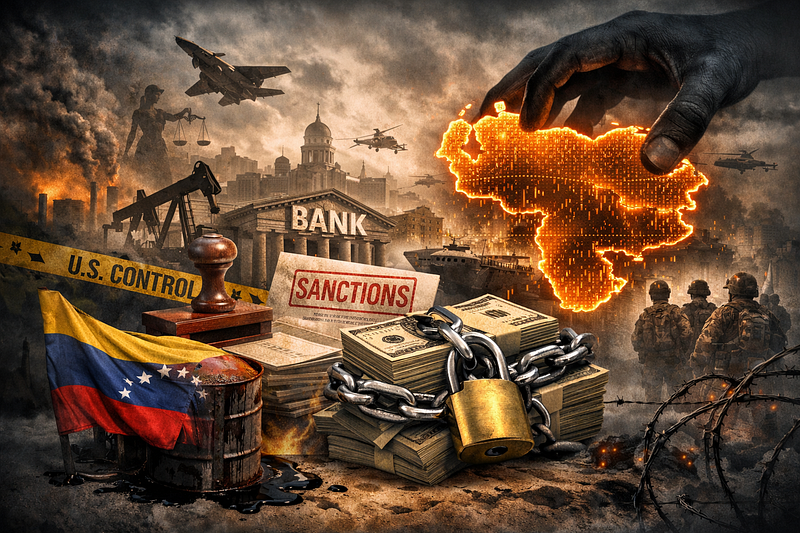
Calling it law does not change what happened. Calling it order does not reverse it. Calling it justice does not disguise it. Control changed hands, in the open, on the record, and the wealth resumed its flow toward those who held the gate. Venezuela is not a scandal. It is a signal, and signals are only sent when the sender is confident they will be absorbed.
Evidence Map
Facts, interpretations, forecasts, and disconfirming signals.
Core claim. The determining variable in Venezuela was control of access (the gates of sale, insurance, transport, and payment), not ownership of the oil; sanctions and the narcotics charge functioned as instruments to transfer that access, a reading confirmed when the 2026 capture of Maduro was followed within weeks by the resumption of Venezuelan oil exports into approved hands.
Evidence level. Facts (high): the Cartel de los Soles terrorist designation (July 2025); the fifty million dollar reward (August 2025); US Southern Command strikes on Caribbean vessels (from September 2025); tanker seizures (December 2025); Maduro's capture and transfer to Brooklyn (January 3, 2026); the post-capture oil sales and expanded Chevron and third-party licenses (early 2026). Interpretation (medium, marked): that drugs functioned as the access label rather than the operative motive, and that access was the determining variable; the thesis is explicitly framed to hold whether or not the charges are true. Forecast (speculative): that the same sequence (designation, pressure, removal, reconnection on new terms) recurs wherever a resource holder loses alignment.
What would confirm this. Continued normalisation of Venezuelan oil exports under the successor government with proceeds routed to approved firms; the absence of comparable enforcement against larger trafficking networks among aligned states.
What would disprove this. Venezuelan oil remaining under tight sanction after the change of leadership with no resumption of approved exports; or even-handed application of narcotics enforcement against allied governments of comparable or greater trafficking volume.
Watchlist. The structure of post-capture oil licensing and who holds the contracts; the durability of the Rodríguez transition; whether the Caribbean strike campaign continues once the oil flow is secured.