The Night Cargo
It begins in darkness.
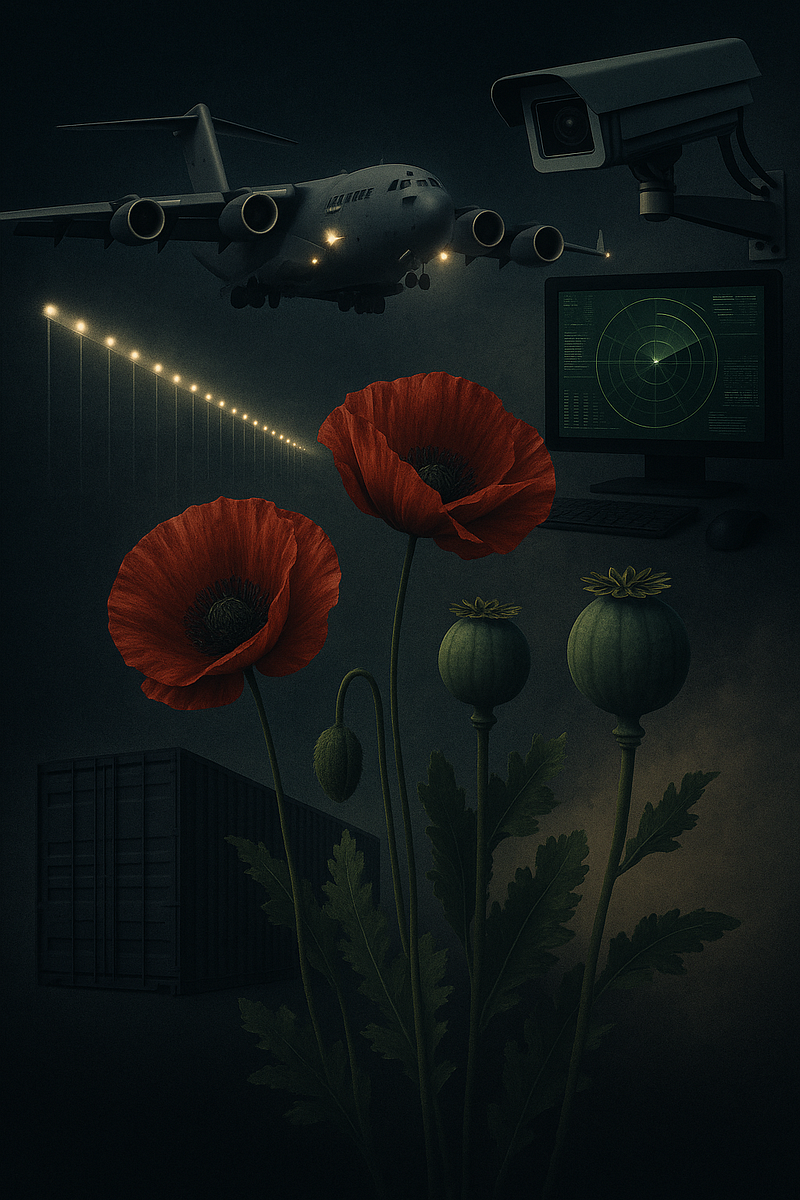
A C-17 descends through the dust above a forgotten airfield. The turbines groan against the heat; flares of static shimmer across the fuselage. Inside, the air smells of hydraulic oil and recycled breath. Cargo straps tremble like the pulse of something alive.
When the landing lights cut the runway, the world below becomes geometry: rectangles of concrete, lines of floodlight, silhouettes waiting in stillness. The rear hatch opens; a single vehicle drives out, headlights off. No customs, no declaration, no signature. Only motion.
The engines never stop. The crew remains aboard. The loadmaster ticks boxes on a handheld screen, his face lit by blue light. In less than twenty minutes, the aircraft rises again, carrying nothing that anyone will record. Somewhere, a manifest updates itself automatically: one code replaced by another, no human initials required.
Since 1945, the United States has built the most extensive logistical architecture ever conceived: seven hundred bases, ports, corridors, supply chains spanning more than eighty nations. Each one functions as a small republic, governed not by geography but by treaty. The Status of Forces Agreements that regulate them grant near-total immunity from local oversight.
“An empire is not measured by territory but by its corridors.”
Inside those corridors move the arteries of global reach: fuel drums, medical crates, microchips, refrigerated blood, humanitarian parcels, and objects whose purpose no one names. The flow never halts; it merely changes direction. Every sealed container is an act of trust, or an act of forgetting.
At dawn, the jet vanishes into a gray sky, leaving nothing but the echo of its turbines and the faint smell of kerosene over sleeping villages. And on a screen in a control room half a world away, a green dot turns white, marked delivered.
“In the silence of logistics lies the rhythm of power.”
The Architecture of Exemption
There is a moment in every empire when the map becomes paperwork.
The modern equivalent of conquest is not the taking of land but the writing of clauses. Under Status of Forces Agreements, American military operations enjoy a latitude unknown to any other institution on Earth. Their shipments are exempt from search; their staff from trial; their budgets from full disclosure.
The logic is circular: the base must be secure, therefore it must be sovereign; because it is sovereign, it cannot be inspected; because it cannot be inspected, it remains secure.
“Power survives by turning necessity into law.”
In host nations, the arrangement is sold as cooperation. The installations provide jobs, contracts, infrastructure. Yet they also carve out zones where local law dissolves. In Sicily, a warehouse becomes an enclave; in Bahrain, a dock becomes extraterritorial. These are not anomalies but blueprints: miniature exemptions scattered across the globe.
For auditors, the problem is both practical and philosophical. Budgets can be traced, but cargo cannot. The material flow moves faster than the paperwork designed to follow it. Even congressional committees see only summaries; each redaction is justified as security, each absence as discretion.
When civilian inspectors ask what passes through the sealed containers, the answer is always the same: classified material under operational necessity. The phrase means nothing and everything. It is the password of empire, the sound that ends inquiry.
“Assistance becomes the language through which power excuses itself.”
Occasionally, a leak reaches daylight: a misplaced invoice, a missing shipment, an audit that lists unverified assets. Then the apparatus flexes, not to deny but to dilute. Accountability is distributed across departments until it evaporates. The structure is so complete that it needs no conspiracy. Its perfection is its invisibility.
At night, the warehouses breathe. Forklifts hum, doors slide, lights blink. Somewhere, a soldier on watch checks a seal, nods, and writes a number that no one will ever question.
“The empire of supply expands not through conquest, but through compliance.”
The Golden Triangle Blueprint
Before there was Afghanistan, there was Laos.
Before drones and satellites, there were propellers and maps drawn by hand.
In the early 1960s, as the Vietnam conflict spilled westward, the jungle became a tangle of invisible borders. From a valley in the mountains of northern Laos, a small aircraft lifted off each morning at dawn. On its fuselage, faint lettering read Air America. Officially, it was a civilian carrier contracted for humanitarian work. In practice, it was the airborne skeleton of an undeclared war.
The pilots were a mixture of veterans and freelancers. They flew without insignia, without explanation. To the villagers below, they were ghosts in American machines, tracing silver lines across the mist. They delivered rice, medical kits, and ammunition; they returned with “agricultural exports,” a term that could mean anything and usually did.
“When war hides behind relief, the supply line becomes confession.”
The region they crossed had a name long before geopolitics discovered it: the Golden Triangle. The French had charted its contours as part of l’Indochine, noting its peculiar wealth, not of minerals or factories, but of soil and secrecy. Opium grew there as naturally as rice. The new conflict simply gave the harvest a destination.
In 1971, historian Alfred McCoy published The Politics of Heroin, a study that followed these routes from jungle fields to European ports. His findings were methodical: production had tripled since the beginning of U.S. operations. The pattern was not proof, but geometry. Every increase in secrecy coincided with an increase in value.
“Wars end. Logistics remain.”
To move supplies into the mountains, the U.S. built airstrips carved into hillsides. To move cargo out, it needed planes, fuel, contracts, and intermediaries. Each layer added distance between action and accountability. Each signature diluted the origin of what moved.
By the end of the decade, the network had perfected a model: the fusion of aid, intelligence, and commerce under a single logistical logic. It could deliver anything, anywhere, as long as no one asked what “anything” meant.
The blueprint was elegant. Civilian fronts masked military aims; humanitarian language softened geopolitical intent. The same companies that flew rice also flew weapons. The same contracts that paid for refugee relief built secret landing strips. Even the word mission acquired a double meaning: salvation and strategy fused in a single syllable.
“Secrecy does not hide systems; it sustains them.”
From Laos the pattern radiated outward to Cambodia, Thailand, and Burma until the distinction between map and route dissolved. What had begun as a regional operation became a prototype for global logistics: a machine that could fund itself, feed itself, and outlast every moral argument about its existence.
Decades later, the names would change, Bagram instead of Long Tieng, Kandahar instead of Vientiane, but the rhythm remained the same. Night flights. Coded cargo. Silence.
At the edge of every empire lies a place where geography meets deniability. The Golden Triangle was that place, a classroom for the next half-century of covert infrastructure.
“The first empire to master logistics no longer needs victory.
It only needs continuity.”
The Invisible Currency
Every war invents its own economy.
Some run on ideology, others on resources. The modern ones run on liquidity, untraceable, fluid, borderless.
When the Vietnam War ended, the aircraft stopped flying, but the funding channels stayed open. The agencies that had mastered secrecy in Asia now applied it elsewhere. The Cold War required motion, weapons, intelligence, money, but Congress could only approve what it could name. Everything else needed another wallet.
“Every secret war needs an unspoken budget.”
By the early 1980s, a new geography of finance was taking shape. It stretched from Washington to Geneva, from Panama to the Cayman Islands: a constellation of banks, shell firms, and charitable fronts. On paper, they moved development aid. In practice, they moved discretion.
In 1986, the Iran–Contra affair made that invisible economy briefly visible. Officially, it was a policy misstep: arms sold to Iran to free hostages, profits redirected to fund the Contra rebels in Nicaragua. Unofficially, it was a revelation of method. Intelligence officers, middlemen, and ex-military contractors built a shadow supply system that bypassed both law and budget.
The Kerry Committee Report of 1989 phrased it carefully: “individuals involved in narcotics trafficking were associated with Contra operations.” No accusation, just adjacency. Yet that phrasing revealed the quiet doctrine of modern power: the state may denounce a trade in public and depend on it in private.
“Policy and profit share the same accountants.”
The structure proved durable because it was logical. To sustain a global military posture, funds must move faster than votes, and deniability must move faster than law. Money is the purest weapon because it travels as silence.
By the time Congress closed one loophole, the architecture had already evolved. Front companies sprang up in Miami, Beirut, and Luxembourg. Private aircraft carried “relief cargo” for undisclosed clients. Auditors followed ledgers that ended in offshore trusts protected by attorney–client privilege. The system didn’t hide its existence, it hid its intention.
Meanwhile, a new institution quietly rose: the Bank of Credit and Commerce International (BCCI). Founded in 1972, it grew into one of the world’s largest private banks by courting those who valued privacy over profit. Dictators, intelligence services, and multinational firms used the same doors, the same ledgers, the same passwords. When BCCI collapsed in 1991, regulators discovered accounts belonging to arms dealers, drug networks, and covert operations. The scandal wasn’t what they found, it was how long everyone had known.
“Corruption, when globalized, becomes administration.”
The parallel systems multiplied. In Italy, Banco Ambrosiano imploded under debts tied to secret funds routed through the Vatican Bank. In London and New York, lawyers built new havens for unregistered capital. In Zurich, wealth managers offered anonymous “diplomatic accounts” to clients described only as strategic. Each investigation ended the same way: a fine, a reform, a silence. None dismantled the structure because the structure was never officially built. It emerged from policy the way a shadow emerges from light, automatically, inevitably.
“Every oversight mechanism becomes part of the machinery it observes.”
By the early 1990s, the United States had perfected not just military supremacy but financial omnipresence. The dollar became the bloodstream of the planet. Every transaction, legal or otherwise, flowed through its arteries. It was not domination in the classical sense; it was something subtler, the normalization of invisibility.
A senator once asked during a closed hearing: “Who supervises the supervisors?” The answer, recorded in the minutes, was a single word: Continuity.
“The true currency of empire is not gold or paper. It is exemption.”
The Return to the Poppy Fields
History has a strange sense of repetition.
Empires rarely visit new landscapes; they revisit the ones that never stopped yielding.
When American forces entered Afghanistan in late 2001, the narrative was clear: counter-terrorism, liberation, reconstruction. The imagery spoke of flags and promises, not of fields. Yet beyond the perimeter of Bagram Air Base, the land glowed red with petals. Whole provinces shimmered in the morning light, Helmand, Kandahar, Nangarhar, their soil turned to a quiet form of gold.
By 2004, reports from the United Nations Office on Drugs and Crime (UNODC) recorded what few newspapers printed: opium cultivation had doubled since the invasion. By 2007, production reached 8,200 metric tons, supplying almost 90% of the world’s heroin.
“The same war that claimed to end the trade became its perfect infrastructure.”
Each harvest followed a rhythm as predictable as the fiscal year. Farmers plowed and planted; militias taxed; police escorted convoys to regional hubs. Trucks rolled through checkpoints bearing sacks marked flour or cement. Above them, American helicopters traced the same valleys, guardians of stability, unaware or unwilling to see what stability meant.
Inside the forward bases, logistics officers typed coordinates into glowing screens. Their concern was efficiency: how to move fuel, ammunition, medical supplies. None of them listed “poppies” on their manifests, yet the routes they maintained kept the trade alive. The war had become a circulatory system, pumping money and material through arteries that no civilian authority could inspect. The supply chain that fed soldiers also fed shadow economies.
“In the absence of oversight, everything becomes infrastructure.”
Outside the wire, DynCorp trained Afghan police, KBR built roads, Fluor ran supply depots, all under multibillion-dollar contracts audited but never truly examined. Each company operated with immunities and each subcontracted to local partners whose names dissolved in translation. Some of those roads led directly into the heart of the opium belt.
The paradox was visible from space. Satellite images from NASA’s MODIS program captured the expansion of irrigated land in Helmand, green ribbons through desert dust. Development agencies hailed it as progress; narcotics analysts read it as prosperity of another kind.
In Kabul, U.S. and Afghan officials launched the Counter-Narcotics Strategy. Billboards proclaimed “Poppy-Free Provinces by 2013.” The same year, UNODC reported record highs. Eradication campaigns burned fields in one district and pushed cultivation into another. The cycle adapted faster than policy.
“Control doesn’t end a market. It redistributes it.”
By the mid-2010s, the logic had inverted. The War on Drugs and the War on Terror were no longer separate theaters; they had merged into a single administrative machine: raids, seizures, reports, funding, repetition. Every statistic justified more intervention, more budgets, more permanence.
Local farmers understood the economics better than any visiting economist. A hectare of wheat brought thirty dollars. A hectare of poppy, three thousand. In a war zone, morality and survival rarely share the same field.
Contractors circulated through compounds built to resemble small cities, air-conditioned, satellite-connected, ringed by T-walls. They discussed security and governance over instant coffee while Afghan laborers unloaded trucks outside. Both groups depended on the same logistics that neither controlled.
The poppy itself became a metaphor: fragile, beautiful, deadly, cultivated by everyone and owned by no one. When the Taliban taxed it, they called it revenue. When foreign donors ignored it, they called it realism. When economists graphed it, they called it development risk. When soldiers flew over it, they called it landscape.
“Every empire inherits the crops of the one it replaces.”
In August 2021, the last American planes left Kabul. Cameras focused on the desperate crowd at the airport; few noticed the fields beyond the city, still blooming. The war was over in name, but the routes remained. The warehouses in Dubai, the contractors in Virginia, the accountants in Zurich, none were demobilized.
From above, the Helmand River still looks like a vein, pulsing through dust. It carries not ideology but logistics: irrigation, supply, continuity. The flowers come and go; the system endures.
“The longest wars are fought not for land, but for the means of movement.”
The Invisible Partners
Every route on earth ends in an office.
The trucks that leave the valley do not vanish; they change costume. Somewhere between the border and the balance sheet, the cargo becomes numbers, and the numbers become normal.
In the twenty-first century, power no longer hides in castles or ministries. It hides in spreadsheets: cells that glow on monitors in Zurich, London, or Washington, where the names are replaced by codes and the accounts are protected by treaties older than most wars.
“Transparency ends where alliance begins.”
The Contractors’ Republic
When the soldiers rotate home, the contracts remain.
The logistics of empire have long been outsourced to private industry, corporations with patriotic logos and foreign shareholders. They build, transport, guard, feed, and repair. Their emblems hang beside flags; their invoices carry the weight of law.
In Afghanistan alone, the Pentagon once listed more than 1,900 private contractors, from fuel suppliers to intelligence analysts. Their combined budgets exceeded those of many nations. For every uniformed soldier, there were at times three civilians, cooks, mechanics, translators, engineers, mercenaries, all bound by clauses, not oaths.
Each contract begot a subcontract; each subcontract a shell company. By the time investigators traced a missing shipment or overpaid invoice, the trail had already dissolved into a thicket of limited liability.
“To outsource a function is to outsource memory.”
The arrangement suited everyone. Governments could wage wars without drafts or debates. Corporations could profit without visibility. Citizens could believe in missions defined by clean language: stability, reconstruction, democracy. In this quiet republic of paperwork, loyalty is measured in billing cycles, not ideals.
The Banks That Never Sleep
Beyond the bases and boardrooms lies the bloodstream of modern empire, the financial circuit that never sleeps. The same banks that handle humanitarian relief also manage defense retainers, intelligence stipends, and reconstruction escrow. What separates them is not law but labeling.
In 2012, HSBC paid a record fine for facilitating billions in illicit transfers tied to narcotics networks. In earlier decades, Banco Ambrosiano collapsed under the weight of covert funds routed through the Vatican Bank (the Institute for Religious Works). And the BCCI scandal of the 1980s revealed how intelligence agencies and traffickers shared a single cashier’s window. Each time, the response was ritual: shock, inquiry, reform, forgetfulness. The architecture of secrecy remained, because dismantling it would cripple the very institutions that depended on it.
“The safest vault is the one that guards everyone’s secret.”
Swiss bankers still use the term Nummernkonto, numbered account. In the digital age, the numbers have no metal key, only encryption keys. They travel faster than any cargo plane, immune to customs, immune to scrutiny. What began as offshore finance evolved into off-world finance: data mirrored across clouds, beyond jurisdiction. A new neutrality, algorithmic, invisible, absolute.
The Vatican Connection
Not all secrecy belongs to states. Some belongs to faith.
The Vatican’s financial arm, the IOR, is technically not a bank but a “religious institution managing assets for the Holy See.” Its records are shielded by canon law; its clients by discretion.
In the 1970s, Italian magistrates investigating the Banco Ambrosiano collapse found connections between the IOR, intelligence intermediaries, and political funds routed through Latin America. No verdicts proved intent, but the pattern was unmistakable: sacred purpose as plausible cover.
Rome never traded in opium or arms, it traded in legitimacy. A blessing, a handshake, a signature could wash almost anything clean. In the theater of power, morality is the most valuable form of currency.
“Moral immunity lasts longer than diplomatic immunity.”
The Quiet Exchange
Follow the routes and they converge on the same image: a conference room without windows, bottled water on the table, and a map projected on the wall, one not of countries, but of connections. There, power speaks a language without verbs: flows, equities, partnerships, compliance. No one mentions war. No one needs to. The infrastructure of conflict has merged with the infrastructure of commerce.
A logistics officer once told an interviewer, “We just move what’s asked.” A banker later said, “We just process what’s approved.” Between those two sentences lies the empire itself.
“Control is the art of making responsibility disappear.”
The Invisible Partners form a paradox. They build nothing, yet without them nothing moves. They obey every regulation, yet define the rules they obey. Their anonymity is not an accident; it is an achievement.
At the edges of this network stand the unacknowledged custodians of continuity: auditors who sign what they cannot see, lawyers who explain what cannot be defined, and public officials who confuse oversight with faith. The result is a structure that resembles religion more than administration: rituals of documentation, confessions of compliance, absolution by report.
“In the modern world, belief has become paperwork.”
The Logistics of Power
The scale itself is revelation.
More than seven hundred installations; a fleet of transport aircraft larger than most national airlines; supply lines reaching from Guam to Rota, from Djibouti to Ramstein. The United States maintains a global infrastructure of movement so vast that it operates like a natural force: routine, unquestioned, almost invisible.
Under Status of Forces Agreements, every shipment, every convoy, every digital transmission passes through layers of immunity. Cargo can cross frontiers without customs; data can travel across satellites without local jurisdiction. What began as necessity, rapid deployment in crisis, has matured into architecture: a system that functions on autopilot.
“Power survives by moving faster than accountability.”
This velocity makes oversight nearly impossible. Auditors can measure expenditure, not direction; legislators can vote budgets, not contents. The sheer complexity of the apparatus, civilian, military, private, creates its own weather of secrecy.
For host nations the trade-off is constant: security for sovereignty. A base brings employment, training, infrastructure; it also removes a portion of national law. Over time, the exception becomes tradition.
At the center of this web is logistics itself, neither good nor evil, only efficient. It does not conquer territory; it connects it. It does not demand loyalty; it demands continuity.
“When movement becomes the measure of success, stillness becomes suspicion.”
The genius of this empire is its neutrality. It does not need to rule, only to circulate. Its aircraft, ships, and servers ensure that the world remains dependently in motion.
The Routine of Empire
At sunrise, the engines wake.
Across continents, runways ignite, data streams surge, and the same coordinates light up again, unchanged, unquestioned. What began as emergency has ossified into instinct. The network no longer serves a mission; it is the mission.
“Continuity is the empire’s camouflage.”
Every system tells itself a story of necessity. Each shipment, each base, each treaty repeats the same logic: we move, therefore we exist. Oversight counts the movement, not the motive. Power does not need to hide when it can define normality.
Inside control rooms, operators watch dots glide across digital maps, tidy, precise, almost beautiful. To them, it is order. To history, it may look like inertia disguised as progress.
“The greatest illusion of control is mistaking repetition for purpose.”
For allies, the bargain remains steady: security in exchange for silence. For the citizens funding it, distance becomes comfort, if power feels omnipresent, it must also be benign. And for those inside the apparatus, ethics dissolves into schedule. The flight departs; the form is signed; the day is complete.
The logistics of empire have achieved what armies never could: obedience without occupation, dominance without spectacle.
The Moral Equation
Every civilization builds one structure it refuses to question. For this one, it is logistics, the art of movement without memory. The ability to deliver has replaced the ability to deliberate. What was once oversight has become choreography.
“Efficiency, left unchecked, becomes belief.”
The danger is not corruption, but forgetfulness. When everything works, nobody asks why. The archive grows thicker; the conscience thinner. Even morality is managed as a process: reviewed annually, renewed automatically, never felt.
Empires do not fall from exposure, they fade into maintenance. They survive by turning vigilance into habit and habit into virtue. That is the quiet genius of the empire of supply: it no longer conquers, it continues.
Closing Reflection | Beyond the Corridors
At dusk, the sky fills again with contrails, white scars across a fading blue. The planes rise, the paperwork closes, and the machinery of motion resets for tomorrow. Nothing ends, nothing begins. Only the rhythm remains.
And when night comes, the sound changes. No fleets, no flags, only signals. Invisible routes bounce between satellites and servers, mapping a world that no longer ends at the edge of its runways. The empire has learned to move without weight.
“Where engines once roared, algorithms whisper.”
What once demanded fuel now runs on attention. Each click, each contract, each algorithmic command becomes another pulse in a network built for obedience, not for meaning. The frontier is no longer physical; it is cognitive. The corridors have entered the mind.
“When control becomes invisible, understanding becomes resistance.”
Treaties that once governed bases now define digital exemptions. Data moves as cargo once did, classified, encrypted, immune. Law follows, but always a few steps behind.
“Regulation is the paperwork of yesterday’s empire.”
Even the rhetoric of sustainability bends to this logic. The supply chain that claims to protect the planet burns more fuel than most nations. Green becomes a color of administration, not of conscience.
“Efficiency has replaced virtue as civilization’s favorite excuse.”
Sanctions turn into markets; surveillance into service. Everything that restricts also sustains. Power no longer hides; it multiplies under new names, innovation, resilience, security.
“Continuity is conquest performed in silence.”
The Critical Eye
This chapter is not a verdict; it is an invitation.
What you have read are patterns, not accusations, verifiable structures that deserve scrutiny, not faith. Every statistic, treaty, and contract mentioned here exists in public record, yet their convergence raises questions that only collective vigilance can answer.
“The reader is the last auditor.”
Ask yourself what remains unseen between policy and practice, between oversight and operation. The empire of supply thrives on our comfort with routine; its antidote is awareness.
“To doubt is not disloyalty. It is citizenship.”
Final Reflection
At night, the glow of engines has merged with the glow of screens.
The world hums in perfect rhythm, a choreography of logistics and belief.
No explosions, no banners, only the quiet, flawless function of movement.
And somewhere, stubborn as static in the signal, one question remains:
“If everything moves in the name of stability, who decides when it should stop?”
Further Reading from The Manifest
Related from The Manifest Archive