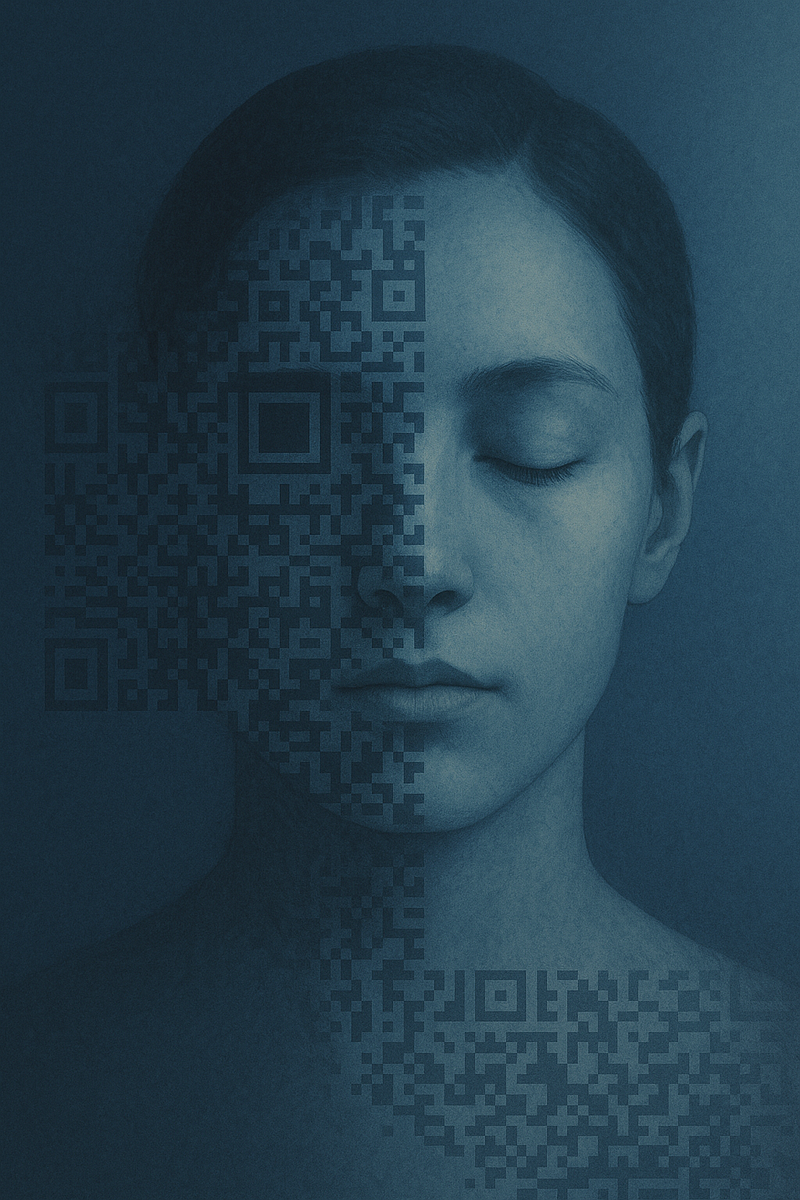
The visible story is convenience and inclusion: a faster gate, a key that guards your name, an identity for the billion who have none. The determining variable is that identity becomes a precondition you must actively maintain to participate, and a single registry that can grant access can also withdraw it.
The gate hums and a green light blinks, and a person leans toward the glass. The motion is now so ordinary that it has stopped feeling like anything: a tap at the turnstile, a face held up to a camera, a thumb pressed to a reader before the day can proceed. We do it at the airport, the bank, the phone shop, the welfare office, and each time the same quiet exchange takes place. The system asks not who you are but for proof, and on receiving the proof it lets you through. The light changes. The next person steps forward. The rhythm repeats, calm and total, and it feels like a courtesy to a machine that opens every door.
What that rhythm conceals is a reversal in the nature of being known. For most of history, being counted was something a power did to you: a census taker came, a clerk wrote you down, and the record sat in a ledger you would never see. Digital identity inverts the direction. Now you must present yourself to be recognized, repeatedly, actively, in order to function at all, and the burden of legibility has shifted from the state that wants to see to the citizen who must arrange to be seen. To exist administratively is no longer a fact about you. It is a thing you do, many times a day, by authenticating. And the moment existence becomes an action that a system must approve, the system that approves it holds a power that no census ever did: the power not merely to record you, but to switch you off.
The line you must be on to exist
The premise of a modern identity system is simple and, stated plainly, severe: there is a list of recognized persons, and to act in the formal world you must be on it. The list decides who can open a bank account, receive a benefit, buy a regulated SIM card, board a domestic flight, register a business, or claim a subsidy. To be on the list is to be a person the system can transact with. To be off it is not to be a rebel or an outlaw; it is to be administratively invisible, unable to do the ordinary things that participation requires, present in the world but absent from the only ledger that counts.
This is the same legibility that built the modern state, carried into the individual and made continuous. The census made a population visible to its government once a decade. The identity system makes each person visible at every transaction, in real time, as the price of the transaction. A census records you after the fact. A gate decides whether tomorrow happens. And because the visibility is now the precondition of action rather than a record of it, the registry stops being a passive archive and becomes an active gate. A gate has two settings. The brilliance of the design, and its danger, is that the same mechanism performs both: the registry that lets you through is the registry that can refuse you, and refusing you requires no force, no arrest, no confrontation, only a flag in a field that turns the green light red.
Legibility is younger than it looks
It is worth remembering how recent the whole apparatus of papered identity is, because its air of permanence is itself part of the spell. For most of human history people moved, traded, and lived without documents proving who they were; recognition was local and personal, vouched for by faces and reputations rather than by a state's register. The modern passport, the document we now treat as the natural badge of a human being crossing a line on a map, is largely a twentieth-century creation, standardized internationally only after the First World War, when a League of Nations conference in the early 1920s fixed the booklet and the format the world still uses. Before that war, much of the world travelled across borders with little or no documentation at all. The requirement to prove identity to authority, far from being the timeless condition of life, is younger than the automobile.
This is the deeper frame the political scientist James Scott gave a name: a state can act on its population only to the degree that it can see it, and most of the machinery we take for granted, the surname fixed and inherited, the street address, the identity number, the very idea that each person carries a single official self, was built to make a once-illegible society readable to the power above it. Digital identity is the latest and most complete turn of that screw. Where the passport made you legible at a border and the census made you legible once a decade, the digital credential makes you legible at every gate, continuously, as the condition of passing through. Seen against the long history, the strange thing is not that we are asked to authenticate. The strange thing is how quickly a demand that would have baffled our great-grandparents came to feel like the natural order, and how completely we forgot that being unrecorded was, for most of the species' existence, simply how people lived.
The invisible billion
The case for building these systems is real, and it must be stated at full strength, because the strongest version of it is genuinely humane. By the World Bank's accounting, several hundred million people, an estimated 850 million and, on the figures of the middle of the last decade, around a billion, have no recognized proof of legal identity at all, and that absence is not freedom; it is exclusion of the harshest kind. Without an identity document a person often cannot open a bank account, receive a wage legally, register a child's birth, access healthcare or schooling, vote, or own property in their own name. The undocumented poor are robbed more easily, governed more arbitrarily, and helped less efficiently, because aid and services flow through records they do not appear in. The gap is not evenly spread: it falls heaviest on the poorest countries and, within them, disproportionately on women and the rural poor, the people already least able to insist on their own existence. A woman who cannot prove who she is cannot inherit, cannot register her children, cannot hold an account in her own name beyond the reach of a husband or a creditor. To such a person, a recognized identity is not surveillance. It is the key to the building everyone else already lives in, and to wave away the program that offers it, from the comfort of already possessing one, is its own kind of privilege.
This is why the drive to enroll the world carries the vocabulary of inclusion and arrives under the banner of development. The World Bank runs a dedicated program, Identification for Development, to close the gap, and the United Nations wrote the goal into its development agenda: target 16.9 commits the world to providing legal identity for all, including birth registration, by 2030. The intention is not sinister, and pretending it is would be a lie told from a comfortable distance. Identity systems do let states reach the unreached, cut the leakage of corruption, and deliver help to people who were previously invisible to it. Any honest account of digital identity has to begin by conceding that the promise is partly kept, and that millions have genuinely gained by being recorded. The argument that follows is not that the inclusion is fake. It is that the same infrastructure that includes is, by its nature, the infrastructure that can exclude, and that the second capability comes free with the first whether anyone intends it or not.
Aadhaar: the largest experiment ever run
The clearest place to see both faces at once is India, which has built the largest biometric identity system in human history. Beginning in 2009, the Unique Identification Authority of India issued every resident a twelve-digit Aadhaar number tied to fingerprints and iris scans, and enrollment grew to cover well over a billion people, the closest thing the species has produced to a complete machine-readable register of a population. The achievement is staggering on its own terms. Hundreds of millions who had no usable identity gained one; subsidies and benefits were linked to the number; bank accounts and mobile connections were opened against it at a scale and speed no paper system could match.
And the second face appeared in the same motion. As Aadhaar became the key to rations, pensions, and wages, authentication became the condition of eating, and authentication can fail. Fingerprints worn smooth by manual labor would not read; rural connectivity dropped; records mismatched. In Jharkhand, where several such deaths were reported, the failure wore an ordinary face: a laborer at a ration shop, hand pressed to the scanner, the small machine blinking red because the ridges of a fingerprint had been worn flat by decades of work, refusing again and again to agree that the person standing there was who they were. A fingerprint worn smooth by labor became the difference between a ration and hunger. Some of the poorest were turned away from the food they were entitled to, and some deaths were attributed to the deprivation that followed, though the government disputed the cause. The system built to include the excluded had produced a new way to be excluded, one with no human at the counter to appeal to, because the counter now answered to the database. India's Supreme Court, ruling on Aadhaar in 2018, upheld the system's core but recognized the danger, limiting how far the number could be made mandatory and curbing its use by private companies. The judgment is the documented admission that the gate has two settings, written into law by the country that built the largest gate of all.
The neutral switch
Step back from any one country and the structure resolves into the same mechanism that runs through every chapter of how power becomes infrastructure. A digital identity system is morally neutral, and its neutrality is precisely the source of its danger. The registry does not care whether the flag against your name was placed for fraud, for unpaid tax, for a clerical error, for your politics, or for nothing at all; it simply reads the flag and acts. The same capability that delivers a pension can suspend it, the same number that opens an account can freeze it, and the act of exclusion is administratively identical to the act of inclusion, performed by the same system through the same interface, indistinguishable until the turnstile that waved you through yesterday stays red today, and there is no one in the booth to ask why.
This is what makes the identity layer a chokepoint rather than merely a record. Power that runs through a single gate does not need to be tyrannical to be total; it needs only to be necessary. When every transaction of ordinary life is routed through one credential, whoever controls that credential controls participation itself, and they control it without ever appearing to coerce anyone, because from the inside the system feels like convenience and from the outside it feels like nothing at all. The danger is not a villain at the controls. The danger is the controls existing, sitting there neutral and indispensable, waiting for whatever hand arrives to use them, the same lesson the tabulating machine taught a century ago, now wired to the individual rather than the census.
The ratchet
Identity systems are almost never introduced as compulsory, because compulsion would meet resistance. They are introduced as voluntary and helpful, a convenience offered to those who want it, and then they ratchet. Each new service that accepts the credential makes living without it a little harder, until the optional has become the unavoidable without a single moment at which anyone was forced. Aadhaar is the documented textbook case. It began as a voluntary number to ease the delivery of benefits, and over a few years it was wired into an expanding list of necessities, taxes, bank accounts, mobile connections, subsidies, school admissions, so that a citizen who declined it found more and more of ordinary life quietly closed off. India's Supreme Court intervened in 2018 precisely against this drift, ruling back the mandatory linkages and restraining private use, which is the legal system's acknowledgment that the ratchet is real and turns in one direction on its own.
The ratchet matters because it dissolves the question of consent. A system that becomes necessary one service at a time never has to ask for agreement, because by the time refusing it would cost you your bank account, your phone, and your benefits, you are not consenting; you are complying, which is a different thing wearing the same face. This is why the language around these systems is always the language of choice and empowerment even as the choice evaporates. The credential is voluntary the way breathing is voluntary: technically optional, practically not, and the gap between those two words is exactly where participation quietly becomes obedience.
When your money needs your face
The gate becomes most powerful where identity fuses with money, because money is the transaction every other transaction depends on. India again shows the pattern at scale: Aadhaar became the spine of a payments architecture, with bank accounts opened against the number and a national instant-payment system layered on top, so that for hundreds of millions the identity credential and the means of payment became, in practice, the same act. The convenience is genuine and the reach historic. But it means that the credential which proves you are a person is also the credential which lets you be paid, and lets you pay, and the two can no longer be cleanly separated. To suspend the identity is to suspend the livelihood: the day the number is flagged, the banking app simply will not open, and there is no teller behind it to plead with.
This is the quiet structural shift beneath the cashless convenience the whole world is adopting. Cash is anonymous and needs no permission; it works for a person the registry has never heard of and cannot be switched off from a console. A digital payment, by contrast, runs through an identified account, which runs through the registry, which can be flagged. As money migrates from notes in a pocket to balances behind an authentication, the ability to transact stops being a default of being alive and becomes a privilege of being recognized, renewable at each tap and revocable at any. A society that has routed both its identity and its money through one gate has not merely digitized two conveniences. It has built a single switch behind both, and handed it to whoever administers the registry.
The wallet and the orb
The frontier of the system is moving in two directions at once, and both are visible now rather than speculative. In Europe, the regulation known as eIDAS, revised in 2024, commits the Union to a European Digital Identity Wallet: a single app, offered by every member state, in which a citizen will hold identity, credentials, and documents and present them across borders and services. It is sold, again, in the language of convenience and sovereignty over one's own data, and it may deliver both. It also gathers what were once a dozen separate proofs into one credential on one device, which is to say it builds, for the most privacy-conscious bloc on earth, exactly the single gate whose concentration is the risk. The concern is not hypothetical paranoia: when the regulation was being finalized, hundreds of security researchers and academics signed open warnings that some of its provisions could weaken the very protections that keep online identity safe, the experts in the field telling the lawmakers that the wallet's convenience and its danger were the same feature. The wallet may still be built well. The point is that it concentrates, and that concentration is a decision whose safety depends entirely on hands not yet known.
At the same time, the credential is reaching for the body. The project once called Worldcoin, now simply World, co-founded by the head of one of the largest artificial-intelligence companies, scans people's irises with a chrome sphere called the Orb to issue a unique "World ID," a proof that the holder is a real and singular human, pitched as the necessary defense against a coming flood of indistinguishable machines. Whatever its merits, it points at the destination: an identity verified not by a document you carry or a password you know but by the body you are, captured once and matched forever. Launched in 2023 and offering people a crypto token in exchange for letting the Orb read their irises, it enrolled millions and alarmed regulators almost immediately. Kenya suspended its operations within weeks; data-protection authorities in Spain and Portugal ordered it to stop processing, and others across Europe and Latin America opened investigations, several specifically troubled by the collection of irreplaceable biometric data in exchange for money from populations for whom the money was an inducement. The pushback is the system's own institutions recognizing, at the biometric frontier, what the gate becomes when the key is your living body and the registry is global. A password can be changed after a breach. An iris cannot. To make the body the credential is to issue a key that can never be reissued, and to store the world's keys in one place is to build the lock that, if it ever turns against its holders, they can never escape.
The model and the halt
Between the largest system and the biometric frontier sit two smaller cases that mark the range of what digital identity can be, and they are worth holding side by side. Estonia is the celebrated model, a small country that since the early 2000s has given nearly every resident a digital identity used to sign documents, file taxes, access health records, and even vote online, all built on a careful architecture of distributed data and citizen visibility into who has accessed their records. It is, by most accounts, the benign version: convenient, transparent, trusted, and genuinely empowering, the proof that the gate need not be a trap. And yet even the model concentrates: it still routes the citizen's dealings with the state through a single digital self, and its safety rests not on the absence of the chokepoint but on the institutions and norms that, for now, govern it well. The model is not the absence of the switch. It is the switch in trustworthy hands, which is a different and more fragile thing.
Kenya marks the other edge, where the gate was reached for and the society pushed back. The government's Huduma Namba program, launched in 2019 to issue a single national identity number, was challenged in court, and the judiciary halted its full rollout, ruling that it could not proceed without adequate data-protection safeguards. Here the registry met resistance not from rebels outside the system but from the system's own institutions, a court insisting that a population could not be enrolled into a single gate until the rules governing the gate existed. Estonia proves the gate can be trusted. Kenya proves trust is not a design feature. The Kenyan halt and the Estonian success are the same lesson read from opposite ends: the technology settles nothing on its own, and everything depends on whether the institutions around the gate are strong enough to govern the people who will one day hold its switch.
The contested case, and the discipline it demands
No account of digital identity can avoid China, and none can be honest about it without discipline, because China is where the Western imagination most often abandons the facts. The documented reality is a mature national resident-identity system, increasingly digital, tied to payments, travel, and access, and a set of mechanisms that condition participation on conduct. What is not documented, and what disciplined analysis must refuse, is the popular image of a single, unified, nationwide "social credit score" that rates every citizen with one number. That picture is largely a Western myth; the real apparatus has been a fragmented patchwork of municipal pilots, industry blacklists, court-enforcement lists, and commercial scoring products, overlapping and inconsistent rather than a single all-seeing meter.
The distinction matters for the argument rather than against it. The point of this chapter is not that one government built a dystopian scoreboard; that framing is both inaccurate and, paradoxically, comforting, because it locates the danger in a foreign villain rather than in the infrastructure everyone is building. The real and documented pattern is subtler and more general: across very different political systems, identity is being made the channel through which access flows, and conduct is being made a condition of identity's privileges. A credential that can be enriched with conditions, on payment, on compliance, on record, is a credential that can govern behavior without a law, and that capacity is latent in every system that ties participation to a registry, in Brussels as much as in Beijing. The honest version of the China case is not a warning about China. It is a warning about what the gate can be configured to do, demonstrated in a place where some of those configurations are furthest along. The danger is not that China built one giant score. The danger is that the rest of the world does not need one.
The determining variable: enrollment
Lay the cases beside one another, India and Europe and the biometric frontier and the contested East, and the determining variable is not the technology or the regime. It is enrollment: the prior question of who is on the registry and on what terms, because that single fact decides who can act. The identity system is the modern, continuous, individualized form of the oldest mechanism of power, legibility, the requirement that a population be visible before it can be governed. The census made the people legible to the state once. The identity system makes each person legible at every moment, and ties the necessities of life to the maintenance of that legibility, so that to be seen is no longer a condition imposed on you but a service you must continually request.
The reversal can be put in a single line. It is the existence that authentication grants, and the authentication that existence now requires: the credential that once recorded a life has become the life that the credential must approve. This is the link that binds digital identity to the longer story of how modern power was built. The tabulating machine made populations countable, and the count became the precondition of administration. Digital identity makes individuals continuously countable, and continuous countability becomes the precondition of ordinary life. The twentieth century's census enrolled you so the state could see; the twenty-first century's identity wallet requires you to enroll so that you can act. The direction reversed, but the principle held: whoever decides what can be counted decides what can be done, and in an identity system the unit being counted, and switched on or off, is no longer the population in the aggregate. It is you, at the gate, every day.
The strongest objection
The strongest objection is that this trades a real and present good for a hypothetical and future harm. Hundreds of millions of people have gained genuine access through digital identity; fraud and corruption that stole from the poor have been cut; services reach the unreached. To weigh those concrete benefits against a danger that is, in most places, latent rather than realized, is to indulge a comfortable Western anxiety at the expense of people for whom recognition is liberation. The gate, the objection runs, has mostly opened, not closed, and a tool should be judged by what it does, not by what it could be made to do.
The objection is correct about the benefit and wrong about the safety, and the response is to hold both. Yes, the inclusion is real, and this chapter has said so at length rather than in passing, because an honest argument concedes the strongest counter before answering it. But the claim was never that digital identity does only harm. The claim is structural: that a system which makes participation conditional on a switchable credential creates a point of control whose danger does not depend on anyone's intent, and that the benefit and the danger are not two systems to be traded off but one system seen from two sides. The same registry, unchanged, delivers the pension and can suspend it; the inclusion and the exclusion are the identical capability. A danger that is latent is not a danger that is absent; it is a danger waiting for a configuration, and history's supply of governments willing to find that configuration has never run short. The falsification is clear enough to name: if digital identity systems at scale consistently included without ever becoming instruments of exclusion, surveillance, or conditional access, the structural claim would be wrong. The early record, from the denied rations of the largest system to the regulatory alarms at the biometric frontier, is not yet kind to that hope.
What remains
To be exact, the documented spine is firm and the reading laid over it is marked, and the speculative material that has attached itself to this subject is set aside rather than smuggled in. Documented: an estimated 850 million to a billion people lack recognized legal identity by the World Bank's count, the higher figure being its mid-2010s baseline; the World Bank's Identification for Development program and the United Nations' Sustainable Development target 16.9 commit to closing that gap by 2030; India's Aadhaar, begun in 2009, enrolled over a billion people and was the subject of a 2018 Supreme Court judgment limiting its mandatory and private use after documented authentication failures and exclusions; the European Union's revised eIDAS regulation of 2024 mandates a European Digital Identity Wallet; the World project issues biometric "World ID" via iris-scanning Orbs and has been suspended or investigated by regulators including in Kenya in 2023; China operates a digital national-identity system alongside conditional-access mechanisms. The marked, interpretive part is the reading of these as one mechanism, identity-as-precondition, the switchable gate whose neutrality is its danger. The genuinely contested part, the nature and extent of China's "social credit" apparatus, is flagged as contested and the unified-score image explicitly rejected. The recurring speculation that digital identity is destined to become a chip implanted beneath the skin is not part of the documented record and is not asserted here; the gate as it actually exists, on the phone and at the turnstile, is more than sufficient to the argument.
What the green light finally teaches is to mistrust the feeling of convenience, because convenience is the form control takes when it no longer needs force. A system that asked us to obey would meet resistance. A system that asks us only to authenticate meets a smile, because authenticating feels like nothing, like a courtesy, like the smooth functioning of a helpful world. And that is the most effective design of all: not a wall that announces itself, but a gate that hums, opens for almost everyone almost always, and asks in return only that existence become something the machine confirms. The day it declines to confirm yours, you will discover what you had agreed to without noticing, which is that the line between being a person and being a record had quietly been erased, and that the registry, not you, had been holding the pen. The old state asked whether you existed. The new one asks whether your credential does. The gate answers for both.
Evidence Map
Facts, interpretations, forecasts, and disconfirming signals.
Core claim. Digital identity turns being known from something a power does to you into something you must continually do to participate; the registry becomes a switchable gate, and the same system that includes the unregistered can exclude anyone by a flag, which makes its moral neutrality the danger rather than the reassurance.
Evidence level. Facts: high (the World Bank's legal-identity gap and its Identification for Development program; UN Sustainable Development target 16.9; India's Aadhaar, begun in 2009 under the UIDAI, over a billion enrolled, the 2018 Supreme Court judgment limiting its mandatory and private use, and reported ration-denial exclusions from authentication failure; the modern passport's standardization after the First World War; the EU's revised eIDAS regulation of 2024 and its mandated Digital Identity Wallet, with hundreds of security researchers warning about it; the Worldcoin/World iris-scanning Orb of 2023 and the regulatory actions in Kenya, Spain, and Portugal; Estonia's e-ID; Kenya's court-halted Huduma Namba; China's digital national-identity system). Interpretation: medium (reading these as one mechanism, identity-as-precondition, the switchable gate whose neutrality is its danger). Contested and explicitly rejected: a single unified nationwide Chinese "social credit score" (a Western myth; the real apparatus is fragmented). The recurring claim that digital identity is destined to become a chip implanted under the skin is not part of the record and is not made.
What would confirm this. Identity systems continuing to ratchet from voluntary to effectively mandatory; and access to money, services, and movement concentrating ever further on a single switchable credential.
What would disprove this. Digital identity systems at scale consistently including the excluded without becoming instruments of exclusion, surveillance, or conditional access; or the credential proving genuinely separable from the necessities of life.
Watchlist. The rollout of the EU Digital Identity Wallet and of biometric proof-of-personhood systems; the function-creep of national IDs from optional to required; and whether courts and data-protection regimes prove able to constrain the gate.
Jerry van der Laan writes The Manifest Archive, a continuous investigation into how institutions, language, and systems shape what people are permitted to see as reality. He does not report events. He traces the structures beneath them.
Related from The Manifest Archive