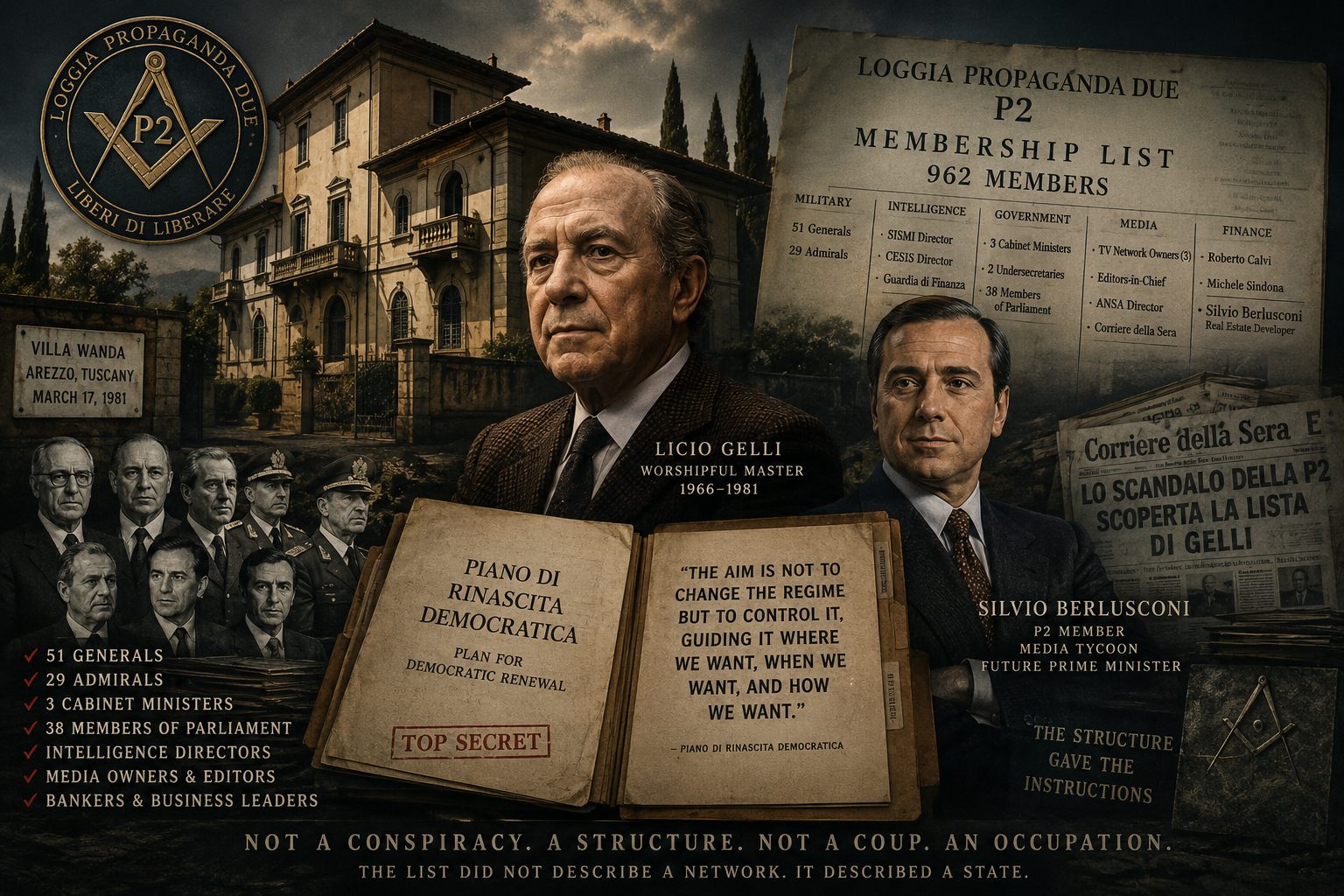
Loggia P2: How Licio Gelli installed 962 members across Italy's military, intelligence, and media between 1966 and 1981, and why not one was convicted for the membership itself.
AI-generated image. The Manifest Archive, 2026.
March 17, 1981. Arezzo, Tuscany. Officers of the Guardia di Finanza, acting for two Milan magistrates investigating the Sicilian banker Michele Sindona, search the properties of Licio Gelli. Gelli is not there. He has left. His villa above Arezzo, Villa Wanda, yields little. In nearby Castiglion Fibocchi, in a safe at his textile factory, the officers find a folder.
Inside: a membership list.
Nine hundred and sixty-two names. No codes. No aliases. Real names, real titles. Generals and admirals. Judges. Editors. Ministers.
A second document surfaced sixteen months later. In July 1982, at Rome's Fiumicino airport, officers searched the suitcase of Gelli's daughter, Maria Grazia, arriving from Nice. In its false bottom was a text titled the Piano di Rinascita Democratica. Plan for Democratic Renewal.
The investigators did not immediately understand what they were holding. The list reached the government on March 25. Two months later, it was public. What it described had been operating, silently, for fifteen years.
The Folder and What Was in It
The P2 membership list is one of the few primary documents in postwar European history that requires no interpretation. The names are there. The institutions are there. The simultaneity is there.
Forty-three generals: twenty-two from the army, twelve from the Carabinieri, five from the Guardia di Finanza, four from the air force. Eight admirals. The director of SISMI, Italian military intelligence, and the director of SISDE, its civilian counterpart. The director of CESIS, the body that coordinated all Italian intelligence services. The commander-general of the Guardia di Finanza. Two sitting cabinet ministers, and the signed membership application of a third. Five undersecretaries of state. Forty-four members of parliament, drawn from across the governing parties, including the Christian Democrats and the Socialists.
The media layer reached the top. Angelo Rizzoli, owner of the publishing group that owned Corriere della Sera, and its general manager, Bruno Tassan Din. Franco Di Bella, the Corriere's editor-in-chief. Roberto Calvi, chairman of Banco Ambrosiano, Italy's largest private banking group. Michele Sindona, whose case had led investigators to Gelli. Silvio Berlusconi, card number 1816, then a real estate developer beginning to build a television empire that would eventually give him control of three commercial networks and, later, the prime ministership.
This was not a conspiracy. It was a census.
A conspiracy requires coordination, secrecy, shared instructions. What the P2 list documented was something structurally different: simultaneous membership across every institution that held state power in Italy. The forty-three generals did not need to call the SISMI director. The SISMI director did not need to brief the cabinet minister. The cabinet minister did not need to instruct the newspaper editor. They were all members of the same lodge, under the same Venerable Master, with knowledge of who else held that membership.
The list was not the coordination mechanism. The knowledge of the list was.
The list did not describe a network. It described a state.
The Man Who Built It
Licio Gelli was born in 1919 in Pistoia, in the same Tuscan hill country where he would later build his villa. He was twenty when the Second World War began, and he served with the efficiency of someone who understood institutions early. He was a member of the Blackshirts, Mussolini's paramilitary force. Accounts of his later wartime career, never fully documented, place him as a liaison between the fascist administration and German forces in northern Italy.
After 1945 he was arrested, convicted in absentia and then acquitted on appeal or amnestied; his wartime role never led to a lasting sentence. Western intelligence needed what Gelli had: access to the networks of the defeated regime, now available for recruitment into anti-communist operations. The Anselmi Commission later concluded, from a file kept by Italian military intelligence, that Gelli had worked for the Italian services from 1950. In 1944 and 1945 he had also worked for the partisan liberation committee in Pistoia while still in German uniform. He had connections in Argentina, where, by many accounts, he helped former fascists escape through ratlines that ran via Vatican channels. He had connections in the Italian military, in the far-right MSI party, and in the emerging stay-behind infrastructure that would eventually become Operation Gladio. He did not hold a formal intelligence rank. He held something more durable: access without accountability. Access translated into income. His role as intermediary between the lodge and Banco Ambrosiano generated commissions that made P2 not only an instrument of influence but a financial enterprise with a proprietor who never appeared on a ledger.
In 1966, on the recommendation of deputy Grand Master Roberto Ascarelli, Grand Master Giordano Gamberini moved him into a reserved lodge. In 1971 he became organisational secretary of the Loggia Propaganda Due, a regular Masonic lodge operating under the Grand Orient of Italy; in 1975, its Venerable Master. He began recruiting. His method was not ideological. He did not require members to share a political platform. He required them to hold positions of institutional power, and to become members. That was sufficient.
He never held a public office. He never needed one.
What Gelli understood, and what the P2 list demonstrates, is that institutional power does not require institutional position. Position creates accountability: public officials can be investigated, dismissed, prosecuted. Membership in a private lodge creates none of those liabilities. The power is informal, structural, deniable. It compounds with each additional member recruited from each additional institution. By 1976, when the Italian Communist Party reached 34.4 percent of the national vote, the lodge had reached something close to institutional saturation.
How Coordination Without Orders Works
By 1981 the lodge's seized lists held 962 names, and the lists were incomplete. The recruitment was deliberate and vertical. He did not want any general. He wanted generals who commanded divisions. He did not want any judge. He wanted judges who presided over cases that could implicate the network. He did not want any editor. He wanted editors who controlled what the reading public understood about the institutions whose officers were members.
The resulting network covered every level of the Italian institutional hierarchy: military command, intelligence direction, political leadership, judicial oversight, media framing, and financial infrastructure. Each layer touched the others. An investigation that emerged in the judiciary would be visible to the intelligence services before it advanced. A news story that threatened to expose a member's conduct would pass through editorial hands before reaching print. A parliamentary inquiry that reached toward the lodge's financial operations would be staffed by members of the legislature who knew the stakes.
No instruction was necessary. The structure gave the instructions.
The parliamentary commission that investigated P2 after 1981 documented this logic in its 1984 report. The commission, chaired by Tina Anselmi, described the lodge's design as subversive and its presence as a pollution of national life, worked from inside the institutions. The finding is precise. Not a shadow government standing outside the state, but a parallel structure that occupied the actual state while remaining formally separate from it.
What the familiar phrase for P2, a state within the state, gets right is one word: within. A state outside the state can be expelled. A state within it has nowhere to go.
The lodge did not replace the state. It sat inside it, at every level simultaneously.
The architecture did not require unanimity. It required only that, at each critical threshold, the right person occupied the right position.
The Piano: What Democratic Renewal Meant
The document found in Maria Grazia Gelli's suitcase was, in some ways, more revealing than the list.
The Piano di Rinascita Democratica was not a wish list. It was an operational blueprint, systematic and concrete. It proposed buying influence inside the governing parties, with thirty to forty billion lire, and named the politicians it judged usable. It proposed acquiring newspapers and weeklies, breaking up the state broadcaster RAI and coordinating the coming cable television. It proposed separating the careers of judges and prosecutors and making the magistracy's governing council answerable to parliament. Parties, press, unions, government, judiciary: each was a target, each with a method.
Gelli had titled it a plan for democratic renewal. The word performs a specific function. Renewal implies that what existed before was insufficient and required correction. It positions the document not as the capture of democracy but as its restoration. The language of stabilization, modernization, and rescue from extremism runs throughout the Piano.
The word democratic appears throughout the Piano. It names the target, not the method.
The political context made that language available. In 1976, with the PCI at 34.4 percent and the prospect of a communist government or communist coalition partner visible for the first time, the Italian right and its American backers understood that conventional political competition might be insufficient. Gelli's lodge offered something that required no coup, no tanks, no visible rupture with democratic norms. It required only that the right people be in the right positions when the moment arrived.
The Piano called it renewal. The list had already done the replacement. The document described a democracy being restored. The list described a democracy being replaced.
The two documents were not a plan and its execution. They were a record and its justification. The list showed what had been accomplished. The Piano explained, to whoever read it, why the accomplishment was necessary. Together they documented an architecture that had been functioning for fifteen years before anyone outside it saw either document.
The Investigation and the Accountability Gap
In May 1981, Prime Minister Arnaldo Forlani released the P2 membership list to the public. His government fell within days. Two of his ministers, Franco Foschi and Enrico Manca, were on the list, and among the seized papers was the signed membership application of his justice minister, Adolfo Sarti, who resigned. Forlani himself was not, but the government he led was structurally compromised at multiple levels simultaneously.
What followed was the most extensive parliamentary inquiry in Italian postwar history. The Commissione Parlamentare d'Inchiesta, chaired by Tina Anselmi, worked for three years. The 1984 report documented P2's structure, its recruitment methods, its political interventions, and its connections to Sindona and Calvi. It recorded that the heads of all three intelligence bodies, SISMI, SISDE and CESIS, were on the list. Gladio, the stay-behind network that operated under NATO's Allied Clandestine Committee, was not publicly acknowledged until 1990, six years after the report.
The criminal consequences were real but selective. In 1995 Gelli's conviction for misdirecting the investigation into the 1980 Bologna train station bombing, which killed 85 people, became final. In 1998 his twelve-year sentence for the fraudulent bankruptcy of Banco Ambrosiano became final; he fled, and was arrested in Cannes that September. The Bologna case is also the clearest documented instance of lodge membership producing coordinated institutional action: SISMI officers, among them General Pietro Musumeci, whose name was on the P2 list, were convicted with Gelli for planting false evidence that steered the inquiry toward a fictitious foreign trail. Calvi had been found hanging under Blackfriars Bridge in London in June 1982. In 2007 a Rome court ruled that his death was murder, and acquitted all five defendants.
Membership itself was never punished by a criminal court. Gelli and the lodge's leaders were tried for political conspiracy and acquitted in 1994, a verdict confirmed on appeal in 1996.
This is the accountability gap the Anselmi Commission identified and could not resolve. In January 1982 parliament dissolved P2 by law, as a secret association of the kind the Constitution forbids. But dissolution attached to the entity, not to the people in it. The law allowed disciplinary proceedings against public employees who had been members, and some officers and magistrates were disciplined. None of the 962 was convicted for having belonged. Careers continued. Pensions were collected.
Gelli died in December 2015 at the age of 96, at Villa Wanda. He never served a prison sentence in Italy. Apart from short spells in custody, in 1945 and 1946 and in Parma in 1988, he served his sentences under house arrest at Villa Wanda.
The institutions that P2 had occupied survived the investigation of P2.
The Structure After the Disclosure
What distinguishes the P2 case from most institutional scandals is the completeness of the primary record. The list exists. The Piano exists. The Anselmi Commission report exists. The parliamentary resolutions exist. The criminal convictions for peripheral acts exist. There is no evidentiary gap at the level of facts.
The gap is at the level of consequence. And that gap is itself a structural fact worth examining.
Democratic accountability assumes the institutions doing the accounting were not themselves occupied. That assumption is what P2 tested.
The European Parliament passed a resolution in November 1990 calling on member states to investigate their own stay-behind networks after Giulio Andreotti confirmed Gladio's existence. Belgium and Switzerland held parliamentary inquiries; elsewhere, governments said little. Where inquiries were held, they confirmed that the networks had been designed to operate outside democratic accountability. Much of the authorising paper stayed classified.
The P2 lodge was formally dissolved by law in January 1982. The institutions whose officers had been members continued to function. The individuals whose names appeared on the list continued in their careers. The financial network around Banco Ambrosiano and the Vatican Bank collapsed in its own scandals, and the legal proceedings generated by that collapse lasted for decades. The documentation generated by those proceedings confirmed, at each stage, what the list had shown: that the infrastructure was real, that it had reached every institution, and that the accountability mechanisms available within the democratic system were insufficient to address a network that had occupied those mechanisms from within.
Disclosure is not accountability. The two are frequently confused for each other.
Gelli understood this before the investigators did. In his later public defences of the lodge he was composed. He presented P2 as an association whose members had done nothing wrong, and private association as a constitutionally protected right. He was not entirely wrong. The system he had built was designed to survive exactly the kind of disclosure that occurred in 1981.
The design held.
The Safe, the Folder, the Names
On March 17, 1981, the investigators who opened Gelli's safe expected financial records. They found something that described the architecture of the Italian state more accurately than any official document the state had produced about itself.
The list named generals and admirals at the top of the armed forces, the intelligence directors who determined what the government knew about its own security services, judges who could preside over cases that might have reached the lodge, the editor who decided what the public read about all of them. Not one of those men had been appointed by Licio Gelli. Not one of them received a documented order from him.
They did not need to. The knowledge that the man who ran their lodge also ran the lodge of their commander, their overseer, their judge, and their editor was the coordination mechanism. It required no meetings, no instructions, no paper trail. It required only the awareness that the list existed and that everyone on it had the same reason to want it to stay hidden.
The lodge was dissolved. The institutions it had occupied continued. The men whose names appeared on the list continued. The financial networks collapsed in their own time and their own manner. What was not dissolved, because no law could dissolve it, was the structural lesson the Piano di Rinascita Democratica had encoded: that a democratic state contains within it every mechanism necessary for its own quiet replacement.
The ballot box. The general staff. The court system. The press. The central bank. Each one a democratic institution. Together, under coordinated occupation, something else entirely.
The state was not overthrown. It was occupied from within, one membership at a time, over fifteen years.
The list is in the Italian parliamentary archives. It has been there since 1981. Nine hundred and sixty-two names, each one the record of a man who held a position the Italian state believed it controlled.
The architecture accounts for every actor named on that list. The Italian public, whose institutions those were, does not appear on it anywhere.
The P2 network did not operate in isolation from the broader infrastructure of Cold War covert action in Italy. The stay-behind weapons that the same network protected were used in at least one documented case of domestic terrorism. "Peteano 1972: The Gladio Explosive Hidden for Twelve Years" traces the chain from a NATO explosive cache to a roadside ambush, and the twelve years of misdirection that followed. The financial architecture that P2 relied on had its own history of protection and impunity. "Hitler Lost the War. Von Braun, Gehlen and Dulles Won the Peace." documents the institutional continuity between the postwar intelligence networks and the structures that followed them into the Cold War.
Correction, 12 October 2026: this piece has been corrected. The 1981 list contained 43 generals and 8 admirals, not 51 generals and 29 admirals; two sitting ministers were on it, with the signed application of a third, not five ministers including the defence minister. The list was found in a safe at Gelli's factory in Castiglion Fibocchi, not at Villa Wanda, and the Piano di Rinascita Democratica was seized separately, in July 1982, at Fiumicino; the description of the Piano now follows its text, which does not mention Banco Ambrosiano. Gelli moved to a reserved lodge in 1966 and became organisational secretary of P2 in 1971 and Venerable Master in 1975. His Ambrosiano conviction became final in 1998, not 2005. Parliament dissolved P2 by law in 1982 as a secret association; it did not declare it a criminal organisation, and the lodge's leaders were tried for conspiracy and acquitted. The Anselmi Commission did not, and could not, confirm a Gladio role for Gelli; Gladio was disclosed in 1990. Also corrected: the number of undersecretaries (five) and parliamentarians (44), the Bologna misdirection, the date of the Calvi murder ruling (2007), the publication timeline, the media figures on the list, and the Gladio inquiries abroad. An unsourced Andreotti statement and a quotation attributed to the commission have been removed. A second check on 12 October corrected Gelli's postwar record (arrested, convicted in absentia and acquitted in 1945 to 1947), his prison history (short spells in custody in 1945-46 and 1988, later house arrest), his lodge entry in 1966, the commission's wording (subversive, not criminal), and an unsupported claim about American intelligence ties. The corrections log is at themanifestarchive.com/standards.
Jerry writes The Manifest Archive: forensic analysis of the institutional structures that shape geopolitics, history, and power. Published on Ghost and Medium.
Related from The Manifest Archive