On the fifty-sixth floor of Rockefeller Center, in the family office known simply as Room 5600, stood a machine most banks would not recognize as banking equipment. It was an electronic Rolodex, five feet tall, custom built, and it held roughly 200,000 index cards covering about 100,000 people. Every time David Rockefeller met someone worth remembering, an assistant typed a card: name, position, date, subject discussed. Then another card for the next meeting, and the next. He maintained the machine for half a century. After his death the cards, more than 200,000 of them, recorded encounters with presidents, prime ministers, finance ministers, central bankers, editors, and academics from the more than one hundred countries he visited, each annotated in the same even administrative tone.
A Rolodex is a list of who you know. This one was closer to an inventory. It was the physical index of a structure that has no name in any constitution, and the cards were its census.
There is a structure inside democratic governance that is not elected, not regulated, and not named in any founding document. It does not issue orders. It does not pass laws. It does not hold press conferences. It arrives at conclusions first, and then waits for governments to reach the same conclusions through their own process. By the time legislation reaches a floor vote, the range of what is considered possible has already been defined.
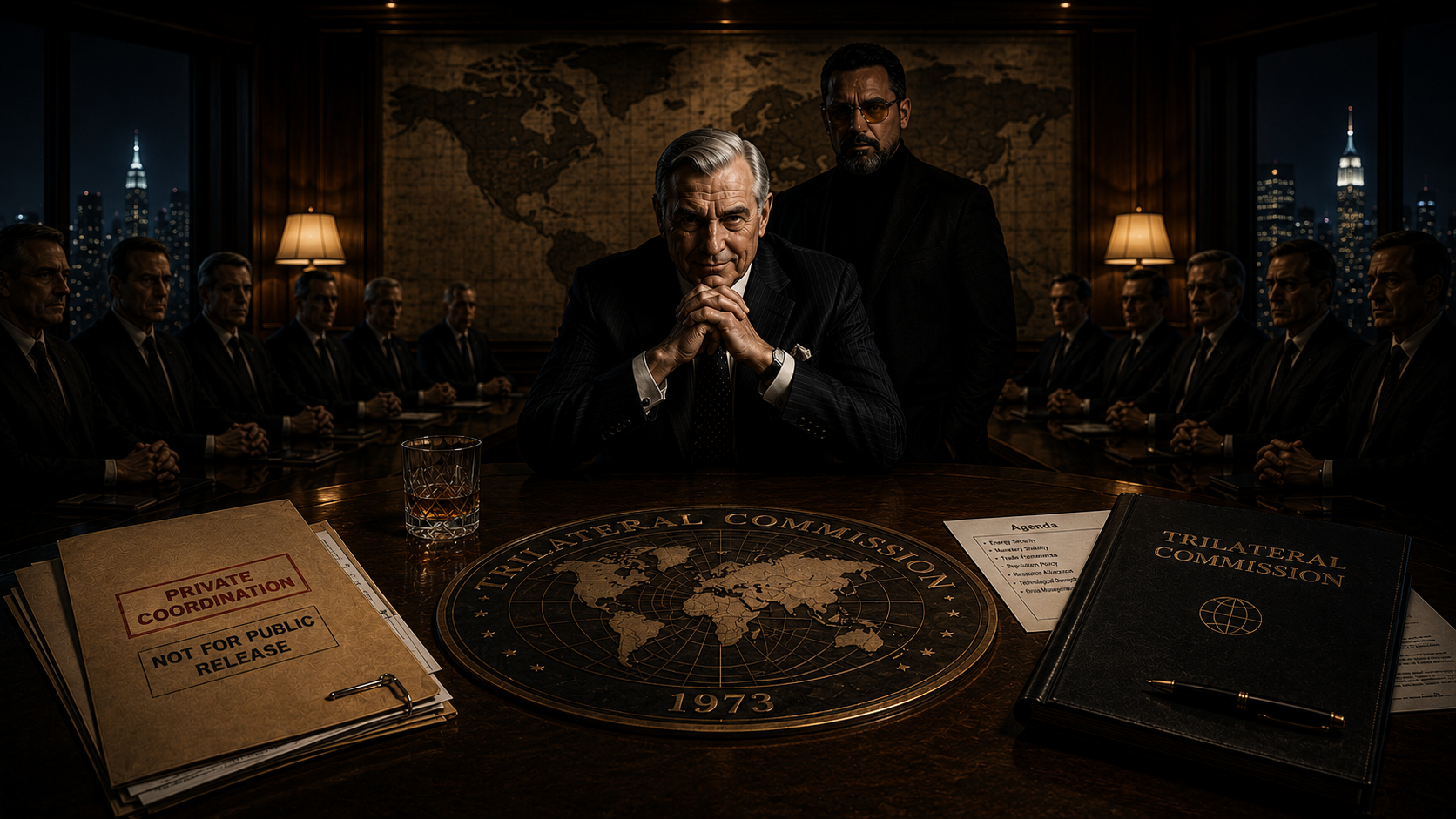
David Rockefeller understood this architecture better than anyone of his century, because he built more of it than anyone of his century. In 1973 he founded an institution designed to operate exactly this way. He called it the Trilateral Commission. Nearly thirty years later, in a memoir published by Random House, he answered critics of his family’s internationalism in a passage that ends with the sentence: “If that’s the charge, I stand guilty, and I am proud of it.”
This is an account of what he built, how it functioned, and what he meant.
The Commission Before the Cabinet
The Trilateral Commission was founded on July 1, 1973, with simultaneous offices in New York, Paris, and Tokyo. Its stated purpose was to foster closer cooperation among North America, Western Europe, and Japan on shared economic and political challenges. That description is accurate as far as it goes. What it leaves out is the mechanism, and the timing.
The timing first. In 1971 the Nixon administration had ended the dollar’s convertibility into gold and imposed import surcharges without consulting the allies whose currencies and exports absorbed the shock. Japan, by then the second largest economy in the capitalist world, had no seat in the informal Atlantic clubs where such shocks were normally cushioned. The postwar machinery of coordination was visibly out of date. Rockefeller’s response was not to lobby for a new treaty organization or a reformed monetary conference. It was to build a private one, answerable to no legislature, funded by no state, and staffed by the people who would later hold the offices that treaties require. Where the moment called for an institution of governments, he supplied an institution of persons. The choice of form is itself the finding.
The mechanism, second. The Commission brought together senior figures from government, banking, academia, and media in annual and regional meetings conducted under Chatham House rules. No public transcripts, although the Commission published its task-force reports and meeting summaries. No attribution of statements to individuals. Members were drawn from the same institutional layer that would, within years, staff cabinet positions, central banks, and international financial organizations. The Commission did not lobby these officials. In many cases, they became these officials.
Chatham House rules are usually described as a procedural courtesy, a way of letting officials speak candidly. Read structurally, they do something else. They create a space in which consensus can form among future officeholders while leaving no record that any particular person held any particular view. What survives the meeting is not a document that can be subpoenaed. What survives is alignment. The rule does not hide the institution, whose membership is published. It hides the only thing accountability could attach to: who persuaded whom, of what, and when.
The Administration That Arrived Pre-Assembled
The Carter administration provided the clearest documented example of the pipeline in operation. Jimmy Carter was himself a Trilateral Commission member before his presidential campaign, recruited in 1973 as a promising southern governor. When he formed his government in 1977, the appointments included Zbigniew Brzezinski, the Commission’s founding director, as National Security Advisor; Cyrus Vance as Secretary of State; Harold Brown as Secretary of Defense; Michael Blumenthal at Treasury; and Walter Mondale as Vice President. All were Trilateral Commission members. Holly Sklar’s 1980 study Trilateralism is one of several that tallied the overlap. Counts ranged from fifteen to about twenty Commission members in senior Carter posts; the Washington Post counted at least eighteen in 1978, from an American membership that numbered several dozen. A substantial share of the club had moved into the government.
The pattern extended past the cabinet into the institution that sits deliberately outside electoral reach. In August 1979, Paul Volcker, a member of the Commission, took office as chairman of the Federal Reserve after Carter nominated him that July. What followed shows why the appointment mattered more than any cabinet post. Over the next three years Volcker drove interest rates toward twenty percent to break inflation. The decision restructured the American economy, and it did something larger abroad: countries across Latin America and Africa had borrowed dollars through the 1970s at floating rates, from banks that very much included Chase Manhattan, and the Volcker shock raised the cost of their floating-rate debt at each reset. In August 1982 Mexico announced it could no longer service its obligations, and the developing world entered a debt crisis that defined its next two decades, managed by the IMF on terms set in Washington. None of this is alleged as a plot, and none of it needs to be. Nor is the Federal Reserve’s insulation a scandal: the institution was designed to be independent of electoral pressure, deliberately and for defensible reasons. That is precisely what makes the appointment the sharpest case. The single most consequential economic decision of the era was made by an official over whom electoral accountability had, by design, only the most indirect influence, and the man who filled that insulated office came from the same private forum that had supplied the diplomats. The pipeline did not only staff the offices voters watch. It staffed the offices deliberately placed beyond their reach.
The policy frameworks that shaped the administration, the normalization of relations with China, the SALT II negotiations, the response to the Iranian revolution, were carried into office through a network that predated the election. This is not a coincidence of personnel. It is the mechanism functioning as designed. The Commission did not coordinate what governments would decide. It coordinated who would be in position to decide, and what frameworks they would carry with them when they arrived. The appointments are consistent with a recruitment pattern that drew heavily on the Commission, and the documented overlap points to substantial convergence in policy frameworks before any appointment was made. What cannot be shown from the personnel record alone is why: whether the network selected the officials or merely contained the kind of people administrations select.
The personnel record is documented fact. Whether that overlap produced policy directionality or merely reflected convergent expertise is an interpretive question, and the honest version of this chapter holds it open at this point in the argument. Two further documents narrow it. The first is a report the Commission published about democracy itself. The second is what Rockefeller wrote about his own intent.
The available record suggests the frameworks did not travel from government to the Commission. They traveled the other way.
The Report That Said the Quiet Part
In 1974 the Commission convened a task force on what it called the governability of democracies. Its report was written by three academics, one from each region: Michel Crozier for Europe, Joji Watanuki for Japan, and, for the United States, Samuel Huntington of Harvard. The document was discussed at the Commission’s plenary meeting in Kyoto in May 1975 and published that year as a book. Its title was The Crisis of Democracy.
The report’s diagnosis of the United States deserves to be quoted rather than paraphrased, because no critic of the Commission ever wrote anything as damning as its own text. The problems of governance, Huntington’s chapter argued, “stem from an excess of democracy.” The 1960s had produced a surge of participation, from previously passive groups, in a political system that could not absorb their demands. What was needed, Huntington wrote, was “a greater degree of moderation in democracy,” and the report’s concluding chapter set American leaders the task “to restore the prestige and authority of central government institutions.”
Read that sequence slowly. A private, unelected forum of bankers, officials, and academics commissioned a study of why democratic publics had become difficult to govern, received the finding that the difficulty was too much democracy, discussed it at a private plenary, and published it without embarrassment. The report was not leaked. It was not disavowed. It remains in print, a primary source in which the coordination layer describes democratic participation as a management problem and names its own class of institutions as the solution.
This is the document that makes the Commission legible. An organization that existed to advise democracies would treat rising participation as the condition to be served. An organization that existed to govern alongside them treats it as the condition to be managed. The Crisis of Democracy does not prove that the Commission dictated policy. It proves something prior and more important: how the network understood the relationship between its own deliberations and the public’s, and which of the two it regarded as the disturbance.
And the report’s afterlife completes the demonstration. Two years after diagnosing the excess of democracy, Samuel Huntington entered the White House himself, serving under Brzezinski on the National Security Council as coordinator of security planning. The man who had co-signed, for a private forum, a report setting American leaders the task of restoring the authority of central government institutions, was now inside a central government institution, appointed rather than elected, planning its security posture. The report was not a manifesto that a movement had to fight to implement. Its author simply traveled down the same pipeline as everyone else in the network, from the private diagnosis to the public machinery, without passing through a single vote on the way.
The report and the pipeline belong to the same picture, and the dates are the argument. In 1975 the Commission published its view that democratic demands needed moderating. In 1976 one of its members won the presidency. From 1977 more than a dozen of them held senior posts in the machinery those demands were addressed to. No step required the others, and no step was hidden. Together they describe an institution positioned on both sides of the democratic process at once, diagnosing the electorate in private, then staffing the government the electorate believed it had chosen. The voters of 1976 selected between candidates. They were not consulted about the pool the candidates and their governments were drawn from, and the pool had already put its view of the voters in writing.
The Bank as Parallel State Department
Rockefeller’s second institutional vehicle was Chase Manhattan Bank, where he became president in 1961 and chairman and chief executive in 1969, positions he held until 1980 and 1981 respectively. Under his leadership, Chase operated as something closer to a parallel diplomatic channel than a commercial bank. In countries where formal American diplomatic relations were constrained or absent, Chase maintained financial relationships that carried their own conditions and their own geopolitical signals.
Consider what 1973 looked like from the fifty-sixth floor. In the same year that he founded the Trilateral Commission, Rockefeller opened both communist capitals to his bank. In the spring, Chase became the first American bank to open a representative office in the Soviet Union, at an address the bank’s own people enjoyed reciting: 1 Karl Marx Square. In June 1973, in the wake of Nixon’s opening and years before formal recognition, he traveled to Beijing and met Premier Zhou Enlai, and Chase became the first American correspondent bank to the Bank of China. Formal diplomatic recognition of Beijing was still six years away. The cards went into the Rolodex.
On August 10, 1973, the New York Times published Rockefeller’s account of the China trip, an essay titled From a China Traveler, in which the chairman of America’s third-largest bank praised the “social experiment in China under Chairman Mao’s leadership” as “one of the most important and successful in human history.” The sentence has been quoted against him ever since, usually as evidence of naivety, sometimes as evidence of sympathy. It is better read as evidence of function. A diplomat must weigh such a sentence against a government’s position, a senator against his voters, an editor against his readers. A banker opening a market weighs it against nothing. Rockefeller could say in print what no accountable official could say, and conduct the outreach no accountable official could conduct, precisely because no electorate existed that could reach him. The freedom of language and the freedom of movement had the same source: the absence of anyone entitled to object.
The same pattern, with harder edges, ran through the Cold War’s southern theaters. In those same years Congress cut off military aid to Chile in 1976 and to Argentina in 1978 over human rights, while American commercial banks kept lending to both governments. In Chile the syndicates of the late 1970s were managed by banks such as Morgan Guaranty, Bankers Trust, and Wells Fargo. In Argentina, when the junta’s economy minister, José Alfredo Martínez de Hoz, went looking for foreign credit in 1976, he had the personal support of his close friend David Rockefeller. In each case, private credit continued to flow while human rights scrutiny in Congress was widening.
The banks did not wait for policy. They moved on their own clock.
The most consequential instance concerns Iran, and it is the one case where the private layer’s interests and the public’s costs can be laid side by side with documents. By 1979, according to figures reported by the New York Times in 2019, the bank held more than 500 million dollars in Iranian deposits, carried more than 360 million dollars in Iranian loans on its books, and had syndicated more than 1.7 billion dollars in Iranian lending. When the Shah was deposed in January 1979 and fled the country, he was initially denied entry to the United States. David Rockefeller and Henry Kissinger applied sustained pressure on the Carter administration to admit him for medical treatment. The administration’s internal deliberations, recorded in chief of staff Hamilton Jordan’s memoir Crisis, included explicit warnings that admitting the Shah would place American citizens in Iran at risk of seizure. Carter admitted the Shah on October 22, 1979. Thirteen days later, Iranian students seized the American embassy in Tehran. Fifty-two Americans were held for 444 days.
Chase Manhattan’s financial exposure was raised in the press at the time and has been documented since, but it was never formally weighed in the decision itself. Rockefeller always said his motive was loyalty to an ally and American credibility, not the bank’s position. It was also never investigated as a matter of policy conflict. One distinction must be kept exact here, because this episode invites the collapse of it: the exposure is documented, and the advocacy is documented, but the motivation connecting them is not. No record shows Rockefeller pressing for the Shah’s admission because of the deposits. What the record shows is an unelected banker whose institution had a large stake in Iran leading a campaign, with Henry Kissinger and John J. McCloy, that helped persuade an elected government to admit the Shah, without any mechanism to weigh the one against the other. The conflict of interest did not need to be acted on to be structural. The men who pressed for the admission held no office. The officials who granted it answered for the consequences. The man whose bank held the deposits answered to his board.
Here a bank’s chairman, holding no office, helped force a foreign policy decision that only the government would answer for.
The Document That Closes the Inference Gap
In most institutional analyses of this kind, a gap remains between documented action and documented intent. What a structure does can be shown through records, testimony, and outcomes. What it was designed to do usually requires inference, and inference is where such analyses are attacked. Rockefeller’s memoir, published in 2002 when he was eighty-seven, states his intent himself.
By the late twentieth century he had become a recurring target of what he called ideological extremists at either end of the political spectrum. Critics from both ends of the political spectrum described him as the architect of a globalist agenda conducted through private institutions that bypassed national democratic processes. He addressed the accusation on page 405, in a passage that requires no interpretation:
“Some even believe we are part of a secret cabal working against the best interests of the United States, characterizing my family and me as ‘internationalists’ and of conspiring with others around the world to build a more integrated global political and economic structure, one world, if you will. If that’s the charge, I stand guilty, and I am proud of it.”
This passage is unusual in the literature of institutional power. It is not a denial. It is not a reframe. It is a primary source admission of intent, written by the architect, published commercially, never retracted. Note what he accepted. He embraced the internationalist label and the goal of a more integrated global political and economic structure. He attributed the claims of inordinate influence and a secret cabal to ideological extremists. What he rejected was the idea that the enterprise was secret or worked against American interests. In his account, the coordination was real. The charge against it was what was wrong.
That is a narrower defense than it first appears, and a more revealing one. It concedes the architecture entirely and contests only the evaluation of its purpose. A man defending himself against a false accusation says the structure does not exist. A man defending a structure he is proud of says the structure exists and is good. Rockefeller chose the second defense, in writing, under no duress, with three decades of the Commission’s history behind him.
He did not deny the coordination. He named it, located it in himself, and called it something to be proud of.
One Man, Four Rings
To see the architecture whole, stop looking at any single institution and look at the career that connected them. Rockefeller chaired the Council on Foreign Relations from 1970 to 1985, the body whose studies and journal, Foreign Affairs, have supplied the intellectual stock of incoming administrations since the 1920s. He attended the first Bilderberg conference at the Hotel de Bilderberg in the Dutch village of Oosterbeek in May 1954, organized by Joseph Retinger with Prince Bernhard of the Netherlands as host and Rockefeller among the American participants, and he remained part of its steering and advisory bodies for decades. He founded the Trilateral Commission in 1973. Three forums and a bank, one lifetime, and at nearly every point the same man simultaneously inside all of them.
The three forums differ in radius, not in kind. The CFR is national and open, a membership organization with a published journal. Bilderberg is transatlantic and closed, a hundred and thirty guests, once a year, no press. The Trilateral Commission extended the same format to Japan. What they share is the load-bearing feature: each convenes public officials and private principals in a setting where consensus can form without any of the participants being accountable for it, because nothing said there is attributable and nothing decided there is, formally, a decision.
Only one other figure of the century moved through all the rings for as long: Henry Kissinger, who attended Bilderberg from the 1950s, held the offices of National Security Advisor and Secretary of State, and on leaving office in 1977 joined the Trilateral Commission and the CFR board, resuming in private the coordination he had just conducted in public. Rockefeller and Kissinger were close collaborators for fifty years, and the Iran episode above shows the two halves of the mechanism working as one: the banker with the exposure and the statesman with the access, pressing the same demand on an elected government that answered to neither of them.
This is what the overlap means, and why it needs no conspiracy. A person who spends six decades inside every ring at once does not need to command anything. He is the continuity. Administrations arrive and depart around him. The forums persist, the frameworks persist, the Rolodex grows, and each new government draws its personnel and its sense of the possible from the same standing pool. Institutional memory is usually praised as a virtue of bureaucracies. Here it resided in a private citizen, and the bureaucracies borrowed it from him.
The One Election That Noticed
The architecture became a campaign issue most visibly once, and the episode is worth recording because of how it ended. In the 1980 presidential campaign, the Trilateral Commission briefly became an issue. It emerged that President Carter and two of the Republican contenders had all passed through it: George H.W. Bush and John Anderson, who went on to run as an independent, were members, and Ronald Reagan’s supporters attacked the Commission’s grip on the field, pointing out that his opponents across the spectrum shared its outlook. For one season, the coordination layer was visible on the campaign trail.
Bush’s response is the instructive part. He had already left the Trilateral Commission, and later the Council on Foreign Relations, before the primaries, and Reagan still chose him as running mate. He was elected vice president that November and president in 1988. The resignations cost him nothing, because membership was never the mechanism. The formation, the relationships, the shared sense of the viable, all of it survived the lapsed subscription intact. An electorate can force a candidate to hand in a membership card. It cannot make him hand back the consensus. The one time voters were invited to hold the architecture to account, the architecture demonstrated that there was nothing in a voter’s reach to hold. The card was paper. The alignment was not.
The Architecture That Ran Without Him
Rockefeller stepped down from Chase in 1981, left the CFR chairmanship in 1985, and stayed active in Trilateral affairs into the 1990s.
By the time he withdrew from active management, the infrastructure no longer required him. The loop runs as follows. Private coordination forums bring together institutional leadership before electoral processes begin. Members refine frameworks for shared challenges in settings with no public record. Members who reach governmental positions carry those frameworks with them, not as instructions but as the boundary of what appears viable. Policy options arrive at democratic deliberation already pre-shaped. No single actor directs this in real time. The architecture directs it. That is the reading the evidence assembled here supports, and it is offered as a reading. Stated at full strength:
Governments did not form the Commission’s conclusions. The Commission formed theirs.
Rockefeller died on March 20, 2017, at the age of 101. Four days later, the Trilateral Commission convened its annual plenary in Washington as scheduled, from March 24 to 26. The Council on Foreign Relations continued publishing. That June, the Bilderberg conference met in Chantilly, Virginia; its published attendee list included ministers, central bank executives, intelligence chiefs, and the heads of the largest financial institutions of the member countries. No journalist was permitted inside and no transcript was released, which is not a gap in the record but the design. The founder’s death did not appear as an interruption anywhere in the system he had built. The meetings were already on the calendar.
He built it to run without him. He left the bank in 1981. The architecture did not leave with him.
The Strongest Counterargument
The strongest counterargument to this reading does not dispute the documentary record. It accepts that Rockefeller founded the Trilateral Commission, held the positions described, and wrote the passage quoted. What it disputes is the inference from coordination to capture.
The argument, advanced most systematically in the tradition of Joseph Nye’s work on interdependence, runs like this. Elite coordination through institutions like the Trilateral Commission is a feature of liberal international order, not a malfunction of democracy. In complex interdependent systems, prior alignment among technical experts and institutional leaders is necessary for coherent governance across borders. The alternative to Trilateral-style coordination is not more democracy. It is less coherent policy in exactly the domains, monetary stability, trade, alliance management, where incoherence is most expensive. On this reading the Commission prepares government rather than bypasses it. And the members themselves experienced it exactly that way: not as conspirators but as professionals attending conferences in their field, the way surgeons attend surgical congresses. No participant needed malign intent for the system to function, and almost certainly nearly all of them lacked it. The banality of the mechanism is real, and it is the strongest reason to distrust every account of these institutions that requires a room full of villains.
This deserves a precise response rather than a dismissive one. The reading offered here does not claim that the Commission issued directives, or that elected officials were puppets. It claims something narrower: that the pre-formation of policy frameworks within private institutions systematically shapes which options appear viable when democratic deliberation begins, and that this shaping sits outside every accountability mechanism democracies possess. Democratic systems can hold officials responsible for decisions made in office. They cannot reach the prior consensus that determined which decisions were imaginable. The gap is not one of secrecy. Membership lists are published. The gap is temporal. Accountability begins at the election. The formation of the consensus ends there.
And the two exhibits above resist the benign translation. A body engaged in neutral technical preparation does not commission a report describing democratic participation as an excess to be moderated. A member engaged in disinterested coordination does not accept, in his own memoir, the charge of working to build a more integrated global political and economic structure and declare himself proud of it. The counterargument explains the ordinary members. It does not explain the founder’s stated intent, and it does not explain the report.
The claim is falsifiable, and it should be stated as such. If Carter’s Trilateral appointments showed no stronger alignment with Commission-developed frameworks than comparable administrations staffed without Commission members, the directional inference fails. That comparison has never been conducted at the scale that would settle it. What exists instead is Rockefeller’s own account of his intent, and the Commission’s own account of its view of democracy, both published, both unretracted.
There is a comfortable conclusion available here, and it should be named so it can be declined. The comfortable conclusion is the cabal: a hidden directorate, a world government in waiting, the version sold by half a century of pamphlets. That version is comfortable because a cabal can be exposed, indicted, and defeated. The documented version offers no such exit. There is no secret to reveal, because the membership is public. There is no order to intercept, because no orders are given. There is nothing to indict, because forming a consensus is not a crime. What the record shows is worse than the pamphlets, precisely because it is legal, durable, and proud of itself.
What the Architecture Accounts For
There is a category of power that does not appear in any government directory. It does not hold office. It does not command troops. It does not appear on a ballot. It builds the preconditions under which visible power operates, and then becomes invisible once the architecture is established. David Rockefeller named this category, described his role in building it, and expressed satisfaction with what he had built.
The Trilateral Commission still meets. The Council on Foreign Relations still produces the frameworks that stock incoming administrations. Personnel who pass through these institutions still arrive in government carrying prior conclusions, across administrations of both parties. The range of what is considered viable in foreign policy, monetary architecture, and institutional design is still shaped before the democratic process begins. No one currently in office designed this. They entered an architecture that was already running.
Consider what accountability would require. It would require a mechanism to review whether frameworks developed in private, without transcripts, by members who later assumed office, produced outcomes that diverged from what open deliberation would have produced. No such mechanism exists, and none is proposed. The Freedom of Information Act reaches government documents, not Chatham House discussions. Congressional oversight reaches executive agencies, not private membership organizations. Electoral accountability reaches candidates, not the networks that shaped what candidates considered viable before they ran. You cannot vote out a man who never stood for election, and you cannot subpoena a consensus.
That is the finding, stated as a mechanism rather than a villain. Democratic accountability is aimed at decisions. The power Rockefeller built operates on the step before decisions, where the menu of options is written. Watch the timeline, not the meeting: whoever forms the consensus before the election owns the decision after it, and every instrument of oversight democracies have constructed begins its work one step too late.
The boundary of the claim should be as visible as the claim. The institutions, the personnel flow, the 1975 report, and the page-405 passage are documented record. The causal reading of that record, that the flow carried direction and not only credentials, is this chapter’s interpretation of it, and the Evidence Map below marks exactly where the one ends and the other begins.
The architecture accounts for every actor in this system. The elected official who implements a pre-formed framework. The academic who developed it. The banker who funded the forum. The journalist who covered the policy announcement without covering the forum where it was first discussed. The only figure without a designed role is the one reading this, because the architecture was built before the question of inclusion was asked.
The Rolodex survives, two hundred thousand cards. Visitors describe it as a marvel of networking, a master class in relationships, which is what it looks like once it has stopped working. For fifty years it was something else. It was the operating index of the structure this chapter describes: one private citizen’s running record of everyone who governed, financed, edited, and advised the democratic world, maintained more carefully than any government maintained its record of him.
The architecture is not hidden. It is simply outside every accountability structure that democracies have built.
Evidence Map
Facts, interpretations, forecasts, and disconfirming signals.
Core claim. David Rockefeller built and led a layer of private coordination institutions, the Trilateral Commission above all, whose function was to form policy consensus and place personnel before democratic deliberation began, and whose own documents, the 1975 Crisis of Democracy report and Rockefeller’s 2002 memoir, state the Commission’s premise and his internationalist intent directly.
Evidence level. Facts (high): the founding of the Trilateral Commission on July 1, 1973; the Carter administration’s roughly eighteen Trilateral members including Brzezinski, Vance, Brown, Blumenthal, Mondale, and Volcker; the Crisis of Democracy report (Crozier, Huntington, Watanuki, 1975) and its “excess of democracy” diagnosis; the memoir passage on page 405; Chase’s Iranian deposits and the Shah’s admission, thirteen days before the embassy seizure, with warnings documented in Hamilton Jordan’s Crisis; the Trilateral plenary held four days after Rockefeller’s death. Interpretation (marked): the inference that framework pre-formation produced policy directionality, rather than reflecting convergent expertise, is an analytical reading. The documented intent and the documented pipeline support it; a controlled comparison across administrations has never been conducted.
What would confirm this. A systematic comparison showing administrations staffed from private coordination forums align more closely with forum-developed frameworks than administrations staffed otherwise; continued personnel flow from the same forums into offices insulated from electoral reach.
What would disprove this. Evidence that Trilateral-heavy administrations diverged from Commission frameworks as often as comparable administrations without them, which would reduce the pipeline to credential overlap and the memoir passage to rhetorical bravado.
Watchlist. The personnel overlap between the current coordination layer, including its newer venues, and incoming administrations on both sides of the Atlantic; whether any oversight instrument is ever proposed that reaches pre-electoral consensus formation.
Correction, 12 October 2026: this piece has been corrected. The memoir passage on page 405 was read as an admission: "conspiring" and "inordinate influence" are the critics' words that Rockefeller reported, and the text now says what he accepted (the internationalist label and a more integrated global structure) and what he rejected. Chase's exposure in Iran was raised in the press at the time, Rockefeller gave non-financial motives, and the deposit and loan figures are those reported by the New York Times in 2019, not by Time. Chase is no longer described as lending to the Pinochet government or the Argentine junta; no reliable source was found for that, and the passage now names the banks documented in Chile and Rockefeller's personal support for Argentina's economy minister. Huntington's report is quoted more precisely, and the claim that a bank's chairman set the terms of the Shah decision was scoped. George H. W. Bush had left the Trilateral Commission before the 1980 primaries. Paul Volcker was a member, not a founding member, of the Commission. The count of Commission members in the Carter administration now gives the range of contemporary counts. Unsupported claims about the Rolodex archive, the World Economic Forum, Chase lending ahead of policy, and Rockefeller's Bilderberg role were removed or scoped, and John J. McCloy was added to the campaign to admit the Shah. The corrections log is at themanifestarchive.com/standards.
Related from The Manifest Archive
- The Deep State Is Real. It’s Just Not a Conspiracy.
- Who Owns the Federal Reserve?
- The Vatican Blessed Inclusive Capitalism. BlackRock Counts the Votes.
- In 1981, Italy Found a List of 43 Generals, 8 Admirals, Two Ministers and Berlusconi. Nobody Was Convicted for Being on It.
Jerry van der Laan writes The Manifest Archive, where he examines power, history, and institutions. He traces the structures beneath them.