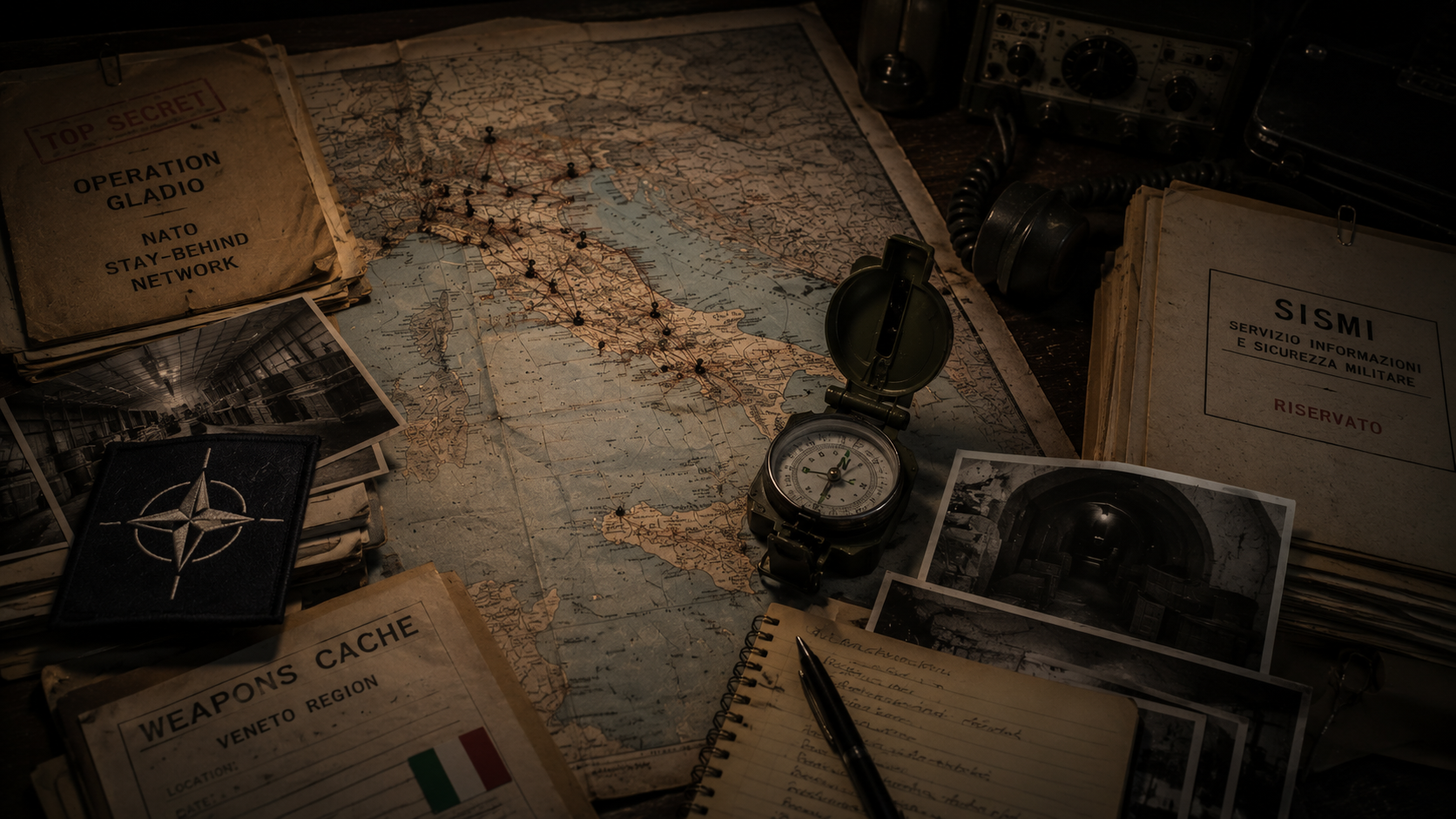
Operation Gladio: How NATO's secret Italian arms network supplied the 1972 Peteano bomb, and why the cover-up lasted twelve years.
May 31, 1972. Peteano, a hamlet of Sagrado near Gorizia in northeastern Italy, close to what was then the Yugoslav border. The road was narrow and ran between fields. It was a Wednesday night. At 22:35 an anonymous caller reported an abandoned Fiat 500 with two holes in its windshield.
Carabinieri patrols drove out from Gradisca and Gorizia. Among them were Antonio Ferraro, Donato Poveromo, and Franco Dongiovanni. The car was white, parked at the edge of the asphalt, coated in road dust. The hood was closed. The surrounding fields were quiet.
When they opened the hood, the car exploded.
All three died. Two other officers, Angelo Tagliari and Giuseppe Zazzaro, were wounded.
The road was still. Fragments of metal and glass were scattered across the asphalt. The surrounding fields were quiet in the same way they had been before.
In the village, families who did not yet know were asleep or getting ready for the night.
The anonymous call had been made from a public telephone. The explosive, investigators later concluded, matched material held in a secret Gladio arms depot. Judge Felice Casson pointed to the NASCO depot at Aurisina near Trieste, a few kilometres away, though another magistrate later said the link was not proven. That structure, unmarked from the outside, contained NATO-grade explosives. It had been maintained for years by a network whose existence was classified at the level of the Atlantic alliance.
The investigation that followed lasted twelve years. What it eventually found was not a criminal network operating outside the Italian state. It found a weapons cache maintained by the Italian state, coordinated through NATO, and accessible to the neo-fascist networks that had built the bomb.
The Investigation That Looked Away
In the months after the bombing, the Carabinieri inquiry under Colonel Dino Mingarelli first turned toward the far-left Lotta Continua, then charged six local young men who were later acquitted. A police explosives expert, Marco Morin, himself a member of Ordine Nuovo, filed a false report claiming the explosive matched that used by the Red Brigades. Both leads were wrong.
The actual explosive was C-4, a military-grade compound used by NATO forces. Years later, magistrate Felice Casson had the evidence re-examined, established that it was C-4, and argued that it came from a Gladio depot. The material in the evidence container had not changed. The original conclusion had.
The false report could have been passed off as error. Forensic analysis in 1972 had real limits, and the political climate gave a left-wing attribution a ready plausibility. What makes that explanation insufficient is what happened next: the error was not corrected when better tools and a different investigator became available. It was corrected only when a magistrate forced the question.
For twelve years, the official case pointed at the wrong people: first the far left, then six local men who were acquitted. The neo-fascist network that had actually constructed the bomb continued operating. The weapons cache that had supplied the explosive continued to exist. Three Carabinieri were dead. The system that had killed them was intact.
The investigation did not fail to find the truth. It was steered away from it.
The Confession
In 1984, Vincenzo Vinciguerra, a member of Ordine Nuovo and later Avanguardia Nazionale, confessed to the Peteano bombing. He had constructed the bomb.
Casson's later investigation linked the explosive to a depot of Operation Gladio, a NATO-coordinated stay-behind network that had operated in Italy since the 1950s. Vinciguerra himself spoke of a secret structure inside the state that had protected him. The cache had been established for one documented purpose: armed resistance in the event of Soviet invasion. The weapons were catalogued. They had been there, accessible, for years.
Vinciguerra also named the institutional mechanism that had protected him for twelve years. Carabinieri officers had manipulated the post-bombing investigation to redirect it away from the actual perpetrators. They served the same infrastructure the bomb had come from.
The weapons were NATO's. The cover was institutional. Neither was coincidental.
The bomb came from inside the house.
The Judge Who Followed the Evidence
Vinciguerra had named the protection. What remained was to find the source.
Felice Casson, a magistrate in Venice, reopened the Peteano investigation in 1984. He focused on the physical evidence. Forensic re-examination identified the explosive as C-4, and Casson traced it to the Gladio depot at Aurisina, near Trieste, a link another magistrate later called unproven. The cache was one of dozens distributed across Italy as part of the Gladio stay-behind network.
Casson requested access to the state archives. He was refused. He appealed. The archives remained closed. He appealed again. The same answer. In 1990, he went directly to Prime Minister Giulio Andreotti. Andreotti granted partial access to the SISMI files. By the time the doors opened, Casson had already built the forensic picture through material evidence and Vinciguerra's testimony. The files confirmed what six years of closed doors had been preventing him from reading.
Casson was not an outsider to the institutions he was investigating. He was a magistrate from Venice, operating through the tools those institutions provided, pursuing a triple homicide that had been officially attributed to the wrong perpetrators, on the strength of a false explosives report, for twelve years. The resistance he encountered, the refused requests, the sealed doors, the years of procedural deflection, came from the same state that employed him. He worked with what he could reach. He continued anyway. When the doors finally opened in 1990, the physical evidence had already made the argument. The files confirmed what the obstruction had been protecting.
What those files confirmed was straightforward: the Gladio network existed, the cache existed, and the officers who had misdirected the original investigation had demonstrable connections to the same network they had protected.
Casson did not uncover a secret. He documented one that had been protected for twelve years.
October 24, 1990
Prime Minister Giulio Andreotti stood before the Italian parliament on October 24, 1990, and confirmed the existence of Operation Gladio. The network had operated for forty years. It was coordinated through NATO structures, specifically the Allied Clandestine Committee and the Clandestine Planning Committee under SHAPE. Andreotti stated that he had known of its existence, though not its full scope.
He named the organizational framework. He described the weapons caches. He confirmed that the Italian state had maintained a parallel military infrastructure outside normal parliamentary oversight for four decades. The chamber was quiet while he spoke.
The Carabinieri who had died at Peteano eighteen years earlier had been killed by explosives from that infrastructure. The officers who had misdirected the investigation had protected it. The European Parliament responded on November 22, 1990, with Resolution B3-2021/90, which condemned stay-behind networks across member states and called for full disclosure.
No NATO official was prosecuted. No intelligence director faced criminal charges for the Peteano cover-up. The three officers who had died were now part of a formally acknowledged historical record. The architecture that had killed them was formally acknowledged and formally dissolved.
Andreotti confirmed what Casson had found. The architecture confirmed itself and survived the confirmation.
The Pattern Behind Peteano
The years between 1969 and 1980 in Italy are called the Anni di piombo, the Years of Lead. Bombings, assassinations, and political violence marked every year. Official narrative attributed the violence to two extremes: the Red Brigades on the left, neo-fascist networks on the right.
The Commissione parlamentare d'inchiesta sul terrorismo in Italia, which sat from 1988 to 2001, documented in its proposals and reports a pattern that complicated that account. In multiple cases, neo-fascist perpetrators had operated with the protection or active assistance of elements within Italian intelligence. In multiple cases, investigations had been misdirected toward the left. In multiple cases, that misdirection could be traced to officers with demonstrable connections to Gladio-linked networks. The commission applied the term Strategia della tensione, the Strategy of Tension. The commission did not conclude that every act of violence during the Anni di piombo was orchestrated. It concluded that state actors had, in multiple documented instances, manipulated those acts and their investigations for institutional purposes.
Peteano is the case with the clearest evidentiary chain: a confession, a specific explosive, a specific cache, a specific cover-up, a specific institutional connection. Every link documented. The chain from NATO weapons depot to dead Carabinieri to twelve years of deliberate misdirection is not inference.
Italy was not the exception. Parliamentary investigations in Belgium and Switzerland confirmed comparable stay-behind networks with their own weapons caches, kept outside parliamentary view. Belgium's network was linked in later inquiry to far-right figures and coordinated through NATO structures. Switzerland, outside NATO, had built its own. Belgium's Senate inquiry in 1990 documented weapons caches and far-right connections structurally identical to Gladio's Italian configuration. Switzerland's Parlamentarische Untersuchungskommission found a secret armed organization operating without legal basis or parliamentary control. The architecture was not Italian. It was NATO's.
The violence was attributed to chaos. The cover-up required coordination.
Two more bombs, the same machine
Peteano is the clearest case, but it is not the only one, and the cases that bracket it show the same mechanism at the start and the end of the Years of Lead. The period had opened three years earlier, in the same pattern. On the twelfth of December 1969 a bomb tore through the Banca Nazionale dell'Agricoltura in the Piazza Fontana in Milan, killing seventeen people and wounding nearly ninety. The investigation turned immediately toward the left. An anarchist, Pietro Valpreda, was arrested and held for three years, and another anarchist, Giuseppe Pinelli, died falling from a police-station window during interrogation, a death that became a national wound. Years later the evidence pointed the other way entirely, to the neo-fascist cell of Ordine Nuovo in Padua and the men who ran it. And yet, after decades of trials, the Court of Cassation ruled in 1987 that although the evidence linked them to the bombing, it could not be established who had planned or carried it out. The bomb that opened the Years of Lead was, in the end, attributed to no one, after first being attributed to the wrong side.
The period closed the same way, on a larger scale. On the second of August 1980 a bomb in the waiting room of Bologna's central station killed eighty-five people and wounded more than two hundred, the deadliest attack in postwar Italian history. The material perpetrators were eventually identified as members of the neo-fascist NAR and sentenced, after fifteen years, to life. But the more revealing convictions were the others handed down in the same judgment. Licio Gelli, the head of the P2 lodge, and two senior officers of the military intelligence service were convicted of obstructing the investigation. The false claim of responsibility, designed to point the inquiry elsewhere, had been traced to an office of the intelligence service itself, and a P2-linked general had tried to plant matching explosives on another train to corroborate the misdirection. Four decades later an Italian court would describe the Bologna bombing, in the language of its own ruling, as a massacre that involved the state.
Three bombs, eleven years apart, one architecture. A neo-fascist device, an investigation steered toward the left or toward no one, an intelligence service that obstructed rather than pursued, and an accountability that arrived late, partial, or never. Peteano is not an anomaly within the Years of Lead. It is the period's clearest specimen, the one case where every link in the chain was finally documented, of a mechanism that ran from the first bomb to the last.
The purpose, in the perpetrator's words
The most direct account of what the bombs were for came from the man who built one. At his trial Vinciguerra explained that the killing of civilians was not a failure of aim but the aim itself. The point of the bombings, he said, was to attack ordinary people, the people, women and children, "innocent people far removed from any political game," precisely because such attacks would frighten the population into demanding protection from the state. A frightened public asks for order. A public that asks for order accepts the apparatus that promises it. This is what the period's investigators came to call the strategy of tension: violence not aimed at a target but at a mood, designed to move an entire electorate toward the security the state alone could offer, and away from the political left that the network existed to contain.
That strategy needed an instrument, and the instrument predated the bombs by years. The stay-behind network had been formalized in a written agreement in 1956, the document in which the name Gladio first appears, and it established a system of independent cells coordinated, according to the files surfaced in 1990, from a base in Sardinia. Across the country it maintained on the order of a hundred and thirty-nine arms caches, sealed and catalogued, holding explosives, automatic weapons, and ammunition for a war that never came. The caches were built for a Soviet invasion. What the Peteano case shows is that an infrastructure built for one contingency does not sit idle waiting for it. It becomes available. Weapons stored against an enemy who never arrived were used against the citizens they were meant to defend, and the strategy Vinciguerra described could be carried out because the means to carry it out were already in the ground.
The same architecture across the border
The reflex is to read Peteano as a story about Italy, a country with a particular history of fascism, a particular weakness of the state, a particular talent for the unsolved case. The records of the other stay-behind countries remove that comfort. The network was never Italian. It was the standing architecture of the Western alliance, replicated nation by nation, and where the files were opened the same shape appeared.
Switzerland, a neutral state that belonged to no military alliance, ran its own stay-behind organization, known as P-26, with its own caches and its own insulation from parliamentary view, exposed only by a federal inquiry at the turn of the 1990s. Belgium's network, coded SDRA8, surfaced in connection with one of the most disturbing unsolved episodes in its postwar history: the Brabant killings of the early 1980s, a series of attacks on supermarkets and public places that left twenty-eight people dead, never definitively solved, and repeatedly linked in later inquiry to far-right figures and to elements within the security apparatus. Italy, Switzerland, and Belgium each convened a parliamentary commission to examine what had been built in their name without their knowledge.
Three countries, three commissions, one finding repeated in three languages: a secret armed structure, coordinated through the alliance, maintained outside the reach of the parliaments that were supposed to govern the use of force. The detail differs. The design does not. Peteano is the case where the chain was documented end to end, but the structure that produced it was continental, and the question it raises is not why Italy was unusual. It is why every parliament involved discovered, only after the fact, an apparatus it had never been allowed to see.
When the parliaments learned of their own armies
There is a detail in the 1990 disclosure that is easy to pass over and worth stopping on. When Andreotti stood before the chamber and confirmed that a secret armed network had operated in Italy for forty years, most of the people listening were learning of it for the first time, and they were the elected representatives of the state that had maintained it. The structure had outlasted governments, parliaments, and the entire careers of the legislators now hearing about it. They had voted budgets, debated defense, and overseen the security services through every one of those years without being shown the thing itself. The instrument of last-resort national defense had been kept secret from the nation's own legislature.
The same astonishment repeated across the continent. In Belgium, in Switzerland, in country after country, parliaments convened inquiries into networks they had not authorized and had not known existed, reconstructing after the fact an architecture that had been built around them. The European Parliament responded on the twenty-second of November 1990 with a resolution that condemned the stay-behind networks in the strongest available language, protested that a clandestine structure had operated outside democratic control, and demanded full investigation and the dismantling of what remained. The caches that could be located were located. Some of the weapons were recovered from the ground where they had waited for four decades.
And then the energy drained out of it. The resolution carried no enforcement. The national inquiries produced reports, and reports are not indictments. Gladio was declared dissolved, its coordinating committees decommissioned on paper, and within a few years the subject had migrated from the front pages to the footnotes, where it largely remains. The structure was exposed, condemned, and named in the official record of a dozen states, and almost no one answered for any part of it in a courtroom. This is the pattern Peteano shows in miniature and the continent showed at scale. A secret survives its own exposure when the exposure is procedural rather than criminal. The parliaments learned what had been built in their name, wrote down that it should not have been, and moved on. Knowing, it turned out, was not the same as accounting, and the distance between the two is exactly the space in which an architecture like this one is designed to live.
The case that does not fit
A method that explained every death of the Years of Lead the same way would not be an analysis. It would be a faith. The discipline of the Peteano reading is that it claims only what the chain documents, and the period's most famous crime shows where the claim stops.
On the sixteenth of March 1978 a commando ambushed the car of Aldo Moro in the via Fani in Rome, killed the five men of his escort, and took the former prime minister alive. For fifty-four days he was held, interrogated, and made to write letters while the state refused to negotiate. On the ninth of May his body was found in the boot of a car parked in the historic center, near the headquarters of both major parties. The Red Brigades, a left-wing organization, claimed the kidnapping, carried it out, and killed him. That attribution has held. There is no NATO cache in the Moro case, no neo-fascist cell, no forensic chain leading back to a Gladio depot.
The Moro case has its own unresolved questions, its own controversies about what the state knew and how hard it tried to find him. But the core is not in dispute: the perpetrators were who they appeared to be. And that is exactly why it matters here. The strategy of tension was real, and the stay-behind network was real, and neither fact converts every act of violence in those years into their product. Peteano is documented from cache to cover-up. Moro runs the other way. Holding the two apart is not a weakness in the account. It is the thing that keeps the account honest, the line between a pattern that is proven and a pattern that is merely felt.
The Coordination Layer Above
The Gladio network had a military and paramilitary infrastructure: the weapons caches, the trained operatives, the paramilitaries available for deployment. It also had a political coordination layer. That layer was Propaganda Due, the P2 masonic lodge headed by Licio Gelli, who has been alleged to have had ties to Gladio.
When Italian police searched Gelli's properties near Arezzo on March 17, 1981, they found, at his company in Castiglion Fibocchi, a document: 962 names typed in columns. The list included forty-three generals, eight admirals, the heads of the intelligence services, forty-four members of parliament, serving ministers, and Silvio Berlusconi. P2 did not plan individual operations. It coordinated the institutional environment in which operations could proceed without accountability.
When a Gladio-connected officer needed a P2-connected intelligence director to look away from an investigation, no instruction was required. The architecture required only alignment. Alignment was built into the membership list.
No document places a P2 member in direct communication about the Peteano investigation specifically. What the record shows is structural overlap: the officers who misdirected the inquiry held institutional positions within the same network as those who would have required that misdirection to continue.
The coordination did not need to be explicit. An officer who identified the wrong explosive faced no institutional pressure to correct his conclusion. Correcting it would have meant documenting the source of the right one.
P2 did not need to direct the cover-up. It had placed the people who would conduct it.
The Mechanism
NATO established weapons caches across Italy for a documented purpose: armed resistance in the event of Soviet occupation. Those caches required operatives to maintain them. Some operatives had connections to neo-fascist networks operating within Italian civil and military society. Those networks accessed the caches. They used the weapons in domestic attacks. Italian intelligence services, staffed by officers connected to the same networks, manipulated the investigations that followed.
The sequence is documented at each stage. The cache is documented. The confession is on record. The identification of the explosive as C-4, and Casson's tracing of it to a Gladio depot, are part of the Casson investigation. The investigative manipulation is part of the same record. Andreotti's parliamentary statement is a primary source.
What makes Peteano structurally significant is not that it demonstrates ideological contamination of a defensive network. It demonstrates that the network's design created the conditions for the contamination.
A weapons infrastructure maintained outside parliamentary oversight, staffed by operatives without independent accountability, and coordinated through alliance structures that no national parliament was permitted to examine, produced exactly the outcome that such a design makes possible.
This is not a story about bad actors inside a good system. It is a story about what the system produced.
What the cover-up actually controlled
The bomb killed three men. The cover-up did something quieter and larger: it controlled what the country was allowed to know it was looking at. For twelve years the official record pointed at the wrong people and rested on a false explosives report, and as long as it said that, the question that mattered, where the weapons had come from, could not be asked. This is the deeper function the architecture performed. It did not only hide a perpetrator; it governed the boundary of the thinkable, keeping an entire parallel structure, the caches, the network, the alliance coordination, outside the frame of any question a citizen or a parliament could pose. Power of this kind does not need to win an argument. It needs only to keep the argument from forming. The most effective control is not over the answer but over which questions are allowed to exist, and a murdered investigation is that control applied to a single road near the Slovenian border.
The strongest case against this reading
The honest objection runs through the Cold War. The stay-behind networks were not invented to kill Carabinieri; they were built for a real and reasonable fear, that the Red Army might one day cross into Western Europe, and that an occupied country would need a pre-positioned resistance with arms, training, and communications already in place. By that logic Gladio was prudent contingency planning, and what happened at Peteano was the work of rogue elements who diverted a defensive asset to criminal ends, a betrayal of the network's purpose rather than its expression. On this reading the scandal is real but local: bad men inside a legitimate structure, not a structure that produced bad outcomes.
That objection deserves its full weight, and part of it holds. The original anti-Soviet purpose was real, and most of the network's operatives never built a bomb. But the defense answers the wrong question. The issue is not whether the purpose was legitimate. It is what a particular design makes possible. A weapons infrastructure held outside parliamentary oversight, staffed by operatives without independent accountability, and coordinated through alliance structures no national parliament was permitted to examine, is a design in which diversion is not an accident waiting to be prevented but an outcome waiting to occur. The reading offered here would weaken if the contamination had been isolated, caught early, and prosecuted, the sign of a healthy structure expelling an infection. The record shows the opposite. The contamination was protected for twelve years by the same institutions, and when it was finally disclosed, almost no one was held to account. A system that protects its own diversion is not a good system betrayed. It is a system working as its secrecy designed it to.
What Followed
Vincenzo Vinciguerra was convicted of the Peteano bombing and sentenced to life imprisonment. Carlo Cicuttini, the Ordine Nuovo member who made the phone call, also received a life sentence.
The officers who had manipulated the original investigation were identified in Casson's report. Legal proceedings were initiated. Cases moved through the Italian judicial system over years. Appeal acquittals were annulled, and in 1992 Colonel Dino Mingarelli and Antonio Chirico received final sentences of three years and ten months, Napoli three years and one month. State secrets provisions restricted the documentary record available to prosecutors. Extended judicial timelines allowed statutes of limitations to exhaust. The institutional standing of the accused generated procedural obstacles that successive appeals sustained indefinitely.
The institutional framework that had enabled the cover-up was not the subject of criminal prosecution. Gladio was formally dissolved after the 1990 disclosure. The Allied Clandestine Committee and the Clandestine Planning Committee were decommissioned, officially.
In any ordinary criminal framework, the deliberate misdirection of a murder investigation for twelve years would itself constitute a prosecutable offense. In the Peteano case, the officers who conducted that misdirection were identified by name. Three were convicted, with sentences of under four years.
The asymmetry is the record. Vinciguerra, who placed the bomb, is in prison. The officers who ensured the investigation could not find him for twelve years were identified, prosecuted, and given sentences of under four years. The institution that maintained the cache from which the explosives came was formally dissolved without criminal liability attached to any of its administrators. Disclosure, in this case, functioned as a form of closure. The parliamentary record replaced the criminal record. What the state acknowledged, it simultaneously placed beyond the reach of the courts.
The system was disclosed. The accountability never arrived.
The law Peteano reveals
Strip away the Italian particulars and a general mechanism remains, one that has nothing to do with fascism or the Cold War and everything to do with how secret infrastructure behaves over time. A capability built for one purpose does not expire when the purpose does. It persists, it is maintained, and it becomes available to whoever can reach it. The caches were built against an invasion that never came. They were emptied for a war against citizens. Nothing about that conversion required a new decision at the top. It required only that the means existed, that the oversight did not, and that someone with access found a use.
This is the determining variable, and it is not ideology. It is accountability, or its absence. Two networks can hold identical weapons; the one that no parliament may examine is the one whose weapons end up in a Fiat on a country road. The secrecy that was justified as protection against an external enemy is the same secrecy that protected the cover-up afterward, because a structure invisible to oversight is invisible in both directions: it cannot be watched while it works, and it cannot be held to account when it is done. The lesson of Peteano is not that the men were evil, though some were. It is that a society which builds armed capability outside the reach of its own institutions has already, before any bomb, decided that some uses of force will never be answerable to it. The bomb only collects on the decision.
This is not a problem that ended with the Cold War. Every state that builds a capability it cannot publicly account for, a covert program, an off-books partnership, an instrument held beyond the reach of the body that funds it, recreates the same structural bet, that some force can be exercised without ever being answerable. The names change and the technology changes. The bet does not. Peteano is valuable precisely because it ran its full course, from the sealed cache to the dead officers to the parliamentary confirmation forty years on, and so it lets us read the whole arc of a wager that newer secret capabilities have only just begun to make. The road near Gorizia is one place where the cost of that wager became visible. The wager itself is still standard practice. What changed at Peteano was not the wager but the visibility: for once, the cache, the bomb, the cover, and the confession all ended up in the same record, and the structure could be seen entire. That is the rare part. The wager is everywhere; the full account of where it leads is almost nowhere.
The Design
May 31, 1972. A country road near the Yugoslav border. Carabinieri responding to an anonymous call, driving out to a white Fiat 500 parked at the edge of the asphalt, hood closed, fields on both sides. The call had been placed to bring them there. The car had been prepared to kill them. The explosive had been stored, according to Casson's investigation, in a Gladio depot near Trieste, catalogued, maintained by the state they served, coordinated through the alliance their state belonged to, accessed by a network that operated inside the institutions responsible for their security.
Vinciguerra, the man who confessed, understood what he had been part of. His stated purpose in confessing was not remorse. He wanted the record to show that the weapons had come from inside the state and that the cover had been provided by the same institutions that had investigated the crime. He went to prison to make that record exist.
The Commissione Stragi documented the pattern across thirteen years of investigation. The European Parliament condemned it in 1990. No NATO structure was dismantled on criminal grounds. No intelligence director was convicted for the twelve years of deliberate misdirection.
The three Carabinieri were not part of the architecture. They had received a call, driven to a road, and opened a hood. The system that killed them had a function for every other actor in that sequence: the officers who built the cache, the operatives who maintained it, the networks that accessed it, the intelligence directors who suppressed the inquiry. Each had a role.
The road near Peteano is still there. The fields are still quiet. Antonio Ferraro, Donato Poveromo, and Franco Dongiovanni are not.
Evidence Map
Facts, interpretations, forecasts, and disconfirming signals.
Core claim. The 1972 Peteano bombing was carried out with NATO-grade explosive that investigators traced to a Gladio stay-behind cache, blamed for twelve years on the wrong perpetrators by officers connected to the same network. The case is the clearest documented instance of the Strategy of Tension, in which a secret parallel infrastructure produced domestic violence and then governed what could be known about it, and the deeper claim is that this was a function of the network's design rather than a betrayal of it.
Evidence level. Facts (high): the 1972 bombing and the three deaths; Vinciguerra's 1984 confession; the re-identification of the explosive as C-4, which Casson traced to a Gladio depot; the obstruction of the original inquiry; Andreotti's 24 October 1990 parliamentary confirmation of Gladio and the European Parliament resolution that followed; the P2 membership list found in 1981; the Piazza Fontana and Bologna cases, including the Bologna obstruction convictions of P2 and intelligence figures. Interpretation (medium, marked): that the misdirection was deliberate rather than error; that P2 provided coordination through alignment rather than instruction; that the outcome was a product of the design. Forecast: not applicable; this is a closed historical record.
What would confirm this. Further declassification showing coordination between the caches, the perpetrators, and the obstructing officers; comparable documented chains in the other national stay-behind networks.
What would disprove this. Evidence that the explosive was not from a NATO cache; that the misdirection was genuine error corrected on its own; that the network had no operative overlap with the perpetrators.
Watchlist. The remaining sealed state-secret files on Gladio and the Years of Lead, and the slow release of intelligence archives across the stay-behind countries.
Jerry van der Laan writes The Manifest Archive, forensic journalism on the systems beneath power, money, and history. He traces the structures beneath them.
Correction, 12 October 2026: this piece has been corrected. The attack happened on a Wednesday night, not a Tuesday morning, and two further officers were wounded. The original inquiry did not identify Semtex or blame the Red Brigades officially: a false expert report by an Ordine Nuovo member pointed to the Red Brigades, while the case was built first against Lotta Continua and then against six local men who were acquitted. The explosive was C-4, which Judge Casson traced to the Gladio depot at Aurisina near Trieste, not to a cache in the Veneto, and that link was later disputed. Carlo Cicuttini was also sentenced to life, and three Carabinieri officers were convicted of the cover-up in 1992, so the claims that none were convicted have been removed. Also corrected: Gelli's Gladio membership is an allegation; the P2 list held 43 generals and 8 admirals and was found at his company in Castiglion Fibocchi; the Commissione Stragi sat for thirteen years; and Germany held no parliamentary inquiry. The title has been changed accordingly. The corrections log is at themanifestarchive.com/standards.
Related from The Manifest Archive
- In 1981, Italy Found a List of 43 Generals, 8 Admirals, Two Ministers and Berlusconi. Nobody Was Convicted for Being on It.
- Allen Dulles: CIA Director, Nazi Financier, and the Man Who Investigated JFK's Murder
- Hitler Lost the War. Von Braun, Gehlen and Dulles Won the Peace.
- Inside Europe's Secret War, 1945-1990
- After the Führer