In 2001 a paleographer working in the Vatican's archive pulled a parchment that had been catalogued under the wrong reference number for nearly seven hundred years, and discovered that the Catholic Church had quietly absolved the Knights Templar in 1308. The document, written at Chinon, recorded that Pope Clement V had examined the Templar leadership, found them guilty of lesser infractions but not of the heresy for which they were burned, and reconciled them with the Church. The order was destroyed anyway, for political reasons, and the absolution sat in a box in Rome for centuries while the world told a different story. The researcher who found it, Barbara Frale, had not unearthed a hidden secret. She had found a misfiled one. The truth had been there the whole time, sitting in the open inside a building most people imagine as a vault of buried things.
That is the first thing to understand about the place the Vatican now calls the Apostolic Archive, and which the world still calls the Secret Archive. It is not a crypt of concealed bombshells. It is something stranger and, in the end, more revealing: the most complete paper record of power on earth, twelve centuries of it, in which nearly every turning point of the Western world left a document, because at nearly every turning point the institution doing the judging, the crowning, the condemning, or the dividing was the one in Rome. The archive is not interesting because of what it hides. It is interesting because of what it proves: that for a thousand years there was one room every empire, monarch, heretic, and discoverer eventually had to pass through, and that room kept the receipts.
What it actually is, and what its name never meant
Start with the physical scale, because it is the part no one disputes. The archive holds an estimated eighty-five kilometres of shelving, organized into roughly six hundred fonds, the record-collections of the distinct bodies of the Church's administration, with a documentary stream that runs unbroken from the eighth century to the present day. There is no comparable continuous archive anywhere. States rise and fall and their records scatter; dynasties end and their papers burn. The Church kept writing, and kept the writing, across the entire span of recorded European history, through every collapse that ended everyone else. The only institutions now assembling a record of remotely comparable ambition are the technology companies of our own century, storing the behavior of billions in server farms, and the comparison is not decoration; it is the destination this story is travelling toward.
The word secret was always a translation accident. The Latin in the old name, Archivum Secretum, did not mean concealed. It meant private, in the sense that the archive was the personal property of the pope, separate from the public Vatican Library, the way a household's private papers are distinct from its public library. In October 2019 the institution formally dropped the word, restoring the title Vatican Apostolic Archive, on the stated grounds that secret had aged badly in modern translation and was feeding misunderstanding. The name changed. The contents, the access rules, and the release schedules did not. How the institution governs the opening of its own record is a deep and separate mechanism, and it is the subject of a companion investigation; this one is about something the public actually searches for and rarely gets straight, which is what is in there, and what the documents themselves reveal once you stop looking for a hidden bombshell and start reading the scope.
Rome as the judge of an order: the Templars
Return to the Chinon Parchment, because the Templar case is the clearest illustration of what the archive really records. The Knights Templar were the most powerful military and financial order of medieval Christendom, a transnational network with its own fortresses, fleet, and banking system, answerable to no king. In 1307 the King of France, deeply in debt to them, had their members arrested, tortured, and accused of heresy. The order was suppressed in 1312 and its last Grand Master, Jacques de Molay, burned in 1314.
The parchment found in 2001 shows that the pope's own investigation had reached a different verdict from the one history remembers: Clement V had absolved the leadership of heresy. The Vatican published it in 2007 in a limited edition of seven hundred and ninety-nine copies, under the title Processus Contra Templarios. What the document demonstrates is not that the Church hid the truth, but that the Church was the court. The fate of the richest order in Europe turned on a papal judgment, and the record of that judgment, the actual trial process, was kept in Rome. To destroy the Templars, a king first needed the institution in Rome to rule, and the ruling is in the archive. The power on display is not secrecy. It is jurisdiction.
Rome as the judge of science: Galileo
The same pattern governs the most famous trial the archive holds. The records of the proceedings against Galileo Galilei, examined in 1616 and condemned in 1633 for holding that the earth moves around the sun, are kept in the Vatican. Galileo was forced to recant and spent the rest of his life under house arrest, and the documentary trail of that confrontation, the depositions, the injunction, the sentence, sits on the shelves in Rome.
Here is the honest and instructive part: historians who have studied the Galileo files report that they largely confirm what was already known. There is no buried revelation that rewrites the story. And that is exactly the point worth absorbing, because it cuts against the legend of the place. The Galileo record matters not because it conceals a secret but because it documents an authority: the claim of one institution to rule on the structure of the cosmos and to enforce that ruling on a man's life. The archive is where the Church's assertion of authority over knowledge itself is written down, in its own hand, dated and signed. The scandal is not hidden in the file. The scandal is the file.
Rome as the judge of belief: Bruno and the Inquisition
If Galileo shows the Church judging the structure of the heavens, the records of the Roman Inquisition show it judging the contents of the mind, and the most absolute of those cases is Giordano Bruno. A Dominican friar turned wandering philosopher, Bruno taught that the universe was infinite, that the stars were other suns with their own worlds, and that the soul transmigrated, ideas the Church found intolerable. He was tried by the Inquisition over seven years and burned alive in the Campo de' Fiori in Rome in 1600, his tongue restrained so he could not address the crowd. The summary of his trial, long thought lost, was rediscovered in the Vatican in the twentieth century, which is itself a small lesson in how this record behaves: even the documentation of the Church's most extreme judgments survives, misplaced rather than destroyed, waiting in the building.
The Inquisition material is the darkest stratum of the archive's holdings, the written trace of an institution that claimed authority not only over kings and cosmology but over what a person was permitted to believe, and enforced it with fire. Most of that material sits in the separate archive of the former Holy Office rather than the main Apostolic Archive, and much of the twentieth-century portion remains closed. But the principle the surviving records establish is the same one running through every collection here. The Church did not merely hold opinions about heresy. It convened courts, examined the accused, rendered verdicts, and carried out sentences, and it wrote all of it down. The archive is the procedural memory of a body that treated belief itself as a matter of jurisdiction.
Rome as the hinge of nations: Henry VIII and Luther
Two documents in the archive mark the moment Western Christianity broke, and between them they show how much hung on a single institution's yes or no.
The first is a petition from 1530, a parchment roughly a metre wide, sent to Pope Clement VII by dozens of England's lords and senior clergy, asking him to annul King Henry VIII's marriage to Catherine of Aragon. It carried the seals of the men who ran England and language that edged toward threat, warning that a refusal would force the kingdom to find its own remedy. Clement refused. The consequence of that refusal is the Church of England, the English Reformation, and the entire subsequent history of a nation that left Rome because Rome would not sign one document. The request is in the archive. The refusal made a country.
The second is the bull Decet Romanum Pontificem, issued on the third of January 1521, by which Pope Leo X excommunicated Martin Luther after he refused to recant. The act that formalized the largest schism in the history of Western Christianity, the break that produced Protestantism and reshaped the politics of Europe for centuries, was a papal document, and the record of it runs through Rome. Read together, the Henry petition and the Luther bull make the same point from opposite directions. Whether Rome said yes or no, the saying was the hinge. Nations and entire confessions formed around the institution's decisions, and the decisions are on the shelves.
Rome as the maker and breaker of emperors
Before Rome judged orders and scientists, it made emperors, and the archive's stream begins in the era when it did. On Christmas Day in the year 800, Pope Leo III placed a crown on the head of Charlemagne in St. Peter's and named him emperor, reviving the imperial title in the West and establishing a principle that would shape European politics for a thousand years: that legitimate supreme rule required the blessing of Rome. The coronation was not a ceremony decorating a power that already existed. It was the act that conferred the power, and it established the papacy as the institution that could turn a king into an emperor.
What it could confer it could also withhold, and the most famous demonstration is preserved in the record of the conflict between Pope Gregory VII and the Emperor Henry IV. In the winter of 1077, after Gregory excommunicated him and his nobles began to abandon him, Henry crossed the Alps and stood for three days outside the castle of Canossa, barefoot in the snow, as a penitent begging the pope's absolution. The emperor of the Latin West, humbled in the cold at the gate of a pope, is the single sharpest image in the long contest between throne and altar, and "going to Canossa" entered European languages as the phrase for total submission. The dispute that produced it, the Investiture Controversy over who appointed bishops, was at bottom a fight over the same question the whole archive turns on: who holds the authority that legitimizes everyone else. The record of that struggle, like the coronation that started it, runs through Rome, because Rome was not a party to the question of legitimacy in medieval Europe. For centuries, it was the question.
The day Rome was told to submit: the Mongol letter
The archive's reach is not only over Europe, and its most extraordinary single document is the one that records the limit of papal power rather than its exercise. In 1245 Pope Innocent IV, alarmed by the Mongol armies tearing through eastern Europe, sent envoys to the Great Khan with a letter urging him to stop killing Christians and to explain his intentions. The reply came back from Güyük Khan in 1246, sealed in Mongolian script, and it has been kept in the Vatican ever since.
It is not a letter of negotiation. It is a letter of contempt. The Khan, ruler of the largest contiguous land empire in history, informed the pope that his very request was incomprehensible, that the Mongols ruled by the will of heaven, and that if the pope wished to survive he should come in person to the Khan's court and offer his submission. Here, preserved in the same archive that holds Rome's judgments over kings and scientists, is the one surviving record of a power that ranked Rome beneath itself and said so in writing. And the telling thing is that Rome kept it. An institution obsessed with its own authority retained, for eight centuries, the document in which a greater power demanded its obedience. The archive does not only store Rome's victories. It stores the full ledger, including the entry where Rome met something larger than itself, which is part of why the ledger is so valuable: it is not propaganda, it is the record.
Rome as the cartographer of empires: dividing the New World
One more document completes the picture of scope, because it shows the institution not judging the past but allocating the future. In 1493, the year after Columbus returned, Pope Alexander VI issued the bull Inter Caetera, drawing a line down the map of the newly encountered world and assigning the lands west of it to Spain and the lands east to Portugal. With a papal document, two European crowns were granted the right, in the eyes of Christendom, to claim and divide continents and the peoples living on them.
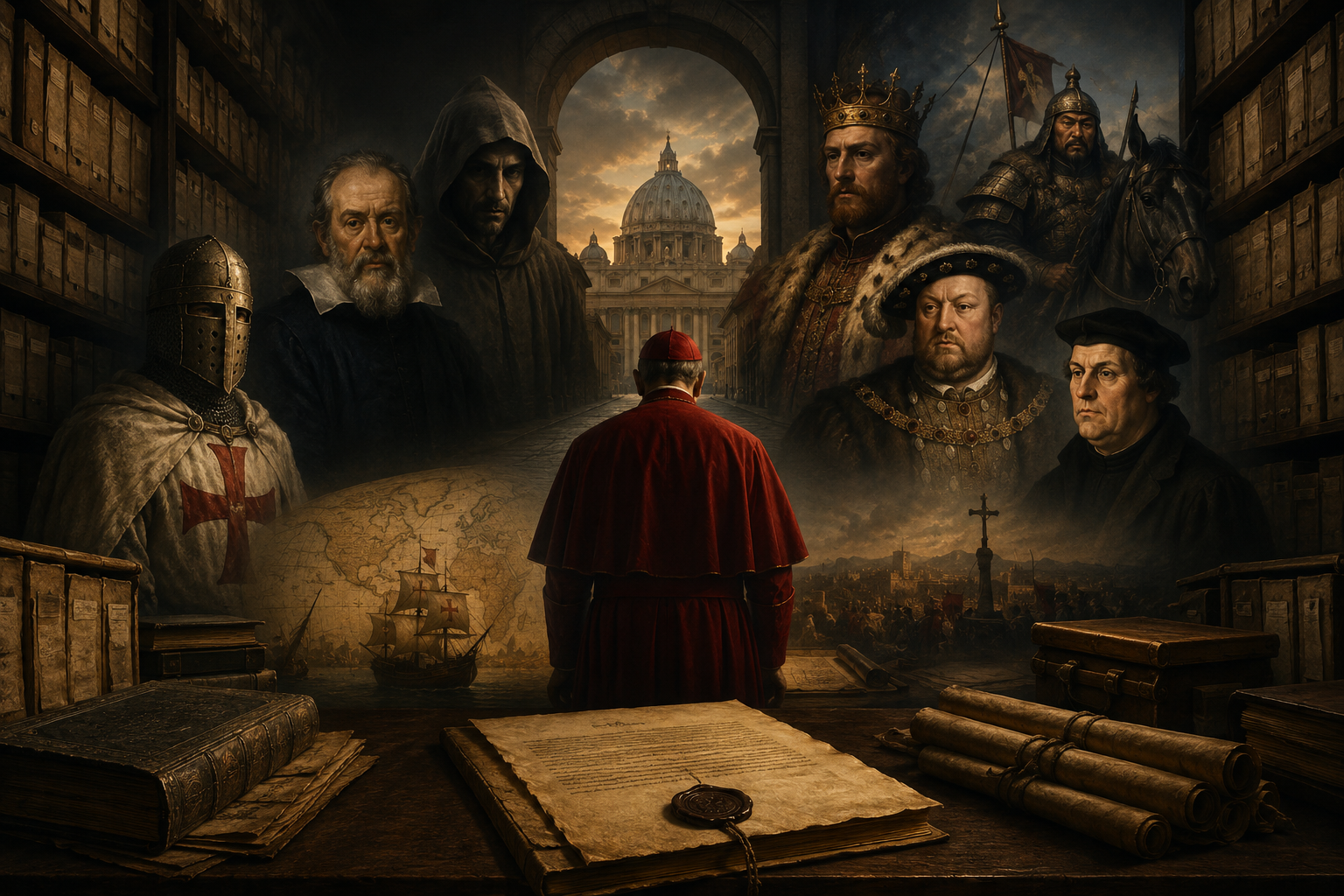
The line on that map echoes through five centuries: the reason Brazil speaks Portuguese while the rest of South America speaks Spanish runs back to a papal partition. Whatever one thinks of its legitimacy, and it had none for the people whose lands it carved, the document records an institution behaving as the arbiter of the planet, dividing what it had never seen between favored crowns. That bull is in the archive too. Put the holdings side by side, the Templar judgment, the Galileo sentence, the Henry petition, the Luther bull, the Khan's demand, the partition of the Americas, and the shape of the thing becomes clear. This is not a collection about the Church. It is a collection about the world, kept by the one institution that was present, as judge or counterparty or cartographer, at the hinge of nearly every chapter.
Rome and the sanction of conquest
The partition of 1493 did not come from nowhere; it completed a sequence of papal documents that had spent the previous decades authorizing conquest itself. In 1452 the bull Dum Diversas, issued by Pope Nicholas V, granted the Portuguese crown the right to reduce "Saracens, pagans, and other enemies of Christ" to perpetual servitude. It was reinforced in 1455 by Romanus Pontifex, which extended and confirmed those rights over the lands and peoples Portugal was beginning to reach along the African coast. Together with Inter Caetera, these documents form what later scholars and indigenous advocates would call the legal and theological scaffolding of European colonialism, the papal sanction that let Christian powers treat conquest and enslavement as licensed rather than criminal.
These are not obscure footnotes; they are among the most consequential documents the institution ever produced, because they helped license the Atlantic slave trade and the colonization of two continents, and they did it in the same documentary voice that absolved the Templars and excommunicated Luther. The point here is not to deliver a verdict on the medieval papacy. It is to register what the holdings, taken together, actually are. An institution that could grant one kingdom the right to enslave the peoples of a coast, and divide two continents between two crowns with a line on a map, was not a chaplaincy with diplomatic hobbies. It was a power that issued binding authority over the fate of peoples who had never heard its name, and the instruments of that authority were documents, kept, like all the rest, in Rome.
Rome as the keeper of time itself
The partition of the New World divided space. Another document in the same tradition divided something more fundamental, which is time. In 1582 Pope Gregory XIII issued the bull Inter Gravissimas, reforming the calendar to correct the drift that had accumulated in the old Julian system. The reform was a genuine scientific improvement, and it also required an act of pure authority: in the Catholic states, the calendar simply skipped ten days, so that the fourth of October 1582 was followed directly by the fifteenth. People went to bed on one date and woke up ten days later, because a document in Rome said so.
The calendar most of the world now runs on, the one that governs every contract, flight, and deadline on the planet, is named for a pope and was promulgated by a papal bull whose record belongs to the same institution. It is worth pausing on how total that is. Rome did not only judge kings and divide continents; it reset the count of days for civilization, and the rest of the world, Protestant and Orthodox states grumbling and resisting for centuries, eventually fell into line with the Catholic reckoning of time. The bull that did it is part of the same documentary heritage as the Templar trial and the Galileo sentence. The archive is the record of an institution that claimed jurisdiction over space, over belief, over kingship, and over the calendar itself.
The forgery that founded a throne
There is one more document, or rather one more kind of document, that belongs in any honest account of Rome's paper power, because it shows the mechanism working even when the paper is false. For roughly six centuries the papacy's claim to temporal authority over the Western empire rested in part on the Donation of Constantine, a text in which the emperor Constantine, upon his conversion, supposedly granted the pope dominion over Rome and the western provinces. It was cited in canon law, deployed in disputes with emperors, and treated as one of the foundation stones of papal sovereignty. It was also a forgery, composed centuries after Constantine, and in 1440 the humanist scholar Lorenzo Valla proved it so by analyzing its Latin, which contained words and constructions that did not exist in Constantine's era.
The lesson of the Donation is the most unsettling in the whole archive, and it is the opposite of a hidden secret. A document does not have to be genuine to function as power; it only has to be kept, cited, and believed. For six hundred years a forged grant did real work, dividing authority between popes and emperors, because it lived inside the documentary system of an institution with the standing to treat it as true. That is the deepest version of the point this archive keeps making. The power was never only in the authenticity of the record. It was in the authority of the keeper, who could make a parchment load-bearing simply by preserving it and acting as though it counted. It is worth holding that thought against our own moment, when which version of a fact counts as true is increasingly settled not by a parchment in Rome but by a search ranking, an encyclopedia entry, or the dataset a model was trained on, each one a keeper deciding what the record says.
Into the modern century: the treaties Rome still signs
It would be wrong to leave the impression that the archive's reach ends with parchment and emperors. The same institution that judged the Templars and divided the New World remained, into the twentieth century and the present, a sovereign diplomatic actor that signs binding treaties with states, and the records of that diplomacy run through the same building. The Holy See maintains formal relations with well over a hundred and eighty countries and negotiates concordats, treaties governing the relationship between the Church and a given state, with monarchies, republics, and dictatorships alike.
The most studied of these is the Reichskonkordat of 1933, the treaty between the Holy See and Nazi Germany, negotiated for the Vatican by Cardinal Eugenio Pacelli, who would later become Pope Pius XII. Whatever its intentions, it was an agreement that gave the new German regime a measure of international legitimacy in its first year, and it sits in the diplomatic record alongside the Vatican's dealings with every other power of the century. The point is not to relitigate that treaty here; it is that the archive is not a museum of medieval curiosities. It is a working diplomatic memory that extends to the regimes of living memory, which is precisely why the boundary between what it opens and what it keeps shut falls where it does, and why the documents of the recent past are the ones still held back.
The secret that mostly is not one
Now the honest correction the legend needs, because the romance of the Secret Archive oversells the concealment and undersells the truth. Most of what the archive holds is not hidden at all. It is catalogued, and a great deal of it is open to qualified researchers who apply, are vetted, and are admitted to a reading room to consult specific collections. In 2012, for an exhibition called Lux in Arcana, the Vatican sent a hundred of its original documents out of the building to be displayed publicly in Rome, including several named here. The institution is not sitting on a single explosive file that would rewrite everything. The repeated finding of the scholars who actually work there, as with Galileo, is that the documents tend to confirm and deepen the known record rather than overturn it.
That exhibition is worth picturing, because it is the rare moment the archive stepped into daylight. For the first time, original documents that had lived for centuries behind the Vatican walls were carried across Rome and laid in glass cases in the Capitoline Museums for the public to file past: the Khan's letter with its Mongolian seal, the metre-wide English petition with its dangling wax seals, the trial papers, the bulls. Visitors stood in a line to look at the actual parchments on which kings had been judged and continents divided. Nothing in the room was a revelation; everything in it was already known to historians. And yet the effect was overwhelming precisely because it was real, the physical objects rather than the legend, and because the institution had chosen, once, to let them be seen, on its own terms, for a few months, before returning them to the dark. The display was an act of openness that was also a demonstration of ownership. These are ours, the exhibition said in effect, and we decide when you may look.
This matters because it relocates where the power actually is. If the archive's authority depended on a hidden bombshell, then one leak would end it. It does not depend on that. Its power is the scope itself, the sheer fact that the receipts of a thousand years of Western turning points are gathered, ordered, and preserved in one sovereign institution that answers to no outside authority. You do not need to hide the documents when you are the only one who has kept them all, when you decide who reads which collection, and when the very completeness of your record makes you the arbiter of what the past is allowed to look like. The deepest line the original version of this piece reached for still holds: whoever owns the archive owns a share of the power to decide what history is, and what it is not. The correction is only that the owning, not the hiding, is the mechanism.
What is genuinely withheld
That said, the withholding is real, and it falls along one clean line: what is open is what time has rendered safe, and what is closed is what can still act in the present. The famous documents named here, the Templars and Galileo and the rest, are the disarmed past, safe to display because their danger has cooled into history. The recent pontificates, the separate and largely sealed archive of the former Holy Office, and the abuse dossiers held inside the living administration are the part that could still change something now. How the institution actually governs that line, the timing, the rules, the protocols by which a given decade is released or held, is its own deep mechanism and the subject of a companion investigation. For this account it is enough to mark the boundary: the institution shows you the receipts that no longer threaten anyone, and that is not the same as showing you everything.
One room at the hinge of the world
Lay the holdings side by side and the pattern stops being a list and becomes a single fact. It judged the richest military order in Europe and recorded the verdict. It judged the man who said the earth moves and kept the sentence. It refused a king his divorce and so created a national church. It excommunicated a friar and so opened a continent-wide schism. It granted one crown the right to enslave a coast and split the New World between two others with a line. It reset the calendar and the world eventually kept its time. Every one of those acts is a document, and every one of those documents is in one building.
That is the thing the legend of the Secret Archive gets backward. The romance imagines a vault of concealed answers, and the truth is heavier than concealment. An ordinary archive keeps a record of power. This one is a record that was power, because the institution that wrote it did not describe the decisions of the age from the outside; it made them, and then it kept the only complete copy. The documents are not commentary on history. For twelve centuries they were history's operative instruments, and Rome was the room where they were issued, judged, and filed. The deepest secret was never a hidden parchment. It was the ownership of the drawer.
The Honest Objection
The strongest case against reading any grand significance into this deserves to be stated. It is that every old institution accumulates an archive, that secrecy rules of seventy years or so are entirely normal and exist in national archives everywhere, and that the dramatic framing here is selection bias dressed as insight. Of course a twelve-century institution touched every major event, the objection runs; anything that old would. Pointing at the Templars and Galileo and Henry VIII and calling it a pattern of power is just listing the famous contents of a famous library and adding ominous music. There is no conspiracy in a well-run archive with a reading room and an application form.
The objection is fair on the conspiracy point and wrong on the structural one, and the distinction is the whole argument. Nothing here requires a conspiracy, and the piece asserts none; the documents mostly confirm the known record, and the access rules are ordinary. But the claim was never that the Vatican secretly controls history through hidden files. The claim is narrower and survives the objection intact: that this particular institution did not merely witness or record these events, it adjudicated them. A national archive stores a government's papers about its own affairs. The Vatican archive stores the rulings of a body that claimed, and for centuries exercised, the authority to judge other powers, to crown and depose kings, to define orthodoxy for a civilization, and to divide continents it had never seen. The selection is not bias. It is the evidence. The reason the same institution appears at the Templar trial, the Galileo trial, the English schism, the German Reformation, and the partition of the Americas is that the same institution claimed jurisdiction over all of them, and the archive is where that claim is written down. The contents are famous because the power was real.
Who keeps the receipts now
It would be comfortable to leave this as antiquarian wonder, a tour of old parchments behind a famous door. The reason it is not antiquarian is that the underlying mechanism, an institution whose power rests on being the keeper of the complete record, has not disappeared. It has migrated. The dominant institutions of the present are also, increasingly, defined by what they retain and control: the firms that hold the complete behavioral record of billions of people, the systems that store the permissions and identities through which modern life is conducted, the platforms that decide which version of the record is surfaced and which is allowed to fade. They present this, as Rome always did, as service and stewardship rather than power. They keep the receipts, govern who may see them, and decide the terms on which the past stays legible.
The Vatican archive is the oldest and clearest example of a form of power that does not announce itself as command, the power of the institution that remembers everything and decides what the rest of us are permitted to remember with it. The parchments are old. The principle is not. Whoever keeps the complete record, and controls the room it is read in, holds a quiet authority over what reality is allowed to have been, and the world has never stopped building new versions of that room. Rome simply built the first one that lasted, and kept, for twelve centuries, the proof of everything it had ever judged, including the one letter in which a greater power judged it.
Evidence Map
Facts, interpretations, forecasts, and disconfirming signals.
Core claim. The Vatican Apostolic Archive (the former Secret Archive) is significant less for hidden contents than for documented scope: its holdings show that the institution in Rome was the judge, counterparty, or arbiter at nearly every turning point of the Western world, and the power lies in keeping and controlling the complete record, not in concealing a bombshell.
Evidence level. Facts (high): the ~85km of shelving, ~600 fonds, eighth-century-to-present span; the 2019 renaming and the secretum/"private" translation; the Chinon Parchment (rediscovered 2001 by Barbara Frale, published 2007 as Processus Contra Templarios); the Galileo trial records (1616/1633) which scholars say confirm the known account; the 1530 annulment petition to Clement VII and his refusal; Decet Romanum Pontificem (3 Jan 1521) excommunicating Luther; Güyük Khan's 1246 reply demanding the pope's submission, held in the Vatican; Inter Caetera (1493) dividing the New World; the 2012 Lux in Arcana public exhibition; the seventy-year rule, the separately time-capped Holy Office archive, and the date-independent closure of abuse files. Interpretation (medium, marked): that scope and curation, not concealment, are the operative power. The full release-governance mechanism is treated in the companion piece and not re-argued here.
What would confirm this. Continued findings that opened files confirm rather than overturn the known record; the most consequential closures (Holy Office twentieth century, abuse dossiers) remaining shut beyond what the time-rule alone explains.
What would disprove this. Discovery that the archive's authority rests on a specific concealed document whose release collapses the institution's standing; or a move to whole-archive open access that dissolves the curation advantage without affecting the institution's power.
Watchlist. Apostolic Archive release schedules; Holy Office archive policy; digitization and public-exhibition programs; scholarship emerging from recently opened pontificates.