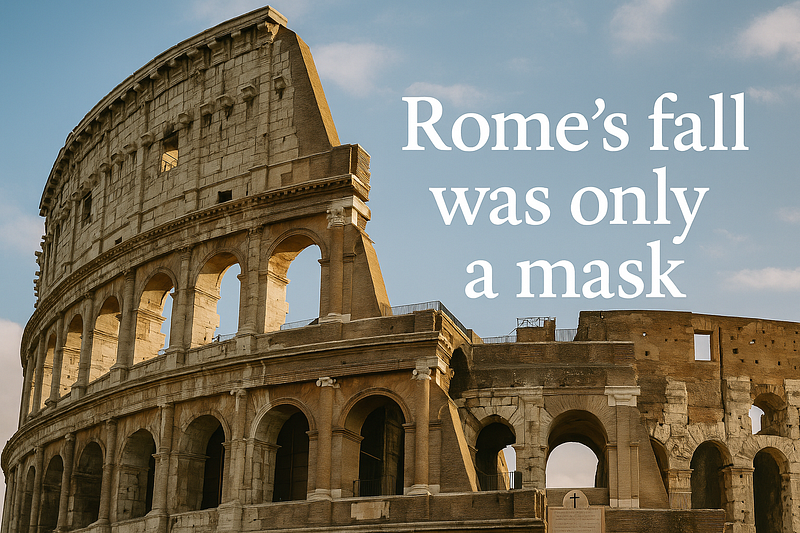
The schoolbook gives you a date and a funeral. Rome fell in 476, the barbarians won, the lights went out. It is a tidy story with a tombstone, and like most tombstones it tells you almost nothing about where the body went. Because the strange thing about Rome is not that it ended. It is that you used it this morning and did not notice.
Look at the date on your phone. You are living in a month named for a Roman dictator and another for a Roman emperor, counting years in a calendar a pope corrected in 1582 from one Julius Caesar imposed in 45 BC. The letters you are reading now are Roman letters. The court that would hear your dispute reasons in categories a Roman jurist drew. The empire did not vanish. It dissolved into the furniture of ordinary life so completely that you stopped being able to see it. This is the same continuity the Manifest traces in Rome Never Fell, told from the other side: not the mechanism of how the apparatus survived, but the inventory of what survived, sitting in plain view on your desk.
In this chapter: the courtroom that thinks in Latin · the water that still runs · the pound in your grandfather’s pocket · a Caesar ruled until 1918 · who invented the fall. For the mechanism of how the apparatus survived its own funeral, read the companion chapter: Rome Never Fell: The Empire That Learned to Hide.
The calendar on your wall is a Roman document
Start with time, because it is the inheritance you cannot put down. The months you live by are Roman. July is the month of Julius Caesar, August the month of Augustus, and the run from September to December still carries the Latin words for seven, eight, nine, and ten, the fossil of an older Roman count that began the year in March. Caesar's calendar of 45 BC ran the Western world for sixteen centuries, and when it drifted out of step with the sun it was not replaced but repaired, by Pope Gregory the Thirteenth in 1582, which is why the system you use is called the Gregorian calendar and why much of the world still dates its life from a reform issued in Rome.
The week is a quieter Roman gift, its days named for Roman gods and planets, surviving in the Latin languages almost untouched and in English half-translated. None of this was voted on. It was simply never put down, generation after generation, until a Roman emperor's name on a summer month became so ordinary that no one hears the empire in it at all.
Even the number of the year is a Roman artifact. The count that puts you in this year, anno Domini, was devised around 525 by Dionysius Exiguus, a monk working in Rome, calculating dates for the church half a century after the western empire supposedly ended. The most universal number in your life, the year on every document, contract, and gravestone, was invented in post-imperial Rome by a man who plainly had not heard that civilization there was over.
The alphabet is the empire in miniature
You are reading Rome right now. The Latin alphabet, carried across the empire on stone, coin, and document, became the script of Western Europe and then, through European reach, the most widely used writing system on earth. Billions of people who never think about Rome for a single day encode their entire lives in its letters.
Latin itself is supposed to be the textbook's cleanest death, a dead language. It is one of the most active corpses in history. It remained the working language of the Western Church until the liturgical reforms that followed the Second Vatican Council in the nineteen-sixties, which means Rome's administrative tongue was still being spoken as living policy within living memory. It is the language in which every plant and animal on the planet is formally named. It supplies the vocabulary of medicine, of law, of science, and of the state. When a doctor writes a diagnosis, a court issues a writ, or a biologist names a species, they reach, usually without knowing it, for the language of an empire that is supposed to have died fifteen hundred years ago.
The language that never died, it changed its name
The textbook calls Latin a dead language, and the previous section showed how busy this corpse is in the professions. But the larger truth is stranger, and it hides behind a renaming. Latin did not die. It kept being spoken, continuously, in the streets and kitchens of the former empire, changing gradually the way all living languages change, until its regional forms drifted far enough apart to be given new names. We call them Spanish, Portuguese, French, Italian, and Romanian. The Romance languages are not descendants of Latin in some loose, metaphorical sense; they are Latin, continued without a single break in transmission, from the soldiers' and farmers' speech of the empire to the roughly billion people who speak them natively today. Nobody ever stopped speaking Latin in Iberia or Gaul. They just stopped calling it that.
Run the numbers on that renaming. Spanish alone has around half a billion native speakers, more than any language on earth except Mandarin. Add Portuguese, carried to Brazil; French, carried across Africa; Italian and Romanian at home, and the everyday speech of the Roman empire is, by any honest count, one of the largest linguistic communities in human history, at its peak not in the second century but now. Even outside the Romance world the empire colonized the dictionary: more than half of English vocabulary, by common estimates, arrives from Latin directly or through French, which is why English speakers can often read a Romance sentence they could never say. A language is the most intimate infrastructure there is, the thing you think in. On that infrastructure, the empire never even had a bad century.
The courtroom still thinks in Latin
Of all the inheritances this is the one with the most weight on ordinary lives, and it is invisible precisely because it is structural. Between 529 and 534 the Roman emperor Justinian had the whole accumulated inheritance of Roman law gathered and codified into what later ages called the Corpus Juris Civilis. For centuries it sat dormant in the West. Then scholars at Bologna recovered it around the twelfth century, and it became the foundation on which continental European law was rebuilt.
The result is still load-bearing. The civil-law systems of most of continental Europe, and through European empires the legal systems of most of Latin America and much of Africa and Asia, descend in their categories and their reasoning from that codified Roman law. When a French, German, or Brazilian court reasons about a contract, a property line, or an obligation, it works inside a structure a Roman jurist would recognize. Even the English-speaking world, which built a different system, kept the Roman vocabulary: subpoena, habeas corpus, affidavit, pro bono, alibi. The empire that supposedly fell still writes the rules in roughly half the courtrooms on earth, and lends its words to the other half.
The church that kept the emperor's title on its front door
Stand in St. Peter's Square and read the front of the basilica. Carved across the façade in letters a meter high is a dedication: IN HONOREM PRINCIPIS APOST PAVLVS V BVRGHESIVS ROMANVS PONT MAX. Paul the Fifth, of the Borghese, a Roman, Pontifex Maximus, in the year 1612. The last two words are the point. Pontifex Maximus was the highest priesthood of pagan Rome, held by Julius Caesar, absorbed by Augustus, and carried by the emperors for four centuries until it was abandoned under Gratian in the late fourth century as the empire Christianized. Whether the papacy formally inherited the office is a question historians still argue about, and this chapter does not need to settle it. The inventory is enough: the most senior religious title of the pagan Roman state is carved, in the emperor's own formula, on the front of the most famous church in the world, and it appears on papal inscriptions and coins to this day.
The title is the visible tip of an administrative inheritance that runs deeper. When Diocletian reorganized the empire around the year 300, he grouped its provinces into large districts called dioceses. The word should sound familiar. When the western state dissolved, the church kept the map: to this day the Catholic Church, and with it much of Anglican and Orthodox Christianity, administers the world through dioceses gathered into ecclesiastical provinces, the filing system of a third-century emperor still sorting believers into districts seventeen centuries later. Even the buildings kept their Roman job titles. A basilica was not originally a church; it was a Roman civic hall, the building type where courts sat and business was done. The form was adopted wholesale for Christian worship, and the name came with it, which is why the world's most important church is called by the name of a Roman courthouse.
And the language of that administration never left the payroll. Latin remains an official language of the Holy See, a functioning European sovereign, whose documents of state are still issued in the tongue of the Caesars; for years even its cash machines offered Latin on screen. The schoolbook says the empire's government dissolved in 476. Its chief priesthood is on a façade signed by a Borghese, its provincial map runs the world's largest religious organization, and its chancery language still stamps a working state's paperwork.
The words you use for power are Roman
Listen to how a modern state describes itself and you are hearing Latin. A republic is a res publica, the public thing. A senate is a council of elders. A dictator was a specific Roman emergency office. Citizens, candidates, elections, magistrates, the very word politics through its Roman channel, all of it is the vocabulary of Roman public life, carried intact into systems that imagine themselves entirely modern. The United States did not merely borrow the word senate; it put its senate on a hill it called the Capitol, after the Capitoline, the temple hill of Rome, and crowned it with a Roman dome.
That is the tell that turns the language into architecture. When a young republic in the eighteenth or nineteenth century wanted to look legitimate, it did not invent a new visual language of power. It reached for Rome, for the column, the pediment, the dome, the eagle, because Roman form still meant authority two thousand years after the fact. Walk up to almost any parliament, courthouse, or bank built to impress in the last three centuries and you are walking up to a Roman temple. The costume changed owners. The costume stayed Roman.
The roads, the arch, the concrete
The most physical inheritance is under your feet. Roman engineering set the template for the European road network, much of it still traced by routes the legions surveyed, and the Roman arch and dome and the Roman use of concrete shaped how the West built for two millennia. The empire poured a material the world then forgot how to make at scale for centuries, and rediscovering it was part of what we call the modern age. Even here the pattern holds: not a clean break and a fresh start, but a capability lost, recovered, and re-inherited, the apparatus of Rome surfacing again under new management.
The water still runs
Every day, tourists at the Trevi Fountain throw coins over their shoulders into water they assume is simply city water. It is older than that. The Trevi is fed by the Acqua Vergine, the restored course of the Aqua Virgo, the aqueduct Agrippa completed in 19 BC. The channel has been repaired, rebuilt, and rerouted in places across two thousand years, but the route and the source are the ones a Roman engineer chose while Augustus ruled, which means the most photographed fountain on earth is, functionally, the last working tap of the Roman water system. The empire's plumbing did not become a ruin. It became a utility.
Walk fifteen minutes from the fountain and the point gets larger. The Pantheon, completed around 126 AD, still carries the largest unreinforced concrete dome in the world, a span of more than forty-three meters that nothing built since has exceeded without cheating, because everything modern leans on steel reinforcement. For most of two millennia nobody fully understood why Roman concrete lasted while ours cracks in decades. A study led from MIT in 2023 supplied part of the answer: the Romans hot-mixed their concrete with quicklime, leaving small lime clasts through the material that dissolve when water enters a crack and recrystallize to seal it. The concrete heals itself. We published the mechanism in a scientific journal eighteen hundred years after the builders poured the dome, which is a strange direction for technology transfer to run.
The same quiet usefulness holds the ground you travel. Across Europe, modern roads still trace the routes the legions surveyed, and the street plans of cities from Turin to Cologne to the old core of Barcelona still show the rectangular grid of the Roman army camp they began as. The funeral story predicts ruins, and Rome has those. But the more telling inheritance is the infrastructure that never stopped being used: the aqueduct with a water bill, the dome that still sheds rain, the road under the asphalt of your commute. A civilization has not fallen while you are still driving on it.
Sometimes the persistence is right there in the address. Cologne is simply Colonia, a Roman colony, worn smooth by German mouths; London grew from Londinium, Paris from a Roman city on the Seine, Vienna from the legion camp of Vindobona. Millions of Europeans mail letters every day to Roman place names and read them as home.
The numbers on the clock and the cornerstone
Look at a formal clock face, the front matter of a book, the name of a king, the cornerstone of a public building, the closing credits of a film, and you will often find Roman numerals, a counting system from a civilization the textbook buried. We keep them precisely where we want to signal weight and permanence: monarchs are numbered in Roman, not Arabic, so that a queen is Elizabeth the Second in the old imperial hand. The everyday arithmetic of the modern world is Arabic, faster and built for zero, and the West adopted it in the late Middle Ages because it worked better. But it never fully evicted Rome. It kept the Roman numerals as the script of ceremony, the typeface of things that are meant to outlast us, which is a fitting afterlife for the numbers of an empire that specialized in looking eternal.
And once a year the habit goes on television. The most-watched broadcast in the United States numbers itself, by unbroken tradition, in Roman numerals: the Super Bowl is not the sixtieth anything, it is Super Bowl LX. A hundred million Americans read a Roman number off their screens every winter and not one in a thousand hears the empire clearing its throat.
Money, salary, the very word for wealth
Open your wallet and you are holding Roman vocabulary. The word money comes from the temple of Juno Moneta in Rome, where coins were struck. The word salary descends from the Latin for salt, the commodity tied to a Roman soldier's pay. Capital, the central word of the entire modern economy, comes from the Latin caput, the head, the same root that gives us the Capitol and the capital city. Mint, coin, fiscal, debit, credit, all of it is Latin, the financial dialect of an empire reaching across two thousand years into the language of the markets that imagine themselves the most modern thing on earth. When economists argue about capital, they are using a Roman word for a Roman idea about counting heads of cattle, and they are doing it without a flicker of recognition that the empire is in the sentence.
The pound in your grandfather's pocket
The Roman names for money, from the last section, could be dismissed as etymology, the harmless fossils every language carries. So take the harder case: not the names of money but its actual units. Until the fifteenth of February 1971, the United Kingdom, then still one of the world's principal economies, counted its currency in pounds, shillings, and pence. The system's own abbreviations gave the secret away: £sd stood for librae, solidi, denarii, the money of Rome. The d on every British price tag meant denarius, the silver coin of the legions. The £ sign itself is a crossed L, for libra, the Roman pound of silver. A person shopping in London in 1970 was making change, without knowing it, in the denominations of the Roman army's pay ledger, and the country only stopped on a Monday within living memory, an event the British called Decimal Day.
The solidus, the gold coin Constantine introduced, had an even longer afterlife. It became the sou of France and the soldo of Italy, and it hides inside the word soldier, which descends from the coin: a soldier is, literally, one who is paid in solidi. Every army on earth that calls its people soldiers is describing them in terms of a Roman payroll. And the denarius did not merely survive in Britain's small change. Carried through Greek and Arabic as the dīnār, it is legal tender today: the dinar of Jordan, Iraq, Kuwait, Algeria, Tunisia, Libya, and Serbia is the denarius, still being earned and spent across three continents.
The mint of Rome struck its last denarius in the third century. The word went on collecting salaries for another seventeen hundred years and has not stopped. That is the pattern this whole chapter keeps finding: the object dies, the use survives, and the use is the empire.
Nor was Britain the last to count in Roman. Italy priced its life in lire until the euro arrived in 2002, and the lira is simply the libra, the Roman pound, in its own language; Turkey and Lebanon use the word still. When the euro retired the lira, newspapers called it the end of an era. Few noticed which era: a unit of account that had run, under one name or another, since the Roman mint.
The eagle over the state
Finally, look at the symbols states choose when they want to say they are powerful and permanent. Rome marched under the eagle, the aquila of the legions, and under the letters SPQR, the Senate and the People of Rome. When later powers wanted to clothe themselves in that authority, they did not design something new. The double-headed eagle flew over the Holy Roman Empire, over the tsars of Russia, over Austria. The single eagle was taken up by Napoleon, by the German Reich, by the United States, whose national bird clutches the same posture of imperial Rome. Strip the eagle off a dozen national seals and you are left with one bird, and that bird is Roman. The fasces, the bound rods that gave fascism its name, still flank the doors of legislatures and courts that would be horrified to be called Roman. The empire did not need to survive as a country. It survived as the visual grammar that power still reaches for whenever it wants to look like it will last.
The deliberate heirs
Most of the persistence in this inventory is unconscious, which is what makes it invisible. But at least once, the inheritance was claimed on purpose, in public, by men who could quote it in the original. When the founders of the United States built a republic in the 1780s, they did not invent a political language. They raided Rome's. The upper chamber became a Senate and was seated on a hill renamed the Capitol, after Rome's Capitoline. The president received a power described by a single Latin word, veto, I forbid, the exact utterance with which a Roman tribune blocked the acts of magistrates. The authors of the Federalist Papers signed their argument for the constitution with one name: Publius, after the founder of the Roman republic. And when George Washington surrendered military power and went home to his farm, his officers founded the Society of the Cincinnati in his honor, naming him after Cincinnatus, the Roman who did the same in 458 BC. An entire American metropolis, Cincinnati, is named, at one remove, for a Roman farmer who held supreme power for sixteen days and gave it back.
The symbols went as deep as the words. Behind the rostrum of the House of Representatives, flanking the flag, stand two bronze fasces, the bound rods that signified a Roman magistrate's authority. The American dime carried the fasces on its reverse from 1916 until 1945, which produces one of the stranger sentences in this inventory: through the entire war against fascism, a movement that had taken its very name from that Roman object, every American carried the same object in their pocket change, stamped there first, and innocently, by their own republic.
This is what separates the deliberate heirs from the unconscious ones. The calendar persists because no one thinks to put it down. The Capitol persists because ambitious men, building something new, understood that two thousand years after the funeral, Rome was still the only brand of legitimacy strong enough to borrow against. Both kinds of persistence end in the same place: the empire, load-bearing, in the middle of the modern world.
The Americans were not the only deliberate heirs of their century. Napoleon took supreme power in France in 1799 under a Roman job title, First Consul, before trading it for emperor; he revived the eagle for his standards, wore the laurel of a Roman triumph on his coronation head, and exported through his Code civil a legal architecture that carried Justinian’s categories into the law books of half the world. Whenever the modern age has needed to found something and make it look inevitable, it has reached for the same dead empire, and the empire has never once failed to answer.
Your name, your city, your idea of the West
The inheritance reaches all the way down to what people are called. Across the Western world the most common given names are still Roman or Latin: Mark from Marcus, Anthony from Antonius, Julia and Julian from the house of Caesar, Victoria from the Roman goddess of victory, Paul, Felix, Laura, Diana, Marcus, Maximus. Parents who have never read a line of Latin reach for it to name the people they love most, because the names still sound like dignity, which is what a name was for in Rome.
And above the names sits the largest inheritance of all, the one so big it is hard to see: the idea of the West itself. For most of the last fifteen centuries, European and then Western civilization has defined itself as Rome's heir. Charlemagne was crowned emperor in Rome; the Holy Roman Empire wore the name into 1806; the framers of new republics modeled their institutions on Roman ones on purpose; empires from the Spanish to the British to the American cast themselves as the new Rome, sometimes in those exact words. The funeral the schoolbook describes was followed by two thousand years of would-be heirs fighting over the estate, which is a strange amount of effort to spend on something that had truly died.
A man titled Caesar ruled until 1918
Here is a quiz the schoolbook fails. When did the last ruler titled Caesar leave power? The textbook answer implies the fifth century. The documented answer is the twentieth. The family name of a Roman politician murdered in 44 BC did not retire with the western empire; it became the ordinary European word for emperor and stayed in the job for nearly two thousand years. In German it became Kaiser. In the Slavic languages it became Tsar. Nicholas the Second, Tsar of Russia, abdicated in March 1917. Wilhelm the Second, the German Kaiser, abdicated in November 1918. Within the lifetime of people whose grandchildren are alive today, two of Europe's great powers were governed by men whose title was, philologically, simply Caesar.
The eastern half of the story is stranger still. The empire ruled from Constantinople never heard the news of its own fall; its people called themselves Romaioi, Romans, without interruption, until the city fell in 1453, a thousand years after the schoolbook's funeral. And when it did fall, the conqueror did not bury the title. Mehmed the Second claimed Kayser-i Rûm, Caesar of Rome, by right of holding the Roman capital, a claim pressed loudest in his own generation. Greek-speaking villagers went on calling themselves Romioi, Romans, into the modern era, which means there were people alive in the twentieth century who identified, in their own everyday word for themselves, as Romans. Meanwhile in the west, an empire with Roman in its name, the Holy Roman Empire, carried the word until 1806, when its last emperor laid the crown down under pressure from Napoleon, who had crowned himself in a ceremony thick with borrowed Roman form.
Trace the one word, then. Caesar: a surname in 100 BC, an office by the first century, and a working imperial title in Berlin and St. Petersburg while telephones were being installed. No dynasty in recorded history kept a name in power that long. How the institutions beneath these titles actually carried the inheritance is the companion chapter's subject; this chapter only enters the word itself into the inventory, because the word alone outlasted every state that used it.
Who invented the fall
If the empire is this present, a fair question follows: who told you it fell? The funeral has authors, and they wrote long after the supposed burial. The frame of a darkness following Rome owes much to Petrarch in the fourteenth century, a poet mourning lost eloquence. The definitive tombstone was carved in 1776, when Edward Gibbon began publishing The History of the Decline and Fall of the Roman Empire, a title so successful that it became the fact it described. The people we now call Byzantines, who considered themselves simply Romans, were renamed by later scholars; the label the textbook uses for a thousand years of Roman history was invented by people who needed the empire to have ended on schedule.
The strongest objection to this chapter deserves its full weight, and it is not the schoolbook's. It is the archaeologist's. Bryan Ward-Perkins has argued, in the most influential modern case for a real fall, that the material record of the post-Roman West shows genuine collapse: pottery that had been mass-produced and traded across seas became crude and local, building in stone nearly ceased, even cattle shrank, the livestock of a poorer world. Ice cores drilled in Greenland add a planetary witness: lead pollution from Roman smelting, a proxy for industrial activity, peaked under the early empire and then collapsed, not returning to that peak for roughly a thousand years. For the person living through the fifth and sixth centuries in Britain or Gaul, the lights truly dimmed, and no inventory of surviving words softens what that impoverishment meant.
Concede all of it, and notice what the concession does not touch, and what the ice itself quietly adds. The Greenland record shows the great industrial collapse beginning in the second century, with the plagues, three hundred years before the date on the tombstone, which means the material decline does not even fit the funeral story it is supposed to prove; the hardware was failing long before 476, and the software outlasted the hardware by millennia. This chapter never claimed nothing broke. It claims that what you were told died is on your desk. And the sharpest evidence is fourteen centuries of behavior: Charlemagne crowned in Rome in 800, Moscow declaring itself the Third Rome, Mehmed taking the Caesar title in 1453, an empire named Roman until 1806, Caesars reigning until 1918. If the estate were truly empty, the heirs would not have spent the whole of subsequent history fighting over the will.
What this adds up to
Set all of it on one table and the funeral story looks thin. The state fell, and the people who lived through that fall paid for it in poverty and danger, and that is real and is not waved away here. But a state is the part of an empire built to be seen, and these other things, the calendar, the script, the language of law and medicine, the codified law itself, the vocabulary and the very buildings of power, are the parts built to last. They did not depend on the emperor whose deposition the textbook dates. They depended on use, and use does not stop on a date.
So the honest correction to the schoolbook is not that Rome did not fall. The western state fell. The honest correction is that the question "when did Rome fall" quietly assumes Rome was the kind of thing that can fall in a year, when most of what Rome actually was had already become so embedded in daily life that it could not be removed by deposing one teenage emperor in one city. You do not notice the empire for the same reason a fish does not notice water. You are inside it. You wrote today's date in it, read this sentence in it, and will be judged, if it comes to that, in its categories.
Rome did not die. It changed its costume so thoroughly that the costume became the world, and the world stopped recognizing the body underneath.
Jerry van der Laan writes The Manifest Archive, a continuous investigation into how institutions, language, and systems shape what people are permitted to see as reality. He does not report events. He traces the structures beneath them.
Evidence Map
Facts, interpretations, forecasts, and disconfirming signals.
Core claim. The "fall of Rome" describes the end of the western Roman state, not of Roman civilization: the calendar, script, law, language of power, money units, engineering, symbols, and even the imperial title itself persisted in continuous use, in some cases into the twentieth century and the present day. This chapter is the inventory of that persistence; the companion chapter, The Empire That Learned to Hide, documents the mechanism.
Evidence level. Facts: high and largely uncontested. Documented: the Julian reform of 45 BC and Gregorian correction of 1582; Justinian's codification (529 to 534) and its recovery at Bologna as the base of civil-law systems; the abandonment of the pontifex maximus title under Gratian and its later papal use, carved on the façade of St. Peter's (1612); Diocletian's dioceses surviving as church administration; the Aqua Virgo of 19 BC still feeding the Trevi via its restored course; the Pantheon as the largest unreinforced concrete dome; the 2023 MIT-led study on self-healing Roman concrete; British £sd (librae, solidi, denarii) until Decimal Day 1971; the dinar as living descendant of the denarius; Kaiser and Tsar as forms of Caesar, in office until 1917 and 1918; Kayser-i Rûm claimed in 1453; the Holy Roman Empire until 1806. Interpretation, marked: reading this persistence as "Rome never really fell" is a reframing of an uncontested record. The strongest counter-reading, Ward-Perkins's material-collapse argument, is presented in the chapter and conceded as real for the western fifth and sixth centuries.
What would confirm this. Continued documented use of the inventory: the persistence claims here are checkable against standard reference works and, in several cases, against objects the reader can inspect (a calendar, a court code, a façade, a fountain).
What would disprove this. Evidence that the continuities listed are retrospective inventions rather than continuous use: for instance, that the civil-law tradition does not descend from Justinian's corpus, that the £sd system did not derive from Roman units, or that the imperial titles were antiquarian revivals rather than unbroken descent. The philological and institutional record currently supports continuity in each listed case.
Watchlist. Historiographical, not forecasting: the ongoing debate between the transformation school and the material-collapse school (Ward-Perkins) over how much broke in the West, which this chapter treats as a debate about the hardware, not the software.