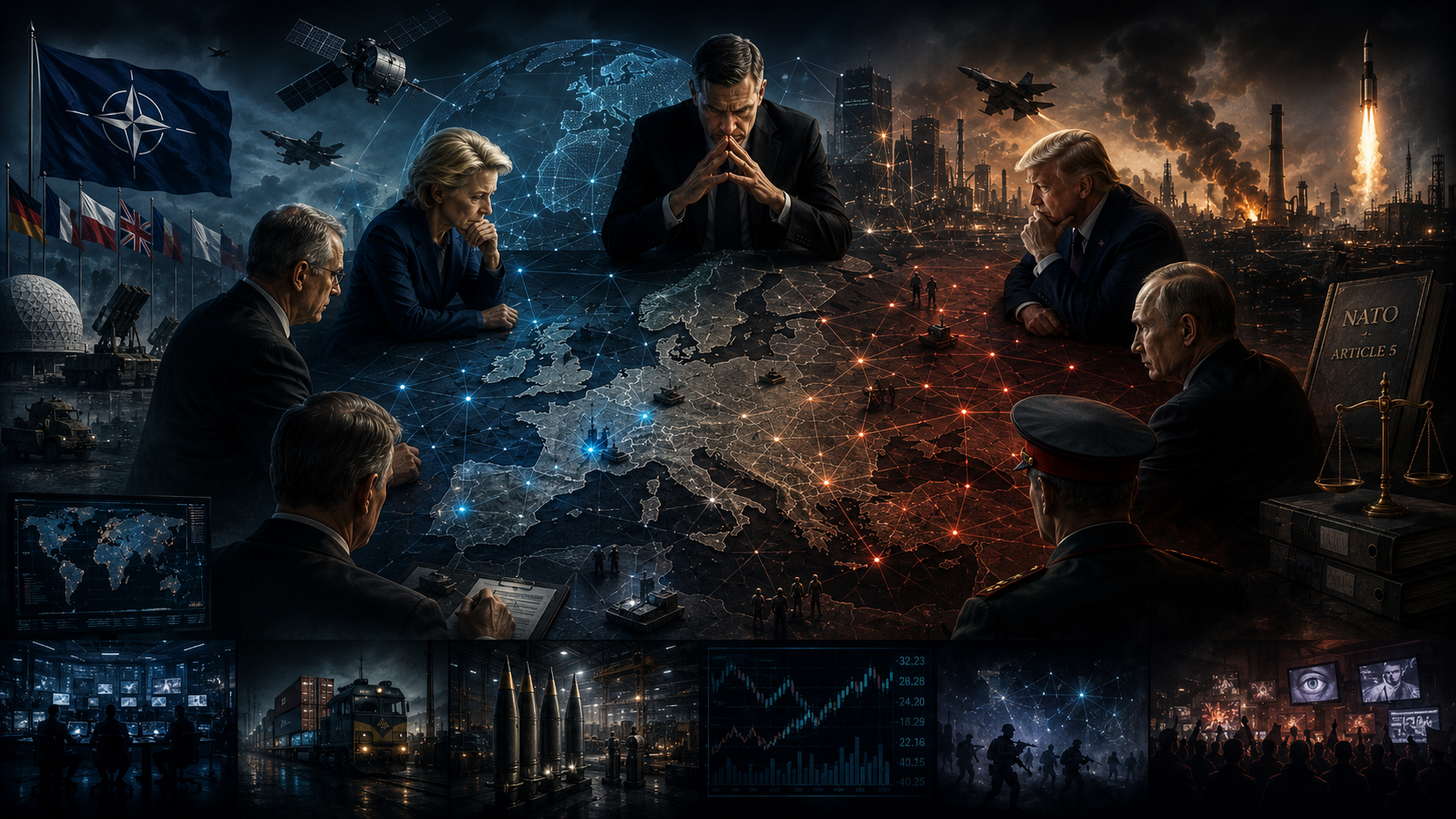
NATO's architecture manufactures constraint through structure, not conspiracy. What happens when political pressure meets institutional lock-in by Q4 2026.
The System That Requires No Intention
The architecture does not require conspiracy. It requires only that thirty nations make rational decisions, separately, and that no single actor see the whole machine taking shape.
NATO's statements are not contradictory. They are simultaneous. The alliance says to Russia: "We are not your enemy. We do not seek confrontation." NATO also says: "We will defend every member as if an attack on one is an attack on all." Both are true. Neither is a deception. Both are the mechanism at work.
By 2025, the system had already formed. NATO did not declare war on Russia. NATO established PURL in July 2025: the Prioritized Ukraine Requirements List. Thirty nations began the work of identifying weapons gaps, coordinating supply, managing logistics. Each decision was separate and defensible. Send weapons to an ally under attack. Integrate targeting so weapons are effective. Provide intelligence so strikes succeed. Train Ukrainian forces so they can use what arrives.
Each decision made sense in isolation. Collectively, they built a machine. At the systems level, the Level 2.5 hypothesis being articulated here the machine does not require anyone to be in control. It requires only that the system perpetuate itself. When Russia retaliates against ammunition factories in Poland, Europe accelerates procurement. When casualty rates climb, conscription pressure intensifies in Moscow. When conscription intensifies, military leadership assesses sustainability. When sustainability is questioned, escalation becomes one option among a contracting set.
This is how mechanisms work at the structural level. They lock actors into outcomes that no actor chose.
How the Machine Works
PURL is the structure, but the machine is the movement through it. NATO satellites identify targets. Real-time data travels from the Bucharest coordination center to Ukrainian command posts in Kyiv, Kharkiv, the eastern zones. This is not information flow. This is a targeting cycle. Hours between satellite identification and strike execution. Western weapons fire. Russian positions suffer casualties. Conscription notices arrive in Moscow. Families calculate whether another son can be sent. Whether another son should be.
Europe watches the response. Russian strikes hit ammunition convoys rolling through Poland. European air defense strengthens. Production accelerates. More ammunition arrives. Rheinmetall and MBDA and a dozen other European contractors now have locked supply contracts running through 2028, securing industrial capacity and procurement incentives aligned with NATO coordination. These are not conspiracy. These are fiduciary obligations. The lock-in operates at multiple levels simultaneously. Companies organize profit projection around weapons deliveries through 2028. Shareholders expect revenue discipline from those projections. Suppliers hire workforce and schedule machinery around three-year production forecasts. European governments budget procurement around contracted flows and industrial capacity. Each actor defends its rational position. Collectively, they have structured their interests around the system's perpetuation. Defense contractors have locked their production capacity, shareholder commitments, and corporate revenue streams into NATO rearmament schedules extending through 2028. A European defense contractor cannot de-risk production without cratering shareholder value. A supplier cannot reduce workforce without breach penalties. A government cannot reduce procurement without industrial unemployment. The machine does not require sinister alignment at the top. It requires only that each component perpetuate its own interest. That multi-level lock-in is structural incentive for system continuation, not corrupt influence but interlocked rationality. Understanding this mechanism's weight: how profit motive, shareholder expectations, supply-chain planning, and alliance coordination lock together is the reason to recognize why withdrawal becomes institutionally difficult for all actors simultaneously. The cycle accelerates again.
France chairs this. Poland hosts it. Germany funds it. The United Kingdom supplies the systems. Nordic countries supply the training. Each has a role. Each claims a supporting position. Each is necessary. But coordination itself is labored: procurement delays, inter-alliance friction over burden-sharing, doctrinal disputes about deployment, bureaucratic slowness, accusations of insufficient contribution. NATO's real machinery is neither elegant nor efficient. It is fractious, slow, often chaotic. Yet even within this friction, even because of this friction, the system perpetuates. No single nation can withdraw without accusations of burden-abandonment. No single nation controls the pace, so none can slow it unilaterally. Together they have constructed a system that does not require central control to function. It requires only that each piece continue its work.
The brilliance lies in distribution. When Russia strikes European ammunition production, which NATO member is attacked? The one that sent the weapons? The one that provided the intelligence? The one that coordinated timing? All are necessary. None can be isolated. The system manufactures what looks like diffusion of responsibility. What it actually manufactures is diffusion of control. No single actor commands the machine. The machine commands the actors.
Russian strategic planners are likely increasingly assessing this architecture. With each NATO retaliatory action, the structural constraints become harder to ignore. The cage is not built by one decision. It is built by thirty decisions, each rational, each separate, each feeding the next. Whether this assessment reaches unified consensus by Q4 2026 depends on coherence within Moscow's own elite: itself fragmented between doctrine schools, regional commands, and competing institutional interests.
Why the Historical Escape Routes No Longer Work
Russia has faced military advantage before. In 2008, Russian forces defeated Georgia's army. Russia could have taken all of Georgia. Instead, Russia accepted a frozen conflict. Ossetia and Abkhazia remain frozen. Low operational cost, manageable sanctions, no existential challenge.
In 1992, Russia won Moldova's civil war. Russia could have taken full control. Instead, Russia accepted Transnistria. A frozen line. Thirty-four years of stalemate. No escalation required.
In 2014, Russia took Crimea. Seven years of frozen conflict followed. International isolation, sectoral sanctions, but no NATO integration. No real-time targeting intelligence. No integrated air defense systems. No drone warfare density. Sustainable.
This is Russia's doctrine: escalation management, not escalation pursuit. Accept the frozen line. Wait for international pressure to ease. Absorb the sanctions. Maintain a low operational tempo. Let time work against Western unity.
But Ukraine is not Georgia, not Moldova, not Crimea. Every previous frozen conflict operated in conditions that no longer exist. NATO integration depth is incomparable. Poland and the Baltics and Romania are all Article 5 members providing direct support infrastructure, not neutral spectators. Sanctions scale is multiple orders of magnitude larger: not sectoral, but total. Energy, finance, technology, industrial capacity. Cryptocurrency embargoes, SWIFT exclusions, technology denial. A frozen conflict in Ukraine requires Russia to absorb permanent economic warfare indefinitely.
ISR saturation is unprecedented. Georgia and Moldova involved limited satellite reconnaissance. Ukraine operates under constant NATO surveillance, signals intelligence integration, real-time targeting data. A frozen conflict means Russian forces remain continuously mapped, continuously vulnerable, continuously assessed.
Drone warfare density is without historical precedent. Thousands of drone strikes per month. Small unit attrition. Continuous tactical ISR-to-strike cycles. A frozen conflict at these casualty rates produces losses incompatible with historical freeze patterns.
The freeze option exists. Russia could choose it. But the structural conditions that made it sustainable in Georgia, Moldova, and Crimea: limited NATO integration, manageable sanctions, modest drone density, ISR sparsity are gone. The doors that used to open to frozen conflicts are closing.
The Timeline of Pressure
What began in 2024-2025 as NATO system-construction PURL created, production ramping, weapons accelerating. Has become pressure accumulation by early 2026. High sustained casualty estimates across multiple tracking models suggest casualty rates that Russian planners increasingly assess as politically corrosive over multi-year timelines. The asymmetry is structural: NATO air defense systems, NATO intelligence feeds, NATO logistics networks systematically degrade Russian force effectiveness while preserving Ukrainian combat capability. But what is sustainable depends on political tolerance, which varies by regime type, battlefield perception, and elite cohesion none of which are transparent to external analysis. Russia can theoretically absorb high casualties for years through conscription. The question is political, not logistical.
But conscription has political costs. Each mobilization wave domestically weakens. By Q3 2026, Russian military leadership has completed its sustainability assessment. The question is not whether Russia can fight longer. The question is whether Russia can fight indefinitely while maintaining political stability at home. If that assessment concludes no, escalation becomes the only option among a contracting set.
The assessment occurs simultaneously with two other events. European production accelerates in Q4 2026. Ammunition and weapons materialize as promised, if they materialize at all. Ukrainian capability either increases or does not. But the central variable, the one that modulates all Russian calculations is American commitment. This is not a minor factor among three equal convergences. American commitment is the variable that transforms the entire equation.
The American Variable: Three Trajectories
Russia must forecast American commitment across three scenarios simultaneously. A Trump administration signals burden-shifting: NATO coordination fragments, allied coherence weakens, escalation pressure declines as allied response becomes unpredictable and less integrated. But American security guarantees simultaneously weaken, creating different instabilities. A continuity administration deepens intelligence integration and industrial coupling: NATO technical depth increases, escalation ladder coordination tightens, non-escalatory options become more constrained. A third scenario, partial withdrawal or neutrality repositioning decompresses Russian escalation pressure immediately, but American security umbrella collapses, leaving European actors without guarantor.
Russian planners cannot predict the outcome. They must weigh three incompatible strategic geometries. Under continuity, the cage lock-in hardens. Under burden-shift, allied response becomes chaotic. Under withdrawal, American protection vanishes. Each scenario produces a different calculation of whether escalation appears rational.
When Russian unsustainability assessment, European production hardening, and American commitment uncertainty converge by Q4 2026, Russian military leadership faces what appears to be a narrowing window. Not an objective deadline. A window that appears to be closing from inside Russian strategic assessment, depending on which American scenario seems most probable and when that probability becomes clear.
The Cage With One Exit
Russian military leadership is not irrational. It is trapped. The assessment is clinical, not emotional. Negotiate? NATO and Ukraine commit to continued support "through negotiations." Negotiations become rest stops, not exits. The war resumes. The casualty cycle continues.
Consolidate defensive positions? Defensive wars in attrition produce higher casualty rates, not lower. Russian doctrine treats defensive grinding as unsustainable. Consolidation extends indefinite war, which is the problem to begin with.
Accept indefinite attrition? This requires accepting year-after-year conscription waves, casualty announcements, political costs. Political sustainability beyond 2-3 years is unknown. Unknown feels like unacceptable.
Escalate to break the cycle? Direct strikes on European ammunition production reduce weapons flow. Direct intervention seizes territory and forces settlement negotiation. This is the mechanism that breaks the attrition lock.
The strongest counterargument to this analysis does not dispute the documented lock-in architecture. It accepts that NATO coordination has deepened, that escape routes have narrowed, and that pressure accumulates. What it disputes is what follows from pressure. The most rigorous pro-patience position asserts that Russian military leadership, despite understanding the constraints, could rationally prioritize nuclear threshold fear above threshold-crossing risk. This argument observes that fortress-defense doctrine has historical precedent even at casualty rates exceeding current levels Georgia consolidated defensively across nineteen years, Transnistria has endured thirty-four years of frozen stalemate without escalation. A frozen line is not collapse. Stalemate is not defeat. Moreover, elite fragmentation might actually prevent unified escalation consensus rather than force it. Doctrine schools favoring escalation dominance could clash with institutional layers (General Staff, Federal Security Service counterintelligence, regional military commands) advocating strategic patience. Some elites might calculate that nuclear threshold-crossing risk exceeds the cost of indefinite grinding. Sustaining the pro-patience position itself requires active institutional management: disciplined command structure, doctrinal messaging against threshold-crossing, officer-corps consensus on the costs of escalation. This is not passive acceptance but institutional work. This pro-patience case is structurally serious. It explains why historical frozen conflicts persist despite high costs. It acknowledges real constraints without assuming constraints automatically convert to action.
This reading does not dismiss the pro-patience position. It does not claim escalation will occur. It does not claim Russian leadership is powerless or the outcome is mechanical. It does not argue that NATO conspired or Russia is irrational. It claims something more specific: that the mechanism raises the cost of non-escalatory choices and narrows the window for them. From the perspective of Russian military assessment in a closed strategic room, options one, two, and three appear exhausted. But exhausted is not the same as impossible. Other paths exist stalemate acceptance, elite-driven reversal, negotiated settlement, but they are slower, require elite consensus that may not materialize, or demand political sacrifices that may prove unacceptable. If escalation occurs, it will be because the mechanism has presented one calculation as faster than others, making threshold-crossing appear rational within a constrained choice set. Escalation is presented not as inevitable, but as the fastest mechanism that changes the equation. Whether decision-makers choose speed over ambiguity, or accept the slower friction of indefinite attrition, depends on factors no external analysis can fully predict: the coherence of elite consensus, the interpretation of American commitment, the tolerance for casualties, the confidence in escalation dominance itself.
NATO did not build this trap with intention to trap. Each NATO member made defensible decisions. Send weapons to an ally under attack. Coordinate to make them effective. Provide intelligence so strikes succeed. Train forces so they can use what arrives. Each decision was rational. Each was separate. Together, they constructed a mechanism that offers no escape route except through NATO territory.
This is the mechanism's brilliance: No single actor chose it. Every actor contributed to it. Every actor is trapped by it. NATO is not guilty of conspiracy. Russia is not irrational. The system produces both outcomes through the accumulated weight of distributed rationality.
System Elasticity: Why Pressure Does Not Automatically Convert to Action
Yet pressure is not destiny. Within the locked-in architecture, competing forces absorb and redirect escalation impulse. These are not hopes. They are structural.
NATO itself is fatigued. Alliance burden-sharing fractures over time. Germany debates rearmament costs. France hedges on American leadership. Poland fears abandonment. These tensions do not dissolve the mechanism, but they slow it, creating space for political calculation. Procurement schedules slip. Weapons promised in Q4 2026 arrive late. Production bottlenecks reduce ammunition flows below optimistic projections. Russian drone adaptation improves. Electronic warfare countermeasures degrade NATO targeting efficiency. The system generates friction from within its own functioning.
Russian adaptation operates in parallel. Black-market procurement networks supplement official channels. Battlefield stalemate normalization: the grinding horror that becomes accepted routine reduces domestic mobilization pressure. Elite fragmentation in Moscow means competing doctrine schools: those favoring escalation dominance clash with those advocating strategic patience. Risk-averse institutional layers within Russian command chains create friction against threshold-crossing decisions. Fear of nuclear miscalculation, even calculated fear, operates as counterpressure. These factors do not eliminate escalation incentive. They create competing weights in the calculation.
Political exhaustion is real. Years of war produce populations tired of sacrifice, elites divided on strategy, leaders calculating electoral cost. The indefinite grinding that seems unacceptable in abstraction becomes normalized in experience. Stalemate at the current frontline, while strategically frustrating, remains operationally sustainable for longer than mechanical models predict.
None of these factors breaks the lock-in mechanism. None reverses the architecture. But each operates as elasticity within the system: competing pressure absorber that slows the conversion of pressure into action. Pressure accumulates. Pressure does not automatically generate escalation. Organizational theorists recognize this pattern as commitment device architecture: when individual rational choices lock all participants into a shared outcome none of them individually chose. The distinction is critical. A system can contain escalation potential for extended periods if competing forces balance the incentive structures. The mechanism does not determine the outcome. It constrains the available options and increases the cost of non-escalatory choices. But it does not eliminate them.
How the Trap Could Break
Three things could reverse the trajectory. A genuine settlement would release all pressure. If Russia and NATO agreed to terms including territorial recognition and NATO membership exclusion, the mechanism would stop. Weapons would stabilize. Casualties would ease. This requires Europe to offer genuine settlement terms. The Paris Declaration commits Europe to support "through negotiations." No settlement path exists.
European unity could fracture. If NATO withdrew support due to economic costs or internal division, Russia could sustain indefinitely. Every NATO country increased defense spending after 2022. Every attempt to fracture unity failed. The bonds show no sign of breaking.
Russia could accept indefinite attrition. If Russian military doctrine changed to accept grinding war, the escalation pressure would ease. Russian doctrine historically emphasizes escalation dominance, not attrition acceptance. Doctrine does not change quickly.
A fourth option exists but operates on a different timeline. Russia could choose freeze over escalation. Historical precedent supports this. Georgia, Moldova, Crimea all chose frozen lines rather than maximalist seizure. A new frozen line at or near the current frontline could be operationally sustainable. Russia could accept territorial loss, maintain a low operational tempo, and wait for European will to weaken. This is possible. It is not the direction the mechanism is currently moving.
The Window as Russian Perception
By late 2026, three convergences occur. Russian military leadership completes its sustainability assessment: can Russia absorb indefinite casualties while maintaining domestic political stability? European production surges: ammunition arrives, weapons systems are delivered, Ukrainian capability either increases or does not. American commitment becomes clear following the election: deepening, stable, or weakening.
But the American outcome is the keystone variable. It transforms how Russia reads the other two.
If American commitment deepens (continuity administration scenario): NATO technical integration tightens, intelligence fusion deepens, escalation ladder coordination becomes precise. European rearmament locks into permanent structure. The cage hardens. From Russian perspective, non-escalatory options collapse into two forms: indefinite grinding war, or slower political reversal that may never arrive. The window, the time before lock-in becomes irreversible appears to close. Escalation becomes the fastest mechanism that changes the equation.
If American commitment fractures (Trump burden-shift scenario): Allied coherence weakens, NATO coordination slows, escalation ladder clarity dissolves. Russian planners gain maneuver space. But that maneuver space is unstable. European states act unpredictably. Ukrainian capability depends on whether Europe maintains support independently. The window does not close; it becomes murky. Escalation appears less necessary but also less predictable in outcome.
If American retrenchment occurs (partial withdrawal scenario): American security guarantees evaporate. Escalation pressure decompresses immediately. Russia regains strategic autonomy. But the European response becomes the new variable. Will Europe continue support without American coordination? The calculation shifts from "break NATO lock-in" to "what does a Europe without American guarantee look like?"
Each scenario produces a different Russian reading of the window. In scenario one (continuity), the window appears to be closing and escalation appears rational within time pressure. In scenarios two and three, the pressure and timeline are fundamentally different. Russian planning must simultaneously hold three incompatible calculations.
The freeze option exists. Russia chose it in Georgia, Moldova, Crimea. But the structural preconditions that made freeze sustainable limited NATO integration, manageable sanctions, modest drone density, ISR sparsity are gone. The doors that used to open to frozen conflicts have changed their architecture. Whether they remain passable depends on American commitment trajectory.
The mechanism does not require anyone to choose escalation. It requires only that the system continue. Each NATO member continues its rational, separate work. Each contributes to the cage. Russia sees the options contracting but the speed and shape of that contraction depends almost entirely on American choice. By Q4 2026, Russian leadership faces three possible closed systems, not one. Negotiate: no exit in any scenario. Consolidate: higher casualties in any scenario. Accept attrition: unsustainable in any scenario. Escalate: the mechanism that changes the equation, but with vastly different calculus depending on which American future becomes clear.
This is not inevitable. But it is how the machine works if actors choose speed over ambiguity within their perceived constraint set. If escalation occurs, it will not be conquest. It will be one actor's calculation that remaining within the system absorbing friction, accepting stalemate, waiting for political reversal costs more than the risk of threshold-crossing, weighted against the specific American scenario that has emerged. Whether Russian leadership reaches that conclusion depends on factors that resist prediction: elite coherence, battlefield perception, confidence in American intelligence signals, nuclear threshold psychology, and the specific American administration's stance that clarifies in late 2026. The system constrains outcomes. It does not determine them. But American commitment is the variable that determines whether the constraints appear to be tightening, loosening, or becoming unpredictably chaotic.
The Europeans who built this cage did not intend to build a cage. They made rational decisions, separately, to support an ally under attack. But the aggregate of thirty rational decisions becomes a mechanism that offers no exits except through NATO territory. Understanding how distributed systems trap actors is the only way to see what is being built while the pieces are still being put in place.
This mechanism of distributed power creating unintended systems has deeper structural layers. The Macht-architectuur analysis maps the four-tier institutional scaffolding within which NATO coordination operates as a Level 2.5 apparatus. The Defense-Industrial Cluster essay traces how European rearmament has locked specific procurement beneficiaries into the escalation cycle through supply-contract lock-in running through 2028.
Related from The Manifest Archive


