Four systems are breaking quietly while the world counts strikes.
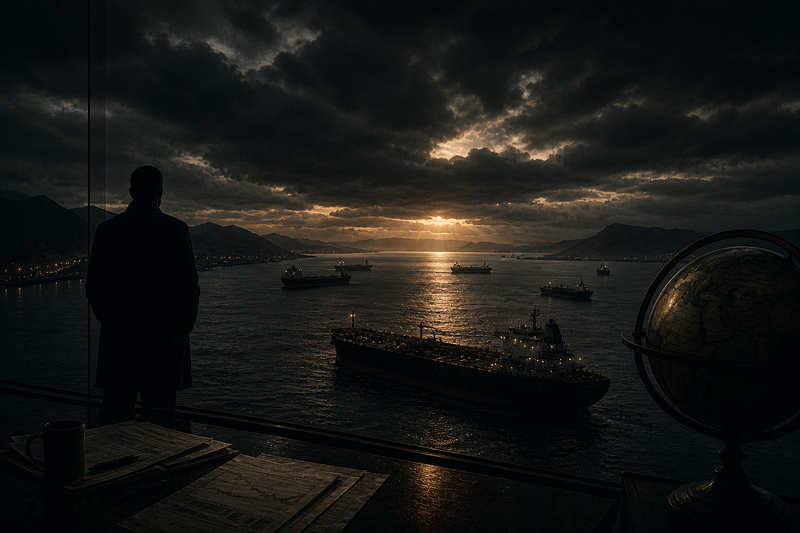
The Strait of Hormuz is twenty-one miles wide. Through it moves one-fifth of the world’s oil, one-fifth of its LNG, and the pricing assumption that holds the dollar at the center of global trade. It is not a bottleneck. It is a load-bearing wall. When you remove a load-bearing wall, the building does not leak. It falls.
Every Western newspaper covering the Iran crisis is operating from one premise: this is a temporary geopolitical disturbance with regrettable price effects. The premise is wrong. It is the wrongness itself that makes the coverage possible. The frame is not a misreading of the situation. It is the cover under which the situation can continue.
What is actually underway is the slow-motion structural detonation of the post-Cold-War financial, energy, and security order. The United States operates inside an incentive landscape that produces escalation as output, not because anyone inside chooses escalation, but because every relevant subsystem rewards it and none of them pays for it. The system is not being driven. It is being run forward by its own structure.
The Strait of Hormuz carries roughly twenty percent of global oil and one-fifth of global LNG trade. Since early March 2026, when war-risk cover was cancelled and traffic collapsed, the strait has functioned as closed, and since 13 April the United States has enforced its own blockade of Iranian ports. War-risk premiums rose four- to sixfold within a single week, and the P&I clubs then withdrew cover outright. The Islamabad talks of 11 and 12 April, with Vice President Vance leading the American side, ended after twenty-one hours without an agreement. None of these are price events. Each is a structural one. Together they describe the opening minutes of a much longer cascade.
This is not about gasoline. This is about whether the dollar order survives the decade, whether four to six new states acquire nuclear weapons within the next twenty-four months, whether the regimes in Egypt and Pakistan still exist on this side of 2027, whether the NATO security architecture has any operational meaning left, and whether the post-1945 global trade architecture survives at all in recognizable form.
You will not read it that way in the Financial Times. The Financial Times itself is a node in the system being detonated.
The closing did not need a navy. On 1 March the Norwegian club Gard gave notice that its war-risk cover would end from 5 March, citing its reinsurers, and other clubs followed within days. On 12 March UK P&I told its members that a Hormuz transit was no longer covered unless the club approved it in advance. Each notice was a verdict rather than a price: once it took effect, the route stopped existing as a commercial proposition for the ships it covered. The Strait did not close because anyone announced a closure. It closed because the contracts that let a ship sail were withdrawn, one circular at a time.
This chapter was written in the first days of May 2026, under the April ceasefire and the American blockade, and it stands as written: the four systems it names have kept breaking on schedule. For what has happened since, the ceasefire's collapse in July, the twenty percent toll, the restored blockade, and the war’s arrival at your fuel bill, continue with Nobody Is Watching the Sentence and Nobody Is Watching Your Fuel Bill. In this chapter: the apparatus · the blockade before the name · the dollar audit · the bread chain · the probability map.
Iran is not a country. Iran is an apparatus.
The first lie of mainstream Iran coverage is that Iran is a country with a regime. The truth is that Iran is a dual-state operational apparatus running three systems in parallel inside one set of borders.
There is the elected layer of presidents, parliament, and ministries. Above it sits an unelected religious-military vertical headed by the Vali-e Faqih, held by Ali Khamenei from 1989 until he was killed in the opening strikes of 28 February 2026, and since 8 March by his son Mojtaba, holding constitutional final authority over foreign policy, defense, justice, and the armed forces. Around the apparatus runs a parallel armed force, the Islamic Revolutionary Guard Corps, with its own ground troops, navy, air force, intelligence service, and the extraterritorial Quds Force. Beside the IRGC sit the bonyads, foundations holding tens of billions of dollars in assets exempt from standard taxation and reporting only to the Office of the Leader. Beyond the borders, the proxy network: Hezbollah in Lebanon, the Houthi in Yemen, the Popular Mobilization Forces in Iraq, until 2024 the Assad regime in Syria. Each presents itself as a sovereign political actor. Operationally, each is wired to the Quds Force.
This apparatus has absorbed eight years of war with Iraq, two waves of mass protest in 2009 and 2022, four decades of sanctions, the largest assassination campaign of the post-Cold-War era, and the loss of its Syrian land bridge in 2024. It is not fragile. It is one of the most institutionally robust regimes on earth.
The Assembly of Experts named Mojtaba Khamenei Supreme Leader on 8 March 2026, eight days after his father’s death. His first statement as Leader, on 12 March, was read out by a state television anchor over a still photograph, and in the weeks that followed he did not appear in public video. Inside Western coverage this registered as a curiosity, not as a signal.
A regime in succession does not negotiate. A regime in succession consolidates. A regime in succession needs an external enemy of the right scale to suspend internal contestation.
The Hormuz crisis arrives at exactly the moment the apparatus needs it.
This is the actor against which the United States is now applying blockade-grade pressure. The pressure will not break the apparatus. It will break the systems around it.
The sanctions that built the regime they were meant to bury
The structural absurdity at the heart of US Iran policy is that the sanctions regime imposed since 1979, hardened after the JCPOA breach in 2018, and intensified under Maximum Pressure, has not weakened the apparatus it was designed to dismantle. It has constructed it.
A regular Iranian exporter cannot complete an oil transaction without dollar clearing. An IRGC-affiliated trader can, through ship-to-ship transfers, undocumented bills of lading, and yuan and rouble settlement rails. The premium produced by sanction circumvention flows directly to the actors keeping the regime alive. The bonyads, exempt from standard tax and reporting, became the natural conduit. Khatam al-Anbiya, the IRGC’s industrial arm, became one of the largest contractors in the Iranian energy sector because no foreign investor could enter without sanctions risk. The civilian middle class shrank. The IRGC economy expanded. The sanctions regime functioned as an industrial policy for the parallel state.
This is not an unintended side effect. It is the ten-year structural function of the architecture as it has been built. Many officials working inside the sanctions architecture understand this. None can say it on the record because the entire policy edifice rests on the public premise that sanctions weaken the regime. They strengthen it. They are now being doubled down on, on top of an apparatus they have already optimized for circumvention.
The blockade before anyone named it
The closure began weeks before Washington used the word. When President Trump announced a blockade of Iranian ports on 12 April, effective the next day, the strait had been functionally shut since early March. Around the declared blockade runs layered pressure: insurance premiums hiked to the point of unviability, naval interdictions framed as enforcement actions, supertanker reroutings around Africa adding twenty days of fuel-burn, selective sanctioning of port operators across the Gulf, and a Navy posture that the Iranian Revolutionary Guard navy can read as preparation for kinetic action without anything kinetic having yet occurred. The cumulative effect was a blockade long before it carried the name.
What this produces is no longer price inflation. It is physical scarcity. Petrochemical plants in Germany, Korea, and Texas built around specific grades of Gulf crude cannot substitute Brent or WTI without retooling that runs into months and billions. A refinery is not a blender. When the input is gone, the output is gone.
Goods that are not there cannot be priced into existence. This is the fact the central banks of the West cannot face, because their entire toolkit was built for demand-side disturbances, not supply-side amputations.
It’s already inside your heating. It’s already inside your fuel. It’s already inside every product that arrived on diesel.
The dollar order is being audited in real time
The dollar’s status as the world’s reserve currency rests on the petrodollar arrangement made in Saudi Arabia in 1974: oil settled in dollars, dollar reserves held by every importer, US Treasury bonds purchased to recycle the surplus. That arrangement is what allows the United States to finance an annual deficit larger than the GDP of most G20 countries.
Iran has not settled in dollars for years. China buys Iranian crude in yuan. Russia rerouted its oil exports to India and China in rouble and yuan after 2022. Saudi Arabia signed a 50 billion yuan currency swap with China in November 2023, and its central bank joined the mBridge cross-border payment project in 2024. A Hormuz crisis forces every importer to choose, in real time, which side of a new monetary order they want to stand on.
When dollar demand drops, US rates rise to compensate. When US rates rise, European rates follow. When European rates rise, sovereign debt costs in Italy, France, and Spain reach refinancing pressure that the European Central Bank cannot absorb without reigniting the eurozone debt crisis. Inside that scenario, latent banking weaknesses in the German, French, and Italian financial systems, not defused since 2008 but sedated by quantitative easing, return to the surface.
This is not theory. The first signal is already in your mortgage offer. The second is in your pension fund’s funding ratio. The third is in the budget your municipality just released. They look like separate stories. They are one story.
The bread chain that runs through Hormuz
The food layer is the layer that produces regime collapse, not just inconvenience. Fertilizer is made from natural gas and oil derivatives. Tractors run on diesel. Container ships run on heavy bunker fuel. The cold chain that delivers winter tomatoes from Morocco runs on electricity drawn substantially from gas.
When the oil flow falters, the entire agro-logistics chain falters with it. Egypt, Pakistan, Bangladesh, and large parts of sub-Saharan Africa import bread. Their grain comes mostly from Russia and Ukraine, across the Black Sea. Hormuz reaches it another way: through fuel, freight insurance and fertilizer, since Gulf exporters supply roughly a fifth of world urea trade. A country that cannot afford bread cannot defend its currency. A currency in collapse produces importer bankruptcies. Importer bankruptcies produce queues. Queues produce regimes that wobble and fall.
Egypt, with more than 100 million people, is one structural shock from the failure mode that produced 2011. Pakistan, with 240 million people and a nuclear arsenal, is closer to that line than any Western diplomat will say on the record. Bread, grain and currency were among the documented triggers of the collapse that took Tunisia and Libya in 2010 and 2011, alongside unemployment and repression. The world economy is now feeding the same chain into Cairo, Karachi, Dhaka, and Lagos at the same time.
It’s already in your groceries. It’s already in countries you have never put on a map. The fact that you have not put them on a map is the work of the frame.
The proliferation cascade that already started
By June 2025 the IAEA counted 440.9 kilograms of uranium enriched to 60 percent, in theory enough for about ten weapons if enriched further, and since the strikes the agency has been unable to verify the stockpile. The institutional question has never been technical. It has been political: at what point does crossing the threshold cost the regime less than not crossing it? A sustained blockade combined with the killing of the Supreme Leader moves the calculus.
Saudi Arabia has stated for years that an Iranian breakout would trigger a Saudi response. Turkey’s President Erdoğan publicly questioned the rules that keep Turkey from nuclear weapons in September 2019. In South Korea, the debate over a national bomb has been open since President Yoon raised it in January 2023.
The mainstream description is that this is a hypothetical scenario. The forensic reading is that it has already started, in the form of slowly lowering political and industrial thresholds across several capitals. Each step makes the next step cheaper. A world with twelve to fifteen nuclear-weapon states is not a world with a third more nuclear weapons. It is a fundamentally different security regime, with regional escalation ladders that intersect, and deterrence doctrines forced to operate on hours of communication between unfamiliar capitals.
This layer is rarely named in Western coverage. It is named here.
The eastward axis that is the real beneficiary
Behind the Iran cascade sits a beneficiary the Western frame is structurally incapable of naming. The Hormuz crisis is the largest single transfer of strategic leverage from Washington to Beijing and Moscow since the fall of the Soviet Union, and it is being executed by Washington itself.
China imports roughly 90 percent of Iran’s exported crude. Each premium dollar of price increase is paid by Western consumers and recycled into Chinese purchasing power that the United States cannot interdict. The weapons flow ran the other way: Russia became the principal recipient of Iranian Shahed drones for the Ukraine theatre, and later built them at home.
The Russia-Iran-China triangle was a loose alignment of interest in 2020. By 2026 it is a working architecture: shared payment rails outside SWIFT, shared sanction-evasion infrastructure, shared satellite-targeting cooperation, and a quiet North-South corridor through Iran linking Russian industry to the Indian Ocean while the Suez and Hormuz routes are politically encumbered.
Every new Hormuz incident strengthens this triangle. Every supertanker rerouted around Africa adds fuel-burn that drives global prices, drives global inflation, drives global flight from the dollar, and drives the eastward shift. China does not need to fight the United States in the Pacific. It needs only to wait while Washington dismantles the financial architecture that made American power possible. Beijing has been counting on this since Xi Jinping’s third-term consolidation in 2022. The Iran cascade is the gift Washington keeps giving.
The Iran apparatus understands this. Its calculus is not survival under blockade. Its calculus is survival as a node inside a new Eurasian order in which the dollar is no longer ascendant. A Khamenei succession executed inside that order, as this one now is, differs fundamentally from one executed under unipolar Western pressure. The apparatus has reasons of its own to extend, not end, the current crisis.
The coalition: not abstract, not anonymous
The structural question is why the apparatus keeps producing escalation outputs if the eastward shift is the predictable outcome. The answer is not that any individual is foolish. The answer is that a coalition inside the American apparatus operates inside incentive structures that override de-escalation, and a parallel coalition inside the Israeli political class depends on the war continuing for domestic survival.
Inside Washington, four structural loci.
The defense-industrial axis: Lockheed Martin, Raytheon, Northrop Grumman, Boeing. The relevant observation is not which executive lobbies for what. It is that the order books for Patriot, THAAD, F-35 sustainment, naval munitions, and Iron Dome interceptor lines stay full only while a Gulf threat persists. Each peace deal closes a budget line. Each escalation reopens one.
The energy majors, ExxonMobil, Chevron, ConocoPhillips, post their record quarters during exactly this kind of shock-driven pricing, and their shareholder structures reward exactly this volatility.
The Treasury benefits structurally from oil-driven dollar scarcity that keeps Treasury bond demand intact while sovereign debt rises, which is to say its institutional balance sheet improves under the same conditions that strain everyone else’s.
The Israel coalition inside Congress: AIPAC, the Republican majority’s evangelical Zionist wing, the Foundation for Defense of Democracies, the right flank of the Democratic establishment. The relevant pattern is not the lobbying spend itself. It is that this coalition fought the 2015 nuclear deal in Congress, lost that vote, and won the argument three years later when the United States withdrew in 2018.
CENTCOM as an institution has its own embedded interest in Gulf threat persistence, since its budget, force posture, and bureaucratic relevance scale directly with Iran being a problem.
Inside Israel, Benjamin Netanyahu’s political survival depends on a continuous external threat large enough to suspend domestic accountability for the 2023 judicial overhaul crisis, the Gaza catastrophe, and the corruption indictments still active against him. Iran is the only threat large enough to do that work. A peace deal with Iran ends the Netanyahu coalition within months. The same logic operates around the Israeli defense establishment, where careers built on Iran-deterrence doctrine have a vested interest in the doctrine remaining live.
These are not anonymous structural pressures. They are named institutions, named individuals, and named order books. Nobody inside that coalition pays for escalation. The costs are externalized to an Egyptian middle class, a Dutch homeowner, an Iranian young person whose economy is being strangled by sanctions that strengthen her regime.
The war is not about Iran. Iran is about the war. The war is about who inside the apparatus books profit as long as the war runs, and who loses the moment it stops.
As long as that balance holds, the war runs.
Europe is not coming
The Western frame still gestures occasionally toward “the international community” as if there were one. There is not. The European political class is incapable of either supporting a full US-Iran confrontation or stopping it. Germany cannot survive an oil shock that pushes industrial energy costs another forty percent without triggering social rupture. France cannot survive a banking shock against the backdrop of fiscal pressure already forcing pension cuts. Italy cannot refinance its sovereign debt at rates pushed up by US monetary tightening.
Donald Trump’s transactional posture toward NATO, in his first term and again since January 2025, has already demonstrated that the alliance no longer functions as a unified strategic actor. The Sondervermoegen rearmament programme launched in Germany in 2025 was structured as if Russia were the only threat, and now produces military-industrial capacity that cannot be deployed to a Persian Gulf theatre without exposing Europe at home. NATO has not held a substantive Iran-strategy session at heads-of-state level. It cannot. The disagreements inside the alliance are now larger than what unified language could paper over.
What this means in practice is that when the Hormuz cascade enters its acute phase, no European actor will be in a position to mediate, to constrain American action, or to absorb the financial shock. The cavalry is not coming. The cavalry has already disbanded.
The catastrophe scenarios nobody publishes
What does the next eighteen months look like if the current trajectory holds? Four scenarios are credible enough that they are credible enough to belong in serious contingency planning across Western capitals, while public coverage is forbidden from naming them at this resolution.
Scenario one
A Hormuz incident escalates to direct US-Iran naval engagement. The IRGC navy executes asymmetric strikes on US assets using anti-ship ballistic missiles Iran has fielded since the early 2010s. The United States retaliates against Iranian oil infrastructure. Oil prices spike past two hundred dollars within a week. Asian importers move to emergency rationing. European energy contracts enter default. The eurozone enters financial crisis within sixty days.
Scenario two
Egypt enters a 2011-pattern collapse driven by bread shortage, currency failure, and IMF withdrawal. Refugee flows north into Europe peak at 2015 multiplied scale. The Sisi regime falls or holds through martial law. Either path destabilizes the entire eastern Mediterranean.
Scenario three
Pakistan’s economic deterioration combined with Indian electoral pressure on Modi produces a Kashmir flare-up that crosses the conventional-nuclear threshold for the first time since both states tested nuclear weapons in 1998. The United States is too distracted in the Gulf to mediate.
Scenario four
Saudi Arabia, watching the Iranian threshold crossed in fact if not in declaration, accepts a Pakistani-supplied warhead building on the mutual defence pact the two states signed in September 2025, which Pakistani officials have played down as a nuclear umbrella. Within twenty-four months, four to six new states cross the threshold publicly. The non-proliferation regime built since 1968 collapses inside a single news cycle.
Each scenario is independently plausible. The shared trigger is the Hormuz cascade running now. Two of the four are already partly in motion.
At this point, the crisis stops behaving like news. It becomes a risk model.
If the war runs another two months: a probability map
The catastrophe scenarios above are not equally likely on a sixty-day horizon. They run on different clocks. A naval engagement can detonate inside a week. A regime collapse needs months of bread-currency stress to mature. A proliferation cascade is a multi-year process whose first public threshold-crossings tend to lag the underlying decisions by quarters. Confusing those clocks is one of the reasons informed observers are still unable to communicate the actual shape of the risk.
The probabilities below are forensic estimates, not market quotes. They draw on base rates from comparable historic transitions, on the operational state of the relevant systems as of early May 2026, and on explicit reasoning about what would shift the estimate up or down. They are level-2.5 claims: the underlying mechanisms are documented, the timing distributions are inference. The reader should treat the ranges as orientation, not prediction.
The horizon assumes the conflict continues for at least sixty more days at current intensity, with no Hormuz operation rollback and no diplomatic re-engagement.
Scenario one. Naval engagement
Probability of a kinetic exchange inside sixty days: 40 to 55 percent. The conditions are largely already in place. IRGC navy postures, Western naval interdictions, and the absence of de-escalation channels mean a single misread radar track or a single tanker incident converts posture into kinetic exchange. The anti-ship ballistic missiles Iran has fielded over the past decade lower the kinetic threshold further, because they reduce the time available for either side to back down once a salvo launches. What would lower the estimate: a sudden de-escalation channel opened through Oman or Qatar, a tactical pause from Washington for domestic political reasons, a health event around the new Leader, already reported wounded, that freezes decisions. None is currently visible.
Conditional on engagement, probability of an oil price spike past two hundred dollars: 50 to 70 percent. Conditional on a sustained spike, probability of acute eurozone bond stress within sixty days: 35 to 50 percent. Joint probability of the full Scenario-one chain inside sixty days: 12 to 22 percent.
Scenario two. Egypt acute crisis
Probability of an acute crisis within sixty days: 15 to 28 percent. Egypt is closer to the bread-currency-regime failure mode than any other major Arab state. The IMF programme has been under structural strain since 2024. A sustained Hormuz cascade compresses that timeline.
What would lower the estimate: emergency Gulf-state liquidity injections from Saudi Arabia or the UAE, accelerated grain shipments, a dollar stabilization that gives the Egyptian pound a brief floor. What would raise it: a second simultaneous shock, a regional incident, or a Suez disruption layered onto the Hormuz one.
Probability of full regime failure inside the window: 5 to 12 percent. Probability of refugee flow acceleration to twice current levels: 25 to 40 percent.
Scenario three. Kashmir nuclear-threshold
Probability of a conventional Kashmir flare-up within sixty days: 8 to 15 percent. Probability of crossing the conventional-nuclear threshold within the window: 1 to 3 percent.
The horizon is too short for the full chain. A nuclear-threshold incident requires a precipitating conventional attack, a political failure of de-escalation, and a calculated rather than panicked nuclear signal. Each step has its own latency. What would shift the picture upward: a Pakistani economic implosion that produces Modi-government domestic pressure to externalize, a Lashkar-e-Taiba style attack timed to the Hormuz cascade, a Pakistani Army internal succession event. None is currently in motion. The risk is real, just not concentrated in this window.
Scenario four. Proliferation cascade
Probability inside sixty days: under 3 percent. Probability of visible preparation steps becoming public (leaked Saudi-Pakistan negotiation paper, NPT-withdrawal trial balloons from Riyadh, Turkish nuclear-posture review surfacing): 18 to 30 percent.
The full cascade is a 24-month scenario. The sixty-day question is whether enough institutional movement becomes visible to mark the trajectory as having begun. That is materially likely. The cascade itself crystallizing in public inside this window is not.
The meta-layer
Probability that at least one of the four catastrophe scenarios triggers in some recognizable form inside sixty days: 38 to 58 percent.
The scenarios are not independent. A Hormuz engagement raises Egypt’s failure probability through accelerated currency stress. An Egypt collapse raises Pakistan’s deterioration probability through MENA-region capital flight. The interaction is upward-correlating. The lower bound assumes weak correlation. The upper bound assumes the kind of coupling visible in 2008 and in early 2020.
The medium-impact layer
High-probability outcomes inside the same sixty days that fall short of the catastrophe threshold:
Oil price sustained above one hundred fifty dollars: 45 to 60 percent.
Acute eurozone sovereign bond stress, defined as Italian or French ten-year yields above six percent and ECB emergency programmes reactivated: 25 to 40 percent.
Bread rationing or emergency import schemes expanding in a North African or South Asian state outside Egypt: 30 to 45 percent.
Public proliferation discussion entering one or more major capital’s policy circles in a way that breaches Western media silence: 30 to 45 percent.
Significant Iranian succession-related institutional movement becoming visible, such as a Mojtaba Khamenei consolidation event or an Assembly of Experts session leak: 25 to 40 percent.
The combined picture is not that one specific catastrophe is highly likely. It is that the system is now operating at a point where the integrated probability of significant structural rupture inside two months is in the same range as the probability of a recession in a normal year. That probability has only been visible at this level twice in the post-1945 record: 1956 to 1962 and 1973 to 1979. Both episodes restructured the world order. Neither was named that way while it was happening.
What would invalidate this map: a Hormuz operation rollback inside two weeks, paired with verified de-escalation channels, paired with a stabilization of dollar-denominated debt rolls in Egypt and Pakistan. Three conditions, jointly. The probability of those three conditions occurring inside the same window is currently in single digits.
The reasoning that always survives until it doesn’t
You will hear the counter-arguments. Hormuz has been blocked before. Oil prices have spiked before. Central banks know what to do. Iran is rational. The world economy is more robust than 1973.
Each sentence is correct in isolation and meaningless in combination. Hormuz has never been shut in a world where the dollar order was already eroding, the proliferation threshold had already lowered, Western sovereign debt was already at historic highs, the eastward axis was already operational, NATO had already disaggregated, and a major US ally needed the war for domestic political survival.
The four cascades are catastrophic only in their convergence. Not the oil alone. Not the debt alone. Not the proliferation alone. Not the eastward shift alone. The simultaneity is the crisis.
What would flip this reading? A swift dismantling of the Hormuz operation, paired with dollar stabilization, paired with an Iran negotiation breakthrough that touches the unelected layer of the Iranian state, paired with a fall of the Netanyahu coalition, paired with a NATO realignment that produced unified European strategic action. Five conditions at once. None is on the horizon.
The “it’ll blow over” reasoning never tests its own assumption. It assumes that today’s shocks are the same class as yesterday’s. That is precisely the assumption every historic system collapse made up to the moment it fell.
What you will not be allowed to see until it has happened
This is not a warning about what is coming. This is a report on what is already underway.
You feel it in your wallet. You feel it in your mortgage. You feel it in a holiday that cost more this year. You feel it in headlines from countries you have never put on a map. What you do not feel is that the signals belong together. That is the work of the frame. The frame chops the story into isolated incidents. A pump price here. A grain crisis there. A rate decision somewhere else. A Chinese yuan-oil contract elsewhere. And so the system stays invisible.
Western politics tells you this is a phase. The structure shows you it is a pattern. Phases end. Patterns continue until something inside the system itself shifts.
What is shifting now is not Iran. Iran is the apparatus the system is running through. What is shifting is the larger architecture of permanent pressure that the United States built to manage the post-Cold-War order, and which is now consuming the order itself. The mechanism designed to discipline Tehran is amputating the dollar, the bread chain, the proliferation regime, the alliance architecture, and the Eurasian buffer that made the United States the system’s manager in the first place.
There will be no announcement. The order does not collapse on a Tuesday at noon. It collapses in the quiet of a thousand subsystems giving way at slightly different times. By the time the announcement comes, the announcement is no longer needed.
The question is not whether it escalates. That has already been answered. The question is who inside the apparatus loses enough to want it to stop. Until that balance tips, the mountain we are walking toward keeps growing.
You will not see the mountain until you have hit it. From here, it looks like a few extra cents at the pump. From the other side, it looks like the order you used to live inside.
This chapter is part of The Manifest, an ongoing work about how systems break, who profits while they break, and the language used to keep the breaking invisible.
To go deeper into the cascade mapped here, three related chapters:
Israel and the US Attacked Iran. The Invoice Is Ours. On how a strike on Iran turned the Strait of Hormuz into an inflation engine for the rest of the world, and on the insurance-clause mechanism that quietly closed the route before any vessel was stopped.
Iran and the War That Doesn’t Need Victory. On Hormuz as a pressure machine and the new war form that values continuation over outcome, where a half-open strait does more strategic work than either closure or peace.
Iran and the Architecture of Permanent Pressure. On how sanctions stopped being a policy tool and became a permanent condition that reshapes both the country imposing them and the country receiving them.
Follow The Manifest if you want to see the structure before it becomes visible.
Sources. Gard Circular 01/2026 and UK P&I Circular 05/26 (war-risk cancellations, March 2026). US Energy Information Administration (Hormuz oil and LNG tonnage). Robert Pape, Escalation Trap, his Substack on the stages of escalation. Iranian institutional architecture per The Manifest Iran-dossier reference series.
Jerry writes The Manifest Archive. Forensic analysis of the institutional structures that shape geopolitics, history, and power. Published on Substack and Medium.
Related from The Manifest Archive
- The Iran War Triggered the Largest IEA Reserve Release in History. The Buffer Runs Out in July. Nobody Published the Date.
- The Architecture of Scarcity: How the Chip Shortage Became a System of Global Control
- The Age of Managed Crisis: Why Nothing Gets Fixed Anymore
- No Warship Closed Hormuz. An Insurance Committee in London Did.
- Current Wars in the World, 2026: The Expanding Conflict Map
- 67 Days of Airstrikes Did Not Reopen the Strait of Hormuz.
- Three Mechanisms Break the IMF’s Hormuz Model. All Three Are Already Running.
- Strait of Hormuz: The Chokepoint That Could Break the World Economy
- Institutional Collapse: The Hormuz Mechanism