Domenico Napoleone Orsini held a place that almost no layman in the Catholic world could hold. When the pope appeared in full ceremony, a prince from one of two Roman families stood beside the throne, ranked just below the cardinals, in the highest position the papal court offered to anyone outside the clergy. From the mid-1920s until his death, that prince was often him. He was the head of a house first recorded in Rome in 998, a house that had given the Church three popes and at least twenty-seven cardinals.
He died on 21 March 1947 in an apartment in the Grand Hotel.
The detail comes from the family's own history, a respectful volume published in Milan in 1955 by Gustavo Brigante Colonna under the plain title Gli Orsini. It is set down without comment, between a list of honours and a note about his heir. I read it twice. The internet has a settled view of the Orsini. They are a bloodline, one of the black noble families of Rome that, in the version repeated on thousands of pages, never lost power and still sit somewhere behind the visible order. This archive has used a more careful version of that sentence itself, in a chapter called The Black Nobility: Europe's Families Who Never Left Power.
A family that never left power does not usually end its line of princes in a hotel apartment.
So I went looking for the paper trail. What did the Orsini own, what did they hold, and when did each thing go? I expected to find the familiar shape, a family that lost the visible throne and kept the invisible chairs. The record turned out to be more ordinary than that, and the ordinary answer opened a stranger question about the other family that stood beside the pope.
The Peace on the Campidoglio, August 1511
For anyone who arrives here asking who the Orsini were, the short answer is that they were among the two or three most powerful baronial families of medieval and Renaissance Rome. Britannica traces the documented line to a certain Ursus de Paro, recorded in the city in 998, and dismisses the older legends. The family's fortune came from a churchman. Giacinto Bobone Orsini became Pope Celestine III in 1191 and enriched his nephews with land around Rome. A second Orsini pope, Nicholas III, followed in 1277, and a third, Benedict XIII, in 1724. Between them the family placed cardinals in the Sacred College for six centuries: the figures in the New Catholic Encyclopedia add up to twenty-seven, and the family's own count is forty.
The other great baronial house was the Colonna, and for three hundred years the two families fought each other across the city. The Orsini led the Guelf side, loyal to the papacy; the Colonna led the Ghibellines. Britannica calls the rivalry savage and says it dominated the politics of Rome. Under the Borgia pope Alexander VI the Orsini were dispossessed and three of them were put to death. Families like these were not courtiers. They held fortresses, towns and private armies, and a pope who wanted to govern Rome had to govern them first.
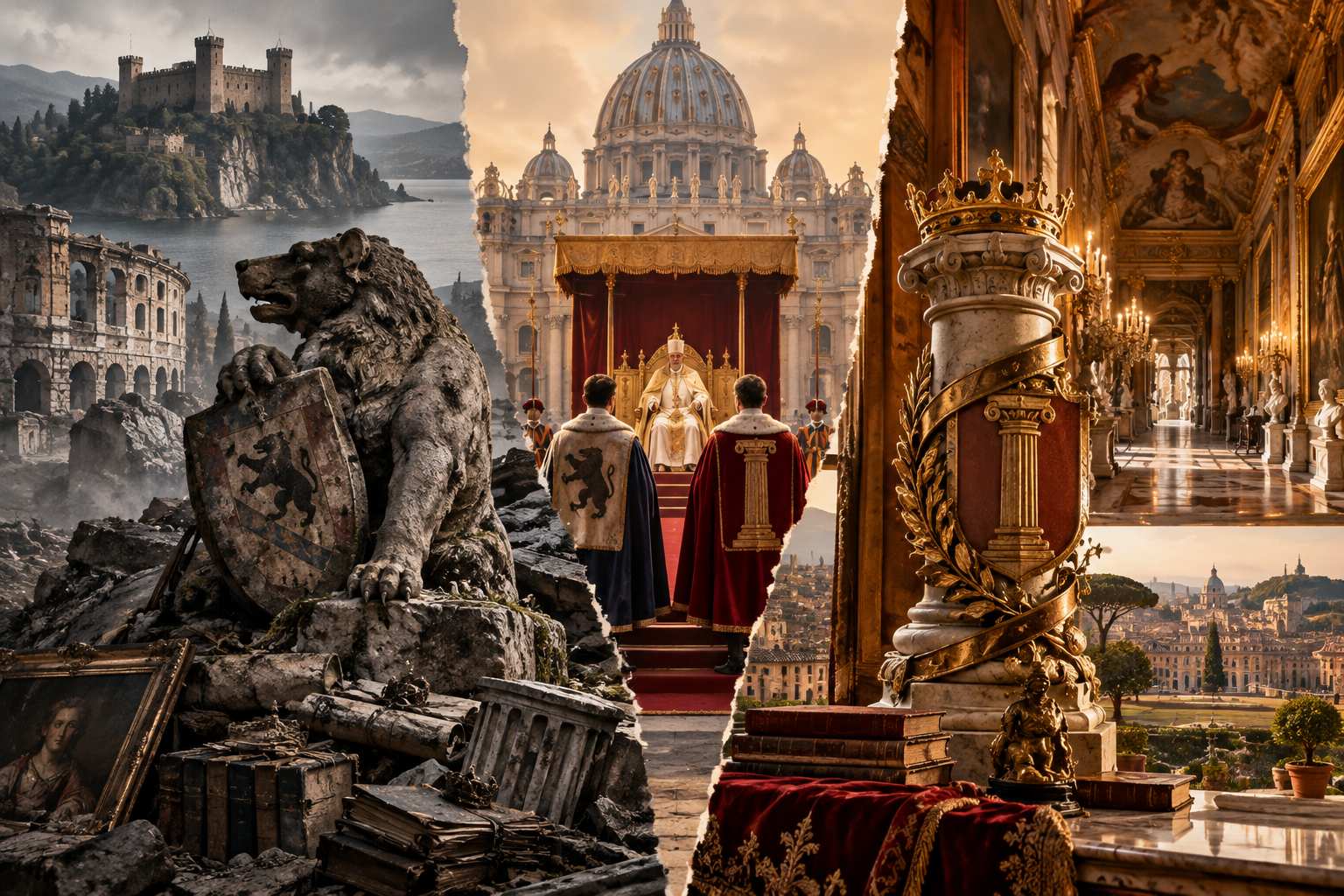
Julius II tried to do it with a ceremony. In the last days of August 1511, the barons of Rome assembled on the Campidoglio and swore a peace before a notary, in sessions the family history dates to the 27th and 28th. Medals struck for the occasion carried the words Pax romana and an image of a bear, the Orsini emblem, embracing a column, the emblem of the Colonna. And according to the family's own account, Julius gave the heads of the two houses a place at his side that no one else could claim. They became Assistants to the Papal Throne, the office passing by right from each head of the family to his eldest son. Other sources date the grant to the Orsini later, to Pius IV in 1560, and record that Gregory XVI confirmed it as the exclusive right of the two families only in 1834; the family history itself admits years in the eighteenth century when neither house exercised it. The dates differ. In every version the right comes from a pope.
The family history presents this as an honour, and it was one. Read for what it did, it was also a settlement. Two armed families that had made the city ungovernable received the closest seats to the pope that a layman could occupy, in exchange for keeping the peace. The seat bound them to the papacy as much as it raised them above other nobles.
It also produced a quarrel that lasted two centuries. Both families wanted the more honourable side of the throne. The papal ceremonial tables, the family history notes, came to mark each function with an O or a C, to record whose turn it was. The rotation was settled under Benedict XIII, the third Orsini pope, in the 1720s, and the two princes went on alternating at the most solemn ceremonies of the Church into the twentieth century.
There is a word in all of this that does more work than it seems to. The office was hereditary. But it was hereditary because a pope had said so, in a settlement the papacy wrote and the papacy could interpret. The inheritance came with an unwritten clause: under whose rule.
Hereditary is a word with a missing clause.
Bracciano, 336,000 Scudi
The paper trail of the Orsini is long, because the family was important enough for everything it did to be written down. Read from the seventeenth century forward, it has one direction.
The family palace on Monte Giordano, a fortified hill in the bend of the Tiber that had been an Orsini stronghold since the Middle Ages, was sold at the end of the seventeenth century to the Gabrielli, and in the late nineteenth century it passed to the Taverna counts, whose name it still carries. The great lakeside castle of Bracciano, which the Orsini had built in the fifteenth century, went in 1696. Flavio Orsini, the last duke of Bracciano, was buried in debt, and he sold the fief and the castle to Livio Odescalchi, nephew of Pope Innocent XI. The family history gives the price as 336,000 scudi. The Odescalchi still own the castle, which a later Prince Livio Odescalchi opened to the public in 1952 and which is managed today by a foundation named after him.
The main line had moved south, to the duchy of Gravina in Apulia, which it held until 1807. The finding aid to the family papers at the University of California, Los Angeles, records what happened to the southern estates next. By the end of the nineteenth century they had been lost to creditors.
In Rome, the Gravina Orsini had bought a new seat. In October 1716, according to a notice in the Diario di Roma quoted in the family history, the Congregation of Barons, the papal body that administered indebted noble estates, adjudicated the former Savelli palace to the Duke of Gravina Orsini for 29,000 scudi. It is one of the strangest buildings in Rome, a Renaissance residence built into the curved arcades of the ancient Theatre of Marcellus, on the slope the Romans call Monte Savello. Filippo Orsini, head of the house, died there on 17 March 1924. Twenty-three years later his son died in the Grand Hotel. I could not find the deed that records when the palace left the family. The UCLA finding aid says only that within decades of the losses in the south the Roman palace was sold as well. In the 1950s the writer Iris Origo rented and then bought her part of the building, which by then had several owners, and in 1994 another wing was left to the Sovereign Military Order of Malta by Countess Valeria Rossi di Montelera Litta.
Then the papers went. In April 1904 a notice announced the auction of the Orsini family archive. The prefect of Rome intervened, and on 8 February 1905 the city bought the first part of it, which is now in the Archivio Storico Capitolino. The second part went on the market in 1963. Two years later it was bought, through the Los Angeles dealers Zeitlin & Ver Brugge, by the library of the University of California, Los Angeles, where it is catalogued as Collection 902: 560 boxes, 280 linear feet of documents, covering roughly eight centuries.
The castle went in 1696, the southern estates by about 1900, the Roman palace within a few decades after that, and the archive in 1905 and 1965.
None of these sales is mysterious. Each has a seller, a buyer and, usually, a debt. Together they make a staircase that runs downward for two hundred and fifty years. At the bottom of it one thing was left that a creditor could reach only through the pope, because the family held it from him rather than owning it outright: the seat beside the throne.
What I Expected to Find
I had a hypothesis when I started, and it came from this archive's own earlier chapters. The Roman families who stayed loyal to the pope after 1870, the hypothesis went, lost the visible state and kept a quieter kind of position: offices at the papal court, places in Vatican administration and finance, marriages into the new Italian banks, seats on boards. The Orsini, the most famous name among them, should show that pattern more clearly than anyone.
So I looked for the Orsini in those places. I looked for an Orsini senator of the Kingdom of Italy and found only an in-law. I looked for Orsini on the boards of Italian banks and companies, in the administration of Vatican City after 1929, in the lay offices of the Holy See after the Second Vatican Council. I looked for the large property that a family of this rank would normally keep somewhere, a palace, a villa with an estate, a collection. I searched the family's own history, the standard Italian and English reference works and the press and parliamentary records I could reach online, and for the period from 1958 to the present, in searches made in October 2026, I found nothing. I treat that as an absence in those records and nothing more.
For the Orsini, the ordinary explanation accounts for the documented decline without needing a hidden one. An old family with many branches spent more than it earned for two centuries, sold what it could, lost what it could not sell to creditors, and kept a ceremonial office until one of its holders embarrassed the institution that granted it. No hidden circle is needed to explain any step. The continuity hypothesis, applied to the family the internet names first, does not hold.
That should have been the end. It was not, because the ordinary explanation raised a question it could not answer by itself.
The Colonna had the same antiquity as the Orsini, the same centuries of feuding, the same office beside the same throne, popes and cardinals of their own. They also spent, borrowed and divided their estates among heirs. If debt and time explain why the Orsini ended in a hotel, what kept the Colonna from ending in one?
The Colonna still live in Palazzo Colonna, on the slope of the Quirinal, in the building their family has occupied, by the gallery's own account, for eight centuries.
Late January 1958
Before I could answer that, the seat itself had to be explained, because it disappeared from the Orsini in a single week.
At Easter 1950, the family history records, Filippo Napoleone Orsini was made Prince Assistant to the Papal Throne. He was thirty, born in Milan, married to Franca Bonacossi of a family of counts, and the father of a two-year-old son. He was not, strictly, the next in line. His father Virginio was alive and, in the family history's words, lived usually in America. The office that passed from eldest son to eldest son passed over him. It went to the man the papacy wanted to see beside the throne.
Seven years later Filippo Orsini fell for the British actress Belinda Lee, who had left her husband, the photographer Cornel Lucas, in September 1957 and was living in Rome. The affair was covered in the Italian and English-language press, and in the last week of January 1958 it became a scandal. According to Time, Lee collapsed from a barbiturate overdose the morning after she flew back to Rome from South Africa. Orsini made a scene at the hospital and was removed. The next day he cut his wrists with a razor blade. Both of them recovered.
The Vatican's answer came quickly. American newspapers reported on 29 January that he would lose the title if it were proven that he had tried to kill himself. Within days, Time reported, the Secretariat of State let it be known that Prince Aspreno Colonna alone would serve as Prince Assistant to the Papal Throne and that Prince Orsini should not appear at the Vatican again. His wife told reporters, Time wrote, that she stood by her husband, and she sent him off to La Catena, a castle in the hills. There was no trial and, as far as I can find, no published decree. Whether this was a formal deprivation or a practical exclusion, the record I found does not say. A family that had stood beside the throne for centuries, by a right it traced to 1511, was simply no longer asked to stand there.
Lee and Orsini lived together in Paris for a time and parted at the end of 1959. She died in a car accident in California on 12 March 1961, at the age of twenty-five. Genealogical lists give 1984 as the year of his death.
What happened next to the seat says more than the scandal does. For four years Aspreno Colonna served alone. Then, in 1962, as the Second Vatican Council was about to open and the ceremonies of the Church needed two princes again, John XXIII named a second Prince Assistant. He did not restore the Orsini. He chose Alessandro Torlonia, head of a family of bankers who had been ennobled in 1798, nearly three centuries after the office was created, and who had, as it happens, owned the Orsini's former castle at Bracciano for a time, buying it from the Odescalchi in 1803 until the Odescalchi redeemed it in 1848.
The seat was not inherited back. It was filled.
Pontificalis Domus, 28 March 1968
Six years later the office ended for everyone. On 28 March 1968 Paul VI issued the motu proprio Pontificalis Domus, which turned the old papal court into a smaller Papal Household. Its text, published by the Holy See in Latin and Italian, is direct. In the Papal Household, section three declares, no office is to be considered hereditary. Section six lists the dignities of the papal chapel that are abolished, both as offices and as names, and the Princes Assistant to the Throne are among them. Section seven keeps a lay function called Assistants to the Throne, without the princely rank and without inheritance, whose holders offer their services to the Prefect of the Apostolic Palace.
The princely dignity ended there; the lay role that kept the name had neither rank nor inheritance. Aspreno Colonna died in 1987. Alessandro Torlonia died at the turn of 2018, at the age of ninety-two, still described in his obituary as an assistant to the papal throne. Whether either man held the new lay role formally until his death or kept the title as an honour, the papal documents I read do not say.
It is worth being precise about what this sequence shows, because the internet version of the story turns it into a purge. The record does not support that. The papacy that created the office in 1511 to bind two armed families to itself had no further need for armed families by the twentieth century. It kept the office as long as it served a purpose in ceremony, adjusted it when a holder became an embarrassment, gave it to a newer family when it needed a second prince, and closed it when it reformed the court. At every step the decision belonged to the institution that granted the seat. The families held it on terms they did not write.
An inheritance that someone else can revoke is a lease.
That reading explains the Orsini without anything hidden. It leaves the Colonna exactly where they were. They lost the office too, in 1968, on the same terms. Yet one of the two families is still in its palace and the other is not. If the seat beside the pope was not what kept the Colonna in place, something else was.
The Law of 28 June 1871
The answer I found was in a law passed by the state that ended the papal state.
On 20 September 1870 the army of the Kingdom of Italy entered Rome, and the temporal power of the popes came to an end. The families that stayed loyal to Pius IX, the families later called the black nobility, were on the losing side. The new state set about extending its own law to the city. One of its targets was the fedecommesso, the old legal device by which a family bound its property to pass undivided from heir to heir, so that no single generation could sell it. The Italian civil code of 1865 had abolished such entails. A law of 28 June 1871, number 286, extended the abolition to the province of Rome from the first of July.
But the same law made an exception, in its fourth article. Galleries, libraries and other collections of art or antiquities bound by such entails were to remain indivisible and inalienable among the heirs.
The kingdom that had just taken Rome from the popes wrote into its own statute that the entailed collections of the Roman families could not be divided or sold. The minister who defended the article in the Senate called it provisional.
The motive, as the later laws make clear, was the fear that the great Roman collections, freed from their entails, would leave Italy piece by piece. In 1883 a further law allowed the collections to pass to the state, the provinces or the cities, on condition that they stay undivided and open to the public; the Corsini collection passed to the state that year. In 1891 a royal regulation required the owners to declare their collections and banned transfers without authorisation, and in 1892, after works from the Sciarra collection had been sold abroad, a new law added criminal penalties. In 1902 the state bought the Villa Borghese and its collection outright. In 1934 a special decree allowed the Barberini collection to be broken up. The protection held where the state wanted it to hold and was released where the state chose to release it.
It has never been repealed, although the state has made exceptions to it. The Italian cultural heritage code of 2004, in article 129, expressly keeps in force the provisions on the former entailed art collections set down in the laws of 1871, 1883, 1891 and 1892.
The Colonna gallery is one of those collections. The family inaugurated its great gallery hall in 1700, and according to the gallery's official partners its paintings, sculptures and furnishings have been bound by an entail since 1800, inalienable and indivisible, tied, in their words, to the walls of the palace. When Italy abolished the entails in 1871, the article that saved the galleries kept that bond in force, and the code of 2004 keeps it in force today. How far the bond reaches beyond the paintings is less clear. The study I relied on cites a Rome court ruling of 1875 that extended the same inalienability to the rooms housing bound collections, but it names no case and I could not trace one, so this piece does not rely on it. I found no document that binds Palazzo Colonna as a building. Protection against sale is also not protection against ruin: a family can still borrow against other assets, put off repairs or lose its income. The family lives in the palace. Part of it opens to visitors on set mornings, and the Associated Press reported in 2025 that the family's sitting prince, Don Prospero Colonna, still resides there.
There is no Orsini gallery in this story. In the study of the former entailed collections of Rome that I relied on, which names the Borghese, Doria Pamphilj, Colonna, Spada, Corsini, Barberini, Chigi, Albani, Torlonia, Boncompagni-Ludovisi and Rospigliosi-Pallavicini, the Orsini do not appear. By 1871 the Orsini had already sold their castle and much of their land. Whatever they still had, the record does not show a great collection bound to their walls that the new law could freeze.
Put the two families side by side and the difference is not in their blood or their place beside the pope, which were alike. One difference is in what each still held in 1871 that the law would not let it sell.
The Orsini inherited a privilege the pope could withdraw. The Colonna inherited a collection the state would not let them divide.
Both halves of that sentence are documented. What the documents do not show is that the law is the reason the family is still in its palace. I cannot rule out that Colonna money, marriages and management would have kept the palace without it. A bound collection can also hang on walls that a family can no longer afford to heat; the Doria Pamphilj, whose gallery is protected by the same law, set up a private trust in 2013 to keep their collection and properties together. What I can say is narrower. The law does not explain why the Colonna still had a great collection in 1871. It helps explain why that collection could not disappear the way the Orsini castle and archive did.
Three different things have travelled together in this story under the single word inheritance. The first is a status, the seat beside the throne, which the papacy granted and could withdraw, and did, for the Orsini in 1958 and for everyone in 1968. The second is property, castles, palaces, estates and papers, which heirs could divide, owners could sell and creditors could take, and for the Orsini all three happened. The third is protected heritage, a collection that the state, from 1871, would not let the heirs divide or sell. For centuries the three looked like one thing, a great family. Pulled apart, they behave differently, and in this reconstruction which of them a family still held goes a long way to explain what is still visible of it in its own house.
The Strongest Case Against This Reading
The strongest objection does not dispute any of these facts. It accepts the dates, the sales, the scandal and the statute, and it says the conclusion is drawn from the wrong comparison.
The Orsini decline began almost two centuries before 1871. Bracciano went in 1696, the Roman palace on Monte Giordano at about the same time. No law of 1871 could have saved an estate that was already gone, so the statute cannot be what separates the two families; at most it protected what each had left. The Colonna may simply have been richer, luckier with heirs, more careful with marriages and better at managing debt, and the law merely preserved the result of that difference. And the Colonna did something after 1870 that the Orsini did not: they joined the new state. Prospero Colonna was mayor of Rome from 1899 to 1904 and again from 1914 to 1919, and a senator of the Kingdom from 1900. A family that takes office in the state that defeated its pope has a second source of standing that has nothing to do with paintings. The law also binds collections, not buildings. The Barberini collection was bound by the same rule and was broken up anyway by a special decree in 1934; the Borghese collection, bound in the same way, left the family when the state bought it in 1902. A rule that can be lifted by the state at will does not keep any family anywhere.
This objection is structurally serious, and much of it is right. The reading offered here does not claim that the law of 1871 saved the Colonna or ruined the Orsini. It claims something narrower. Blood carried nothing on its own in either family, and the Colonna had more than one support. The office beside the throne was a grant that the papacy could interpret, withhold and close. And among the houses examined here, what remains of the old families in place today is held through something that could not be freely sold: a gallery bound by statute, a castle managed by a foundation, a collection in the care of a family foundation that signed an agreement with the Ministry of Culture in 2016, as the Torlonia marbles are. Both readings can be true at once. Wealth and prudence decide how much a family has left to protect. The lock decides whether the heirs can sell what is left, for as long as the state keeps it shut.
What would break this reading is a Roman family of the same rank that kept its palace and position after 1870 without any such lock, by fortune and choice alone, or a family whose bound gallery stayed bound while the family left anyway. The Barberini are the nearest case, and they point in the direction of the lock: the collection left when the state released it.
Collection 902
The Orsini have not disappeared. Genealogical lists name the present head of the house as Domenico Napoleone Orsini, Duke of Gravina, born on 11 April 1948, whose birth the family history of 1955 records, and the son of the prince who lost the seat in 1958. I found no public office, board seat or major property connected to the family since then, which again is a statement about what the record shows and not proof of anything.
The places carry other names now. The castle at Bracciano is the Castello Odescalchi, and the guidebooks call it Orsini-Odescalchi. The Theatre of Marcellus palace is known as Palazzo Orsini, but a wing of it belongs to the Order of Malta. The palace on Monte Giordano is Palazzo Taverna. The seat beside the throne was abolished, by name and as an office, in 1968.
The papers that recorded all of it are divided between the Capitoline archive in Rome and the department of special collections of the library at the University of California, Los Angeles, whose finding aid describes Collection 902, the Orsini family papers, as 560 boxes of documents dated from about 1150 to about 1950.
The Orsini papers are requested in a reading room in Los Angeles, while the Colonna paintings still hang in the gallery hall their family inaugurated in 1700.
Who are the Colonna family?
The Colonna are one of the oldest noble families of Rome, documented from the eleventh century. They produced Pope Martin V (1417) and were for centuries the great rivals of the Orsini. From 1511 the heads of the Colonna and Orsini families shared the hereditary office of Prince Assistant to the Papal Throne, which Paul VI abolished as a hereditary dignity in 1968.
Does the Colonna family still live in Palazzo Colonna?
Yes. The family lives in Palazzo Colonna in Rome, and the Associated Press reported in 2025 that the family's sitting prince, Don Prospero Colonna, still resides there. Part of the palace, including the Galleria Colonna, opens to visitors on set mornings.
Why can the Galleria Colonna not be sold?
According to the gallery's partners, the collection has been bound by a family entail (fedecommesso) since 1800. When Italy abolished such entails in Rome in 1871, article 4 of Law 286 kept art collections bound in this way indivisible and inalienable, and article 129 of the 2004 cultural heritage code keeps that provision in force.
What happened to the Orsini family?
The Orsini sold the castle of Bracciano in 1696, lost their southern estates to creditors by about 1900, left their Rome palace at the Theatre of Marcellus before 1947 and the larger part of their archive passed to the city of Rome in 1905; the rest was put on the market in 1963 and bought by UCLA in 1965. In 1958 Filippo Orsini was excluded from serving as Prince Assistant to the Papal Throne after the Belinda Lee scandal. The family continues; its present head is listed as Domenico Napoleone Orsini, Duke of Gravina.
Sources: Gustavo Brigante Colonna, Gli Orsini (1955); Britannica, Orsini family; UCLA, Orsini family papers, Collection 902; Paul VI, Pontificalis Domus (1968); Time, "The Papal Prince" (10 February 1958); D.Lgs. 42/2004, art. 129 and a study of the Roman entailed collections; Galleria Colonna; Treccani, Giovanni Torlonia; Il Centro on Alessandro Torlonia (2018).
Jerry van der Laan writes The Manifest Archive, Forensic Narrative Intelligence Writing on the systems beneath power, money, and history. He traces the structures beneath them.
Evidence Map
Facts, interpretations, forecasts, and disconfirming signals.
Core claim. The Orsini, the family most often named as a hidden Roman bloodline, left a documented trail of sales from 1696 to 1965 and held no documented office after their hereditary seat beside the papal throne was withheld in 1958 and abolished in 1968. That seat was a papal grant the papacy could interpret, fill with another family and close. The Colonna, with the same office and history, remain in their palace; their collection is bound by an entail that the Italian law of 1871 kept inalienable and that the 2004 heritage code still preserves. This chapter revises, for the Orsini, the continuity reading in The Black Nobility: Europe's Families Who Never Left Power.
Evidence level. Facts (high): the office and its 1968 end (Pontificalis Domus text), the 1958 removal as reported by Time and US newspapers, the Torlonia appointment of 1962, the sales of Bracciano and the archive, Law 286 of 1871 and article 129 of the 2004 code, the Colonna residence. Single-source (marked or attributed): prices in scudi and the 1716 purchase (family history), the 1950 appointment details, the 1800 Colonna entail (gallery partner site). Interpretation (marked in the text): that a lock on sale, more than blood or office, marks which family stayed in place. Competing explanation (in the text): the Colonna's integration into the Italian state after 1870, with a mayor of Rome and a senator of the Kingdom.
What would confirm this. Records of other Roman houses showing the same split, with families holding bound collections or foundations still in their palaces and those without them gone; the list of bound collections in the royal decree of 1891.
What would disprove this. A Roman family of the same rank that kept its palace and position after 1870 without any legal or institutional lock on its property; documentation of a substantial Orsini office, board seat or property after 1958.
Watchlist. Any amendment to article 129 of the 2004 code; future sales or transfers of the Colonna or Doria Pamphilj collections; the deed recording when Palazzo Orsini at Monte Savello left the family.