December 7, 1970. Rome. 11 PM.
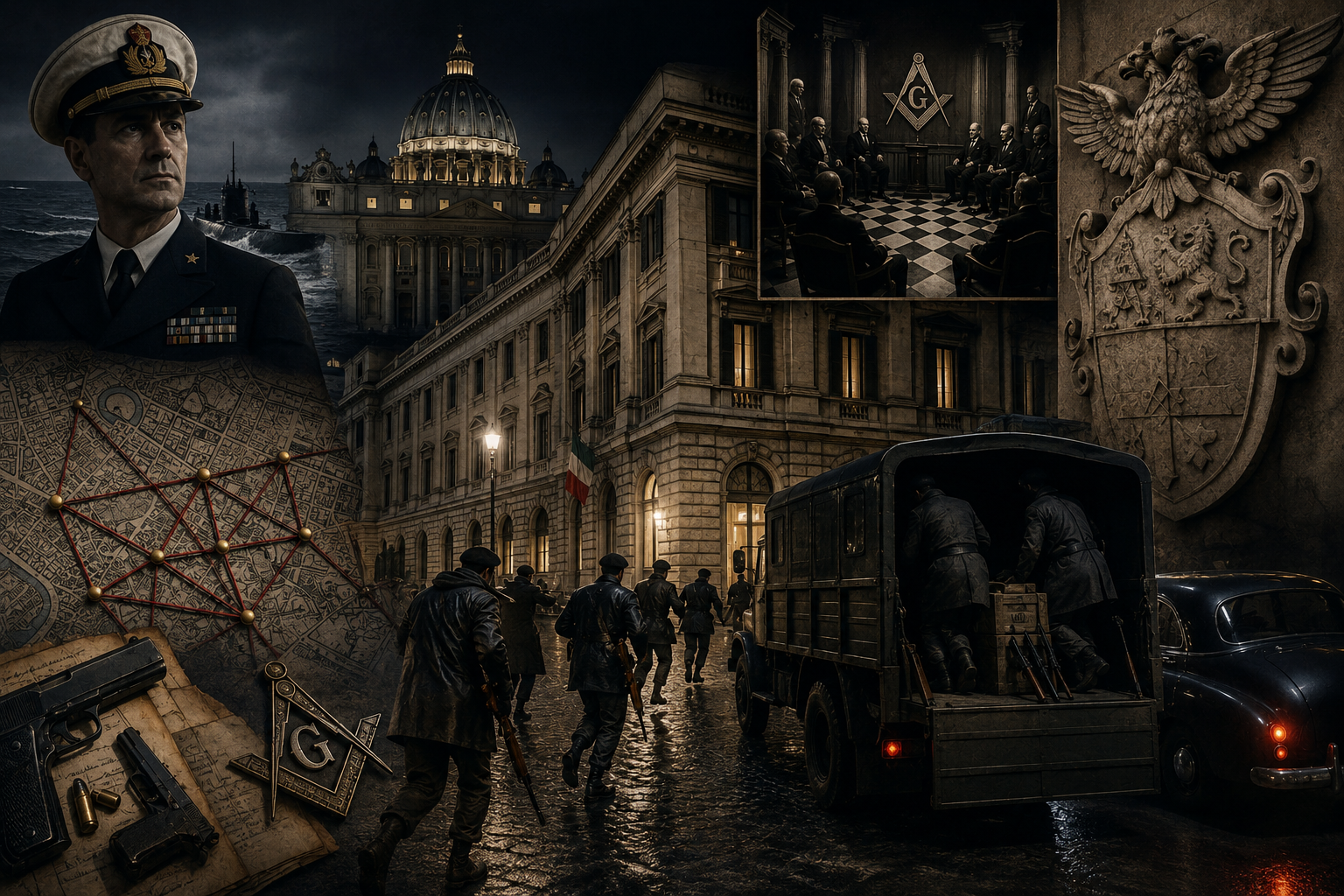
Commando units from the Fronte Nazionale move through the city in coordinated silence. One group, associated with Stefano Delle Chiaie’s Avanguardia Nazionale network, enters the Ministry of the Interior on Via Agostino Depretis. They are not police. They are not authorized military personnel. They carry weapons. They enter an armoury inside the ministry complex and begin removing weapons.
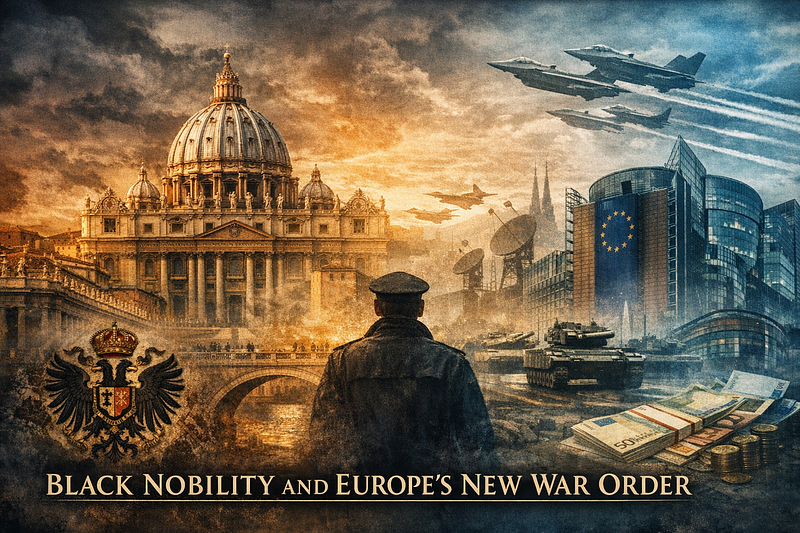
In other parts of the city, additional units are moving into position. The plan is specific: seize the Interior Ministry, take control of the state broadcaster RAI, neutralize government buildings, and install a provisional government under Junio Valerio Borghese, the Black Prince of Italian fascism, WWII naval commander, and descendant of a family that placed a pope on the throne of Rome in 1605.
At 1:40 AM on December 8, Borghese sends the abort signal. The men stand down. The weapons go back. By morning, nothing has officially happened.
The Italian government will not acknowledge the event for three months. The parliamentary reconstruction will take fourteen years. No final conviction for the political conspiracy will survive.
The Family That Placed a Pope in Rome
The Borghese are not incidental to this story. They are one of the oldest institutional layers within it.
The family originated in Siena in the 13th century, built on wool trade and municipal offices. In 1541, Marcantonio Borghese moved the family to Rome. In 1605, his son Camillo was elected Pope Paul V, and the transformation of the Borghese from regional nobility into one of the most powerful dynasties in European history began.
Pope Paul V was what the Vatican historians call an unabashed nepotist. He named his brother Francesco Duke of Rignano and General of the Papal Army. His brother Giambattista became Governor of the Borgo and Castellan of Castel Sant’Angelo. His nephew Scipione Caffarelli received the cardinal’s hat. Within a decade, the Borghese family had embedded itself in every structural layer of the papal state.
The Villa Borghese. The Borghese Chapel in Santa Maria Maggiore. The Galleria Borghese. These are not simply buildings. They are an institutional record: a family announcing, in stone and fresco, that it had arrived permanently.
When the Papal States fell in 1870 and the Italian state absorbed Rome, the families that chose loyalty to the Pope over recognition of the new secular government became known by a specific term: the Black Nobility. They refused to set foot in the Quirinal Palace, the papal residence now occupied by the Italian king. They retreated into a social world structured around the Vatican, sustained by inherited land, titles, and the financial architecture that three centuries of papal favour had built.
The Borghese bankruptcy of 1891 dispersed some of that wealth. The Villa Borghese gardens became a public park in 1902. But the name survived. The title survived. The social authority attached to both survived.
The Black Nobility is not defined by wealth. It is defined by loyalty and continuity.
The Black Prince
Junio Valerio Scipione Ghezzo Marcantonio Maria Borghese was born in Rome on June 6, 1906, into what remained of the family’s aristocratic position. He was educated at the Naval Academy in Livorno and became one of Italy’s most decorated officers, earning the Gold Medal of Military Valour for commando operations that no other unit in the Italian navy had attempted.
As commander of the Decima Flottiglia MAS, the Tenth Assault Vehicle Flotilla, Borghese directed elite sabotage operations against Allied shipping in the Mediterranean. His unit’s frogmen attached explosives to British warships in Alexandria harbour in December 1941, sinking two battleships and a tanker in a single night. It was one of the most tactically successful naval special operations of the Second World War.
After 1943, when Italy switched sides, Borghese refused. He remained loyal to the Salò Republic, Mussolini’s German-backed rump state in northern Italy. His unit shifted from naval sabotage to anti-partisan operations in the Po valley.
In 1945, Borghese was arrested, tried for collaboration, and sentenced to twelve years. He served four. An amnesty signed by Minister of Justice Palmiro Togliatti released him in 1949. He walked out of prison with his title, his network, and his military reputation intact. His wartime record was simultaneously a war crime conviction and, in certain circles, an unbroken mark of distinction.
He did not retire. He reorganized.
By 1967, Borghese had founded the Fronte Nazionale, a neo-fascist political organization that drew together former military officers, right-wing extremists, and elements of the Italian intelligence apparatus. His name was not simply a political brand. It was a structural asset: the institutional inheritance of a family historically associated with papal power, combined with wartime military command, and the specific kind of credibility that only 300 years of institutional positioning can produce.
The Infrastructure Underneath
The Golpe Borghese was not primarily Borghese’s plan. This is what the Anselmi Commission, the Italian parliamentary commission that investigated the P2 Masonic Lodge, concluded in its final report, submitted in July 1984. The figure the commission placed at the centre of the operation was Licio Gelli.
Gelli’s biography reads like a map of the architecture. Born in Tuscany in 1919, he fought with Franco’s forces in Spain, served as a Fascist liaison officer, and transitioned smoothly into postwar Italian business and Masonic networks. By 1965, he was running Propaganda Due, the P2 lodge of the Grand Orient of Italy.
P2 was not a lodge in the conventional Masonic sense. When its membership list was discovered at Gelli’s villa in March 1981, it contained 962 names: 51 generals, 29 admirals, three cabinet ministers, sitting members of parliament, judges, industrialists, and the heads of all three Italian intelligence services. The Anselmi Commission’s 1984 report described P2 as a secret political organization operating in violation of the constitutional order. The first episode analyzed in that report was the Borghese coup.
The connection between P2 and the leadership of the Italian intelligence apparatus was not inferential. It was documented in the lodge’s own membership records and examined by the Anselmi Commission. At the time the list was discovered, the heads of Italy’s principal military and civilian intelligence services were among P2’s members.
Operation Gladio entered the official parliamentary record later. Its existence was publicly acknowledged in 1990, six years after the Anselmi report. Subsequent parliamentary investigations examined Gladio alongside the obstruction of terrorism inquiries and the repeated departure of elements of the security apparatus from their lawful institutional role. These are connected historical layers, but they were not established by a single commission at a single moment.
Vito Miceli had become head of SID, the military intelligence directorate, in October 1970, two months before the coup. He was arrested in October 1974 on charges related to the coup investigation. He was acquitted in 1978. He then served as a deputy in parliament for the neo-fascist Italian Social Movement.
The boundary between the network and the intelligence leadership was not intact.
The Night of December 7
What the plotters intended was specific. The plan, as reconstructed from testimony and documents in subsequent judicial investigations, included several coordinated objectives: seize the Ministry of the Interior; take control of RAI, the state broadcaster; secure key government buildings; arrest members of the government; and install Borghese as head of a provisional national government.
The units mobilized included elements of the Forestry Corps (the Corpo Forestale dello Stato), whose officers, unlike regular military personnel, had operational authority to carry weapons in civilian contexts. This explains the coup’s unofficial name: Golpe dei Forestali. Weapons stored in the Forestry Corps’ national depot were to be redistributed. On the night of December 7, some already had been.
Inside the Ministry of the Interior, the unit was in position. Weapons from the national armoury had been removed and loaded. Units were moving across Rome and, according to testimony, in several other Italian cities simultaneously.
At 1:40 AM, the abort order arrived.
No official explanation has ever been established for why Borghese called it off. The theories are documented but not resolved. One version: Borghese received information that the government had been alerted and the operation was compromised. A second version, documented in a statement made to a magistrate by one of the main accused: the United States would have accepted the new political order only if Giulio Andreotti led it; Andreotti refused; American intelligence then ordered the cancellation. A third reading: the abort was always part of the plan: a mobilization test, not a genuine takeover attempt.
What is established in the documentary record is this: one of the main accused stated to the examining magistrate that US President Richard Nixon had been personally informed of the preparations for the coup by two CIA officers. The military attaché at the US embassy had close ties to the coup organizers. These statements were made in court. The allegation was never judicially established. It was also never formally investigated as a criminal matter.
The coup failed. The record of what was ready to execute did not.
The Immunity That Followed
The Italian government acknowledged the coup attempt on March 18, 1971, when the left-wing newspaper Paese Sera ran the headline: “Subversive plan against the Republic: far-right plot discovered.” The event had occurred three months earlier.
Investigations followed. Trials followed the investigations. The results were consistent.
Junio Valerio Borghese never stood trial for the coup. An arrest warrant was issued, but Borghese had already fled to Spain in 1971, where Francisco Franco’s government provided refuge. He died in Cádiz on August 26, 1974. The official cause of death was listed as natural. Separate speculation about the circumstances was never legally pursued.
Vito Miceli, the intelligence chief whose directorship overlapped precisely with the coup’s preparation and execution, was arrested in 1974, tried, and acquitted in 1978. He subsequently became a parliamentarian for the neo-fascist MSI.
Licio Gelli, the P2 grandmaster whose role the Anselmi Commission treated as central to the operation, was later prosecuted in cases arising from the Banco Ambrosiano collapse. He was separately investigated in connection with Roberto Calvi’s death, found hanging beneath Blackfriars Bridge in London in 1982, but that investigation produced no conviction against him. His documented role in the Borghese network likewise produced no criminal conviction related to the coup.
The Anselmi Commission submitted its findings in 1984, fourteen years after the event. The findings became political record. They were cited in academic papers and historical accounts. They did not trigger new prosecutions.
The state documented what it was unable, or unwilling, to prosecute.
The Coup That Fit a Larger Pattern
Almost exactly one year before Borghese’s men mobilized in Rome, a bomb exploded inside the Banca Nazionale dell’Agricoltura in Piazza Fontana in Milan. December 12, 1969. Seventeen people died. The Italian state initially directed suspicion toward anarchists. Later investigations established the attack’s neo-fascist provenance and documented interference and misdirection within the original inquiry. Piazza Fontana became the opening symbol of what Italian scholarship would call the strategia della tensione, the Strategy of Tension.
The Borghese coup unfolded inside that same period of political violence, covert mobilization, and compromised investigation.
On May 31, 1972, a car bomb near Peteano in Friuli killed three Carabinieri. The original investigation was redirected toward the wrong suspects. Evidence identifying the neo-fascist perpetrators was suppressed or manipulated. Vincenzo Vinciguerra later confessed. Examining magistrate Felice Casson’s reopened investigation exposed the institutional obstruction surrounding the case and led him into secret-service archives that would contribute to the public revelation of Gladio in 1990.
On August 2, 1980, a bomb at Bologna railway station killed 85 people and injured more than 200. Criminal proceedings ultimately produced convictions of members of the neo-fascist Nuclei Armati Rivoluzionari. Separate proceedings addressed efforts by figures connected to P2 and the military-intelligence environment to misdirect the investigation. The two sets of proceedings addressed distinct questions: who carried out the attack, and who attempted to derail the investigation.
These episodes were examined by different courts and parliamentary commissions across more than three decades. No single inquiry established one command centre behind them all. The combined record established something more structurally revealing: recurring overlap between neo-fascist networks, intelligence personnel, P2 figures, concealed evidence, redirected investigations, and accountability delayed until the operational networks had changed form or dispersed.
The Borghese coup was not proof of a single hidden command. It was one visible event inside a recurrent institutional pattern.
That is what makes December 7, 1970 analytically significant. Not its military viability, which was limited. Its place in a sequence through which the Italian Republic repeatedly discovered that parts of the apparatus assigned to protect it were also capable of obscuring the networks operating against it.
The Strongest Counterargument
The strongest counterargument to this reading does not dispute the documentary record. It accepts that the coup happened, that P2 was involved, that intelligence services were structurally compromised, and that the Borghese name was part of the operation. What it argues is that none of this constituted a serious threat.
The force mobilized, at most several hundred men drawn from the Forestry Corps, the Fronte Nazionale, and associated far-right networks, was nowhere near sufficient to control a modern Italian state. No communications infrastructure was seized. No senior government official was detained. No military unit of significant size defected. The Interior Ministry was occupied by a small commando team for a few hours in the early morning of a winter night. The Republic did not waver. When the abort order came, the men dispersed without resistance. By this reading, the Borghese coup was less a genuine takeover attempt and more a mobilization exercise for a movement that overestimated its own readiness.
This counterargument is structurally serious. The coup, on the operational evidence available, was undersized for its stated objectives. Serious analysts of the period have argued exactly this, and the point is not easily dismissed.
The analytical claim offered here is narrower. Not that the Republic nearly fell. The evidence does not support that conclusion. The claim is about what the mobilization established: that in December 1970, a network connecting aristocratic continuity, wartime military command, Masonic parallel governance, and embedded intelligence infrastructure was sufficiently operational to coordinate a simultaneous multi-city action. That the abort was called from within, not suppressed from without. That the legal aftermath cannot be explained by evidentiary weakness alone. It emerged from the interaction of concealed information, compromised institutions, delayed parliamentary disclosure, and legal thresholds applied to an incomplete record. The reading offered here does not claim the Republic was about to fall. It claims that the architecture protecting what attempted to cause it to fall was already in place, and remained in place afterward.
December 7, 1970. 1:40 AM. Rome.
A man descended from a papal dynasty sends an abort signal to units already inside a government ministry. The men leave. The weapons return to their racks. By morning, the city does not know.
The Italian government takes three months to acknowledge what happened. The parliamentary commission takes fourteen years to name it. The courts take another decade. The conspiracy convictions disappear on appeal.
The Borghese family’s paper trail runs from the conclave of 1605 to the Ministry of the Interior in 1970. That record is not hidden. The Anselmi Commission published its findings. The coup has a name in every European language.
What has no name is the mechanism that made the aftermath possible.
The parallel state does not prove itself by taking the capital. It proves itself by surviving the investigation. December 1970 demonstrated that the network could mobilize. The decades that followed demonstrated that exposure did not produce dismantlement.
The architecture accounts for every actor in this sequence. The only one without a designed role is the one reading the record after the architecture has already done its work.
Evidence Map
Core claim. On December 7, 1970, a network connecting aristocratic lineage (Borghese family / Black Nobility), parallel Masonic governance (P2), and embedded intelligence directorship (SID) coordinated a simultaneous multi-city mobilization against the Italian Republic. The pattern of institutional immunity that followed is as structurally significant as the mobilization itself.
Observed conditions (high confidence, directly documented). Borghese mobilized the Fronte Nazionale on December 7–8, 1970; the Italian government acknowledged the event on March 18, 1971 (Paese Sera). The Anselmi Commission identified Licio Gelli as the central organizer; the P2 lodge membership list discovered at his villa in March 1981 contained 962 names, including 51 generals, 29 admirals, three cabinet ministers, and the heads of all three Italian intelligence services (Anselmi Commission, 1984). Vito Miceli was appointed SID director in October 1970, arrested in October 1974 in connection with the coup investigation, acquitted in 1978, and subsequently elected to parliament for the neo-fascist MSI (Tribunale di Roma; parliamentary record). Borghese fled Italy in 1971 and died in Spain in 1974; no trial for his role in the coup was ever conducted. Gelli was prosecuted for separate offenses arising from the Banco Ambrosiano collapse; no criminal conviction related to the coup was produced despite the Anselmi Commission's findings.
Documented structural dependencies (medium-high confidence). Forestry Corps officers provided weapons-carrying authority in civilian contexts, enabling the mobilization's operational cover. P2 lodge membership overlapped with the leadership of Italian military and civilian intelligence at the time of the coup, as established by the Anselmi Commission. Parliamentary disclosure was delayed fourteen years; criminal proceedings for the conspiracy produced no convictions that survived appeal.
Analytical inferences (medium confidence). Gelli's organizing role is treated as established by the Anselmi Commission but was never adjudicated in criminal proceedings. US intelligence awareness of the coup preparations: stated in court by a main accused, with Richard Nixon named as personally informed; never judicially confirmed and not investigated as a criminal matter. The events at Piazza Fontana (1969), Peteano (1972), and Bologna (1980) were examined by separate courts and commissions; no single inquiry established a unified command structure; the combined record documents recurring institutional overlap between neo-fascist networks, intelligence personnel, and compromised investigations.
What would confirm this. Declassified Italian or US intelligence records documenting operational awareness of and response to the Golpe Borghese. Sustained criminal convictions for the political conspiracy (none stand at time of publication). Additional documentation of CIA operational contacts with coup organizers beyond existing court testimony.
What would disprove this. Evidence that the December 7 mobilization was uncoordinated and involved no P2 figures. Evidence that the overlap between intelligence leadership and coup participants was coincidental and non-operative. Documentation establishing that Borghese acted without the institutional network the Anselmi Commission described.
Watchlist. Declassification of Italian SISMI/SID operational files from 1970–1975. Declassification of CIA Italy-related operational files from the same period. New judicial proceedings arising from continuing investigations into the Strategy of Tension period.
Confidence assessment. Borghese mobilization: high confidence (acknowledged by the Italian state; documented in parliamentary record). P2 coordination layer: high confidence (Anselmi Commission, 1984; primary source). SID leadership overlap with coup network: high confidence (Miceli appointment and P2 membership documented by Anselmi Commission). CIA involvement: low confidence (court testimony only; not investigated). Strategy of Tension systemic reading: medium confidence (structural pattern documented across multiple judicial proceedings; unified command not established by any single inquiry).
The P2 lodge’s membership list and its documented role in coordinating military, intelligence, and political elites, the same network that the Anselmi Commission placed at the centre of the Borghese coup, is established in In 1981, Police Found a List of 51 Generals, 29 Admirals, Three Cabinet Ministers, and Silvio Berlusconi. None Were Prosecuted for Being on It. The Peteano bombing of 1972 and the investigation that exposed institutional obstruction within the Italian security services is examined in The Bomb That Killed Three Carabinieri Was Made from NATO Explosives.
Sources: Commissione parlamentare d’inchiesta sulla loggia massonica P2, Relazione conclusiva (Anselmi Commission, July 1984). Paese Sera, March 18, 1971. Parliamentary testimony, Vito Miceli trial, 1974–1978. Declassified Italian judicial proceedings, Tribunale di Roma. Pillar I + II + III. Level 1 (Anselmi Commission, Miceli arrest record, Paese Sera disclosure). Level 2.5 (Gelli as architect per commission findings, CIA abort order per magistrate testimony).