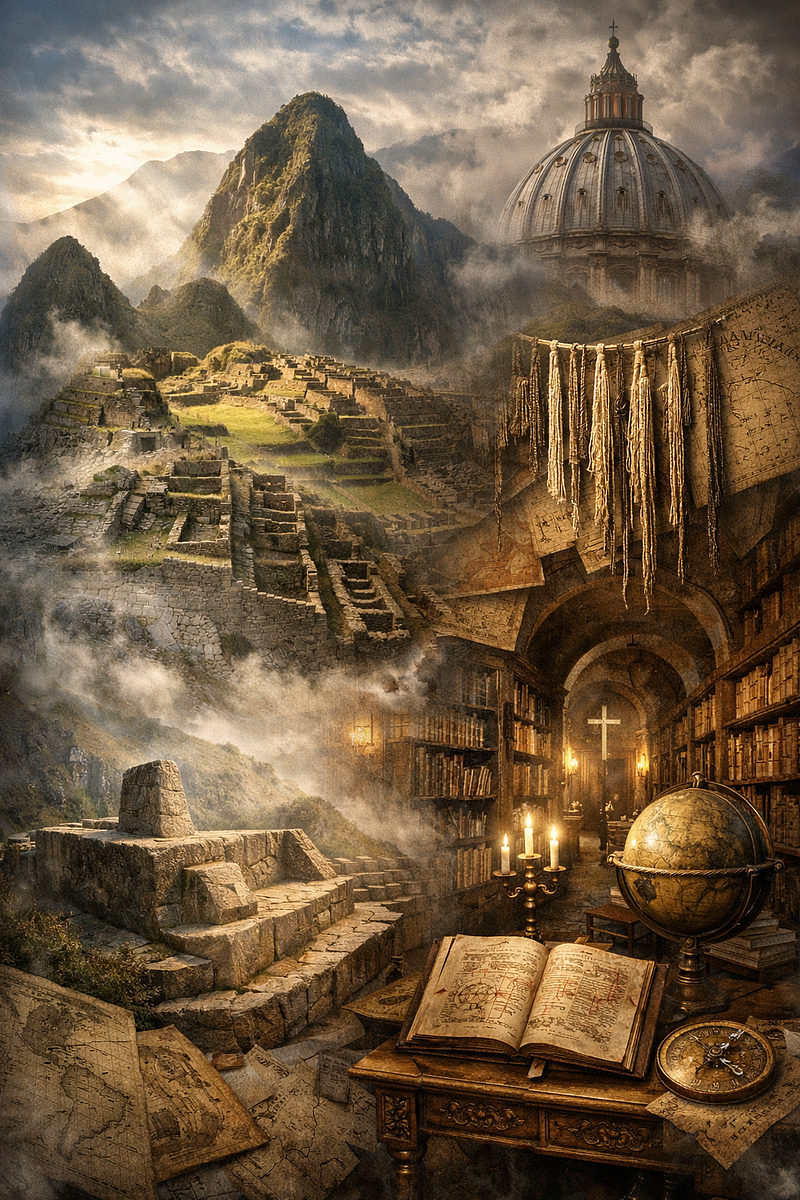
Machu Picchu was never lost. It stood on its ridge the whole time, drained by a stone hydraulic system that still works, aligned to a sun that still arrives on schedule. What disappeared was not the place. It was the framework that could read it, the people and the records that knew what the terraces were for, and that framework did not erode by accident. It was dismantled, catalogued, translated, and in places burned, by an institution that understood something the conquistadors with swords did not: that you defeat a civilization for good not when you take its cities but when you take command of its memory.
This is the part of the Andean story that the word "lost" is built to hide. The military conquest of the Inca was fast and brutal and is well told. The conquest that actually endured was quieter and came after, conducted not with steel but with grammars, councils, and archives. It decided which Andean knowledge would be allowed to survive, in whose language, and inside whose categories, and it left the mountain standing precisely because the mountain, stripped of the framework that explained it, was no longer dangerous. The determining variable in whether a people's knowledge survives a conquest is not whether the monuments are left intact. It is who controls the archive that the knowledge has to pass through to be remembered at all.
The conquest that mattered was archival
After the soldiers came the cataloguers, and the cataloguers did the lasting work. Franciscans and Jesuits moved through the Andes not only as evangelists but as record-keepers, learning the languages, writing the first grammars of Quechua, observing the ritual calendars, and filing reports. In Spanish America the church operated under the crown's royal patronage, so the Andean record flowed not to Rome but inward to the Spanish imperial apparatus, the Council of the Indies and its archive, and to the religious orders. (Rome ran a parallel global machine of its own, the Congregation for the Propagation of the Faith, Propaganda Fide, founded in 1622, the clearest early example of a church functioning as a worldwide information system, though its remit lay over missions outside the Iberian empires rather than over the Andes.) The point is the form these archives shared: a machine for naming, translating, and filing everything an expanding power encountered, with information flowing inward toward the metropolitan record. Everything that could be named was named. Everything that could be translated was translated.
The scale of this was not improvised. The Spanish crown ran its own parallel machine, sending out standardized questionnaires, the relaciones geográficas, that required local officials across the Americas to report the languages, rulers, rites, and resources of the territories they administered, a continent-wide census of conquered knowledge filed into the imperial archive in Seville. Between the crown's questionnaires and the church's grammars, catechisms, and visita reports, the Andes were surveyed, written down, and shipped across the ocean in a volume of paper that dwarfed anything the Inca state, which had no alphabet and kept its records in cord, could answer in kind. The conquered civilization could be read by the conqueror far more completely than it could read the conqueror, and that asymmetry of legibility, who can fully record whom, is itself a form of dominance, the precondition for deciding what the record would say.
The reorganization was physical as well as documentary. Under the viceroy Francisco de Toledo in the 1570s, the dispersed Andean population was resettled into Spanish-style towns, the reducciones, a policy that broke the lived relationship between communities and the sacred landscape, the springs, peaks, and huacas, around which their knowledge had been organized. And from the early seventeenth century the church ran formal campaigns of "extirpation of idolatry," sending visitadores through the highlands to identify, record, and destroy Andean ritual objects and practices. The structure of those campaigns is itself the argument: the extirpator first catalogued what he found and only then destroyed it, so that the act of erasure produced its own archive, a written record of the thing eliminated, held by the institution that eliminated it. Even the destruction was an act of filing.
The physical re-coding was just as deliberate. On the foundations of the Coricancha, the Inca sun temple in Cusco, the Dominicans raised the church of Santo Domingo, literally building the new framework on top of the old one and leaving the Inca masonry as a base. It is the whole mechanism rendered in stone: the prior structure is not entirely demolished, it is overwritten, kept as a foundation for a meaning that now points elsewhere.
This was not, mostly, total destruction. It was something subtler and more permanent. The knowledge of the Andes was not simply erased; it was re-coded, lifted out of its own framework and rewritten inside the conqueror's. A ritual became a "superstition" to be corrected. A calendar became a curiosity to be noted. A way of organizing a society became a chapter in someone else's report. Knowledge that has been re-coded this way technically survives, and the institution can even point to its own records as proof of preservation, but it survives only in translation, inside categories chosen by the people who conquered it, and a thing that can only be remembered in its conqueror's language has, in the way that matters, been conquered a second time.
The knot they could not read
The clearest case is the quipu, the Andean system of knotted cords. It is still often dismissed as a primitive abacus, but the evidence points to something far larger: a recording technology that encoded information through knot type, position, colour, and the twist of the fibre, a multidimensional system that stored far more than tallies. It was the Andes' writing, in a form the Europeans were not equipped to read.
What cannot be read cannot be ruled, and the response of the colonial church follows that logic precisely. The Third Council of Lima, which met in 1582 and 1583 under Archbishop Toribio de Mogrovejo and which definitively organized the Catholic Church across Spanish America, ordered the destruction of quipu that recorded non-Christian practice, condemning them as idolatrous obstacles to conversion. And here is the revealing part, the part that shows this was administration rather than rage: the same council did not ban quipu outright. It encouraged their continued use for Christian confession and for memorizing doctrine. The knot was not the enemy. The unreadable knot was. A quipu that recorded an offering to an Andean god was burned; a quipu repurposed to help a convert recite the catechism was permitted. The system was not destroying a technology. It was deciding which uses of it would be allowed to live, which is the exact signature of an archive at work: not blanket erasure, but selection.
So the knowledge did not simply vanish. Some of it was destroyed, some of it was bent to the colonial administration's own accounting, and the capacity to read the rest atrophied as the cords that carried forbidden meaning were burned and the people who could interpret them died without successors. A writing system was not defeated in a battle. It was closed, one permitted use at a time.
That closure, four centuries on, is only now beginning to be tested. A small number of researchers have started to decode surviving quipu, matching cords to colonial census documents and finding that the knots do encode phonetic and narrative content, not merely numbers. The work is slow and the readable corpus tiny, because most of what could have been read was burned. But it matters for the argument in a precise way: the archive's verdict is not always final. What was closed can sometimes be partly reopened, and every cord that is read again is a small reversal of a decision taken in 1583, which is also the cleanest test of the thesis. If the knots turn out to hold what their decoders suspect, the scale of what the extirpation destroyed becomes legible for the first time, measured in the gap between the few that survived and the many that did not.
The chronicle that was archived into silence
If the quipu shows destruction by selection, the manuscript of Felipe Guamán Poma de Ayala shows the gentler and more total method: silence by filing. Around 1615 this indigenous Andean nobleman finished an extraordinary document, El primer nueva corónica y buen gobierno, twelve hundred pages, four hundred drawings, written in Spanish with long passages in Quechua, an account of Andean civilization and a furious indictment of colonial rule, addressed directly to King Philip III of Spain. It was an attempt by a conquered people to enter the imperial record in its own voice.
It reached the centre. And then nothing happened to it for three hundred years. The manuscript was never published, its very location unknown for centuries, until a scholar rediscovered it in the Royal Danish Library in Copenhagen in 1908, where it had drifted through European aristocratic collections and come to rest, unread. The most complete indigenous testimony of the conquest sat in a European archive for three centuries, perfectly preserved and perfectly silent. No one burned it. No one had to. This is the lesson the quipu only half teaches: an archive does not need to destroy a document to neutralize it. It only needs to not read it. Preservation and suppression can be the same act, and the most effective way to bury a voice is sometimes to file it carefully and leave it on a shelf the world has no reason to open.
There is a second indigenous chronicle that makes the point by contrast, because it suffered the opposite fate and reveals the rule. Inca Garcilaso de la Vega, the son of a Spanish conquistador and an Inca noblewoman, wrote his Comentarios Reales de los Incas in elegant Castilian, from Spain, framing Andean civilization in terms a European readership could receive. It was published in the early seventeenth century, read across Europe, and became, for centuries, the authorized version of the Inca past. Two indigenous-descended testimonies, written within a decade of each other. The one composed in the conqueror's idiom and categories was printed and canonized. The one that wrote back in its own furious voice, half in Quechua, was filed unread for three hundred years. The archive did not flip a coin. It read the version it could assimilate and shelved the version it could not, and the difference between being canonized and being buried was not truth or quality but legibility to the imperial frame. That is the mechanism stated as cleanly as history ever states it.
The mountain it could not move
You can remove a manuscript and you can burn a cord, but you cannot remove a mountain, and so the system did to Machu Picchu what it could not do physically: it neutralized the site conceptually. The stone stayed exactly where it was. What changed was the label. "Lost city." "Ceremonial retreat." "Royal estate abandoned to time." Each phrase performs a quiet closure, placing the site safely in a dead past and stripping it of any meaning that might still operate. Call something lost and you excuse yourself from asking what it did. Call it ceremonial and you file its engineering as decoration. The drainage system that still works becomes a curiosity rather than a question; the solar alignment becomes folklore rather than knowledge.
The romance was not incidental; it was the instrument. The story that took hold after 1911, the lost city found by a heroic outside explorer, swept through the public imagination precisely because it asked nothing further. A "lost city" is complete as a story the moment it is found; it carries no obligation to wonder what its builders knew, because being lost and then found is the whole of its meaning. Mystery, packaged as romance, is one of the most effective forms of containment, because it feels like fascination while functioning as closure. The site was not hidden. It was contained, in the only way a thing too large to move can be contained, by being given a name that explains it away. The archive could not file the mountain, so it filed the meaning of the mountain, which served the same end. What the visitor is invited to see is a romantic ruin. What the visitor is steered away from asking is what kind of accumulated, late-stage Andean knowledge the place actually represents, because that question reopens precisely the framework the archival conquest was built to close.
The same mechanism, in 1911
None of this ended with the colonial church, which is why it is a mechanism and not just a historical episode. When Machu Picchu re-entered the wider world, it did so through the same operation in a secular form. Its scientific "discovery" in 1911 by an outside expedition was less a finding than a transfer of custody, from a landscape that local people had never actually forgotten to an institution that could name, measure, and own it. Thousands of artefacts were carried off to a foreign university, and Peru recovered them only after a dispute that ran for roughly a century. The grammar was identical to the colonial one: the knowledge and the objects of the Andes had to pass through an external archive, academic this time rather than ecclesiastical, which would decide how they were classified, where they were held, and on what terms they could be seen. The cataloguer changed costume. The function did not.
The same fire, a continent north
The Andes were not a special case, which is how you know it was a mechanism and not an accident of one conquest. A continent to the north, the same logic ran on a people with an undisputed full writing system. The Maya kept books, folding-bark codices covered in glyphs. In 1562, at Maní in the Yucatán, the Franciscan Diego de Landa staged an auto-da-fé and burned Maya codices, twenty-seven by his own account, along with thousands of ritual objects, as works of the devil. Of the thousands of Maya books that once existed, a handful survive in the entire world.
And then comes the turn that makes the parallel exact. The same Landa wrote an account of Maya civilization, the Relación de las cosas de Yucatán, recording the calendar, the rituals, and a flawed key to the glyphs, and that account by the man who burned the books became, centuries later, one of the indispensable sources for decoding Maya writing. The destroyer's archive outlived the thing destroyed and replaced it as the record. Burn what cannot be controlled, file what can, and let the file stand in for the world it helped erase. Andes or Yucatán, ecclesiastical fire or scholarly shelf, the operation is one operation, and it is the operation of the archive.
The archive as the crossing point
Step back and the structure is clear, and it reaches far beyond the Andes. A conquered civilization's knowledge does not survive on its own terms. It survives only if it can pass through whatever archive the conqueror controls, and the archive is a crossing point: a single conduit through which the knowledge must flow to persist, and which therefore decides what persists, in what form, and in whose language. Everything that passes through is named, filtered, translated, or refused. The quipu that could not be read was burned. The chronicle that could be filed was filed into silence. The mountain that could not be moved was relabelled. The artefacts that could be carried were carried. In each case the deciding power was not the sword. It was control of the conduit through which memory had to travel.
This is why the most durable form of conquest is archival rather than military. Armies take territory, which can be retaken. An archive takes the categories in which a people is allowed to remember itself, and those are far harder to win back, because by the time anyone tries, the records that would support a different account have been burned, untranslated, or shelved unread for three hundred years. To rule a people's present you take their land. To rule their past, and through it the questions their descendants are able to ask, you take their archive. The Andes lost both wars, and the second one is the one still being fought in the footnotes.
What the crossing point governs, in the end, is not the past itself but the present's access to it. Power of this kind does not rewrite what happened; it controls the conditions under which what happened can be known, which is the more economical and more permanent achievement. It decides which sources exist, in which language, held where, readable by whom. A people whose record survives only inside the conqueror's categories cannot easily think its way back out of them, because the very terms available for the attempt are the conqueror's terms. This is the deepest layer of the mechanism and the reason it outlasts every regime that built it: the most effective control over a people is not over what they may do, but over what they are able to know they once were.
The honest objection
The strongest case against this reading is that it imputes design to what was often chaos and bad luck. Much colonial loss was incidental, the result of disease, disorder, and neglect rather than a coherent archival strategy. And the same institutions that destroyed also preserved: the Jesuit and Franciscan grammars are the reason Quechua was written down at all, the very councils that burned quipu kept records that historians now depend on, and figures like the mestizo chronicler Inca Garcilaso de la Vega carried Andean memory into the European canon rather than out of it. An archive that preserves the only surviving sources cannot be only an instrument of erasure.
This is true, and it narrows the claim without dissolving it. The argument is not that a single mind planned the silencing of the Andes, nor that the colonial archive preserved nothing. It is that the power to decide what is recorded, in what categories, and what is allowed to be read functions as control whether or not anyone intends it as such, and that this power consistently favoured the conqueror's frame over the conquered's. That the church preserved Quechua in Spanish letters is not a refutation; it is the mechanism, the re-coding of a living system into the conqueror's script, which is preservation and capture at once. The honest version of the thesis is the sturdier one: not a conspiracy of erasure, but a structural truth that whoever holds the archive holds the terms on which the past may be remembered, and the Andes did not hold theirs.
Who archived the Andes
So the answer to the question in the title is not a single villain. It is a function, performed across centuries by missionaries and councils and, later, by universities and museums: the function of the archive, the crossing point through which a conquered people's knowledge had to pass and at which it was named, filtered, and rationed. Machu Picchu endured because it was too large to file and offered little that could be immediately repurposed. Its meaning did not endure, because meaning could be filed, and was.
The deepest conquest is the one that decides which of the conquered's knowledge may be read, and in whose language. By that measure the Andes were not conquered in the 1530s, when the empire fell, but in the slow decades afterward, in the councils and the grammars and the shelves, and the conquest has never been fully reversed, because you cannot retake an archive the way you retake a city. The mountain still stands and still works, draining its water and catching its light, waiting for a framework that can read it again. The records that would supply that framework are scattered across the archives of the people who took it, which is exactly where an archival conquest always leaves them.
Evidence Map
Facts, interpretations, forecasts, and disconfirming signals.
Core claim. The lasting conquest of the Andes was archival, not military: the colonial church (and later secular institutions) functioned as the crossing point through which Andean knowledge had to pass to survive, and it decided what was destroyed, what was re-coded into Christian and European categories, and what was simply filed unread. Control of that archive, not of the territory, is what determined which of the conquered's knowledge endured and in whose language.
Evidence level. Facts (high): the Third Council of Lima (1582-83, Archbishop Mogrovejo) ordering destruction of "idolatrous" quipu while permitting quipu for Christian confession/doctrine; the quipu as a complex non-tally recording system; Propaganda Fide's founding (1622) and the missionary production of Quechua grammars and reports; Guamán Poma's c.1615 chronicle reaching Spain and lying unread in the Royal Danish Library until its 1908 rediscovery; the 1911 expedition's removal of artefacts and their return to Peru after a roughly century-long dispute. Interpretation (marked, Level 2.5): that these constitute a coherent "archival conquest" / crossing-point mechanism, and that re-coding is a form of capture. The lost-advanced-civilization and inherited-knowledge readings are excluded as unsupported.
What would confirm this. Further evidence that colonial knowledge-control tracked readability and orthodoxy (what could be read and Christianized survived; what could not was destroyed or shelved); continued asymmetry in where Andean sources are held and on whose terms they are accessible.
What would disprove this. Evidence that destruction and loss were overwhelmingly incidental rather than selective; that indigenous knowledge survived as fully on its own terms as in the conqueror's categories; or that the surviving record shows no systematic favouring of the colonial frame.
Watchlist. Repatriation and access disputes over Andean artefacts and manuscripts; scholarship decoding quipu (which would partly reverse the archival closure); the institutional location and accessibility of colonial-era Andean sources.
Related from The Manifest Archive
- The Jesuits and the Vatican: The Hidden Network Behind Education, Finance, and the Black Nobility
- The Archive of Power: How the Vatican Survived Every Collapse
- Hidden History: The War on Memory
- The Power Behind the Dutch Throne
Jerry van der Laan writes The Manifest Archive. He traces the structures beneath the events.