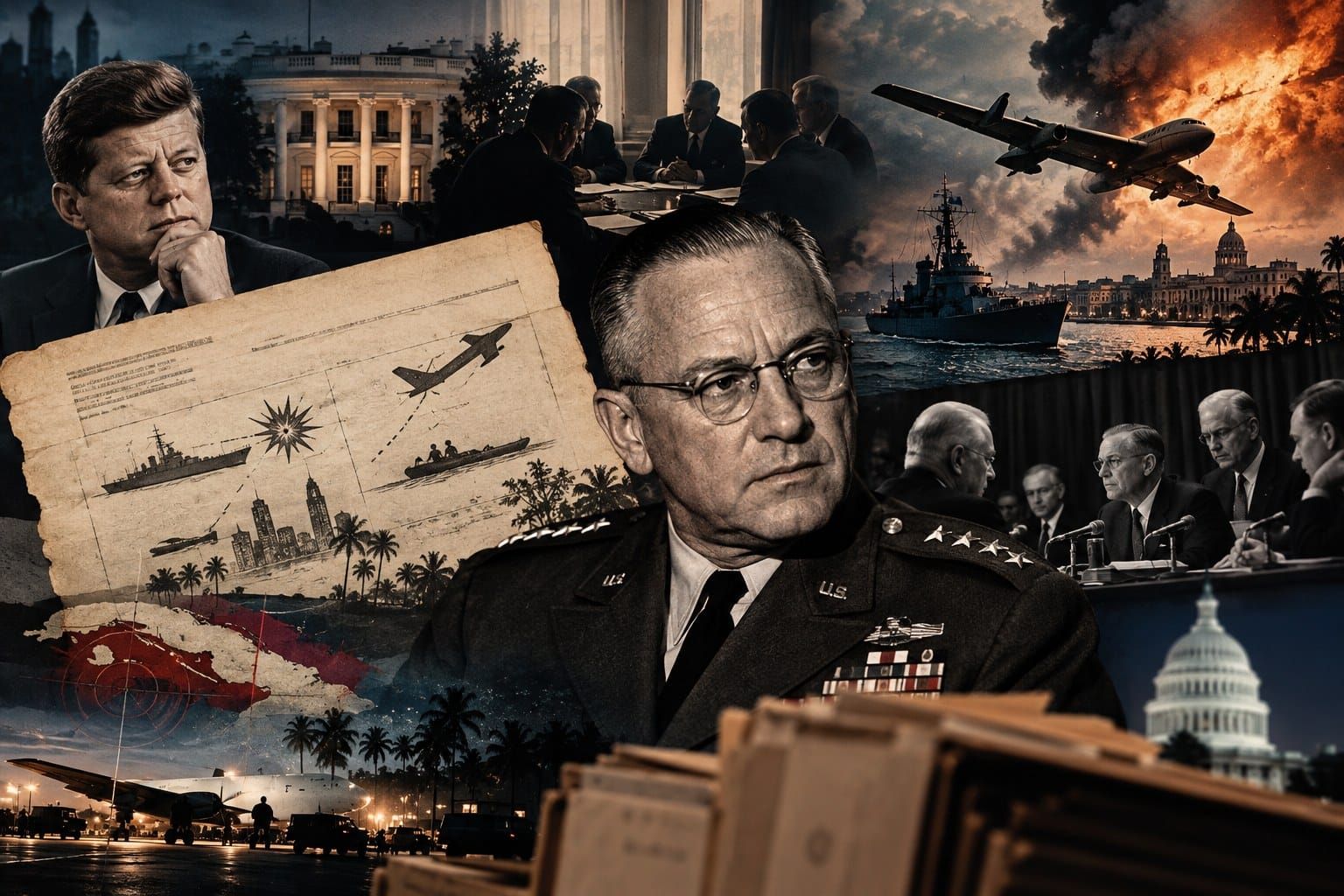
There is a page in the files of the Rockefeller Commission on which one of the commission's own members appears as a witness.
It is page 50 of a typed summary, eighty-six pages long, that the commission's executive director, David Belin, finished in early June 1975. The summary is about plans inside the American government to kill foreign leaders, and most of it is about Cuba. On page 50 Belin sets out what several men remembered of a meeting held in Washington on 10 August 1962, at which, according to a CIA officer who was there, someone raised the possibility of the "liquidation" of Fidel Castro. The director of central intelligence, John McCone, testified that he objected, and the officer recalled that McCone got rather red in the face. Then comes a short entry with its own heading: the affidavit of General Lemnitzer.
"Lyman Lemnitzer, a member of the CIA Commission, was also present on the August 10, 1962, meeting. In an affidavit he declared that he has no recollection of the question of liquidation of Castro or other Cuban leaders being discussed."
That is the whole entry. Lemnitzer had been chairman of the Joint Chiefs of Staff in 1962, and he sat on the group of senior officials that oversaw the secret campaign against Castro. In January 1975 President Gerald Ford appointed him to the eight-man commission that was to find out whether the CIA had broken the law at home. Five months later the commission's own summary listed him among the people who had been in the room.
I came to this page from the other direction. I had gone looking for a different document with his signature on it, the plan known as Operation Northwoods. His seat on the commission is no secret; it appears in every list of its members. What I had not seen anyone set beside it was page 50, or the route by which both papers eventually came out.
What Was Operation Northwoods? 13 March 1962
On 13 March 1962 Lemnitzer signed a memorandum for the secretary of defense, Robert McNamara. Its subject line read "Justification for US Military Intervention in Cuba," and it was marked top secret. The Joint Chiefs had approved it at their meeting that day. It forwarded a paper the chiefs had prepared for the Cuba Project, the covert program run by Edward Lansdale, and it asked that the paper be treated as "a preliminary submission suitable for planning purposes." The plan inside was code-named Northwoods.
The paper's annex is titled "Pretexts to Justify US Military Intervention in Cuba," and it is a list. It runs to nine numbered items, and what they share is a purpose stated plainly in the appendix: to place the United States "in the apparent position of suffering defensible grievances" from Cuba, so that the world would accept an invasion. The annex called its ideas "suitable only for planning purposes"; the appendix expected the projects to be "operable within the next few months." "We could blow up a US ship in Guantanamo Bay and blame Cuba," one item reads. "Casualty lists in US newspapers would cause a helpful wave of national indignation." Another proposes that "we could develop a Communist Cuban terror campaign in the Miami area, in other Florida cities and even in Washington," aimed at refugees seeking haven in the United States. A third describes a civilian airliner and an exact duplicate: an aircraft at Eglin Air Force Base "would be painted and numbered as an exact duplicate," hand-picked passengers traveling under aliases would board the copy, and the empty original, flown as a drone, would send a distress call over Cuba before being destroyed. Other items cover staged incidents at Guantanamo, American pilots flying copies of Cuban MiGs, fake hijackings, a simulated Cuban attack on a neighboring country and a fighter jet reported shot down over international waters.
None of it was carried out. That sentence appears in almost every account of Northwoods, and it is true. It is also where most accounts stop, because the two ways the document is usually read both end there.
For one group of readers, Northwoods is proof that the government of the United States is capable of planning violence against its own people to start a war, and therefore that later claims of staged events deserve a hearing. For another, it is proof that such plans get rejected, and therefore that it proves nothing about anything that happened afterward. Both camps read the nine items, and in both readings one question goes unasked, which is how the paper itself traveled: who could have read it, when, and why it surfaced only in 1997, thirty-five years after it was signed and nine years after the man who signed it was dead.
That is the question this piece follows. It led back to page 50.
The White House, 16 March 1962
Three days after the memorandum reached McNamara, Lemnitzer was at the White House. The meeting was about the guidelines for the Cuba Project, and the men around the President were the group that ran it: McCone, General Maxwell Taylor, Deputy Secretary of Defense Roswell Gilpatric, the Attorney General Robert Kennedy, the national security adviser McGeorge Bundy, and Lemnitzer. Two short records of the meeting survive.
One is a handwritten note by U. Alexis Johnson of the State Department, attached to the State Department's copy of the guidelines and printed in the official Foreign Relations series. The President, Johnson wrote, "expressed skepticism that in so far as can now be foreseen circumstances will arise that would justify and make desirable the use of American forces for overt military action." It was "clearly understood no decision was expressed or implied approving the use of such forces although contingency planning would proceed." The same note records the President's "general approval" of the guidelines themselves, which assumed that final success against Castro would require decisive American military intervention.
The other is Lansdale's own memorandum of the meeting, which is not printed in the official series and which I have read only as quoted by the Mary Ferrell Foundation's archive. In that account, Lemnitzer told the President that the military had plans "for creating plausible pretexts to use force," and "the President said bluntly that we were not discussing the use of U.S. military force."
Those two sentences are the closest the record comes to a scene in which Northwoods reaches the President. Even here, the record is careful in a way the retellings are not. It shows a President declining to discuss military force against Cuba, with Lemnitzer present and pretexts mentioned. It does not show anyone reading the nine items aloud, and it does not show a decision on the memorandum of 13 March.
The No That Nobody Wrote Down
I expected the rejection to be easy to find. Almost every retelling says Kennedy rejected the plan, and some add that he removed Lemnitzer because of it. So I went looking for the document in which the plan was turned down. What I found instead was a sequence: the chiefs' approval, then silence from the secretary of defense, then the chiefs asking again, and only a year later the first civilian objections on paper.
Most people have read fifteen pages, the excerpt the National Security Archive posted in 2001. They contain the covering memorandum, the chiefs' paper, dated 12 March, and a short record headed "Decision on JCS 1969/321." That record says the Joint Chiefs approved the paper's recommendations at their meeting on 13 March. One of those recommendations was to send it to the secretary of defense "for approval and transmittal" to the Cuba Project. In those pages there is no reply from McNamara, no routing slip back, no note of disapproval. The full case file runs to 197 pages. The Review Board's staff summary of it records the chiefs' repeated recommendations to McNamara and Lansdale from February to August 1962, and no written disapproval. The Mary Ferrell Foundation, which has studied the file closely, says the plan was "apparently rejected" and that the circumstantial evidence is strong that McNamara turned it down. ABC News, reporting the plan in 2001 with the author James Bamford, put it more carefully than most since: "Whether the Joint Chiefs' plans were rejected by McNamara in the meeting is not clear." I found no public comment by McNamara on Northwoods.
The chiefs did not treat the silence as a final answer. On 10 April 1962 Lemnitzer sent McNamara another memorandum on Cuba, which a Review Board chronology summarizes as a recommendation that the United States adopt a national policy of early military intervention. On 1 May 1963, seven months after Lemnitzer had left the chairmanship, a Joint Staff report prepared for the chiefs proposed again that "the United States should initiate a coordinated program to create a pretext for overt U.S. military intervention in Cuba," and its appendix repeated many of the 1962 ideas. In October 1963 the report was withdrawn from the chiefs' consideration, after a staff note had judged an engineered incident, as the sole cause for an invasion, to be inadvisable for the time being. That persistence does not prove the March 1962 memorandum was never rejected. It shows that rejecting a particular proposal, if that happened, did not end the military's consideration of the underlying idea.
The civilian objections on paper came a year after Northwoods, and they are weaker than the legend needs. In April 1963 a proposed new program for Cuba, discussed by the Special Group, said that covert action "which might be used as a pretext for overt military intervention is ruled out." McGeorge Bundy questioned the line, and McCone and the CIA's Desmond FitzGerald explained that it was not meant "to preclude such a situation if it should turn out to be desirable at some time in the future." In May 1963 two officials, U. Alexis Johnson of State and Paul Nitze of Defense, sent Bundy contingency studies that, they wrote, did not necessarily represent their departments' views; one concluded that it "would not be feasible or desirable to contrive a mock Cuban attack" on an American reconnaissance aircraft. The first refusal adopted as policy came at the end of that year. A contingency plan approved by the secretaries of state and defense and the director of central intelligence was forwarded on 30 December 1963. As summarized in a memorandum to the secretary of defense in January 1964, it stated that the United States did not contemplate a premeditated full-scale invasion of Cuba "or the contrivance of a provocation which could be used as a pretext for such action."
That is a refusal on paper, twenty-one months after Northwoods, five weeks after Kennedy's death, and addressed to the concept rather than to the memorandum. As for Lemnitzer's departure, his official biography says Kennedy did not give him a second term as chairman because the President judged him "not sufficiently innovative" for the unconventional wars he expected in the Third World. His term ended on 30 September 1962, and he went to Europe to command NATO's forces. No document I found ties that decision to Northwoods.
The rejection everyone remembers, of the memorandum of March 1962, is the one part of the story that nobody has found in writing.
Executive Order 11828, 4 January 1975
On 22 December 1974 the New York Times reported that the CIA had run a large domestic intelligence operation against antiwar activists and other dissidents, in violation of its charter. Thirteen days later Ford answered with an executive order. Its fact-finding duty was a single clause: the commission was to "ascertain and evaluate any facts relating to activities conducted within the United States by the Central Intelligence Agency" that raised questions under the law that created the agency.
The order named one agency. It did not exclude the military, because it had no reason to mention the military at all.
On the day the order was signed, Ford sat in the Oval Office with Henry Kissinger and Brent Scowcroft and went through names. "We can get Griswold, Lemnitzer, Friendly, Reagan, Jack Connor, Shannon, Dillon," he said, according to the memorandum of the conversation. In the same meeting Kissinger passed on a warning from the former director of central intelligence, Richard Helms: "Helms said all these stories are just the tip of the iceberg. If they come out, blood will flow. For example, Robert Kennedy personally managed the operation on the assassination of Castro." The men who would choose the commissioners knew that the trail could lead to Cuba in the early 1960s. The commission they chose included the man who had been chairman of the Joint Chiefs while that program ran.
The White House announced the members the next day, 5 January 1975: Nelson Rockefeller as chairman, the former Treasury secretary C. Douglas Dillon, the former solicitor general Erwin Griswold, the former governor Ronald Reagan, the union leader Lane Kirkland, the businessman John Connor, the university president Edgar Shannon, and Lemnitzer, described as a retired general who had chaired the Joint Chiefs and commanded NATO forces in Europe.
What happened next is documented in material the National Security Archive published in 2016. Rockefeller wanted to keep the commission away from the assassination plots, limiting it to whether Cuba had a role in Kennedy's death. Members of his own commission, among them Reagan, refused, and the commission took up the plots. The published report would later call it "unclear whether or not those allegations fell within the scope of the Commission's authority," in a passage the National Security Archive attributes to the White House edit. Belin's staff gathered testimony and affidavits, and Belin himself wrote most of the summary of what they found. Two came from men who now sat on the commission: Dillon gave an affidavit about the Congo, and Lemnitzer gave his about the meeting of 10 August 1962.
The summary that records his affidavit says, on its first page, that it had been reviewed by neither the staff nor the commission. Inside the White House, Ford's deputy chief of staff, Dick Cheney, led the editing of the final report, and the eighty-six pages on assassinations were removed and replaced by a short statement that time had not permitted a full investigation. Ford received the report on 6 June 1975. The assassination material went to the President, who passed it to the Senate's new intelligence committee, chaired by Frank Church.
What a Witness Is Asked
I spent some time with the idea that page 50 was the cover-up. A man who had signed a plan for staged terror sits on the commission, appears as a witness, and says he recalls nothing. The pieces fit too neatly, and that was the first reason to distrust them.
The question in the affidavit was about "liquidation," the killing of Castro and other Cuban leaders, discussed at one meeting in August 1962. Northwoods was something else: a set of pretexts for an open invasion, proposed in March by the Joint Chiefs, not the CIA, and routed to the secretary of defense. No document I have seen shows that anyone asked Lemnitzer about the March memorandum in 1975. No document shows that anyone on the commission or its staff knew it existed. His answer was an answer to the question he was given. I cannot tell from the record what he remembered or what he chose not to volunteer, and nothing I have read suggests that his affidavit was false.
What the record establishes is narrow. Lemnitzer signed the memorandum in 1962, sat on the commission in 1975 and gave an affidavit to its inquiry on a different question. Whether anyone on the commission knew of the memorandum, whether he mentioned it in private, and whether he shaped the inquiry's scope, its questioning or its conclusions are things the documents I have read leave open. I found no record of how he voted when the commission overrode Rockefeller, and none of a part in the editing. By 1975 he had been retired for six years, and whether the Joint Chiefs' papers stayed classified was not in his hands. The executive order did let the commission ask any department for information, the Pentagon included. Nothing I have seen shows that it asked the Joint Chiefs for their Cuba papers, or that it had a reason to.
So the explanation I started with does not hold. What replaces it is less dramatic and, I think, more useful. The commission was built to look at one agency. Its mandate named the CIA; its staff gathered what the CIA and the people around its operations could tell them; the one document that would have connected the head of the military to a plan for staged attacks sat in the military's own files, under a different chain of custody, answering to a different department. Even the part of the inquiry that strayed beyond the mandate, the assassination chapter, strayed in a particular direction: toward CIA plots, because those were the allegations in the newspapers. Each step was reasonable. Together they produced a commission that could take a sworn statement from the signer of Northwoods without anyone in the room having a reason to mention it.
What the Church Committee Printed, 1975 and 1976
The Church Committee inherited the material and went further than the Rockefeller Commission ever had. Its interim report, "Alleged Assassination Plots Involving Foreign Leaders," published on 20 November 1975, is the most detailed public account of the Cuba operations from that era. It names Lemnitzer as a member of the Special Group (Augmented), the body that oversaw the campaign against Castro. It quotes the January 1962 memorandum from the Pentagon's representative on Lansdale's working group, Brigadier General William Craig, offering "a concept for creating distrust and apprehension in the Cuban Communist Hierarchy": Operation Bounty, a scheme of cash rewards "for killing or delivering alive known Communists," from informers to government officials. It quotes Gilpatric's testimony that the Joint Chiefs had contingency plans for an invasion, but that overt military action "was out of bounds" as far as the Special Group was concerned.
What it does not contain is the pretext plan. A full-text search of the published interim report, of the five books of the committee's final report of 1976, and of the final report and most hearing volumes of the House Select Committee on Assassinations, which followed in 1979, finds no mention of Northwoods, of the title "Justification for US Military Intervention in Cuba," or of the Joint Chiefs' proposals to manufacture an incident. The word "pretext" appears in the Church Committee's assassination report, but about Chile.
The committee printed a memorandum from the Joint Chiefs' own representative when it touched on killing, and nothing of the chiefs' proposals to manufacture a war. The committee's mandate reached improper activities by any federal agency, but its report on Cuba was a report on plots to kill, and that report filtered by the act. A silence in a published report proves little about what a committee knew. The committee had Lansdale's papers and Craig's memoranda; it may have seen more than it printed, and its working files are beyond what I have read. What can be said is narrower and still striking. The most extensive congressional intelligence investigation of its era published nothing about a military pretext proposal that would later become one of the most widely cited documents of the Kennedy years, and the man who signed that proposal appears in its report as a member of the oversight group and a participant in meetings, never as its signer.
Record Group 218
The document came out through a door built for a different question.
In December 1991 Oliver Stone's film "JFK" ended with a title card about government records on the assassination that would stay sealed for decades. The public reaction helped push Congress, which passed the President John F. Kennedy Assassination Records Collection Act in 1992. The law created an independent Assassination Records Review Board, which worked from 1994 to 1998, and gave it the power to decide what counted as an "assassination record."
The Board chose to read that phrase broadly. In its final report it wrote that its definition "enabled the Board to look beyond the narrower confines of the assassination to find and release valuable documents from the early 1960s." At its request the Joint Staff searched its own archived files and flagged records from 1961 to 1964 "from the files of Joint Chiefs of Staff Chairmen Lyman Lemnitzer, Maxwell Taylor, and Earle Wheeler," together with selected records from the Joint Staff's central files. Of the 147 records flagged, the Board's staff judged that 146 qualified. About two thirds concerned Cuba.
So the paper that two decades of investigators had not printed was found in the Joint Chiefs' own records, among the papers of the period when its signer was chairman, by a board whose authority came from a law about a murder the paper did not mention. The Northwoods file, which the Mary Ferrell Foundation traces to the Joint Chiefs' central files, carries a record number from that process. In the National Archives it is, formally, an assassination record.
The same machinery, in the same years, helped bring out the other half of this story. The White House and commission records in which the Rockefeller report was edited, including the summary with Lemnitzer's affidavit on page 50, were among the records whose release in the 1990s the Review Board helped secure, according to the National Security Archive, which published them in 2016. Both pages, the memo and the affidavit, reached the public through a law about Kennedy's death. Neither page is about Kennedy's death.
18 November 1997: The First Coverage
The Review Board released Northwoods on 18 November 1997, with about 1,500 pages of military records from the early 1960s. It was not ignored. The New York Times ran a story under the headline "Documents Show Pentagon's Anti-Castro Plots During Kennedy Years." The Associated Press story that ran in newspapers across the country opened with "a bagful of dirty tricks to harass or humiliate Fidel Castro," and noted, accurately, that none was carried out. A Review Board member, the historian Anna Nelson, said the documents showed how deep the interest in forcing Castro from power had been.
The initial coverage faded. Three and a half years later, the document returned to public attention through a very different story.
In April 2001 Bamford published "Body of Secrets," a history of the National Security Agency, with a passage on Northwoods. ABC News reported that the plans "have gone undisclosed for nearly 40 years." Bamford explained the delay this way: "The reason these were held secret for so long is the Joint Chiefs never wanted to give these up because they were so embarrassing." The posted file bears him out on one point. Its first page carries a stamp: "Systematically reviewed by JCS on 21 May 84. Classification continued." On 30 April the National Security Archive posted the fifteen pages online. Five months later came the attacks of 11 September, and Northwoods began its second life as one of the most cited documents in arguments that governments stage the events that start wars.
The ABC sentence was wrong about the date and right about something else. A record can be released without being disclosed in any sense that matters to readers. In 1997 Northwoods was one item in a large release about Cuba under a law about Kennedy, framed by the wire services as a story about tricks. In 2001 it was the centerpiece of a bestselling book, framed as a plan to kill Americans. The paper had not changed. What it was taken to mean depended on who read it first and what they were reading for.
Allen Dulles, 1964
Lemnitzer's position in 1975 has an older and better-known parallel. In November 1963 President Lyndon Johnson appointed Allen Dulles to the Warren Commission, the panel that investigated Kennedy's assassination. Dulles had been director of central intelligence until Kennedy replaced him after the Bay of Pigs, and he had led the agency when its plots against Castro began. In 1976 the Church Committee's fifth book concluded that the Warren Commission had not been told about those plots, though they bore directly on one of the questions it was trying to answer.
The cases differ. Dulles knew about a program inside the agency he had run, and the Church Committee found that his commission should have been told. Lemnitzer's memorandum belonged to an institution his commission was not asked to examine, and I have found no evidence that anyone there knew to ask. What they share is the architecture: a commission drawn from the senior men of the period it examined, and a document central to that period sitting in files the inquiry had no evident reason to request.
That raises a broader question than one general. How often have American investigations examined the agency accused of wrongdoing without examining the institutions that proposed, authorized or enabled the same conduct? The Rockefeller Commission was drawn around an agency. The Church Committee's assassination inquiry was drawn around an act. Northwoods, a military paper about manufacturing a war, was neither the agency nor the act, and it fell between the two. How many other papers fell with it is more than I have been able to check.
The Strongest Objection
The best objection to this reading is that it needs no architecture at all. The Rockefeller Commission was set up to answer a newspaper story about domestic spying, and it did. The Church Committee chased assassination plots because those were the allegations in front of it. Neither was asked to audit the Pentagon's invasion planning for Cuba, and Northwoods was a rejected planning paper, one of thousands in the Joint Chiefs' files. No investigation misses what it is not looking for. Lemnitzer's appointment was the ordinary choice of a respected retired general; Dillon, a former Treasury secretary from the same administration, gave an affidavit too, and nobody calls that a conflict. The late release is explained by classification, which is what Bamford said: the chiefs did not want to give these papers up. On this reading, the coincidence of page 50 is a coincidence, and the mechanism is a description of how inquiries ordinarily work.
Most of this is right, and the piece does not claim otherwise. It does not claim that anyone hid Northwoods from the commission, that Lemnitzer withheld anything he was asked about, or that the commissions failed at the tasks they were given. Its claim is about what "ordinarily" produces. An investigation can have the authority to cross institutional boundaries without having the evidence, the mandate or the reason to know where to look. Military classification kept the paper closed. Inquiries drawn around the CIA and around plots to kill gave no one an evident reason to open it. The two operated alongside each other, and in the documented record it was a law written for a different purpose, interpreted broadly by an independent review board, that eventually crossed the line. The documented investigations did not bring Northwoods into the public record. Their institutional and subject boundaries help explain why, but the surviving evidence does not establish whether investigators knew the document existed. No decision to hide the paper is required to explain how it stayed out of two national investigations of the period it came from.
12 November 1988
Lyman Lemnitzer's part in this story ends with his affidavit. The commission on which he served published its report without the chapter on assassinations, and the chapter went to a Senate committee whose published reports never mentioned the plan he had signed in March 1962.
He died on 12 November 1988, at the age of 89.
Nine years later his memorandum was released from the records of the Joint Chiefs of Staff, catalogued as a record of the assassination of President Kennedy.
Questions readers ask about Operation Northwoods
What was Operation Northwoods? A plan approved by the U.S. Joint Chiefs of Staff and sent to Secretary of Defense Robert McNamara on 13 March 1962. It proposed staged incidents, including attacks blamed on Cuba, to create a justification for a U.S. invasion. It was never carried out.
Was Operation Northwoods real? Yes. The memorandum, signed by General Lyman Lemnitzer, was declassified and released by the Assassination Records Review Board on 18 November 1997. The National Security Archive published it online in 2001.
Who rejected Operation Northwoods? No written rejection of the 13 March 1962 memorandum has been found. The plan was not carried out, and on 16 March 1962 President Kennedy declined to discuss the use of U.S. military force against Cuba. Written objections to the pretext idea appear in 1963, some of them qualified or non-binding; the first adopted as policy is in a contingency plan of December 1963.
Did JFK reject Operation Northwoods? No document records Kennedy rejecting the memorandum itself. Two notes of a White House meeting on 16 March 1962 record that he was skeptical of using U.S. forces against Cuba and declined to discuss military force, with Lemnitzer present. His decision not to give Lemnitzer a second term is officially attributed to other reasons.
Why is Operation Northwoods linked to 9/11? Its details became widely known in April 2001, five months before the attacks, and it has since been cited as evidence that governments plan staged events. The memorandum proves that such a plan was proposed in 1962. It says nothing about later events.
Why was Operation Northwoods released through the JFK records law? The Review Board read the term "assassination record" broadly and searched Joint Chiefs of Staff records from 1961 to 1964, where the Northwoods papers were among those released.
Evidence Map
Facts, interpretations, forecasts, and disconfirming signals.
Core claim. Operation Northwoods did not enter the published record of two national investigations of its own era. Nothing shows that anyone hid it. The inquiries' boundaries, one drawn around the CIA and the other, in its report on Cuba, around plots to kill, help explain why, while the plan sat in the Joint Chiefs' files; whether investigators knew it existed is not established. Its signer gave an affidavit to the 1975 commission on which he served, on a different question. The paper surfaced in 1997 under a law about the Kennedy assassination.
Evidence level. Facts: high for the memorandum and its dates, Lemnitzer's membership and affidavit (commission summary of 5 June 1975, page 50), the executive order's scope, the excision of the assassination chapter, the Joint Chiefs' 1984 review that continued the file's classification, the Joint Staff's search of the chairmen's files for the Review Board, and the 1997 and 2001 coverage. Interpretation: medium for the mechanism that inquiries filtered by agency (the Rockefeller Commission) and by act (the Church Committee's assassination report) left a military pretext plan outside both. Not established: whether anyone on the Rockefeller Commission knew of the memorandum or of Lemnitzer's role in it; whether he influenced the commission's scope or findings; what the Church Committee saw in its working files; and who, if anyone, formally rejected the memorandum.
What would confirm this. Release of Church Committee or Rockefeller Commission working files showing that the Joint Chiefs' pretext papers were outside the material requested or produced; other Review Board releases of military records on matters that earlier CIA-focused inquiries had not reached.
What would disprove this. Evidence that either inquiry knew of Northwoods and deliberately excluded it, which would substantially change the explanation and require an investigation of that decision rather than treating the omission mainly as a consequence of institutional boundaries; or a written rejection by McNamara or Kennedy, which would remove the second finding but not the first.
Watchlist. Further releases under the JFK records law; the Rockefeller Commission records at the Ford Library; any publication of Church Committee staff files on the Special Group (Augmented).
Sources. The Northwoods file (National Security Archive), the Rockefeller Commission's summary of facts on assassination plots and the Archive's 2016 account of its excision, Ford's conversation of 4 January 1975, the 16 March 1962 note, the Church Committee's Alleged Assassination Plots, and the Review Board's final report.
Jerry van der Laan writes The Manifest Archive, Forensic Narrative Intelligence Writing on the systems beneath power, money, and history. He traces the structures beneath them.
Related from The Manifest Archive
- George Joannides Has Been Dead Since 1990. His CIA File Outlived the Law Meant to Open It.
- Allen Dulles: CIA Director, Wall Street Lawyer, and the Man Who Investigated JFK's Murder
- The NSA Proved the Gulf of Tonkin Attack Never Happened. It Classified the Finding for 41 Years.
- Swiss Intelligence Knew Who Owned Crypto AG. It Told the Police Otherwise.