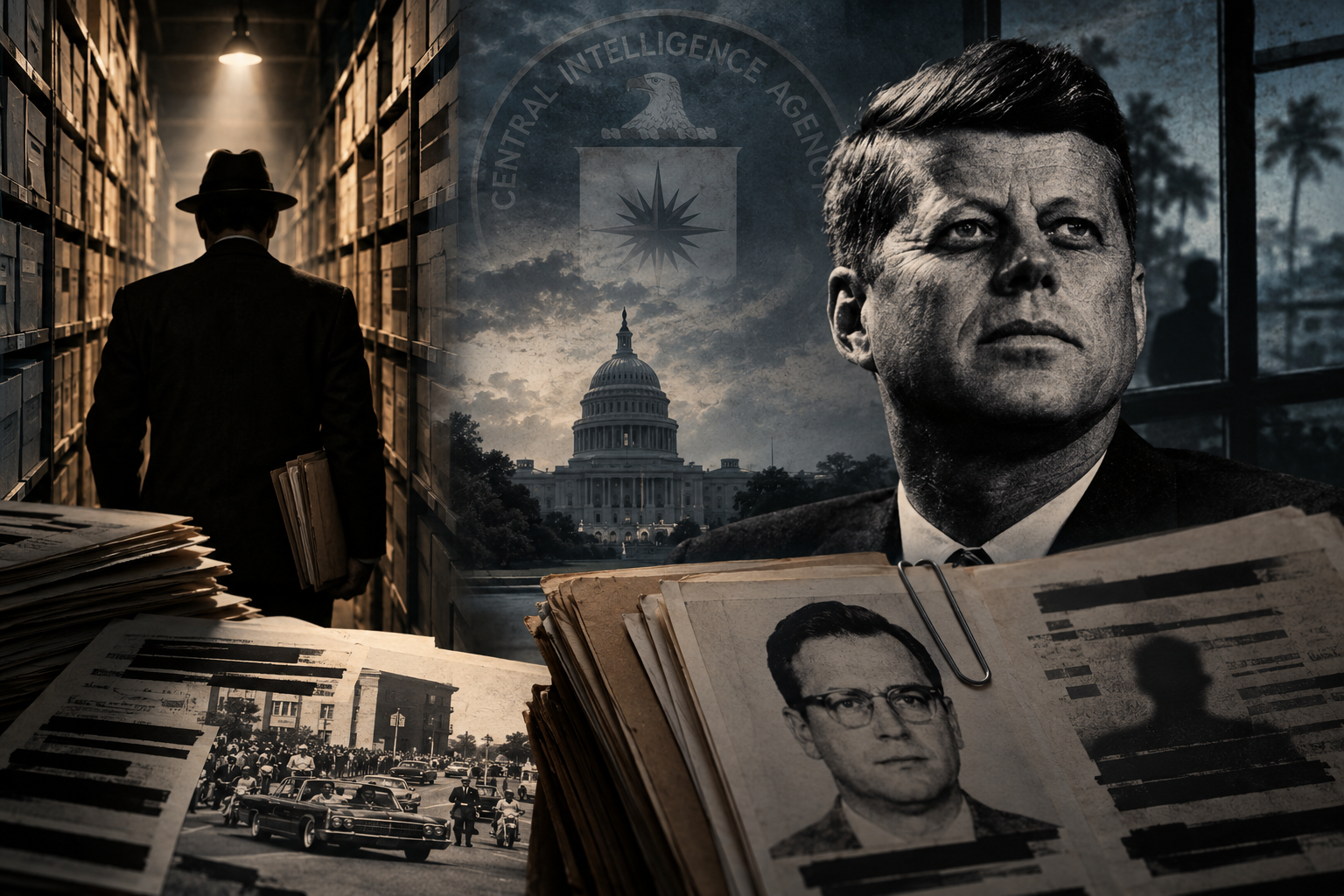
George Joannides has been dead since 1990. His personnel file was still being fought over in federal court twenty-eight years later, even though Congress had separately ordered assassination records open in full by 2017.
That law had a name and a birthday: the President John F. Kennedy Assassination Records Collection Act, signed by George H.W. Bush on October 26, 1992, in direct response to the furious public reaction to Oliver Stone's film JFK, released the previous December. The Act did something federal secrecy law almost never does. It did not simply order agencies to review their holdings and use their judgment. It wrote its own ending into the statute: every assassination record in the government's possession would be fully released within twenty-five years, by October 26, 2017, and the President could postpone specific records past that date only by personally certifying that release would cause "an identifiable harm to the military defense, intelligence operations, law enforcement, or conduct of foreign relations of the United States," and that the harm was "of such gravity that it outweighs the public interest in disclosure." Congress built the Assassination Records Review Board to do the collecting and reviewing between 1994 and 1998, then let the Board's independent authority lapse and left the certification power exactly where discretion always lives: with the President, acting on the recommendation of the same agencies whose records were being judged.
This is not a piece about who killed John F. Kennedy. It takes no position on that question and needs none. It is about a narrower and more answerable one: what happens when a legislature tries to remove an executive branch's discretion over its own secrets by writing a deadline into law, and gives that removal exactly one escape hatch. The escape hatch is the subject. Nine years after the law's own deadline, and thirty-four years after the law itself, the escape hatch is the only part of the statute that has never once expired.
Twenty Years of Distrust, One Film
The 1992 Act did not appear from nowhere, and the distrust behind it was not manufactured by a screenwriter. In 1975 and 1976, the Senate's Church Committee documented, on the record, that the CIA had run assassination plots against foreign leaders including Fidel Castro, using intermediaries with organized-crime connections, throughout the early 1960s, the same years and the same target the Warren Commission's own investigation had never been told to examine. The Committee's findings did not accuse the Agency of killing Kennedy. They established something adjacent and, for the purposes of public trust, nearly as damaging: that the CIA had run precisely the kind of covert program whose existence the Warren Commission would have needed to know about to assess the full range of motives surrounding the President's death, and that the Commission itself was never informed of it, even though Allen Dulles, its former CIA director turned Commission member, knew that covert world from the inside.
That history sat mostly dormant for fifteen years, a matter for historians and a small community of researchers, until Oliver Stone's 1991 film gave it a mass audience and a villain with a face. The film took liberties the historical record does not support, and critics said so at the time. It also asked, in front of tens of millions of viewers, a question the Church Committee had already partly answered and the government had never fully acted on: what did the people investigating this assassination already know and choose not to pursue. Congress's response, unusually fast by legislative standards, was not a commission or a further inquiry. It was a statute with a deadline, because a commission can be told the same evasions a previous commission was told, and a deadline, on paper, cannot.
The Clause on Paper
Read cold, the certification standard sounds narrow by design. "Identifiable harm" is not "possible embarrassment" or "ongoing sensitivity." It asks for a harm that can be named, tied to defense, intelligence, law enforcement, or foreign relations specifically, and weighed against the public's documented interest in knowing how its government investigated the murder of a sitting president. The word "identifiable" does work here that a weaker word would not: Congress was trying to foreclose the kind of open-ended, self-renewing secrecy that the intelligence community had spent decades practicing, the reflex that classifies first and asks whether classification still serves a purpose only when someone with standing to sue forces the question.
The Assassination Records Review Board is the proof that the design could work. Operating from 1994 to 1998 with genuine statutory independence, including the power to override an agency's own classification judgment, the Board built a collection of 318,866 records, roughly five million pages. When it finished, only 1.1 percent of those records, 3,603 of them, remained withheld in full, and another 11 percent carried partial redactions. The rest, close to ninety percent of everything the government held on the assassination, was opened while an independent body with real authority was still doing the opening. The CIA never once appealed an ARRB release order to the President, the mechanism the statute allowed it. It simply complied, in public, four years running. The clause was never the problem while someone other than the agencies themselves controlled it.
Why Twenty-Five
The number later became familiar across the classification system, but the JFK Act got there first. In 1992, Congress imposed a twenty-five-year outer limit at a moment when Executive Order 12356 had actually eliminated governmentwide declassification schedules. Three years later, Executive Order 12958 adopted twenty-five years as the general default for automatic declassification of historical national-security records.
The exemption logic was not unique to the later executive order, either. Classification review has always let agencies request exemptions for specific categories of information, and agencies request them routinely, at a scale large enough that the government has run a standing office, the National Declassification Center, for over a decade largely to work through the resulting backlog. The JFK Act's certification clause was written as something narrower and more accountable than that general exemption process: the President personally certifying continued postponement against a specific statutory harm standard, rather than a category-wide administrative exemption request. In practice, once independent review ended in 1998, the two mechanisms converged. A President certifying withholding on the recommendation of an agency is doing, in substance, what an agency exemption request does in the general system: asking the same institution that classified the information to judge, unchecked, whether declassifying it is still safe. The statute tried to build something more disciplined than the ordinary rule. What it built, for its final and longest stretch, behaved like the ordinary rule anyway.
2017: The Deadline That Wasn't
The Board's own authority expired in 1998, nineteen years before the statute's disclosure deadline. What replaced independent review, for the twenty-five-year clock's final and most consequential stretch, was the certification standard alone, administered by the President on the recommendation of the same agencies the Board had spent four years occasionally overruling.
October 26, 2017 arrived with that clock already run out. President Trump did not decline to release the files. He also did not release them in full. Citing requests from the CIA and FBI, he certified continued withholding on a large share of the collection, a tranche reported at 15,834 records still carrying redactions, and ordered the agencies to conduct a further review, with a new deadline of April 2018 rather than the one Congress had written into law twenty-five years earlier. He framed the delay as reluctant. "I have no choice," he said of the postponement, the language of a formality already decided rather than an independent judgment he was making himself.
The following April, the pattern repeated at smaller scale: more redactions lifted, more records released, and a further extension of the ones that were not, this time pushed out toward 2021. Each cycle followed the same shape. A deadline arrived. Agencies identified records they wanted withheld. The President certified the withholding, citing the agencies' own judgment as the basis for his own. A new date was set. Nothing in the statute required this particular rhythm. The statute required a decision, made and defended, against a standard that had to be satisfied for the information being withheld. What it got, repeatedly, once independent review was gone, was a renewal.
The Man Who Has Been Dead Since 1990
The clearest illustration of what "identifiable harm" meant in practice, once the agencies alone were judging it, is not a still-active operation or a living source. It is George Joannides. His case is worth setting out in full: not an isolated redaction, but the exception clause's logic worked all the way through on a single file, predating the 2017 deadline by two decades.
Between 1962 and 1964, Joannides was the CIA case officer running the Cuban Student Directorate, known to the Agency by the cryptonym AMSPELL, a group of Cuban exiles based in Miami and New Orleans. In the summer of 1963, DRE members in New Orleans had a series of public confrontations with a man distributing pro-Castro leaflets on a street corner: Lee Harvey Oswald. The encounters were public, documented in contemporary radio recordings and the DRE's own newsletter, months before Oswald was named as the assassin. Fifteen years later, in May 1978, the House Select Committee on Assassinations reopened the investigation, and the CIA assigned an officer to serve as its liaison to the Committee, responsible for producing the Agency's records and managing its cooperation. The officer the CIA chose was George Joannides. The Committee was never told that its own CIA liaison had personally run the group whose contact with the accused assassin it was trying to reconstruct.
Joannides died in 1990. He was never questioned under oath about either role. Even during the ARRB's independent review in the 1990s, the Board later found that the CIA had given it "inaccurate representations" specifically about Joannides's records, a friction point strong enough to survive contact with the one body that could override a CIA refusal outright. When the 1992 Act's twenty-five-year deadline arrived in 2017, without that override available any longer, Jefferson Morley later reported that the CIA was still withholding a further tranche of roughly 330 of his personnel and operational files, including at least forty-four documents spanning 1963 to 1978 that the Agency had described, per that reporting, as concerning his "cover and intelligence methods." Among the material reportedly fought over: a 1963 performance evaluation that discussed the AMSPELL operation directly, a 1979 evaluation praising him as "the perfect man" for the Committee liaison assignment, and the citation for a 1981 Career Intelligence Medal awarded after his HSCA service. The known descriptions of the withheld material do not identify an operation that remained active, and the public record did not establish what living source, if any, disclosure would endanger. The man has been dead for going on four decades. The harm the statute required the government to identify was never publicly tied, in this file, to anything a reader could see was still capable of being hurt.
Fifteen Years in Federal Court
The Joannides fight did not begin with the 2017 deadline and did not end with it. On July 4, 2003, the journalist Jefferson Morley filed a Freedom of Information Act request for Joannides's operational files. The CIA refused to search its own operational records at all, arguing the request was not specifically about Joannides in a way the statute required, a position narrow enough that in December 2007 the D.C. Circuit Court of Appeals reversed a lower court and ordered the Agency to search anyway. The litigation continued for another decade past that reversal. By 2018, when the courts finally resolved a separate dispute over Morley's attorney's fees, the tally stood at 524 responsive records identified across the whole fifteen-year fight, of which 113 had already reached the National Archives on the Agency's own initiative and 411 had been forced into the open only because a federal court ordered the search that produced them.
The courts kept ruling in narrow, procedural steps that never quite forced a final accounting. A 2016 appellate opinion, addressing yet another dispute over Morley's legal fees rather than the withholding itself, records what some of the eventually released material actually turned out to be: a handful of travel records, a photograph, and the citation for a career medal. That opinion describes the travel records only as a "very close match" capable of marginally supporting one hypothesis about Joannides's activity; it does not itself establish that the records place him in New Orleans during Oswald's own 1963 presence there, and this piece draws no conclusion from the possible overlap either way. What the court did note is that the CIA had spent over a decade in litigation resisting the release of a former employee's travel itinerary.
A single case officer's personnel file, for a man dead since 1990, took fifteen years of continuous federal litigation, from a Fourth of July filing in 2003 to a fee dispute still being argued in 2018, to move roughly four hundred documents, itineraries and medal citations among them, from withheld to public. No statute wrote that timeline. No court order requires that a FOIA fight over one man's paperwork should outlast most careers. It happened because every incremental disclosure had to be individually litigated, at the requester's expense and on the requester's initiative, against an agency that bore no cost for having refused the previous nine requests along the way, and no obligation to explain, at the end of it, why an old travel record had needed a decade of federal litigation to become a photocopy anyone could read.
The Serial Finale
The extensions did not stop with Trump's first term. President Biden delayed further disclosure in 2021, citing pandemic-disrupted agency review, and again in 2022. On December 15, 2022, the National Archives released another 13,173 records, with hundreds more still held back on national security grounds the government did not itemize in public. By July 2023, the White House was ready to declare the matter effectively closed: the press secretary told reporters that over ninety-nine percent of the collection was now public, releasing what remained only when the strongest possible reasons counseled otherwise.
It was ninety-nine percent resolved in July 2023. It had been substantially resolved in April 2018. By March 2025, every record previously withheld for classification would be declared released. Each ending was reported as real. None of them were the last one. Ninety-nine percent, stated in a briefing room, sounds like an ending. It functions, on inspection, as the fourth ending the public had been offered since 2017, each one final until the next one. The remaining one percent of a collection running past five million pages is not a rounding error. It is tens of thousands of pages, and the standard invoked to keep them closed, "the strongest possible reasons," is not a citation to the statute at all. It is a paraphrase, offered eight years after the law's actual deadline, of a legal test that was supposed to require a specific, nameable harm every single time it was used.
It would be easy, faced with this pattern, four rounds of extension across two administrations of different parties, to read it as evidence of a coordinated intention: that something specific in the withheld material has been protected on purpose, by design, across every change of government, because whatever it is has mattered more than any president's stated commitment to disclosure. Hold that thought. It has to be answered before the end. But notice, first, what the pattern actually requires to explain it, because the requirement is smaller than the reading assumes.
Capture by Design
Set the two eras side by side. From 1994 to 1998, with an independent board holding override power, roughly 88 percent of the collection was released in full, another 11 percent with partial redactions, and the CIA appealed none of it. From 1998 onward, with certification returned entirely to the agencies and the President who took their recommendations, the same collection took a further twenty-seven years, and at least five separately announced endings, to reach the point the Board had nearly reached on its own in four. The variable that changed between those two periods was not the statute's language. The certification standard was identical throughout. The variable that changed was who got to apply it.
Since the ARRB expired in 1998, no independent statutory body with comparable override power has stood between an agency's recommendation and presidential certification. An agency recommends withholding, the President's staff reviews the recommendation, and the President certifies it. The agency that classified the record in the first place is also the agency whose judgment the certification defers to. There is no adversarial party in the room, no one whose institutional interest runs the other way, and no penalty attached to over-classifying that comes close to the penalty attached to a release that turns out, even years later, to embarrass the agency that approved it. That asymmetry does not require a plan. It only requires that every individual reviewer, in every individual agency, in every individual year, correctly perceive that withholding a record carries less immediate institutional downside, and releasing one carries a small, non-zero risk of one. Multiply that calculation across thousands of records and three decades, and the aggregate result looks exactly like a coordinated cover-up, because coordinated cover-ups and uncoordinated risk-aversion produce the same document: withheld, cited to "identifiable harm," never itemized further. The clause built to require a specific, provable harm asks a question that is expensive to answer honestly and free to answer with a reflex. Reflexes are cheaper, and cheaper wins by default across elections, administrations, and parties.
The Cost of a Recurring Ending
There is a second-order effect here that the certification standard was never built to weigh, because the statute only ever asks whether a specific harm outweighs the public interest in a specific record. It does not ask what repeatedly promising an ending, and repeatedly missing it, does to the public interest itself.
Consider what each of the five declared endings actually taught anyone paying attention. In 2017, the lesson was that a hard statutory deadline could be met with a certification and a new date. In 2018, the lesson repeated. In 2023, when the government put a number on it, ninety-nine percent, the number itself became the story, because a state that can specify ninety-nine percent so precisely invites the question of what, exactly, sits in the other one, and why a harm too grave to disclose has survived five reviews by five different sets of officials without ever being named even in general terms. In March 2025, the lesson seemed finally to change: a President simply refused the premise and ordered release. Then January 2026 arrived with eleven thousand more pages, and the lesson reverted to the first one. A person who has watched this sequence since 2017 has been given, at minimum, five separate occasions to conclude that the government's declarations about its own secrecy cannot be taken at face value, on a matter it had thirty-three years and a specific statutory obligation to resolve. The Church Committee gave the public a reason to doubt the Warren Commission's completeness. Three decades of missed endings gave the public a reason to doubt the government's word about its own doubt.
None of this requires that anything sinister sits in the pages still being found. A government that cannot reliably tell the public when a review is actually finished produces the same distrust as a government that is hiding something on purpose, because from outside the institution the two are indistinguishable, and indistinguishability is itself a cost, whether or not anyone intended to impose it. The statute's authors in 1992 understood that secrecy corrodes trust. What the following three decades demonstrated is that a broken promise to end the secrecy corrodes it further, because it adds a specific, repeated failure of institutional reliability on top of the underlying question the secrecy was already raising.
2025: The Order That Still Hasn't Finished
On January 23, 2025, President Trump signed Executive Order 14176, directing the Director of National Intelligence and the Attorney General to deliver, within fifteen days, a plan for the "full and complete release" of the JFK assassination records still withheld, a directive materially stronger than any his own 2017 certification had been. Three weeks later, on February 11, 2025, the FBI announced it had located roughly 2,400 additional records related to the case that it said had never previously been recognized as belonging to the collection at all, eight years after the Act's own deadline and thirty-three years after the Act itself. A law that assumed the government knew what it held was still discovering, in 2025, that it did not.
Then the releases came in a rush that no previous administration had matched. On March 18, 2025, the National Archives published 31,419 pages across 1,123 files at seven in the evening, followed the same night by another 37,127 pages across 1,062 more files at half past ten. Two days later, on March 20, a further 14,318 pages. On March 26, a smaller batch of 53 pages. On April 3, 704 more pages across 207 files. By the Archives' own account, posted alongside the March 18 releases, every record in the collection that had previously been withheld for classification had now been made public. Thirty-three years after the statute was signed and eight years after its own deadline, an American president had finally forced the exception clause to yield in full, not by certifying a narrower harm, but by refusing to certify one at all.
It did not end the story. On January 30, 2026, ten months after the Archives had declared all previously classification-withheld records released, it released another 11,022 pages across 140 files. The law was written to end on a date. Instead, every apparent ending produced another review, another release, or another discovery.
Here is where the objection raised earlier deserves its strongest form, because it fits this fact better than any before it. If the pattern were purely structural, an artifact of institutional risk-aversion with no strategic content, a presidential order with real political cost behind it, backed by a fifteen-day deadline and no agency veto, should have closed the file the first time it was tried. It did not. Records kept surfacing after the government had announced the release of everything previously being withheld for classification. That could mean the structural reading is wrong, and something is still being protected on purpose, past the point where any President has been willing to stop it. It is a serious possibility, and it is not answerable from the documents examined here.
What can be said, and what does not fully dispose of the objection, is this: the March 2025 order changed who held the discretion, from the agencies certifying harm to a President refusing to accept any certification at all, and it changed the outcome from an extension to a release. What it did not change, and could not change by fiat, is whether the government's own records management had ever produced a complete, verified inventory of what it held. An order can override a certification. It cannot retroactively create the accounting that thirty-three years of extensions never required anyone to build. The FBI's own newly identified 2,400 records predate the March release; they surfaced during the renewed search and inventory effort, not because anyone had been shown to be actively concealing them. A file can go missing from simple neglect just as easily as from design, and thirty-three years without a mandatory, externally audited inventory, the kind the ARRB alone was ever built to run, is long enough for both explanations to produce an identical result: material nobody can locate, whether or not anybody hid it.
What the Clause Proves
Every reform statute that survives long enough eventually faces the same question: does the exception it wrote for the rare case become, in practice, the rule for every case, or does it stay rare because the political and institutional cost of using it stays high? The JFK Records Act answers that question about as cleanly as a single statute ever will. Under independent review, full withholding had fallen to just 1.1 percent of the collection, with another 11 percent partially redacted, and the CIA appealed none of it. Once review reverted to the agencies alone, the exception was invoked at the first deadline, invoked again at the second, invoked a third time and a fourth, described as ninety-nine percent resolved at a fifth, and only stopped being invoked when a President chose to stop asking agencies to justify it and simply ordered the release instead, three decades after the law was signed.
Congress wrote a deadline to end the agencies' discretion. The agencies wrote the discretion back into every deadline that followed, for as long as no one else was allowed to check their answer. That sentence describes what happened whether or not any single official ever decided it should. No memo needs to exist ordering two administrations to keep extending the same clause for the same reasons; the clause did that work by itself, because it made extension free and specificity expensive, and free options get exercised more reliably than a conspiracy ever could, because nobody has to agree to anything and nobody has to remember why.
The file that started this piece is a fitting place to end it. The publicly described Joannides records have not been shown to concern a live operation, a living source, or information whose disclosure would produce the kind of present harm the statute contemplated. They concern a dead officer whose agency role intersected twice with investigations of the same assassination: first through the exile group he handled in 1963, and later through the congressional investigation he was assigned to assist. That dual role survived an independent board that caught it in an inaccuracy, a deadline it quietly outlasted, and fifteen years of a private citizen's own lawsuit. The record of the harm his files might do was never the point. Whatever harm the files were formally said to pose, one thing their withholding demonstrably prevented, patiently, across five administrations, one independent board, and one company of lawyers, was scrutiny of how the withholding itself had worked, and it is the one thing no version of the statute ever asked anyone to name.
Evidence Map
Facts, interpretations, competing explanations, and what would break this.
Core claim. The 1992 JFK Records Act wrote a twenty-five-year self-executing deadline into law specifically to remove open-ended executive discretion over assassination-related secrecy, permitting postponement only through a narrow presidential certification of identifiable, specific harm. Under the independent Assassination Records Review Board (1994 to 1998), full withholding had fallen to just 1.1 percent of the collection, with another 11 percent partially redacted. Once review reverted to agency self-certification alone, the same exception was invoked repeatedly across successive review deadlines for eight years by two presidents of both parties, functioning as a renewable default rather than a rare exception, until a third administration's 2025 executive order forced release by refusing to accept further certification, an order whose own declared completion in March 2025 was contradicted by a further release of over eleven thousand pages in January 2026.
Evidence level. Documented: PL 102-526 (October 26, 1992) and its certification standard; the ARRB's final statistics (318,866 records, roughly 5 million pages, 1.1 percent withheld in full, 11 percent partially redacted); the ARRB's Final Report finding that the CIA did not communicate the existence of its Castro assassination plots to the Warren Commission even though former CIA Director Allen Dulles, then a Commission member, was aware of them; the ARRB's separate finding of inaccurate CIA representations regarding Joannides; the October 2017 and April 2018 certifications and the reported 15,834-record figure; the Joannides litigation record (Morley's July 4, 2003 FOIA filing, the December 2007 D.C. Circuit reversal, and the 2018 ruling establishing 524 total responsive records, 113 previously transferred and 411 forced by litigation), and the separately reported 330/44-document tranche at issue around the 2017 deadline; the December 2021, December 2022 (13,173 records), and July 2023 (over 99 percent) disclosures; Executive Order 14176 (January 23, 2025) and its fifteen-day plan requirement; the FBI's February 11, 2025 disclosure of roughly 2,400 newly identified records; the March to April 2025 release dates, page counts, and file counts, and the National Archives' own March 18, 2025 statement that all previously classified records had been released; the January 30, 2026 release of 11,022 pages. Interpretation, marked as such throughout: that these events form a single structural pattern of capture by default rather than a series of unrelated administrative decisions.
Competing explanation. That the repeated extensions reflect a learned strategic practice, specific material being protected on purpose across changes of government, rather than a structural default with no coordinating intent. This is not excluded here and is treated in the text as the strongest available objection.
What would strengthen the structural reading. The same pattern, near-total openness under independent review followed by serial extension under agency self-certification, appearing in a comparably aged, comparably reviewed federal records collection unrelated to intelligence or law enforcement.
What would weaken it. Evidence that specific, named officials across multiple administrations coordinated to protect identifiable material, rather than each administration independently deferring to agency recommendations it had no institutional incentive to challenge.
What would resolve the Joannides case specifically. Full, unredacted release and independent historian review of the disputed personnel and operational files, confirming whether their content is limited to personnel administration or extends to operational material capable of the harm the statute requires.
Open documentary questions. Whether the January 2026 release exhausts the collection or whether further FBI or CIA-held material remains unidentified; the current status of Joannides-related litigation; whether any further records surface as a result of the 2025 to 2026 review process.
Related from The Manifest Archive
This piece sits beside three others that trace the same architecture from different angles. Allen Dulles: CIA Director, Nazi Financier, and the Man Who Investigated JFK's Murder follows the same Warren Commission through the man who sat on it while hiding what he knew, fifteen years before Joannides did the same thing to a different committee. Deep State Explained: Myth, Mechanism or Structural Power and Narrative Replaces Reality map the wider machinery this single clause is one instrument of, and Nothing Is Missing And That's the Problem asks the harder question this piece only opens: what a complete file is actually worth once the reasons behind it are gone.
Jerry van der Laan writes The Manifest Archive, a forensic study of the systems that decide what people are allowed to see as reality. He traces the structures beneath them.