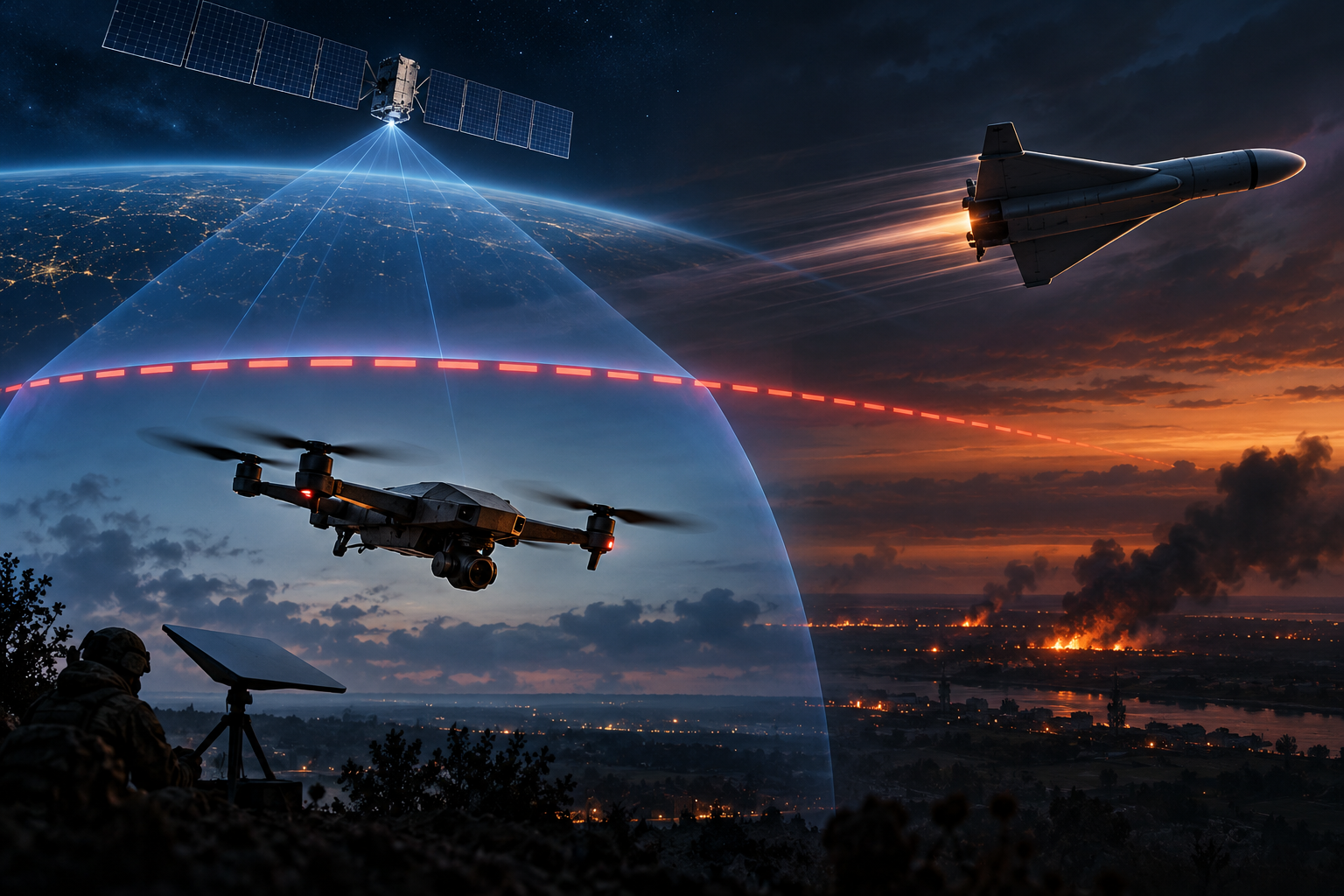
The determining variable in the Starshield affair is not who gave the order. It is the form the order took.
On October 14, 2026, Ukrainian drones connected to Starshield, the military version of SpaceX's Starlink network, lost their links whenever they flew faster than about 160 kilometers an hour. Interceptor drones flown over Starshield, which chase Russian jet-powered Shaheds, became close to useless. For eight days the argument has been about a name: Musk, Trump, someone in the White House, someone at the Pentagon. Every candidate has denied it or pointed at another.
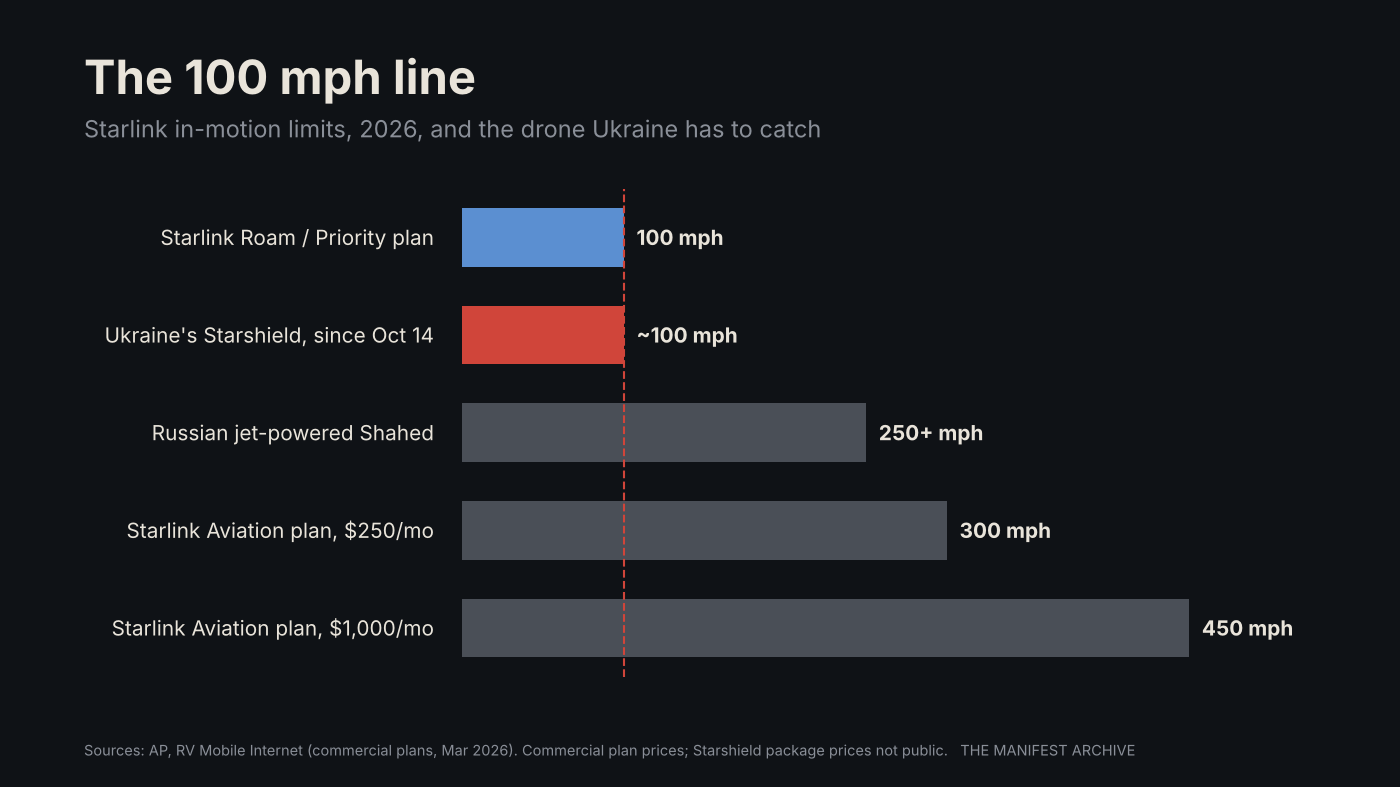
Look at the number instead and a different story appears. 160 kilometers an hour is 100 miles an hour, and 100 miles an hour, a round number but a specific one, is the in-motion limit SpaceX set this spring for its commercial Roam and Priority plans, the ones sold to travelers, boat owners and RV households. Faster connections exist. They are sold as aviation plans, at a higher price. In the Associated Press's account of an interview with Ukraine's own adviser, the way out is described in that vocabulary: lift the limit, or switch to a separate Starshield package designed for aircraft, which has no speed limit and costs much more.
This piece follows that number back through four years of Ukraine's dependence on one company's network, from donated terminals in 2022 to a speed check in January 2026 that was built to protect Ukraine and worked brilliantly. What it finds is not a villain. It is a system in which a decision with military consequences can be executed as a change of service setting, described as terms of service, answered with talk of a costlier package, and left without any public signature. That form is what makes it so hard to answer the question everyone is asking.
The night of October 13
The first people to notice were the drone crews.
On the night of October 13 to 14, units of Ukraine's 7th Rapid Reaction Corps reported that their strike drones lost connection for ten to twenty seconds at a time once they climbed to cruising speed, around 110 to 120 kilometers an hour. The drones kept flying but became harder to control, and several missions were called off. A volunteer who relays reports from the front, Serhiy Sternenko, first reported drops above 160 kilometers an hour and later, citing military reports, drops at 60 to 70. By morning Serhiy Beskrestnov, a defense-technology adviser to President Zelensky who goes by the call sign Flash, confirmed that a speed limit had been switched on for terminals in motion. "Our defense forces did not receive a warning about this limitation," he said, and it had disrupted a number of missions.
Within a week the Institute for the Study of War published a chart of Ukrainian drone strikes on Russian targets near the front. Through the summer the daily count had mostly run between 100 and 150, and earlier in October it had briefly topped 200. On October 14 it fell below 50. In the days that followed it crept back above 50. ISW itself noted that the limit does not touch Ukraine's long-range strikes into Russia, which do not run over Starlink, and the chart shows timing rather than cause. I will not claim more than that.
What the limit does touch is interception. Russia's jet-powered Shaheds fly at more than 400 kilometers an hour. A Ukrainian interceptor drone that has to chase one at the speed of a family car on a motorway does not catch it. Before October 14, according to the Associated Press, Ukraine's Starshield service had no speed limit at all.
$4,500 a month, 2022
The idea that Ukraine's war runs on a product with tiers is not a metaphor. It has been literally true since the first month of the invasion.
The first Starlink terminals arrived in Ukraine at the end of February 2022, after Ukraine's digital minister asked Elon Musk for them on Twitter. By the autumn there were about 20,000. SpaceX donated some; around 85 percent were paid for fully or partly by others, chiefly Poland, the United States and the United Kingdom. On September 8, 2022, SpaceX's director of government sales wrote to the Pentagon that the company was "not in a position to further donate terminals to Ukraine" and asked the Defense Department to take over funding for military use. The letter, obtained by CNN, put the cost for the rest of 2022 at about $124 million and for a full year at close to $400 million. It also listed the prices. The top tier of connectivity, the one the military wanted, cost $4,500 per terminal per month. A cheaper tier cost $500. Ordinary Ukrainian consumers paid $60.
In July of that year General Valerii Zaluzhnyi, then Ukraine's commander-in-chief, had written to Musk asking for 6,200 more terminals plus 500 a month to replace those destroyed in combat. SpaceX told him to take the request to the Pentagon. After CNN published the letter, Musk withdrew the funding request and said SpaceX would keep paying. By June 2023 the Pentagon had confirmed it was buying Starlink service for Ukraine anyway.
The same year produced the two episodes that framed the debate for the next three. In September 2022, during a Ukrainian sea-drone attack on the Russian fleet at Sevastopol, Ukraine asked SpaceX to extend coverage to Crimea, and Musk refused. Walter Isaacson's biography first claimed Musk had switched coverage off; Isaacson later corrected himself, writing that the Ukrainians thought coverage was enabled all the way to Crimea "but it was not." The area had been geofenced beforehand. Musk later said enabling it would have made SpaceX "explicitly complicit in a major act of war and conflict escalation." In October 2022, as Ukraine advanced in the south, front-line units reported Starlink outages they called catastrophic, worst in Kherson and Zaporizhzhia. Reuters reported in 2025, citing three sources, that Musk had personally ordered coverage cut near Kherson; SpaceX did not confirm it.
Notice the shape of those arguments. They were about maps: where coverage existed and where it did not. The tool was a border on a map, and it was visible to everyone on both sides of it.
Poland's $50 million a year
The second fact that matters is who pays, because it is not who controls.
By March 2025 there were about 42,000 Starlink terminals operating in Ukraine. Poland had funded roughly half of them, and its digitization ministry was paying about $50 million a year for the service. When Poland's foreign minister, Radoslaw Sikorski, said that Poland might have to look for other suppliers if SpaceX proved to be an "unreliable provider," Musk answered on X that his Starlink system was "the backbone of the Ukrainian army" and that the front line "would collapse if I turned it off." Marco Rubio, newly secretary of state, joined in: "No one has made any threats about cutting Ukraine off from Starlink." Musk added that Starlink would never turn off Ukraine's terminals and that he would not use it as a bargaining chip.
That exchange contains the whole structure in miniature. The customer paying for half the terminals had no say over the service. The supplier described his own control in the first person. And the American government, which was neither the main payer nor the operator, spoke for both. Two weeks earlier Reuters had reported that US negotiators raised the possibility of cutting Ukraine's Starlink access in talks about mineral rights.
December 2024: Starshield for 2,500 terminals
Starshield is the part of this system the US government buys under military terms; the Pentagon had also been paying for ordinary Starlink service for Ukraine since 2023. SpaceX markets it as a separate, more secure and encrypted service for government customers, running over the same constellation. In September 2023 the Space Force placed its first order for it, worth up to $70 million, under a general contract for satellite services, and said Starshield differed from commercial Starlink because of "unique Department of Defense terms and conditions that are not found in commercial service contracts."
For Ukraine, the step came in August 2024 and became public in December, when Bloomberg reported that the Pentagon had contracted SpaceX to extend Starshield access to 2,500 Starlink terminals already in Ukraine, on top of 500 connected earlier. Space Systems Command confirmed the deal and declined to give its value. That contract has not been published.
So by 2025 Ukraine's satellite communications ran on three layers with three different payers: consumer and military Starlink paid by Poland, the Pentagon, other governments and donors; Starshield for a few thousand terminals paid by the Pentagon; and SpaceX's own network underneath all of it. Only one party sat in all three layers, and it was the operator.
January 27, Kharkiv: the network learns to clock a drone
The capability used on October 14 was sharpened in January, for Ukraine's protection.
By the start of 2026 Russian forces were fitting Starlink terminals to their own long-range strike drones, Shahed variants, Molniyas and Italmas among them. A drone that talks to a satellite ignores Ukrainian jamming. Starlink already had a limit on terminals in motion, around 40 kilometers an hour, but Russian operators got around it by spoofing the speed their terminals reported. After a Russian strike on a passenger train in Kharkiv region on January 27 killed at least five people, Ukraine's defense ministry asked SpaceX to act, and SpaceX changed method. It began measuring each terminal's speed with its own constellation instead of trusting the terminal, and cut service to anything moving faster than roughly 75 to 90 kilometers an hour. A soldier in a truck stayed online, while a fixed-wing drone at cruise speed went dark. Terminals registered to Ukrainian brigades could have the limit lifted. Mykhailo Fedorov, then Ukraine's new defense minister, publicly thanked Gwynne Shotwell and Elon Musk for their quick response. On February 5 the second step followed. Unregistered terminals in Ukraine were cut off, and only devices on a verified list, built by Ukraine together with SpaceX, kept working. Beskrestnov said Russian command and control had collapsed in places. A pro-Kremlin military blogger, Boris Rozhin, admitted there was for now no alternative, and some Ukrainian positions lost their links too until their terminals were registered.
Stop at what existed after those two weeks in winter. A satellite operator held a list of which terminals belonged to Ukraine's armed forces. It could measure how fast each one was moving without trusting the device. And it had demonstrated, on the Russian side, that it could cut service by speed so precisely that one terminal stayed connected and the next went dark. Every one of those capabilities was put to work at Ukraine's urging and for Ukraine's protection, and every one of them worked. In 2022 control had meant a border on a map. By February 2026 it meant a setting, applied per terminal, per speed and per list.
March 2026: 100 mph enters the price list
The fourth layer was commercial and had nothing to do with the war.
In early 2026 SpaceX changed its in-motion policy for ordinary customers. On the Roam plan and on the Local and Global Priority plans, the maximum speed at which a moving terminal is supported fell from 450 miles an hour to 100. Faster use moved into dedicated aviation plans. RV Mobile Internet, which tracks the plans for travelers, listed them in March: $250 a month for up to 300 miles an hour within twelve nautical miles of land, $1,000 a month for 450 miles an hour with ocean coverage, each with 20 gigabytes included and a charge per gigabyte after that.
This is a normal pricing decision. Aircraft use more of a network's capacity, cross more beams and need more engineering, and charging more for them is unremarkable. I mention it only because of the number. From that spring on, 100 miles an hour was the line on SpaceX's price list between ground service and air service.
October 14: the ceiling lands on the front
On October 14 that line landed on Ukraine.
According to Ukrainian officials and to Michael Kofman of the Carnegie Endowment, cited by the Wall Street Journal, Starshield terminals in motion in Ukraine were capped at about 160 kilometers an hour, with connections in practice holding only below about 130. Interceptor drones, which chase targets at more than double that speed, could no longer be flown over the network. The AP reported that Starshield had previously carried no speed limit.
Two days later Beskrestnov gave the AP an interview. "We are now in active negotiations with the Pentagon, SpaceX and the U.S. government," he said. According to the AP's account, Ukraine is trying to find out whether it can switch to a separate Starshield package designed for aircraft that has no speed limit, or have the restriction on the current service lifted, and that aviation package costs much more, which would also be difficult for Ukraine. Those are the AP's words, not his. His own were sharper. "We now understand that this is not only a technical issue and not only a business issue, but also a political one," he said. And: "How this will develop, who will make this decision, who influences these decisions, we can only guess."
Technical, business and political at once: that is the most precise description of the problem I have found, and its three layers deserve to be kept apart, because the evidence for each is different.
What is established is the match. The reported military limit and the commercial limit sit at the same number, Starshield had no such limit before, and a costlier aircraft package is part of what Ukraine is negotiating.
What is plausible but unproven is the cause: that both limits rest on the same product logic, so that Ukraine's terminals were in effect moved onto a ground tier. It could also be a separately imposed military restriction that happens to use the same round number. I can't tell you which. The Starshield package's price has not been published, and the commercial aviation prices I quote apply to ordinary customers.
What holds either way is the analytical conclusion. Whatever the precise trigger, the system made it possible to restrict a military capability through a centrally managed setting, on one class of terminal, overnight, without a public order. Russia's jet-powered Shaheds fly at more than 400 kilometers an hour, two and a half times the cap.
October 14 to 20: the accounts, day by day
Then came the question of who had changed the setting. The answers arrived in this order.
October 14. Musk, replying on X to Fedorov, wrote that Starshield is owned and controlled by the US government and that "any limits on speed or usage are decided by the US military and ultimately POTUS." SpaceX itself made no statement. Beskrestnov said the limit could not be a coincidence and tied it to the political situation. Days earlier he had posted that "Zelensky has gone too far."
October 15. Reuters, citing two US officials and a Western official, reported that Pentagon leaders had been told that Ukraine's Starshield service needed to be slowed, and that the order came from inside the White House, without saying who gave it. A senior US official said no such request was ever made by the president. The same day nine senators, led by Jeanne Shaheen and including four Republicans, asked the Pentagon's inspector general to investigate whether any official had directed or authorized changes to Starlink or Starshield service for Ukraine.
October 16 and 17. Trump said "it wasn't me, and I don't think it was Elon," and that "we didn't slow it down at all." Rubio, speaking to reporters on October 17, said: "Nobody ordered that Starlink speed to be slowed down. It sort of happened, but my understanding is it's been restored." He said it wasn't deliberate, that Ukraine does not have Starshield now, and that Ukraine wanted Starshield access "to conduct deep strikes inside of Russia," which implies yet another tier of the same product. Kyiv said the limit was still in place, and Musk, Ukrainian officials and the AP all describe Ukraine's drones as running on Starshield; the Pentagon's 2024 contracts extended it to about 3,000 terminals.
October 19. Trump: "I don't know who it was, but I'd like to find out."
October 20. Pete Hegseth, the defense secretary, speaking in Eau Claire, Wisconsin, said the Pentagon had made no directives and that "Starlink has the option to make decisions concerning its terms of service." The same day the Wall Street Journal reported that Musk himself had ordered the cap, after speaking with senior administration officials including Trump, according to one source, and that SpaceX later asked the White House for "a unified understanding and subsequent message." CBS reported conversations between Musk and officials before the order.
These accounts rest largely on unnamed sources and contradict each other, and I treat them as reports rather than findings. Set the anonymous material aside and the on-the-record statements still form a closed loop. The operator says the government decides. The defense secretary says the operator's terms of service decide. The secretary of state says it sort of happened and that Ukraine does not have the service in question. The contract that would settle it has not been published.
A setting nobody admits to changing is still a setting.
What a plan change does that an order cannot
Here is the mechanism, stated as plainly as I can.
An order to stop helping an ally has to be given by someone, and it is visible. Turning off coverage over a whole region in 2022 produced maps, outrage and a biography chapter. A plan limit works differently in at least four ways. It is granular: it touches certain terminals, at certain speeds, and leaves the rest of the service running, so the ally still has a network and cannot say it was cut off. It is deniable in its own language: a speed tier is a term of service, and anyone asked can describe it as technical. It is reversible piecemeal: Rubio could say it had been restored while Kyiv said it had not, and both could be partly right, because a setting can be lifted for some units and kept for others. And the exit under discussion is priced: when the way back runs through a costlier package, a question of policy starts to look like a question of procurement, and the conversation moves from who authorized this to who will pay to restore it. None of those properties requires anyone to intend them. They follow from running a war over a network on which commercial product logic and military control share the same technical levers, whether or not they are the same decision.
Follow the incentives and the arrangement turns out to be stable for nearly everyone involved except the user. For the operator, a capability that becomes a separate tier is a product, and a pricier one. For a government that wants leverage over an ally during negotiations, a setting is a lever that leaves no signature. For the payers, Poland and the Pentagon among them, the bill arrives on schedule, throttled service included. The one party without a lever is the one whose drones are in the air. None of this requires a design, and it explains why nobody has a strong reason to change it.
This is the point where the familiar frames stop helping. Ivan Illich warned that a tool, past a certain threshold, becomes a radical monopoly: indispensable, and then able to dictate terms to those who depend on it. Ukraine's dependency on Starlink fits that description: a network that saved the country's command and control in 2022 is now a single point through which a foreign company or government can throttle it. Nassim Taleb would call it fragility: a system that runs smoothly most of the time but cannot absorb a sudden, total break at a single point, arriving without warning, which is what Beskrestnov said happened. But both describe the dependency. Neither describes the form. What is new in 2026 is that the control has become so fine-grained that it no longer looks like a decision at all. It looks like a configuration.
There is a second-order effect worth naming. The precision that makes this possible was built for Ukraine. Every registry made to keep the enemy off a network is also a registry of the friend, and every speed check that catches an enemy drone also measures the friend's. The finer the protection a defender asks for, the finer the control someone else holds over the defender. That is no reason to refuse protection, only a reason to ask, before accepting it, who holds the setting.
Microsoft, The Hague: the same form, seventeen months earlier
The pattern is not limited to satellites, and the archive has met it before.
In February 2025 President Trump signed an executive order sanctioning officials of the International Criminal Court. By May the court's chief prosecutor, Karim Khan, had lost access to his Microsoft email account and moved to a Swiss provider, the AP reported. Microsoft's president, Brad Smith, said the company's measures "in no way included the termination of services to the ICC." A Microsoft spokesperson said the company had been in contact with the court since February about the process that resulted in "the disconnection of its sanctioned official from Microsoft services." At the end of October 2025, according to Handelsblatt, the court decided to move from Microsoft to openDesk, an open-source suite backed by the German government.
The resemblance lies in how the decision was carried out, not in who signed it: the ICC sanction carried a presidential signature, which is exactly what is missing in Ukraine. But in both cases the decision, whoever made it, reached its target as an account setting. In both cases the provider could truthfully say that service to the institution had not been ended, because the setting touched one person or one class of terminal. And in both cases the institution's response was not to win the argument about who decided but to look for a provider whose settings it could control. The same question runs through the archive's earlier piece on cars that can be stopped remotely by their makers. When the operator sits in another jurisdiction, the user's real contract is with that jurisdiction's politics, and the user finds out which clause applies only when it is used.
The strongest case against this reading
The best objection is that nothing here is unusual, and that I am dressing up ordinary commerce as geopolitics.
Every military that rents a commercial service accepts the vendor's terms and the vendor's plans. Ukraine benefited enormously from SpaceX's precision this winter, and the January speed check and the February whitelist were requested by Ukraine's own defense ministry. A network that can stop Russian drones must, by construction, be able to stop any drone. The United States is Ukraine's largest backer and is trying to negotiate an end to the war; Trump and Musk had both criticized Ukraine's strikes on Russian refineries in the preceding weeks. If Washington wanted those strikes reduced, a speed setting is a quieter and less escalatory tool than a public order, and arguably a legitimate one for the country paying for Starshield. On this reading, the 100 mph coincidence is simply SpaceX applying its standard non-aviation ceiling to a service that had been given an exception, which is a policy choice like any other.
All of that can be true, and the mechanism holds anyway. Whether the cap was policy, a contract term or one man's decision, it was carried out as a service setting that matches a commercial price tier, offered back as a more expensive package, and eight days later nobody will sign for it. The objection explains why the tool exists. It does not explain why its use has no publicly acknowledged owner, which is a narrower thing than having no responsible party: if SpaceX applied an existing contractual power, someone is contractually identifiable, and an inspector general can find them; what is missing is anyone willing to say so in public. If a signed directive from the Pentagon or the White House surfaces, my reading that nobody owns the decision fails in the most useful way, and this becomes an ordinary story of a government instructing its contractor, which would at least tell Ukraine whom to negotiate with. The mechanism, a political decision carried out as a service setting, would stand.
October 14 and the next setting
On rented infrastructure, a decision of war can arrive as a change of plan.
Ukraine knows this. Some units already carry backup links, and Europe's answer, the IRIS² constellation, is real but slow: €15.6 billion on the latest estimate, 348 satellites, a first launch expected in 2029 and initial government services in 2030. Until then the settings that govern Ukraine's drones will be set by a company in Texas and a government in Washington that is negotiating the war's end.
The lesson reaches past Ukraine's border and past satellites. Any country, court or company that runs something essential through someone else's software is on a plan, whether it reads the plan or not: the cloud that holds a prosecutor's email, the payment rail, the car in the driveway that updates overnight. The useful question is not whether the operator is friendly today. It is which plan you are on, who can change it, what the upgrade costs, and whether anyone has to sign.
Evidence Map
Facts, interpretations, forecasts, and disconfirming signals.
Core claim. Two claims, kept apart. First: on October 14, 2026, a restriction with military consequences reached Ukraine's Starshield terminals as a service setting, a 100 mph in-motion limit at the same number that divides Starlink's commercial ground plans from its aviation plans. Second: as of October 22, no official or company has publicly accepted responsibility for it.
Evidence level. Facts, high: the limit itself (Reuters, AP, WSJ via Kofman); the commercial 100 mph limit and aviation pricing (March 2026); the January speed check and February whitelist; the on-the-record statements of Musk, Hegseth, Rubio, Trump and Beskrestnov; the 2022 tier prices (CNN). Operational reports, medium: dropped links and cancelled missions come from Ukrainian units and officials. Statistical coincidence, not cause: ISW's fall in daily strikes shows timing only. Interpretation, marked: that the October limit follows the same product logic as the commercial tier. Anonymous reporting on who ordered it (WSJ, CBS, Reuters, the Telegraph) is contradictory and is not relied on.
What would confirm this. Publication of the 2024 Starshield contract or the inspector general's findings showing that in-motion limits are a SpaceX service parameter; Ukraine restoring interception by buying an aircraft package rather than through a policy reversal.
What would disprove this. For the first claim: evidence that the 160 km/h figure was set independently of SpaceX's commercial tiers, which would remove the plan-tier reading while leaving the setting itself intact. For the second: a signed directive or a public acceptance of responsibility, which would refute the missing owner but not the mechanism of a decision executed as a setting.
Watchlist. Responses to the senators' letter and the Pentagon inspector general; whether the cap is lifted, and on what terms; Ukraine's negotiations on an aircraft package; any publication of Starshield contract terms; IRIS² milestones toward 2029.
Sources. CNN's report on SpaceX's September 2022 letter to the Pentagon; the AP's interview with Serhiy Beskrestnov; Reuters on the White House order and on the October 14 limit; RV Mobile Internet on Starlink's commercial in-motion limits; DroneXL on the January speed check and on the WSJ, Musk and Hegseth; Newsweek on Rubio and on ISW's strike count.
Related from The Manifest Archive
- Everyone Is Watching Chinese Cars Win Europe. Nobody Is Asking What Any Maker Can Still Switch Off.
- Microsoft and the Digital Veto
- The Ownership Illusion: License vs Ownership in the Digital Age
- Palantir and the Price of Exit: How Switching Cost Became Power
Jerry van der Laan writes The Manifest Archive, Forensic Narrative Intelligence Writing on the systems beneath power, money, and history. He traces the structures beneath them.