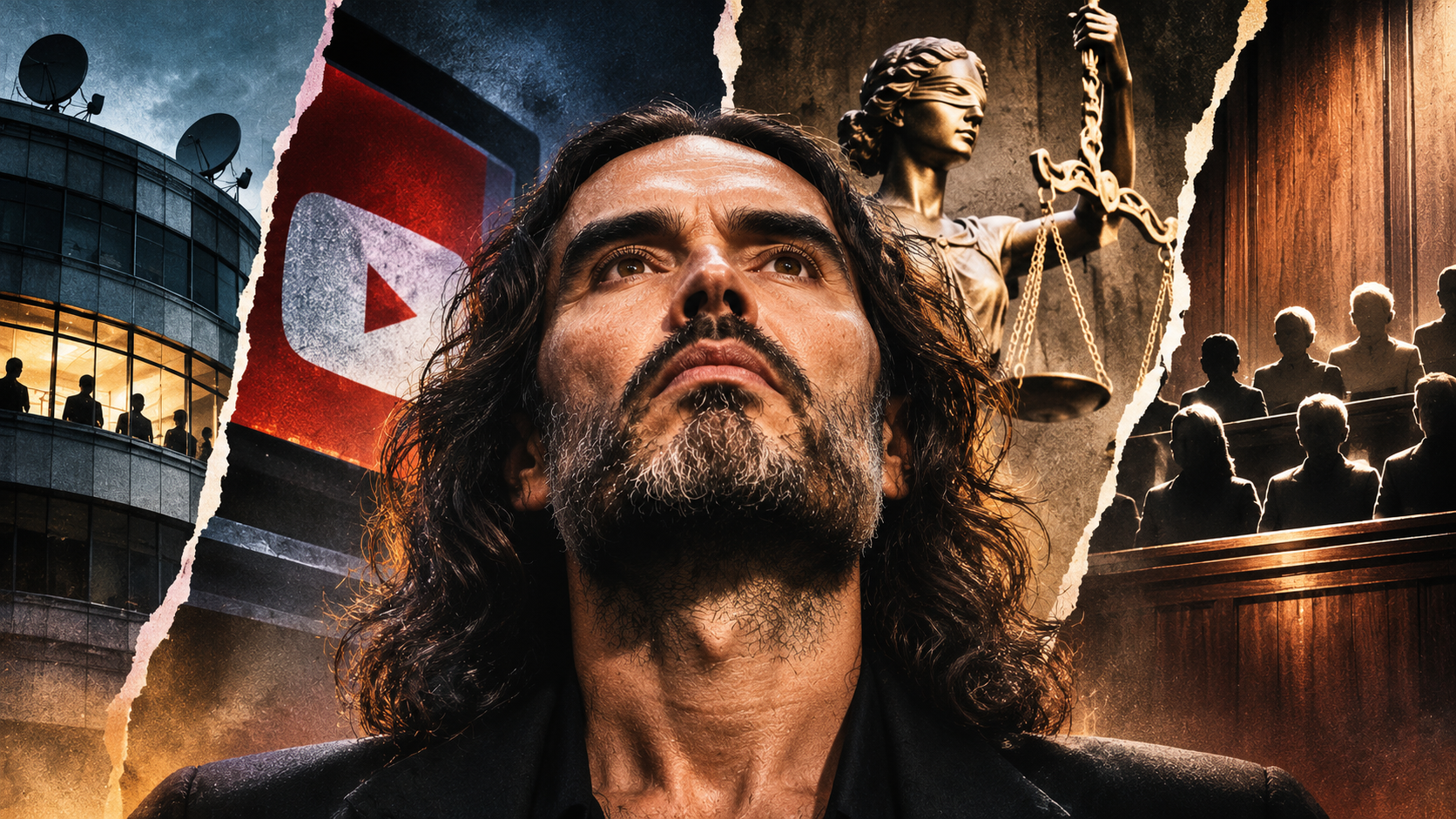
On Thursday 5 November 2026, in a corridor outside Southwark Crown Court in London, a barrister walked up to a journalist.
Minutes earlier, at the end of the Russell Brand trial, a jury had found him guilty of one rape and three sexual assaults. The barrister was Ian Winter KC, who had defended him. The journalist was Rosamund Urwin of The Sunday Times. Her reporting, with The Times and Channel 4's Dispatches, had opened the public side of the case three years before.
Winter told her he hoped she was pleased with herself. She said she was pleased that justice had been done. He said it had not been. On his way out, he left her with one more word: congratulations.
Several outlets reported the exchange. They agree on its shape, if not on every word.
Both of them used the same word, and they meant opposite things by it. For the lawyer, justice was a verdict spoiled in advance by a media campaign. For the journalist, it was a verdict earned by years of work.
Between them stood a question that has followed this case since September 2023, and that a Dutch talk show asked again recently, almost in passing. Was all of this a way to silence a man who spent years attacking the powerful?
I started from the same suspicion. Brand has an audience in the millions, he was loud about the elite, and four days after the verdict he was jailed for ten years and six months. From the outside, that combination is exactly what a silencing would look like. So I did what the Manifest does with a suspicion. I wrote down what it predicts, and I looked.
What I found was not what either end of that corridor argues.
A short note on sourcing before I begin. Documented means records or independent sources support it. Reported means journalism I could not trace to its document. Claimed means a named person says it. The six women who gave evidence are anonymous for life. I do not name them, and I do not describe what they said beyond what the court's outcome makes public.
One Word, Four Jobs
When Brand says he was silenced, two different claims hide inside the word.
The weak form says that once the allegations were public, powerful actors moved to cut off his income before any court had decided anything. That is a claim about letters, platform decisions and dates. It can be checked.
The strong form says the allegations, the investigation and the prosecution were built or steered to remove him. That is a claim about design and motive, which nobody can see directly. The only honest way to test it is to ask what it would predict, and then to look for those things.
Before testing either, the word itself needs splitting. The record shows not one silence but four.
The first is the silence that shielded him. For years, people who worked around Brand did not raise concerns, and the institutions that employed him have since said so in plain language.
The second is the silence that punished him. After publication, a company and a parliamentary chair acted against his income, before any court had been asked anything.
The third is the silence he obtained. Years before any of this, Brand went to the High Court to stop a woman from repeating an accusation against him. The order still binds her.
The fourth is the silence built into the trial. A jury is told to decide on what it hears in the room and nothing else. It is a silence designed for fairness.
The idea of an elite silencing him merges these into one plot. Pull them apart and the plot changes. And one fact, which surfaced on the second day of the trial, changes how all four look.
A silence can only be understood by asking what it was for.
The Silence That Shielded Him
The first silence began long before 2023.
In January 2025 the BBC published an independent review of Brand's time at Radio 2 and 6 Music, from 2006 to 2008. It counted eight complaints in total. Only two were raised while he worked there. The review approached 72 people and interviewed 39. Brand did not take part.
The reason for the gap is in the review itself. Many staff felt unable to raise concerns, because Brand was seen as too influential and was thought to always get his way. The review put management failings and a lack of systems at the center. It also found that a 2007 incident was not properly dealt with. The BBC apologised to its staff.
Other employers found the same pattern. The production company Banijay found that informal concerns about his conduct between 2004 and 2008 were never escalated. Channel 4 found no evidence that its staff knew of the allegations in the Dispatches film, but accepted that a 2009 complaint from a staff member had been badly handled, and apologised. A report on Big Brother's Big Mouth described his behavior as tolerated, summed up in the phrase "Russell being Russell."
Two further items sit at a lower level of evidence. A complaint at Comic Relief in 2017 appears only in secondary coverage. Index on Censorship reported in 2023 that alleged victims said they had been threatened with legal action. I could confirm neither, so I keep them as leads, not findings.
Read these reports for function rather than intent. A presenter whom programme-makers valued. A workplace with no safe route for a complaint. Junior staff who judged, correctly, that speaking up was risky. Nobody had to conspire. The structure produced the silence by itself.
One limit matters here. These reviews describe a culture at three organisations. They are not evidence about the acts the jury judged, and they do not show what happened in any one room. What they do show is that the best-documented silence in this case surrounded Brand. It was not imposed on him.
What He Said Under Oath
Brand described the same culture from the inside.
On 28 October he took the stand. He denied the allegations of all six women and told the court that consent is essential. He said that no friend or colleague had been willing to testify for him, and that his life had been consumed by the case.
He also said something that none of the institutional reports could have said for him. As he became more famous, he testified, he grew comfortable letting that fame open sexual access to women. He agreed with the prosecutor that this was wrong.
It was not a confession to any count. He denied them all. But it is the BBC's finding seen from the other side. Staff said he was too influential to complain about. Brand called the same thing comfort.
There is a second tension in his words. In December 2025, when two further charges were announced, he wrote that he felt blessed to have the chance to atone for the many things he had done wrong. He prayed that anyone he had harmed "in my years of mindlessness in sin" would be healed. He had been baptised in the Thames the year before.
In court, he denied every count. Both positions can be sincere, because a man can repent of a life and still deny a crime. But they went to different audiences. The prayer went to his followers. The denial went to the jury.
The prosecutor answered his claim that nobody stood with him with two numbers: millions of followers, and a 2,000-seat theatre he filled after the story broke. Those numbers are the point. The same reach that made complaints costly in 2006 supplied the audience for a claim of persecution in 2023.
Reach was his armor before the story and became his argument after it.
The Silence That Punished Him
The second silence is the one Brand's supporters mean. Its weak form can be tested, because it left dates.
On Friday 15 September 2023, Brand posted a video denying what he called very serious criminal allegations. He said he had received two "extremely disturbing" letters. That detail is easy to miss. It means the outlets had written to him before publishing, which is the standard right of reply. His video was his answer, delivered first to his own audience.
On Saturday 16 September, The Times, The Sunday Times and Dispatches published their joint investigation, with a ninety-minute Dispatches film, Russell Brand: In Plain Sight. That same evening, Brand played a sold-out theatre in Wembley.
On 19 September, YouTube suspended the advertising income on his channel. It cited its Creator Responsibility policy, which allows action over a creator's behavior off the platform. It did not remove the channel. Its 6.6 million subscribers could still watch him.
On 20 September, Dame Caroline Dinenage, who chairs the Commons culture, media and sport committee, wrote to Rumble and reportedly to other platforms, asking whether they would follow YouTube. Rumble refused, calling the request "deeply inappropriate and dangerous."
The order matters. YouTube moved first. The politician followed. So the claim that she made YouTube act does not fit the dates.
On 25 September, Brand went live on Rumble under the title "Are we being silenced?" He asked his followers to pay sixty dollars a year, and said the government was trying to bypass the courts. It was not the government. It was one committee chair writing one letter, and that is the kind of distinction a person defending a principle should want kept.
Here is what the dates establish. Nobody had been charged, and nobody would be until April 2025. Yet within days of publication, a company acting under its own policy had cut his income, and a politician had asked others to do the same. No court had to find anything first. The money stopped. The speech did not.
Why YouTube Could Act Before Any Charge
Why could a sanction arrive so long before a charge? YouTube's chief executive, Neal Mohan, answered that days later on CBS. A creator can be suspended from monetisation for off-platform behavior, he said, "or there's off-platform news that could be damaging to the broader creator ecosystem."
Read the second half of that sentence slowly. The trigger it names is not a finding. It is news. Publication made the sanction possible. YouTube decided whether and when to impose it.
The second feature is discretion. YouTube had applied the same policy to creators such as James Charles, Onision and Dr Disrespect, who were mostly not political. But the policy says only that YouTube "may" act, and it does not publish how it chooses which accused creators to act against. Discretion is not evidence of bias. But when the criteria are not published, outsiders cannot easily test whether a decision was even-handed.
The third feature is history. Brand and YouTube had clashed before. In September 2022, YouTube removed one of his videos for Covid misinformation and gave him what he called a lifetime warning. He moved his daily show to Rumble. The sanction of 2023 fell on a creator with whom the platform already had a dispute. That is the strongest fact on the side of the target reading.
There was a way back. YouTube's rules let a suspended creator appeal within 21 days, or reapply after 90. I found no record of whether Brand did either.
The cost is harder to measure than it looks. The business assets of his company, Pablo Diablo's Legitimate Business Firm, grew by £3.2 million in 2023, to more than £8 million, according to Chortle's reading of its accounts. Assets are not profit, and I have not checked the filing. The company kept growing, though the figures do not show how much the YouTube sanction cost him.
What emerges is a new kind of sanction, somewhere between the law and nothing, applied by whoever controls the rails the money runs on.
What a Staged Case Would Predict
So the weak form holds. The harder question is the strong form. If the case had been built to remove a political voice, what would the record show?
I wrote down five indicators. Three carry real weight. Two are weaker, because a staged case need not convict on every count or silence its target completely.
The first weighty test is timing. A case built to stop a critic would start after he became a nuisance. This one did not. The Times and The Sunday Times say they received reports in early 2019, and Channel 4 commissioned the film in December 2019. Brand's audience grew most sharply from late 2020, when he turned to Covid, as view data from Media Matters, a group critical of him, shows.
So the Covid version of the target theory does not fit the dates. The media-critic version still could, because he had attacked the media since launching The Trews in 2014.
The second test is coordination. The journalists and the prosecution say the women did not know each other and that no one was paid. Both are interested parties. The real test was cross-examination, which was long.
The third test is pressure on the people who decide. I found none reaching the police, the prosecutors or the judge. The documented pressure sits at a company and a parliamentary committee, places where nobody has to give reasons in public. In court, the judge refused Brand's attempt to stop the trial.
The two weaker tests point the same way. The jury convicted on four of seven counts, not all of them. And the voice did not go quiet. Within minutes of the verdict, Megyn Kelly went live to 4.1 million subscribers, and Elon Musk wrote in support.
On the three weighty tests, the sources I could read support the strong form on none. The two weaker observations do not exclude political influence somewhere else in the chain. They only rule out a plot that controlled everything.
The evidence weakens the theory of a coordinated campaign. It cannot establish that no political influence occurred anywhere in the process.
The Best Case for the Defence: A Poisoned Well
The strongest argument on Brand's side, then, is not a conspiracy. It is a legal one, made by a skilled lawyer.
Winter argued, before the trial and again in his closing speech, that the 2023 reporting had "poisoned the well" of the evidence. He called the publication of anonymous allegations by Channel 4 and The Sunday Times unlawful, and the Dispatches film a work of fiction, noting that the anonymous women in it were played by actors. The regulator saw it differently: Ofcom rejected almost two hundred complaints that the film was unfair or misleading.
Winter asked the judge to stop the trial. The judge refused. English courts rarely halt a trial over publicity. Their usual remedy is to tell the jury to decide on the evidence alone. That is a principle, not a loophole, though it can still fail.
The argument gets one thing right. The journalism came first. The women went to the police after the 2023 reporting, so the prosecution grew out of it. The defence calls that contamination. The prosecution calls it witnesses being found. Commentators split the same way in 2023: a Spiked editor argued that nobody should accept Brand's guilt before a court decided, and a Spectator columnist replied that a conviction cannot be the only test of a newspaper investigation.
So the defence leaves a precise question. Can a public exposé shape the testimony of the people who come forward after it?
The Women in the Dispatches Film Never Testified
The answer begins with a fact from the second day of the trial.
On 15 October, the judge told the jurors that the women whose allegations were featured in the documentary had not been prepared to speak to the police, according to Reuters. Their allegations had never been tested in court and were not part of this case. All six women who gave evidence at this trial had come forward after the film. According to Sky News, the judge also called the film "one-sided and dramatic in manner," and ruled that the jury would not see it.
The fact is not hidden. It was reported that day, and some of Brand's defenders have since used half of it. What I have found almost nowhere is the fact used whole.
Start with what it means for the defence. Brand's side is right about something larger than it usually claims, and the judge's own words about the film support it. The accusations in the September 2023 reporting, the reporting that came before YouTube's decision and the committee chair's letter, never reached a witness box in this trial.
Then consider what it means for the conviction. The verdict does not rest on the film. It rests on accounts by other women, who went to the police themselves, were interviewed by detectives, and were cross-examined by one of the country's leading defence barristers. The jury was not asked to judge the film. It was asked about seven counts concerning six other women, and it split: four proved, three not. The judge drew the same line at sentencing, setting aside the film's allegations and those on which the jury acquitted or was unsure.
Now consider what it does not show. It does not show that the film's allegations were false. Untested is not the same as untrue, and the women in the film may have spoken elsewhere. It does not prove that the jury was untouched by what it had seen in 2023. It narrows the poisoned-well question. It does not settle it, and that remains a matter for a court of appeal. TMZ reports that his lawyers are preparing one. I could not confirm that one has been filed.
What it shows, within this trial, is that the story on screen and the story in court were about different people.
The women in the film never testified. The women who testified were never in the film.
The Silence He Obtained
The documentary raised a question about who had been heard. An earlier court case raises a different one: who had been prevented from speaking?
The third silence was imposed by a court, on one individual, at the request of Brand and his then partner, Jemima Goldsmith.
In 2014, a massage therapist told police that Brand had assaulted her. Police took no further action. Brand and Goldsmith then went to the High Court, not for libel but for harassment, and obtained an injunction. In the published judgment, Mrs Justice Carr found a campaign of emails to journalists, solicitors and a charity. She said the central issue was not whether the allegations were true, but the way they had been spread. At that stage, an exception still let the woman pursue her complaint with the police.
In 2015, another judge gave summary judgment, without a trial, and made the order final. As reproduced by the barrister Dan Neidle of Tax Policy Associates, it forbids her to approach the media or to publish any allegation that the claimants committed an offence against her. It contains no exception for the police.
So the order that began in 2014 with room for the police had become, by 2015 and in the version reproduced, final and without that room. Since then, it has been questioned in court. In 2016, a Court of Appeal judge wrote that the judgment gave no reasons for one of its key findings. In September 2026, another declined to reopen the appeal, while observing that the order appears on its face to prohibit contact with the police. She said the proper route was an application to vary it.
Four days after Brand's conviction, Goldsmith published a statement. She said she had agreed in December 2025 to vary the order so that the woman could speak to the police, and that any change also needs Brand's consent. She also said that she herself had endured violence, coercive control and abuse from him. That is her account, and it has not been tested.
I need to be exact about what this shows. It does not show that the woman's account is true, and the verdict does not decide that. It does not show that the order was sought to prevent a prosecution: a judge found a campaign, and the courts upheld the order.
What it shows is a function. Of the silences in this case, the only one a court ordered against a named person was not imposed on Brand. He helped obtain it. By his former partner's account, the man who went live in 2023 to ask whether he was being silenced is one of the two people whose consent the order needs before it can be loosened.
The court order in this story did not silence Brand. He helped obtain it.
The Silence Built Into the Jury
Three silences protected, punished or constrained someone. The fourth is easy to overlook, because it is not an injustice. It is a design.
Every jury trial cuts the jurors off from the world. In this case the judge went further. Fifty potential jurors were asked about the 2023 coverage, and the six who remembered it were excluded. He told the rest they "absolutely must not carry out any research at all" about Brand.
Midway through the trial, he also restrained the prosecution. He ruled that there was insufficient evidence on one indecent assault count. Brand was formally acquitted of it, and the jury was asked instead whether he had attempted that offence.
For four weeks, twelve people were the only participants in this story who were kept, on purpose, from the noise.
Set that beside the other kind of audience. Brand built his over a decade. People join it by choice. It hears one voice, everywhere, all the time, and mostly it does one of two things with that voice: agree with it, or leave. When Brand spoke to it on 15 September, days before any platform acted and years before any court, he was putting his case to a jury that had selected itself by liking him.
The audience on the other side behaved the same way. Within days, as far as feeds and comment sections show, both audiences had settled on verdicts of their own. The jury at Southwark took more than eight hours over two days, and returned something neither audience is built to produce: a split.
That is the thought I did not expect to reach. The word silenced was supposed to explain who stood on which side. Instead it points to the one institution built on enforced silence, and that institution produced the only verdict in the story that was not all one thing.
Seen this way, the phrase witch hunt does odd work. It is one phrase applied to seven counts, four of which a jury found proved and three of which it did not. The guilt story told on the other side has the same flaw. Neither survives being asked, one count at a time, what was proved.
Who Gains From Each Story
If no plan connects these silences, something else keeps each story alive. Function before intent: every account of this case runs on an incentive, whether or not anyone intends it. The incentives run from the individual outward, so I take them in that order.
Start with Brand himself. The account of being silenced keeps an audience loyal, and an audience is income. In the livestream in which he asked whether he was being silenced, he also asked followers to pay for his Rumble channel.
His supporters gain something too: a case that fits a larger political fight. They add arguments of their own, that the offences were two decades old and never reported at the time, and that the women gave evidence from behind screens Brand could not see past. Screens are a standard protection in English sexual offence trials, and the defence could still cross-examine through them, but the objection is real to the people who make it.
Next, the institutions that told and handled the story. A newsroom that wins prizes for an investigation gains from a conviction. A platform that answers to advertisers gains from distance.
Then the institutions of politics. A parliamentary committee gains visibility on online safety. Its chair's register of interests records hospitality from YouTube at Glastonbury in June 2023, worth £3,302 and declared as the rules require. That is a fact about proximity, not influence: YouTube acted before she wrote, and it gave similar hospitality to MPs of other parties.
After the verdict, the government gained a reform agenda. The prime minister said he would look at changes to rape trials, and the Metropolitan Police commissioner called parts of the defence's approach close to victim blaming. The Spectator replied that the jury had not fallen for rape myths, since it convicted, and that using the case to change trial rules risks tipping the scales.
My own situation is no exception. A Manifest piece that finds a surprise gains from the surprise, which is why I keep the labels visible and the limits stated.
At the end of this chain are the six women who gave evidence. They are anonymous for life. They have no audience to sell to, no platform to monetise and no prize to win. I make no claim about anyone's inner motives, and different incentives do not make anything they said true. Theirs only differ in kind.
The Timing Question Nobody Has Answered
There is one question on which Brand's supporters have a real point, and I cannot close it.
If the journalists began work in 2019, and the conduct the court judged ended in 2009, why did the story arrive in September 2023? A conservative commentator who calls Brand a friend asked why the media waited until Brand became politically inconvenient. The question is fair, and the record contains no document that answers it.
Three explanations are possible, and each leaves a different mark. The first is the one the journalists would give: an investigation involving hundreds of sources, legal checks and women deciding whether to go public takes years. The second is that the political moment mattered: by 2023 Brand was a figure whose fall would draw an audience. The third is the one his supporters prefer: someone decided that the time had come.
The first fits everything I found, including the 2019 commissioning date. The second is plausible, but it is about audience, not orchestration. The third needs a document or a witness, and I have seen neither. Only the outlets hold the dated record that would settle it.
Ordinary delay could explain the timing. The record I could examine does not establish why that date was chosen.
Proportional to What? The Sentence, Explained
The other number his supporters point to is the sentence. Ten years and six months sounds extraordinary. For a few hours, it looked like proof to me. The sentencing guideline tells a more complicated story.
The total is two terms, not one: nine years for the rape, and eighteen months for the most serious sexual assault, served after it. The other two assault sentences run alongside.
The judge placed the rape in category 2B of the guideline, which runs from seven to nine years. So nine sits at the top. He added time for aggravating features of the offence, and took a year off for mitigation, which included the seventeen years since the offences and his charity work.
He also refused several aggravating features the prosecution asked for. One was fame itself: he warned against punishing Brand more for being famous. His remarks do not mention Brand's politics.
The comparison that went around social media set Brand's expected sentence against a three-year sentence another man received for rape in 2025. Musk wrote "Unjust" under it, before the sentence had been announced. But two sentences with the same label can hold very different cases. That is why England has a guideline: to compare category with category, not label with label.
A sentence within the guideline range is not, by itself, evidence of political interference. Whether the judge weighed every factor correctly is a separate legal question, and a sentence at the top of the range is a reason to watch any appeal.
Who Paid, and Why the Fast Layer Exists
Any account of power has to ask who paid. In this case several people did, and not equally.
Four of the women had victim statements read in court before sentencing, describing lasting psychological harm. They cannot be named, so for the rest of their lives they carry a case the world discusses without them. For three years, strangers argued over whether their accounts were a plot.
Brand said the allegations had cost him his marriage, his children and his health. That is his testimony, not a finding. His wife and three children belong to the same story, and none of them is accused of anything.
And there is a wider cost. If a company or a committee can cut off a person's income before any charge, the tool exists for everyone, including people with no millions of followers to fall back on.
But look at why that tool exists at all. The investigation began in 2019. Brand was charged in 2025. The verdict came in 2026. The conduct dates from 2004 to 2009. A system that needs years to answer produces demand for something that takes four days, and that is what a demonetisation is. I cannot show that the delay caused YouTube's decision. YouTube cited its own policy. It is a pattern worth testing, not a finding.
For the women, who had waited seventeen years or more, the slow system was the only one that could say guilty. For Brand, the fast system was the one that spoke before any court did.
A system that needs years to answer creates a demand for something that takes four days.
The Strongest Version of the Silencing Argument
The strongest silencing argument requires no conspiracy. It requires only institutions making separate decisions that push in the same direction.
Each actor in this story had a plausible institutional rationale. YouTube could point to its advertisers, the committee chair to public alarm, and the newsrooms to an investigation begun years earlier. Broadcasters that had tolerated Brand for years had reason to distance themselves. Each decision is defensible alone, and I found no evidence that they were coordinated. Together, those decisions restricted his access to established sources of income and institutional support, without ending his ability to speak. Brand and his admirers feel that effect whatever the intent.
First, what supports the argument. Add a parliamentary chair writing to platforms about someone not yet charged, a method that can be used against any speaker, as Spiked and The Hub both said in 2023. Add the earlier dispute with YouTube.
Add the documentary the judge himself described as one-sided and dramatic, whose accusations were never tested in court. Add a policy whose criteria are not published. Add the timing question, which no document answers. None of this requires Brand to be innocent, and a critic with 6.6 million subscribers is exposed in a way a quiet man is not.
Then, where the evidence stops. Exposure is not design. Design predicts a rule bent for him. What I found is a rule applied before to creators who were mostly not political. The comparison is loose: several of them had admitted some of the conduct, Brand denied everything, and I found no large critic of power accused of anything comparable to test the rule on.
This counterargument is serious, and it is right about the second silence. The reading offered here claims something narrower. The early sanction and the verdict are different events with different evidence. The first required no criminal conviction and operated under a private platform policy. The second required a jury to decide each count under criminal law, with the defence free to cross-examine every witness. The second does not borrow its legitimacy from the first, and the first does not lend its illegitimacy to the second.
What would change my verdict on the strong form is specific: documents showing contact between the committee, the platforms and the outlets before publication; evidence of coordination or payment among the complainants; a Court of Appeal finding that the trial was unfair; a record of why the publication date was chosen; or right-of-reply letters showing the outlets pressing him on his views rather than his conduct. If any of them appear, I will revisit this piece.
Convergence can look exactly like conspiracy. The difference is whether anyone can show a plan.
What the Corridor Left Out
Return to the corridor. Winter and Urwin each carried the same word down it, and meant opposite things by it. Behind both of them stood twelve people whom neither addressed.
The jury had one job. It had to decide seven counts on the evidence placed before it. Four were proved. Three were not. Its task was not to judge the film the world argued about.
Outside the courtroom, other verdicts had been forming for years. Employers had stayed quiet. A platform had decided before any charge. A court order still limits what one woman may say. Audiences had chosen their sides within hours. None of those silences meant the same thing, and none of them was required to separate what had been proved from what had merely been said. The audience has a feed, and nothing in it forces anyone to decide count by count.
The jury's silence ended with its verdict. The noise did not.
Questions Readers Ask
What was Russell Brand convicted of?
On 5 November 2026, a jury at Southwark Crown Court found him guilty of one rape and three sexual assaults against four women, committed between 2004 and 2009. It acquitted him of two rapes and one attempted indecent assault.
What was his sentence?
On 9 November 2026 he was sentenced to ten years and six months in prison: nine years for the rape and eighteen months for the most serious sexual assault, served after it. He must serve two thirds before release on licence.
Did the women in the Dispatches documentary testify?
No. On 15 October the judge told the jury that the women whose allegations featured in Russell Brand: In Plain Sight had not been prepared to speak to the police, and that their allegations were not part of the case, according to Reuters. All six women who gave evidence came forward after the film.
Why did YouTube demonetise Russell Brand?
On 19 September 2023, before any charge, YouTube suspended his advertising income under its Creator Responsibility policy, which allows action over off-platform behavior or news. His channel stayed online.
Is Russell Brand appealing?
TMZ reports that his lawyers are preparing an appeal. As of this writing, I could not confirm that one has been filed.
Was Russell Brand silenced?
His income from YouTube was cut before any charge, which is documented. I found no evidence that the case itself was built or steered to silence him. The full reasoning is above.
Research Appendix
| Claim | Label | Source | Not verified |
|---|---|---|---|
| Verdict 5 Nov 2026: guilty of one rape and three sexual assaults; acquitted of two rapes and one attempted indecent assault | Documented | AP, Reuters, Al Jazeera, CNN | Nothing material |
| Sentence 9 Nov 2026: 10 years 6 months; nine for the rape, 18 months consecutive; two thirds to be served | Documented | CPS statement, judiciary.uk remarks, AP | Remarks read |
| Winter and Urwin exchange in the corridor | Reported | LBC, Irish Legal News, Irish Examiner | Exact wording differs by outlet |
| Winter's "poisoned the well" argument; request to halt trial refused | Documented | LBC, Irish Examiner | Written ruling not read |
| Brand cited letters received before publication | Reported | Press coverage of his 15 Sept 2023 video | Video text not read |
| YouTube suspended ad income 19 Sept 2023, 6.6 million subscribers | Documented | LBC, Fortune, YouTube statement | One source gives 20 Sept |
| Committee chair wrote to Rumble, X, TikTok, Meta; Rumble refused, 20 Sept | Documented | LBC, ITV, Yahoo/BBC, NME | Other letters not read |
| Livestream 25 Sept 2023, "Are we being silenced?", 60 dollars a year | Reported | NME | Transcript not read |
| BBC review Jan 2025: eight complaints, two during his time there; staff felt unable to complain | Documented as a report | NYT, PA, STV, Chortle, TheWrap | Report text not read; 39 interviewed of 72 approached |
| Banijay: concerns 2004 to 2008 not escalated | Reported | PA | Primary text not read |
| Channel 4: no evidence staff knew of allegations; 2009 complaint badly handled; June 2024 report | Reported | Channel 4 summary, Chortle | Full reports not read |
| Comic Relief complaint, March 2017 | Reported, secondary | GB News via Deadline | No primary source |
| Alleged victims threatened with legal action | Claimed | Index on Censorship, 21 Sept 2023 | No confirmation |
| Investigation began 2019; Dispatches commissioned Dec 2019 | Reported | Reuters, Press Gazette, The Times timeline, PA | Duration conflicts across sources; Times original not read |
| Women did not know each other; none paid | Claimed | The Times, CPS | Tested only in court |
| Defence character witnesses; Brand's testimony that no one would testify for him | Reported | Complex, Courthouse News | Transcript not read |
| Kelly to 4.1 million subscribers; "witch hunt"; Musk "Unjust"; Shapiro | Reported | NYT via The Nightly, National Review, The Blast | Original posts not read |
| Reborn selling "Free Russell" shirts | Reported, tabloid | The Blast | Not verified; no longer used in the body |
| Account kept posting in custody | Reported | LADbible | Who posts is unknown; no longer used in the body |
| Sentence: category 2B (starting point 8, range 7 to 9); +2 aggravating, -1 mitigation, 9 years; assaults 9, 8 and 18 months (cut from 2 years), concurrent with each other and consecutive to the rape; 2020 average 9y10m | Documented | Sentencing remarks (judiciary.uk), Sentencing Academy | Guideline 2B starting point 8, range 7 to 9 (Court of Appeal judgments); judge's own starting point not stated |
| Judge: 2023 reporting exposed the allegations and encouraged several women to come forward; he set aside the film's allegations and those on which the jury acquitted or was unsure | Documented | Sentencing remarks | Nothing material |
| Appeal prepared, not filed; 28-day deadline | Reported | TMZ, gov.uk | Nothing confirmed |
| Women in the documentary not prepared to speak to police; their allegations not part of the case; all six complainants came forward after the film | Reported | Reuters (Sam Tobin), 15 Oct 2026, judge's remarks to jury; Sky News via Variety | Transcript not read |
| Judge: film "one-sided and dramatic in manner", not shown to jury | Reported | Sky News via Variety, Eastern Eye | Transcript not read |
| YouTube Partner Program: appeal within 21 days or reapply after 90 | Documented | YouTube Help Centre | Whether Brand appealed unknown |
| Post-verdict reform debate: PM, Met commissioner, Victims' Commissioner; Spectator response | Reported | PA via Irish News, LBC, Spectator | Nothing material |
| Jury screening: 50 asked, six excluded; research warning | Reported | IBTimes, Courthouse News | Ruling not read |
| Judge found insufficient evidence on one indecent assault count mid-trial; formal acquittal on that count, replaced by an attempt count | Reported | Variety | Ruling not read |
| Timing question raised by a conservative commentator who calls Brand a friend (Ben Shapiro) | Reported | National Review, The Blast | Original post not read |
| Spiked editor (Brendan O'Neill) and Spectator columnist (Sam Leith), 2023 | Reported | Spiked, The Spectator | Nothing material |
| YouTube CEO: suspension possible for "off-platform news" | Documented | CBS interview, Deadline | Nothing material |
| YouTube Covid removal and warning, Sept 2022; move to Rumble | Documented | Mediaite, Free Speech Union letter 6 Oct 2022 | Nothing material |
| Company business assets up £3.2m in 2023 to over £8m (assets, not profit) | Reported | Chortle, from accounts | Company 05954827 exists, last accounts to 31 Dec 2023 (Companies House); figures not read from the filing |
| Audience growth from late 2020 | Reported | Media Matters view data | Partisan source |
| Ofcom rejected ~190 unfairness complaints | Reported | Chortle | Ofcom bulletin not read |
| Committee chair: YouTube Glastonbury hospitality £3,302, June 2023 | Documented | Register of Members' Financial Interests (via Parallel Parliament) | Nothing material |
| 2014 injunction; 2015 final order; 2016, 2017, 2026 appeal orders | Documented | Brand v Berki [2014] EWHC 2979 (QB); Tax Policy Associates | 2015 order as reproduced, not seen |
| Goldsmith statement: agreed to vary; Brand's consent needed; her abuse account | Claimed | Goldsmith on X, via Variety, Jewish News | Untested |
| December 2025 statement on atonement; baptism | Documented | AFP, Brand on X | Nothing material |
| Judge rejected fame, abuse of trust, vulnerability as aggravating; politics not mentioned | Documented | Sentencing remarks | Nothing material |
| Two further files with prosecutors | Reported | Met, IBTimes | No decision reported |
A note on comparison. In the COINTELPRO cases, state coordination was documented in the FBI's own memos. The strong form of the Brand hypothesis would need a record of that kind. As of this writing, none has surfaced. Similar outcomes are not evidence of similar intentions.
Related from The Manifest Archive
- How John Lennon Was Silenced
- COINTELPRO: The Program That Turned Movements Against Themselves
- The Power of Silence: How Truth Hides in Plain Sight
Jerry van der Laan writes The Manifest Archive: Forensic Narrative Intelligence Writing on the systems beneath power, money and history.
The questions, the editorial judgments and the responsibility for every published claim are mine. AI assists with the research, the drafting and the source checks.