I did not notice it in the headlines.
I noticed it in the gaps.
After the towers fell in New York, the world was flooded with images. Fire tearing through steel. Smoke swallowing the skyline. Bodies running through dust so thick it looked solid. The footage repeated until it burned itself into collective memory. Nothing was left unseen. Nothing was spared.
And yet, in that saturation, something else emerged. Not an image, but an absence.
A building collapsed though no plane struck it. Firefighters spoke of explosions. A passport survived forces that bent steel like wax. Financial bets were placed before the impact. Debris was removed before it could be studied.
None of this was hidden.
What was hidden was the permission to ask about it.
At some point during that week, without announcement or vote, something shifted. You were still allowed to speak. You were no longer expected to matter.
That was the moment silence began to work.
Silence Is Not Absence
Silence is often mistaken for nothingness. A void. A lack.
It is not.
Silence is an architecture. It is designed space. It is what remains after a system decides which questions will no longer be answered, not because they are wrong, but because they are inconvenient.
What followed 9/11 was not the suppression of information. The anomalies were reported, discussed, aired, even documented. They were visible enough that they could not be erased.
So they were neutralized.
The neutralization did not come through force. It came through tone. Through framing. Through ridicule presented as reason.
You could speak.
But speaking no longer carried weight.
“The most effective censorship is ridicule disguised as common sense.”
That sentence is not metaphorical. It describes a procedure.
Language as a Weapon
The weapon had been prepared decades earlier.
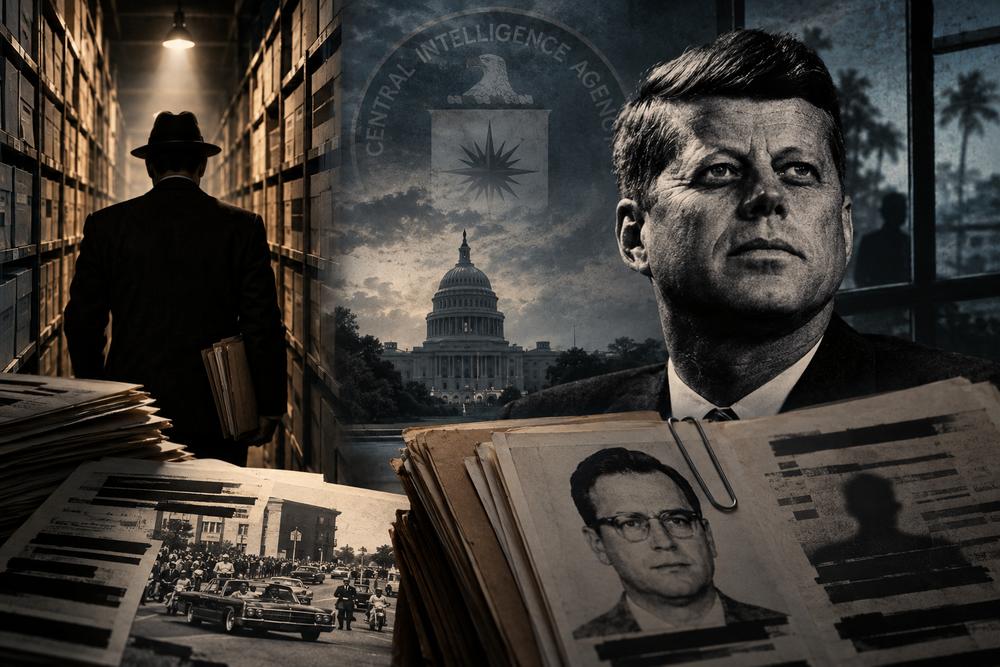
After the assassination of John F. Kennedy, public doubt began to surface around the Warren Report. Not fringe doubt. Institutional doubt. Journalists, legal scholars, and former officials questioned inconsistencies that could not be reconciled.
The response was not to debate them.
It was to rename them.
In 1967, the CIA circulated an internal memo advising media and institutions to frame critics of the official narrative as “conspiracy theorists.” A neutral term describing secret coordination was deliberately repurposed to signal irrationality, paranoia, and social deviance.
The tactic worked.
By the 1970s, the phrase carried stigma.
By the 1980s, it carried dismissal.
By the 1990s, it carried social risk.
Raising contradictions no longer invited inquiry. It invited isolation.
This was not censorship.
It was reclassification.
“The evidence was not disproven. It was disqualified.”
“Once doubt is reclassified as pathology, it no longer needs an answer.”
9/11 and the Removal of the Questioner
By 2001, the weapon was refined.
The anomalies of that day were glaring. WTC 7 collapsed symmetrically into its footprint despite not being struck by an aircraft. The Pentagon displayed damage inconsistent with the claimed impact profile. Eyewitnesses described explosions. Financial instruments indicated foreknowledge. Physical evidence was removed at unprecedented speed.
These facts were not secret.
What disappeared was the legitimacy of the person asking about them.
To question was no longer to investigate.
It was to reveal something undesirable about yourself.
I did not notice this immediately.
For a long time, I assumed silence was caution. That restraint was responsibility. That not asking certain questions meant being mature, reasonable, grown.
It took years to realize what had actually happened.
The system did not silence questions.
It silenced questioners.
“From that moment on, asking the wrong question did not make you wrong.
It made you irrelevant.”
That is how silence functions in modern power. It does not ban speech. It removes standing.
The Architecture of Forgetting
Silence does not end with the present. It restructures memory.
Commissions omit testimonies. Media repeats dismissive frames until skepticism sounds childish. Archives become inaccessible through bureaucracy rather than force. Algorithms demote what does not align.
Nothing is destroyed.
It is entombed.
Over time, anomalies shrink into footnotes. Contradictions become trivia. What once demanded investigation begins to feel embarrassing to recall.
Forgetting is not decay.
Forgetting is construction.
“The elite do not fear evidence. They fear memory that cannot be managed.”
This is why silence is more effective than censorship. It leaves the illusion of openness intact while quietly reorganizing relevance.
The Script Repeats
“Silence does not follow power.
It prepares the ground for it.”
The silence surrounding 9/11 was not an exception. It was a template.
In Iraq, weapons of mass destruction were invoked as certainty. When they failed to appear, the silence absorbed the contradiction. The war continued. Contracts were signed. Accountability dissolved.
In Libya, humanitarian intervention fractured a state. Markets for arms and humans followed. The silence settled over the aftermath, not the intervention itself.
In Afghanistan, silence stretched across two decades. When collapse finally arrived, the questions that might have prevented it were remembered only to remind dissenters that they had once been labeled unpatriotic.
Each time, the pattern held.
Anomalies surfaced.
Ridicule followed.
Consent was assumed.
Silence sealed the process.
History did not repeat itself.
The exclusion of the public did.
Silence and the End of Consent
Consent did not disappear.
It was rendered unnecessary.
This is where the mechanism reveals its true function.
Silence does not merely hide truth. It replaces consent.
Decisions of war, finance, surveillance, and risk no longer require agreement if dissent can be neutralized socially rather than legally. Democracies continue to function procedurally while participation erodes substantively.
You are allowed to vote.
You are not invited to decide.
The removal is subtle. No announcement. No rupture. No visible coup. Just a narrowing of what may be asked without consequence.
And eventually, people stop asking.
Not because they are convinced.
But because they have learned the cost.
“Silence does not protect truth.
Silence protects power.”
Closing Reflection
What begins as ridicule becomes stigma.
What becomes stigma fades into forgetting.
And what is forgotten becomes permission.
Silence does not arrive all at once. It accumulates. It settles. It teaches people what is no longer worth asking.
Not because the questions disappeared.
But because those who asked them did.
The issue is not what was hidden.
The issue is when you stopped being consulted.
This chapter is part of the Manifest, a longform counter-archive examining how language, procedure, and silence are used to disable public agency while preserving the appearance of freedom. The details change. The choreography does not.
Related from The Manifest Archive