On the night of December 10, 1971, in a basketball arena in Ann Arbor, Michigan, fifteen thousand people waited past midnight to hear a Beatle sing a protest song. The rally was for John Sinclair, a local activist serving ten years for handing two joints to an undercover officer, and John Lennon had flown in to perform a handful of new songs, one of them written for Sinclair by name. The song was crude and direct and it asked, simply, for the man to be let go. Three days later, Sinclair walked free, released on the wave of pressure the rally had helped raise, months before the state's high court would formally strike down the marijuana law that had jailed him.
In the crowd that night were people taking notes for the government. FBI informants and sources sat among the students and the activists and reported what they saw, and the Bureau's file preserved the lyrics, the actual words of the songs, so they could be filed and assessed. This is not a rumor or an inference. It is in the documents the government was later forced to release. A democratic state had sent agents to a concert to transcribe a musician's lyrics, because it had concluded that the lyrics were a problem.
Consider what that rally had just demonstrated. A man had sung a song about a prisoner, and within three days the prisoner walked free. The legal reasoning was its own, the timing perhaps partly coincidence, but the lesson for anyone watching was unmistakable: this performer could focus the attention of fifteen thousand people, and then a nation, on a single cause, and things moved. A guitar had done in a weekend what years of petitions had not. To the activists it was a triumph. To the men taking notes, it was a demonstration of a capability, and capabilities, unlike opinions, get filed.
That is the real and documented beginning of the story usually told as a murder mystery, and it is more disturbing than any mystery, because nothing in it is hidden. The United States government decided, in writing, that John Lennon was a political threat, and set out, through entirely visible legal and bureaucratic means, to neutralize him. He was not silenced by a bullet, whatever the theories say. He was silenced twice over, in ways that are fully on the record: first by a state that tried for years to remove him, and then, after his death, by a culture that kept his melody and buried his meaning. This is the story of both silencings, and of why a man with a guitar frightened a government at all.
The unowned voice
To see why Lennon was treated as a threat, you have to set aside the gentle icon and recover the specific danger he posed in 1971 and 1972. He was, by then, among the most famous human beings alive, and he had turned that fame fully toward the antiwar movement at the exact moment the movement was cresting and the Vietnam War was at its most unpopular. He was not a politician with a constituency that could be bargained with, not a party leader who could be defeated at a convention, not an American who could be told to love his country or leave it. He was a foreigner with a global audience, no party, and no master, who could fill an arena faster than any candidate and who had decided to use that power against a sitting president.
That combination is what made him, in the precise sense this archive keeps returning to, dangerous: an unowned unifier. His reach belonged to no one. No campaign could deliver it, no donor could fund or defund it, no rival could discredit him as the other side's man, because he was not on a side in the ordinary sense. He spoke over the heads of all the normal brokers of political power, directly to millions of young people, in a language the brokers could not control. A leader people merely agree with can be answered. A figure people trust more than they trust the institutions, who can move them by the hundred thousand without permission, is a different kind of problem, and governments built on the management of opposition do not know how to process him. They tend, instead, to try to remove him.
The man who spent his fame
To understand the threat, you have to watch how deliberately he built it. Lennon did not drift into politics; he converted the largest cultural platform on earth into a political instrument, step by step, in public. The first sign came in 1966, when he remarked in an interview that the Beatles had become more popular than Jesus. In Britain it passed almost unnoticed. Reprinted in the United States that summer, it detonated: records burned, radio bans, threats across the American South. The episode taught him something that would shape the rest of his life. His fame was not merely commercial. It was a form of power large enough to frighten institutions, and it could be pointed.
By 1969 he was pointing it. With Yoko Ono he staged the bed-ins for peace, week-long media events in hotel rooms in Amsterdam and Montreal, inviting the world's press to a bedroom to talk about ending the war, turning celebrity itself into an antiwar broadcast. In a Montreal hotel room in June 1969 he recorded Give Peace a Chance with a roomful of guests singing along, and it became the chant of the movement, sung by half a million people at the Vietnam Moratorium in Washington that November. Think about what that means as a demonstration of power. A man had written a chant in a hotel bed, and months later half a million people were singing it at the seat of American government, against the policy of that government. No politician in the country could summon that. He had built, out of nothing but melody and fame, a direct line to the largest crowd in the capital, and he had aimed it. Later that month he returned his MBE, the honor the British state had given him, to the Queen, in protest at British and American policy. He was handing back the establishment's embrace in public.
Then, in August 1971, he moved to New York and went all the way in. He fell in with the American radical left, with figures like Jerry Rubin and Abbie Hoffman, and began to speak of using his concerts not just to protest but to organize. This is the figure the government encountered: not a pop star with vague good intentions, but the most famous man in the world, living on American soil, deliberately spending his fame against the American state at the height of an unpopular war. He had spent fifteen years learning exactly how much power his voice held. In 1971 he decided to use all of it, and the government was paying attention.
The memo
The fear was not vague, and it was not imagined by his admirers. It was written down at the highest level. In early 1972 a memorandum reached the Nixon White House, authored within the orbit of Senator Strom Thurmond, warning that Lennon was planning to combine rock concerts with voter registration, to tour the country and turn his audiences into a bloc of young voters mobilized against Nixon's re-election. The timing made the warning urgent. The voting age had just been lowered to eighteen by constitutional amendment, enfranchising millions of young Americans for the first time, precisely the demographic that filled Lennon's concerts and opposed the war. The memo's logic was simple: a man who could draw fifteen thousand to an arena in Ann Arbor could, if he chose, register and move enough new voters to matter in a close election, and he should be dealt with before he could.
The fear had a concrete shape, because Lennon had been discussing a concrete plan. Rubin's idea was for Lennon to headline a national concert tour timed to the 1972 election season, a travelling combination of rock show, voter-registration drive, and antiwar rally that would move from city to city as the campaign did, with talk of converging on the Republican National Convention. To an administration facing a newly enfranchised youth electorate, a touring stadium act registering young voters against it was not a cultural event but an organized political operation led by someone it could not control. That the tour never happened, that Lennon ultimately balked at returning to the road and then was tied up in his immigration case, does not soften the point. The plan was real enough to be feared, and the fear was acted upon.
This is the document that turns the whole story from interpretation into record. The motive usually treated as a conspiracy theory, that the government wanted Lennon gone for political reasons, is not a theory at all. It is in a memo. The administration was told, in writing, that a foreign musician posed an electoral threat, and it acted on that warning. What followed was not a plot in the shadows. It was a deportation case in open court, and that is exactly what made it effective.
Why Nixon tried to deport John Lennon
The instrument the government reached for was immigration law, and the pretext was a small one. In 1968, in London, Lennon had pleaded guilty to possession of cannabis, a misdemeanor. Years later, an ocean away, that minor conviction became the legal basis for the United States to declare him an undesirable alien and begin proceedings to deport him. In March 1972 his visa was not renewed and he was ordered to leave the country. He fought it, and the fight consumed years of his life.
The genius of the method, like the methods described elsewhere in this archive, was that it never had to admit what it was. There was no order that said: remove this man because he opposes the president. There was only a routine immigration matter, a foreigner with a drug conviction, handled by the book. But the book was being applied to him with a thoroughness reserved for almost no one, and the effect was precisely what the memo had recommended. While the case dragged on, Lennon lived in limbo. He could be deported at any time. He curtailed his political activity, knowing it was being watched and could be used against him. The grand voter-registration tour never happened. The threat described in the memo was neutralized, not by silencing the man directly, which would have created a martyr, but by entangling him so completely in his own precarious status that he silenced himself. For four years his life ran on the rhythm of the case: the hearings, the appeals, the deportation order renewed and contested and renewed again, the lawyers, the press conferences on the courthouse steps. He carried the standing possibility of expulsion at the end of any session. He could not be sure he could leave the country and return. He could not plan a tour around a future he did not hold, and he had to weigh every public word against a courtroom that held his residence in its hands. He and Ono were trying to start a family under the low constant hum of a government that wanted him gone. The uncertainty itself was the punishment, and it worked in a way a clean ban never could have, because a ban makes a victim and a cause, while an endless case makes only a tired man managing his own precarity, too busy defending his right to stay to do the thing he had been about to do.
He finally won, and received his green card, in 1976, four years later, by which point the election the memo had worried about was long over and the movement he might have mobilized had dispersed. The deportation case did not need to succeed. It only needed to last, and it lasted exactly long enough.
The FBI files on John Lennon
For decades, the natural objection to all this was that it could not be proven, that it was the resentful imagining of fans who could not accept a senseless death. That objection no longer holds, and the reason it no longer holds is itself part of the story. A historian named Jon Wiener spent fourteen years suing the federal government under the Freedom of Information Act to force the release of the FBI's files on Lennon. The government took the fight as far as the Supreme Court, which declined to hear its appeal in 1992. The Bureau resisted for years on national-security grounds, fighting to keep secret its surveillance of a dead musician, and only settled in 1997, releasing nearly all the pages it had withheld and paying the plaintiff's legal costs. The last ten documents came out in 2006.
What the files showed was a sustained surveillance operation: the tracking of Lennon's movements and associations, the monitoring of his political ties, the FBI informants at the rallies, the lyrics transcribed and filed. The state had watched a singer the way it watched suspected subversives, because in its own classification that is what he was. The significance of the FOIA fight is not only what it revealed but what the resistance to revealing it confirmed. A government does not spend fourteen years and an appeal to the Supreme Court fighting to keep secret the surveillance of a man who was merely a celebrity. It fights that hard to keep secret something it understands to be incriminating. The files are the documentary spine of this entire account, and they exist because one person refused, for fourteen years, to accept that they should stay sealed.
It is worth situating those files in their moment, because Lennon was not a special case so much as a famous one. The same Bureau, under the same director, had until April 1971 been running its domestic counter-intelligence program against American political movements, infiltrating, discrediting, and disrupting civil-rights, Black-liberation, and antiwar groups, treating organization itself as the threat. The program was formally closed months before Lennon arrived. The mindset that built it was not. Lennon's file was one entry in a vast apparatus that had already decided dissent was a security matter. What made his case unusual was not that he was watched, which thousands were, but that the subject was a global celebrity whose every move was also public, so that the surveillance of him eventually became provable in a way most of that apparatus never did. He is the rare window through which the ordinary machinery of the era can be seen clearly, because he was too famous to disappear and someone fought long enough to open the file.
The night at the Dakota
On the night of December 8, 1980, John Lennon was shot and killed outside the Dakota, his apartment building in New York, by a man named Mark David Chapman, who had waited for him at the entrance and had, hours earlier, obtained Lennon's autograph. Chapman fired several times, made no attempt to flee, and stood reading a paperback novel until the police arrived. He pleaded guilty. He remains in prison.
This is the point at which the documented account and the conspiracy theories sharply part, and where this essay parts from the version of Lennon's story that has circulated for years, because honesty requires it. There is a large and durable body of speculation that the murder was arranged, that Chapman was a programmed assassin, that the state finished what the deportation case began. It is essential to be clear: there is no reliable evidence for any of this. The documented record describes a troubled, obsessive man with a personal and widely attested set of grievances, enraged by Lennon's wealth, by the atheism of songs like God, by the line about being more popular than Jesus, who killed a famous man to make himself significant. To assert, without evidence, that the government pulled the trigger is to commit exactly the error this archive exists to avoid, and worse, it is unnecessary, because the documented story is already damning and does not depend on the murder at all.
That is the crucial move, and it deserves to be stated plainly. The argument here does not need Lennon to have been assassinated by the state, and it does not claim he was. The state's documented campaign against him, the memo, the surveillance, the deportation, was waged while he was alive and is complete in itself. The murder, by the evidence we have, was a separate American horror, the lone act of a disturbed man with a handgun, which says more about a country awash in guns and parasocial obsession than about any agency. Conflating the two, folding a documented surveillance campaign and an unrelated murder into a single plot, is the temptation, and it is the thing that has kept the real story from being taken seriously. The real story is worse precisely because it required no conspiracy.
What they did to the song
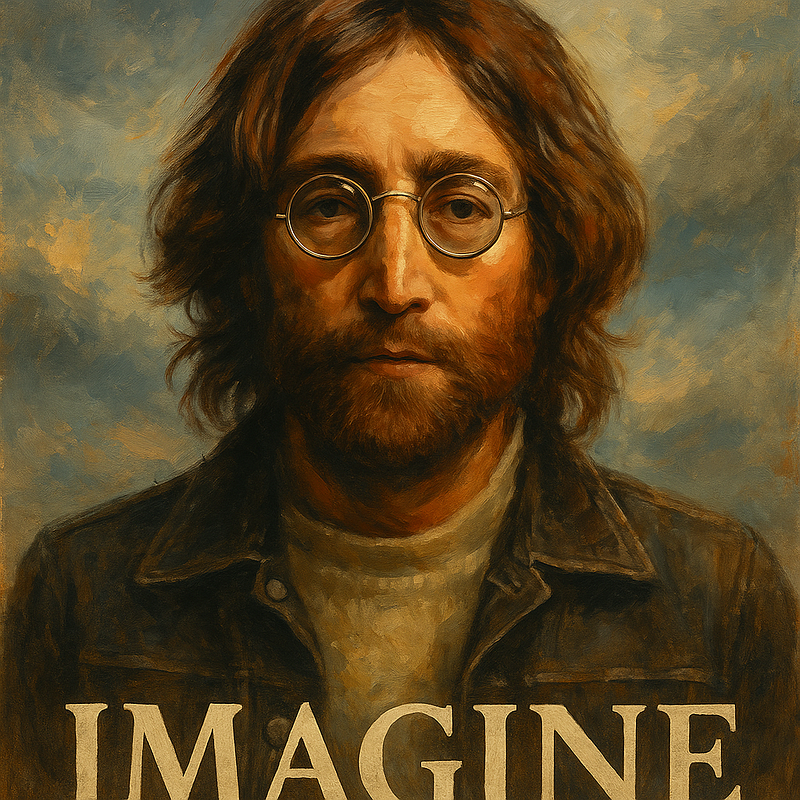
The second silencing needed no gun at all, and it is the one that succeeded most completely. While he lived, Lennon's signature anthem was genuinely radical. Imagine asks the listener to picture a world with no countries, no religion, and no possessions, the dismantling of the nation, the church, and private property in three gentle verses. Lennon said plainly that it was an anti-religious, anti-nationalist, anti-capitalist song, a manifesto sweetened almost into a hymn so that it could be swallowed. Sung in 1971, against that war and that president, it was an attack on the foundations.
Lennon knew exactly what he had done, and said so. Asked about the song, he described it as anti-religious, anti-nationalistic, anti-conventional, and anti-capitalistic, and explained that it was accepted only because it was sugarcoated. Put your political message across, he said, with a little honey. He had deliberately wrapped a manifesto in a melody so disarming that people would carry it past their own defenses, the radical content smuggled in under a tune. It was a brilliant act of delivery, and it carried the seed of its own undoing, because a message that travels on its sweetness can, once its author is gone, be received as nothing but sweetness. The honey can be kept and the message left to dissolve in it.
The preference for a gentler Lennon did not even wait for his death; the market signaled it while he lived. In 1972, at the height of his radical phase, he released an overtly political album, full of songs about prisons, Northern Ireland, feminism, and the issues of the day, and it was a commercial disappointment, received coldly next to the universal warmth of his less confrontational work. The lesson the industry drew was the one it always draws: the political Lennon did not sell, and the tender one did. The curation that would define his afterlife was already underway in his lifetime, expressed as sales figures rather than as suppression.
After his death, that preference hardened into permanence. The song was kept and its meaning was quietly removed. Imagine became one of the most performed anthems on earth, played at Olympic opening ceremonies, sung to the crowd in Times Square as the new year turns, performed at official commemorations and state occasions, licensed for advertisements, sung by choirs and pop stars and quoted by the very institutions, governments, churches, corporations, whose dissolution it had called for. The line imagine no possessions is now sung by the wealthy to vast audiences and used to sell things, and the song about owning nothing became one of the most valuable musical properties on earth, a possession of immense worth built on a lyric against possession. The radical content did not provoke a backlash; it simply evaporated, leaving a melody warm enough to mean nothing in particular. The irony is total and almost no one feels it anymore, which is the surest sign the defanging is complete: when a contradiction this sharp can be sung by millions without a flicker of discomfort, the meaning is well and truly gone. The state that had once filed his lyrics as evidence now had no need to ban the song. The culture had defanged it more thoroughly than any censor could, by keeping every note and discarding every demand.
This is the same instrument seen across these cases, at its gentler setting. While Lennon lived and the message was active, the state reached for the documented tools of removal. After he died and could no longer renew the meaning, the market completed the work by preservation, turning the most subversive popular song of its era into ceremonial background music. What power could not deport, it learned to play at its own ceremonies. The man was made into a saint, the manifesto into a refrain, and the safest possible version of John Lennon, the gentle dreamer with no politics, became the only one most of the world would ever meet.
The cost of the years
The deportation case did its damage even though Lennon won it, and the damage is measurable in what he stopped doing. The most politically active artist of his generation, at the peak of his reach, spent the years of the case watched, constrained, and unable to plan, and when it ended he did not return to the barricades. In 1975, around the birth of his son Sean, he withdrew from music and public life almost entirely, taking the role he called house husband, raising the child, baking bread, walking in Central Park, recording nothing for release for half a decade. It is usually told as a tender personal choice, and in part it was. But it is impossible to separate it cleanly from what had come before, from more than three years of living under threat of removal, of knowing every association was logged, of watching his anthem turn into the establishment's lullaby in real time. The man who had handed his fame to a movement spent the back half of the 1970s in domestic retreat.
He was only beginning to re-emerge when he was killed. In 1980 he returned to the studio and released new music, his first in years, and gave a round of interviews in which the old engagement flickered back. Whatever he might have become in a second active phase, an older, freer Lennon with nothing left to prove and no case hanging over him, the world never found out. The point is not to assign blame for the murder, which the evidence assigns elsewhere. It is that the documented campaign had already cost him, and the movement that might have used him, years that do not come back. Neutralization does not require a killing. It requires only that the dangerous figure be made to spend his most dangerous years on defense.
The pattern, not the exception
Lennon is not a singular case but a clear one, and the same structural position recurs around figures who become unifying voices a system cannot own. A Jamaican musician is shot two days before a concert meant to be non-partisan and then, after his death, repackaged into a brand of relaxation. A civil-rights leader is surveilled and harassed by the same Bureau and, after his murder, sanded into a safe national holiday. The fates differ and the causes differ, and it would be an error to flatten them into one plot. What recurs is the position. The one who can move millions without permission, who belongs to no faction and can be claimed by none, occupies dangerous ground, and meets some version of the same two-part instrument: the documented pressure while living, the commodification after. Lennon's case is unusually well documented because of one man's fourteen-year lawsuit, but the shape is general, and once it is seen in one life it becomes legible in others.
The variable was reach, not message
Strip the case to its mechanism and the determining variable comes into focus, and it is not the content of Lennon's politics. Plenty of people held the same antiwar, anti-establishment views and were left entirely alone. What singled him out was reach, specifically a kind of reach the system could not route through its usual controls: the ability to move millions of people directly, instantly, and without any intermediary it could pressure. A newspaper has an owner. A party has donors. A broadcaster has a license. Each is a channel through which influence can be checked. Lennon's influence ran through none of them. It ran from a stage or a record straight into the minds of an audience larger than most nations, and it answered to no editor, board, or party that the state could lean on.
That is the portable law under the Lennon case, and it explains the otherwise strange intensity of the government's response to a musician. Power organized around the management of opinion can tolerate almost any message, however radical, so long as it flows through a channel that power can ultimately reach. What it cannot tolerate is an unowned channel of mass influence, a person who can move the public directly and whom no one can instruct, because such a channel is the one variable in the system that sits outside the system's control. The threat is never simply what the figure believes. It is that he can broadcast it, at scale, through a pipe no one owns. Find the unowned channel of mass trust, and you have found what every power built on managed opinion most needs to capture, deport, or, failing both, drown in honey.
The honest objection
The strongest case against this reading deserves full statement. It is that the pieces do not connect the way a tidy narrative wants them to. The deportation case, on this view, was a genuine if cynical legal proceeding, not unique to Lennon in an era when the government leaned on immigration law for political ends, and he won it. The surveillance was real but produced no action beyond paperwork; the FBI watched many people and did nothing. The murder was the act of one disturbed individual with a documented personal pathology and no connection to any of it. And the commodification of Imagine is simply what happens to every enormous hit, from Beethoven to the Beatles, with no need for a theory of containment. On this account, the essay strings together a legal case, a surveillance file, a random murder, and ordinary music-business afterlife, and implies a coherence among them that the facts do not support.
That objection is largely right about the particulars, and conceding it sharpens rather than weakens the claim, because the claim has been kept deliberately narrow. It is not asserted that one hand directed all of this; it is asserted, and documented, that the state identified an unowned unifier as a political threat and used the tools available to it, surveillance and immigration law, to neutralize that threat while he lived, and that the culture afterward preserved his image while discarding his message. Each link is independently documented: the memo exists, the files exist, the deportation case is a matter of public record, the defanging of the song is audible at every ceremony that plays it. The murder is explicitly excluded from the chain, because the evidence excludes it. What remains, without any conspiracy at all, is a clear instance of how a system handles a voice it cannot own: not usually with a bullet, which it does not need and which makes martyrs, but with the patient, legal, deniable machinery of removal, and, failing that, with the gentler erasure of being remembered beautifully and incorrectly.
What he actually was
Strip away both the murder mystery and the saint, and the figure that remains is more interesting than either. John Lennon was a man who understood, earlier and more clearly than most artists ever do, that his fame was a form of power, and who chose to spend it rather than protect it. He pointed it at a war and a president, and the government of the most powerful country on earth took him seriously enough to put him under surveillance and try for four years to throw him out. That is not the biography of a gentle dreamer. It is the biography of someone a state regarded as a genuine political force, and treated accordingly.
The lesson of his case is the one this archive keeps finding under different names. Power built on the management of opinion is not most threatened by opponents, who can be managed, but by the rare figure who can dissolve the boundaries it depends on and move people directly, owned by no one. Such a figure will be answered, and the answer is rarely the dramatic one. It is the immigration file, the sealed surveillance record, and, when the man is finally gone, the careful curation of his memory into something that can be sung at the ceremonies of the institutions he opposed.
There is a final symmetry worth naming. Lennon understood that a hard message travels best when it is sugarcoated, that you slip the manifesto past the listener's defenses inside a melody sweet enough to be welcomed. He was right, and it was the source of his power. But the same property that let the message in alive let the meaning leak out once he was dead. A song carried on its sweetness can be received, in the end, as only sweetness, the honey remembered and the medicine forgotten. The very technique that made him dangerous became the mechanism of his defanging. He weaponized comfort to deliver a threat, and after he was gone the world simply kept the comfort and discarded the threat, which is perhaps the most fitting and most quietly devastating thing that could have happened to him.
They kept the song. They returned the rest to the archive, marked subversive, and waited for the world to forget that imagine was ever an instruction rather than a comfort. It worked. Most people who can sing every word have never been told it was a demand.
But the mechanism did not retire with him, and that is the question worth carrying out of the Dakota. The real question is no longer what happened to John Lennon in 1971 or in 1980. It is who occupies his position now. The lesson of his case was that the dangerous thing is not the message but the unowned channel, the ability to reach millions directly through a pipe no institution controls, and that channel has only multiplied since. It now belongs not to one Beatle with a record contract but to anyone with a large enough direct audience and no owner sitting above it, the independent broadcasters and platforms and feeds that route around the old gatekeepers exactly as a stadium once did. The form is new and the structural fact is ancient: power built on managed opinion still cannot abide a voice it does not own, and it still reaches, when it can, for the patient and deniable tools, the investigation, the legal entanglement, the slow attrition, and, when the figure is finally safe, the warm and respectful burial. Lennon's file is closed. The position he occupied is filled, many times over, and the men who once wrote down lyrics in an arena would recognize the problem instantly. They would only need to learn the new names.
Evidence Map
Facts, interpretations, forecasts, and disconfirming signals.
Core claim. The United States government identified John Lennon as a political threat, an unowned unifier capable of mobilizing newly enfranchised young voters against Nixon in 1972, and used documented, legal means, FBI surveillance and a deportation case built on a minor 1968 cannabis conviction, to neutralize him while he was alive; after his murder, the culture completed a second silencing by preserving his anthem Imagine while stripping it of its radical meaning. The determining variable is unowned reach the system could not control, and the mechanism operates without any claim that the state was involved in his death.
Evidence level. Facts (high): the December 1971 John Sinclair Freedom Rally in Ann Arbor with FBI informants present, with the lyrics recorded in the file; the circa-1972 Thurmond memo to the Nixon White House warning of Lennon's voter-mobilization plan; the 1972 deportation order based on the 1968 London cannabis conviction and the years-long case ending in his 1976 green card; the FBI surveillance files, forced into the open by Jon Wiener's fourteen-year FOIA lawsuit and a late-1990s settlement; the December 8, 1980 murder by Mark David Chapman, a lone gunman who pleaded guilty, with a documented personal motive; the posthumous ubiquity of Imagine at official and ceremonial occasions. Interpretation (marked): reading the surveillance and deportation as one coherent neutralization, and the commodification as a second silencing, is analytical interpretation grounded in those facts. Excluded as unsupported (marked): claims that the state arranged or directed the murder; the documented evidence describes a lone perpetrator and is treated as such here.
What would confirm this. Further released documents detailing the political rationale for the surveillance and deportation; the continued ceremonial use of Imagine drained of its stated content.
What would disprove this. Evidence that the deportation case was routine and unconnected to Lennon's politics; evidence that the surveillance was incidental rather than targeted; an account in which Imagine's afterlife reflects only ordinary popularity with no loss of its original meaning.
Watchlist. Any further FBI or INS records released on the case; scholarship building on the Wiener files.
Jerry van der Laan writes The Manifest Archive, where he examines power, culture, and institutions. He traces the structures beneath them.
Correction, 12 October 2026: this piece has been corrected. Jon Wiener's lawsuit never reached the Supreme Court as a case: the Court declined the government's appeal in 1992, the FBI settled in 1997, and the last documents were released in 2006. COINTELPRO was formally closed in April 1971, before Lennon moved to New York. The rally reports in the FBI file came from informants and sources, not agents shown to be in the arena. The deportation threat lasted more than three years, not five, and the Smile Jamaica concert is now described as meant to be non-partisan. The corrections log is at themanifestarchive.com/standards.