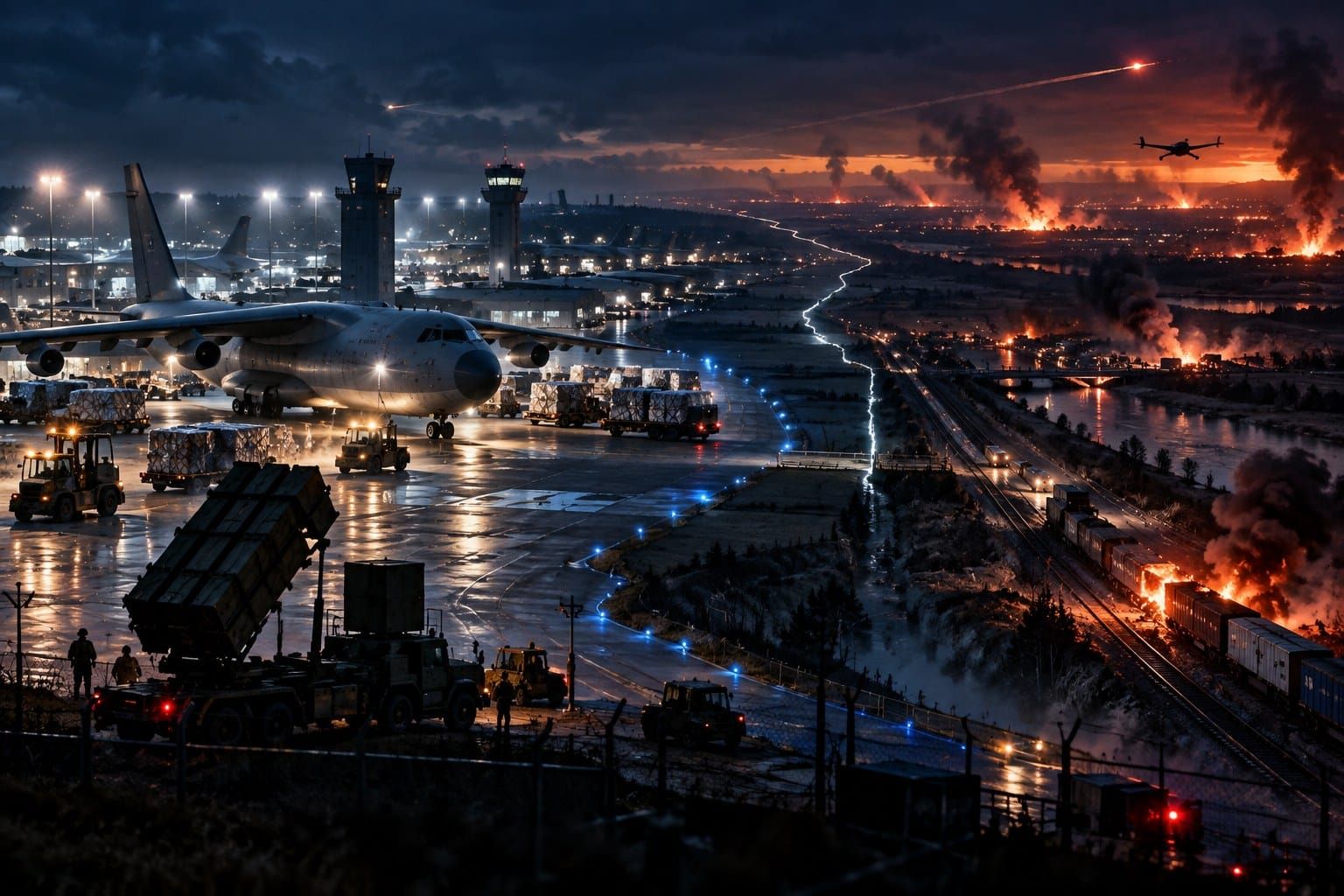
Before the war, Michał Tabisz helped run a regional airport. Rzeszów-Jasionka, in the south-eastern corner of Poland, handled about 730,000 passengers a year and the occasional cargo flight. By the autumn of 2023, its vice president was describing a different place. Up to twenty fuel trucks arrived every day, carrying some 175,000 gallons. A single wide-body cargo jet now burned the fuel that once covered a whole week of passenger flights. Roughly 3,500 wide-body aircraft had landed since February 2022. "This is a place where we never expected to host 250 government delegations per year," Tabisz told a visiting reporter. At the edge of the field stood Patriot batteries crewed by Americans. In January 2025, German crews took over the job, and in December 2025 Dutch crews took it over from them.
Ukraine is about fifty miles to the east. According to Defense One's reporting, around 80 percent of allied military aid to Ukraine has moved through Poland, and much of it has passed across this one runway.
Russia has missiles that can reach it. In more than four and a half years of war, it has not deliberately fired one.
That absence usually gets folded into one of two arguments. In one, the West arms Ukraine, trains its soldiers and lets it strike deep inside Russia, and Moscow, for all its threats, does nothing. In the other, the West keeps pushing and one day the answer will come all at once. Both treat Russian retaliation as a switch, off today and perhaps on tomorrow.
The record of the past four years does not fit that picture. Over the same period in which Rzeszów stayed untouched, a warehouse full of Ukraine-bound Starlink equipment burned in east London in a Wagner-directed operation that prosecutors tied to a foreign state, explosive-laden drones fell beside a Ukrainian cargo plane at Leipzig/Halle airport, and Russian drones struck a fuel station and a passenger locomotive a couple of kilometres from the Polish border. Something is being answered. It is being answered somewhere else, and in a different form.
This piece asks a narrow question: if the absence of a Russian strike on Rzeszów is not proof that Moscow accepts the West's role, what is it a measurement of?
Rzeszów, fifty miles from the border
A modern war runs on flow: shells, interceptors, fuel, satellite terminals, vehicles, medical supplies. Ukraine builds a growing share of its own drones and some of its own missiles, but for artillery ammunition, air defence and many heavier systems it has depended on deliveries from abroad, and most of those cross a handful of Polish entry points: the airfield at Jasionka, the rail and road crossings at Medyka, Dorohusk and a few others, and the logistics hubs behind them.
In the language of military planning, that makes the Rzeszów area a critical node in the supply network. One successful strike on the fuel farm or the apron would not end Western support, but it would cost weeks of throughput. By the logic of war alone, this is exactly the kind of target a belligerent wants to hit. Russia has spent the war striking Ukrainian rail junctions, power substations and fuel depots, because it understands exactly what logistics are worth.
And yet the pattern is consistent. Russian missiles and drones have struck Lviv, less than a hundred kilometres from the Polish border. They have struck targets in Volyn and along the Danube within sight of NATO territory. They have not struck the node on the other side of the line.
The simplest explanation is not a Russian decision about Rzeszów at all. It is the line itself. The airport is in Poland, Poland is a member of NATO, and an armed attack on a member state is the event that Article 5 of the North Atlantic Treaty was written for. The treaty does not prescribe the answer; each ally decides what action it deems necessary. But it makes such an attack the moment the alliance as a whole must respond. Whatever else Moscow calculates, it calculates that one.
I do not know whether anyone in the Kremlin ever wrote down a rule that says the hub is off limits, and I would be suspicious of anyone who claimed to. What can be observed is the behaviour. Across more than four years, through every escalation of Western supply, Russian fire has approached the edge of NATO territory and stopped there, apart from stray drones and brief incursions that Moscow has never acknowledged as attacks. The absence at Rzeszów looks less like an accident of targeting than like the shape of a threshold, visible in the negative.
The most important target in the Western supply chain is defended less by its Patriots than by the treaty line it sits behind.
Hanoi, 1965, and Jalalabad, 1986: the rule nobody signed
The logic that keeps Rzeszów intact is older than NATO's eastern enlargement, and far older than this war. It was worked out, without anyone formally agreeing to it, in the proxy wars of the Cold War.
On 24 July 1965, a Soviet-built SA-2 surface-to-air missile brought down an American F-4C over North Vietnam, the first American aircraft lost to that weapon. Soviet specialists trained the crews and, in the early months, manned sites themselves. Over the following years, Soviet-supplied air defences destroyed hundreds of American aircraft. The United States knew where the missiles came from. It bombed the launch sites in Vietnam. It never struck the Soviet factories that built the missiles, the ports that shipped them, or the Soviet Union itself.
Twenty-one years later the roles reversed. On 25 September 1986, near Jalalabad airfield in eastern Afghanistan, mujahideen fighters fired American-made Stinger missiles at a flight of Soviet Mi-24 helicopters and, by the mujahideen's account, brought three of them down. The Stinger programme, run through Pakistan with CIA funding, went on to cost the Soviet air force heavily over the remaining years of the occupation. Moscow knew where the missiles came from, too. It did not strike the United States. Against Pakistan, the conduit, it answered in deniable form: thousands of cross-border air violations and a bombing campaign in Pakistani cities attributed to the Afghan secret police, KHAD, which in 1987 alone killed hundreds. It never waged open war on the state that hosted the pipeline.
Neither superpower accepted these losses out of indifference; both accepted them because the alternative was a direct war between nuclear powers. The arrangement was never negotiated, never written down, never announced. It was observed, in thousands of individual decisions, by governments that agreed on almost nothing else.
The rule, reduced to its core, was this. A great power may arm the enemies of another great power. It may not fire on the other power directly. And the other power, in exchange for that restraint, absorbs the losses the weapons inflict and answers them where the proxy war is being fought, or deniably along its supply lines.
Seen against that record, the current war looks like the same rule operating again, under the strain of a much closer border and much larger volumes.
The Korean sky and the value of not knowing
The most revealing case is the one that stayed hidden longest.
From late 1950 until the armistice, Soviet fighter pilots of the 64th Fighter Aviation Corps flew MiG-15s against American aircraft over northern Korea. They wore Chinese or North Korean markings, were ordered to speak Korean over the radio and were forbidden to fly over the sea or near the front lines where they might be shot down and captured. Hundreds of air battles took place between the two superpowers' pilots. For decades, neither government acknowledged it.
The political scientist Austin Carson, drawing on documents that became available after 1991, found something more interesting than Soviet concealment. The Americans knew. Washington chose not to publicise it. As Carson puts it, major powers "individually and collectively conceal evidence of foreign involvement when the danger of unintended conflict escalation is acute." Secrecy created what he calls a "backstage," a space in which adversaries "can exceed limits on war without stimulating hard-to-resist pressure to escalate further." The result, in his phrase, is "tacit collusion": two powers competing hard for advantage while cooperating quietly on one thing, which is keeping the competition from becoming a war neither wants.
Carson borrowed the backstage from the sociologist Erving Goffman. In Korea, the front stage was the official story of a war between the United Nations and two Asian communist states. The backstage was a shooting war between American and Soviet pilots. What held the arrangement together was not ignorance but shared, deliberate silence.
Carson's finding matters here because it inverts the usual intuition about deniability. We tend to think of deniability as something the attacker uses to fool the victim. In Korea it was something both sides used to protect themselves from their own publics, their own hawks and their own declared commitments. The victim of the covert act was often the most careful guardian of the cover story.
Hold that thought. It returns later, in a very different place.
Bucharest, April 2008: a promise without a guarantee
The ceiling this article describes did not appear in February 2022. Treating the full-scale invasion as the starting point hides the most useful thing about the line, which is how long both sides have been practising it.
In May 1997, the NATO-Russia Founding Act recorded that the alliance had "no intention, no plan and no reason" to station nuclear weapons on the territory of new members, and that in the security environment of the time it would not permanently station substantial combat forces there either. Enlargement went ahead, and so did a set of self-imposed limits on what enlargement would look like on the ground. On 3 April 2008, at the summit in Bucharest, the allies wrote into their declaration that Ukraine and Georgia "will become members of NATO," and in the same meeting declined to give either country a Membership Action Plan. The result was an unusual status: a stated future membership without the protection of actual membership. Four months later Russia and Georgia were at war, and NATO did not fight.
In 2014 the pattern repeated at larger scale. Russia annexed Crimea in March; armed conflict in the Donbas followed from April, with Russian involvement that Moscow denied. The Western answer was sanctions and diplomacy, and the Minsk agreements of September 2014 and February 2015 tried to hold the war inside a negotiating framework. Washington did not approve the sale of Javelin anti-tank missiles to Kyiv until March 2018. Even after the invasion of February 2022, the first weeks produced two telling refusals: NATO rejected calls for a no-fly zone over Ukraine, and in March the Pentagon turned down a Polish plan to hand its MiG-29s to the United States at Ramstein for delivery to Ukraine, saying the prospect of jets leaving a NATO base for contested airspace raised serious concerns for the entire alliance.
None of this settles who is to blame for the war, and it is not meant to. Ukraine made its own political choices, Russia made its own decisions to use force in 2014 and 2022, and NATO's open-door policy follows a security logic of its own. The narrower observation is about form. Across nearly two decades, each side extended the confrontation step by step while keeping its formal category unchanged: a promise without Article 5, a war without NATO, a negotiating framework over a frozen front, then weapons without soldiers, and strikes without a strike on the supplier. Each step could look rational on its own terms. Nobody had to design the configuration that resulted.
Seen this way, Rzeszów looks less like the place where the ceiling begins than like what it has produced: the physical point at which eighteen years of boundary-shifting without category-shifting meet a runway, a fuel farm and a treaty line.
Five red lines, five crossings
If the Cold War rule is operating again, it should leave a characteristic trace: loud Russian warnings, followed by Western steps across the line, followed by a Russian response that stays inside Ukraine or below the threshold of open war with NATO. That is what the record shows.
In June 2022, as the first American HIMARS launchers arrived, Moscow warned that longer-range rocket systems would cross a line and that new targets would be struck. The launchers arrived. In January 2023, as Western governments approved modern main battle tanks, Russian officials called the step extremely dangerous. The tanks arrived. Warnings about F-16s described a colossal risk; the first jets reached Ukraine in the summer of 2024. ATACMS missiles were delivered in October 2023. And in August 2024 Ukrainian forces crossed into the Kursk region, the first sustained occupation of Russian territory by a foreign army since the Second World War, an event that had been cast in advance as intolerable.
Each crossing was followed by continued or intensified Russian attacks on Ukraine. None was followed by an acknowledged Russian strike on NATO territory. The sequence encouraged a view in Western policy circles, the view that underpins the question this article began with: that Russian red lines are rhetorical, that each step can be taken if it is taken incrementally, and that the cost of crossing them is paid in Ukraine rather than in Europe.
That lesson is half right. Russia's declared red lines have indeed not mapped onto its behaviour toward NATO. What does not follow is that no answer was given. The answer was real. What changed was where it was delivered.
A red line crossed without an open response may simply have been relocated.
21 November 2024: the right Moscow claimed and did not use
The clearest test came in one week in November 2024.
On 17 November, it was reported that President Joe Biden had authorised Ukraine to use American ATACMS missiles against targets inside Russia. On 19 November, Ukraine fired them at an arsenal near Karachev in the Bryansk region, around 115 kilometres from the border. The same day, Vladimir Putin signed a revised nuclear doctrine. The old text reserved nuclear use for threats to the existence of the state. The new one allowed it in response to conventional aggression creating a "critical threat" to Russian sovereignty, and it treated an attack by a non-nuclear state supported by a nuclear state as a joint attack by both. On 20 November, Ukraine fired British Storm Shadow cruise missiles into the Kursk region, a use London never officially confirmed.
On the morning of 21 November, a new intermediate-range ballistic missile, which Putin called the Oreshnik, struck the Yuzhmash missile and space plant in Dnipro. That evening Putin went on television. His address contained the sentence that defines the whole period: "We consider ourselves entitled to use our weapons against military facilities of those countries that allow to use their weapons against our facilities."
Then look at what followed. The countries went on supplying the missiles, the strikes on Russian territory went on, and the right was never exercised against a NATO state. The Oreshnik fell on Ukraine, and in the same address Putin promised to warn civilians before future strikes of that kind on Ukrainian territory.
This is the Cold War rule in its purest form. The declared doctrine expanded while the behaviour toward the supplier states stayed where it was. Five months earlier, in June 2024, Putin had told international news agencies in St Petersburg that Russia might supply long-range weapons of its own to regions from which Western facilities could be struck: a proxy answer to a proxy war, the one form of retaliation the old rule permits.
What the week in November shows is that the escalation ladder has two different rails. Russia climbed the rail pointed at Ukraine, with a new missile, a new doctrine and a demonstration strike, while standing still on the rail pointed at NATO. Anyone who reads the first rail and concludes that Russia is on the edge of war with the West, and anyone who reads the second and concludes that Russia does nothing, is looking at half of the same machine.
Leyton, 20 March 2024
The other half is visible in a courtroom in London.
On the night of 20 March 2024, a fire was set at a warehouse on the Cromwell industrial estate in Leyton, in east London. It held humanitarian aid and Starlink equipment bound for Ukraine. The damage was estimated at about £1 million. The man who organised it, Dylan Earl, was twenty years old. Prosecutors showed that he had been recruited over Telegram and was acting on instructions from people connected to the Wagner Group, the Russian state-linked mercenary organisation. Among the further plans discussed was an arson attack on businesses in Mayfair owned by a prominent critic of the Russian state, and the kidnapping of their owner.
Earl had already pleaded guilty. In July 2025 a jury convicted his co-defendants, the first convictions under Britain's new National Security Act for activity connected to a foreign state. In October 2025 he was sentenced to seventeen years, the others to between seven and twelve.
The case matters for its structure. The target was part of the supply chain to Ukraine. The attacker was a young Briton with no military training, hired over an app and directed at a distance by an organisation with documented ties to the Russian state that can always be described as private. Every element functions to keep the act far below the level at which a government would have to treat it as an armed attack. A fire in a warehouse in Leyton is a police matter; a Russian missile on the same warehouse would be a matter for NATO.
That is the other rail of the ladder. On it, Russia has not stood still.
The count: two hundred and forty-six percent
In August 2025 the International Institute for Strategic Studies published what it described as the most comprehensive open-source database of Russian sabotage operations in Europe, graded by confidence, separating what was known from what was judged probable. Even so, the trend line was steep. Confirmed Russian sabotage against European critical infrastructure, they found, increased by 246 percent from 2023 to 2024. In the first five months of 2025 they recorded 25 incidents of sabotage, espionage and vandalism against NATO military infrastructure alone.
Two details in the report carry more weight than the totals. The first is what gets hit. According to the IISS, the most frequent targets are facilities linked to the war in Ukraine and government facilities: bases, production plants, and the sites involved in moving military aid. Around forty arson plots linked to Russia were identified in Germany and Poland. Polish prosecutors had found, as early as 2023, a Russian-directed network that installed hidden cameras to watch railway lines used for Ukraine-bound shipments.
The second is who does it. The report describes a "gig economy approach": recruitment of third-country nationals and local petty criminals, paid per task, so that the Kremlin can "avoid attribution and responsibility." That is the Leyton model scaled up across a continent.
The report's authors draw the timing link themselves: the sharp escalation, they write, "aligns closely with Western removal of restrictions on Ukraine's use of advanced Western-supplied weapons, particularly long-range systems used to strike inside Russia."
The years in which Russia's declared red lines were crossed without an open answer are the same years in which deniable action against the supply chain rose sharply, a pattern neither of the popular stories captures.
It would be too strong to say the data prove that each act of sabotage is a reply to a specific Western decision. They do not, and the IISS does not claim it. What the data do show is narrower and still significant: Russian action against the countries supporting Ukraine has grown, it concentrates on the support effort, and it is engineered to stay deniable. My reading, which is an interpretation and not a documented finding, is that this is where the retaliation the West believes is missing has gone.
Leipzig, 4 August 2026
Through 2024 and 2025, the covert campaign mostly meant fire: warehouses, shopping centres, Bundeswehr trucks at a depot in Erfurt, incendiary parcels routed through courier networks. The events of the summer of 2026 suggest that its ceiling is being tested.
On the evening of 4 August 2026, a small quadcopter carrying explosives reached the cargo area of Leipzig/Halle airport, at or beside an Antonov An-124 of the Ukrainian carrier Antonov Airlines, which is based at the airport. Germany's federal prosecutor, who took over the case two days later, stated that "professional explosives and a detonator" had been attached to the drone. The detonator did not fire. The following morning a DHL-operated Boeing 757, diverted during the disruption, struck an unidentified object during a go-around, which the prosecutor described as "presumably another drone," and landed safely in Hanover. Nobody was hurt.
Leipzig/Halle is not a random location. It hosts NATO's An-124 airlift contract and plays a key logistical role in supplying Ukraine: the German cousin of Rzeszów. On 1 September, after a month of investigation, the interior minister, Alexander Dobrindt, said: "Russia is responsible for the hybrid attack in Leipzig on August 4." He cited police work, the pattern of the act and intelligence, and components resembling those seen in Russia's war against Ukraine, likely handled by low-level agents. Berlin ordered the Russian consulate general in Bonn closed and ended the leases on the Russian House of Science and Culture in Berlin. NATO's secretary general and several allied governments backed the finding. Moscow denied any involvement, and Putin accused Berlin of fabricating the evidence.
It matters what kind of finding this is. It is a formal attribution by a government, supported by allies and, according to earlier American reporting, by US intelligence. It has not been tested in court, and Germany has not published its evidence. The prosecutor's own press release names charges of attempting to cause an explosion and endangering air traffic, not espionage or foreign direction. Press reports of a DNA trace have contradicted one another, and two suspects named in investigative files leaked to Welt am Sonntag, one of them reportedly a GRU operative now back in Russia and the other a Belarusian, remain at large. On the standard this article applies elsewhere, Leipzig sits between the Leyton case, proven in court, and the Dutch rail incident, attributed to no one: officially attributed, not yet proven.
If the attribution holds, Leipzig joins the November 2025 explosion on the Warsaw-Lublin railway near Mika, a line that carries aid to Ukraine, which Poland attributed to Russian services working through Ukrainian recruits. Together they mark a step from matches to explosives against the supply chain on NATO territory. It is still built for deniability. A small drone launched from nearby is not a cruise missile fired from Russian airspace; it has no return address that radar can read. And the German answer, expelling diplomats and closing a consulate, sits exactly where the act sits: below the threshold of armed conflict.
Look at the pair of moves together. The attack took a form that could be attributed but not proven in the way a missile strike can be proven. Berlin answered with a finding it asserted but did not publish, and with penalties that punished without escalating. Dobrindt described the response as "verhältnismäßig und besonnen, aber gleichermaßen entschlossen" (proportionate and measured, but equally resolute), and the foreign minister, Johann Wadephul, explained that Berlin had deliberately stopped short of expelling the ambassador to keep open a path back to a constructive relationship. Both kept the event on the backstage. Carson would recognise it immediately.
Yahodyn, two kilometres
Five weeks later the pressure moved to the border itself.
In the early hours of 13 September 2026, Russian drones struck the area around the Yahodyn crossing in Ukraine's Volyn region, opposite the Polish checkpoint at Dorohusk. A fuel station and several trucks were hit, along with road infrastructure and the locomotive of a Kyiv-Warsaw passenger train, about two kilometres from Poland; one outlet put the nearest impact at 800 metres. No one was injured. A train carrying Western visitors, among them Boris Johnson and Carl Bildt, had crossed shortly before, and some analysts suggested they may have been the target.
Whether the target was the supply route or the visitors, the geometry is the same. The strikes landed on the Ukrainian side of the line. They hit fuel, trucks and rail, the category of target a strike on Rzeszów would hit on the other side. And they came within a couple of kilometres of NATO territory. If the question is where the threshold lies, Yahodyn is about as precise a measurement as the war has produced: Russian fire now reaches almost to the treaty line and, deliberately at least, stops there. About ten days later, a Russian drone crashed in Romania after minutes in its airspace and a Russian helicopter strayed a few hundred metres into Poland. Neither was claimed as an attack, and neither was treated as one.
A year earlier, on the night of 9 to 10 September 2025, some nineteen to twenty-three Russian drones had crossed into Polish airspace during an attack on Ukraine. Dutch F-35s and Polish F-16s shot several of them down, the first time NATO aircraft had engaged Russian military assets over allied territory in this war. Moscow called the accusations groundless and said no targets in Poland had been planned; Polish prosecutors later identified the recovered drones as unarmed decoys. Warsaw invoked Article 4 of the treaty, which calls for consultations, not Article 5, which calls for collective defence. NATO launched a new air-policing mission, Eastern Sentry.
Faced with Russian military drones over its own territory, the alliance chose the consultative clause. The line is held from both sides.
The morning of 15 September
Two days after Yahodyn, on 15 September 2026, pipes up to two metres long were found fastened to railway tracks at several locations in the central and eastern Netherlands. A train struck one near Steenwijk; nobody was hurt. Rail traffic through Utrecht seized up, and the intelligence service AIVD assisted the police. At the time of writing, nobody has claimed responsibility and no government has attributed it. A Leiden terrorism researcher named the plausible possibilities as a state actor such as Russia, left-wing extremists, or protesting farmers, and was explicit that this was speculation. Within a day, Dutch media and investigators were pointing chiefly at radical farmer activists, not at Moscow.
I include the episode because it probably has nothing to do with Russia, and that is exactly the point. Within hours, a country with no front line and no border with Russia was asking whether a disrupted morning commute was an act of war. The question arose because the campaign has made every unexplained incident a candidate, and forces governments to spend attention, money and political capital on questions they cannot quickly resolve.
Deniability, in other words, is a weapon as well as a shield.
What the ceiling is made of
Pull the threads together and the mechanism can be stated without reference to anyone's intentions.
The ceiling has four components. The first is legal and political: Article 5, and the consensus that an armed attack on a member state obliges the others to treat it as an attack on themselves. The second is nuclear: both sides possess the means to turn any direct war into a catastrophe, which gives both an overriding interest in keeping the war indirect. The third is inherited: the Cold War practice, never written down, that arming a rival's enemies is tolerated and firing on the rival is not. The fourth is what makes the other three workable: an attribution architecture. Deniability helps the ceiling exist rather than merely operating beneath it, because violence that cannot be quickly and publicly assigned to a state does not automatically acquire the political meaning of an armed attack. The system does not prevent violence. It governs how legible the violence is allowed to become. Seen from here, Article 5 works as a classification mechanism as much as a deterrent. By making one category of act extremely expensive, it pushes pressure toward acts that are harder to classify as an armed attack, and attribution itself becomes part of escalation management.
None of these requires a meeting between Moscow and Washington, any more than the proxy rule in Vietnam or the silence over Korea did. Repeated independent decisions can produce a stable boundary without any agreement creating it, and this one holds because every alternative looks worse to everyone involved.
It also holds because the ambiguity pays. Moscow gets coercion without war and pressure on the supply chain without a NATO response. Western governments avoid a test of Article 5 that no electorate has been asked to accept, and can answer sabotage with prosecutions rather than mobilisation. Each capital keeps its own hawks at bay. The costs fall on people who were never party to the arrangement: warehouse owners, rail passengers, border truck drivers, and above all Ukrainians, who carry the part of the war that the ceiling leaves on their side of the line. The runway is safe because the risk lands elsewhere, and the risk lands elsewhere because the runway must stay safe.
Given the ceiling, the form of each side's action is largely determined. The West supplies an increasingly broad range of weapons to Ukraine, but it restricts, delays or conditions the steps that look most like direct participation: the long-range strikes into Russia, the deployment of its own troops, the use of its own aircraft over Ukraine. Russia can strike anything in Ukraine, including targets a couple of kilometres from the Polish border, and it can act inside Europe through arson, sabotage, drones without return addresses, cyber operations and recruited proxies. What neither side does is the one thing that would force the other to abandon the ceiling. So the question "why does the West think it can get away with it?" has a surprising answer. The West has not avoided a price; it has paid one that is spread thin, is hard to attribute and is booked, if at all, as crime, accident or domestic security failure. And Russia, rather than simply absorbing the deep strikes and the Western supply, answers them in the only currency the ceiling allows, and has been steadily increasing the amount it spends.
The ceiling does not stop the retaliation. It decides what currency the retaliation is paid in.
The classic question about deterrence is whether it prevents violence. This case suggests a different one: which violence it prevents, and which it displaces. With the ceiling, a missile on a Polish hub becomes a fire in a London warehouse. The effect is not less violence but less attributable violence. Call it deterrence displacement.
The strongest objection
The strongest counterargument to this reading does not dispute the incidents. It accepts that sabotage in Europe has risen sharply and that much of it has been traced to Russian services. It questions the causal story. Russia's covert campaign in Europe is older than the full-scale invasion. The explosions at the Vrbětice ammunition depots in the Czech Republic in 2014, which the Czech government attributed in 2021 to the Russian military intelligence unit 29155, killed two people. Sergei Skripal was poisoned in Salisbury in 2018. On this view, what we are seeing is not retaliation for Western support but the continuation of a long-standing strategy of pressure and intimidation, which would have grown with or without Western weapons in Ukraine. And the absence of a strike on Rzeszów, the counterargument continues, reflects capacity and priorities as much as any threshold: Russia's long-range missiles are scarce, heavily defended targets are expensive to hit, and every missile fired at Poland is a missile not fired at Ukraine.
This counterargument is structurally serious. It explains why the campaign existed before 2022, although even Vrbětice, according to Czech investigators, targeted ammunition reportedly bound for Ukraine or Georgia, and it rightly warns against reading every fire in Europe as a message about a particular weapons delivery. The reading offered here does not claim that each act of sabotage answers a specific Western decision, or that Moscow's covert campaign is purely reactive. It claims something narrower: that Russian action against the states supporting Ukraine has consistently taken forms that stay below the level likely to be treated by NATO as an armed attack under Article 5, that this action has concentrated on the support effort itself, and that Western responses have been calibrated to the same level. The capacity argument alone does not account for that shared calibration. Russia has found the means to strike within a couple of kilometres of Poland, to put explosive drones on a German airfield and to set fires across the continent. What it has not done, in more than four years, is cross the one line that would change the war. Whatever combination of capability, deterrence and political calculation produces it, the observable result is sustained restraint at that boundary, and the West's choice of Article 4 over Article 5 in September 2025 is its mirror image.
Where the ceiling breaks
A mechanism that explains a pattern has to say what would break it. There are three ways this one could fail.
The first is a direct strike. If Russia fires openly, from its own territory, at a supply hub such as Rzeszów, Leipzig or a port on the Baltic, the threshold as described here was not what held it back, or has ceased to hold. The same applies in reverse: if NATO states deploy their own forces into combat against Russian units, the proxy rule has been abandoned from the other side.
The second is a decoupling of targets. If court cases show the covert campaign aimed mostly at objectives unrelated to Ukraine, such as dissidents, elections or energy prices, the reading here narrows to something more modest.
The third is subtler, and I think it is the real risk. A threshold that both sides respect is also a threshold that both sides learn to operate against. Every deniable attack that is punished only with expulsions teaches the attacker that the next one can be a little larger. Every Western step without an open response teaches the supplier the same lesson. The ceiling is stable only while both sides agree, without saying so, where it is. Leipzig, with its explosive drones rather than matches, and Yahodyn, a couple of kilometres from the line, suggest that its height is being tested. So does the fact that in September 2026 Poland's prime minister warned of Russian drone or missile strikes on NATO territory that could be presented as accidents.
That last phrase deserves attention. An accident is the perfect instrument for a threshold. It allows the damage of a strike to be delivered while denying its meaning. If attacks on NATO territory begin to arrive in that form, the ceiling will still exist on paper. In practice it will have been moved.
The Cold War rule survived for four decades partly because both superpowers kept most of their friction far from each other's territory, in Korea, Vietnam, Angola and Afghanistan. The current version has no such distance. The proxy war is fought on the border of the alliance, the supply chain runs through its airports, and the backstage is its own cities.
Back to the runway at Jasionka
At Rzeszów the fuel trucks still come. The cargo jets still land. Allied Patriot crews, Dutch this year after the Americans and the Germans, still watch the eastern sky, although what they have been watching for has so far never arrived.
On the ordinary reading, that quiet proves the West has got away with it. On the reading offered here, the quiet at Rzeszów is not the absence of an answer. It is the measurement of the rule that decides where the answer goes. The answer went to a warehouse in Leyton, to an apron in Leipzig, to a fuel station at Yahodyn, and to a hundred smaller places in between, each chosen or functioning to stay on the near side of a line that neither Moscow nor Brussels has ever drawn on a map.
Nobody in the system is accountable for that line. It appears in no treaty, no communiqué and no parliamentary vote. No government has to defend it, because no government admits it exists. The people who pay its price are the ones who were never part of the calculation: the owner of a burned warehouse, the driver of a truck at a border fuel station, the passengers on a Kyiv-Warsaw train, each absorbing a cost that the architecture keeps below the level at which anyone must answer for it. At the level of states, the system works: the runway stands, the alliance and Russia remain formally outside a direct war, the nuclear threshold holds. The risk has been redistributed rather than removed, onto people and places that sit beneath the line.
The ceiling protects the runway. It does not protect them.
Evidence Map
Facts, interpretations, forecasts, and disconfirming signals.
Core claim. Russia has not failed to answer Western support for Ukraine. Its answer has been shaped by a shared, unwritten threshold, rooted in Article 5, nuclear deterrence and the Cold War proxy rule, that keeps Russian action against supplier states below the level of open armed attack, while Western responses are calibrated to the same level. The untouched Rzeszów hub is a measurement of that threshold, not proof of Russian acquiescence.
Evidence level. Facts (high): Rzeszów-Jasionka throughput and Patriot deployments (Defense One 2023; Defense News January 2025); first US aircraft lost to SA-2, 24 July 1965; first Stinger use near Jalalabad, 25 September 1986; Soviet 64th Fighter Aviation Corps in Korea and Carson's findings on mutual concealment (International Organization, 2016); Russian red-line warnings and crossings 2022 to 2024; the 17 to 21 November 2024 sequence (ATACMS, nuclear doctrine, Storm Shadow, Oreshnik) and Putin's 21 November statement; the Leyton arson of 20 March 2024 and the 2025 convictions and sentences under the National Security Act; IISS August 2025 dataset (246 percent increase in confirmed sabotage of critical infrastructure 2023 to 2024; target categories; "gig economy" recruitment); the November 2025 Mika rail explosion in Poland (Polish attribution to Russian services); the 4 August 2026 Leipzig drone with explosives and detonator (federal prosecutor) and the German government's attribution to Russia (official, backed by NATO and allies; evidence unpublished, not court-tested, denied by Moscow); the 13 September 2026 Yahodyn strikes (target contested: supply route or departing Western officials, per ISW); the 9 to 10 September 2025 drone incursion into Poland, Article 4 and Eastern Sentry; the 15 September 2026 Dutch rail sabotage (unattributed; farmer activists chiefly suspected, included only as an illustration of ambiguity). Interpretation (medium, marked): that covert action in Europe is where Russian retaliation for Western support has been displaced; that the threshold is maintained from both sides. Not established: that any specific act of sabotage answers a specific Western decision; any attribution of the Dutch rail incident.
What would confirm this. Further Russian attacks on Ukraine-supply nodes in NATO states that remain deniable (proxies, short-range drones, "accidents"); Western responses that remain below Article 5 (expulsions, sanctions, Article 4 consultations); Russian strikes on the Ukrainian side of NATO borders continuing to approach but not cross the line.
What would disprove this. An open Russian strike from Russian territory on a NATO supply hub; court findings that most attributed sabotage in Europe targets objectives unrelated to Ukraine support; a clear decline in covert incidents during periods of intensified Western supply.
Watchlist. Over the next twelve months: prosecutions and attributions arising from the Leipzig and Dutch rail cases; any NATO invocation of Article 4 or Article 5 over incidents presented as accidents; Russian strike patterns along the Polish, Romanian and Moldovan borders; changes in Western restrictions on long-range strikes into Russia.
Jerry van der Laan writes The Manifest Archive, forensic journalism on the systems beneath power, money, and history. He traces the structures beneath them.
Related from The Manifest Archive
- The NATO-Russia Escalation Trap: How Distributed Coordination Increases Confrontation Risk
- Russia Named European Drone Factories as Military Targets on April 15.
- In 1990, James Baker Promised Russia NATO Would Not Move One Inch Eastward.
- Putin Made His Position Clear in 2007. He Made It Formal in 2021.