The myth of collapse
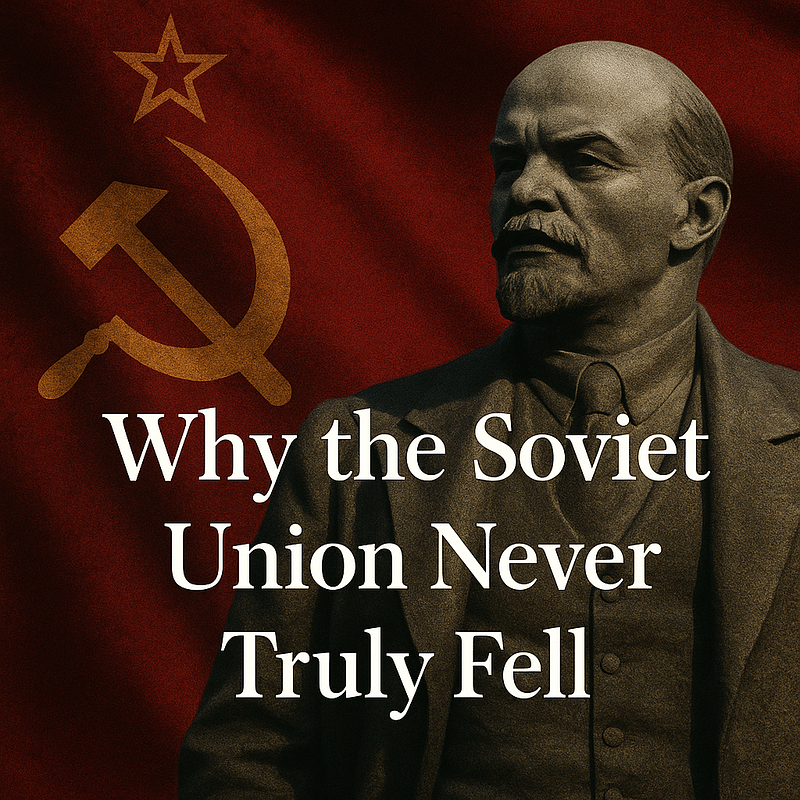
The world celebrated in 1991. The red flag came down over the Kremlin, and the statue of the secret police founder was hauled off its plinth in Moscow. The Cold War had ended, the Soviet Union was gone. Or so the story was told.
Yet behind the television images of collapse, something more subtle was happening. Institutions did not dissolve; they adapted.
An empire that supposedly fell, but whose skeleton remained intact.
From party to oligarchy
The West saw chaos, breadlines, privatization. But to those inside the networks of Soviet power, it was not chaos, it was a metamorphosis. Party and Komsomol functionaries moved into business within a few years. State property was transferred into private hands, and the new owning class was, in the words of later research, often derivative of the late Soviet nomenklatura, though none of the famous tycoons of the 1990s had sat in the Politburo.
The illusion of collapse disguised the continuity of power.
The hidden skeleton
The KGB did not vanish, though it did not simply change its name either. It was formally dissolved on 3 December 1991 and split into four parts; its Russian domestic branch became the Ministry of Security in 1992, the FSK in 1993 and the FSB in 1995, and it never left the Lubyanka building. The army did not stay intact: it was divided among the new states, the Russian Armed Forces were created by decree on 7 May 1992, and their strength fell from about 2.7 million to about one million by 2000. The secret cities that built nuclear weapons stayed closed, but their funding collapsed and salaries went unpaid for months through the 1990s.
The security core of the empire survived, even as its symbols disappeared.
Putin as continuity
When Vladimir Putin rose to power, acting president from 31 December 1999 and elected in March 2000, the West framed it as a new beginning. In truth, he was continuity made flesh: a former KGB officer and former FSB director, loyal to old structures, fluent in the codes of survival.
He did not resurrect the Soviet Union. He revealed that it had never truly gone away.
Closing reflection
The fall of 1991 was not the death of an empire, but the transformation of its mask. And perhaps that is the deepest lesson: power rarely collapses. It adapts, mutates, and waits.
Read the full chapter
Related from The Manifest Archive