How a superpower was dissolved by ceremony while its apparatus survived, its wealth was transferred, and its security state took both back
In a sealed town that did not appear on any Soviet map, a physicist kept solving equations by hand through the winter of 1993, paid in arrears or not at all, heating his calculations with a paraffin lamp because the grid was unreliable and the salary was a rumor. The town was Arzamas-16, the place where the Soviet Union had built its first atomic bomb, and the man was doing what the men around him were doing, which was keeping a weapons-design capability alive on belief and improvisation while the country that had funded it dissolved around them. Across eleven time zones the same scene repeated in different costume. Intelligence officers became consultants. Generals counted warehouses they were told no longer mattered. Engineers left their bureaus and stayed close enough to come back. Seen from Washington this was the end of a rival. Seen from inside it was something else, something for which the celebratory vocabulary of 1991 had no word.
The visible story of 1991 is that the Soviet Union collapsed and a weak, new, post-communist Russia was born into the arms of a victorious West. That story is not false. The collapse was real and the suffering was immense. But it is incomplete in the one place that decides what came next. The determining variable was never whether the regime fell. It was whether the apparatus fell with it. And the apparatus, the intelligence services, the weapons science, the closed cities, the energy export, the trained cadres, did not fall. It survived the regime, watched the country's wealth transferred over its head, and then took that wealth back into the orbit of the state. Three things happened in those years, not one. The apparatus endured. The property moved. The apparatus reclaimed the property. The story usually told remembers only the collapse in the middle and misses the continuity on either side of it. A regime can be abolished by decree. A state apparatus cannot.
What actually happened to the KGB after 1991
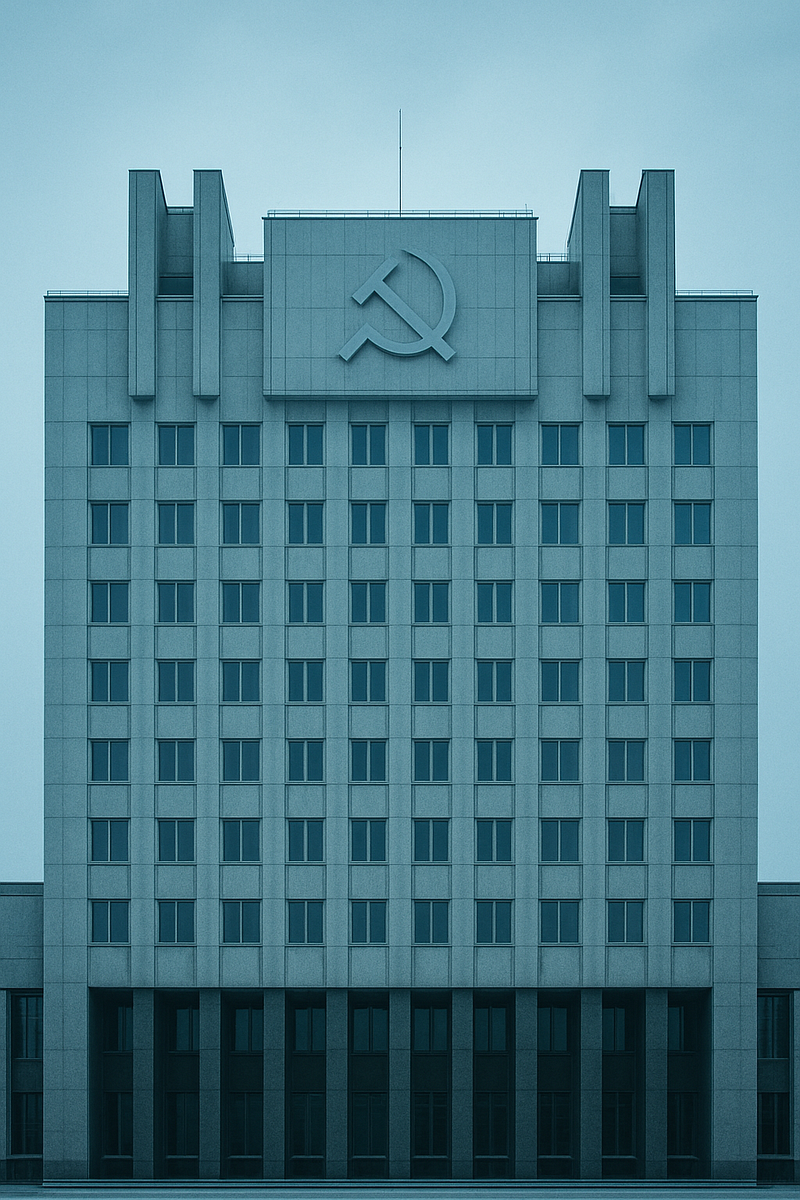
On 26 December 1991 the Supreme Soviet of the Soviet Union voted itself out of existence and the red flag came down over the Kremlin. Three weeks earlier, on 3 December 1991, the institution that had been the nervous system of Soviet power, the KGB, had already been formally dissolved. To read those two events as the same event is the first mistake, and it is the mistake the triumphal narrative depends on.
The KGB was not abolished in the sense that a thing is abolished. It was disaggregated. Its First Chief Directorate, foreign intelligence, was carried out intact and renamed the Foreign Intelligence Service, the SVR. Its domestic security functions passed through a short sequence of renamings, Ministry of Security, then Federal Counterintelligence Service, before settling in 1995 as the Federal Security Service, the FSB. Signals intelligence became FAPSI. The protection service became what is now the FSO. The border guards became their own service before folding back under the FSB. Military intelligence, the GRU, did not even bother with a new name; it was the one element of the Soviet security state that kept institutional continuity without interruption, the same directorates under the same General Staff, the same officers, surfacing decades later running the same kind of operations under the same roof.
What moved between these boxes was not paper. It was people. The personnel continuity from the Soviet services to the Russian ones was very close to total. The same officers, the same residenturas in the same Western capitals, the same operational habits, now under a flag with the hammer and sickle removed. The structure had been made less legible without being made less operational. This is the pattern in miniature, and it is worth holding still, because everything that follows is a variation on it. The Soviet Union was dissolved by ceremony. The Soviet state was not.
The man the apparatus produced
One career makes the continuity concrete. A KGB officer who had served in Dresden until the Wall came down returned to a collapsing country, entered the new political apparatus of his home city, rose to direct the FSB in 1998, became prime minister in August 1999, and was acting president of the Russian Federation by the last day of that year. The man who would define Russia for a generation was not a product of the new order. He was a product of the apparatus that survived the old one. The machine did not merely persist. It produced the next sovereign.
That single biography should be read as a warning against the entire framing of a clean break. The institution that the West believed it had dissolved in December 1991 had, within eight years, placed one of its own officers in the presidency of the successor state. A thing that can do that has not been abolished. It has been waiting.
What shock therapy did to Russia
While the apparatus survived in the shadows, the visible economy was subjected to an experiment. This is the part of the story the West remembers least accurately, because it remembers it as generosity.
Advisers arrived from Harvard and from European institutions with models presented as rescue. Price controls were lifted at the start of 1992, and the result was not a market but a detonation. By 1994 consumer prices stood at roughly two thousand times their 1990 level. Output fell by something close to half. Life expectancy dropped by years, an almost unheard-of peacetime collapse in a developed society. To the policy papers this was transition. In the kitchens it was a different word. Teachers sold vegetables on sidewalks. Doctors worked second jobs and skipped meals. A grandmother sold a war medal for coal. The vocabulary of the seminar room and the vocabulary of the street had stopped describing the same country.
It is essential to see that this collapse was not the opposite of the asset transfer that followed. It was its precondition. A population that cannot be sure of its next meal does not hold paper claims on the future. It sells them. The hunger and the transfer were not two stories. They were the setup and the payoff of one. Transition was the word in the reports. Disaster was the word in the kitchens.
How Russia's oligarchs got rich: vouchers and loans for shares
The transfer came in two acts, and the first was disguised as its opposite. In 1992 the government issued a privatization voucher to nearly every citizen, around a hundred and fifty million of them, each notionally worth a slice of the state's enterprises. On the surface this was the widest distribution of property in history. Every Russian became, on paper, an owner.
The surface was the point. A voucher redeemable someday for a fraction of a company that paid no dividend was not wealth in a year when prices doubled every few weeks. It was an abstraction, and an abstraction does not feed a family in February. So the vouchers were sold, by the tens of millions, for cash and for food, and they were bought, in bulk, for a few dollars each, by the small number of people who had cash and knew what the paper would later be worth. The mechanism presented as universal ownership functioned as a sieve. It put a token of the national wealth into every hand precisely so that it could be collected back out of almost every hand. By the time the program closed, around seventy percent of the economy had passed into private hands and roughly fifteen thousand enterprises had changed owner. The distribution had been total. The concentration was the result. Universal ownership was the form. Collection was the function.
The vouchers moved the smaller assets. The crown jewels required a second, more brazen mechanism, and it arrived in 1995 with a banker's elegance and a government's desperation. The state was broke. It could not pay pensions or wages, and a presidential election loomed the following year in which a deeply unpopular Boris Yeltsin faced a resurgent Communist Party. Into that gap stepped a proposal from the banker Vladimir Potanin, endorsed by the deputy prime minister overseeing privatization. The government would auction the right to manage its controlling stakes in the largest industrial companies, the oil and metals giants, in exchange for loans from commercial banks. If the state failed to repay, which everyone understood it would, the banks would keep the shares.
The loans-for-shares auctions were rigged in the open. The banks that lent the money also organized the auctions, and they organized them so that they themselves won. Rival bids were disqualified on technicalities or never admitted to the room. The numbers tell the rest. A controlling stake in Yukos, an oil company worth on the order of five billion dollars, went to Mikhail Khodorkovsky's bank for around three hundred and ten million. Sibneft, worth perhaps three billion, went to Boris Berezovsky for roughly one hundred million. Norilsk Nickel, producing a large share of the world's palladium, went to the man who had designed the scheme. These were not undervaluations in the way a bargain is an undervaluation. They were transfers wearing the paperwork of sales, at a fraction of worth that only makes sense once you stop reading the auction as an auction and read it as a handover. It was called a sale because a handover needs a buyer, and a buyer needs a price, however small.
The seven bankers and the echo of 1610
By 1996 a handful of bankers controlled a commanding share of the country's strategic industry, and they had a name. The press called them the semibankirschina, the rule of the seven bankers: Berezovsky, Khodorkovsky, Gusinsky, Smolensky, Potanin, and the two principals of Alfa, Fridman and Aven.
The name was not casual, and the Russian ear heard what a foreign one misses. It was built on the semiboyarshchina, the rule of the seven boyars, the seven nobles who in 1610, during the Time of Troubles, deposed the tsar and opened the gates of Moscow to a Polish garrison. The word fused two ideas in a single breath: that a small group had seized the country, and that they had done it in a moment of national collapse by arrangement rather than conquest. A society reaching for a four-hundred-year-old term to describe its present is telling you how the present feels from inside. It felt like 1610. A weak center, a handful of men with the resources to act, and a transfer of the country conducted while everyone else queued for bread.
The price was an election
The question that exposes the whole arrangement is the one rarely asked directly. Why would a state, even a broke one, hand its most valuable assets to a few bankers at a hundredth of their worth? The answer is that the assets were not given away. They were exchanged, and what they bought was the survival of the men who authorized the exchange.
In 1996 Yeltsin's approval stood in the single digits and the Communist candidate led the polls. The same bankers who had just acquired the oil and metals turned their new wealth and their media holdings toward his reelection, financing the campaign, saturating the television they now owned, and delivering a victory that had looked impossible months earlier. The sequence is the argument. The assets were transferred in 1995. The election was won in 1996. The transfer and the rescue were two halves of one transaction, and the property of the Russian state was the currency in which a political outcome was purchased. This is why the word reform fails as a description. Reform implies an attempt to build a market that fell short. What happened was more coherent than failure. A bankrupt state losing an election converted the one thing it still owned, the industrial inheritance of the Soviet Union, into political survival, and the men who advanced the funds kept the inheritance as their fee. The oil was not sold for money. It was sold for a presidency.
The closed cities and the arsenal that waited
The military told the same story as the intelligence services, in steel instead of personnel. Western analysts in the 1990s declared Russia finished as a serious military power, and on the visible numbers they were right. Procurement stopped. Design bureaus emptied. Budgets evaporated. What the analysts did not count was the difference between a capability that has been dismantled and one that has merely been switched off.
The difference was institutionalized in geography. Scattered across the Urals and Siberia was a system of closed cities, the ZATO towns that never appeared on civilian maps and that ordinary citizens needed a permit to enter. Sarov, where the first Soviet bomb was designed, still housed its nuclear-weapons laboratory. Snezhinsk held the second one. Zheleznogorsk kept its plutonium and its satellite work. These places had been built to outlast any single crisis, and they did. Through the years when the rest of the country bartered for food, the closed cities kept their reactors warm and their mathematicians employed, paid late and partially, holding a weapons-design tradition in amber. The crates stayed sealed. Production lines were mothballed rather than scrapped. The design bureaus did not destroy their drawings; they filed them. Engineers dispersed but stayed within reach of the plants they had left, because the plants, on paper, still existed.
What the system lacked was not capability. It was money, and money is the most reversible of all shortages. It came back from under the ground. Russian crude that traded near twelve dollars a barrel at the end of the 1990s was selling for over a hundred by 2008, and that revenue did not vanish into consumption alone. It reopened the gates. Mothballed lines restarted. Prototypes shelved in the 1980s came out of the vaults and into testing, and several of the hypersonic and missile programs later unveiled with great ceremony trace their origins directly to late-Soviet design work that had simply been waiting for a budget. Energy was not a metaphor for Russian power in these years. It was the specific mechanism by which a preserved military capacity was switched back on. The arsenal that the spreadsheets had written off had not died. It had waited. Two decades later, when a major war returned to Europe and Western models again predicted that Russian stocks would be exhausted within months, the prediction failed for the same reason the earlier one had: it measured the visible budget and missed the preserved capacity. The spreadsheet recorded an absence. The warehouse held the answer.
How the security services took the state back
For a decade the oligarchy that the transfer had created looked like the real power in Russia, a class of men who owned the industry and had bought a president. That impression did not survive contact with the apparatus, and the moment it broke is precisely datable.
When the security men moved back into the open in the 2000s, they did not arrive as newcomers. They returned as the same cadre that had staffed the Soviet organs, now taking the commanding heights of the Russian state. A former intelligence officer who had served alongside the president in Dresden took control of the state technology conglomerate. A career security man took the chair of the largest state oil company. The director who had run the FSB at the turn of the century moved to the Security Council and stayed at the center of strategic decision-making for two decades, and his successor at the FSB has held the post since 2008, a tenure that by itself signals an institution built for continuity rather than rotation. This was not a new elite capturing an old state. It was an old apparatus reoccupying a state it had briefly stepped out of.
The reoccupation announced itself on the property. In October 2003 the richest of the oligarchs, Mikhail Khodorkovsky, whose Yukos had adopted Western accounting, listed on exchanges, funded opposition parties, and opened talks with American oil majors, was arrested on the tarmac of a Siberian airport. Yukos was dismembered through tax claims and sold, at an auction won by an unknown shell company that immediately resold it to the state oil champion run by the president's security ally. The largest private oil company in Russia became the core of the largest state one. The message to the rest was not subtle, and it did not need repeating. The Yeltsin oligarchy had been a political rival. The new oligarchy would be a political instrument, holding its wealth at the pleasure of the apparatus rather than the other way around. The property that had been transferred out of the state in the 1990s was, in substantial part, transferred back into its orbit in the 2000s, and the institution that pulled it back was the one that had survived 1991. The flag changed twice in a decade. The personnel barely changed at all.
The foreign services told the same story in a different register. The residenturas that the SVR inherited from the KGB's First Chief Directorate kept their addresses in the same Western capitals, and the extraterritorial operations the Soviet services had run never actually stopped. The poisoning of a defector in London in 2006 and of another in southern England in 2018 were received in the West as a shocking new aggression. Read against the continuity, they were something duller and more revealing, a capability that had been preserved like the warehouses and the design bureaus and switched back on when it was wanted. The instruments carried new initials. The hands and the habits were old.
Why the continuity needed no conspiracy
It is tempting, looking at all this, to reach for a directing hand, a plan by which the apparatus engineered its own survival and its reconquest of the property. The temptation should be refused, because the truth is both more disciplined and more unsettling. No central plan was required. The apparatus survived for the same reason any apparatus survives a regime: it was knowledge and structure rather than sovereignty, and knowledge and structure can change owners without dying. The people best placed to navigate a lawless transfer, to know which official to reach and which rule could be bent, were frequently the people who had run the old state's covert machinery, and when the revenues returned, the institution with the cohesion to act was the one that had never actually disbanded.
That is the general law underneath the Russian case, and it is not a Russian peculiarity. It is the same mechanism by which the United States absorbed the scientific and intelligence machinery of a defeated Germany after 1945, hiring the apparatus of the enemy because the apparatus was more useful than the ideology it had served. Regimes are mortal and visible. Their machines are durable and quiet. So the machines tend to outlive the governments that built them and pass to whoever is positioned to use them next. In Germany the new owner was the victor. In Russia the new owner was the successor state itself, which inherited the loser's machine because it was the loser, reorganized. A regime can lose its ideology and keep its apparatus. An apparatus can lose its regime and keep its function.
The siege that was felt
One thread runs outward rather than inward, and it explains why the surviving apparatus turned the way it did. As Russia passed through the worst of the collapse, the Western alliance moved east in stages, Poland and Hungary and the Czech Republic, then the Baltic states, then Bulgaria and Romania. From Brussels this was the voluntary integration of free nations, which it genuinely was. From a Moscow that had just placed its trust in Western hands and been handed two thousand percent inflation, it read as encirclement. Whether any binding promise against expansion was made in 1990 is contested among historians and does not need to be settled here, because the determining variable is not what was pledged but what was perceived. A felt siege shapes a security service as surely as a real one. That perception became one of the load-bearing facts of the Russian strategic worldview, and the apparatus was the institution that carried it forward. What one side experienced as integration, the other experienced as siege.
The strongest case against reading it this way
The honest objection gathers all three movements and calls them hindsight. On this account the 1990s were a genuine catastrophe and nothing cleverer: the economy halved, tens of millions fell into poverty, the conventional military rotted, and to narrate this as an apparatus shrewdly preserving itself and then reclaiming the loot is to impose a design on what was only chaos. The giveaway prices were not theft but the real value of unmanageable assets in a country with no capital market. The 1996 financing was a defensible choice by people who believed a Communist restoration would be worse. And the security men returning to power was just the normal consolidation any state undergoes after a decade of weakness. Add the contested NATO pledge and the whole frame of survival and siege starts to look like a story Moscow tells to justify what it did later.
The objection is right about the suffering and wrong about what follows from it, and the distinction is the entire point. Nothing here claims that Russia did not collapse or did not suffer; it claims that the suffering and the survival happened at the same time, in different organs. Insolvency explains why the state needed cash. It does not explain why the auctions were rigged so that the lenders themselves won, why rival bids were excluded, or why the assets cleared at a hundredth rather than a half of their worth. A genuine fire sale produces low prices and open bidding. This produced low prices and closed bidding, and that difference is not constraint, it is capture. The continuity reading does not require the security men or the seven bankers to have coordinated as a cabal; it requires only that each, facing the same opportunity, took it, and that the apparatus, when the money returned, was the one body cohesive enough to take the property back. If the post-Soviet state had been built from genuinely new institutions, with the KGB personnel retired rather than rebadged and the weapons plants dismantled rather than mothballed, and if the auctions had been open and cleared near value, the whole reading would fail. The record shows the opposite on every count.
What 1991 actually was
The story of the end of the Soviet Union will keep being told as a death, because the ceremony was real and the human cost was real and a flag really did come down. Watch the inheritance under the collapse. What ended in 1991 was a name, an ideology, a flag, and a planned economy that had already failed. What continued was the machinery beneath all four: the service that watched, the science that armed, the cities that hid, the pipelines that paid. The wealth that the state lost in the 1990s, it did not lose to history; it lost it to a few dozen men, and then, in the decade after, pulled much of it back. The Soviet Union dissolved. The Soviet state changed costume, lost its property, and recovered it.
This is why the years that look like Russia's weakness are the key to its present strength, and why the conflicts of the current decade make more sense when read backward into them. The apparatus that the West believed it had defeated had not been defeated. It had been underfunded, and underfunding is reversible. When the revenues returned, so did the machine, with the same instincts and many of the same hands, now governing the state it had once merely served and owning, again, the assets it had once watched slip away. The regime that died in 1991 was the part designed to be seen. The state that survived it was the part designed to last.
Evidence Map
Facts, interpretations, forecasts, and disconfirming signals.
Core claim. The USSR's apparatus, its security cadre, networks, and strategic industry, survived the regime's visible collapse and was inherited largely intact by the Russian state that replaced it; the machine outlived the flag.
Evidence level. Facts: high (the near-total overlap between late-Soviet security personnel and the successor Russian services, the concentration of strategic companies in the security-linked cadre, the 1990s transfer and 2000s reclamation of strategic property). Interpretation: medium (apparatus migration as the determining variable; the regime as the visible part, the apparatus as the durable part).
What would confirm this. Continued archival and prosopographic work showing near-total overlap between late-Soviet security personnel and the Russian services that replaced them; the strategic companies staying concentrated in the security-linked cadre; the apparatus-survival pattern recurring in other collapses.
What would disprove this. Records showing the Russian services were genuinely rebuilt from new personnel; the mothballed-capacity claim proving marginal rather than load-bearing for the later military revival; or the 1990s transfer and 2000s reclamation proving disconnected accidents rather than one continuous movement.
Watchlist. Evergreen and structural, with live tracking of FSB and SVR historical disclosures, Western archival releases on Soviet-era intelligence continuity, and Russian state-company ownership records.
Jerry van der Laan writes The Manifest Archive, a continuous investigation into how institutions, language, and systems shape what people are permitted to see as reality. He does not report events. He traces the structures beneath them.
Related from The Manifest Archive