They stood shoulder to shoulder against Hitler, then turned their backs on each other. This chapter traces how an alliance of necessity became the architecture of rivalry.
Introduction | The photograph that lied
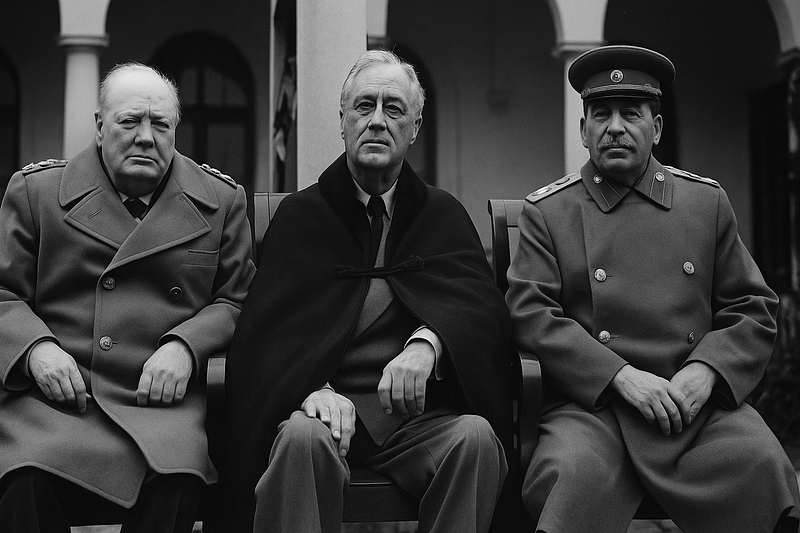
February 1945. The war in Europe was almost over. In a palace on the Crimean coast, Roosevelt, Churchill, and Stalin sat shoulder to shoulder for the cameras. To the world, the photograph was proof of unity: three giants who had crushed Hitler and would now shape the peace.
But inside the room the atmosphere told another story. The smell of damp uniforms, the scratching of pens on maps, the pauses before translations, everything signaled mistrust. Roosevelt, already dying, spoke of a United Nations. Churchill maneuvered for the survival of empire. Stalin calculated buffer zones, some of them already divided by percentage with Churchill in Moscow the October before. Every smile was for the press. Every promise was provisional.
The alliance was never built on friendship. It was built on fear, and fear is a contract that expires the moment the enemy is gone.
Within two months, Roosevelt would be dead. Within months, Truman would unveil the atomic bomb not only to Japan but as a message to Moscow. Even before the victory parades ended, British planners wrote Operation Unthinkable, a secret plan to attack their recent ally with Allied forces and up to ten rearmed German divisions.
The photograph the world saw was unity. What history inherited was the Cold War.
Before the fire
The long shadow of Versailles
The story of why allies became enemies does not begin in Yalta. It begins in Versailles, in 1919, where a treaty ended one war and quietly prepared the ground for the next.
Germany was punished, but not pacified. Reparations drained its treasury, while humiliation fermented in speeches and streets. Britain faced the arithmetic of decline: shrinking tonnage of ships, restless colonies murmuring independence. France clung to its Maginot Line, scar tissue disguised as fortification. The United States withdrew behind oceans, its factories roaring, its politics inward.
And in the East, the Soviet Union rebuilt through famine and purges, steel rising behind barbed suspicion.
Democracies and dictatorships
When fascism marched in Rome and Berlin, Western leaders hesitated. To many, Mussolini and Hitler seemed less dangerous than Lenin’s heirs. Dictatorship was ugly, but Bolshevism threatened property itself.
Munich, 1938, was not a misstep but a choice. By handing Hitler the Sudetenland, London and Paris signaled their preference: better fascism than revolution.
Stalin watched. His conclusion was simple. If the West would sacrifice allies for time, then Moscow must learn to buy time for survival.
They saw the fire, but feared the firefighter.
A pact of clocks
August 1939. Under chandeliers in Moscow, Molotov and Ribbentrop signed a pact that stunned the world. Nazi Germany and the Soviet Union, sworn ideological enemies, agreed to divide Eastern Europe between them.
The pact was no romance. It was a clock. Germany wanted months to strike west. The Soviet Union wanted its frontier shifted to soil already fertilized with Russian blood in 1914. Two signatures purchased time, and in that time both sides prepared.
On June 22, 1941, the pact shattered. Operation Barbarossa roared across the border. Three million German troops, tanks, and planes surged eastward. Villages burned. Cities starved. The Red Army reeled.
But it did not collapse.
Factories were dismantled and carried east of the Urals, reassembled to produce tanks under new roofs. At Stalingrad, every street became a trench, every building a fortress, every death a sentence written into stone.
It was not democracy that stopped fascism. It was sacrifice.
By 1943, the Wehrmacht was bleeding out on the Volga. In Kursk, Soviet armor crashed against German panzers in one of the largest tank battles in history. The tide had turned, and the Red Army pressed westward.
The marriage of necessity
Lend-lease and endurance
The West extended a hand early. Britain signed an agreement with Moscow in July 1941, the first Arctic convoy, Dervish, sailed in August, and on 7 November 1941 Roosevelt declared the defense of the Soviet Union vital to the United States, opening Lend-Lease. American factories transformed into arsenals, producing trucks, aircraft, and rails that crossed oceans in convoys hunted by submarines. Lend-Lease was not charity, it was logistics, steel turned into survival.
Churchill admired Soviet endurance but mistrusted its aims. Roosevelt soothed Stalin with promises of a second front. Stalin kept meticulous records, every agreement stored like a receipt to be cashed later.
They were allies because defeat was worse.
Tehran: The first table
In 1943, they met in Tehran. Maps covered the table like carpets. Stalin demanded depth, Poland, the Balkans, time carved in territory. Churchill argued for Mediterranean leverage, a backdoor through Europe’s underbelly. Roosevelt pressed for Normandy, and for an institution that might survive him: the United Nations.
They posed for photographs. They spoke in careful sentences. They left with plans for D-Day.
They smiled for the cameras, but the maps between them told the truth.
Yalta, or how to draw a future
By early 1945, Allied victory was near. Yalta staged its unity in a photograph that reassured the world. Roosevelt, Churchill, and Stalin sat shoulder to shoulder, heavy coats against the cold, the world reading hope into their expressions.
But every sentence contained a contradiction. “Free elections” in Eastern Europe translated differently in English and Russian. “Security” in Washington meant democracy. In Moscow it meant armies stationed where invasions once came.
Germany would be divided. Poland’s borders shifted. The Balkans had already been reduced to percentages scribbled on paper, in Moscow, the previous October.
Every line drawn at Yalta became a frontier of the Cold War.
The photograph promised peace. The footnotes prepared rivalry.
Potsdam and the new tone
Truman’s entrance
Roosevelt did not live to see Potsdam. He reported on Yalta to Congress on 1 March 1945 and died at Warm Springs on 12 April. In July 1945, Harry Truman sat at the table in Potsdam. He was cautious, untested, but holding a secret.
The atomic signal
In New Mexico, a desert sky had opened under the Trinity test. Three weeks later, Hiroshima burned. Nagasaki followed. Japan surrendered, but the bomb’s audience was broader. It was also a message to Moscow.
The Soviet Union understood. Its scientists were already working at fever pitch, spies feeding secrets from Los Alamos. Nuclear competition began at the instant of victory.
The bomb was less a weapon of war than a signal of empire.
The alliance had served its purpose. With the enemy gone, there was nothing left to hold it together.
Unthinkable thoughts
In London, before victory parades had ended, planners drafted Operation Unthinkable. The proposal: strike the Red Army, using Allied forces and even rearmed German divisions. The plan was shelved, but its existence betrayed the mindset. The gap between ally and enemy was measured not in decades, but in weeks.
It was called Unthinkable because it had already been thought.
Truman’s containment doctrine soon gave form to instinct. Aid became leverage. Alliances gave aid a spine. Propaganda gave the spine a smile. The Cold War had no declaration, but already it had a blueprint.
From Aid to Architecture
In March 1947, Washington introduced a new word into the bloodstream of global politics: containment. President Harry Truman stood before Congress and promised to support “free peoples who are resisting attempted subjugation.” It sounded moral. It was strategic.
The Soviet Union, once an ally, was now framed as the shadow behind every crisis. Greece, with civil war tearing its villages, became the first test. Turkey, guarding the straits between Black Sea and Mediterranean, became the second. Both were offered money, weapons, and advisors.
This was the Truman Doctrine: a policy that ended partnership with Moscow by declaring it unthinkable.
The Marshall Plan
Months later, George Marshall spoke at Harvard. His words promised more than sympathy. Billions of dollars were pledged to revive Europe. Food, steel, coal, and credit would flow across the Atlantic, turning ruins into markets.
Ships docked in Rotterdam and Marseille, unloading crates stamped “Made in USA.” Children drank powdered milk from tins with foreign labels. Railroads were rebuilt, power stations lit up again, factories buzzed back to life.
But every crate carried conditions. Aid was tied to alignment. Gratitude meant dollars, and dollars meant policy.
Moscow saw through it. Stalin forbade Poland, Hungary, and Czechoslovakia from accepting Marshall’s help. Eastern Europe was locked into scarcity rather than risk disobedience. The Iron Curtain was now visible not only in borders but in warehouses and store shelves.
The curtain was not iron. It was economic, political, and psychological, yet it divided the world all the same.
Germany as a Laboratory
The Theater of Justice
Germany was both criminal and indispensable. At Nuremberg, prosecutors unrolled reels of film showing camps, corpses, and crimes too vast for language. Robes and gavels gave morality a stage. The world wanted justice, and justice was performed.
The Science of Utility
Yet in the shadows of tribunals, another trial unfolded. American officers interviewed engineers who had built rockets. Soviet agents scoured labs for blueprints. Both sides asked the same question: What can you build for us now?
Operation Paperclip ferried more than a thousand German scientists to the United States. Their résumés were scrubbed, their pasts abbreviated. Wernher von Braun, who once sketched rockets for Hitler, now designed spacecraft for NASA. His equations leapt from V-2 missiles that cratered London to Saturn rockets that would carry Apollo.
Justice bowed to progress.
The Soviets seized their own engineers, relocating them in a single night in October 1946 to guarded sites such as Gorodomlya, an island in Lake Seliger northwest of Moscow. Jet propulsion, rocketry, and chemistry were absorbed at gunpoint. Expertise changed uniforms.
Technology forgives what ideology condemns.
The Inheritance of Secrets
In a quiet corner of Bavaria, Reinhard Gehlen surrendered. As head of the German army’s intelligence branch for the Eastern Front, he carried maps, files, and agents who knew the Soviet frontier like the backs of their hands. He offered them all to the Americans.
They accepted. Within years, Gehlen’s network became the foundation of West Germany’s intelligence service. The CIA, still in its infancy, fed on Nazi data to chart the East.
The paradox was grotesque yet pragmatic. Yesterday’s enemy became today’s informer. Democracies adopted the skeleton of the Reich to peer into the Kremlin’s darkness.
Defeating an enemy is simple. Forgetting his methods is harder.
The architecture of allegiance
NATO’s birth
In April 1949, in a hall in Washington, twelve nations signed a treaty that promised collective defense. The North Atlantic Treaty Organization was born.
Its language was defensive. Its reality was structural. Strategic command resided in American hands. European sovereignty was effectively outsourced to Washington.
Bases spread across Britain, Germany, and Italy. Radios hummed on shared frequencies. Officers trained side by side, though their orders flowed from across the ocean. Europe’s independence became dependence, dressed as protection.
The Warsaw response
Moscow responded in 1955. The Warsaw Pact mirrored NATO’s geometry. Where NATO promised freedom, the Pact promised fraternity. Where NATO offered dollars, Moscow offered ideology.
The symmetry was complete. But symmetry is not trust. Borders stiffened into lines of suspicion.
Security is the art of turning fear into structure.
Gladio and the shadows
Officially, NATO was transparent: an alliance of signatures and parades. But beneath the bureaucracy lived a hidden skeleton.
Stay-behind networks, later called Gladio, were designed to resist Soviet invasion. Weapons caches lay buried in Italian hills and Belgian barns. Recruits trained in forests, swore secrecy, waited for a war that never came.
Whether they remained idle is still disputed. In Italy, parliamentary inquiries after 1990 examined links between the stay-behind world and the political violence of the 1970s and 1980s. In Belgium, a parliamentary inquiry looked for a link to the unsolved Brabant killings and could not prove one. The suspicion was circular: destabilize society to prove society needed protection.
To Moscow, Gladio was proof that Western peace was camouflage. To Washington, it was prudence, a fire extinguisher hidden in the walls.
Peace is often the continuation of war by quieter men.
The battle for memory
Hollywood’s beaches
While armies reorganized, storytellers rewrote. In Hollywood, D-Day became a genre, with John Wayne among the stars of The Longest Day. Films celebrated D-Day, tanks rolling onto beaches under blue skies. Audiences cheered salvation scripted in English.
Stalingrad, Leningrad, and Kursk appeared only as footnotes. Twenty-seven million Soviet deaths shrank into statistics.
Moscow’s sacrifice
In Moscow, Pravda printed a different gospel. Victory was the triumph of socialism, painted in parades and films. Children recited the number of martyrs as a catechism. The Western allies were reduced to supporting roles.
Both narratives simplified. Shared sacrifice evaporated. The wartime alliance was remembered as though it had never been.
History’s first casualty is not truth but proportion.
Culture as a frontline
The Cold War was not only about armies. It was also about imagination.
Western freedom in paint
In Paris and Berlin, exhibitions opened with canvases dripping with abstraction. Jackson Pollock’s splatters were framed as metaphors of liberty. Behind the galleries stood the CIA, channeling funds through the Congress for Cultural Freedom. Writers published essays that proclaimed independence while unknowingly serving strategy.
Soviet realism
In Moscow, the approach was overt. Socialist realism painted workers with radiant smiles, factories glowing like temples. Symphonies thundered the glory of the collective. Art was propaganda, unapologetically.
Different aesthetics, same intent: to shape allegiance, to persuade without firing a shot.
Truth became a currency, printed by governments and spent on belief.
The television pulpit
By the 1950s, the new priesthood of propaganda glowed in living rooms.
In America, sitcom kitchens displayed abundance. Anchors spoke in calm tones, reassuring audiences that democracy equaled prosperity. Advertisements made happiness synonymous with consumption.
In the East, parades marched across screens. Leaders waved from balconies, their images multiplied in magazines. Obedience was equated with safety.
Citizens were not shouted at. They were sung to.
The museum of selective truth
By the 1970s, remembrance was managed like an archive. Museums in the West celebrated liberation. Museums in the East sanctified resistance. National holidays scripted memory into parades. In Paris, plaques remembered the liberation of August 1944; in Moscow, monuments remembered victory by the Red Army.
Photographs were cropped. Files were sealed. The word ally disappeared from plaques. Cooperation was inconvenient.
History is not erased. It is replaced.
Generations inherited curated versions of the past. Children grew up knowing who had won, but not who had bled.
The age of persuasion
When the guns went silent, a different noise replaced them. It came from printing presses, film reels, and radio waves. Nations discovered that memory could be shaped as powerfully as territory.
The United States information agency
In 1953, Washington created the United States Information Agency. Its purpose was neither diplomacy nor war, but something in between: communication. Pamphlets, radio shows, and films carried the message that capitalism meant freedom, communism meant chains.
Hollywood obliged. Every film that ended with a waving flag was another sermon, packaged as entertainment. The world was invited into American kitchens, filled with shiny refrigerators, laughter, and abundance.
Pravda and symmetry
Moscow mirrored the effort. Pravda filled its pages with heroic workers and disciplined soldiers. Red Square parades were filmed as living monuments. Radio Moscow broadcast in dozens of languages, repeating the mantra that socialism was the destiny of the oppressed.
The Cold War was not fought for territory, but for imagination.
Both sides accused the other of propaganda. Both were correct.
The classroom frontier
Education became a quiet battlefield.
In Western Europe, textbooks praised democracy as destiny. Maps shaded the East in ominous red, spreading across pages like contagion. Children learned that freedom had been rescued at Normandy and secured in Washington.
Across the Curtain, Soviet children recited opposite lessons. Capitalism was rot, socialism was cure. Their maps shaded the West as the enemy, oceans bristling with hostile fleets.
The wartime alliance vanished from curricula. Shared sacrifice became a footnote, then disappeared altogether. What remained was moral geometry: good, evil, and no neutral ground.
What nations forget together, they remember forever.
Generations grew up believing their freedom, or their equality, had been achieved alone.
The Secular Crusade
Faith transformed
Religion retreated, but belief found other altars. In the West, progress became doctrine, markets became salvation, dissent became heresy. In the East, labor became liturgy, factories cathedrals, Party loyalty the only creed.
The Cold War was a crusade without saints.
The bureaucratic afterlife of empire
The Berlin Wall fell. The Soviet Union dissolved. Crowds filled squares, tearing down symbols of socialism. Washington declared victory, capitalism triumphant.
Yet institutions remained. NATO expanded rather than dissolved. Surveillance systems grew sharper. Intelligence networks adapted to new enemies. Propaganda shifted tone but not method.
The Cold War ended, but its machinery did not.
Empires end. Bureaucracies inherit.
The rivalry had been theatre. The stagehands never left.
Closing reflection | The memory of peace
The Second World War promised renewal. What it delivered was management.
The Allies and the Soviet Union were together because the alternative was worse. They were apart because victory put mirrors where windows had been. The alliance was performance, necessary but temporary, staged for a world that needed hope.
When the curtain fell, the set remained. Borders, doctrines, propaganda, institutions, they were the architecture of rivalry, not the inheritance of peace.
They called it freedom. They called it security. But it felt like supervision.
They won the war, then rewrote it.
Related from The Manifest Archive