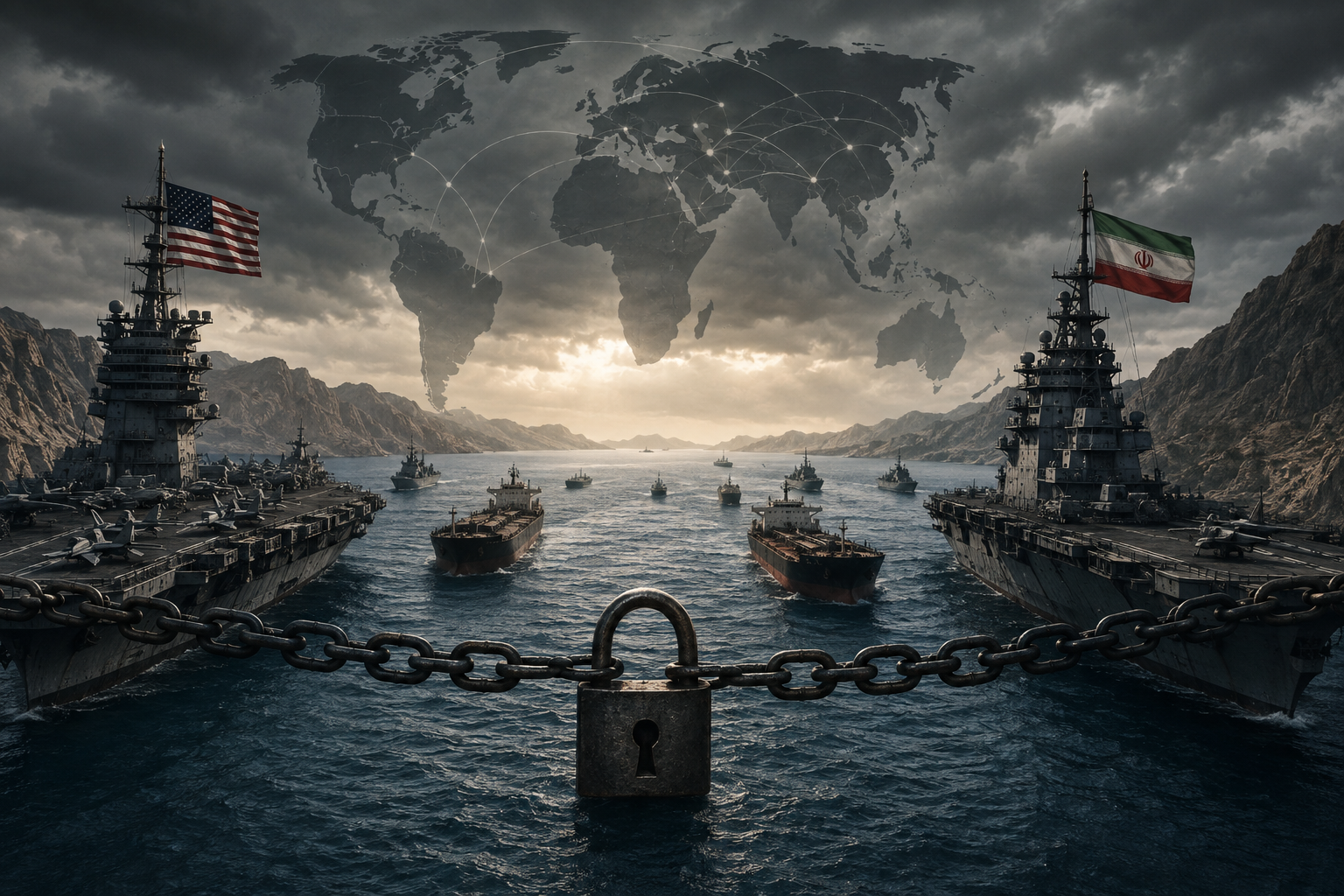
There is a difference between being trapped and being locked in. A trap snaps shut. A lock clicks slowly, one turn at a time, until the door no longer moves.
On February 28, 2026, the United States and Israel launched Operation Epic Fury: 900 strikes in 12 hours. By March 8, Supreme Leader Ali Khamenei was dead. By March 17, ground invasion. By April 8, ceasefire after 40 days of sustained combat.
Four months later, the ceasefire has broken. Iran attacks tankers under US military escort. The US maintains 40,000-50,000 military personnel in the Gulf. Two Carrier Strike Groups remain positioned. The Strait is effectively closed-only 10 ships on some July days, compared to 88 normally.
A casual observer asks: Why not escalate and finish it? Or withdraw and end the bleeding?
This analysis projects current trends and statements toward August 2026; the underlying historical mechanisms described are documented and verified.
The answer reveals a structural trap. The United States cannot escalate. It cannot withdraw. So it remains-military present, diplomatically locked, waiting for a resolution that will not come.
This is not a temporary stalemate. This is a permanent architecture masquerading as a crisis.
Why the US Cannot Escalate
Oil prices have not behaved as escalation theory predicts. On August 3, 2026, Brent crude trades at 84.95 dollars per barrel. In July, it briefly touched 88. This is not $150. It is not even close to $150.
The Strait of Hormuz normally carries approximately 20 percent of global seaborne petroleum. When Iran closed it in late February 2026, global markets recalculated. Insurance premiums spiked. Shipping routes diverted. Refineries retooled. Yet the price floor held. Global supply chains absorbed the disruption through reserves, rerouting, and demand destruction.
If the US escalates further, two things follow. First, oil spikes on speculative panic, which is briefly possible. But sustained escalation in a region where alternatives exist (routes around Africa, US shale reserves, Strategic Petroleum Reserve releases, Saudi production increases) does not produce $150 oil. It produces $100-120 oil at most, and only briefly. Second, and more damaging, sustained escalation requires sustained explanation. That explanation goes to Congress. Congress includes politicians from districts that depend on oil prices staying moderate. Those politicians lose elections in 2026 midterms if gas prices spike.
Trump's original timeline-four to six weeks of combat-was not arbitrary. It was the outer boundary of public tolerance. Thirty-eight days was already stretching that boundary. Further escalation would require public messaging that links American military action to American gas price increases. That is politically impossible in an election year.
The US military can escalate. American voters cannot absorb the domestic cost. Therefore escalation is not an option.
Withdrawal is also not an option, but for different reasons.
Why the US Cannot Withdraw
In 1974, US Secretary of State Henry Kissinger negotiated what became known as the petrodollar arrangement with Saudi Arabia. The United States would guarantee military security to the Gulf states. In return, Saudi Arabia would price oil in dollars and invest petrodollar surpluses into US Treasury bonds, supporting American borrowing costs.
This arrangement produced two cascading benefits for America. First, it meant every country that wanted to purchase oil had to hold dollars. Global demand for dollars is not a choice-it is a structural necessity created by energy pricing. Second, it meant the United States could borrow at rates lower than fundamental economic conditions would otherwise produce, because demand for dollar-denominated assets was artificially inflated by oil pricing.
The petrodollar system did not create American power, but it extended it. It allowed the US to run persistent fiscal deficits. It allowed the Federal Reserve to maintain low interest rates without capital flight. It supported a global military presence that would otherwise be fiscally impossible. As energy economists have documented, this system's erosion is measurable in accelerating central bank reserve diversification and the growth of bilateral non-dollar energy settlements-particularly between China and energy-exporting states.
Withdrawing from the Gulf means withdrawing from the petrodollar arrangement. Not immediately-the architecture takes years to unwind. But the signal is immediate. If the US cannot maintain military presence in the Gulf, then the security guarantee that props up the petrodollar system is revealed as conditional, not structural. Other countries begin hedging. China accelerates alternative energy arrangements. Russia accelerates non-dollar bilateral settlements. The dollar's structural dominance begins to erode.
The cost of withdrawal is not measured in 2026. It is measured across the next decade as the dollar's monopoly position weakens. It is measured in the interest rates the US must pay when demand for dollar-denominated debt declines. It is measured in fiscal space for military spending, social programs, and economic stimulus.
The US cannot afford to withdraw. But it also cannot afford to escalate indefinitely, because indefinite escalation requires explaining to American voters why their gas prices are high. Therefore withdrawal is also not an option.
The US is locked into a middle position: present enough to signal commitment, but constrained enough to avoid domestic political collapse.
Why Iran Cannot Retreat
The lock-in is not unilateral. Iran faces the same structural constraints from the opposite direction.
Iran's regional legitimacy rests on demonstrated capability to threaten American interests. The proxy network-Hezbollah, the Houthis, Iraqi militias, Quds Force operatives-exists not merely to project power, but to signal that Iran is a permanent player in Gulf geopolitics. Every concession, every strategic retreat, undermines this legitimacy domestically and regionally.
When Ali Khamenei was killed in March 2026, Iran faced a succession crisis precisely because the proxy network had been designed to survive decapitation. By August 2026, Mojtaba Khamenei had assumed the Supreme Leader role with the IRGC's backing, reinforced by the network's continued operations. But succession required proving to the Islamic Republic's hardliners and regional partners that deterrence remained operational.
Retreating from the Strait means surrendering the only leverage Iran has against an enemy with vastly superior conventional military power. Accepting a return to pre-war conditions means accepting that the 2026 conflict was a net loss-maintaining presence at the Strait is the price of appearing victorious. Escalating the conflict beyond current levels means inviting destruction; de-escalating means inviting defeat. Iran is trapped in a paradox: every option carries catastrophic cost.
Moreover, Iran's economy is destroyed. Sanctions-enforced through OFAC designations and secondary penalties on financial institutions-have collapsed bilateral energy trade with Iran's primary buyer, China, by an estimated 90 percent from peak 2024 volumes. Reconstruction requires either Chinese financing (which comes with strategic strings) or regional Arab investment (which depends on demonstrating continued strength). Neither occurs if Iran appears defeated.
So Iran, like the US, is locked into continued presence at the Strait. It cannot escalate indefinitely-the costs are unsustainable. But it cannot retreat-the domestic and regional costs would be catastrophic. Both nations are committed to proving something that neither can resolve: that the status quo serves their interests better than any alternative.
Why China Benefits From the Lock-In
China does not face the constraints that bind the US and Iran. China has no security guarantee to maintain in the Gulf. China has no petrodollar system to defend. Yet China has every reason to sustain the lock-in indefinitely.
A closed Strait benefits China in three ways. First, it degrades American petrodollar dominance. Every day the Strait remains contested, alternative energy arrangements accelerate. Chinese investments in African oil, Russian energy deals, Middle Eastern relationships create redundancy in Chinese energy sourcing. China does not need the petrodollar arrangement to survive; China benefits from its erosion.
Second, it weakens American strategic presence globally. Resources committed to managing the Gulf cannot be deployed to the Indo-Pacific, where China's greatest threat lies. The US military presence in the Gulf, now locked in place by the mechanisms described above, is a drain on American strategic depth.
Third, it creates opportunity for Chinese financing. Iran's economy is destroyed. Reconstruction requires either Chinese credit with strategic strings attached, or regional Arab investment (unlikely while Iran remains embattled). China can position itself as the only credible financier of Iranian recovery-at a price measured in influence, not dollars.
China's lock-in is inverted: China benefits precisely because both the US and Iran remain locked in. The longer the conflict persists at its current level-contested but not escalated-the more advantage China accumulates. China has no need to intervene, negotiate, or risk. China simply waits while the petrodollar system erodes at American expense.
This creates a perverse alignment: both the US and Iran are locked into the Strait, and China is locked into the lock-in persisting. Three nations, three forms of imprisonment.
This inverted lock-in extends security-dilemma theory beyond bilateral symmetry. The classical security dilemma, as Jervis and Snyder describe it, turns on how defensive measures by one actor are perceived as offensive by another, spiraling toward mutual imprisonment. But here, a non-participant benefits precisely from others' structural imprisonment-and that benefit structure means withdrawal by any party would harm the very actor positioned to gain. Where the classical dilemma describes how action begets counter-action, the inverted lock-in describes how inaction is structurally rewarded yet structurally constrained.
The same logic is visible in the Taiwan Strait. The US and China are each locked into opposing commitments-the US to Taiwan's security, China to reunification. But the lock-in creates an inverted benefit for other powers: Japan accumulates influence through neutrality, Singapore deepens its role as regional broker, India gains strategic depth through ambiguity. Each benefits from the US-China stalemate precisely because they do not directly intervene. The structure that imprisons Washington and Beijing rewards those positioned to wait.
The Architecture of the Lock-In
Understanding how three nations become imprisoned requires understanding how the trap was built. The constraint works like this.
The ceasefire of April 8, 2026, was designed to accomplish three things: declare tactical victory (Operation Epic Fury succeeded in its stated objectives), transition to diplomatic pressure (Project Freedom to reopen the Strait), and manage the American electoral timeline (maintain presence through midterms without escalation).
It accomplished the first two, partially. It failed at the third.
Trump's stated objective before taking office in January 2025 was to resolve the Iran situation quickly. Kissinger's doctrine of managing regional power balances was replaced with a doctrine of overwhelming force and rapid settlement. The timeline was explicit: four to six weeks. This allowed Trump to claim victory before the fiscal and political costs accumulated.
The April ceasefire fit this timeline. But it did so by deferring resolution, not achieving it. Iran did not concede regional position. The US did not withdraw security guarantees. The Strait remained contested. Both sides paused to reset and reassess.
By early July, that reassessment was complete. Iran, facing sustained sanctions and Chinese trade collapse, chose to test American commitment by attacking tankers. The US, bound by public tolerance limits, escalated minimally-air and naval presence, no new strikes. Iran escalated slightly more-more frequent drone and missile tests. By August 3, the pattern is clear: a pulsing cycle of probe-and-response, with neither side willing to break the structure but both sides testing its boundaries.
This cycle can persist indefinitely because it serves both sides' interests. Iran preserves deterrent capability without the costs of full warfare. The US maintains strategic presence without the fiscal drain of sustained combat. Both sides can claim, domestically, that they are protecting their interests.
But this is not a stable equilibrium. This is a renewable commitment trap.
The US must keep forces in the Gulf to maintain the petrodollar architecture. Iran must keep demonstrating deterrent capacity to justify its regional legitimacy and proxy network. Both nations are locked into proving something that neither can fully resolve: that the status quo benefits them more than any alternative.
How We Got Here: The 1974 Arrangement and Its Descendants
The petrodollar arrangement was negotiated in a moment when the US had just suffered the shock of the 1973 oil embargo. American reserves were depleted. The Suez Canal was closed. Oil prices had quadrupled in a matter of weeks. The Nixon administration, under Kissinger's direction, understood that American power could not be sustained through military dominance alone-energy security required structural leverage.
Kissinger's insight was architectural: create an arrangement where the US provides security, and in return, the pricing and financial flows of global energy are denominated in dollars. This locks every other country into dollar dependence, which sustains American borrowing costs and financial dominance.
For fifty years, this arrangement held. Through the Iran-Iraq War (1980-1988), through the Gulf War (1991), through two decades of counterinsurgency in Iraq and Afghanistan, the US maintained Gulf military presence. The arrangement was never formally articulated-no treaty exists-but it operated as unwritten law.
In 2026, that arrangement is being tested at its foundation.
China, America's strategic competitor, has spent the last decade building alternative energy supply chains. Chinese investments in African oil, Russian energy deals, and Middle Eastern relationships have created redundancy in China's energy sourcing. China does not need the petrodollar arrangement to survive. In fact, China benefits from its erosion, because it weakens American structural power.
Iran, which has been outside the petrodollar system for decades, sees in the 2026 conflict an opportunity to demonstrate that American security guarantees are conditional. If Iran can impose sufficient costs on American presence-through proxy attacks, through tanker harassment, through extended disruption of the Strait-then other countries might calculate that the security guarantee is worth less than the costs it imposes.
Russia, which also sits outside the petrodollar system, has no interest in strengthening it. Russia benefits from petrodollar erosion the same way China does.
The United States, meanwhile, is defending an architecture that is no longer as effective as it once was. Global oil markets are less dependent on Gulf supplies than they were in 1974. The US is itself a major oil producer. The dollar's dominance is eroding slowly but measurably.
Yet the US cannot abandon the arrangement, because abandoning it would accelerate the erosion. This is the lock-in: the cost of maintaining the system grows even as the benefits decline.
The Mechanism: Seven Turns of the Lock
Escalation leads to domestic political costs (gas prices, midterm elections). Domestic political costs lead to troop withdrawal pressure. Withdrawal pressure leads to petrodollar concern (other countries see commitment as conditional). Petrodollar concern leads to dollar erosion (alternative energy arrangements accelerate). Dollar erosion leads to higher American borrowing costs. Higher borrowing costs lead to reduced fiscal space for military spending. Reduced fiscal space leads back to escalation pressure (try to resolve it quickly). Escalation pressure leads back to domestic political costs.
The loop does not escape-it closes. Escalation produces the political costs meant to prevent withdrawal; withdrawal produces the financial erosion meant to prevent withdrawal. The system cannot be broken from inside. It can only be reinforced.
That is not a solution. That is a closed loop.
The US cannot break the loop by escalating, because escalation produces political costs that force the very withdrawal the escalation was designed to prevent. The US cannot break the loop by withdrawing, because withdrawal produces petrodollar concerns that erode the very financial dominance that funded American military presence in the first place.
The only stable position is the middle: maintain presence without escalating, absorb the costs without withdrawing, and hope that time and circumstance create an off-ramp.
But time does not create off-ramps in locked systems. Time only demonstrates that the lock is permanent.
The Steelman: What If American Commitment Can Be Renewed?
The strongest counterargument to this reading does not dispute the mechanisms described above. It accepts them. Instead, it argues that the American commitment can be renewed-that a new regional settlement, perhaps involving Israel and Gulf states in a formal architecture, could replace the petrodollar arrangement as the basis for US military presence.
This counterargument is structurally serious. It acknowledges that the 1974 arrangement is eroding. But it asserts that the US can build a new basis for commitment that is not dependent on energy pricing or financial flows. A security architecture based on mutual defense against a common threat (Iran, or China in the broader sense) could sustain American presence without the petrodollar mechanism.
This counterargument explains why Trump was willing to invest heavily in the 2026 conflict despite the fiscal costs. The calculation was not to extend the petrodollar arrangement, but to rebuild American credibility as a security guarantor, preparing for a new arrangement based on explicit alliance rather than implicit financial dependency.
The reading offered here does not claim this is impossible. It claims something narrower: that the transition from the old arrangement to the new one is not cost-free, and the costs are being absorbed in 2026 in the form of the locked-in military presence described above. The mechanism does not disappear if a new arrangement is negotiated. It merely changes form.
If a new security architecture is built, the lock-in becomes: the US must maintain presence to prove the new arrangement works, or it risks undermining the credibility it spent so much capital rebuilding. The names change. The structure remains.
What Remains on August 3, 2026
The Strait of Hormuz is closed. It has been closed for 156 days. It will likely remain contested for years.
Oil prices have not spiked. They have remained below $90 per barrel throughout the crisis. This is not because the disruption is insignificant. It is because global supply chains are absorbing the costs through reserves, rerouting, and demand destruction. Those reserves are finite. Those alternative routes have capacity limits. That demand destruction is temporary.
The question is not whether the Strait will reopen. It will. The question is under what conditions it reopens, and whether those conditions require the US to maintain the military commitment that currently keeps it contested.
The answer is yes. The US is guarding a Strait it cannot fully open, through a commitment it cannot fully abandon, in service of an arrangement it can no longer afford.
The architecture accounts for every actor except one: the power to change the structure itself.
Further Reading
On the petrodollar arrangement and its structural role in American power, Henry Kissinger's 1974 agreements with Saudi Arabia remain the foundational text, though the mechanism is analyzed in depth in contemporary work on petrodollar recycling and US Treasury dominance. The erosion of petrodollar hegemony is tracked in central bank reserve data and, more speculatively, in the growth of alternative bilateral energy settlement arrangements-particularly those between China and energy-exporting states.
The IRGC's structural autonomy and proxy network design is documented extensively in Congressional Research Service reports on Iranian military organization. The succession of Mojtaba Khamenei following Ali Khamenei's death in 2026 established precedent for distributed command within the Iranian system.
China's strategic positioning relative to energy security is visible in its Belt and Road Initiative energy corridors and its diversification of oil sourcing across Africa, Russia, and Central Asia. The acceleration of Chinese alternatives to petrodollar-denominated energy trade has been measured in bilateral settlement volumes and LNG contracts.
On security dilemmas and structural traps in international relations, the foundational work remains Glenn Snyder and Paul Diesing's "Conflict Among Nations" and the broader tradition extending through Robert Jervis's work on the security dilemma. This analysis applies that framework to contemporary energy geopolitics.
The specific mechanisms described here-how commitment becomes lock-in, how both sides lose the option to exit-are visible in historical parallels: the Cold War's mutually assured destruction (a trap both superpowers built together), the US commitment to NATO expansion (which locked Russia into a specific strategic posture), and the current Taiwan Strait dynamics (where both US and China are increasingly committed to positions from which retreat is politically impossible).
Related Analysis
Six Industries Published Reports About Hormuz. None of Them Talked to Each Other. - A companion analysis documenting how the structural lock-in produces convergent system stress across shipping, aviation, energy, food, and pharmaceutical sectors-six crises reported in six separate languages by six industries that do not read each other.
The Manifest Archive publishes two versions of each analysis. This is the extended Ghost version. A condensed Medium version, including the Iran and China sections, is available separately.