The morning that follows
On December 26, Rome does not feel quiet.
Quiet suggests rest, or recovery, or pause. What settles over the city is something else entirely. A sense of completion, as if a sequence has reached its final movement and now recedes without ceremony. Not emptied, not abandoned, not asleep. Finished, in the way a ritual finishes when every gesture has been executed exactly as intended.
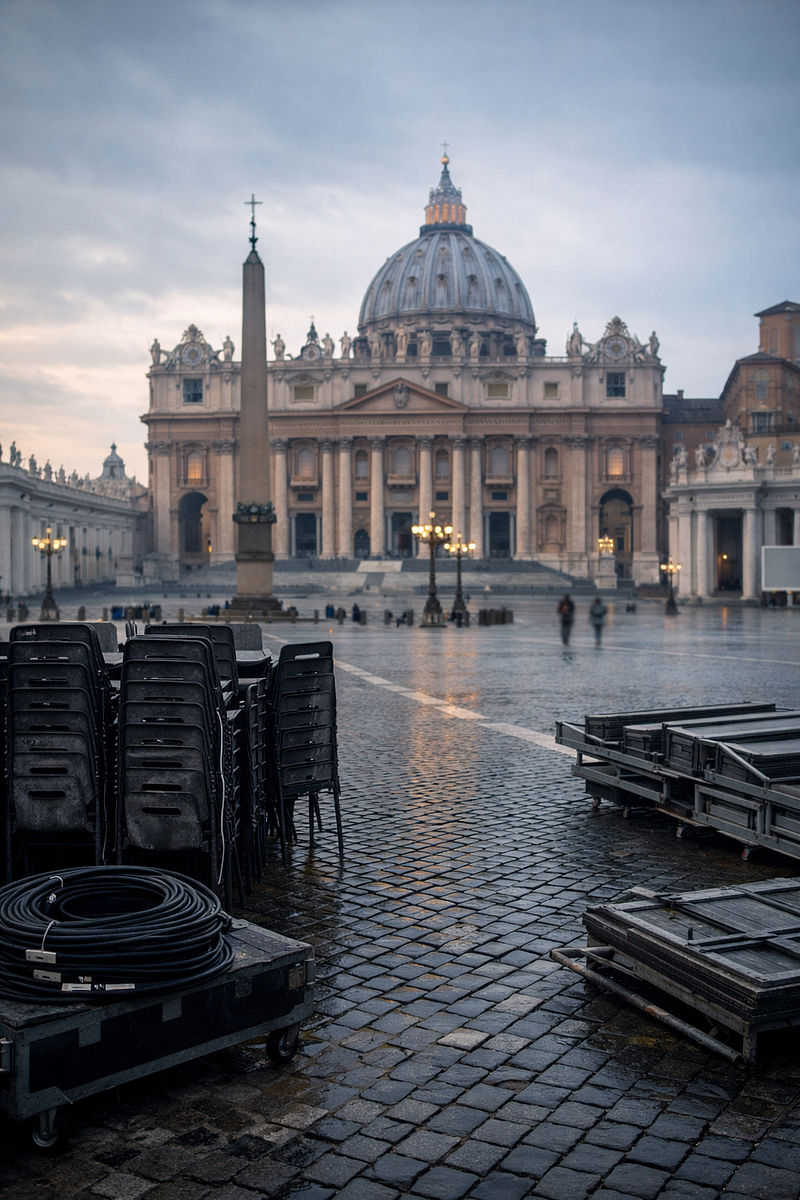
The chairs on St. Peter's Square no longer face an altar. They are stacked in compact columns, metal touching metal, no longer inviting attention. Cables are rolled with practiced hands and carried away. Temporary platforms are dismantled piece by piece. The square exhales and returns to stone.
The night before, the Pope spoke. He spoke of peace, of fragility, of a child born into darkness. His voice was calm, measured, almost restrained, as if the weight of the words mattered less than their familiarity. Cameras captured every angle. The crowd listened. The world watched.
Now there are no words. No follow-up statement, no clarification, no attempt to preserve meaning. Rome does not explain what it has just performed. It moves on.
Most people miss this moment. They remain focused on what was said, on the images, on the emotional residue of the night before. They treat Christmas as an event, a peak, a culmination, something that happened and can be remembered and then set aside. Rome does not. Rome treats it as a fixed point in a sequence that continues regardless of attention. The ritual appears, fulfills its function, and withdraws. Nothing is extended. Nothing is milked. Nothing is justified.
If power is to be understood, it is not in the proclamation, but in what follows immediately after.
The pope dies, the office does not
The day after Christmas is a small rehearsal of a much larger fact about this institution, the one that explains everything else: the Vatican is built to never be empty.
Consider what happens when a pope dies, an event that would be a succession crisis in almost any other system of absolute authority. In the Vatican it is a procedure. The moment the pope dies the Church enters a state with its own name, sede vacante, the vacant seat, and a designated official, the camerlengo, steps in not to rule but to administer the interval. The dead pope's apartments are sealed. The machinery of governance continues. Within weeks the cardinals enter the conclave, vote behind locked doors, and emerge with a successor, and the white smoke announces not a new beginning but a continuation. The institution did not pause. It changed the man and kept the office.
This is the distinction that the rest of the world finds hardest to grasp about the Vatican, because it is the opposite of how modern power works. A presidency is the person; when the president falls, the office is contested and the direction can reverse. The papacy is the reverse: the office is permanent and the person is the temporary occupant. More than two hundred and sixty men have held it. Not one of them was the institution. Each was a tenant of a structure that was old when he arrived and would be there after he was gone, and the structure was designed, deliberately and over centuries, so that the death of any one of them would change as little as possible. The seat is never vacant for long, and even while it is vacant, it is still the seat.
When power no longer needs to speak
Modern power fears the interval the Vatican treats so calmly. It fears the dissipation of attention, the evaporation of relevance once the spotlight moves on. It compensates with repetition, with summaries and highlights, with insistence. It speaks again and again, not because it has more to say, but because it has learned to associate silence with loss.
Old power does not share this reflex. Old power understands rhythm.
It understands that repetition without rhythm erodes authority, that words decay faster than structures, that people remember cycles more reliably than arguments. It understands that meaning does not need to be defended if it is scheduled to return. Rome learned this before modernity learned to measure power in minutes, polls, and headlines. It learned it when emperors still believed permanence required visibility, when conquest was loud and collapse was sudden. And it learned, slowly and patiently, that endurance rarely announces itself.
Any contemporary institution would struggle with this restraint. It would package the message, circulate the highlights, ensure the language continued to echo. It would fear being forgotten. Rome does none of this. It knows attention returns on schedule.
The institution that outlived everyone who tried to end it
The calm is not faith. It is experience. The Vatican is calm about its own continuation because it has, by now, an unmatched track record of outliving the powers that were certain they had ended it.
Begin with the empire that gave Rome its name. The Western Roman Empire fell in the fifth century, the event that for most of European history defined the very idea of collapse. The bishop of Rome remained. Through the centuries when there was barely a functioning state in the West, the papacy persisted as one of the only continuous institutions on the continent, outlasting the empire whose capital it shared.
Then take the clearest single case, because it is almost a controlled experiment. In 1809 Napoleon, then the master of Europe, annexed the Papal States, arrested Pope Pius VII, and had him carried off into captivity in France. The temporal power of the papacy was declared finished; its territory was absorbed into the French empire; its head was a prisoner. For a moment the institution appeared not merely defeated but abolished by the most powerful man alive. Within six years Napoleon was gone, exiled and broken, and Pius VII was back in Rome, restored. The emperor who had abolished the papacy was himself abolished, and the institution he had ended outlived him. It is difficult to imagine a more exact demonstration of the difference between a power that depends on a man and a power that does not.
The pattern repeated with every force that followed. The institution survived the Reformation that split its church, the unification of Italy that took its lands, the rise and fall of fascism that surrounded its walls, and two world wars that redrew every border around it. Empires, kingdoms, republics, and dictatorships rose and fell within sight of St. Peter's. The Vatican watched them arrive and watched them go. That is the experience behind the calm. An institution that has outlived the Roman Empire, Napoleon, and the twentieth century does not panic when the chairs are stacked on the day after Christmas.
The calendar does the work
What is embedded in time does not require persuasion.
The modern world misunderstands calendars. It treats them as neutral tools, conveniences for organizing activity. But calendars are not passive. They instruct behavior. They determine when work pauses and when it resumes, when reflection is expected and when urgency returns. They shape memory by deciding what deserves repetition. The Vatican understood this long before power learned to disguise itself as administration.
Christmas is not central because of theology alone. It is central because it is immovable. It returns whether conditions are favorable or catastrophic. Wars bend around it. Markets acknowledge it. Governments adapt to it. Even those who reject its meaning still recognize its timing. That recognition is not belief. It is alignment. And alignment, sustained long enough, becomes infrastructure.
The Vatican does not need to assert authority when it already occupies the temporal scaffolding of daily life. It does not need to persuade populations when it has trained them, over centuries, to pause and resume on cue. It does not need to enforce compliance when expectation does the work. The calendar most of the secular West still lives by, the one that numbers the years from a birth in Bethlehem and breaks the week for a Roman holy day, is itself a Vatican artifact, adjusted under a pope in the sixteenth century and adopted, eventually, by nations that had rejected his church. To organize time is to organize behavior, quietly, permanently, and without anyone noticing they are being organized.
Losing the state, keeping the power
The most instructive episode in this whole history is the one where the Vatican lost almost everything and lost almost nothing.
For more than a thousand years the popes had been temporal rulers, governing a band of territory across central Italy, the Papal States, with armies, taxes, and prisons like any other sovereign. In 1870 that ended. The new Kingdom of Italy seized Rome, abolished the Papal States, and reduced the pope's domain to the buildings he stood in. By every conventional measure it was a catastrophic defeat: a sovereign stripped of his state. The popes refused to recognize it and retreated behind the walls, calling themselves the prisoners of the Vatican, and for fifty-nine years the institution held no territory at all.
And its actual power barely changed. Stripped of the land, the papacy discovered that the land had never been the source of its authority. Its influence ran through the Church, through the faithful in every country, through the diplomatic network, through the moral and institutional position it held independent of any acreage. In 1929 the Lateran Treaty with Mussolini's Italy formalized the new arrangement: a sovereign micro-state of a few hundred acres, the smallest country in the world, in exchange for the renunciation of the old claims. The Vatican had traded a province for a city block and lost nothing that mattered, because what mattered had never been the province. It is the purest case in the modern record of an institution surviving the loss of its entire territorial state by relocating its power into structures that no army could seize.
Power that feels like environment
This is power that operates without confrontation.
Modern institutions struggle with this because they are conditioned to think in cycles of urgency. Election cycles. Quarterly reports. Crisis windows. Their authority depends on constant renewal. Their legitimacy expires quickly if not reinforced. The Vatican has no such expiration. Its authority is not renewed. It is assumed.
That assumption did not emerge overnight. It was not declared. It was installed slowly, through repetition so consistent that it became indistinguishable from normality. When something happens often enough, it stops being questioned. When it has always happened, it stops being noticed. Continuity stops looking like power when it becomes background.
This is how time becomes governance. The Vatican does not rush because it has nowhere to go. It does not escalate because escalation belongs to those who fear loss. It does not compete because competition implies a horizon it does not recognize. This is not confidence. It is placement. Continuity is not the absence of strategy. It is what remains when strategies exhaust themselves.
The apparatus beneath the throne
If the man is replaceable and the territory was dispensable, what is it that actually persists? The answer is an apparatus, and it is worth naming, because it is the part that never appears in the Christmas broadcast.
The permanent government of the Church is the Roman Curia, the body of congregations, councils, tribunals, and offices that administers the institution regardless of who is pope. A pope dies and the Curia continues. A pope is elected and the Curia briefs him. Its officials are career men who serve across multiple pontificates, who hold the institutional memory and run the machinery while the visible figure at the top comes and goes. It is, in structure, exactly what every durable state develops, a permanent bureaucracy beneath the changeable leadership, and the Vatican developed it earlier and has kept it longer than any of them.
Beneath that sits the deepest layer of all, the memory. The Vatican Apostolic Archive holds the institution's records across more than a thousand years, the correspondence, the rulings, the registers of an organization that has been writing things down and keeping them longer than almost any other body on earth. This is not nostalgia; it is infrastructure. An institution that remembers everything, across centuries, can act with a continuity that no short-lived government can match, because it is never starting over and never forgetting what worked. The archive is why the Vatican can treat a century the way a modern state treats a news cycle. It has the records to know that this, too, has happened before, and that it, too, will pass, while the institution remains. The financial apparatus that funds all of this is its own subject, examined elsewhere in this archive; here the point is narrower. Beneath the throne is not a person. It is a bureaucracy with a memory older than its neighbors' nations.
It even survived itself
The most remarkable proof of the institution's durability is not that it outlived external enemies but that it outlived its own internal collapses, the moments when it broke from within and should, by any normal logic, have shattered.
Twice the structure split at the very top. In the fourteenth century the papacy decamped to Avignon for decades under French influence, and then, in the Western Schism that began in 1378, the Church found itself with rival popes at once, each with his own claim, his own cardinals, his own obedience among the kingdoms of Europe. By the height of the crisis there were three men simultaneously claiming to be the one true pope. This was not a quarrel over policy; it was a duplication of the supreme office itself, the kind of legitimacy crisis that has destroyed empires. The institution absorbed even this. A council met at Constance, deposed or accepted the resignations of the claimants, elected a single successor, and the line continued as though the rupture had been a procedure rather than a catastrophe. The office survived having three occupants by the simple fact that everyone still agreed there could only be one.
Then came the schism it could not heal, and it survived that too. The Reformation in the sixteenth century tore Christendom in half; whole nations left, and the Church lost a vast share of Europe permanently. A body that loses half its membership in a generation might be expected to collapse. Instead it reorganized. The Council of Trent overhauled doctrine and discipline, the Counter-Reformation rebuilt the institution's coherence, and new orders, the Jesuits foremost among them, became the instruments of its renewal. The Vatican did not survive the Reformation by winning it back. It survived by adapting the apparatus to a smaller but consolidated base, and continuing. An institution that can lose half of Europe and keep going has learned something about endurance that no state built on territory ever learns, because a state that loses half its land is simply a smaller state, while the Church that lost half its faithful remained, structurally, itself.
The oldest diplomacy on earth
When the territory went, the diplomacy remained, and it is the oldest continuous diplomatic service in the world. The Holy See, the central government of the Church, is recognized in international law as a sovereign entity distinct from the few hundred acres of Vatican City, and it maintains formal diplomatic relations with the large majority of the world's states, sends and receives ambassadors, signs treaties, and holds permanent observer status at the United Nations. None of this depends on the size of its land, because none of it ever did. A micro-state smaller than many city parks conducts diplomacy at the scale of a great power, because what it brings to the table is not territory or armies but position, continuity, and a presence in nearly every country on earth through the Church itself.
This is the practical form of power that has been relocated out of geography. An ordinary state projects influence through its borders, its economy, its military. The Holy See projects it through a network that exists inside other states, a structure of dioceses, clergy, and institutions present in almost every nation, coordinated from a center that has been doing exactly this for longer than any government it deals with has existed. When the popes lost their state in 1870, this was the power that did not move, because it had never been territorial in the first place. The smallest country in the world keeps one of the largest diplomatic reaches, and the mismatch is the whole point: the reach was never a function of the country.
The clock the Vatican reset
Return to the calendar, because the deepest example of time-as-power is also the most overlooked. The calendar most of the world now runs on, the one that dates the year, fixes the months, and sets the global rhythm of business and government, is a Vatican instrument. In 1582 Pope Gregory XIII reformed the inherited Roman calendar to correct its drift, and the Gregorian calendar is the result, named for the pope who promulgated it. Catholic states adopted it at once. Protestant and Orthodox states, which had every reason to reject anything issued from Rome, resisted for a long time, some for well over a century, and then adopted it anyway, one by one, because the practical cost of being out of step with the rest of the world grew too high. Britain and its empire converted in the eighteenth century; others held out into the twentieth.
Consider what that means. A pope adjusted the world's reckoning of time, and even the institutions that had defined themselves by rejecting his authority eventually kept his calendar, because alignment with everyone else mattered more than rejection of its source. The years are still numbered from the birth the Church placed at the center of history. The week still breaks for a day the Church made holy. To set the calendar is to set the unconscious rhythm of every life lived by it, and the Vatican set the calendar so long ago, and so successfully, that almost no one experiences it as an exercise of power at all. It is simply what year it is. That is the purest form of the kind of power this whole essay is about: a structure so thoroughly absorbed into the background that it has stopped looking like a structure.
Older than every state around it
Set the institution against the powers that have shared its map, and the scale of its endurance becomes plain. The Western Roman Empire, gone for fifteen centuries. The Byzantine Empire, gone. The Holy Roman Empire, gone. The Papal States the popes themselves once ruled, gone. The kingdoms and republics and dictatorships of Italy, a long procession of them, gone. Napoleon's empire, the Habsburg monarchy, Mussolini's regime, gone. Every one of these was, in its day, more powerful in the conventional sense than the bishopric across the river, with larger armies and greater wealth and more visible command. Every one of them has ended. The institution that crowned some of them, excommunicated others, and outlived all of them is still there, still administering, still keeping its archive and its calendar and its succession.
It is among the oldest continuously functioning institutions on earth, and almost certainly the oldest continuous monarchy, an unbroken line of office-holders stretching back into antiquity. That is not a claim about whether its doctrine is true. It is a claim about structure, and the structural fact is simply this: nothing else in the Western world has lasted so long while changing its occupants so completely. The men are utterly forgotten, most of them; the office is permanent. The lesson the Vatican teaches across two thousand years is that the way to outlast everyone is to make sure your power never depended on anyone in particular, including the man wearing the white.
Why nothing needs to happen
By the afternoon of December 26, the square is ordinary again. Tourists drift back. Traffic resumes. Vendors reappear. The extraordinary dissolves into routine so seamlessly that it feels as if nothing significant occurred at all.
This is the illusion. The disappearance of spectacle is not the disappearance of structure. It is the confirmation that structure does not depend on being seen.
Empires fall because they spend themselves proving relevance. Revolutions fail because they accelerate faster than their structures can hold. Ideologies decay because they require constant affirmation. The Vatican requires none of these things. When the Vatican does not respond, it is not because it has nothing to say. It is because speaking would shrink the scale on which it operates. Silence preserves proportion.
This is why the day after Christmas matters more than Christmas itself. The ritual displays vulnerability. The day after confirms position. The child disappears from view. The language recedes. Administration resumes. Symbols invite interpretation. Structure invites continuation.
The white smoke
It is worth watching the succession itself, because the ritual is engineered to communicate exactly one message: continuity. When a pope dies, the cardinals gather in the Sistine Chapel and are sealed in, cut off from the outside world. They vote, and after each round the ballots are burned. Black smoke from the chapel chimney means no decision yet; white smoke means a pope has been chosen, and the announcement follows, Habemus Papam, we have a pope. The entire performance is designed so that the world's attention is held not on the gap but on its closing. There is a death, and then, within days, smoke and a name, and the line resumes.
Notice what the ritual hides in plain sight. The interval of vacancy is real; for that stretch there is no pope. But the ceremony is built to make the vacancy feel like a held breath rather than a void, a pause inside a continuity rather than a break in it. The smoke is a signal that the machine is working exactly as designed, that the office is being refilled on schedule by a procedure older than any living institution around it. Other systems treat the death of the leader as a crisis to be managed. The Vatican treats it as a scheduled maintenance event with a centuries-old protocol and a puff of smoke to mark its completion. The drama of the white smoke is the drama of a system advertising that it cannot be interrupted.
The king's two bodies
There is a name for the principle beneath all of this, and it comes from exactly the world that produced the papacy. The historian Ernst Kantorowicz, in his study The King's Two Bodies, traced the medieval doctrine that a ruler possesses two bodies at once: a body natural, which is mortal and ages and dies, and a body politic, the office itself, which never dies and passes intact to the successor. The phrase the king is dead, long live the king captures it exactly: in the same breath, the mortal man ends and the undying office continues. Kantorowicz showed that this idea was not originally political at all but theological, developed first in the language of the Church, the corporation that never dies, before it was borrowed by the monarchies.
This is the conceptual machinery the Vatican runs on, and it ran on it first. The pope, the man, is a body natural; he is elderly, often frail, visibly mortal, and the world watches him age and die. The papacy, the office, is the body politic that does not die, that was there before him and continues after him unchanged. The genius of the institution is that it built this distinction into its very structure centuries before modern states learned to separate the office from the person, and it has maintained the separation more completely than any of them. When we watch a pope, we are watching a body natural, a temporary occupant. The power was never in him. It was in the body politic he briefly wore, the office that, by design, cannot die.
As the land fell, the doctrine rose
There is a final irony in the year everything supposedly ended. In 1870, as the Italian army was taking Rome and stripping the papacy of its temporal state, the First Vatican Council was sitting, and what it produced was not a surrender but a consolidation: the formal definition of papal infallibility, the doctrine that the pope, speaking on faith and morals from the chair of his office, cannot err. At the precise moment the institution lost its territory, it centralized and hardened its spiritual authority, drawing the power inward as the land fell away.
This is the move in its purest form. A conventional sovereign losing its capital is simply being defeated. The papacy, losing its capital, simultaneously tightened the one kind of authority that no army could take, the authority that ran through doctrine, office, and the obedience of the faithful rather than through soil. The timing was not a coincidence so much as a revelation of where the power had always really lived. As the visible, territorial form of the institution was being dismantled in the streets of Rome, the institution was reinforcing the invisible, structural form that would carry it through the next century and a half. It lost the body it could see and reinforced the body it could not. That is the whole architecture, performed in a single year.
The illusion of collapse, in a single institution
Step back far enough and the Vatican becomes the clearest case of a principle that runs through this entire archive: that what looks like the end of a power is usually only the end of its visible form. We are trained to read collapse from spectacle. The empire falls, the regime is overthrown, the leader dies, and we record it as an ending. But the apparatus beneath the spectacle frequently survives, transferred, renamed, or simply waited out, and the Vatican is the institution that has done this more times, and more openly, than any other.
It lost the Roman Empire and remained. It lost to Napoleon and outlived him. It lost its entire state in 1870 and kept its power. Each time, the visible form ended and the structure continued, because the structure was never lodged in the visible form. The man is not the office. The territory is not the power. The spectacle is not the institution. Hold those three distinctions and the survival of the Vatican across two thousand years stops being a mystery of faith and becomes a lesson in architecture: build your power into the office, the apparatus, the memory, and the calendar, into the things that do not depend on being seen, and you will outlast everyone who built theirs into armies, territories, and applause.
After the chairs are gone
By evening, December 26 looks indistinguishable from any other winter day. The light fades early. The square empties. People pass through without stopping. Few linger. Fewer still remember precisely what happened there the night before.
This forgetting is not a failure of memory. It is its completion. Rituals are not designed to be recalled in detail. They are designed to be absorbed, to settle beneath language, to leave behind a sense of order rather than a sequence of facts. What matters is not what was said, but that the moment occurred exactly when it was expected to occur.
The Vatican has always understood this. It does not rely on persuasion, because persuasion expires. It does not rely on explanation, because explanation invites revision. It relies on repetition so reliable it no longer feels imposed. What it preserves is not doctrine alone, but position. Position in time. Position in memory. Position in the sequence of things.
As night settles over Rome, there is nothing left to see. No crowd. No ceremony. No message. Only stone, standing where it always has. What disappears is the spectacle. What remains has already moved on. And the city moves on with it.
Evidence Map
Facts, interpretations, forecasts, and disconfirming signals.
Core claim. The Vatican endures not through spectacle or territory but by lodging its power in structures that do not depend on being seen: the permanent office (the papacy survives any pope via the sede vacante and conclave mechanism), the permanent bureaucracy (the Roman Curia), the institutional memory (the Apostolic Archive), and the organization of time itself (the liturgical calendar). The determining variable of its survival is this apparatus, not the visible figure or the temporal state, which is why it outlived the fall of Rome, Napoleon, and the 1870 loss of the Papal States.
Evidence level. Facts (high, documented): the sede vacante / camerlengo / conclave succession mechanism; 260+ popes; the survival of the bishopric of Rome past the fall of the Western Empire; Napoleon's 1809 annexation of the Papal States and arrest of Pius VII, and the papacy's restoration after Napoleon's fall; the 1870 seizure of Rome / end of the Papal States and the 1929 Lateran Treaty establishing Vatican City; the Roman Curia as the permanent administration; the Vatican Apostolic Archive; the Gregorian calendar reform. Interpretation (marked, Level 2.5): that these together constitute a single deliberate "permanence architecture," and that the Vatican is the clearest instance of the Illusion-of-Collapse pattern (apparatus surviving the end of its visible form). No claim of secret control; the argument is structural.
What would confirm this. Continued seamless succession and institutional continuity across pontificates and crises; the Vatican's influence persisting independent of its tiny territory.
What would disprove this. Evidence that the institution's authority actually depended on its temporal state or any individual pope (i.e., collapsed when these were lost), rather than surviving their loss.
Watchlist. Succession dynamics at the next conclave; the Curia's continuity through reform; the Vatican's institutional position independent of any single pontificate.
Related from The Manifest Archive
- The Archive of Power: How the Vatican Survived Every Collapse
- The Hidden Throne: Inside the Vatican's Absolute Power
- How Vatican Power Survived Through the Black Nobility
- The Black Nobility: Europe's Families Who Never Left Power
Jerry van der Laan writes The Manifest Archive. He traces the structures beneath the events.