Introduction, the hall and the silence
A chamber built for ceremony
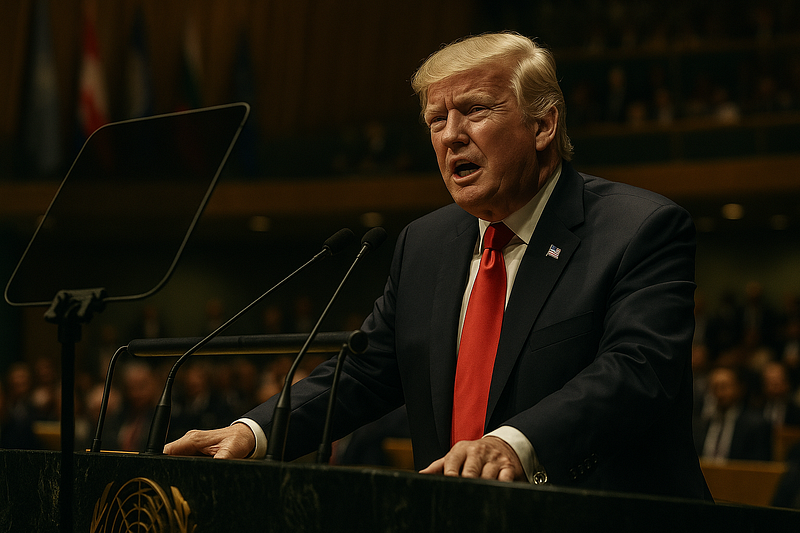
The United Nations General Assembly in New York was designed for ritual. Flags align in precise rows, interpreters’ booths glow behind glass, and delegates sit beneath the high ceiling, waiting for the voice of the moment’s speaker. On 23 September 2025, that voice belonged to U.S. President Donald Trump.
As cameras tightened their focus, the rhythm faltered. The teleprompter flickered, its letters froze, and Trump paused. For a moment the hall was silent, caught between protocol and disruption. Then he leaned into the microphone and said: “The teleprompter is not working. Whoever is operating this teleprompter is in big trouble.”
What followed no longer carried the polish of scripted diplomacy. The words unfolded raw, sharp, direct. This speech would not be remembered for careful sentences, but for the absence of them.
“The moment the screen went dark, the façade of diplomacy cracked. What remained was unfiltered power speaking in its own voice.”
The United Nations attacked
Dismissing the stage itself
Trump began by questioning the purpose of the UN itself. “What is the purpose of the United Nations?” he asked, accusing the institution of being a forum of empty resolutions without results. He contrasted that with his own leadership, claiming to have “ended seven wars in just eight months.”
The claim was dramatic, but it faltered on inspection. No verifiable evidence supports the notion that seven wars ended under Trump’s hand. Egypt and Ethiopia, cited as examples, were not at war. Other conflicts he implied had been resolved still burned on.
The record against the rhetoric
The United States has long had an ambivalent relationship with multilateral institutions. In 1919, the Senate rejected membership in the League of Nations. In 1961, John F. Kennedy used the same stage to urge negotiation “never out of fear.” In 1960, Nikita Khrushchev pounded his shoe in this hall. In 2003, Washington bypassed the UN altogether to invade Iraq.
Trump’s 2025 remarks fit this lineage, but with a twist. Where past leaders dramatized or defended their agendas through the Assembly, Trump dismissed the institution outright.
“When a leader mocks the stage itself, the performance is no longer diplomacy. It is demolition.”
Migration as invasion
The hostile framing
From the podium, Trump shifted to migration, calling it an “invasion” and warning European leaders their countries were “going to hell” if they did not close their borders. Migration was not presented as a humanitarian challenge but as a hostile act undermining sovereignty.
By choosing the language of invasion, Trump recast refugees as armies and borders as battlefields.
“The very flows of people Trump condemned as invasion often trace back to wars in which America itself was a central actor.”
What reality shows
Migration is driven by conflict, poverty, persecution, and climate change. International law obliges states to protect refugees, not vilify them. To label migration as invasion is to erase its causes and to ignore frameworks designed to manage it.
Forgotten origins of refugee flows
The wars behind the movement
The flows of people that reached Europe in recent decades did not appear from nowhere. They stemmed from wars in which the United States and its allies played decisive roles. The 2003 Iraq invasion displaced millions. The 2011 NATO intervention in Libya destabilized North Africa, expanding Mediterranean crossings. Two decades of U.S. presence in Afghanistan ended with a chaotic withdrawal that triggered another exodus.
These episodes are not marginal. They are central to the refugee story. The irony of Trump’s words is that he condemned consequences without acknowledging causes.
The silence in the hall
Delegates in the chamber knew these histories. The silence that followed Trump’s words was not surprise but recognition. The hall remembered Iraq, Libya, Afghanistan. The hall remembered that the U.S. had helped create the very crises it now described as invasion.
“The refugee flows Trump condemned were, in part, America’s own shadows returning across the sea.”
The UN accusation
Turning the institution into a culprit
Trump accused the United Nations itself of facilitating migration to the United States, claiming it had “budgeted hundreds of millions of dollars” to bring migrants in. It was a dramatic reversal: the UN, born as an arena of states, recast as an active adversary.
The reality was more prosaic. Agencies such as UNHCR and IOM operate along migration routes, but their role is tents, food, registration. They do not charter flights to the United States. They cannot override national decisions. Every refugee resettlement to America requires America’s own signature.
“Far from a secret pipeline, UN agencies were shrinking under U.S. cuts.”
In 2025, Washington’s own budget reductions left those agencies warning of “dramatic consequences.” The claim of hundreds of millions being spent to move migrants into the U.S. ignored the truth: the operations were being starved, not expanded.
Climate as scam
The great dismissal
Trump dismissed climate policy as “the greatest scam in history.” He mocked renewable energy, called wind turbines “inefficient and harmful,” and ridiculed international agreements.
The dismissal was not casual. It contradicted the central consensus of global science. Decades of data confirm the planet is warming because of human activity. The Intergovernmental Panel on Climate Change has described the moment as “code red for humanity.”
“Where delegates gathered to confront evidence, Trump dismissed evidence itself.”
The Paris shadow
For the Assembly, climate change is not abstract. It is floods in Bangladesh, droughts in Africa, fires in Australia, storms in the Caribbean. The Paris Accord, signed by nearly every nation, was designed as the collective response. Trump’s scorn was more than contrarian; it was rejection of the very reason the chamber existed.
The silence that met his words was heavy. Diplomats did not argue, did not interrupt. They listened, and they noted. In diplomacy, silence is not absence. It is a verdict.
Ukraine and the “simple deal”
The promise of easy peace
On Ukraine, Trump declared the war could be solved through a “simple deal”, sanctions lifted in exchange for peace. The phrasing was seductive. Simple deals always are.
But history said otherwise. Ukraine demanded restoration of its territory. Russia insisted on recognition of annexations. Sanctions slowed Moscow’s economy but did not force retreat. The war was not a negotiation over tariffs. It was a struggle over sovereignty.
“The idea of a simple deal concealed the depth of a conflict rooted in land, memory, and blood.”
The hardened positions
Trump’s line ignored the stalemate. Since 2014, trenches had been dug not only in soil but in politics. Kiev would not yield territory. Moscow would not surrender gains. Diplomats in the Assembly knew the weight of these positions. What Trump offered was not resolution but simplification.
America as non-neutral actor
The myth of detachment
Trump framed the United States as a potential broker, an external force that could trade sanctions for ceasefire. The record told a different story. Since 2014, Washington had trained and armed Ukrainian forces, provided billions in financial support, and led sanctions against Russia.
America was not outside the conflict. It was inside its machinery.
“By calling itself a broker, Washington disguised the hand already moving the board.”
The aggressor in disguise
In Russian narratives, the United States was no peacekeeper but an aggressor cloaked in neutrality. To many in the hall, this rang true. Whatever label one prefers, the reality remained: America was not detached. It was a driver of events it claimed merely to observe.
Europe’s energy dependence
The accusation
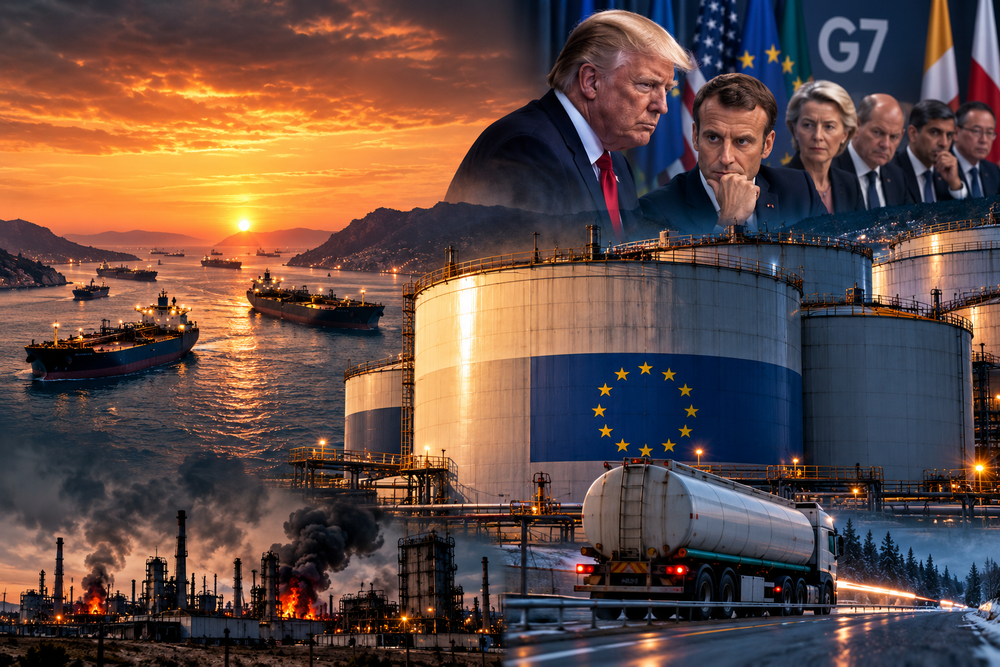
Trump mocked Europe for condemning Russia while still buying Russian oil and gas. The charge was not false, but it was incomplete.
Yes, Europe had long relied on Russian pipelines. But after 2022, imports fell sharply as states turned to Norway, the Middle East, and above all the United States.
The hidden rupture
The true rupture was not consumer hypocrisy but sabotage. The explosions that disabled the Nord Stream pipelines in September 2022 ended Europe’s direct line of supply. No culprit was officially named. Washington denied involvement, though investigations pointed in its direction.
Whatever the truth, the result was undeniable. Europe lost cheap Russian gas and turned to American liquefied natural gas at several times the price. U.S. energy companies reported record profits. The dependence had not disappeared. It had shifted.
“Europe’s scramble for energy did not liberate it. It bound it to a different master.”
Gaza and Palestine
Hostages as slogan
On Gaza, Trump promised that hostages would be freed “with or without the United Nations.” He said recognition of Palestine was a “reward for Hamas.”
The chamber knew better. Hostage negotiations at the time were brokered by Egypt, Qatar, and the UN itself. To call the institution irrelevant was to ignore the machinery already at work.
Recognition of Palestine was not a gift to terrorism but, for many states, a path to negotiation. By collapsing recognition into betrayal, Trump erased decades of diplomacy with a single phrase.
“By turning hostages into a slogan and recognition into treason, the speech reduced a decades-long conflict to improvisation.”
Iran as perpetual enemy
Accusation without opening
Trump expanded his critique to Iran, labeling it the “chief sponsor of terror” and blaming it for enabling Hamas and other groups. His words contained no nuance, no opening for dialogue.
Iran’s role in the region is contested. Tehran acknowledges moral and political support for militant groups but denies orchestrating every act of violence. Previous U.S. presidents condemned Iran while leaving space for negotiation. Trump did not.
He cast Iran not as a state but as a category: the eternal enemy.
“Iran was not described as a government one might one day negotiate with, but as the perpetual foe around which alliances must harden.”
The economy as myth
The golden age claim
Trump ended with the U.S. economy, calling it a “golden age.” He claimed inflation had been defeated, prices were falling, and $17 trillion in investments were arriving. The words were triumphant, but the numbers resisted.
Official statistics showed inflation edging upward in the months before his speech. No record of $17 trillion in new investment could be found. Analysts searched in vain for evidence. What remained was not a report but a narrative.
“On a stage built for multilateral dialogue, the president delivered the language of campaign rally triumph.”
The chamber as backdrop
The Assembly hall was designed for collective debate. In Trump’s hands it became a backdrop for national self-celebration. Diplomats listened not to policy but to performance, not to negotiation but to narration.
Global reactions
The silence of diplomacy
The reception was uneven. In Europe, diplomats described the speech as unusually harsh, silence replacing applause. Across the Global South, some delegates welcomed the criticism of global institutions, hearing echoes of their own frustrations. In media worldwide, coverage emphasized factual inaccuracies and tied the improvisational tone directly to the teleprompter malfunction.
In diplomacy, applause is optional. Silence is intentional.
“The silence that filled the chamber was its own form of verdict.”
Closing reflection, the peacekeeper abandoned
From referee to player
Since 1945, the United States has been cast as peacekeeper, the guarantor of a fragile order built on institutions it helped design. Trump’s 2025 speech suggested otherwise. The U.S. moved from referee to player, from multilateralism to sovereignty, from diplomacy to bluntness.
Where past leaders used the Assembly to defend or dramatize their visions, Trump used it to dismiss the institution itself. The words were less policy than posture, less argument than rejection.
“When the peacekeeper abandons neutrality, the world is left without a referee.”
The silence remembered
The speech of 23 September 2025 will be remembered less for its claims than for its delivery. The teleprompter’s failure stripped away the veil of ceremony, exposing a voice unfiltered. The content rested on assertions unverified by fact. The hall built for cooperation became the stage for its dismissal.
Whether this moment will be remembered as a passing improvisation or as the point where America abandoned the language of peacekeeping altogether is uncertain. But the silence that followed was historic.
“Remember always where it truly began, and who set it in motion.”
Related from The Manifest Archive