Prologue | The Day the River Stood Still
On a quiet morning near Vinci, long before anyone knew his name, the river Arno did something unusual.
It slowed.
Not enough for the villagers to notice.
Not enough to disturb the mills or the fishermen.
But enough for one boy standing on the bank to see it.
The light folded differently on the surface, as if the water had momentarily remembered a shape it once knew.
Leonardo watched without blinking.
The world around him moved as it always did.
Yet something in the river’s hesitation matched something in him.
A pattern.
A whisper.
A memory.
He knelt and traced the curve in the mud.
It belonged to no local geography, no Renaissance handbook, no childhood imagination.
It belonged to something older.
And the world had not changed that morning.
Only one mind had.
Years later, when he drew vortices of air and galaxies no one had mapped, the same geometry returned to his page.
He never explained why.
Some memories do not require language.
History calls him a genius.
But geniuses are born.
Leonardo behaved like someone who was returning.
Everything he made felt less like invention and more like restoration.
A restoration of a world the rest of us had already forgotten.
Some truths are buried by ignorance.
Others by design.
Leonardo da Vinci knew the difference.
The Mind That Was Not Born Into Its Time
By fifteen, the villagers no longer laughed when they saw him kneeling in fields tracing spirals.
They sensed something beyond curiosity, something deliberate.
He did not observe the world.
He interrogated it.
A bird did not merely fly.
It solved an equation.
Water did not flow.
It revealed an intelligence.
Faces did not express emotion.
They exposed micro-structures beneath thought.
To Leonardo, nature was not scenery. It was a system speaking in code.
His notebooks contain no hesitation.
He wrote as if confirming what he already suspected, as if the world would match forms he recognized intuitively.
Discovering and remembering are not the same.
Leonardo’s notebooks belong unmistakably to the latter.
The Forbidden Anatomy
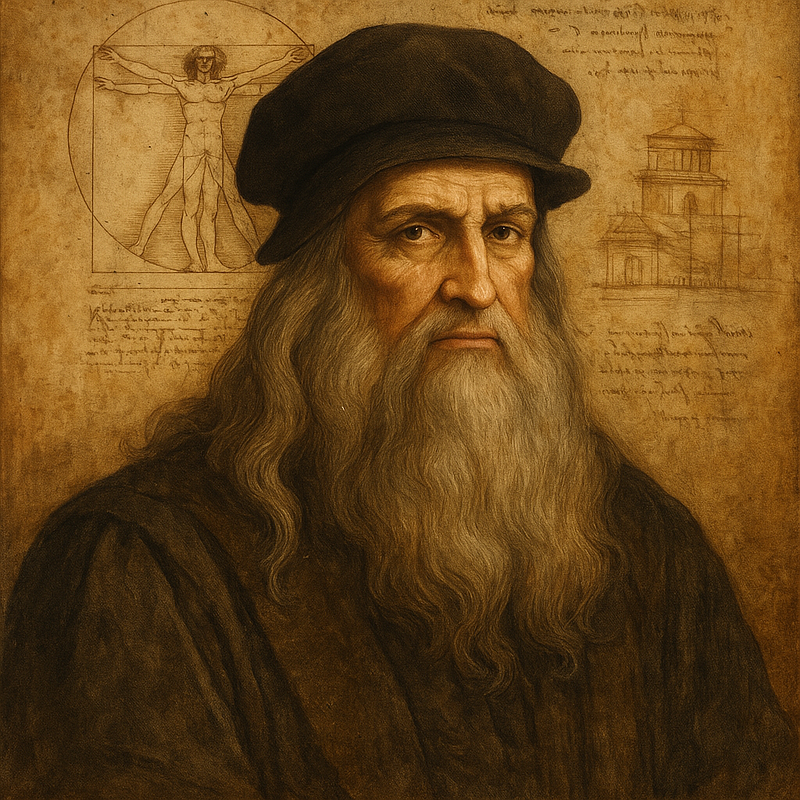
In the winter of 1508, Leonardo began dissecting human corpses at night, guided by oil lamp and a sense of obligation he never explained.
His anatomical drawings remain astonishingly precise even now.
But precision is not the anomaly.
Premonition is.
He drew structures Renaissance anatomy could not name.
Filaments suggestive of neural conduction.
Channels behind the eye resembling modern ocular pathways.
Lattice tissues beneath the ribs resembling early immunological mapping.
One sketch shows a radial pattern around the skull.
Dismissed as ornamentation by historians.
Recognized quietly as proto-electrophysiology by neuroscientists.
Another depicts a cardiac node not formally identified until centuries later.
Mistakes, they say.
Yet Leonardo’s mistakes grow more accurate with time.
The most threatening pages are missing.
Edges cut cleanly.
Leaves removed.
Knowledge does not vanish.
It is guided away from the places where it becomes dangerous.
Machines From a Forgotten World
The machines people know, the gliders, the bridges, the automata, are the safe ones.
The ones allowed to survive.
The real anomalies hide in the margins.
A rotating frame designed to cancel torque.
A chamber directing air like early ion propulsion.
A device suspended over a magnetic axis with no visible means of support.
No theory of his century could produce such sketches.
Yet Leonardo drew them tentatively, like a man trying to recall something rather than invent it.
A propulsion expert who studied these diagrams centuries later whispered:
“This is reconstruction, not imagination.”
These machines echo geometries found in ruins Leonardo never saw.
Ratios repeated in pyramids, megaliths, temples carved by hands erased from history.
Principles embedded in stone, rediscovered on parchment.
He was not building for a future he envisioned.
He was retrieving fragments of a world he intuited.
Light as a Carrier of Memory
Leonardo’s writings on light are the most disquieting.
He wrote that light travels with speed.
That it bends.
That observation alters it.
But the most troubling term he used is almost untranslatable.
Light carries qualità.
Not quality.
But encoded essence.
Memory.
In one margin:
“The eye receives what the light remembers.”
This is not metaphor.
This is information theory, articulated centuries before physics had vocabulary for it.
Below the words are sketches resembling wave interference.
Diagrams eerily similar to the double-slit experiment.
Curves matching quantum behavior long before quantum language existed.
He was not speculating.
He was recognizing.
Light stores information.
Leonardo sensed it intuitively because he recognized the pattern from elsewhere.
The Echo of Civilizations That Should Not Be Connected
Across his notebooks appear references impossible for his time.
Hydraulic solutions resembling Mesoamerican engineering.
Ratios found in Anatolian ruins.
Structural geometries mirroring the Indus Valley.
Symbols echoing Paleolithic cave spirals.
Historians call this coincidence.
But coincidence repeated with precision becomes something else.
Leonardo’s work reads like fragments of a curriculum from a forgotten epoch.
A scientific language older than the Renaissance.
Recovered through intuition.
He was not ahead of his time.
He was out of sequence.
The Institutions That Preferred Obedience
Institutions did not fear Leonardo’s brilliance.
They feared his coherence.
Truth rarely destabilizes power.
Patterns do.
Leonardo’s pages suggested:
A world older than doctrine.
A humanity shaped by forces unrecorded.
A continuity of knowledge inconsistent with Europe’s narrative of rebirth.
When a page contradicted orthodoxy, it was archived.
When a sketch revealed too much, it was separated.
When a theory became intolerable, it quietly ceased appearing in inventories.
This is not conspiracy.
It is choreography.
Every age preserves its authority not by what it tells the world, but by what it prevents the world from remembering.
Leonardo threatened remembrance.
The Strange Modern Confirmation
Five centuries later, modern science keeps drifting toward him.
Neuroscience confirms the conduction patterns he drew.
Cardiology acknowledges the structures he mapped.
Fluid dynamics reads like commentary on his vortices.
Quantum optics echoes his diagrams of interference.
Astronomy reveals shapes he traced instinctively.
If Leonardo lived today, he would not astonish us.
He would align with us.
And alignment implies continuity, not ahead, not behind, but part of a longer, forgotten arc.
The Memory He Tried to Protect
In his last notebooks, Leonardo wrote:
“The hand remembers what the mind forgets.”
He was not being poetic.
He was diagnosing himself.
He drew what he could not fully express.
He remembered what the world had forgotten.
His work is not the dawn of the modern age.
It is the residue of an earlier one.
A world erased through narrative, not catastrophe.
A world whose geometry survived only in ratios, instincts and the few minds capable of hearing its echo.
Leonardo heard it.
Meta-Reflection | The Fact, the Meaning, the Misinterpretation
The fact:
Leonardo produced knowledge centuries before humanity possessed the instruments to verify it.
The meaning:
His work implies inheritance from an older framework of understanding.
The misinterpretation:
History calls it genius because genius preserves the timeline.
Patterns do not.
Patterns require explanations.
It is safer to praise the mind than confront the memory that shaped it.
Deep Consequence
We call Leonardo ahead of his time because admitting the alternative would fracture our timeline.
We call him genius because the truth, that he was not the source but the echo, destabilizes everything.
We venerate his notebooks because we fear what their missing pages might confirm.
We insist he was singular because we fear those who came before him.
We celebrate the Renaissance because it conceals the evidence of civilizations forgotten rather than fallen.
Closing Reflection | The Hand That Remembered
In the end, Leonardo left a warning disguised as simplicity:
“The hand remembers what the mind forgets.”
He meant that creation is not invention but inheritance.
That knowledge is not generated but resurfaced.
That humanity is shaped not only by its future but by its buried past.
He was not imagining the impossible.
He was retrieving the inevitable.
And the world, unable to tolerate the implications, did what empires always do when confronted with someone who remembers too much.
It curated him into safety.
It celebrated the paintings, not the questions.
It protected the myth, not the memory.
It turned the truth into silence.
Knowledge does not disappear.
It waits.
And when it returns, it chooses a mind unafraid of its weight.
Leonardo was such a mind.
And the story of his life is not the origin of genius, but the shadow of a deeper continuity.
Remember always where it truly began, and who set it in motion.
Related from The Manifest Archive