On the evening of 5 December 1976, a man walked onto a stage in Kingston, Jamaica, in front of roughly eighty thousand people, with a bullet still lodged in his left arm. Two days earlier, seven armed men had pushed into his house on Hope Road and opened fire. His wife had been shot in the head and survived. His manager had taken the worst of the fire, shot in the legs and torso, and survived. Bob Marley had been hit in the chest and arm, and now, forty-eight hours later, he played for ninety minutes anyway. No one was ever tried for the attack.
The stage he stood on was already political, whether he wanted it or not. Jamaica in 1976 was under a state of emergency, its neighborhoods carved up by gangs aligned with the two parties, and the concert, called Smile Jamaica, had been promoted by Michael Manley's government as a unity event. Marley had agreed on the understanding that it was national, not partisan. Then Manley called a general election for 15 December, ten days after the concert date, and the distinction dissolved: the biggest voice in the country was now, in appearance, singing for the government two weeks before a vote. The gunmen came two days before the show. Who sent them has never been established, and this essay will not pretend to know. What the episode fixes in place is the theme of everything that follows: Marley had become a figure whose stage presence could plausibly move an election, which is to say he had stopped being an entertainer in the eyes of everyone who mattered, and the people who understood that first were not his listeners.
What happened on that stage is documented. What happened afterward is the subject of this essay, because afterward is where the interesting machinery lives.
There is a silence that follows certain deaths that feels different from grief. It is not the quiet of shock, nor the stillness of mourning. It is a managed silence. Briefly permissive, then decisively closed. Questions are allowed to rise just long enough to appear humane, before they are gently guided toward resolution.
A cause is named. A narrative is set. The file is closed.
What disappears is not the person. What disappears is the direction they were pointing.
The world rarely stops when such figures vanish. It reorganizes. Interviews are replayed with new emphasis. Lyrics are softened by nostalgia. Images are reframed until they can be admired without friction. The edge is removed, not by denial, but by context.
This essay is not about death. It is about what happens immediately before and immediately after.
Let that sentence carry its full weight, because it is also a boundary. The original version of this chapter let the reader conclude that a pattern of deaths was itself the finding. That conclusion outran the evidence, and this version will not repeat it. Marley died of a melanoma first diagnosed under a toenail in 1977, four and a half years after the shooting. That is the documented record, and nothing in this essay disputes it. What this essay traces is something that does not need a hidden hand behind any death to be real, because it is visible in paperwork: the file that opens while the voice is alive, the reframing that follows, the speed of closure when the voice is gone, and the myth that is installed afterward. Each stage of that sequence has left documents. We are going to read them.
The memo that wrote down the theory
The reason this pattern can be treated as a mechanism rather than a mood is that, at least once, the state wrote the theory down itself.
In March 1968, the FBI circulated a memorandum to its field offices setting out the goals of its counterintelligence program against what it called black nationalist groups. The program was COINTELPRO, running since 1956, and the memo's language was not analytic but architectural. Among the stated goals: prevent the coalition of militant groups, and, in the memo's own capitalized urgency, prevent the rise of a messiah who could unify and electrify the movement. The bureau was not describing a criminal to be caught. It was describing a junction to be prevented: a figure through whom separate frustrations might begin to flow in one direction.
The public was never meant to read that sentence. It surfaced because, on 8 March 1971, a group of activists burgled an FBI field office in Media, Pennsylvania, and mailed the program's files to newspapers, and because the Church Committee spent 1975 and 1976 dragging the rest into the congressional record. The Manifest has traced that program's full anatomy elsewhere; what matters here is the sentence itself. It is the clearest statement in the modern record that institutions think about cultural figures in exactly the terms this essay proposes: not as artists with opinions, but as infrastructure through which direction can travel.
That is a Level 1 fact, in the archive's terms: a documented instruction, in the government's own hand. Hold onto it. Everything that follows is an attempt to establish how far beyond that documented core the pattern actually extends, and where the evidence stops.
When culture stops entertaining
A cultural figure grows beyond entertainment. That is the moment everything changes, and it is worth being precise about why.
Music can be turned off. Films end. Icons age. As long as culture remains optional, it poses no structural threat. It absorbs emotion without redirecting it. It gives identity without agency. In this form, culture is not merely tolerated. It is actively promoted.
The problem begins when culture changes function.
When a musician is no longer background but reference. When an actor becomes a mirror rather than an escape. When a public figure begins connecting fragments of discontent into a shared intuition.
At that point, culture stops behaving like a product and starts behaving like infrastructure. Infrastructure does not persuade. It routes. It shapes how ideas move, where they gather, and what they can reach. Unlike institutions, cultural infrastructure cannot be regulated openly. It does not announce authority. It spreads horizontally, through identification, repetition, and emotional recognition.
This is the precise moment when tolerance shifts to attention. Not applause. Observation. The 1968 memo is what that shift looks like when it is written down. The files are what it looks like when it is carried out.
The file: three documented cases
Files are rarely opened to accuse. They are opened to preserve options. A file allows institutions to track trajectory rather than intent, movement rather than guilt. That claim would be an aphorism if the files themselves had not been pried loose. They have been, three times, in three different decades, and the pattern inside them is consistent.
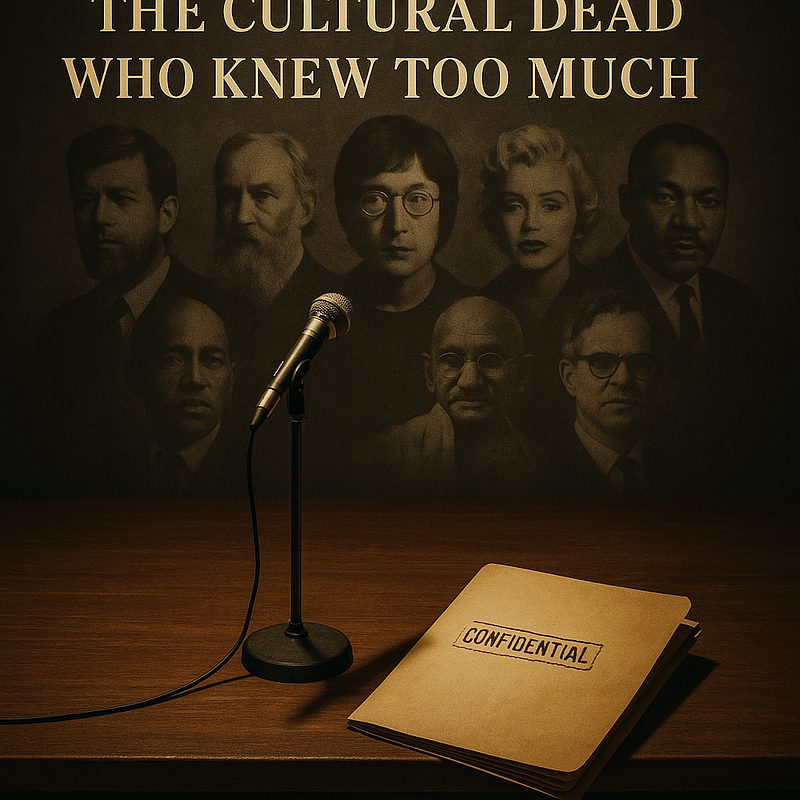
John Lennon. The FBI's file on Lennon runs to roughly three hundred pages, and it took the historian Jon Wiener twenty-five years to get it. He asked for it in 1981; the bureau fought him, with the ACLU at his side, for a quarter of a century, and surrendered the last ten documents only in December 2006. What the pages show is the mechanism in miniature. The surveillance did not begin when Lennon sang about peace; it began in late 1971, when Lennon's money and fame started to overlap with antiwar organizing in an election year, and concerts stopped being performances and started being gatherings. In February 1972, Senator Strom Thurmond sent a memo to the Attorney General suggesting, in the memo's own words, that terminating Lennon's visa would be "a strategy counter-measure." Weeks later, the Immigration and Naturalization Service opened proceedings to remove Lennon from the country. The file contains informant reports on the daily lives of activists, transcripts of television appearances, and a proposal that Lennon be arrested by local police on drug charges. What the file does not contain is any crime. That is the point. Its function was never prosecution. It was orientation.
And it kept the campaign's calendar, not the man's. The surveillance thickened through the spring of 1972, as the election approached, and thinned after Nixon's re-election that November. The deportation order was overturned in October 1975; the green card followed in 1976. Lennon's politics had not changed across those four years. The dates on which they could matter had. A file that tracks a person rises and falls with the person. A file that tracks a threat rises and falls with the threat's window, and this one moved with the window. Five years after the file went quiet, Lennon was shot outside his home by a fan with no connection to any of it, a fact this essay states plainly and builds nothing on.
Marilyn Monroe. Monroe's file tracks a different axis of risk: proximity rather than projection. The version the FBI re-released with many of the redactions removed in December 2012 centers on her February 1962 trip to Mexico and her friendship with Frederick Vanderbilt Field, an American disinherited for his leftist politics; informants reported on her conversations and on the alarm inside her own circle. The bureau monitored her for communist ties until her death that August and, by its own records, never established that she was anything of the kind. The danger was not what she said. It was what she heard. The file, again, contains no crime. It contains a map of a person's reach.
Tupac Shakur. Tupac did not acquire a file. He was born into one. His mother, Afeni Shakur, was a member of the Black Panther Party and a defendant in the Panther 21 case, arrested in the sweep of April 1969, tried, and acquitted with the others in May 1971. Tupac was born one month later. The Panthers were a named target of the same COINTELPRO whose 1968 memo opened this essay, which means the machinery of institutional attention predates Tupac's first breath. By the 1990s his own FBI paperwork, released after his death, records the bureau investigating death threats made against him, in an extortion scheme it attributed to the Jewish Defense League. Read carefully: the documented federal file treats him as a victim, not a target, and honesty requires saying so. The broader monitoring was municipal, and it, too, eventually surfaced in paper: the Miami Herald revealed in March 2004 that police in Miami and Miami Beach had been compiling dossiers on visiting rap artists as a category, consulting a binder of rappers' arrest records supplied by a New York police intelligence unit that did the same. Surveillance organized by genre rather than by suspect is the 1968 memo's logic, sixty blocks downtown and thirty years on. Here, the lineage is the finding. From his mother's courtroom to his own threat file, the state's attention was a family inheritance, and his arc from personal narrative to systemic critique unfolded entirely inside it. He was shot in Las Vegas in September 1996; a suspect was finally charged only in 2023. The murder itself, for twenty-seven years, sat unsolved, and this essay draws no conclusion from it beyond the one already stated: the aftermath, not the act, is where the pattern lives.
Three files, three decades, one shape. None of the three contains an actionable offense. All three map trajectory: who the person was becoming, who was orienting around them, where it all pointed.
A voice that cannot be argued with is often redefined as unreliable.
The man who was removed alive
If the file and the myth are one machine, a single case shows it running start to finish with no death in it anywhere, and it is the most load-bearing case in this chapter precisely because its subject lived through every stage.
Paul Robeson was, at mid-century, one of the most famous performers on earth: the son of a man who had escaped slavery, an All-America football player at Rutgers, a singer who filled concert halls on four continents, and, increasingly, a political voice on colonialism and civil rights that fit no acceptable category. In 1950, the State Department revoked his passport. The foreign halls had been his income; the domestic ones now closed to him one by one. His earnings fell from more than a hundred thousand dollars in 1947 to a few thousand a year by the early fifties, by varying accounts. And then came the retroactive stage, the one that gives this essay its title: his name was struck from the All-America record, so that the official roster of the 1918 team listed ten men. Not eleven men and an asterisk. Ten. The passport came back in 1958, after the Supreme Court gutted the doctrine that had taken it. The football record waited until 1995, when he was inducted into the College Football Hall of Fame, nineteen years after his death.
No one shot Robeson. No coroner ever appeared. The removal was administrative at every step: a travel document, a concert booking, a line in a sports almanac. The mechanism this chapter describes does not need a body. It needs a pen, and patience, and it works best on the parts of the record no one thinks to guard, like a roster from 1918.
And if the name Paul Robeson means little to you now, notice that this is the finding, not an aside. He was one of the most famous men alive. The machine is why you have to be told that.
Character as containment
No cultural figure exists without flaws. That is not the question. The question is how flaws are framed once influence crosses a threshold, and here the archive must be careful, because this is where documented fact and marked interpretation must be visibly separated.
The documented layer is ownership. In August 1985, Michael Jackson paid 47.5 million dollars for the ATV catalogue, which included the publishing rights to roughly two hundred and fifty Beatles songs. He was no longer a performer; he was a holder of cultural capital, one of the most valuable private archives of the century's emotional life. In 1995 he merged it with Sony's publishing arm into Sony/ATV, and by 2016 his estate would sell its remaining half to Sony for 750 million dollars. Prince fought the same war from the other side: unable to own his masters, he changed his name to an unpronounceable symbol in 1993 and performed with the word SLAVE written on his cheek, until he finally regained his masters from Warner in 2014, two years before his death.
Ownership is what connects these cases to the files that came before. It transformed influence from symbolic to structural. A star can be reframed; a rights-holder must be dealt with.
The interpretation, and it is marked as such, is that ownership changed the narrative environment around both men. In Jackson's case, eccentricity that had been indulged as genius began, in the years after the purchase, to function in coverage as evidence of something wrong. Context collapsed into caricature. By the time the criminal allegations arrived, and he was acquitted on all counts at the 2005 trial, the public frame had long since been set, and no acquittal adjusted it. Whether the reframing was caused by the ownership, or merely coincided with it, cannot be established from the public record, and this essay does not claim causation. What can be said at Level 2, as pattern rather than accusation, is this: in both cases the fight over who owned the catalogue and the fight over who defined the man ran on the same calendar, and the second fight is the one the audience was shown.
Prince fought for ownership until ownership became the story. Whitney Houston's voice was reframed as fragility. Philip Seymour Hoffman's precision collapsed, in the telling, into addiction. Different lives. Different talents. The same reduction. Once complexity is translated into pathology, no further context is required. When a figure becomes difficult to frame structurally, their inner life is made to carry the explanation.
Hold Houston and Hoffman in mind. They return at the end of this essay, in a different role than you expect.
The administrative life of a death
There is a moment after certain deaths when chaos is expected. What follows instead is order. Statements align quickly. Timelines settle. Contradictions are acknowledged but never integrated. The speed of closure becomes the most remarkable detail.
That observation stays rhetoric until you watch the sequence run in a case where every step left paper. There is such a case, and it is not a musician.
Gary Webb was an investigative reporter at the San Jose Mercury News. In August 1996 the paper published his series Dark Alliance, which documented how a drug ring connected to the CIA-backed Nicaraguan Contras had helped feed the crack trade in Los Angeles while investigations around it stalled. What happened next is the best-documented dismantling of a working journalist in the American record. The Los Angeles Times, the New York Times, and the Washington Post attacked the series at length, and the attacks migrated, in the familiar way, from the work to the man. In May 1997 Webb's own executive editor, Jerry Ceppos, published a column conceding errors of emphasis in the series, and the paper transferred Webb to a suburban bureau a hundred and fifty miles from his home, covering local news. He resigned before the year was out. He never worked in daily newspaper journalism again.
Then came the confirmation of the core, though not of Webb's every conclusion, timed like a punchline history plays on itself. In October 1998, the CIA's own Inspector General, Frederick Hitz, published the second volume of his internal investigation, which acknowledged that the agency had continued relationships with dozens of Contra-connected individuals despite allegations of drug trafficking, and that investigative and reporting obligations had been sidestepped for years. It was released in the same news cycle in which the House voted to open impeachment proceedings against the sitting president, and it drew a fraction of the attention that the demolition of Webb had drawn two years earlier. The vindication was printed. It simply was not amplified. He was dismantled first, and vindicated on the essentials later, and the second act was quieter than the first.
And in Webb's case, uniquely, we know how the mechanism looked from the inside, because the agency wrote that down too. In 2014, a Freedom of Information request pried loose a six-page internal CIA account, written by a CIA officer for the agency's in-house journal in 1997 and titled, in the agency's own words, Managing a Nightmare. It reviews the Dark Alliance episode as a public relations crisis that resolved itself, crediting what it called the agency's productive relations with journalists, and observing with visible relief that other news organizations were dismantling the story with little need for the agency to intervene. The document does not claim the CIA orchestrated the pile-on. It records something structurally more interesting: that the agency did not have to. The newsroom incentives ran the containment on their own, while the subject of the containment watched the memo's title happen to his life. This is not censorship. It is curation, observed and filed by its principal beneficiary.
Webb was found dead in his home on 10 December 2004, with two gunshot wounds to the head. The Sacramento County coroner ruled it a suicide, and when the two shots drew public disbelief, the coroner stated publicly that two shots in a suicide is unusual but has occurred and was, in his words, a distinct possibility. This essay records that ruling as the official record, disputes no part of it, and needs no other version. The mechanism this chapter traces had finished its work seven years before Webb died. He was removed from journalism in 1997. Everything afterward was aftermath.
Michael Hastings belongs beside him, with the same discipline applied. Hastings was the reporter whose 2010 Rolling Stone profile ended the career of the commanding general in Afghanistan. He died on 18 June 2013, at around 4:25 in the morning, when his car left a straight Los Angeles road at very high speed and struck a palm tree. The police found no evidence of foul play. A former national counterterrorism official, Richard Clarke, told an interviewer that the known details were consistent with what a car cyberattack could look like, while stating plainly that he had no evidence of one; the remark is documented, and it is a remark about possibility, not proof. What is also documented is this: journalists suing under the Freedom of Information Act forced the FBI, three months after the crash, to release a 21-page file that mentioned Hastings, after the bureau had publicly insisted he was never under investigation; the file shows his reporting had been memorialized inside a counterterrorism investigation of the Bergdahl case, and it flagged the story as controversial reporting. Twenty-one pages, no accusation, no crime. Orientation.
Different professions. The same administrative pattern, before and after. Psychological explanations arrive early and dominate completely. They are not required to be perfect. They are required to be final. What is not pursued does not need to be disproven. It only needs to be closed.
The control group
Now return to Whitney Houston and Philip Seymour Hoffman, as promised, because they are in this essay to discipline it, not to swell it.
Houston died in February 2012; the coroner recorded accidental drowning, with heart disease and cocaine use contributing. Hoffman died in February 2014 of acute mixed drug intoxication, after two decades of sobriety ended in relapse. There is no file, no memo, no deportation proceeding, no institutional dossier in either case. And yet the reduction ran anyway, on the same rails and at the same speed: the voice became fragility, the precision became addiction, the complexity became pathology, and the myth arrived on schedule.
This is the essay's own falsification test, applied to itself, and it cuts the claim down to its true size. If the reduction machinery runs identically with and without institutional attention, then the reduction alone proves nothing about institutions. It is ambient. It is what mass culture does to any complicated person who dies. What distinguishes the political cases is not that a myth was built, but the documented sequence around it: the file before, the reframing during, the closure after. Where that full sequence is visible in paper, as with Lennon, Webb, and Hastings, the pattern is a finding. Where only the myth is visible, it is not, and this essay declines to count such cases as evidence. The original version of this chapter counted them. That was the error.
Myth as a safe container
After closure comes preservation. Not of truth. Of image.
Lennon becomes peace without politics. Marley becomes unity without geopolitics. Monroe becomes tragedy without proximity. Tupac becomes youth without trajectory.
The myth is not a lie. It is a reduction. A myth preserves admiration while disabling direction. Memory replaces movement. Nostalgia replaces continuation.
That would remain an aesthetic observation if the reduction had never left a paper trail of its own. It has, at least once, in detail, and the case is Marley's.
In 1984, three years after Marley's death, Island Records prepared the compilation that would become Legend. Island's founder, Chris Blackwell, initially envisioned presenting Marley as the militant he had been. The executive running the project, Dave Robinson, had a different aim, which he stated in six words: sell him to the white world. Robinson commissioned a researcher, Gary Trueman, to run focus groups with white suburban record buyers in England, and the groups reported back precisely what stood between them and the purchase: the religion, the politics, the violent undertones, even the word reggae. They loved the music. So the campaign was built on the findings. The word reggae was kept out of the promotion. The track list was assembled to soothe: love songs forward, and the explicitly political material from the Survival era left off. The video for One Love presented a smiling family man, with a Paul McCartney cameo to certify harmlessness. It worked better than anything Island had ever done with the living Marley: Legend became, and remains, the best-selling reggae album in history.
Read the sequence whole. The man who walked onstage in 1976 with a bullet in his arm, two days after seven gunmen tried to end him in an election season, was, by 1984, a poster about universal love. The reduction was not drift, not nostalgia, not the soft forgetting of time. It was a product decision, tested in focus groups, executed against the explicit image of the man, and it is documented in the recollections of the people who made it. The 1968 memo wrote down the theory of the file. The 1984 focus group wrote down the theory of the myth. The mechanism this essay traces runs between those two pieces of paper.
And, unlike the surveillance, the myth has a balance sheet that can be read.
Jackson's estate collected 750 million dollars from Sony in 2016 for the catalogue half, part of more than two billion dollars the estate has been paid across its major deals, and in the year of the Sony buyout the dead Jackson out-earned every living entertainer on the planet. The posthumous Marley sells more than the living one ever did, on merchandise from headphones to beverages. Monroe's image is licensed by a brand-management corporation. The estates are not villains in this; they are heirs collecting what the work is worth. The forensic point is narrower and colder. Every party with standing to shape a dead icon's public meaning, the estate, the label, the licensee, the documentary producer, earns more from the reduced version than from the directional one. Peace sells. Politics complicates the licensing. No conspiracy is required to explain why the safe myth wins; the incentive gradient runs one way, and everyone standing on it slides in the same direction.
That is also why the myth needs no maintenance department. It maintains itself, the way a well-designed toll road maintains its traffic.
The sequence, named
Step back far enough and the chapter's separate documents assemble into one machine, and the machine has an order of operations.
First the file, opened while the voice is alive, mapping direction rather than crime. Then the reframing, in which coverage migrates from the work to the character, and complexity is translated into pathology. Then the closure, arriving with unusual speed once the voice is gone, psychological where possible, administrative always. Then the myth, assembled from the surviving material with the direction filtered out, and sold.
Four stages, and the sequence is the point. Each stage prepares the next. The file identifies what must eventually be reduced. The reframing makes the reduction plausible in advance. The closure ends the period in which the record could be contested. The myth occupies the space the record held, permanently, and pays for its own upkeep. No stage requires the death, no stage requires a coordinator, and no two stages need to be run by the same institution. The FBI did not commission Legend. Island Records never read Lennon's file. The machine has no operator; it has a gradient, and every institution standing on it, bureau, newsroom, label, estate, slides the same direction for its own reasons.
That is why the fame objection, strong as it is, finally misses. Fame is watched for its size. Direction is watched for its destination. The determining variable in every documented case in this chapter is not how many people were listening. It is whether the listening was beginning to point somewhere. Power does not archive what you are. It archives where you point.
The strongest objection
The best case against this essay deserves to be made at full strength, because it is strong.
It goes like this. Fame itself explains everything here without any mechanism. Famous people attract institutional paperwork as a byproduct of crowds, money, and threat-mail; every president's critic and every stadium act of the era has a file somewhere, and files full of nothing are exactly what bureaucracies produce by default. Famous people also die young at elevated rates, of overdose, of illness caught late, of violence, because fame multiplies exposure to all three. And dead famous people are always simplified, because mass memory can only carry a silhouette. On this reading, the pattern this essay traces is survivorship bias dressed as forensics: a handful of resonant cases selected from thousands of celebrities, arranged in a sequence the evidence does not compel.
The objection explains a great deal, and this essay concedes the ground it actually covers. It explains the deaths; nothing here disputes a single coroner. It explains why myths form at all. What it does not explain is the specific, documented asymmetry inside the paper record: why the 1968 memo names a messiah rather than a criminal; why Lennon's file thickened precisely when his fame touched organizing, and thinned when the election passed; why the bureau fought for twenty-five years to withhold three hundred pages that contain no crime; why Webb's vindication was printed at a fraction of the volume of his destruction. Fame explains attention. It does not explain attention that tracks direction, and that is what every one of these files is about. And the Robeson case answers the selection objection from inside: the sample looks like superstars because successful removal is exactly what makes a former superstar vanish from the sample. The claim of this essay is scoped exactly there: not that anyone was killed for their influence, but that influence of a specific kind is monitored while alive and dismantled or reduced when convenient, and that the record of this is public and readable.
What would overturn even that scoped claim is statable. If matched comparisons showed institutional files of the same depth on equally famous but non-directional entertainers of the same eras, the direction thesis fails, and the files are just celebrity paperwork. If the myth-reduction ran demonstrably softer on directional figures than on harmless ones, the containment reading fails. The comparison has not been run systematically, including by this archive, and until it is, this chapter's central reading stays at the level it is marked: a pattern with a documented spine and open edges.
The silence that remains
So the sentence that closed the original version of this essay was wrong, and the correction is the conclusion.
These figures did not die because they had become dangerous. Some were killed by a fan, some by cancer, some by the pharmacology of despair, and one by a verdict this archive accepts. What the record supports is quieter and, once seen, harder to unsee. While they lived, the dangerous ones were watched in proportion to their direction, not their volume. When they died, however they died, the closure came fast, and the myth came faster. The voice was kept. The direction was not.
The voice was not removed from the record. The record was removed from the voice.
A culture that loses its most directional voices calls the losses coincidence, and in each single case it may be right. A system that files, reframes, closes, and reduces, in the same order in every case examined here, is not a coincidence. It is a habit. Not a plot. A habit. And a habit, unlike a plot, needs no one to remember its purpose in order to keep working.
The silence that follows such deaths is not empty.
It is shaped.
Evidence Map
Facts, interpretations, forecasts, and disconfirming signals.
Core claim. Culturally directional figures attract documented institutional attention while alive (files that map trajectory, not crime), and after their deaths, however caused, public memory of them is systematically reduced from direction to image. The deaths themselves are not part of the claim.
Evidence level. Facts (high): the March 1968 COINTELPRO memo and Church Committee record; Lennon's ~300-page FBI file, the Thurmond memo, and the 25-year Wiener FOIA fight; Monroe's 2012-unredacted file; the Panther 21 record; Webb's Dark Alliance sequence, the CIA's internal "Managing a Nightmare" account, the 1998 Inspector General Volume II, and the coroner's ruling; the Hastings crash record and 21-page FBI file; the focus-group construction of Marley's Legend compilation; the Jackson/Prince catalogue economics; Robeson's passport revocation (1950-1958) and his deletion from the 1918 All-America roster until 1995. Interpretation (marked): that ownership shifts coincided with narrative shifts; that myth-reduction functions as containment. Forecast: none with dates.
What would confirm this. Systematic matched comparison showing surveillance depth tracks a figure's directional influence rather than fame; further FOIA releases with the same trajectory-mapping shape.
What would disprove this. Files of equal depth on equally famous, non-directional entertainers of the same eras; myth-reduction demonstrably no harsher on directional figures than on harmless ones.
Watchlist. Pending FOIA litigation on artist surveillance; the Shakur murder trial; estate licensing deals that reframe directional catalogues.
Related from The Manifest Archive
- COINTELPRO: The Program That Turned Movements Against Themselves
- How John Lennon Was Silenced
- Nothing Is Missing And That's the Problem
- Tesla's Papers Were Declared Worthless in 1943
Jerry van der Laan writes The Manifest Archive, where he examines power, history, and institutions. He traces the structures beneath them.