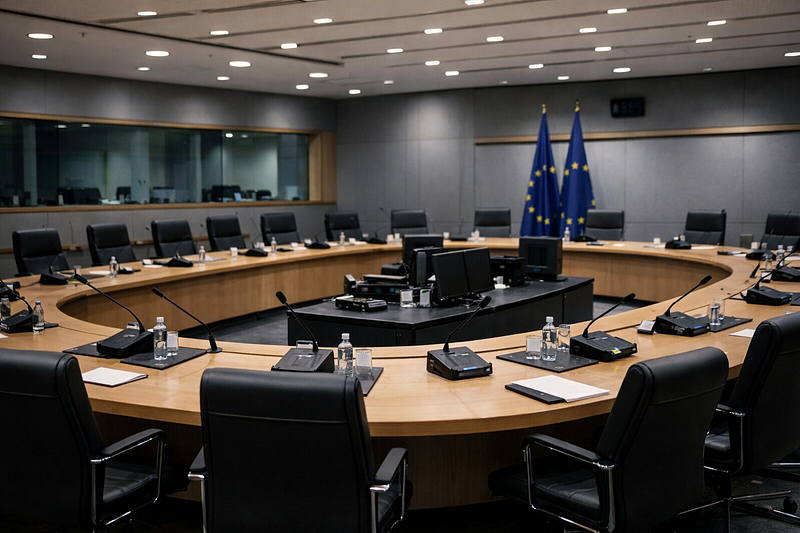
In Brussels offices, the meetings still take place on schedule. The agendas look familiar. The language has not changed. The coffee is poured, documents are stacked, microphones tested. The choreography remains intact.
But the guarantees behind the words are no longer there.
“The most dangerous moment in any long relationship is not the argument that precedes the break, but the silence that follows it.”
The moment when habits persist, expectations linger, but guarantees quietly evaporate.
Europe is entering that moment now.
Not through declarations or summits, not through flags lowered or treaties torn apart, but through something far more destabilizing: the slow realization that the assumptions beneath its security, economy, and diplomacy no longer hold.
The United States remains powerful. What has changed is not capacity, but reciprocity.
Protection has become conditional. Alignment has turned into expectation. Dependency has hardened into leverage.
This moment did not appear suddenly. It is the delayed effect of a system built on delegation rather than ownership.
This is not a hostile scenario.
It is a structural one.
And the danger lies not in rupture, but in behaving as if nothing fundamental has shifted.
The long after of alliances
Most geopolitical analysis focuses on beginnings and endings. The signing of treaties. The outbreak of wars. The collapse of regimes.
Far less attention is paid to what comes after.
After guarantees become conditional.
After commitments acquire footnotes.
After phrases like “shared values” begin to function as placeholders rather than anchors.
This is the least dramatic phase of power shifts, and therefore the most dangerous. There are no images to circulate, no singular moments to remember. Only continuity that no longer rests on the same foundations.
Power rarely announces withdrawal. It revises terms.
Europe’s relationship with the United States has not ended. That would be easier to understand. It has entered a phase in which the form remains, but the substance has changed.
The rituals persist. The assumptions do not.
Security without delegation
For decades, European security was treated as a delegated function. Strategic planning was outsourced, escalation risk absorbed elsewhere, responsibility deferred upward and outward.
This arrangement worked only because American guarantees were stable, predictable, and expensive to withdraw.
That condition no longer exists.
A Europe that acts beyond the United States does not abandon NATO in a dramatic gesture. It inverts its logic.
European command, planning, and doctrine become default.
NATO remains an instrument, not the operating system.
Joint procurement ceases to be symbolic and becomes structural. Air defense, ammunition, drones, logistics, electronic warfare. Shared stockpiles replace national silos. Territorial deterrence replaces expeditionary reflex.
European alternatives were available. Joint command structures were proposed. Shared procurement models were drafted. Independent stockpiles were calculated and costed.
They were not adopted.
Not because they were impossible, but because delegation was cheaper in the short term.
By that stage, the knowledge problem no longer existed.
The risks were mapped. The dependencies quantified. The escalation thresholds rehearsed.
What followed was not delay due to uncertainty, but continuation despite clarity.
From that moment on, every repetition ceased to be accidental.
Each budget cycle that preserved fragmentation, each summit that reaffirmed dependency, each communiqué that substituted reassurance for restructuring marked the same decision, made again without debate.
This was the point at which correction remained available but ceased to be chosen.
Security autonomy does not mean militarization.
It means credibility without permission.
Without that credibility, every other European ambition remains rhetorical.
Inherited architecture and its limits
Any serious discussion of European autonomy runs headlong into NATO. Not as a villain, but as a structure designed for a different world.
NATO was built for hierarchy. American leadership was assumed, embedded, and operationalized at every level: command chains, doctrine, intelligence fusion, strategic lift, escalation models.
European participation occurred within that framework, not alongside it.
As long as American leadership was stable, this architecture functioned.
American leadership did not fail. It simply stopped being unconditional.
Frameworks optimized for American primacy cannot substitute for European responsibility in a system defined by fragmentation, hybrid pressure, and economic coercion.
NATO manages war after escalation well. It is far less equipped to manage the conditions that precede it.
This does not require NATO’s abandonment.
It requires accepting that NATO cannot be the foundation of Europe’s future autonomy.
Architecture built for reassurance cannot substitute for architecture built for choice.
Dependency exposed: energy, money, and leverage
Energy made this visible first.
Europe learned, belatedly, that energy infrastructure is not a market choice but a strategic one. Markets do not neutralize power. They redistribute it.
What was framed as efficiency revealed itself as exposure the moment prices spiked and options vanished.
A post-American Europe stops treating energy as ideology.
Redundancy replaces purity. Stability replaces optimization. Diversification becomes doctrine, not preference.
The objective is not self-sufficiency.
The objective is non-coercibility.
Exposure does not announce itself as crisis. It arrives as procedure.
Higher bills. Slower permits. Postponed investments. Language that replaces explanation with reassurance.
This is why the shift often goes unnoticed.
Exposure does not arrive as rupture, but as revised thresholds, adjusted premiums, conditional access. As the quiet replacement of political choice with administrative necessity.
Most people encounter it not as geopolitics, but as lived narrowing.
A bill that cannot be contested.
An explanation that arrives already concluded.
A decision taken elsewhere, translated locally as inevitability.
By the time it is named, it has already been absorbed.
The same logic applies to finance. Europe’s vulnerability is not debt. It is rails. Payments, clearing, insurance, settlement.
A system anchored elsewhere is a system that can be switched off elsewhere.
A power that cannot choose when to apply pressure is not a power.
It is an extension.
Sanctions illustrate this more clearly than any speech. Economic warfare has replaced diplomacy because it is cheap for those who control the switches.
A future-ready order does not ban sanctions.
It disciplines them.
Time as a weapon
What makes dependency so effective is not force, but time.
Decisions deferred become decisions made by default.
Temporary arrangements solidify into permanent constraints.
Emergency measures harden into baseline assumptions.
Power does not always coerce. Sometimes it simply waits.
Europe’s predicament is not the result of a single error, but of accumulated postponements. Each one rational. Each one defensible. Together, irreversible.
This is how systems drift without appearing to move.
From camps to dossiers
Europe’s failure was not alignment.
It was exclusivity.
A post-American strategy replaces permanent camps with dossier-based partnerships. Reliability emerges not from shared values, but from predictable interests.
China is a systems competitor. Russia is a security challenge. Treating them as moral archetypes rather than strategic files produced paralysis, not stability.
The error was not engagement.
It was engagement without strategy.
This also applies internally. No strategy survives without narrative autonomy.
Citizens tolerate sacrifice when they understand it.
They reject it when language replaces explanation.
Information sovereignty is not propaganda.
It is the ability to explain reality without borrowing someone else’s script.
Why systems miss their own collapse
Systemic failure is rarely first recognized by those trained to manage the system.
Large institutions reward continuity, coherence, and correct application of inherited frameworks. Over time, this produces a specific blindness: the ability to optimize within a model while losing sight of whether the model still works.
Those outside these incentive structures often see breakdown earlier, not because they are better informed, but because they judge systems by outcome rather than legitimacy.
What collapsed here was not expertise.
It was accountability to reality.
Designing stability after hegemony
The collapse of assumptions does not automatically produce chaos. It creates a design moment.
A stable world order is not a friendship system. It is a structure in which no actor can dominate cheaply, and in which cooperation yields more than punishment.
The future is not a single hegemon, but a multipolar equilibrium built on regional pillars.
Europe as its own pole, integrating security, energy, and industry.
North America as a pole, but no longer architect of others.
East Asia embedded in its own security ecosystem.
South Asia anchored by India.
The Middle East as an energy hub governed by stability arrangements.
Africa and Latin America developing regional autonomy rather than serving as pressure valves.
The objective is containment of conflict through structure, so crises remain regional rather than automatically global.
This requires financial plurality. Multiple settlement systems. Interoperable standards. No single switch that can darken the system overnight.
It requires treating energy and critical materials as commons of stability, not instruments of leverage.
It requires brakes, not promises.
Harmony is not the absence of conflict. It is the presence of limits.
The price of adulthood
What failed was not an alliance, but an illusion.
Protection was never free. It was deferred responsibility.
As long as outcomes remained manageable, that responsibility could be postponed. When they did not, it returned without warning.
This is why the present feels disorienting.
Not because the world became irrational,
but because long-standing assumptions expired faster than the institutions built to maintain them.
Europe did not lose its way because it trusted the United States.
It lost its way because it mistook delegation for strategy, and stability for permanence.
What ends now is not loyalty.
It is adolescence.
What follows is not independence, but exposure.
And once exposure becomes normal, responsibility no longer feels like a choice.
Related from The Manifest Archive