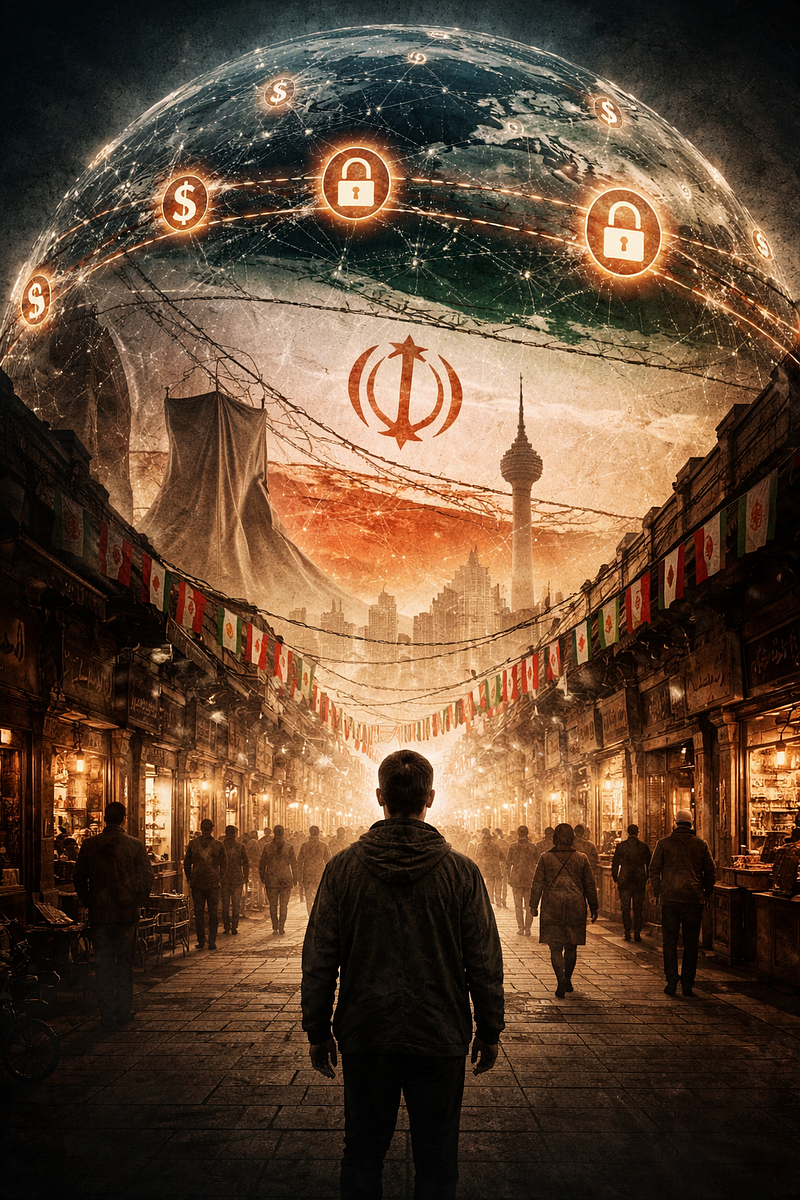
The line outside the currency exchange office in Tehran does not look like a crisis. No shouting. No police presence. No television cameras. People stand quietly, phones in hand, refreshing screens where numbers change several times an hour. What was enough yesterday is almost enough today. What is almost enough today will soon mean nothing.
The rial is no longer falling.
It is thinning.
This is not an emergency. It is a condition. To understand Iran today, one must abandon the expectation of collapse. Collapse is sudden, loud, spectacular. Iran is something else entirely. It is a society that has learned how to function inside pressure that never lifts.
This country does not live despite sanctions.
It lives inside them.
The shop opens.
The price changes.
Life continues.
Pressure as an Environment
From the outside, Iran is often reduced to familiar signs of failure. A collapsing currency. Isolated headlines. Periodic unrest framed as a prelude. The narrative is tidy and reassuring.
Pressure, in this telling, must lead somewhere. Toward capitulation. Toward revolt. Toward collapse.
But pressure does not always break systems.
Sometimes, it reorganizes them.
Currencies do not explain societies. They register conditions. The rial does not tell a moral story. It records exclusion. The cost of existing outside a global financial architecture where liquidity has become power.
Sanctions are not temporary measures.
They are structural conditions that reshape behavior over time.
Trade moves through detours. Payments pass through intermediaries. Insurance disappears. Technology arrives late or not at all. Planning horizons shorten. Expectations are adjusted before ambition even forms.
What remains is not chaos.
What remains is adaptation.
Scarcity does not automatically radicalize. More often, it disciplines. Pressure stops feeling exceptional and starts feeling like climate.
Iran is not a society on the verge of eruption.
It is a society that has learned how to remain intact.
Why Iran Was Sanctioned
The standard explanation reaches quickly for ideology. Religion. Revolutionary rhetoric. These elements matter, but they do not explain duration.
Iran was not sanctioned because it was radical.
Iran was sanctioned because it became autonomous.
In 1979, Iran did not merely replace a ruler. It removed itself from an externally designed order. The Shah was not just a political ally. He was infrastructure. Oil flows, intelligence channels, and regional balance all passed through Tehran.
When that system collapsed, something more destabilizing than hostility appeared.
A precedent.
A state that demonstrated it could exit.
The hostage crisis sealed the rupture, but it did not create the underlying problem. From that moment on, Iran ceased to be treated as a country with grievances. It became a condition to be contained.
Independence in a region built on managed dependence could not be allowed to normalize.
Sanctions as Architecture
What followed was not improvisation, but construction. Sanctions layered upon sanctions. Financial barriers reinforced by legal ambiguity. Secondary sanctions designed not primarily to punish Iran, but to discipline everyone else.
Banks did not need threats.
They needed uncertainty.
Insurers did not need directives.
They needed risk.
Compliance departments did what diplomacy no longer could.
The system enforced itself.
This architecture did not aim to reform Iran. It aimed to restrict its range of motion. To make autonomy expensive enough that others would hesitate before attempting it.
Different moral frames were applied over time. Terrorism. Human rights. Nuclear risk. Each supplied justification. None altered the structure.
Then, briefly, something else appeared.
When Conditionality Died
The nuclear agreement introduced a different logic. Compliance would be met with relief. Behavior would lead to normalization.
Iran complied.
Inspectors confirmed it.
The mechanism functioned.
Then it was withdrawn.
With that withdrawal, sanctions lost their final claim to conditionality. They no longer pointed toward an outcome. They no longer functioned as leverage.
Sanctions stopped being a means.
They became terrain.
From that moment on, pressure did not escalate or de-escalate. It simply persisted.
Life Inside Permanence
Inside Iran, permanence reshaped daily life. The rial became more than currency. It became a psychological instrument.
People plan in days instead of years.
Large purchases disappear.
Saving becomes tactical.
Certainty turns provisional.
A shopkeeper recalculates prices twice before noon.
A pharmacist substitutes what cannot be imported.
A university postpones equipment orders indefinitely.
And still, society functions.
Schools open.
Marriages take place.
Children are born.
This is not free fall.
This is recalibrated normality.
A system that lowers its definition of stability does not announce collapse. It absorbs it.
The Fault Line
None of this means Iran is stable.
The tension is real, but often mislocated. The primary fault line is not simply between state and population. It runs between time layers.
A young society governed by older structures.
A fast cultural reality constrained by slow institutions.
Technology circulating faster than control.
This creates friction. Fatigue. Occasionally anger.
But friction is not rupture.
Iran does not move through explosions.
It moves through abrasion.
The outcome remains open.
From Exception to Precedent
Iran is still described as an anomaly. A special case. A problem state.
That framing is comforting.
It is also false.
Iran is not demonstrating failure. It is demonstrating adaptation to a world where access is conditional, pressure is permanent, and integration can be revoked.
Sanctions are no longer exceptional instruments.
They are becoming standard tools of global governance.
Iran is not collapsing under this condition.
It is showing what endurance looks like when growth disappears as promise.
This is the turn.
From Iran as exception
to Iran as precedent.
Who Appointed the Judge
At this point, a question surfaces that is usually avoided because it has no comfortable answer.
Who decided that the United States would function as prosecutor, judge, and enforcer at the same time?
The honest answer is unsettling.
No one formally did.
This role was not granted by treaty or vote. It emerged through structure. Through the accumulation of financial power, military reach, institutional design, and historical timing.
After 1945, the United States did not merely participate in the international order. It became its operating system. The dollar anchored trade. Security guarantees stabilized alliances. International institutions spoke universal language, but ran on American infrastructure.
Over time, norm-setting and enforcement fused.
What began as leadership hardened into authority.
What began as coordination evolved into judgment.
An unstable judge produces arbitrary verdicts.
As American internal instability grows, that arbitrariness becomes visible. Sanctions arrive faster. Patience shrinks. Pressure replaces persuasion.
The question shifts.
Not whether a country violates rules,
but whether it might one day compete.
Silence as Participation
There is a phrase that rarely appears in policy documents, but governs their effects nonetheless.
Those who remain silent, consent.
What has been done to Iran has not been done by the United States alone. It has been made possible by a wider world that chose accommodation over resistance, access over principle, and stability over confrontation.
Europe did not design the sanctions architecture.
But it enforced it.
Asian economies did not draft the restrictions.
But they adjusted to them.
International institutions did not order exclusion.
But they normalized it.
This was not coercion in the classical sense.
It was compliance through convenience.
Each actor told itself the same story. This is not our decision. This is not our responsibility. We have no leverage. We have no alternative.
And in saying that, they accepted the architecture as inevitable.
What Iran has endured is therefore not only pressure, but global acquiescence. The country was isolated not because the world agreed on its guilt, but because disagreement carried a cost too high to pay.
Silence became the price of access.
No outrage was required.
No declarations were necessary.
The system functioned quietly.
Banks closed accounts.
Insurers withdrew coverage.
Shipping routes disappeared.
Investments were postponed indefinitely.
Each step was small.
Together, they became total.
This is how modern punishment works.
Not through spectacle, but through absence.
Not through condemnation, but through delay.
Not through force, but through non-interference framed as neutrality.
What Iran was subjected to was not global consensus.
It was global resignation.
And resignation, repeated long enough, turns into participation.
Silence, in such a system, is not innocence.
It is endorsement through inaction.
The Moral Question
Here geopolitics crosses into ethics.
Why must a country that governs itself, that does not collapse, that survives under pressure, be weakened further?
The answer is uncomfortable.
Because autonomy, when it works, is contagious.
Power tolerates weakness.
Power tolerates failure.
Power tolerates chaos.
What it cannot tolerate is example.
Iran’s greatest offense was not defiance.
It was persistence.
Who Is Next Is the Wrong Question
Targets are not selected by ideology alone. They are selected by trajectory.
Any state that reduces dependency, builds alternative structures, or demonstrates that life outside the dominant order is possible moves closer to the same threshold.
It does not have to be hostile.
It does not have to be radical.
It only has to be insufficiently dependent.
Closing Reflection
This requires no conspiracy.
No coordination.
No intent.
Architectures enforce themselves.
Iran did not break under pressure.
It adapted to it.
The shop will open tomorrow.
The price will change again.
The line will form quietly.
And somewhere, phones will refresh. Numbers will thin.
Not because the system is strong,
but because it has learned how to exist without relief.
Iran is already there.
Others are closer than they think.
Related from The Manifest Archive