The United States has used military force across dozens of countries since 1945. It has not used a nuclear weapon since Nagasaki. When it last crossed that threshold, it did not yet hold the global reserve currency, underwrite the central treaty of the global nuclear non-proliferation regime, operate the most extensive military alliance among the world's advanced industrial democracies, or anchor the dollar-based financial infrastructure through which much of global trade is invoiced, financed, and settled.
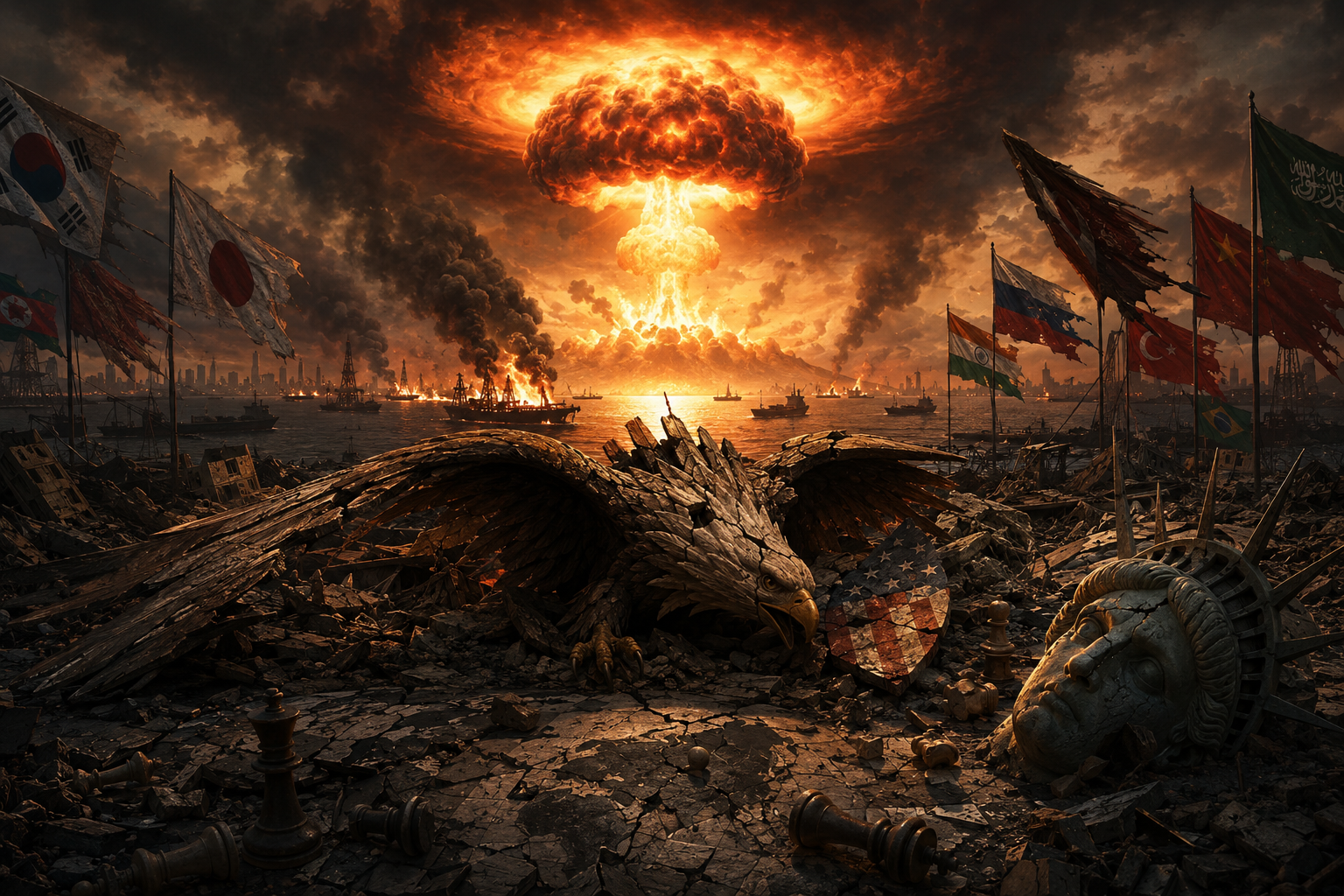
That architecture did not exist when the nuclear threshold was last crossed. It does now. A nuclear strike on Iran would not destroy Iran first. It would destroy the architecture.
Previous American military operations carried risks. None carried this one: that the act of attack would be more destructive to the attacker's structural position than to the target. That is what is new. That is what has never been true before.
This is not an argument about Iran. It is an argument about what the United States would destroy in the act of striking. The target matters less than the architecture surrounding it. Every previous US military action was conducted inside a stable global framework. This one dissolves the framework at the moment of detonation.
The Last Taboo
The nuclear taboo is eighty years old. It began with Hiroshima on August 6, 1945, and Nagasaki three days later, and it has held through Korea, Vietnam, the Gulf War, Iraq, Afghanistan, and every proxy conflict in between. It has held through fourteen US presidents, four Russian general secretaries, five Chinese paramount leaders, and the emergence of eight additional nuclear states.
During those eight decades, the United States had nuclear options in situations where conventional military outcomes were uncertain. It did not use them. General Douglas MacArthur advocated nuclear strikes during the Korean War. Eisenhower and Dulles considered nuclear escalation during the Taiwan Strait crisis of 1954 and 1958. Nixon ordered nuclear alert during the 1973 Arab-Israeli war. The Soviet Union came closer to nuclear use in November 1983, when the NATO exercise Able Archer was misread by Soviet intelligence as the cover for an actual first strike. Oleg Gordievsky, the KGB officer who later defected to British intelligence, testified that Soviet forces were placed on launch readiness. The line held.
The taboo has held not because of moral consensus but because of structural self-interest. Every nuclear state understood that crossing the line would change the rules for everyone, including themselves. The restraint was mutual and self-reinforcing precisely because it was universal.
A US nuclear strike on Iran would break the taboo under conditions that make the break irreversible. Iran is not a nuclear state. It possesses highly enriched uranium but is not publicly assessed to possess assembled nuclear weapons. A nuclear strike on a non-nuclear state is a categorically different act from mutual deterrence. It destroys the broader security assumption on which non-proliferation depends: that states remaining non-nuclear do not thereby make themselves uniquely vulnerable to nuclear coercion or attack. After a US nuclear strike on a non-nuclear NPT signatory, that assumption becomes dramatically harder for any government to sustain.
The NPT has 191 signatories. Its architecture rests on a bargain: non-nuclear states forgo nuclear weapons in exchange for two commitments from nuclear states, namely access to civilian nuclear technology and eventual nuclear disarmament. Article VI of the treaty obligates nuclear states to pursue disarmament in good faith. A nuclear strike on a non-nuclear signatory does not merely violate the spirit of this obligation. It demonstrates that one of the central political assumptions sustaining the NPT, that remaining non-nuclear provides meaningful security against nuclear coercion, can no longer be taken for granted.
The nuclear taboo is not a moral principle enforced by conscience. It is a structural constraint maintained by mutual self-interest. Once broken by a nuclear state against a non-nuclear state, it cannot be restored by the country that broke it.
The restoration would require every other nuclear state to behave as though the break had not occurred. That is not how structural constraints operate. They hold until they break, and once broken, they reset at a lower threshold.
The Proliferation Machine
Every state dependent on non-proliferation guarantees would confront the same conclusion: the NPT provides no protection against a nuclear-armed superpower that chooses to use its weapons.
Saudi Arabia has been the most explicit. Crown Prince Mohammed bin Salman stated publicly in March 2018 that if Iran develops a nuclear weapon, Saudi Arabia would develop one too. A US nuclear strike on Iran removes the conditional entirely. Iran need not develop anything. The lesson has already been delivered by the United States itself. The Saudi nuclear program, now notional, has the infrastructure to begin in earnest: a domestic nuclear program operating under civil nuclear cooperation arrangements actively negotiated with the United States through 2023 and 2024, and a domestic constituency that can now frame nuclear weapons not as aggression but as self-defense against the superpower that just demonstrated nuclear use against a Muslim-majority state.
Turkey has the technical infrastructure of a NATO member with full access to dual-use nuclear technology. President Erdogan stated in September 2019 that Turkey should have the right to nuclear weapons. After a US nuclear strike on Iran, that statement acquires a constituency it did not previously have.
South Korea is perhaps the most structurally significant case. A 2023 Gallup poll found that 76 percent of South Koreans support the development of an independent nuclear arsenal. South Korea has the technical capability: it operates 26 reactors and has developed ballistic missiles with ranges that cover most of Northeast Asia. It has restrained itself under US extended deterrence. After a US nuclear strike on Iran, South Korea faces a US nuclear umbrella that has just shown its conditions of use include striking non-nuclear states. The guarantee is degraded by the act itself.
Japan's position is structurally similar. Its three non-nuclear principles, not to possess, not to produce, and not to permit introduction of nuclear weapons, are foundational to its postwar political identity. A US nuclear strike on Iran would force a domestic debate in Japan that the political establishment has spent seventy years avoiding. The debate begins not from a position of Japanese aggression but from a position of Japanese self-questioning: if NPT membership was insufficient to protect Iran, what does it protect?
Those four cases illustrate the mechanism. The remainder of the field follows the same logic at different speeds. The structural logic suggests that the IAEA inspection regime would face its deepest legitimacy crisis since its creation. The inspection architecture requires the consent of non-nuclear states, and that consent is granted in exchange for the protection that NPT membership is supposed to provide. After a nuclear strike on an IAEA-inspected signatory, the inspection becomes evidence not of compliance but of exposure. North Korea's nuclear doctrine, called irrational for twenty years, becomes the rational model. The states most likely to accelerate toward nuclear capability are not adversaries of the United States. They are US partners who can no longer trust that conventional alignment provides adequate security.
The US would destroy one nuclear program. The structural logic of the taboo break would initiate parallel proliferation decisions across multiple states simultaneously.
The Regional Architecture That Burns First
The United States has 40,000 military personnel stationed in the Gulf. They are not in Iran. They are in Qatar, Bahrain, Kuwait, and the UAE.
Al Udeid Air Base in Qatar is the largest US military installation in the Middle East, home to the 379th Air Expeditionary Wing and the forward headquarters of US Central Command. More than 10,000 US and coalition personnel operate from Al Udeid. After a nuclear strike on Iran, Al Udeid is simultaneously the most valuable and most exposed piece of US infrastructure in the theater.
Qatar hosts the political bureau of Hamas. It has maintained diplomatic relations with Iran while hosting the US military. After a nuclear strike on Iran, the Qatari government would have to reconcile four roles that can coexist only under conditions of controlled escalation: US basing partner, Iranian interlocutor, regional mediator, and Arab government accountable to a public sphere overwhelmingly hostile to nuclear use in the region.
The Fifth Fleet is headquartered in Bahrain, a country with a Shia majority, estimated at 65 to 70 percent of the citizen population, governed by a Sunni monarchy. The Bahraini government suppressed the Arab Spring protests of 2011 with Saudi military assistance. After a nuclear strike on Iran, the domestic pressure on the Bahraini government to request US withdrawal is not a marginal concern. It is an existential political calculation.
Hezbollah's documented arsenal exceeds 150,000 rockets and missiles, including precision-guided weapons capable of reaching Tel Aviv, Haifa, and Ben Gurion Airport. UN Panel of Experts reports have documented the transfer of Iranian-supplied Fateh-110 and Zelzal-2 missiles over the preceding decade. Hezbollah does not need a direct order from Tehran to respond. Its command structure, built over forty years, operates on standing doctrine: Iranian territory attacked means Hezbollah responds. The doctrine exists independent of any single Iranian government. After a nuclear strike on Iran, Hezbollah would face overwhelming doctrinal and political pressure to respond, creating a high probability that a second front would open before the first crisis had stabilized. Israel responds. The second front is open before the first one has cooled.
The Abraham Accords collapse progressively. The normalization agreements between Israel and Arab states were predicated on the premise that alignment with Israel against Iran could be sustained domestically. A nuclear strike on Iran, with Israeli intelligence cooperation implicit or explicit in any strike planning, makes that premise untenable. The accords do not fall formally on day one. They fail as Arab governments calculate, one by one, that the domestic cost of maintaining them exceeds the cost of suspending them.
Iraq presents a specific structural problem. The Iraqi parliament voted in January 2020 to expel US forces following the assassination of Qasem Soleimani. The motion was non-binding and US forces remained. After a nuclear strike on Iran, the Iraqi parliament revisits that question in a political environment where the Shia-majority government faces overwhelming domestic pressure to act. The remaining US forces in Iraq are positioned in a country whose government has both the legal authority and the political motivation to require their departure.
The US has the weapons. It does not have a position from which to use them a second time.
The Energy System in the Blast Radius
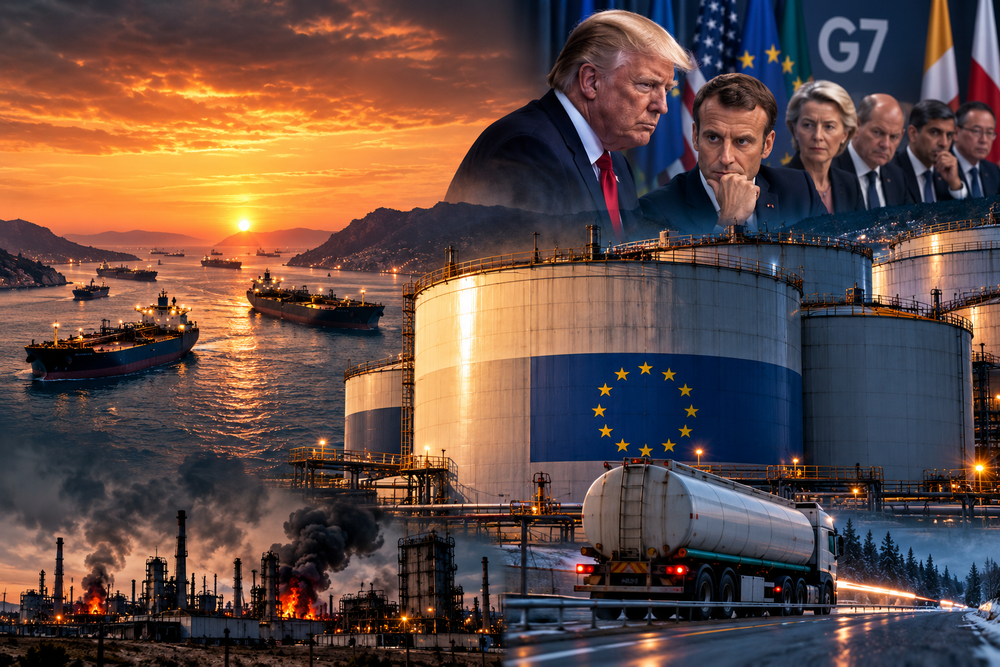
The Strait of Hormuz carries approximately 20 percent of global petroleum supplies and 18 to 20 percent of global liquefied natural gas. Japan receives more than 90 percent of its oil through the strait. South Korea receives 40 percent of its energy. Taiwan's largest power stations run on LNG that transits Hormuz. These supply lines are not threatened by the strike. They are made non-functional by it, through a chain that begins with insurance and ends with the dollar.
The first link is the Lloyd's market. After a nuclear strike on Iran, war-risk coverage for Persian Gulf passage would become commercially prohibitive or effectively unavailable. The JWC operates on documented precedent: during the 2024 Houthi campaign in the Red Sea, JWC designations caused a 400 percent increase in war risk premiums within two weeks. The Persian Gulf is a narrower waterway with higher traffic density and direct exposure to Iranian coastal defense systems. For ordinary commercial operators, war-risk cover would cease to be available on economically usable terms.
Without insurance, vessels cannot obtain trade financing. Without trade financing, cargo owners cannot secure letters of credit. Without letters of credit, commodity contracts cannot settle. The physical ships exist. The financial architecture required to operate them does not. This is not a shipping crisis. It is a financial architecture crisis that expresses itself as a shipping crisis.
Commodity markets reprice before the first Iranian missile is fired. Brent crude spikes discontinuously within the first hour of confirmed nuclear detonation. Even a coordinated IEA reserve release measured in hundreds of millions of barrels would buy time, not restore the insurance, financing, and shipping mechanisms required for sustained Gulf exports. A disruption that produces no visible off-ramp cannot be managed by reserve releases.
That chain, from insurance collapse through letters of credit, commodity settlement, and non-functional oil markets, arrives at the petrodollar. The dollar-oil recycling architecture consolidated through the 1974 US-Saudi arrangements associated with Henry Kissinger and Treasury Secretary William Simon recycled Gulf oil revenues into US Treasury bonds, maintaining dollar demand after Nixon ended the gold standard. It has survived Vietnam, the 1973 oil shock, the Gulf War, the Iraq occupation, and the Hormuz crisis of 2026. It has one load-bearing assumption: that oil markets function. Functioning oil markets require insurable transit through the Persian Gulf.
A nuclear strike on Iran would not merely stress the petrodollar. It would destroy one of the geographical and political assumptions on which its durability depends.
The petrodollar survived Vietnam. It survived Iraq. A nuclear mushroom cloud over the state bordering Hormuz would subject it to a different category of stress: the disruption of the oil geography and security arrangement on which the system itself was built.
The Dollar's Final Stress Test
Reserve currency status rests on three structural pillars: the perception that the currency is politically neutral enough to serve as a global store of value, the military backing of the system that the currency finances, and the absence of a viable alternative.
A nuclear strike on Iran tests all three simultaneously and in the worst direction.
The neutrality argument collapses first. Every central bank that holds dollar reserves, from Beijing to Riyadh to Brasilia to Jakarta, now holds reserves in a currency that has just been used to back a nuclear attack on a non-nuclear NPT signatory. The question for reserve managers would no longer be only whether dollar assets remain liquid. It would be whether the political and military decisions of the issuing state introduce systemic, sanctions, settlement, and access risks into those holdings. That is a different calculation, and one that would systematically accelerate reserve diversification pressures rather than produce an immediate exit.
The military backing argument reverses. The dollar's reserve status was constructed around the implicit guarantee that US military power would maintain the conditions under which global trade and finance can function. A nuclear strike on a country in the world's most energy-critical geography does not maintain those conditions. It terminates them. The instrument that was designed to guarantee the architecture becomes the mechanism of its disruption.
Saudi Arabia joined the mBridge project, the multi-CBDC payment bridge developed by participating central banks and the BIS Innovation Hub, in 2024. It has made repeated public statements about diversifying oil contract currencies. After a nuclear strike on Iran, the political calculus for the Saudi government changes categorically. Continued dollar alignment requires the Saudi government to explain to its population why it remains inside the financial architecture of the state that just struck a Muslim-majority country with nuclear weapons. The explanation does not survive domestic political scrutiny.
China's parallel financial infrastructure is further advanced than most Western analysis acknowledges. The Cross-Border Interbank Payment System processed $12.9 trillion in 2022 and has continued to expand rapidly. The digital yuan has been tested in wholesale interbank settlement across 15 countries. The Shanghai Cooperation Organisation, to which Iran was admitted as a full member in 2023, provides a governance framework. A US nuclear strike on Iran would give China the political cover it has been building toward: the ability to formalize a dollar-alternative settlement system not as aggression but as a response to demonstrated US nuclear doctrine.
Reserve currency status is not a military achievement. It is a confidence arrangement. Confidence is destroyed faster than it is built.
The dollar reserve system took forty years to construct. It does not fall in forty days after a nuclear strike. But the direction of travel would change on the day of detonation, and reversing it would require rebuilding confidence under conditions the strike itself had destroyed.
The Alliance Architecture Under Stress
NATO's Article 5 collective defense clause has never been invoked to cover a scenario in which the United States is the nuclear actor. The article commits members to treat an attack against one as an attack against all. It does not address the obligations of alliance members when the United States strikes a non-NATO country with nuclear weapons.
The legal ambiguity is the smallest part of the problem. The political reality is more immediate: Germany, France, the United Kingdom, Italy, the Netherlands, and Belgium face domestic political environments in which their continued military alliance with the United States becomes a liability rather than an asset. No European government can publicly endorse a US nuclear strike on a non-nuclear state without triggering a parliamentary crisis. The governments that avoid explicit endorsement face a different problem: their silence is read as complicity by constituencies that elected them to oppose nuclear weapons use.
The UK-US Special Relationship faces a legal stress test. GCHQ shares intelligence with NSA under frameworks that assume both states operate within international law. Depending on the target, effects, territorial jurisdiction, and degree of allied participation, British officials involved in intelligence or targeting support could face demands for investigation under domestic, international, or universal-jurisdiction frameworks.
Australia, the third anglophone partner in the AUKUS submarine agreement, faces an analogous problem. The AUKUS arrangement was sold to the Australian public as a conventional deterrence framework. After a US nuclear strike on Iran, Australian politicians who supported AUKUS must explain why their country is in a military architecture with a state that has used nuclear weapons against a non-nuclear opponent.
The US military conducts joint exercises, shares intelligence platforms, and operates combined command structures with more than forty countries. Many of those countries now face domestic legal and political constraints on continued cooperation with a military that has crossed the nuclear threshold. The US military is not weakened by the strike. Its alliance network is.
The United States has never faced a situation in which its primary strategic asset, its network of military alliances, becomes a liability at the moment of greatest military action.
What China and Russia Would Not Do
Neither China nor Russia would go to war with the United States in response to a nuclear strike on Iran. That is not the risk.
The risk is what they do instead.
Russia does not need to match a US nuclear action militarily. It needs to demonstrate to every state watching that the alternative to US alignment provides a credible security guarantee. After a US nuclear strike on Iran, Russia's position is structurally advantageous: it has not used nuclear weapons against a non-nuclear state. It would have the ability to claim the high ground while systematically escalating through indirect means: advanced weapons systems delivered to states in conflict with US allies, infrastructure designed to complicate US communications and logistics, reinforcement of every proxy network in the regions where the US has exposed itself as a nuclear actor.
The 2025 Russia-Iran Comprehensive Strategic Partnership Treaty established a framework for military cooperation, intelligence sharing, and economic coordination that was already in force before any nuclear scenario. After a nuclear strike, that treaty would become an operational commitment. Russia would activate every obligation under it, not through military engagement with the US but through sustained support for the Iranian state's capacity to survive and impose costs.
China's response would be more structurally consequential. China has spent eight years building parallel infrastructure to the US-dominated financial system, the US-controlled technology supply chain, and the US-backed international institutional order. A US nuclear strike on Iran would provide China with the political cover it has been building toward: the ability to accelerate the activation of that parallel infrastructure not as an act of aggression but as a response to demonstrated American behavior.
China would have a unique opportunity to formalize CIPS as a primary settlement alternative, to activate the 2021 China-Iran 25-year Comprehensive Cooperation Agreement as an explicit security framework, and to demonstrate to every non-Western state that it will not abandon the next country the US identifies as a nuclear target. That demonstration does not require a weapon. It requires structural separation from US-aligned systems that China has been building since 2018.
The demonstration would function as a security guarantee for states that have been hedging between US and Chinese alignment. After a US nuclear strike on Iran, the hedging calculus would change. The cost of Chinese alignment falls. The cost of US alignment rises.
China and Russia would not fight the United States. They would build the alternative to it. The alternative is more durable than the fight.
The Decade That Follows
The immediate cascade, comprising the proliferation response, the regional military confrontation, the energy disruption, and the financial architecture stress, is the first-order effect. The second-order effect operates over the following decade, and it is more durable.
Every future US military ultimatum, every diplomatic negotiation in which US military force is implied, every alliance commitment in which US deterrence is the backstop, now operates inside a changed frame. The US has used nuclear weapons against a non-nuclear state. That fact is permanent and irreversible. No subsequent US administration can undo it. No subsequent US president can claim that US nuclear weapons are only deterrence instruments.
Adversary states that have faced US military pressure through diplomatic channels, including economic sanctions, military encirclement, and coercive diplomacy, now recalibrate their options. The diplomatic track that previously looked like the safe choice, because the alternative was conventional military confrontation, now looks different. If nuclear use is on the US table, the calculation of what it costs to be a US adversary changes. Some states accelerate compliance. Others conclude that the only protection from nuclear use is nuclear possession.
The International Criminal Court, which the United States has not ratified and has consistently opposed, gains members and institutional authority from states seeking frameworks that the US has demonstrably rejected. The UN General Assembly passes resolutions that the US vetoes at the Security Council. The veto insulates the US from formal international law consequences. It does not insulate US officials from travel restrictions in countries that have implemented national legal frameworks based on universal jurisdiction over war crimes. The architecture of international law does not constrain the US the way it constrains smaller states. But it shapes the environment in which US officials, US corporations, and US institutions operate, and that environment becomes systematically less accommodating.
American corporations operating in countries that have severed financial ties with the US face a changed regulatory environment. Technology companies that depend on global market access operate in a world where their association with a nuclear state is a liability in jurisdictions seeking to demonstrate independence from US political alignment.
The decade-long consequence is the erosion of what US strategists call structural leadership: the ability to set global norms, lead international institutions, and maintain open-market relationships that provide the economic foundation for US military spending. That erosion does not require a single decisive break. It happens through the accumulation of decisions by states, corporations, and institutions that no longer need to accommodate US preferences because the cost of accommodation has risen above the cost of independence.
The taboo constrained what states could do. What states do now will constrain what the taboo can mean.
The United States would win the strike. It would lose the architecture that made the strike affordable.
The Strongest Counterargument
The strongest version of the argument for a nuclear strike on Iran does not rest on destroying Iran. It rests on preventing a nuclear Iran.
The argument is structural and serious: before verification was disrupted, IAEA reporting showed that Iran had accumulated substantial quantities of uranium enriched to 60 percent, enough, if further enriched, for multiple weapon-equivalents. A nuclear weapon would be within months of a political decision to complete assembly. Iran is not publicly assessed to possess assembled nuclear weapons. A nuclear-armed Iran would permanently alter the strategic landscape of the Middle East. It would provide Iran with deterrence against conventional military action, enabling its proxy network to operate under a nuclear umbrella that forecloses conventional counterforce options. It would accelerate nuclear programs in Saudi Arabia and Turkey. The regional proliferation cascade, according to this argument, would occur whether or not the US struck first. A temporary period of elevated global instability is preferable to a permanent nuclear-armed Iran.
This counterargument is structurally serious. It represents the genuine logic of preventive war doctrine applied to the specific case of a threshold nuclear state with a documented proxy network. The strategic literature on preventive strikes against nuclear programs, the Israeli strikes on Osirak in 1981 and on the Syrian reactor at Al Kibar in 2007, provides partial precedent for the logic. It is not a rationalization. It is the calculation that serious strategic analysts have made and continue to make.
The analysis offered here does not claim the counterargument is wrong about the threat from a nuclear Iran. It claims something narrower: that the counterargument understates the permanence of the consequence on the US side. The NPT taboo is not merely a constraint on one crisis. It is the structural mechanism that has limited nuclear proliferation since 1968. It has done so imperfectly: nine states have nuclear weapons when the treaty envisioned eventual universal disarmament. But the number is nine, not thirty. The constraint produced that outcome. A US nuclear strike on a non-nuclear NPT signatory terminates the constraint permanently. Not in this region but everywhere. Not temporarily but for the United States as an actor in perpetuity.
The counterargument's strongest version asks: what is the cost of not acting against a nuclear Iran versus the cost of acting? The analysis here answers with a different question: what is the cost of acting in a way that destroys the structural framework that has kept the number of nuclear states at nine? That cost is the proliferation cascade the counterargument attributes to Iranian nuclear capability, but applied globally and triggered by US action rather than Iranian action.
For eight decades the United States projected military power across every inhabited continent without destroying the architecture that made that projection possible. It bombed cities, destroyed infrastructure, changed governments, and occupied territories. It has done all of this while the architecture remained intact.
The architecture, the nuclear taboo, the dollar reserve system, the NPT framework, the alliance structure, the global financial infrastructure, has never been the target. It has always been the protection. The military is the instrument. The architecture is what the military protects. The architecture is, ultimately, the source of the resources that make the military possible.
A nuclear strike on Iran would be the first US military action in which the instrument of force destroys the architecture it was built to protect.
This is why the situation is categorically different. The structural cost of using the instrument exceeds the strategic benefit in a way that has never been true before.
The architecture accounts for every actor in this scenario. It accounts for the regional cascade, the proliferation response, the financial system stress, the alliance fractures. The one actor the architecture does not account for is the one who crosses the line that has held for eighty years.
That actor has no designed role in what follows. That has never been true of the United States before.
Evidence Map
Core claim: A US nuclear strike on Iran would destroy six structural pillars of American global dominance simultaneously: the nuclear taboo, the NPT architecture, Gulf military basing, the petrodollar system, dollar reserve credibility, and the barrier to Chinese-Russian structural decoupling. The act would be more destructive to the attacker's systemic position than to the target.
Observed conditions (high confidence, directly documented): Nuclear taboo: unbroken since Nagasaki 1945 through 14 US wars and military actions. NPT: 191 state signatories, operative since 1968, Article VI disarmament obligation documented. Able Archer 83: declassified US intelligence assessments, Gordievsky testimony documented. Hezbollah arsenal: UN Panel of Experts reports document 150,000+ rockets, Fateh-110 and Zelzal-2 transfers documented. Al Udeid Air Base: USAF confirms 10,000+ personnel, forward HQ of CENTCOM. Fifth Fleet HQ: US Navy confirmed, Manama Bahrain. Petrodollar: Bloomberg FOIA 2016 confirmed $117B Saudi Treasury holdings; Kissinger-Simon 1974 agreement documented. China-Iran 25-year Comprehensive Cooperation Agreement: signed March 2021, publicly documented. Russia-Iran Comprehensive Strategic Partnership: signed January 2025, publicly documented. SCO Iran membership: September 2023, documented. Saudi mBridge participation: 2024, BIS documented. South Korean nuclear opinion polling: Gallup Korea 2023, 76% support. MBS nuclear statement: March 2018, CBS interview. Iraqi parliament vote on US forces: January 2020. JWC war risk zone mechanism: Lloyd's documented precedent, Red Sea 2024 crisis, 400% premium increase within two weeks.
Documented structural dependencies (medium-high confidence): Saudi yuan oil pricing discussions: WSJ (2022) and Reuters (2023) reporting; no completed transaction publicly confirmed. CIPS volumes: CIPS annual report 2022, $12.9 trillion, growth trajectory documented. Dollar reserve share decline: IMF COFER data, approximately 70% (2000) to approximately 58% (2025). LNG Hormuz dependency: IEA data, Japan 90%+, South Korea 40%, documented.
Analytical inferences (medium confidence): The simultaneous activation of all failure mechanisms within a 30-90 day window is an inference from documented individual mechanisms, not a documented cascade sequence. The specific proliferation trajectory involves state-level political decisions that are structurally predictable but not pre-documented. China's response trajectory is inferred from observable strategic posture, not from a documented decision.
What would confirm this: A US nuclear strike on Iran followed by: IAEA withdrawal of three or more non-nuclear signatories within 12 months; Saudi announcement of yuan oil pricing within 6 months; China formal acceleration of CIPS as primary settlement alternative; Japanese or South Korean government announcement of nuclear program review; Lloyd's JWC designation of Persian Gulf within 48 hours of strike.
What would disprove this: A US nuclear strike on Iran that does NOT trigger NPT withdrawal by any signatory within 12 months, significant movement in dollar reserve share, Saudi public statement on currency diversification, or Chinese acceleration of SWIFT-alternative settlement within 18 months. If those outcomes do not occur, the cascade analysis is structurally wrong.
Watchlist: IAEA quarterly enrichment reports on Iran; Saudi-China yuan oil pricing announcements; CIPS quarterly volume reports; Japanese and South Korean nuclear policy statements; European parliament votes on nuclear sharing arrangements; mBridge transaction volumes; US War Powers Resolution usage in current Iran conflict.
Confidence assessment: Nuclear taboo significance: high. NPT collapse logic: high. Regional military cascade (Hezbollah, Gulf bases, Iraq): high. Insurance-to-petrodollar chain: high. Dollar reserve credibility impact: medium-high. Alliance architecture stress: medium-high. China and Russia structural response trajectory: medium-high. Specific proliferation timeline by country: medium.
The structural architecture of the conflict itself has a documented history. Everyone Is Watching the Iran War. Nobody Sees Why It Cannot End identifies the four mechanisms — military success, proxy network resilience, sanctions lock-in, and ceasefire design — that removed every available exit before the nuclear question arrived.
The insurance chain begins with the JWC. Hormuz Closed. Houthis Closed Yanbu. The Backups Ran Out. maps how the simultaneous closure of three energy chokepoints in July 2026 collapsed the insurance architecture before the military confrontation ended.
The IEA reserve buffer has a documented depletion timeline. The Iran War Has No Off-Switch traces how three cascade timelines compounded into a structural impasse that reserve releases can delay but not reverse.
The War Powers architecture has a documented floor. Epic Fury Ended May 5. Hormuz Was Still Closed May 6. identifies why the legal ceiling on US military authority and the strategic reality of Chinese leverage produced a gap that conventional action cannot close — and why that gap is still open.
The Manifest Archive is an independent forensic journalism project. Each article is one layer of a structural archive investigating how coherent power outcomes emerge without visible central command. themanifestarchive.com