The most important weapon North Korea will bring home from Ukraine may be the war itself.
November 2024. Kursk Oblast, western Russia.
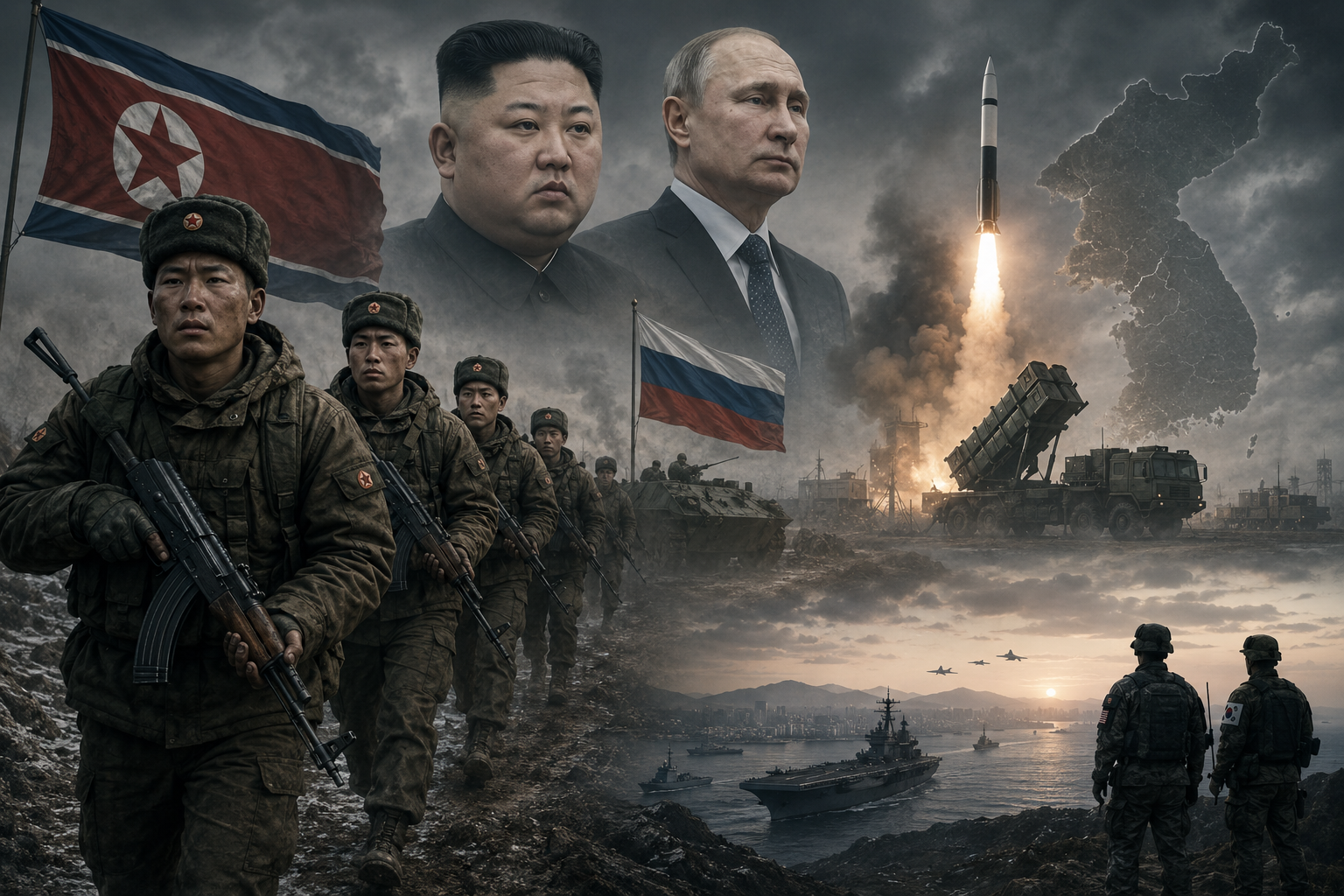
A North Korean unit crosses into Russian territory. The soldiers carry AK-pattern rifles and wear Russian-issue cold-weather gear over their own uniforms. Their officers were briefed through translators. They were trained for mountain warfare and urban combat on the Korean Peninsula, trained for streets, for river crossings, for the specific geography of a conflict frozen since 1953.
They are now in European steppe. The weapons targeting them include HIMARS rocket artillery, first-person-view drones, and counter-battery radar systems supplied by the United States, Germany, France, and the United Kingdom. In the first three weeks, casualty rates in the forward units are severe.
They keep arriving.
By January 2025, South Korean and Ukrainian intelligence estimates place North Korean troop strength in Russia at 11,000. By mid-2026, 14,000 to 15,000 are confirmed on the front lines. Ukrainian President Zelensky warns of a second wave of up to 50,000. In Voronezh, Russian logistics infrastructure is being prepared to receive them. Simultaneously, a North Korean missile unit with up to 120 ballistic missiles and six launchers is deploying to western Russia. North Korean hardware, integrated into the Russian order of battle, targeting Ukrainian territory.
This is not a temporary arrangement. It is a structural deal. And it has a template.
The Deal Neither Side Published
In April 2025, Russia and North Korea jointly confirmed what both governments had previously denied: North Korean troops had fought Ukrainian forces in Kursk.
The confirmation came without a price list. No official document has been published stating what Russia is providing in exchange for North Korean military manpower. But the exchange is not difficult to reconstruct from what is observable.
North Korea's military capabilities have three documented gaps that Russian technology can fill. First: satellite reconnaissance. North Korea's reconnaissance satellite program has been hampered by launch failures and limited orbital coverage. Russia has one of the world's most advanced military satellite architectures. Second: ballistic missile guidance precision. North Korean ICBMs have demonstrated range. Accuracy at intercontinental range remains a documented limitation. Russian guidance technology addresses that gap directly. Third: nuclear submarine design. North Korea operates experimental submarines, but lacks the engineering capacity to field operational nuclear-powered vessels. Russia has designed, built, and operated nuclear submarines for seventy years.
These three gaps share a structural property: none of them can be filled through any channel that does not run through Moscow. Every other state with relevant capability is bound by the sanctions architecture. Every technology-transfer route that does not involve Russia is either blocked, monitored, or legally foreclosed. Russia is not merely a convenient supplier. It is the only state currently positioned to combine the relevant capabilities with a demonstrated willingness to deepen military cooperation with Pyongyang despite the sanctions architecture.
These are not speculative capability gaps. What remains unconfirmed is which of them Russia has actually agreed to fill, and to what extent. Every other channel through which North Korea might address them is sanctioned, monitored, or closed. Russia is the only state on earth with both the capability to provide them and the current incentive to do so.
The deal is: troops for technology. Bodies now, capability later.
Hard currency is almost certainly part of the exchange as well. Bruce Bennett at RAND and analysts at 38 North have documented Pyongyang's consistent pattern of extracting financial payment from every military deployment; that dimension is real and not in competition with the technology reading. Both are true. The technology is more durable. Bennett's reading centers revenue as the primary exchange. The Angola precedent holds that technology is the more consequential column in the ledger, because currency is spent once and capability compounds across decades.
The transaction is larger than technology transfer. Russia is giving North Korea access to something sanctions were designed to deny it: military capability accumulated through technology, integration, and war itself.
Neither side needs to publish the terms for the transaction to be real. The transaction is visible in what each side does next.
Angola, 1975
The structural predecessor to this arrangement was worked out fifty years ago, and the pattern is precise enough to be instructive.
In 1975, the Soviet Union faced a problem in Angola. The MPLA, the Soviet-aligned faction in the Angolan civil war, was losing to South African-backed forces. The USSR wanted to reverse that outcome. But deploying Soviet troops to sub-Saharan Africa in 1975 would have been an overt Cold War escalation with consequences the Kremlin was not willing to absorb. The political cost of Soviet bodies in Angola was prohibitive.
Cuba had a different calculation. Fidel Castro's government had ideological motivation to support the MPLA. Cuba also had something the USSR valued: a battle-ready military with significant manpower and no political constituency at home that would punish losses in Africa. Cuban families did not vote. Cuban media did not report casualties. The political cost of Cuban bodies in Angola was, from the Soviet perspective, externalized entirely to Havana. Moscow did not face domestic pressure over casualties it did not suffer. That is the structural feature: not the absence of loss, but where the loss fell.
The deal was constructed accordingly. The USSR provided weapons, logistics, airlift, and naval support. Cuba provided troops, eventually 50,000 at peak deployment. Cuba came out of Angola with a modernized military, equipped and trained with Soviet hardware that it could not have acquired independently. The Soviet Union got proxy influence in southern Africa without a single Soviet soldier appearing on the battlefield.
The arrangement lasted sixteen years. The last Cuban troops left Angola in 1991. The military bond between Cuba and the Soviet Union, and later Russia, persisted far longer than the conflict it was built to serve.
What Cuba received was concrete and verifiable. Soviet MiG-23 fighters replaced the aging MiG-21s that Cuban pilots had previously operated. T-62 main battle tanks, BM-21 multiple rocket launchers, and SA-8 surface-to-air missile systems entered Cuban inventory. More consequentially, Cuban officers accumulated something that hardware transfers alone cannot provide: operational experience against a peer-equipped enemy. South Africa deployed American-supplied equipment, including sophisticated air defense and armored systems. Cuban commanders who fought in Angola had faced a genuinely capable opponent and learned from that encounter in ways that no training exercise in Cuba could have produced. By the 1988 Battle of Cuito Cuanavale, considered the decisive engagement of the Angolan conflict, Cuban forces were conducting combined-arms operations at a level of sophistication that their 1975 predecessors would not have recognized.
That is the arc. Equipment in. Experience accumulated. Capability out. The arrangement lasted sixteen years. The capability outlasted the arrangement by decades.
Across these cases, the mechanism resolves into roughly the same sequence.
A major power faces battlefield attrition it cannot sustain without triggering domestic political consequences it is not willing to absorb. It identifies a client state with military surplus, meaning soldiers available at zero domestic political cost, and technology deficit, meaning capabilities it cannot acquire through any open or sanctioned channel. It makes an exchange. The client deploys; the patron transfers. The client's soldiers accumulate operational experience under live-fire conditions the patron's adversaries provide involuntarily. Technology moves across the relationship, calibrated to keep the client capable enough to justify continued deployment and dependent enough to sustain the bond. The war ends. A ceasefire is declared. The troops return home.
The technology does not return with them.
Foreign troop substitution is not a strategy for winning the current war. It is a strategy for determining who benefits from the next one. Angola was the proof of concept. Vietnam was the variation. Kursk is the iteration.
The Vietnam Variation
Angola is the closest structural parallel, but not the only one. Between 1965 and 1973, South Korea deployed approximately 320,000 troops to Vietnam in exchange for approximately one billion dollars in US compensation and significant military hardware upgrades. South Korea came out of the arrangement with a more capable military than it had entered with.
South Korea was not Cuba. It was a sovereign ally with its own strategic interests, political costs that were tolerable for a military dictatorship but not zero, and a government that wanted military prestige from the deployment. That is a meaningfully different political architecture than Havana's. What North Korea is accepting in 2024 through 2026 is closer to the Cuban model: Pyongyang has no opposition press, no parliamentary accountability, and a casualty cost that is structurally closer to zero than anything South Korea faced in Saigon.
The structural mechanism held regardless. A power with political constraints on direct commitment deploys a client state's military in exchange for the client state's advancement. The variation in political cost does not change the transaction. It changes only who pays it and how it is absorbed.
What the Battlefield Teaches
The technology transfer is the visible dimension of the deal. The battlefield experience is less visible and may be more consequential.
North Korean officers serving in Kursk are observing something that cannot be purchased, transferred, or replicated in training: how Western-supplied weapons systems perform in combined-arms warfare at scale. They are watching HIMARS targeting cycles in real time. They are learning what drone saturation does to infantry formations. They are developing tactical responses to counter-battery radar systems that North Korea will face if a Korean Peninsula conflict ever escalates.
The specific systems matter. South Korea operates the AN/TPQ-36 and AN/TPQ-37 weapon-locating radars, the same radar family being used against North Korean artillery positions in western Russia right now. South Korea's military is equipped with American MLRS systems. Japan's Self-Defense Forces operate comparable precision strike systems. The doctrine being stress-tested against North Korean formations in Russia is the doctrine those formations will face if the armistice that has governed the Korean Peninsula since 1953 ever breaks down.
Kursk is costing North Korea soldiers. It is also giving the Korean People's Army an education no exercise could provide.
The commanders who survive this deployment will return to North Korea with operational experience that no training exercise can replicate. They will have commanded units in contact with Western weapons systems, under conditions of electronic warfare, drone surveillance, and precision artillery that the Korean People's Army has never faced. That experience will reshape North Korean military doctrine.
North Korean forces were trained in Soviet-era doctrine, emphasizing massed armor, fixed defensive positions, and artillery weight. Kursk exposes them to something fundamentally different: fluid mobile warfare, real-time intelligence-driven strike cycles, and the kind of first-person-view drone tactics that can destroy a tank platoon before the platoon commander understands what is happening. These are not abstract lessons. They are learned in forward positions under fire, by the officers who will design North Korea's contingency plans for the next decade. The tactical lessons transfer in real time. The officers who survive bring those lessons home. The adaptation is already happening.
The Missile Unit as Structural Deepening
The troop deployment established the human dimension of the Russia-DPRK military relationship. The missile unit in Voronezh establishes the hardware dimension.
A North Korean ballistic missile unit is now integrated into Russian operational planning for strikes against Ukrainian territory. Ukrainian military intelligence has reported up to 120 missiles, six launchers, and approximately 90 personnel, a figure not independently confirmed by third-party sources. This is not a transfer of weapons to Russian custody. It is the deployment of a North Korean weapons system under North Korean operational command, coordinated with Russian targeting priorities.
What that integration concretely requires is not visible from the outside, but its components are not speculative. Target data must flow from Russian intelligence architecture to North Korean launch crews, requiring shared communication protocols, encryption standards, and data formats. Strike authorization must be coordinated between Russian operational command and North Korean unit commanders, requiring a chain of command that crosses a sovereign border. Maintenance and resupply must be guaranteed across a logistics chain that Russia controls, creating a dependency that persists as long as the unit is deployed. None of these can be improvised; this is what the integration structurally requires, not what has been officially documented. All of them create institutional relationships between Russian and North Korean military structures that do not dissolve when a ceasefire is declared.
When the war in Ukraine ends, that architecture does not automatically disassemble. The communication channels established to coordinate targeting remain functional. The North Korean officers who learned to operate within Russian command architecture bring that knowledge home. The logistical infrastructure built to support the Voronezh deployment remains in place. What was constructed to serve a war becomes the physical foundation of a sustained military relationship, not by design, but by the institutional logic of everything that was built to make it work.
The hardware relationship and the human relationship are not parallel tracks. They are the same track. The missile unit in Voronezh is teaching North Korean personnel how to operate within Russian command architecture. That knowledge does not stay in Voronezh.
What Seoul and Tokyo Are Watching
Seoul and Tokyo are tracking the North Korea deployment more carefully than any other capital, for reasons that do not require explanation.
What South Korean military planners are watching is not the casualty count in Kursk. It is the qualitative shift in what North Korea's military will look like when those units come home.
The satellite capability question is the most immediately consequential. South Korea and the United States have built their combined deterrence posture on the assumption that North Korea cannot reliably monitor US carrier group movements in the Pacific or track the deployment of reinforcements from the continental United States to the peninsula. That assumption feeds into operational planning at every level: how quickly forces can be positioned, where they can be staged, which movements can be concealed. Russian satellite architecture that gives North Korea persistent monitoring of Pacific naval movements does not just improve North Korean intelligence. It restructures the US-ROK operational calculus.
Japan faces the same problem from a different angle. Japan hosts the forward US military infrastructure that any peninsula contingency would rely on: Yokota Air Base, Yokosuka Naval Base, and the staging infrastructure at Okinawa. Improved North Korean ICBM guidance precision means those installations become credible targets rather than presumptive safe zones. Japanese defense planners are not worried about what North Korea can threaten today. They are worried about what North Korea will be able to threaten in 2030, after four years of Russian technology transfer.
The trilateral security architecture binding the United States, Japan, and South Korea assumes a relatively bounded North Korean threat: serious, nuclear-armed, but constrained in precision and reach. The Russia-DPRK deal is in the process of unbounding that threat. Not through a sudden breakthrough, but through the steady accumulation of transferred technology and operational experience that the Angola precedent shows compounds over years, not months.
What North Korea Becomes
The preceding sections document what has happened and what the historical mechanism predicts. What follows is structural inference, applied to documented inputs.
Project the documented inputs forward five years, without assuming a breakthrough that has not yet occurred.
The North Korea that emerges from this arrangement is still materially different from the one that entered, even if the technology transfers fall short of their implied scope. If the deal proceeds on its current trajectory, North Korea will be moving toward satellite reconnaissance capability sufficient to monitor US carrier group movements in the Pacific, toward improved ballistic missile guidance that narrows the gap between range and accuracy, toward naval architecture that could accelerate its submarine program. The direction is visible in the structure of the deal. The precise destination depends on what Russia actually transfers.
It will also have a cadre of officers who have commanded units in combat against Western weapons systems, and a military doctrine revised accordingly.
The submarine dimension deserves particular attention. A land-based nuclear arsenal, however large, is vulnerable to a first strike. An adversary that can locate and destroy North Korea's missile sites before launch has a credible counterforce option. A submarine-based force would significantly reduce that vulnerability. It would not eliminate it entirely, as land-based systems can be hardened, dispersed, and concealed. But it would add a survivability layer that changes the adversary's targeting calculus in ways that no amount of hardening or concealment can fully replicate. Russian naval architecture transfer, even partial, accelerates North Korea toward that survivability layer by years or decades.
South Korea, Japan, and the United States will face a North Korea in 2030 that is structurally more capable than the North Korea of 2024, not because of some indigenous technological breakthrough, but because Russia paid for North Korean military services with the one currency North Korea most needed.
This is not a prediction of a fixed outcome. It is a bounded structural projection from documented inputs. The Angola precedent shows that such inferences are conservative: Cuba came out of the arrangement more capable than this analysis would have predicted from the deal alone.
The war in Ukraine ends. What North Korea becomes does not.
The Architecture of Isolation
North Korea was not supposed to have access to these capabilities. The sanctions architecture, built across nine Security Council resolutions since 2006, was designed precisely to prevent that access. Resolution 2397, adopted in 2017 with Russian and Chinese support, capped North Korean oil imports and established a panel of experts to monitor compliance. Russia allowed that panel's mandate to expire in March 2024. The enforcement mechanism dissolved while the resolution remained on paper.
Russia does not need to dismantle that architecture. As a permanent member of the Security Council, it only needs to stop enforcing it. The decision cannot be challenged within the Security Council because Russia holds a veto over any resolution that would attempt to close the gap it has opened. North Korea did not break out of the sanctions regime. It found a door that was already inside the architecture, held open by one of the states that built it.
The isolation was not defeated by a frontal assault on the sanctions architecture. It was defeated from within, by one of the states that built it.
The Steelman
The strongest counterargument to this reading is not that the deal isn't happening. It is that the deal may not deliver what North Korea expects.
Russia has made promises it did not keep before. The transfer of advanced military technology is politically sensitive even between aligned states. Russia has incentives to provide enough to keep North Korean troops coming and not enough to create a peer competitor in its own backyard. The technology actually transferred may be substantially less capable than what the deal implies. North Korean troops in Kursk have suffered significant losses; Kim may calculate that the battlefield cost exceeds the technological return.
The counterargument is structurally serious. Technology transfers between states are notoriously difficult to verify, and the history of Soviet-client state relationships includes multiple cases where the client received less than the deal suggested. Cuba received significant Soviet hardware; it did not receive nuclear weapons or the most advanced Soviet fighter aircraft.
The reading offered here does not claim that North Korea will receive every technology the deal implies. It claims something more specific: that even a partial technology transfer, whether satellite reconnaissance, guidance improvements, or some element of naval architecture, represents a capability upgrade that changes the strategic calculus on the Korean Peninsula. The Angola precedent is instructive here too: Cuba did not receive everything the Soviet relationship implied, and it still came out of Angola with a military capability that shaped regional politics for decades.
The question is not whether North Korea gets everything. The question is whether it gets enough. The structure of the deal, bodies for technology from the only supplier available, suggests it gets something. Something is more than the sanctions architecture would otherwise permit.
The Slot
The soldier in Kursk did not choose this war. He was assigned to it by a government that calculated the exchange rate between bodies and ballistic missile technology and decided the trade was worth making.
When he is killed, his death does not appear in North Korean state media. His family receives notification through channels that do not generate obituaries searchable by Mediazona. He is not in the verified database of Russian war dead. He is in a category the casualty-counting architecture was not designed to count.
What he carries back, if he carries anything back, is operational. It lives in the reflexes of officers who survived, in the after-action reports that feed into Korean People's Army doctrine revision, in the quiet conversations between North Korean and Russian military planners that continue after the ceasefire that nobody has yet managed to make hold.
The Angola template took sixteen years to complete. The Cuban troops came home. The military relationship they built did not. The war ended in 1991. The capability it produced is still observable today.
The mechanism does not require the war to last. It requires only that the exchange take place: bodies for technology, operational experience for satellite access, doctrine for guidance precision. Once the exchange is complete, the war's outcome is irrelevant to the client state's trajectory.
The war determines the territory. The deal determines the capability. The ceasefire closes what the war opened. What the deal opened, no ceasefire closes.
The Angola template does not count bodies. It counts what bodies buy. What North Korea is buying in Kursk will not appear on any ceasefire map. It will appear in a missile test range somewhere in the Pacific, years from now, when the gap between what North Korea was and what North Korea has become is no longer deniable.
Evidence Map
Core claim: Russia's deployment of North Korean troops follows a documented historical mechanism, foreign troop substitution in exchange for technology transfer, with structural consequences for North Korean military capability that extend beyond the duration of the Ukraine conflict.
Observed conditions (high confidence, directly documented):
- 14,000–15,000 North Korean troops confirmed in Kursk Oblast; Russia and North Korea jointly confirmed deployment April 2025 (South Korean NIS, Ukrainian military intelligence, joint Russia-DPRK statement)
- North Korean ballistic missile unit (up to 120 missiles, 6 launchers, ~90 personnel) deploying to Voronezh region (Ukrainian intelligence, multiple Western media, August 2026)
- Zelensky warning of second wave up to 50,000; Russian logistics infrastructure in Voronezh prepared for additional arrivals (July–August 2026)
- Cuba deployed up to 50,000 troops to Angola 1975–1988 under Soviet logistics and weapons support; Cuba received Soviet military hardware including MiG-23 fighters, T-62 tanks, and SA-8 missile systems in exchange (declassified Soviet records, Cuban military histories, US State Department assessments)
- US paid approximately $1B and provided hardware upgrades to South Korea in exchange for 320,000 troops in Vietnam 1965–1973 (Congressional records, RAND Corporation analysis)
Documented structural dependencies (medium-high confidence):
- North Korea's satellite program has documented capability gaps relative to Russian military satellite architecture (US Space Command assessments, public OSINT satellite tracking)
- North Korean ICBM circular error probable remains a documented limitation (CSIS, 38 North analysis)
- Russia is the only state both capable of providing relevant technologies and currently incentivized to do so (sanctions architecture, geopolitical alignment)
- AN/TPQ-36 and AN/TPQ-37 counter-battery radar systems deployed against NK units in Kursk are the same systems South Korea operates on the peninsula (US Army field manuals, South Korean Ministry of National Defense procurement records)
Analytical inferences (medium confidence):
- Technology transfer is occurring as payment for military services, based on structural logic of deal and precedent; specific technologies transferred not independently confirmed
- Battlefield experience will revise North Korean military doctrine; mechanism is inferential from historical precedent, not directly observed
- Russia-DPRK military relationship will persist after Ukraine conflict ends; inferred from Angola precedent and structural depth of current integration
Competing interpretation: Bruce Bennett at RAND and analysts at 38 North have interpreted the NK deployment primarily as revenue generation, with hard-currency payments to Pyongyang as the main exchange. That reading does not require technology transfer to be central. The architecture reading offered here holds that revenue and technology are not mutually exclusive, and that the Angola precedent suggests technology is the more durable and structurally significant component of the deal, even when revenue is real.
What would confirm this:
- Documented evidence of specific technology transfers (satellite systems, guidance packages, naval architecture) from Russia to North Korea
- North Korean military doctrine revisions reflecting Kursk operational experience
- Post-conflict continuation of Russia-DPRK military coordination structures
What would disprove this:
- Evidence that technology transfers were withheld or were substantially less capable than deal implied, with no compensating transfers
- North Korean withdrawal from the arrangement before significant battlefield experience was accumulated
- Post-conflict dismantling of Russia-DPRK military coordination infrastructure
Watchlist:
- North Korean satellite launch attempts and observed capabilities, 2026–2028
- North Korean ballistic missile test accuracy data, 2027–2030
- Evidence of North Korean naval construction programs incorporating new design elements
- Post-conflict reports from North Korean officers on operational doctrine
- Security Council procedural moves attempting to address Russia-DPRK military cooperation
Confidence assessment (per claim):
HIGH: North Korean troops are deployed in Russia and taking casualties. Joint Russia-DPRK confirmation April 2025. South Korean NIS, Ukrainian military intelligence, multiple independent Western reporting chains. Not contested by any government with intelligence access.
HIGH: The Angola and Vietnam precedents are structurally documented. Declassified Soviet records, Cuban military histories, US State Department assessments, Congressional records, RAND Corporation analysis. The mechanism is not inferential; it is a documented historical pattern with two confirmed iterations.
HIGH: North Korea has three documented technology gaps Russia can fill. US Space Command assessments on satellite capability; CSIS and 38 North analysis on ICBM guidance limitations; open-source reporting on DPRK submarine program constraints. Each gap is independently documented, not derived from this analysis.
MEDIUM-HIGH: Technology transfer is occurring as payment for military services. Structural logic is strong and consistent with both historical precedents. No independent confirmation of specific technologies transferred. Intelligence assessments from South Korean NIS and US DIA suggest transfers are underway but have not published specific capabilities transferred.
MEDIUM: North Korea will emerge from this arrangement more capable than it entered. The Angola precedent strongly supports this inference. The steelman, that Russia will calibrate transfers to maintain leverage, does not require the deal to deliver nothing, only less than the implied price list. Even partial delivery constitutes a strategic upgrade the sanctions architecture was designed to prevent.
MEDIUM: The Russia-DPRK military relationship will persist after the Ukraine conflict ends. Inferred from Angola precedent and the institutional depth of current integration (communication protocols, targeting coordination, logistics chains). No direct evidence of post-war planning agreements. Falsifying condition: documented dismantling of coordination infrastructure at ceasefire.
The mechanism that converts military deployment into institutional capability operates across more than one theater. Angela Merkel Helped Broker a Peace Agreement in 2015. In December 2022, She Said It Was Never Designed to Bring Peace. traced how formal military arrangements function as instruments rather than resolutions, a pattern North Korea's officers are now learning to read from the inside. The Iran War Has No Off Switch documented the structural architecture that makes military engagement persist independently of the diplomatic vocabulary placed around it.
Jerry writes The Manifest Archive, forensic analysis of the institutional structures that shape geopolitics, history, and power.