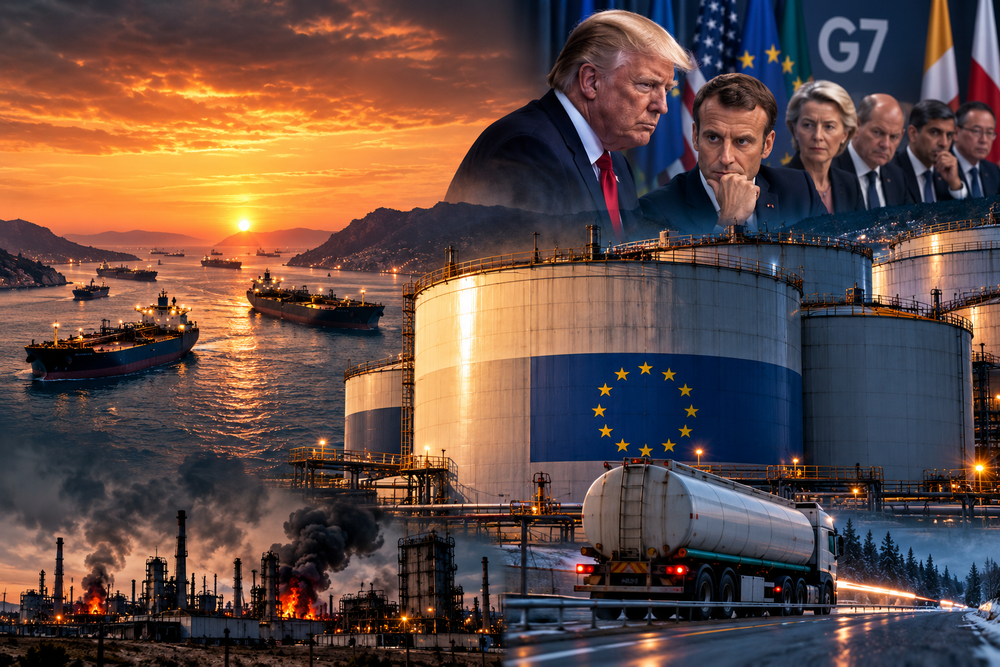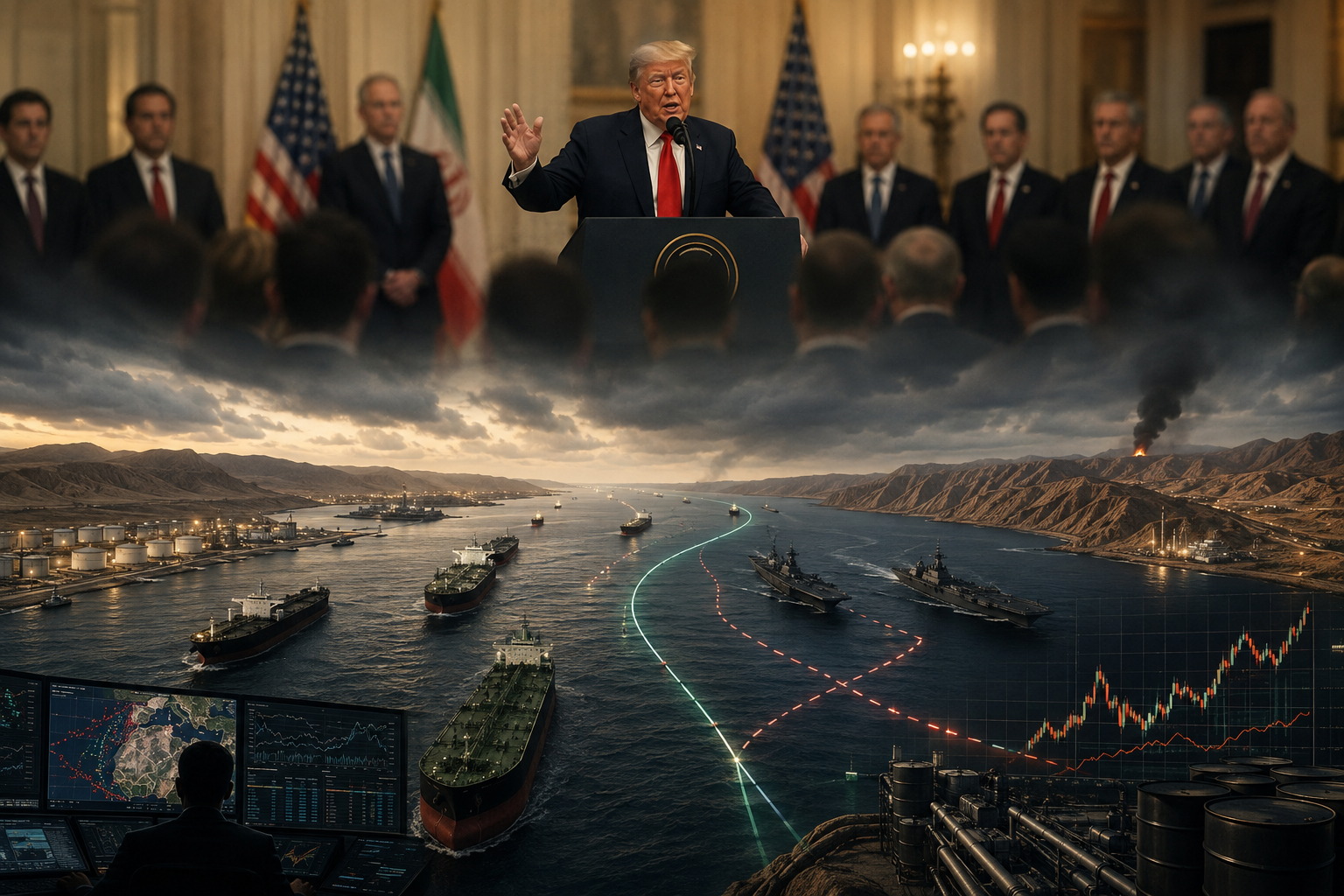
The world has spent months discussing an Iran deal.
Ships have spent those same months preparing for a war economy.
In April 2026, a ceasefire was announced between the United States and Iran. The word "ceasefire" did its diplomatic work. Markets stabilized. Analysts described a pathway toward negotiation. The language of resolution entered the room.
Three weeks later, the United States struck Iranian targets while the ceasefire remained nominally in force.
The ships had already updated their routing calculations.
One reality is made of announcements. The other is made of steel, fuel, inventories, and logistics. They have not been describing the same situation since at least March. The question the market has been calculating, mostly in silence, mostly outside the press briefings, is not whether they describe the same situation. That much is already resolved.
The question is how much longer the buffers can absorb the difference.
The Ceasefire That Wasn't
The ceasefire announced on April 8, 2026 was genuine in one sense: both sides stopped the most visible forms of direct exchange for a period of weeks. That much happened.
What did not happen was any of the structural change that makes a ceasefire into peace rather than a pause.
The United States maintained three carrier strike groups in the Gulf region through the ceasefire period, the largest American naval concentration in the Gulf since the invasion of Iraq in 2003. Military planners do not position carrier groups to reflect optimism. They position them to manage contingencies.
On May 7, United States forces struck Iranian targets while the ceasefire remained in place. The event was documented, reported, and then absorbed into the ongoing diplomatic vocabulary without apparent disruption to the language of negotiation. The strikes happened. The ceasefire language continued. Neither fact canceled the other at the level of official communication.
A 14-point memorandum of understanding was signed on June 17, 2026, establishing a 60-day ceasefire framework and a path toward commercial passage through Hormuz. The dealmaker language described it as a breakthrough. Physical systems began calculating whether the framework would hold.
The MOU lasted 32 days. On July 18, Iran's Deputy Foreign Minister announced the suspension of Iranian commitments, citing American breaches of the agreement's terms. The Strait of Hormuz returned to contested status before the summer ended.
Two language events. Two collapses. The physical systems that registered the first ceasefire's end in May registered the MOU's end in July through the same mechanisms: insurance designations unchanged, transponder-dark vessels, carrier groups still in theater.
This distinction matters not because it exposes bad faith on any particular side, but because it illustrates a structural feature of the current impasse. The language and the physical reality diverged in April. The MOU signed in June was the one moment at which the two planes briefly intersected. Thirty-two days later, the physical reality reasserted itself.
The dealmaker identity requires a deal. What the physical record shows is not a deal. It is two failed attempts at a deal's language.
What Ships Heard
When Lloyd's Joint War Committee designated the Strait of Hormuz and surrounding Gulf waters as a high-risk zone in March 2026, it was responding to something more reliable than press releases. War risk surcharges of $10-14 million per very large crude carrier per voyage reflected a probability assessment produced by underwriters whose models are calibrated to the cost of being wrong.
Those surcharges remained in place through every announcement of diplomatic progress.
When Windward Maritime Intelligence reported 21 vessels operating without AIS transponders in Gulf waters in May 2026, 12 of them VLCC-class ships carrying an estimated 24 million barrels, the operators making those decisions were not consulting State Department readouts. They were calculating whether broadcasting their location increased their exposure. The calculation said it did.
When three carrier strike groups remained positioned across the Gulf region through the same weeks in which officials described constructive discussions, the logistics of that deployment were independent of the diplomatic vocabulary. Three carrier groups require continuous supply chains, rotating personnel, and operational planning that reflects the probability of use rather than the hope of non-use.
None of this behavior responded to statements about deal progress.
Insurance markets do not lower war risk premiums because a foreign minister sounds optimistic. Tanker operators do not route toward a designated combat zone because a diplomatic meeting is described as productive. Military planners do not redeploy carrier groups because negotiations are announced as continuing.
Physical risk markets do not read press releases. They read observable conditions. The conditions in the Gulf have been consistently describing something that press releases have not.
The Absence in the Architecture
In late February 2026, United States and Israeli strikes killed Supreme Leader Ali Khamenei. His son Mojtaba Khamenei, who had spent years consolidating institutional standing in preparation for a succession always expected but never formally acknowledged, became Iran's Supreme Leader.
He was reportedly wounded in the same strike that killed his father, his mother, and his wife. In the five months since, he has not held a formal public audience. He has communicated through written statements read on state television and through audio messages attributed to him by Iranian media. On August 9, 2026, Israeli media reported a 13-second video of Mojtaba Khamenei teaching religious studies to a small group of students. It was the first reported visual image of Iran's Supreme Leader since he took power. The footage has not been independently authenticated.
A Supreme Leader whose first confirmed visual appearance in five months of power is thirteen seconds of classroom footage is not positioned to absorb the domestic political cost of a concession-requiring agreement. The architecture of a deal requires visibility, credibility, and signaling — a public performance that tells domestic constituencies that concessions are coming and that the leadership has the institutional standing to manage them. Thirteen seconds does not perform that function.
The JCPOA required two years of visible Iranian diplomatic positioning before the final signature. Hassan Rouhani's 2013 election was itself a public signal of the internal political direction the regime was prepared to take. The signaling apparatus of a regime moving toward a deal has a recognizable shape. What is visible from outside Iran in August 2026 is a Supreme Leader who has appeared on video for thirteen seconds.
The deal that exists in speeches requires a counterparty with the institutional architecture to sign it. That architecture is operating at its minimum visible expression.
The Buffer Architecture
The reason two divergent realities have been able to coexist for months is not mysterious. Modern economies are equipped with sophisticated mechanisms for absorbing the gap between political narrative and physical constraint.
The International Energy Agency coordinated the largest emergency petroleum reserve release in history in March 2026, drawing more than 400 million barrels from government-held strategic stockpiles. That intervention bridged the supply gap created by Hormuz disruption while diplomatic language described the situation as progressing toward resolution. It worked because the buffers were large enough to absorb the gap.
Simultaneously, commercial shippers activated alternative routing around the Cape of Good Hope, adding approximately 14 days per voyage and 40% additional fuel cost to Asia-Europe trade. That routing was already absorbing the Red Sea disruption created by Houthi attacks since late 2023. It was running at elevated utilization before it was asked to absorb redirected Gulf traffic.
Financial hedging markets allowed energy traders to manage exposure across the disruption period. Insurance markets continued underwriting at elevated premiums. Military escorts maintained navigation in contested waters at the cost of the carrier group deployment that continued through May and beyond.
Each of these mechanisms does the same structural work. It absorbs the gap between a political narrative and a physical reality without closing the underlying divergence.
None of them is infinite.
The IEA reserve release in March represented more than a third of total government-held emergency stocks across IEA member countries. Those barrels cannot be redrawn. The Cape route was absorbing loads it was not designed to handle simultaneously. The carrier deployment accumulated cost across every week it continued.
Buffers do not resolve structural problems. They purchase the time in which structural problems either resolve themselves or exhaust the buffers.
The buffer levels in August 2026 are meaningfully lower than they were in March. The structural gap between political language and physical reality is not.
The Inventory Clocks
Below the strategic buffer mechanisms — the reserve releases, the rerouting, the financial hedging — sit the operational inventories that translate physical disruption into concrete shortage. These clocks are running.
United States distillate fuel oil inventories in summer 2026 are tracking near their lowest levels since 2000, according to EIA data. Diesel moves goods by truck, powers construction equipment, and fuels industrial processes across the supply chains that keep hospitals, cold chains, and food distribution running. The inventory buffer that absorbs supply disruption before it reaches final consumers is at its thinnest in a quarter century.
European natural gas storage reached 57 percent of capacity in early August 2026, against a target of 90 percent before winter, according to data from Gas Infrastructure Europe. The gap between current levels and winter requirements must be closed through LNG imports at a moment when European LNG terminal utilization is already running at elevated rates from the demand shift that followed the loss of Russian pipeline supply. The margin for error before winter is narrower than in any comparable injection season since the transition began.
The pharmaceutical supply chain is carrying a 4-to-6-week shortage risk window for generic medications, according to industry analysis of the disruption. India supplies 47 percent of American generic prescriptions and sources approximately 40 percent of its crude oil through Hormuz-dependent routes. For temperature-sensitive biologics — insulin, monoclonal antibodies, certain vaccines — cold chain integrity on rerouted Cape passages cannot be guaranteed at the same confidence level as direct routes. The supplies most vulnerable to disruption are the ones for which substitution is most difficult.
These are not projections. They are documented inventory positions measured against current demand, at a moment when the buffer mechanisms have been under strain for five months. Each week in which the dealmaker's language extends the expected resolution timeline is a week in which these positions decline further before adaptation can begin.
How Long a Narrative Holds
Complex system disruptions follow a recognizable sequence that public discourse misses because it focuses on each stage in isolation rather than tracing the progression between them.
First comes disruption. Then comes reassurance. Then comes substitution, the phase in which buffers absorb the gap between the reassurance and the disrupted physical reality. Finally comes recognition: substitution capacity is exhausted, and the gap closes not because the underlying situation has been resolved but because the mechanisms financing the divergence have run out.
The sequence can be read as a stack. At the top sits the IDENTITY, which requires a deal to remain coherent. The identity produces the NARRATIVE — that the deal is close, that talks are constructive, that resolution is approaching. The narrative suppresses adaptation because the BUFFERS absorb the gap: the IEA reserve releases, the Cape rerouting, the financial hedging. Below the buffers sit the INVENTORIES: the diesel stocks, the gas storage levels, the pharmaceutical forward cover. The RECOGNITION stage begins when inventory depletion makes the gap impossible to describe as temporary. REALITY follows: adaptation starting from a more depleted position than would have been the case if recognition had come earlier.
This is not a prediction about which week recognition arrives. It is a description of a sequence that has been running since March. The buffers have absorbed five months of the gap. The inventories have absorbed two of those months. The stack does not empty from the top.
Most public conversation about Iran in 2026 exists in the reassurance stage. The MOU's 32-day lifespan was the reassurance stage's most expensive proof of concept. Every diplomatic meeting, every readout describing constructive atmospheres, every statement that a deal remains possible — these are institutional products of the reassurance machinery. The dealmaker's framing is the most prominent version of that machinery, but it is not the only one. The Iranian foreign ministry has produced its own version. European interlocutors have produced theirs.
Physical systems are operating in the substitution stage.
The question that has been building, largely outside public framing, is specific: at what point does substitution capacity exhaust?
That cannot be calculated from public data with precision. The directional signal is clear. The IEA reserves are lower. The Cape route is more congested. The carrier deployment continues to cost. The insurance market continues to price risk at a level that reflects the absence of resolution rather than its approach.
Each week of buffer consumption is a week closer to the moment when physical reality becomes impossible to postpone.
The narrative does not shorten that timeline. It cannot.
How False Hope Makes the Problem Harder
The damage produced by the dealmaker narrative is not limited to the gap between language and reality. The narrative actively makes the underlying problem harder to resolve than it would be without it.
This operates through three documented mechanisms.
The first is the price signal distortion. When energy markets price in an expected resolution, they suppress the investment signals that would otherwise trigger adaptation. Refinery operators do not build alternative crude sourcing infrastructure if they believe Hormuz normalization is six weeks away. Shipping companies do not contract for long-term Cape route capacity if they believe the Red Sea will reopen next month. Governments do not accelerate the domestic energy policy changes that would reduce their Hormuz exposure if they believe a diplomatic resolution is imminent.
Each month in which the dealmaker narrative suppresses those adaptation signals is a month in which the structural vulnerability compounds without the adaptation that would reduce it. The false hope is not neutral. It delays the response that the physical situation requires.
The second mechanism operates on Iranian incentive structures. A counterparty that is being publicly described by the American president as close to a deal faces a specific kind of pressure: none. If the dealmaker is telling his domestic audience that the deal is almost done, Iran has no reason to make the concessions that would actually produce a deal. The domestic American pressure for resolution is being managed by the dealmaker's language, not by the underlying situation. Iran can wait out the optimism without paying the price of the optimism.
Contrast this with the pressure structure that produced the original JCPOA. The Obama administration did not describe the deal as close until it was close. The sustained pressure — sanctions architecture, international coalition, absence of diplomatic optimism — created the conditions under which Iran calculated that the cost of non-agreement exceeded the cost of concession. The dealmaker narrative inverts that pressure structure. It tells Iran that America needs a deal. That is not how deals are produced.
The third mechanism is what might be called substitution lock-in. Because the political narrative describes resolution as imminent, the buffer mechanisms that have been absorbing the physical disruption are not being replenished or replaced. Strategic reserves depleted in March are not being rebuilt because the assumption is that Hormuz normalization will make rebuilding unnecessary. Alternative energy infrastructure is not being developed at the pace the physical situation requires because the assumption is that the deal will make it unnecessary.
The result is that each week of sustained dealmaker optimism is a week in which the structural vulnerability grows while the buffer capacity that has been absorbing it shrinks. The false hope is not just an inaccurate description of the situation. It is an active mechanism that is making the situation materially worse.
The dealmaker's language does not accelerate the deal. It removes the conditions under which the deal becomes necessary for both sides.
The economic cost of this mechanism is not theoretical. The IEA's March 2026 reserve release, the Cape route's elevated utilization, the Lloyd's war risk surcharges accumulating on every cargo leaving the Gulf, the carrier group deployment costs running through every week of sustained deployment: these are documented expenditures produced in part by a diplomatic environment in which the false proximity of resolution has suppressed the adaptation that would have reduced the exposure. The economic cost of the gap between the dealmaker's language and the physical reality is being borne by logistics networks, energy consumers, and public budgets that did not create the gap and cannot control how long it is maintained.
The Strongest Counterargument
The reading offered here deserves direct challenge before it is accepted as complete.
It argues that physical systems are more reliable truth-tellers than political language. That claim is not obviously correct. Markets have systematically mispriced risk for extended periods in ways that were only visible in retrospect. Insurance markets and credit rating agencies collectively failed to identify the 2008 financial system's vulnerability until after it had become impossible to ignore. Oil futures markets have embedded conflict premiums for conflicts that never materialized.
More importantly, there is a serious case that Trump's dealmaker narrative performs a function that physical indicators cannot capture. Sustained diplomatic optimism, when credible enough, can alter the calculations of domestic audiences and third-party actors in ways that create political space for concessions. The language of a deal sometimes precedes the deal. Stating confidence can sometimes produce the conditions for confidence to become warranted.
The JCPOA itself was described as impossible by physical-systems analysts who were tracking Iranian nuclear enrichment data. It was produced anyway, by political will operating at a register that actuarial models could not have predicted.
This counterargument is structurally serious and the historical record supports it.
The reading here does not claim that political resolution is impossible before buffer exhaustion. It claims something narrower: that the current divergence between political language and physical behavior is not normal variance in information timing, and that the mechanisms absorbing that divergence are measurably depleted compared to their March baseline. Whether the deal that exists only in speeches becomes the deal that exists in documents before substitution capacity is exhausted, the evidence available in August 2026 does not settle. What is settled is that the buffers are thinner, the gap has not closed, and the narrative's continued credibility depends on the buffer mechanism rather than the underlying structural situation.
The Invoice
The Iran deal described in speeches in 2026 may yet become the Iran deal described in documents.
The MOU signed in June was the closest it came. For 32 days, the deal existed in both language and paper. On day 32, Iran suspended its commitments. The physical conditions in Hormuz had not changed. The carrier groups were still in theater. The insurance designations were still active. The language produced a document. The document did not survive contact with the physical reality the language had not resolved.
The path from here to a durable agreement has been made materially longer by every week in which the dealmaker's narrative suppressed adaptation, removed pressure from Iran's decision calculus, and allowed buffer mechanisms to deplete without replacement. The diplomatic language did not simply fail to accelerate resolution. It accumulated specific damage: an economy less prepared for prolonged disruption than it would have been if the language had described the situation accurately, a counterparty with less incentive to concede than it would have had under different diplomatic framing, and a buffer stock thinner than it would be if the physical situation had been acknowledged in March.
What cannot happen is for the eventual resolution to occur without the physical world registering it first. Tanker operators will reroute back through Hormuz when their risk models support it, not when a press conference announces they should. Insurers will lower war risk premiums when their probability assessments change, not when officials describe momentum. Military planners will redeploy carrier groups when the contingency calculation shifts, not when talks are described as constructive.
These systems are not cynical. They are structural. They measure what is happening, not what is being said about what is happening.
The ceasefire of April 8 was announced in language. The military strike of May 7 happened in steel. The MOU of June 17 was signed in documents. The suspension of July 18 happened in physics — the Strait of Hormuz was still contested, the insurance models had not changed, and the carrier groups had not moved. All four events were real. Three registered in the physical systems that keep global commerce operating. One was processed by briefings and extended a tab that was already running.
In the months since, the physical systems have continued to describe a world that is not approaching resolution. The gap between that description and the political language has been sustained by buffers running a tab that the dealmaker's narrative does not acknowledge and that the physical world will eventually present.
Iran's Supreme Leader has been visible on video for thirteen seconds since taking power. The Lloyd's designation has not been withdrawn. The carrier groups have not redeployed.
Ships know where they are. The dealmaker's language knows where it needs to be.
Those are not the same place. The distance between them is being paid for by logistics networks, energy consumers, and public budgets that had no voice in the description. The invoice arrives when the buffers run out.
Evidence Map
Core claim The political narrative of Iran deal progress and the physical behavior of shipping, insurance, and military systems have been describing divergent realities since at least March 2026. The divergence has been sustained by finite buffer mechanisms that are measurably depleted compared to their March baseline. The structural direction of this dynamic is observable. The timing of the recognition stage is not calculable from available public data.
Observed conditions (high confidence, directly documented) Ceasefire announced April 8, 2026; United States struck Iranian targets May 7, 2026 while ceasefire nominally in force (multiple wire services, May 2026). 14-point MOU signed June 17, 2026 (Military Times, CNN, Al Jazeera, NBC News, June 17, 2026). Iran suspended MOU commitments July 18, 2026 citing American breaches; MOU collapsed 32 days after signing (ABC News, CFR, Middle East Council on Global Affairs, July 2026). Lloyd's Joint War Committee: Gulf high-risk designation maintained through summer 2026, war risk surcharges $10-14 million per VLCC per voyage (Lloyd's List, 2026). IEA emergency reserve release March 2026: 400 million barrels, largest single coordinated release in IEA history (IEA press release, March 2026). Three US carrier strike groups in Gulf region, largest concentration since Iraq 2003 (US Department of Defense; Army Recognition, March-May 2026). Windward Maritime Intelligence: 21 AIS-dark vessels in Gulf waters May 10, 2026, 12 VLCC-class, estimated 24 million barrels (Windward Maritime Intelligence, May 2026). Ali Khamenei killed in US-Israeli strikes, late February 2026; Mojtaba Khamenei became Supreme Leader (multiple sources, February-March 2026). Mojtaba Khamenei: no formal public audience through August 2026; first reported video appearance 13 seconds, August 9, 2026, authentication pending (Israel Hayom, August 9, 2026). US distillate fuel oil inventories near lowest since 2000 (EIA, 2026). European natural gas storage 57% capacity as of August 2, 2026, vs 90% winter target (GIE AGSI+, August 2026). Pharmaceutical generic supply: 4-6 week shortage risk window; India (47% of US generics) sources 40% crude through Hormuz (PharmExec, Fierce Pharma, CNBC, 2026).
Documented structural dependencies (medium-high confidence) IEA reserve release exceeded one-third of total government-held emergency stocks, constraining future deployment capacity. Cape of Good Hope rerouting absorbing simultaneous Red Sea and Hormuz disruption loads above designed utilization. Saudi East-West Pipeline not restored to full post-2019-attack capacity; Duqm alternative export facility insufficient for diverted volumes at current Gulf output.
Analytical inferences (medium confidence) Physical system behavior is consistent with substitution stage of disruption sequence rather than reassurance stage. The MOU's 32-day lifespan directly evidences buffer-dependency of narrative sustainability: the agreement held only as long as no structural physical threshold was crossed. Buffer capacity has declined directionally since March. Inventory depletion (diesel, gas storage, pharma forward cover) is compressing the substitution window. Internal Iranian political dynamics, as observable through Supreme Leader Mojtaba Khamenei's minimal public presence and 13-second video appearance, are not consistent with a regime actively finalizing concession structures requiring domestic political management.
What would confirm this War risk premiums declining before formal agreement announcement. Carrier groups redeploying before formal agreement. IEA announcing reserve replenishment as Hormuz supply normalizes. Supreme Leader Mojtaba Khamenei making sustained formal public appearances in contexts consistent with a regime positioning for a concession-bearing agreement.
What would disprove this Insurance markets lowering Gulf risk pricing on diplomatic momentum alone, before structural change. Tanker operators routing through Hormuz at current risk levels based on stated optimism rather than changed conditions. These would indicate physical probability assessments had revised independently of the buffer dynamic.
Watchlist Lloyd's JWC Gulf designation status (monthly review). IEA strategic reserve levels (monthly IEA Oil Market Report). VLCC AIS-dark vessel counts (Windward Intelligence, weekly). Mojtaba Khamenei confirmed public appearances and authentication status of August 9 footage. Post-MOU diplomatic channel re-engagement signals. US distillate and European gas storage trajectories vs seasonal norms (EIA weekly, GIE daily).
Confidence assessment Physical behavior observation: high. MOU signing and 32-day collapse as evidence of buffer-dependency: high. Buffer depletion trajectory, directional: medium-high. Inventory clock positions (diesel, gas storage, pharma): medium-high, sourced from EIA and GIE data. Recognition stage timing: low, not calculable from public data. Structural gap observation: high. Internal Iranian political dynamics inferences: medium, based on observable public signals only. Intentionality of any specific actor: not assessed. The buffer mechanism does not require intentional deception to operate.
The chokepoint architecture that forms the physical infrastructure of this standoff connects to three investigations in this archive. Everyone Is Watching Hormuz. Nobody Is Watching the Other Five Passages. mapped how six simultaneous chokepoint crises eliminated the redundancy global trade depended on. Hormuz, Houthis, Yanbu: No Backup traced what happens when the bypass routes entered the target set. The Iran War Has No Off Switch documented the IEA buffer depletion timeline running underneath.
Jerry writes The Manifest Archive — forensic analysis of the institutional structures that shape geopolitics, history, and power.