The most famous economist of his age took the back stairs and paid for it with his heart. John Maynard Keynes had been told by his doctor to use only the lift. The only lift in the Mount Washington Hotel was on the far side of the building, so after a meeting with the American Treasury Secretary he ran up the service staircase, and collapsed with a heart attack. After dinner, according to Ed Conway's account of the conference, journalists in the hotel bar heard that he had died, and a false Reuters report carried the rumour as far as Germany. Keynes, very much alive, later joked that he had received most satisfactory obituaries.
He was in New Hampshire to argue about one question. The Bretton Woods agreement of July 1944, signed by 44 Allied nations after three weeks of talks, fixed the world's currencies to the US dollar and the dollar to gold at $35 an ounce. It created the International Monetary Fund and the World Bank. Twenty-seven years later, on 15 August 1971, Richard Nixon cut the link between the dollar and gold, and the standard account says the Bretton Woods system ended that day.
The gold link ended. The question Keynes ran up those stairs to fight over is still settled the way he lost it, and a second question, one he raised and could not win, has quietly become the more important of the two.
What Was the Bretton Woods Agreement?
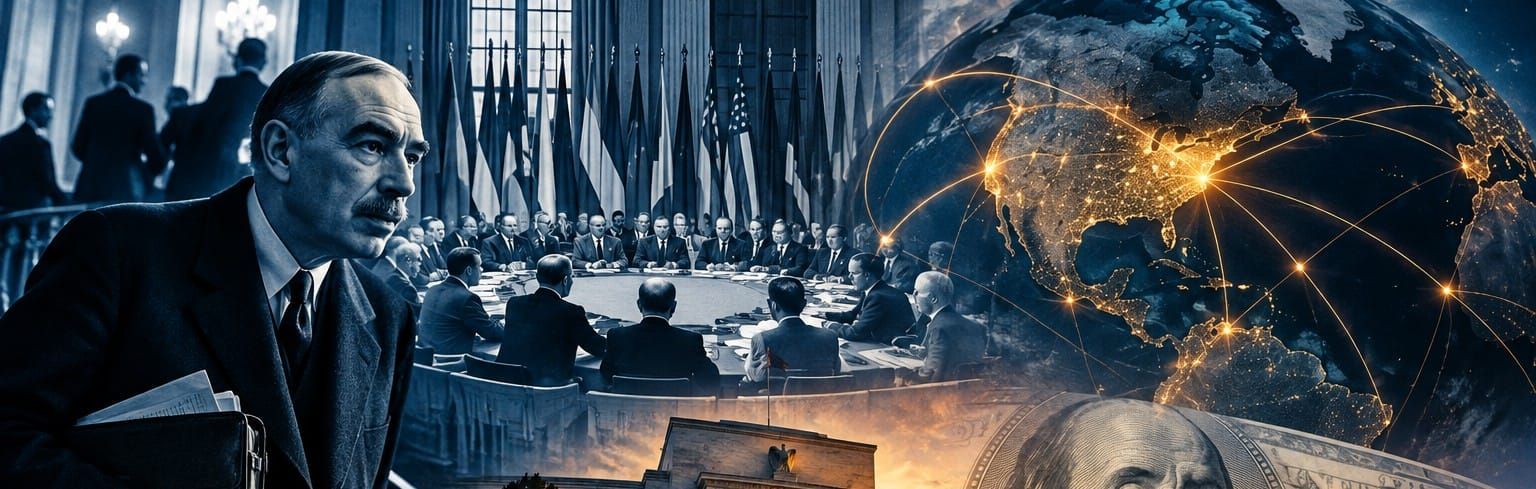
The United Nations Monetary and Financial Conference ran from 1 to 22 July 1944 at a resort hotel in Bretton Woods, New Hampshire. According to the Federal Reserve's history of the conference, 730 delegates came from 44 countries. Henry Morgenthau, the US Treasury Secretary, presided. Harry Dexter White of the US Treasury chaired the commission that designed the Fund. Keynes chaired the one that designed the Bank.
The machinery was simple to describe. Every member set a par value for its currency against the dollar and kept it within one per cent of that value. The United States promised to convert dollars held by foreign governments into gold at $35 an ounce. The IMF, launched formally in December 1945 when 29 countries signed its Articles, would lend to members that ran short of reserves while they corrected their accounts. The International Bank for Reconstruction and Development, the first piece of today's World Bank Group, would finance rebuilding.
Behind the design stood a physical fact. At the end of 1948 the United States held about 21,700 tonnes of gold, between two-thirds and three-quarters of the world's official gold, depending on the count. A system built on gold was, in practice, a system built on one country's vault. The Soviet delegation signed the conference's Final Act and then never ratified the agreements; Moscow stayed out of both institutions.
What the text did not say outright was the thing that mattered most. When trade between two countries is out of balance, which of the two has to change?
Keynes vs White: The Argument Over Who Adjusts
Keynes arrived with a plan for an International Clearing Union. Countries would settle their trade in a new unit of account, the bancor, which no private person could hold. Every country got an overdraft limit sized to its share of world trade. The novelty was the symmetry. Countries that ran large, persistent deficits would face pressure to devalue and pay charges. Countries that ran large, persistent surpluses would face charges as well, and pressure to revalue. Hoarding was meant to cost something too.
The reason was not abstract. In 1944 the country with the surplus, the gold and the factories was the United States, while Britain had sold much of its overseas wealth to pay for the war. A rule that made creditors adjust would have bound Washington first. White's counter-plan was a Stabilisation Fund: a smaller pool of national currencies and gold, no new currency for anyone to hold, and lending to deficit countries on terms the Fund would set. The conference adopted something close to White's design.
One piece of the symmetrical idea survived, written by the Americans into White's own plan: the scarce currency clause, Article VII of the IMF's Articles of Agreement. If a surplus country's currency became scarce in the Fund, the IMF could formally declare it so, and other members could then impose temporary restrictions on exchange operations in that currency. It was the symmetrical idea in miniature, a lever that could one day be pulled against a creditor.
It was never pulled.
The clause is still in the Articles. In eighty years the Fund has never used it, and a study in the Cambridge Journal of Economics describes it as a remnant of the postwar settlement. From 1944 onward, adjustment in practice meant one thing: the country short of money changes its budget, its exchange rate or its wages, and the country long on money may choose not to.
Why Did Bretton Woods End? Triffin, de Gaulle and the Gold Drain
For its first decade the system suffered from the opposite of the problem that later killed it. Europe had no dollars. Marshall Plan aid and American military spending abroad filled the gap, and only at the end of 1958 did the main Western European currencies become freely convertible. The system as designed in 1944 ran at full strength for about twelve years.
In 1960 the Belgian-American economist Robert Triffin described the trap. The world needed a growing supply of dollars to trade with and to hold as reserves. The only way to supply them was for the United States to spend more abroad than it earned. Yet the more dollars piled up overseas, the less believable the promise to swap each of them for gold became. The system needed American deficits to grow, and those deficits would one day break it. Governments did not refute the argument. They managed around it.
The managing lasted a decade. In November 1961 eight central banks formed the London Gold Pool to hold the market price at $35. France pushed back hardest. Valéry Giscard d'Estaing, then finance minister, gave the arrangement its lasting name, the dollar's exorbitant privilege: the United States could pay for imports and foreign investments with money it created and the rest of the world needed to hold. In January 1965 France began converting part of its dollar reserves into gold, and in February Charles de Gaulle publicly called for a return to the gold standard. The Gold Pool collapsed in March 1968, splitting the market into an official price and a free one.
By the summer of 1971, according to an IMF review of Jeffrey Garten's history of the decision, the United States held about $10 billion of gold against some $40 billion of dollar liabilities. On the weekend of 13 to 15 August, Nixon met his economic team at Camp David, among them Arthur Burns, John Connally, Paul Volcker and George Shultz. The Sunday evening broadcast announced a 90-day wage and price freeze, a 10 per cent surcharge on imports and the closing of the gold window. In December the Smithsonian Agreement set a new price of $38 an ounce. By March 1973 the major currencies were floating, and an amendment to the IMF's Articles, in force from 1 April 1978, gave every member the right to choose its own exchange rate arrangement.
What Actually Ended in 1971
The convertibility of dollars into gold ended. Very little else did.
Start with the gold. Once the window closed, the drain slowed, and apart from auctions in 1975 and in 1978 and 1979 the stock has barely moved since the end of the 1970s. The US Treasury's status report lists 261,498,926 fine troy ounces, about 8,133 tonnes, still carried on the books at $42.2222 an ounce, the price Congress wrote into law in September 1973. At the market price in early October 2026, a little over $4,100 an ounce, the same metal is worth more than a trillion dollars. The number is large and it decides nothing. Nobody can redeem a dollar for it, and no market waits on what it is worth.
The institutions continued. The IMF now has 191 members and says it can lend about $1 trillion. The World Bank still finances development. Both are headquartered in Washington.
And the dollar grew more central, not less. On the IMF's latest figures, released on 30 September 2026, the dollar made up 56.7 per cent of the world's allocated foreign exchange reserves in the second quarter of 2026, when total reserves stood at $13.22 trillion. The share has slipped from above 70 per cent around the turn of the century, but no other currency comes close: the euro stands at 20.6 per cent and the renminbi at 2.1. In April 2025, according to the Bank for International Settlements, the dollar was on one side of 89 per cent of all foreign exchange trades, in a market turning over $9.6 trillion a day. Economists noticed the continuity long ago. In 2003 Michael Dooley, David Folkerts-Landau and Peter Garber described a "revived Bretton Woods system", with Asian exporters holding their currencies down against the dollar and piling up US Treasuries much as Europe and Japan had done in the 1960s.
The anchor changed. The asymmetry did not.
The Rule That Survived: Deficit Countries Adjust, the Issuer Does Not
On 28 September 1976 Denis Healey, Britain's Chancellor of the Exchequer, was in the VIP lounge at Heathrow, due to fly to a Commonwealth meeting in Hong Kong and on to the IMF's annual meeting in Manila. Sterling had started the year just above $2. That day it fell to $1.63. Healey abandoned the trip and went back to the Treasury. In December he signed the letter of intent for a $3.9 billion loan, at the time the largest the Fund had ever considered, and committed Britain to public spending cuts. Keynes's own country now sat on the side of the table his plan had tried to protect.
That is the 1944 answer in operation. When a country runs out of dollars it goes to the IMF, and the IMF lends with conditions. In April 2025 Argentina reached agreement on a $20 billion, 48-month programme built on what the Fund called "a strong fiscal anchor". Between Healey and Argentina the same bargain has been struck in dozens of countries: money now, adjustment as the price.
The country that issues the currency faces different arithmetic. At the end of the second quarter of 2026, the US Bureau of Economic Analysis put America's net international investment position at minus $22.42 trillion: what the United States owes the rest of the world, net of what it owns abroad. No other country owes anything close to that, and no other borrows on that scale in money it prints itself. Debtors adjust to the dollar. The dollar does not adjust to its debtors. The line usually attributed to Connally, first recorded in print in 1976, said it plainly: the dollar is our currency, but your problem.
The institutional design keeps the arrangement in place. Major decisions at the IMF need 85 per cent of the votes, and the United States holds 16.49 per cent, according to the Congressional Research Service, enough to block any of them alone. By long convention the Fund is run by a European and the World Bank by an American. None of this is hidden. It is a rulebook, written in public and ratified by parliaments, in which one member writes the money and the others earn it.
The Lender Keynes Wanted Exists. It Is the Federal Reserve.
Keynes lost a second argument in New Hampshire, and today it matters more than the first. His Clearing Union was meant to work like a ledger rather than a favour: a lender large enough, and automatic enough, that a solvent country would never be pushed into crisis by a mere shortage of international money. The IMF was built smaller, slower and conditional.
In 2008 the dollar shortage of the 1940s came back in a new form. European banks above all had borrowed dollars short-term to hold long-term dollar assets, and when lenders stopped rolling those loans the gap could not be closed in euros. According to the Bank for International Settlements, the crisis began as a dollar liquidity problem for European banks. The answer did not come from the Bretton Woods institutions. It came from the Federal Reserve, which lent dollars to foreign central banks through currency swap lines. In mid-September 2008 the Fed had swap lines with two central banks; by late October it had fourteen, on five continents. Lending through them peaked at $586 billion in December 2008, according to the Council on Foreign Relations.
The list then shrank, and in 2013 it set. On 31 October that year the Fed and the central banks of Canada, England, Japan, the euro area and Switzerland turned their temporary lines into standing arrangements that "will remain in place until further notice". In March 2020 the Fed reopened temporary lines to nine more central banks, and swaps outstanding rose from almost nothing on 18 March to $449 billion on 27 May. It also created a repo facility, made permanent in July 2021, that is open more widely but works differently: a central bank hands over US Treasuries it already owns and gets dollars back. It turns dollars a country has saved into dollars it can spend. It does not lend a country dollars it does not have.
Set the two lenders side by side. The IMF can lend about a trillion dollars to 191 members, with conditions attached to each programme. Within ten weeks in 2020, the Fed's swaps with a selected group of central banks reached nearly half that sum, against their own currencies, with no programme of spending cuts attached. Keynes's ledger exists. Admission is decided by the Federal Open Market Committee, which answers to Congress, not to the countries that need the dollars.
Keynes got his lender. It has a guest list.
This is the distinction the textbooks skip. Reserve status is what the world holds. Rescue status is who receives dollars, without conditions, on the worst day. The first is measured every quarter. The second is decided at a meeting in Washington, and in a panic it is the one that counts. The world trades and saves in dollars; its banks borrow dollars they cannot print; a panic makes those dollars scarce; the central banks on the list are supplied and their markets calm; those off the list sell assets, burn reserves or go to the IMF and accept its terms.
The Petrodollar: What the 1974 Deal Did and Did Not Say
The most persistent story about the post-1971 dollar is that a secret deal with Saudi Arabia replaced gold with oil. Part of it is documented.
In July 1974 the Treasury Secretary, William Simon, and his deputy, Gerry Parsky, travelled to Jeddah. According to Bloomberg's 2016 reconstruction, the framework was that the United States would buy oil and supply military aid, and Saudi Arabia would invest its oil revenue in US Treasuries. The kingdom bought through so-called add-ons, outside the regular auction totals. A diplomatic cable records King Faisal's demand that the purchases stay strictly secret, and for 41 years Treasury reports grouped Saudi holdings with those of fourteen other oil exporters. In May 2016, after a freedom-of-information request, the Treasury disclosed the figure for the first time: $117 billion.
What the record does not show is a written promise to price oil only in dollars. Dollar pricing was the market's convention, and it held. In June 2024 a viral claim said a fifty-year "petrodollar agreement" had expired. PolitiFact rated it false: the experts it consulted knew of no such treaty, and the closest real document was the 1974 Joint Commission on Economic Cooperation, which encouraged the recycling of oil revenue into American goods and assets. The documented arrangement is quieter than the legend, and more revealing about how the order works: surpluses recycled into Treasuries, with the size of one country's position kept from the public for four decades.
Is Bretton Woods Breaking Now?
The case for a breakup has real data behind it. The dollar's share of reserves has fallen by roughly a fifth since 2000. Central banks bought more than 1,000 tonnes of gold a year from 2022 to 2024, according to the World Gold Council, after the freezing of Russia's central bank reserves, and some, such as Poland's, say openly that gold is free of any other country's policy decisions. China is building its own payment rails.
The case against is in the data too. The euro is the only real alternative and holds a fifth of reserves; the renminbi holds two per cent; the dollar sits on nine in ten currency trades. Nor has Washington walked away from the institutions it built. When the administration announced its withdrawal from 66 international organisations on 7 January 2026, neither the IMF nor the World Bank was on the list. In April 2025 Treasury Secretary Scott Bessent called their drift into new areas "mission creep" and offered support on condition that they return to their core missions, which is a demand to run the 1944 machine more narrowly, not to switch it off.
What is changing is the hedge, not the rule. Countries are buying protection against the dollar's legal reach while still invoicing, borrowing and saving in dollars. The number most watched is the reserve share. The number that decides a crisis is shorter: the list of central banks with a standing line. A country can halve its dollar reserves and still, on its worst day, need dollars that only a meeting in Washington can supply.
The Strongest Case Against This Reading
The strongest counterargument accepts every fact above. It says the dollar dominates for market reasons that would exist without any treaty: the deepest and most liquid government bond market in the world, enforceable contracts, open capital accounts and the plain network effect that everyone uses dollars because everyone else does. On this view the swap lines are self-defence, not patronage. When foreign banks run short of dollars they dump US assets, and the Fed lends to stop a fire sale in its own markets. The IMF attaches conditions because lending to a country that cannot pay is risky. And the United States did pay for adjustment at times: closing the gold window led directly to two devaluations of the dollar, and the Volcker interest-rate shock of 1979 to 1982 imposed a deep recession at home.
This counterargument is serious, and it explains why no rival has displaced the dollar. The reading offered here does not claim that 1944 caused the dollar's dominance, or that the asymmetry was anyone's plan. It claims something narrower: the question of who must adjust was settled at Bretton Woods against the creditor; the one tool built to reverse that has never been used; and the automatic lending Keynes wanted for every member now exists, by a central bank's decision, for a few. Market depth explains why the world uses the dollar. It does not explain why the rules for using it bind every member but one.
There are ways this reading could fail. If the Fed opened a standing line to any central bank that met published criteria, the guest list would become a rule. If the IMF ever declared a surplus country's currency scarce, Keynes's lever would turn out to be alive after all. If offshore dollar shortages stopped recurring because the world's banks funded themselves in their own currencies, rescue status would matter less than this piece argues. None of these has happened yet. All three are worth watching.
Back to the Staircase
Keynes recovered from the attack in New Hampshire. He crossed the Atlantic again for the opening meeting of the Fund and the Bank in Savannah in March 1946, and died at home in Sussex a few weeks later, at 62. He never saw the system run.
Of the two ideas he climbed those stairs to defend, one survives as a clause in the IMF's Articles that has never been used. The other was built more than sixty years later, inside a single national central bank, with a list of who may borrow and no treaty saying who belongs on it. Every party has a written role: the issuer, the central banks on the list, the governments with programmes. The people whose wages and pensions do the adjusting have none, and never had a seat at the table.
The question at Bretton Woods was never only whether a dollar could be turned into gold. It was who would be allowed to turn a panic into dollars, and on whose terms. Nixon closed the first question in 1971. The second is still being answered, one central bank at a time.
Questions Readers Ask
What was the Bretton Woods agreement?
The Bretton Woods agreement was the July 1944 deal among 44 Allied countries that set up the postwar monetary system. Currencies were pegged to the US dollar within a narrow band, and the dollar was convertible into gold at $35 an ounce for foreign governments. It also created the International Monetary Fund and the World Bank.
Why did the Bretton Woods system end?
It ended because the United States could no longer honour the gold promise. By 1971 foreign governments held far more dollars than the US had gold to redeem, roughly $40 billion against $10 billion. On 15 August 1971 Nixon closed the gold window, and by 1973 the major currencies were floating.
What replaced the Bretton Woods system?
A system of floating exchange rates, formalised by the Jamaica agreement of 1976 and an amendment to the IMF's Articles in force from April 1978. The dollar stayed at the centre: it still makes up about 57 per cent of global reserves and is on one side of 89 per cent of currency trades.
Do the IMF and World Bank still exist?
Yes. Both Bretton Woods institutions still operate from Washington. The IMF has 191 members and about $1 trillion in lending capacity, and the United States holds enough votes to veto its major decisions.
Was there a petrodollar agreement that expired in 2024?
No. There was no fifty-year treaty requiring Saudi Arabia to sell oil in dollars. The documented 1974 arrangement was a secret channel for Saudi purchases of US Treasuries, disclosed in 2016, alongside a joint economic commission. Pricing oil in dollars was a market convention, not a signed obligation.
Evidence Map
Core claim. The end of gold convertibility in 1971 did not end the Bretton Woods order. The rule that deficit countries adjust while the reserve issuer does not survived intact, and the automatic lender Keynes proposed for all members now exists as Federal Reserve swap lines for a selected few. Rescue status, not reserve status, is the variable that decides a dollar crisis.
Evidence level. Documented: the conference facts, the scarce currency clause and its non-use, the gold and dollar-liability figures, the US gold stock and its statutory price, the Healey episode and the 1976 loan, IMF reserve shares (Q2 2026), BIS turnover (April 2025), IMF voting shares, the number of swap lines in 2008, the swap-line amounts and dates, the FIMA repo mechanism, the 1974 Treasury arrangement and its 2016 disclosure. Inference: that the swap network functions as a selective version of Keynes's clearing-union lender, and that the adjustment asymmetry is the continuous element of the order.
What would confirm this. A future dollar crisis in which swap lines again go to a small group chosen in Washington while other countries are directed to IMF programmes; any change to the standing list made without published criteria.
What would disprove this. A standing dollar facility open to any central bank that meets published criteria; an IMF decision to invoke the scarce currency clause against a surplus country; or a lasting end to offshore dollar shortages.
Watchlist. IMF COFER releases each quarter; Fed announcements on swap lines and the FIMA repo facility; any change to US voting power or participation at the IMF and World Bank; central-bank gold purchases.
Correction, 10 October 2026: an earlier version said sterling began 1976 at $2.20; it began the year just above $2. This version also corrects who wrote the scarce currency clause into the plan (the US Treasury) and what it permits, the timing of France's 1965 gold conversion, the US gold sales of 1978 and 1979, and the effect of closing the gold window. Details: themanifestarchive.com/standards.
Jerry van der Laan is an independent analyst and the author of The Manifest Archive.