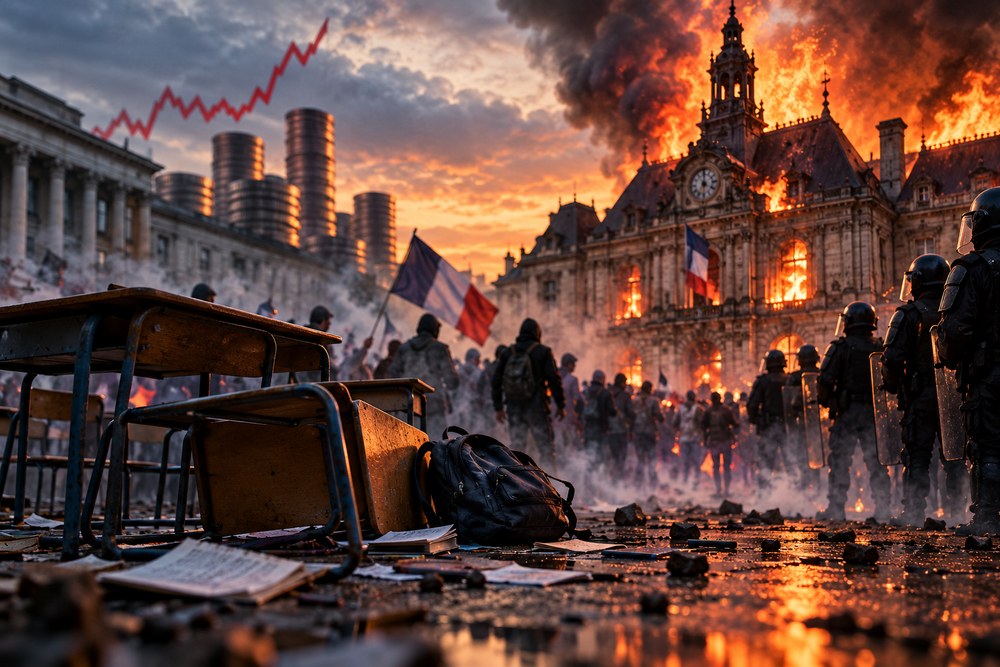
On the fifth of July, 2015, the Greek people were asked a plain question and gave a plain answer. The question was whether to accept the terms their creditors were demanding in exchange for continued support: more spending cuts, more tax rises, more of the austerity that five years of it had already delivered into a depression deeper than the one the United States suffered in the 1930s. The answer was no. Sixty-one percent voted against the terms, in every region of the country, a result so decisive that the government which had called the referendum was startled by its own mandate.
Eight days later, that same government signed an agreement for terms as harsh as the ones the people had just rejected, and in several respects harsher. The cuts came. The tax rises came. The privatizations came. The vote, the largest and clearest expression of the popular will available in a democracy, had changed essentially nothing, and the speed with which it changed nothing, a single week between the verdict and its reversal, is the most honest lesson the episode offers. A nation had been asked what it wanted and had answered, and the answer was not the thing that decided.
This essay is about the thing that did. Not who lends money to governments, which is a question with an obvious answer, but who decides what a government can afford, which is a question almost no one asks, and whose answer turns out to be the outer boundary of what a modern democracy is actually permitted to do.
The institution that does not command
Begin with what the body at the center of this does not do, because the list is most of the misunderstanding.
The International Monetary Fund, created at Bretton Woods in 1944 and headquartered a few blocks from the White House, does not legislate. It does not vote in anyone's parliament. It commands no armies and signs no laws and overrides no constitution. When people imagine its power they tend to imagine something cruder than what exists, a room where unelected bankers simply order sovereign governments around, and that picture is wrong in a way that makes the real mechanism invisible. The Fund does not order. It models. It evaluates. It publishes assessments of whether a country's debt is sustainable, whether its budget is responsible, whether its path is credible, and those words, sustainable and responsible and credible, are where the power lives, because once the Fund has assigned them, the markets that actually hold a country's fate read the assessment and price it in, and the pricing is the discipline.
This is the determining variable, and it is not the loan. A loan is money, and money is the visible thing everyone fixes on, the headline figure, the bailout, the billions. But the loan is not where the power sits. The power sits in the definitions that come attached to it, in the Fund's authority to say what counts as affordable, and that authority operates whether or not a cent is ever lent, because the same models that gate the Fund's own money also tell every private lender on earth how to read a government's books. A country that never borrows from the IMF still lives inside the Fund's definitions of fiscal reality, because those definitions have become the common language in which sovereign creditworthiness is spoken. The Fund does not need to lend to a government to bound it. It needs only to define the terms in which the government's choices will be judged, and then let the judging happen on its own.
Where politics becomes arithmetic
To see how a definition becomes a cage, look at the instrument through which the Fund does most of its defining, because it is dull on its surface and decisive underneath.
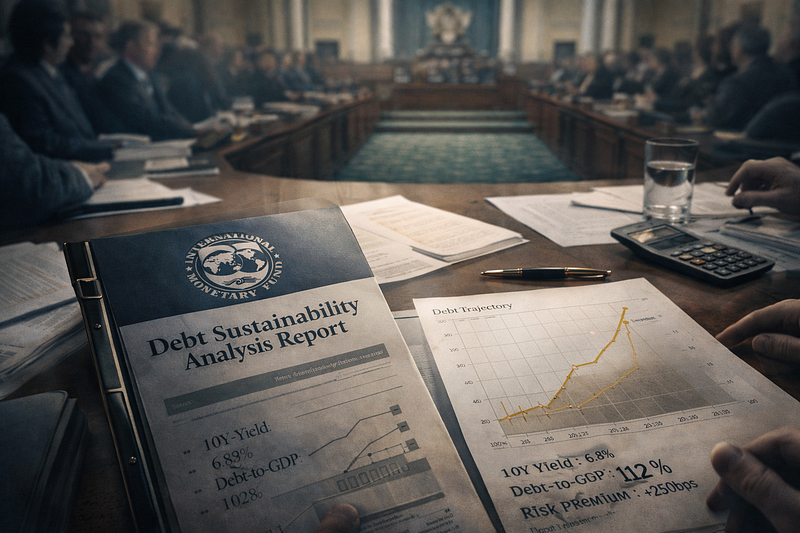
It is called a debt sustainability analysis, and it is, in form, a spreadsheet. It projects a country's debt as a share of its economy forward through time, under a baseline and under stress, feeding in growth, interest rates, the primary budget balance, the exchange rate, the refinancing schedule, and it arrives at a verdict: the trajectory stabilizes, in which case the debt is sustainable, or it does not, in which case adjustment is necessary. That word, adjustment, is the hinge on which a nation's politics turns, because it converts directly into numbers a government must hit: a primary surplus of so many percent of GDP, sustained for so many years, achieved through spending ceilings and revenue targets and privatization schedules. On paper it is arithmetic, and arithmetic carries the great rhetorical advantage of seeming to belong to no one, to be a fact of the world rather than a choice anyone made.
But consider what a single line of that arithmetic contains. To require a country to run a primary surplus of three percent of its economy for a decade is to require it to take three percent of everything it produces, every year for ten years, out of hospitals and pensions and schools and public wages and infrastructure, and to send it instead to service debt. That is not a technical parameter. It is the largest political decision a society can make, the decision about what it will sacrifice and who will bear it, and it has been made, in the form of a target, by a model. Elections still happen around the target. Parties still campaign. But they campaign inside a perimeter the arithmetic has already drawn, and the perimeter is treated as a law of nature rather than what it is, which is the output of a set of assumptions that someone chose.
What that abstraction looked like from inside is not abstract at all. In the years the targets were enforced, Greece lost roughly a quarter of its entire economy, a contraction on the scale of an American Great Depression compressed into a smaller country and a shorter time. More than one in four workers had no job, and among the young it was closer to one in two. Pensions were cut and cut again, hospitals ran short of supplies, and the suicide rate, long among the lowest in Europe, rose. None of this was decreed by name. It was the lived translation of a primary-surplus target, the human form of a number, and the number had been set by a calculation the people enduring it could neither see nor change. This is what it means for politics to become arithmetic. The arithmetic is real, but so is everything it is made of, and the people it is made of do not get a vote on the equation.
The number that turned out to be a choice
Here is the proof that the arithmetic is a choice and not a fact, and it does not come from the Fund's critics. It comes from the Fund.
Every debt sustainability analysis rests on a hidden number called the fiscal multiplier, which answers a single question: when a government cuts its spending by a euro to shrink its deficit, how much does the economy shrink in response? If the multiplier is small, austerity is nearly free, because cutting a euro of spending costs the economy only a fraction of a euro in lost output, and the debt ratio improves smoothly. If the multiplier is large, austerity is self-defeating, because cutting a euro shrinks the economy by more than a euro, so the debt-to-GDP ratio, which has GDP in its denominator, can actually get worse as you cut. The entire judgment of what a country can afford turns on this one assumption, and through the years of European austerity the institutions assumed a multiplier of around half, a number that made the cuts look manageable and the targets look reachable.
In early 2013 the IMF's own chief economist, Olivier Blanchard, published a paper concluding that the assumption had been wrong. The real multipliers, in the conditions of the crisis, had been roughly twice as large as assumed, perhaps larger, which meant that the austerity had done far more damage to output than the models had predicted, which in turn meant that the targets built on those models had been not merely painful but counterproductive, deepening the very debt ratios they were meant to repair. Sit with what that admission is. The institution that had defined what these countries could afford was conceding, after the fact, that the definition had rested on a number it had gotten badly wrong, and that the suffering imposed in the name of arithmetic had been imposed in the name of arithmetic that did not hold. The multiplier was the knob that converted a political choice into a mathematical necessity, and the knob had been set to the wrong place, and the austerity had happened anyway, and could not be unhappened by a later correction in a working paper.
This is the whole argument in a single fact. What is presented to a democracy as the hard edge of the possible, the arithmetic against which its wishes break, is in truth a structure of contestable judgments, and the proof is that the people who built the structure have admitted that one of its load-bearing judgments was mistaken. The definition of affordable was never neutral. It was a choice wearing the costume of a calculation, and the costume is what gave it the authority to overrule a vote.
Before Greece, the older pattern
Greece is the cleanest example, but it is not the first, and treating it as a European aberration misses how old and how wide this power is.
Through the 1980s and 1990s the same definitional authority was exercised across most of the developing world, under the name of structural adjustment. Dozens of countries in Latin America, Africa, and Asia, caught in debt crises, came to the Fund and the World Bank for the financing no one else would provide, and received it on conditions that followed a recognizable template: cut the deficit, devalue the currency, open the borders to trade, sell the state's enterprises, remove the subsidies on food and fuel and the budgets for clinics and schools. The package acquired a name, the Washington Consensus, coined in 1989 by the economist John Williamson to describe the reforms the institutions clustered along the Potomac had come to agree on, though Williamson would later complain that the term was turned into something harder and more ideological than he had meant. Whatever the intention, the effect was that a definition of a responsible economy, drawn up in Washington, became the condition of financing for a large part of the planet.
What that era's record was is genuinely contested, and the honesty of this argument requires saying so. Defenders point to inflations tamed and bloated state sectors reformed; critics, and a substantial body of scholarship, associate the programs with deepened poverty and gutted public health and education, and the dispute has never been fully settled. But notice that the dispute itself proves the point. If the costs and benefits of structural adjustment are still argued over by economists decades later, then the conditions imposed on those countries were never the output of settled arithmetic. They were a contested judgment about what a responsible economy looks like, applied as if it were a fact, to nations that had no vote over the judgment and no alternative to accepting it. The thing presented as necessity was, here too, a definition, and the definition belonged to the lender.
The institution beyond the vote
If the power is the definition, the next question is who controls the definer, and the answer reveals how far outside democratic reach this all sits.
The IMF is governed by a weighted vote, in which a country's say is proportional to its financial quota, and the largest quota by a wide margin belongs to the United States, whose roughly sixteen and a half percent of the vote would be unremarkable except for one structural detail: the most fundamental decisions, the ones that change the Fund's rules, its mandate, the architecture of the thing itself, require an eighty-five percent supermajority. Sixteen and a half is more than fifteen, which means that on those deepest questions the United States, and only the United States, can block any change single-handedly. It cannot, by itself, veto a particular loan; ordinary lending runs on lesser majorities. What it can veto, alone, is reform of the system, which is the more important power, because it means the rules under which every country's affordability is defined cannot be altered against Washington's wishes by any coalition of the rest of the world, however large.
Layer that onto the structure and the insulation becomes clear. The body that defines what democracies can afford is itself the one institution most thoroughly placed beyond the reach of those democracies. Its managing director is appointed by an executive board, not elected by anyone; by an unwritten convention nearly as old as the Fund, the job goes to a European and the leadership of its sister institution to an American, an arrangement no electorate ever ratified. Its staff answer to the institution, not to any public. And the deepest rules of the place are locked by a single country's veto. The Greek voter in 2015 was not merely overruled by a creditor. He was overruled by a definition produced by an institution structurally designed so that no vote he could ever cast, in any election available to him, could reach the people who set it. What the voters decided did not bind them, and what bound them the voters could not decide.
Why the definition is believed
A definition has power only if it is believed, and the question of why the Fund's definitions are believed, treated across the entire financial system as the measure of fiscal reality, is its own part of the answer.
They are believed in part because they are often reasonable, and in part because the institution has spent eighty years accumulating the authority of the place everyone turns to in a crisis. But the deeper reason is that there is no rival definition. When a country's solvency is in question, someone has to say whether its debt is sustainable, and there exists no neutral oracle to consult, no view from nowhere; there is only a set of institutions and the models they run, and the Fund's model is the one the system has agreed to read. The rating agencies defer to it. The private creditors price off it. The other official lenders coordinate around it. A judgment that everyone treats as authoritative becomes authoritative, not because it has been proven correct but because the alternative, a world in which every creditor improvises its own definition of sustainability, is chaos, and a flawed common standard is preferred, by the people who depend on it, to no standard at all.
This is the quiet foundation under everything else. The decisive power is not the power to lend or to forbid but the power to produce the authoritative account of what is true, to be the body whose word on affordability the world has agreed to accept, so that its definition functions as reality whether or not it corresponds to reality. The multiplier was wrong and the austerity proceeded, because what governed the austerity was never whether the number was right. It was that the number was the Fund's, and the Fund's number is the one the system believes. Control of the believed definition is the whole of the power, and it sits one layer beneath the loan, beneath the conditionality, and beneath even the vote.
The quiet transmission
The reason this works without ever looking like coercion is that the constraint travels through the market, which has no address and issues no orders, and so cannot be voted against.
The sequence is undramatic and almost never witnessed as a single event. The Fund publishes an assessment that a country's path is or is not sustainable. The rating agencies fold that judgment into their own. The investors who hold the country's debt, the pension funds and the banks and the bond traders who do not all read the signal alike but who all read it, adjust what they will own and at what price. The yield the government must pay to borrow rises or falls. And the cost of money, which is the cost of everything a state does that it cannot pay for out of current taxes, expands or contracts the fiscal space within which all politics then happens. No one in this chain commands the government. The Fund only assessed; the agencies only rated; the investors only priced; the market only responded. Each actor did something modest and defensible, and the sum of all that modest, defensible behavior is a government that discovers it can no longer afford the thing it was elected to do, with no one in the chain having ordered it not to, and therefore no one to hold responsible.
A four-point rise in a country's borrowing rate, the kind a downgrade can produce, can add billions a year to the interest bill of a state that refinances on any scale, and those billions are not abstract. They are extracted, in the end, from the same hospitals and pensions and schools, not by a decree anyone signed but by an arithmetic that shifted, and the shift can be triggered by an assessment, and the assessment is the Fund's to make. This is why the power needs no army and no law. It needs only to be believed, and the belief is automatic, because the entire financial system has agreed to treat the Fund's definitions as the measure of fiscal reality, and a definition that everyone treats as reality functions as reality whether or not it is correct, as the multiplier showed.
No single hand
It would be easy, having traced the power to the Fund's definitions, to draw a straight line from the IMF to the outcome, as if one institution sat at a console deciding the fate of nations. The reality is both messier and more unsettling, and Greece is again the proof.
In 2015 the Fund was not even the hardest of Greece's creditors. Its own analysis, published as the crisis came to a head, judged the Greek debt deeply unsustainable and argued, against its European partners, that real debt relief was necessary, that no amount of austerity would make the arithmetic close without it. And the Fund was overruled, by the European Commission and the European Central Bank and the eurozone governments, who held the immediate financing and insisted on the harsher terms. The institution most often blamed for dictating Greece's fate was, on the central question, on the losing side of the argument.
This does not weaken the thesis. It deepens it. The harsher terms were imposed anyway, not by a single hand but by several institutions, each acting within the same shared definition of what a responsible settlement looked like, a definition none of them could step outside even when one of them wanted to. The power was not in any one actor. It was in the framework they all inhabited, the common arithmetic of sustainability that bound the lender who wanted relief as surely as the ones who refused it. That is the more frightening kind of constraint. Not a master pulling strings, but a definition so widely shared that even the institutions inside it cannot escape it, and a democracy on the outside has no hope of trying.
Argentina, and the admission
If Greece shows the definition overriding a vote, Argentina shows the definer eventually marking its own work, and failing.
Argentina has been the Fund's most frequent and most troubled patient, in and out of programs for decades, its crises a recurring argument about whether the medicine helps or harms. In 2018, facing a collapsing currency, it received the largest loan in the IMF's history, an arrangement that swelled to around fifty-seven billion dollars, vastly more than its formal entitlement, on the usual conditions of austerity and reform. The program did not work. The economy kept contracting, the currency kept falling, most of the planned reviews were never completed, and the arrangement was abandoned. What makes the case more than another failure is what the Fund itself said afterward: in a 2021 evaluation of its own conduct, it concluded that the program had not delivered on its objectives, a remarkable admission from an institution about its single largest commitment.
Hold that beside the multiplier admission and a pattern emerges that is, in its way, more telling than any accusation of malice. The Fund is not a body that pretends to infallibility; it is, on its own record, capable of judging that it got the largest decision of its kind badly wrong. But the capacity for honest hindsight does not return the lost years to the country that lived them, and it does not touch the structural fact that the judgment, while it was being made, was binding, and the people of Argentina had no more say over the design of a fifty-seven-billion-dollar program shaping their lives than the people of Greece had over the multiplier. An institution that can later admit error is far better than one that cannot. It is still an institution whose contestable judgments, in the moment they are made, are the wall against which a democracy's choices break.
The defense that cannot be waved away
The strongest version of the other side has to be put now, and put without flinching, because on this subject the defense is genuinely strong and an argument that waved it away would deserve to be ignored.
The Fund's defenders would say, accurately, that countries come to the IMF voluntarily, and that they come because no one else will lend to them, usually after their own governments have produced the crisis through years of choices the Fund did not make. Greece had borrowed unsustainably and concealed the extent of it; Argentina had pegged its currency past the point of viability; the Fund did not create these holes, it was called in after the ground had already opened. The conditions attached to its money are, in this telling, nothing more sinister than the ordinary terms any creditor demands, the price of someone else's capital when your own credit has run out, and the realistic alternative to accepting them is usually not a freer set of choices but a disorderly default, a collapsed currency, and a population that suffers more, not less, as Argentina's catastrophe in 2001 showed when the support was withdrawn. And the Fund, the defense continues, is not a sealed dogma but a self-correcting institution: the multiplier admission is itself the proof, as are its published second thoughts about austerity and capital-account liberalization, and its own later evaluation conceding that its largest-ever program, in Argentina, had failed on its own terms.
All of that is true, and the honest form of this essay depends on conceding every word of it. The Fund is, much of the time, the only thing standing between a broke country and something worse, and the people who staff it are not villains but economists doing genuinely difficult work under conditions no one would envy. But notice what the defense establishes and what it does not. It establishes that the Fund's role is often necessary and its conduct often reasonable, and the argument here was never that the Fund is malicious or that its medicine is always wrong. The argument is narrower and harder to answer: that whoever holds the power to define what is affordable holds the decisive power, that this power is real regardless of how wisely or badly it is used, and that it has been placed, deliberately and structurally, beyond the reach of the people whose lives it bounds. A wise definition and a foolish one constrain a democracy in exactly the same way. The problem the multiplier exposed is not that the Fund chose the wrong number. It is that the number, right or wrong, was where sovereignty actually ended, and the people living inside its consequences had no vote over the place where it was set.
What a democracy is allowed to decide
So return, at the end, to the Greek voter holding a ballot that did not bind, because the question that ballot was really testing is the one underneath the whole subject.
A democracy is supposed to be the arrangement by which a people decides how it will live. It can choose its leaders, its laws, its taxes, its priorities, the shape of the common life it wants. What the events of 2015 revealed, in the cleanest possible form, is that there is one decision a modern democracy in crisis does not get to make, which is the decision about what it can afford, and that this one excluded decision turns out to govern most of the others, because a society that cannot decide what it can afford cannot really decide what it will do. The vote chose the policy the people wanted. The definition chose what they would be permitted to have. And only the definition was enforceable, because only the definition was wired into the system that decides whether a country can pay its bills next month.
This is the shape of sovereignty in the modern world, and it is why the IMF is worth understanding not as a lender but as a definer. The power that matters is no longer mainly the power to forbid, which is visible and resented and can be voted against. It is the power to define the terms in which the possible is calculated, to set the multiplier and draw the sustainability line and publish the assessment, and then to let the market do the enforcing, so that the boundary of a nation's choices appears not as someone's decision but as a fact of arithmetic. A people can still vote for anything. It simply cannot vote for what it can afford, and what it can afford is decided, quietly, in a building it does not control, by a definition it cannot reach, in a language that calls itself mathematics so that no one will think to ask who chose the numbers.
Evidence Map
Facts, interpretations, forecasts, and disconfirming signals.
Core claim. The determining variable in the relationship between the IMF and a democracy is not the loan but the power to DEFINE what is "affordable / sustainable / responsible." That definition, embodied in the debt sustainability analysis and its hidden fiscal-multiplier assumption, is a contestable technocratic judgment presented as neutral arithmetic; it bounds democratic choice and is enforced not by command but by the market that treats the Fund's definitions as fiscal reality. The institution that sets the definition is structurally insulated from the democracies it bounds (weighted vote, US veto over the rules, appointed leadership). The power is emergent and procedural, not a cabal.
Evidence level. Facts (high, documented): the IMF (Bretton Woods, 1944; HQ Washington); conditionality via Letters of Intent, tranched disbursement; the US ~16.5% voting share + the 85% supermajority for the most fundamental decisions, giving the US a unilateral veto over the RULES (not over individual loans); the European-MD / American-World-Bank-president convention; the July 5, 2015 Greek referendum (~61% No) followed within ~8 days (July 13) by acceptance of a third bailout with terms as harsh or harsher; the Blanchard-Leigh IMF paper (Jan 2013) finding actual fiscal multipliers roughly twice the ~0.5 assumed; the IMF's own later self-criticism ("Neoliberalism: Oversold?", F&D 2016) and its 2021 ex-post evaluation faulting the record 2018 Argentina program. Interpretation (medium, marked): the "definition, not the loan, is the determining variable" reading; the multiplier-as-the-knob argument; the insulation reading. Contested-as-fact (attributed, NOT asserted): the social-cost record of 1980s-90s Structural Adjustment Programs, and the severity/harm of 1997 Asian-crisis austerity (both genuine scholarly debates, and the contest is itself about the definitions). Precision: the 2015 third bailout was a Troika program (European Commission, ECB, IMF) with the IMF as one of three creditors; notably the IMF's own analysis judged Greek debt unsustainable and pushed for relief, so even the Fund's definition was overridden by the political creditors, which sharpens rather than weakens the thesis.
What would confirm this. Continued cases where a democratic vote against creditor terms is overridden within the fiscal-constraint structure; continued reliance on contestable DSA/multiplier judgments presented as arithmetic; the persistence of the Fund's structural insulation from the electorates it bounds.
What would disprove this. Evidence that IMF definitions do NOT bind market pricing or political space (that a country can simply ignore a sustainability assessment without consequence); or that the definitions are genuinely neutral arithmetic rather than contestable judgments (the multiplier admission cuts strongly against this); or that the institution is democratically accountable to the populations it constrains.
Watchlist. IMF quota/voting reform and the US veto; the treatment of debt-sustainability methodology and multiplier assumptions in new programs; sovereign-debt crises where a popular mandate collides with creditor conditionality; the gap between the Fund's self-criticism and its operating practice.
Related from The Manifest Archive
- Who Owns the Federal Reserve?
- Is the U.S. Dollar Losing Reserve Currency Status? The Quiet Erosion Explained
- Microsoft and the Digital Veto
- Bretton Woods Ended in 1971. The Order It Built Is Still Running.
Jerry van der Laan writes The Manifest Archive, daily forensic essays on power, language, and the systems that shape what we are allowed to see as reality. He traces the structures beneath them.