The members of Iraq's parliament had an agenda for Wednesday, and they set it aside. The day before, the cabinet had approved new exchange rates, and that morning the central bank began selling dollars at 1,520 dinars instead of 1,320. Dozens of lawmakers said nobody had told them how the decision was made or why. Aziz Nasser al-Shammari, speaking for dozens of them in a joint statement, said they had been surprised. "Waging war on the poor like this is wrong," he said. Hassan al-Asadi rejected the measure and proposed cutting unnecessary spending instead. Saba al-Saadi blamed the finance ministry and the central bank and promised to take the matter to the floor. The finance minister and the central bank governor were due to appear before parliament the next day.
At the exchange shops the dollar did not wait for the hearing. Right after the announcement on 7 October, some exchange shops in Erbil quoted as much as 180,000 dinars per hundred dollars on the parallel market, where most Iraqis actually buy their dollars, against a new official rate of 152,000.
Across the border to the south, Kuwait had been dealing with the same war in a different way. In July it raised six billion dollars on the international bond market and received more than eighteen billion in orders. A decree-law now allows its treasury to borrow from the Future Generations Fund, the sovereign savings account that analysts estimate at around a trillion dollars. Salaries and subsidies make up three quarters of the Kuwaiti budget, and I have found no report that either has been cut.
On 13 October the International Monetary Fund published its forecasts for the year. For Kuwait it expects the economy to shrink by 16.7 percent in 2026. For Iraq, by about 16 percent.
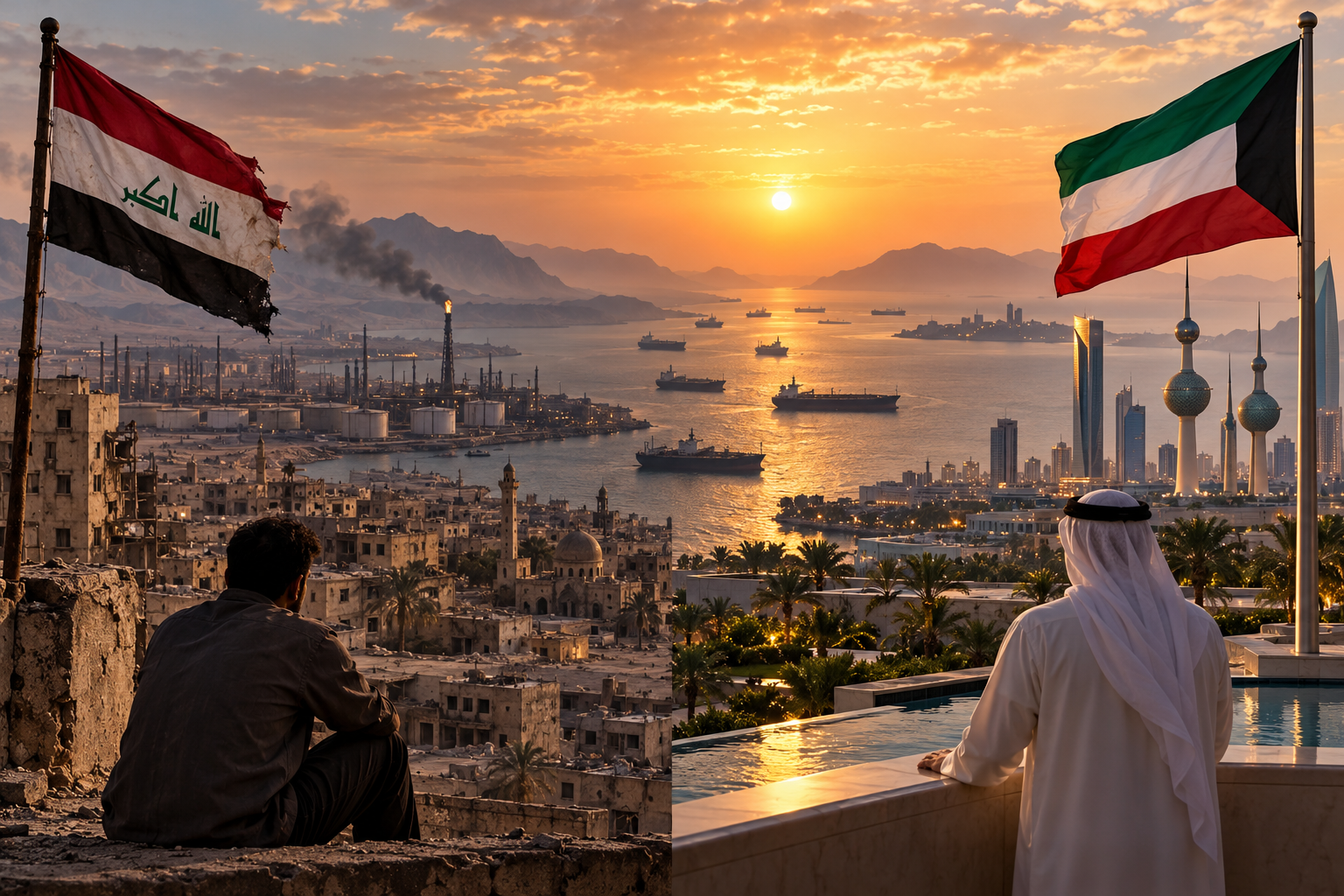
Two oil exporters, the same strait, nearly the same loss. One borrowed from its grandchildren. The other made every dollar cost fifteen percent more dinars in a single morning.
The usual way to describe the economic damage of the Hormuz crisis is through the price of oil, which this week stood close to 110 dollars a barrel, almost half again its price before the war began in February. That price explains a great deal. It does not explain why two countries with almost identical losses are living through such different crises. To see that, you have to follow the shock past the oil, through the routes it travels, the savings that stand behind it, and the decision each state made about who would carry what was left.
I should say at the start what this piece can and cannot show. The country figures come from the IMF's October forecasts, which assume a gradual reopening of the strait from March 2027 and could move a long way if it does not. And the effect of Iraq's devaluation on prices is visible in markets and shops, but I have not found an official inflation figure for the weeks since, so on that point I will be describing what has been reported rather than what has been measured.
The IMF Table of 13 October
Start with the ranking, because it already contains half the answer.
According to the IMF figures reported by Muscat Daily and The National, the six Gulf monarchies and Iraq will have very different years. Oman, the only one whose main export terminals lie outside the strait, is forecast to grow by 4.1 percent. Saudi Arabia is expected to shrink by 3.3 percent and the United Arab Emirates by 3.9. Then the numbers fall off a cliff: Bahrain minus 11.3, Qatar minus 15.6, Iraq around minus 16, Kuwait minus 16.7.
The scale of the swing shows when you put those numbers next to what the same institution expected a year ago. In October 2025, before the war, the IMF forecast growth of 3.8 percent for Kuwait in 2026 and 6.1 percent for Qatar. Its first wartime forecast, in April, still had Kuwait shrinking by only 0.6 percent and Qatar by 8.6. Six months later the expected loss for Kuwait is roughly twenty percentage points away from where it started.
The IMF does not hide what separates the top of the table from the bottom. Saudi Arabia, it notes, "is somewhat less affected, as an economy with more diversified export routes." Saudi Arabia can pump crude across the peninsula through the East-West pipeline, which can carry up to seven million barrels a day to the Red Sea, with exports from Yanbu limited to around four and a half to five million by the loading terminals, according to the tanker tracker Kpler. The UAE has a pipeline from its fields at Habshan to Fujairah on the Gulf of Oman, with a nameplate capacity of around 1.5 million barrels a day; in April, Kpler counted 1.82 million barrels a day loading there. Oman needs no pipeline at all.
Kuwait has no route around the strait. Qatar's gas leaves mostly as liquefied cargo from Ras Laffan, inside the Gulf; only a small share goes by pipeline to its neighbours. Bahrain refines and exports through the same waters.
Iraq is the interesting case, because Iraq once had a way out.
Zubair to the Red Sea, 1989
Iraq built its way out during a war. In 1984, at the height of its war with Iran, when tankers in the Gulf were being attacked so often that the period acquired its own name, it laid a line from Zubair, near Basra, across the border into Saudi Arabia's own pipeline to Yanbu. According to the Oil & Gas Journal, that first stage gave Iraq about half a million barrels a day of export capacity at a crucial stage of the conflict. The second stage, a dedicated line to a new terminal at Muajjiz, south of Yanbu on the Red Sea, began carrying crude in September 1989. Together they were called IPSA, the Iraqi Pipeline in Saudi Arabia. The system cost more than two billion dollars, and the second stage alone could move about 1.65 million barrels a day, about two thirds of what Iraq exported in September.
It is worth pausing on what that capacity would mean now. In May and June, Iraq's exports fell from about 3.5 million barrels a day in February to a little over one million. A working line of IPSA's size could in theory have carried a large share of that missing volume past the strait. The theory has limits: the feeder lines from the southern fields, the state of a pipe that has been idle for decades, Saudi consent, and the fact that the Red Sea route has itself come under attack this year would all have cut into it. But the order of magnitude makes the point that a route is worth the most in exactly the year nobody can build one.
The full line ran for eleven months. On 2 August 1990 Iraq invaded Kuwait, the United Nations imposed sanctions, and on 13 August, according to a Saudi account published in Arab News, the pipeline was shut. Saudi Arabia disconnected it and blocked both ends.
For a decade nothing happened. Then, in June 2001, Riyadh announced that it had taken ownership of the entire system: the line, the pumping stations, the storage tanks, the loading facilities and the maritime terminal. In a letter to the UN secretary-general it cited the damage Iraq's aggression had caused Saudi citizens and pointed to Security Council Resolution 687, which deals with compensation for the occupation of Kuwait. Iraq's ambassador to the UN called it "a hostile action taken by Saudi Arabia against Iraq" and said Baghdad would seek the return of its rights.
Two years later, after the American invasion of Iraq, the question came up again at a pipeline conference in Muscat. A Saudi Aramco official told the room that the line was no longer usable, that there was "no continuity" in it, and then, according to the AFP report of the meeting, said the sentence that settled the matter: "It is not an Iraqi pipeline anymore." According to Kpler, parts of it have since been absorbed into the Saudi gas network. The same survey of the possible routes around Hormuz rated a near-term restart as unlikely, because it would require major rehabilitation and an agreement between Riyadh and Baghdad that does not exist.
What Iraq has left is the line to Ceyhan in Turkey, from the northern fields around Kirkuk. Before the war it carried about 240,000 barrels a day. By early August, according to The National, it was carrying between 40,000 and 60,000. On 1 August Baghdad and Ankara extended their export agreement by a year, setting an export capacity of 750,000 barrels a day, far above anything the line has carried this year.
So the first layer of the answer is geography, and some of the geography is a decision. A route that was built between 1984 and 1989 and lost in 2001 set part of the bill that Iraq is paying in 2026. The routes decide how much oil each country loses when the strait closes. They do not decide what that loss does to the people who live there. For that you have to look at what each state had in the bank, and what it chose to do with it.
$2.3 Billion Against $6.5 Billion
Iraq's state runs on oil in a way few countries do. Crude sales provide more than ninety percent of the federal budget. In the first half of this year, according to figures reported by Shafaq News, salaries and social welfare made up 44.6 trillion dinars of federal spending, about 82 percent of the total. The finance minister, Faleh al-Sari, put monthly salary obligations alone at around 7.8 trillion dinars, close to six billion dollars, and The National puts monthly spending on salaries, pensions and welfare together at about 6.5 billion dollars. When oil revenue falls, there is very little else to take the weight, because most of what the state spends goes to people who are expecting to be paid on a particular day.
In February, before the strait closed, Iraq exported about a hundred million barrels and earned about 6.8 billion dollars. In May and June, according to The National, exports collapsed to around 32 million barrels a month and revenue to roughly 2.3 billion. For two months the Iraqi state took in about a third of what it needed just to pay its own employees, pensioners and welfare recipients, and it had to find the rest from somewhere: from the central bank, from delayed payments to contractors, bondholders and farmers, from bills for Iranian gas and electricity that went unpaid. By the end of July many public employees had not received their salaries, officials were discussing a switch to paying every 45 days instead of every month, and a finance ministry official described the new rule to The National in a sentence that needs no interpretation: "We will pay whenever we have cash." In August the money for salaries arrived near the end of the month, and some employees were paid only in early September. On 21 September, Shafaq News reported, funding for September salaries had not yet been released to any ministry, and three senior officials said the government planned to borrow more than three trillion dinars from local banks to close the gap.
That asymmetry sits at the centre of this story. A barrel that is not sold this month is still in the ground next month, and if the strait reopens it can be sold then, while a salary that is not paid this month means groceries not bought this month, and nothing about next month brings them back.
Iraq's exports did recover. By August they were back to about 2.34 million barrels a day, and in the first three weeks of September to about 2.6 million, according to the oil ministry. The central bank says exports have recently averaged more than 2.5 million. That is still well below the 3.5 to 3.6 million barrels a day Iraq shipped before the war, but it is far from the collapse of May and June. And by then the country's foreign currency reserves, which stood at 97.4 billion dollars at the end of 2025 according to the central bank, had fallen to 80.6 billion at the end of July; government figures put the pre-war level higher, at about 106 billion. Prime Minister Ali al-Zaidi has put the loss of oil revenue at about sixty billion dollars, and the foreign minister, Fuad Hussein, cited losses of about the same size to his Italian counterpart in Rome last week.
The Future Generations Fund
Kuwait's economy is shrinking at about the same rate, and the difference in what that means begins with a fund. Kuwait has two large pools of public savings: the General Reserve Fund, from which the treasury pays its bills, and the Future Generations Fund, into which a share of oil revenue has been set aside for decades and which is not supposed to be touched. Analysts estimate the second at around a trillion dollars. The General Reserve Fund has been under pressure for years; in 2020 the IMF warned that its liquid assets could run out within two years without new financing.
This year Kuwait changed the rules. Decree-Law No. 81, as described by the Middle East Observer, lets the General Reserve Fund borrow from the Future Generations Fund. The loans are capped: in any year they cannot exceed the fund's average realised returns over the previous five audited years, and the total outstanding cannot exceed ten percent of its net asset value. Each loan must carry a return and a repayment schedule. The investment bank EFG Hermes estimates the theoretical room at around a hundred billion dollars, roughly 63 percent of Kuwait's GDP, while noting that the cap based on returns could make it considerably tighter. On top of that, Kuwait restored its legal power to borrow in 2025 and used it in July.
None of this makes the Kuwaiti loss smaller. S&P expects a fiscal deficit of around fifteen percent of GDP for the year to March 2027. The budget for this fiscal year already projected a deficit of 9.8 billion dinars on revenue of 16.3 billion, and salaries and subsidies account for 76 percent of planned spending. What the fund does is change who carries the loss and when. The money for this month's salaries can come out of the fund, and the bill goes to the fund, which is to say to the Kuwaitis of later decades, who will inherit a fund with loans to their own treasury in it instead of cash. A loan of that kind is not wealth destroyed; it is liquid investments swapped for a claim on the state, and its value depends on the state paying it back.
Qatar is in a similar position on a different commodity. Its quarterly exports of liquefied natural gas fell from around twenty million tonnes to under two million, and in the second quarter it posted a budget deficit of 21.2 billion riyals, its largest since late 2016. It has the Qatar Investment Authority behind it. In September the ratings agency Fitch took Qatar off negative watch.
The IMF's forecasts for 2027 show what the fund buys. It expects Kuwait to grow by 17.1 percent next year and Qatar by 18.8, once the strait reopens and the oil and gas that stayed in the ground can be sold. For an exporter with savings, most of this year's loss is a delay.
It would be too neat to stop there. A barrel that stays in the ground this year is not guaranteed to be worth the same when it comes out. If the war ends in a glut, with every producer in the Gulf trying to make up lost volume at once, the oil Kuwait is waiting to sell may fetch less than it would have this year. A buffer does not remove the damage. It moves the damage in time and attaches a price risk to it, and Kuwait does not know what that price will be.
A shock does not land on whoever loses the most. It lands on whoever can least afford to wait.
1,320 to 1,520
This is where the Iraqi story turns from a question of means into a question of choice.
When Iraq devalued, it still held about eighty billion dollars in reserves. Samir Fakhri Nima, the central bank's director general for statistics and research, said at the MERI Forum in Erbil on 13 October that the reserves were still sufficient to cover at least a year of imports. He also explained why the bank had acted anyway. The devaluation, he argued, was the best option for protecting the foreign reserves against the shock to oil revenue. Government operating spending creates demand for dollars at the central bank, and that demand was draining the reserves.
The mechanism is simple once it is laid out. The Iraqi state earns its income in dollars from oil, and most of its spending, above all on salaries, is in dinars. Every dollar it sells to the central bank at 1,520 dinars instead of 1,320 buys fifteen percent more salary. The reserves themselves belong to the central bank, not to the finance ministry. The state earns dollars, sells them to the bank for the dinars it pays out, and much of that money comes back to the bank as demand for dollars to pay for imports, which is the drain Nima described. The devaluation changes the price at both ends of that loop: each oil dollar the government sells buys more dinars, and each dollar the bank sells costs its buyers more. The finance ministry's own accounting rate moved the same way, from 1,300 to 1,500. "It gives the government more dinars for each dollar of oil revenue," the Iraqi analyst Mohammed al-Saffar told Reuters, and then added the other half: it raises the cost of imports. In a country that imports a large share of its food, medicine and consumer goods, those two effects are the same transaction seen from opposite ends. From the household's side, the dinar lost about 13 percent of its value against the dollar, and everyone paid in dinars now holds a salary worth that much less in dollars. How much less it buys at home depends on how far import prices follow, which subsidies hold and how much is produced locally.
The timing matters, because the worst months for Iraqi revenue were May and June, and the devaluation came in October, after exports had recovered to more than 2.5 million barrels a day, and in the same weeks in which the government was preparing a budget for 2027 with planned spending of 217 trillion dinars and a deficit of more than 40 trillion, around thirty billion dollars. My reading of that sequence, and it is a reading rather than a documented intention, is that the devaluation was less an emergency measure forced by an empty treasury than a decision to protect what was left of the dollar reserve and to finance next year's deficit, with the adjustment falling on those who earn and spend in dinars.
There is a fair case against that reading, and it should be stated at full strength. Iraq had been paying salaries late for three months. Its reserves had fallen by about seventeen billion dollars in seven months. Borrowing from local banks only moves the problem into the banking system. A central bank that waits until the reserves are nearly gone loses the ability to choose at all, and the 2020 devaluation, from about 1,182 dinars to the dollar to 1,450, showed that Iraq has done this before when oil revenue collapsed. On this view the devaluation was the least bad of the available options, and the word "choice" makes it sound more voluntary than it was.
One of the analysts best placed to judge saw it somewhat differently. "The country had to do something," Ahmed Tabaqchali of the Atlantic Council told The National, before adding that he was surprised the move was proactive. "In the past we didn't act but we acted while the reserves are still healthy," he said.
It helps to list what the alternatives were, because each sends the bill somewhere else. The central bank could have kept selling dollars at the old rate and let the reserves run down, leaving less cover for the imports of next year. The government could have borrowed more from local banks, as it was already planning to, which moves the strain into the banking system. It could have cut salaries or paid them later still, which puts the cost directly on public employees. Or it could have cut other spending, as Hassan al-Asadi proposed in parliament, which is slow, politically hard and lands on whoever depends on the programmes that go. None of these was free. The devaluation was the one that protected the reserve and spread the cost across everyone who earns and spends in dinars.
I think both things are true, and the second does not cancel the first. Iraq had less room than Kuwait, and that is the point of the comparison. But within the room it had, the state decided which reserve to protect. It protected the dollars.
A Hundred Dollars in Erbil
What that decision means in a shop is harder to pin down than what it means in a budget.
On the parallel market, where most Iraqis buy dollars because they cannot get them at the official rate, some exchange shops in Erbil quoted as much as 180,000 dinars per hundred dollars immediately after the announcement. By the week of 18 October, The National reported, the rate had eased to about 166,350 in Erbil, still well above the official 152,000. Ahmad Abbas, who is paid in dollars, told the paper he had recently bought the same detergent for 20,000 dinars that used to cost 9,000, though he said prices had already risen during the war, and that increase cannot be separated from the transport costs that have climbed since February. "It's safer to be paid in dollars," he said, "because it's unstable when it comes to the currency here." A taxi driver, Rizgar Ali, said of the price rises, "We can't catch a break from them." The government says it will keep fuel and basic-service subsidies in place and is considering customs relief on food and essential goods, and the public distribution system still provides subsidised staples.
That is as far as the evidence goes for now. One shopper's detergent is not an inflation rate. The direction is clear: a currency that buys fewer dollars makes imported goods cost more in that currency, and Iraq imports much of what it eats. The size is not yet known. The test will be the official consumer price figures for October and November, and whether the parallel rate settles near the official one or stays above it.
The currency arithmetic, at least, is exact. At the old official rate a monthly salary of one million dinars was worth about 758 dollars. At the new rate it is worth about 658. That is not the same as a 13 percent cut in what the salary buys in a Baghdad market, but it is the starting point for every imported item on the shelf.
What can be said with confidence is who sits on which side of the line. Iraqis who are paid in dollars, or who hold dollars, are better protected, though not entirely: Ahmad Abbas pays his rent in dollars and his bills in dinars, and expects that "at the end of the day it will kind of be the same." Iraqis who are paid in dinars, including everyone on the state payroll whose salaries were already arriving late, are not. The devaluation does not cut their salaries. It cuts what their salaries buy.
The Strongest Objection
The strongest objection to this whole argument is that it gives the war too much credit. Iraq's public finances were fragile long before February. A state that depends on oil for more than ninety percent of its budget, that spends more than four fifths of it on wages and welfare, and that devalued once already in 2020, does not need a closed strait to reach a crisis. A collapse in the oil price would have done it, as it did six years ago. On this view the war was the occasion, not the cause, and comparing Iraq with Kuwait simply compares a poorly managed oil state with a well-managed one.
Most of that is right. Iraq's vulnerability was built over decades and is not the war's doing. But the objection strengthens the argument instead of breaking it. The IMF expects Kuwait and Iraq to lose a similar share of their output this year; that is not proof that the original shock was identical in size, since the two economies are built differently, but the expected damage is close. What the shock found in Kuwait was a trillion-dollar fund and a legal route into it. What it found in Iraq was a payroll, a reserve that was already shrinking, and no pipeline to the open sea. The shock did not create Iraq's weakness. It found it, and it found it because there was nothing in between: no route to keep the oil moving and no savings large enough to let the state wait.
There is a second objection from the other direction. Calling Kuwait's fund a buffer can make the Kuwaiti response sound costless, and it carries real costs. The Middle East Observer, which described the decree-law in detail, warned that if the fund keeps financing everyday spending after the strait reopens, what was meant as a temporary liquidity bridge will become part of Kuwait's permanent fiscal architecture. Kuwait's structural deficit predates the war. The war gave it a reason to open a door that may be hard to close. That is a real cost, and it falls on Kuwaitis who are not yet working, or not yet born. They will pay it later and out of a fund, which is a different kind of payment from the one being made at Iraqi shop counters this month.
What a Buffer Buys
There is a rough way to put numbers on the difference, and I offer it as an illustration of scale, not as a measure of how long either state could survive. At its worst, in May and June, the gap between what the Iraqi state owed each month in salaries, pensions and welfare and what it earned from oil was about 4.2 billion dollars. That sets one large category of spending against one source of income, so it shows how exposed the budget is to oil rather than the state's full financing need. Eighty billion dollars of reserves divided by that gap is about nineteen months. But, as described above, those reserves belong to the central bank and back the currency and the country's imports; they are not the finance ministry's to spend. On the Kuwaiti side, the theoretical hundred billion dollars of borrowing room in the Future Generations Fund, set against a deficit of about fifteen percent of a GDP of around 160 billion, comes to more than four years before the bond market, though the cap tied to the fund's returns could make the room available in any one year much smaller. The two figures do not measure the same thing, and the comparison is crude. What it shows is the order of magnitude, months for Baghdad and years for Kuwait City.
The general rule that comes out of this reaches well beyond the Gulf. When a shock hits several parties with the same force, the damage settles where the ability to defer the loss is smallest, which is often somewhere other than where the loss is largest. A company that can refinance survives a bad year that bankrupts a competitor with the same revenue. A household with savings rides out a layoff that pushes a neighbour into debt. A state with a fund can keep paying its employees while a state without one changes the value of what it pays them in. Geography sets the size of the shock, and balance sheets decide who absorbs it, including, within a state, the choice of whose balance sheet to protect.
There are clear ways this reading could turn out to be wrong, and they are not all the same kind of wrong. The mechanism would fail if Kuwait or Qatar ran into a cash crisis like Iraq's despite their funds, with salaries going unpaid or the currency under real pressure, because then savings would not be what separated them. The reading of Iraq's decision would fail if documents or officials showed that the devaluation was driven mainly by something other than protecting the reserve, such as a long-planned return to the 2020 rate. And the consequence would turn out smaller than the parallel market suggests if Iraq's official inflation figures for the coming months show only weak pass-through to prices. Separately, if the strait stays closed well past March 2027, the IMF's rebound for Kuwait and Qatar disappears, and the waiting their funds pay for becomes something closer to a slow drain.
Iraq went into this year with neither a fund on Kuwait's scale nor, since 2001, the pipe that might have kept part of its oil moving.
The IMF will publish its regional outlook for the Middle East in Dubai next week. It will give the Gulf's losses in more detail and, presumably, revise them again.
The barrels under Kuwait will still be there in March.
In Erbil this week, a hundred dollars bought 166,350 dinars.
Sources. The country forecasts are from the IMF's World Economic Outlook of 13 October 2026 as reported by The National; the devaluation and the parliamentary reaction from Al Jazeera; the central bank's case from its remarks at the MERI Forum reported by Shafaq News; Iraq's revenue and salary figures from The National; the pipeline's seizure from Arab News (June 2001); and Kuwait's decree-law from the Middle East Observer.
Evidence Map
Facts, interpretations, forecasts, and disconfirming signals.
Core claim. The IMF expects Kuwait and Iraq to lose a similar share of their output to the Hormuz shock. Export routes decided how much oil each lost; savings decided how long each could wait; and Iraq's central bank chose to protect its dollar reserve, which moved the adjustment onto people paid in dinars.
Evidence level. Facts, high: the IMF country forecasts, the exchange-rate change, Iraqi revenue, reserve and salary figures, Kuwait's decree-law, the pipeline's history. Interpretation, medium: that the devaluation was a choice to protect reserves rather than a forced measure (the central bank's own explanation supports it, and an Atlantic Council analyst called the move proactive; intent beyond that is not documented). Forecast, speculative: the IMF's 2027 rebound, which assumes a gradual reopening of the strait from March 2027.
What would confirm this. Official Iraqi inflation for October and November showing clear pass-through; a parallel rate that stays above the official one; Kuwait and Qatar keeping salaries and subsidies intact through 2026.
What would disprove this. The mechanism: Kuwait or Qatar hitting an Iraq-style cash crisis despite their funds (unpaid salaries, currency pressure). The policy reading: evidence that the devaluation was driven mainly by something other than protecting reserves. The consequence: official Iraqi inflation showing only weak pass-through.
Watchlist. The IMF's Middle East outlook (Dubai, late October); Iraqi CPI; Iraq's 2027 budget vote; outstanding loans from Kuwait's Future Generations Fund; whether the gradual reopening of the strait begins in March 2027.
Related from The Manifest Archive
- Hormuz Closed. Houthis Closed Yanbu. The Backups Ran Out.
- Everyone Is Watching Hormuz. Nobody Is Watching the Other Five Passages.
- Everyone Is Watching the Price of Oil. Nobody Is Watching Who Is Paying to Keep It Down.
- Who Decides What a Democracy Can Afford?
Jerry van der Laan writes The Manifest Archive, Forensic Narrative Intelligence Writing on the systems beneath power, money, and history. He traces the structures beneath them.