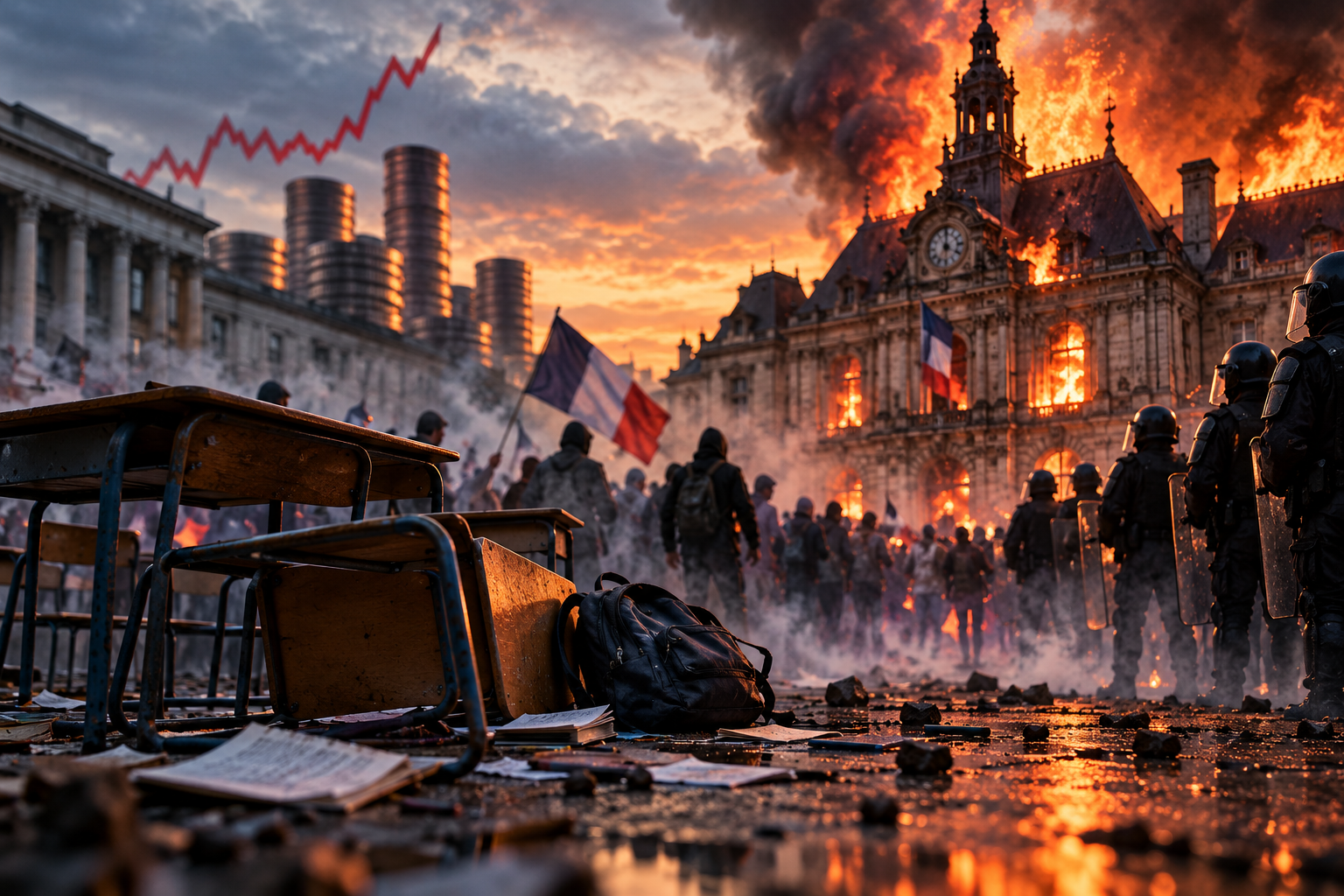
On the evening of Saturday 17 October, firefighters in Limoges watched the roof of the city hall fall in. The building had opened on 14 July 1883, Bastille Day, a Renaissance-style palace of ashlar stone with a forty-three-metre clock tower and two statues beside the clock, one for goldsmithing and one for enamelling, the trades that made the city rich. The state listed it as a historic monument in 1975. By Sunday the fire was under control, the prefect had said it was set deliberately, and what was left of the nineteenth-century Republic's idea of itself in Limoges stood open to the sky.
That same weekend, between 550,000 and 800,000 people marched across France, depending on whether you believe the Interior Ministry or the organisers. Shops were looted in Paris, Marseille, Lyon and Bordeaux. In Marseille demonstrators got into the town hall. Interior Minister Laurent Nuñez first put the number of injured police officers, gendarmes and firefighters above 500; later ministry counts came close to a thousand. One man died of a heart attack, according to Paris police, and the prosecutor opened an inquiry. By Monday evening there was a curfew around Place de la République and Les Halles in central Paris, two-day curfews in Lille, Douai, Denain and Wattignies, and a curfew for minors only in Nice.
None of this started in the street. It started in a classroom.
Créteil, 21 September
The movement that set France alight began at the Lycée Antoine-de-Saint-Exupéry in Créteil, a suburb south-east of Paris, a few days after a teachers' strike in the same education district. The complaints were practical. Absent teachers were not replaced. Classes were too big for their rooms. Buildings had mould, rats and collapsing walls, and Amnesty International recorded one classroom at 39 degrees with a single fan for 37 students. Over all of it hung Parcoursup, the national platform that sorts school-leavers into university places and that a generation of French teenagers experiences as a lottery with their future as the stake.
Within a week, blockades had spread through Seine-Saint-Denis and Val-de-Marne. By 1 October more than a thousand lycées were affected and university students had joined. On 2 October prefects closed about 400 schools. On 5 October a fifteen-year-old boy lost his left hand near the Lycée Auguste-Béhal in Lens, in the coal country of the north. Police sources said he had picked up a stun grenade and tried to throw it back; prosecutors said they had not established whether he picked it up or whether it landed on him. The mayor of Wingles, the boy's home town, said the hand had been amputated. Two days later Nuñez suspended the use of that grenade at student demonstrations, "until we understand what happened." The police inspectorate opened eighteen inquiries in the first weeks, among them a fourteen-year-old whose jaw was broken by a tear-gas round and a sixteen-year-old in Tours who lost the use of an eye.
The figure that ought to have stopped the country came from the Justice Ministry. By 5 October, 5,060 people had been taken into police custody since the violence began, 87 percent of them minors. By 8 October the count was 6,877, still 86 percent minors, and 2,376 people faced prosecution. At the same time 24 schools had been burned or ransacked, some by masked people who were not pupils, including a Paris lycée whose doors were set alight while about a hundred students were inside. A movement of children and a wave of destruction were now running through the same streets, and the state was taking both into custody in the same vans.
By mid-October the classroom had become the country. The CGT union came in behind the pupils. Calls on social media revived the yellow vests. Protesters talked about fuel prices, rents, wages, pensions and public services that no longer worked. Bruno Cautrès of the Centre for Political Research at Sciences Po called it the culmination of several separate mobilisations, tied together by taxes and the national debt. A Figaro poll found that 62 percent of French people thought the movement was justified. In the same poll, 78 percent thought La France Insoumise, the radical left party, was exploiting it. Both numbers were true at once, and that is the whole difficulty in one survey.
Two crowds, 17 October
There are two crowds in this story and they should not be confused. The first is pupils, students, teachers, trade unionists and the people in yellow vests, marching in daylight with demands that could be written on a budget line. The second is masked groups who burn city halls and loot shops. The government says the second crowd is made up of the radical left, the black blocs and ordinary criminals. Steven Decraene, who has covered France for Belgian public broadcaster VRT for years, described many of the rioters as fifteen-to-twenty-five-year-olds from the suburbs around the big cities. There are no official figures that settle the question, and anyone who tells you exactly who burned Limoges is guessing.
What can be said is that the two crowds need each other politically, even if they do not know each other. The peaceful crowd gives the riots a cause. The riots give the government a reason to talk about something other than the cause. Every burning car moves the evening news one step away from the classroom in Créteil and one step towards the question of order. That shift is not a conspiracy. It is how television works, how fear works, and, as it turns out, how a state short of money finds it easiest to work.
Élysée Palace, Sunday 18 October, 8 p.m.
On Sunday evening Emmanuel Macron held an emergency meeting with his senior officials and then addressed the nation from the Élysée at eight o'clock. The tone was firm. "Those who destroyed must pay," he said. "Those who looted must reimburse." The state would be "intraitable," unbending, with rioters and looters. Prefects, together with mayors, would decide on protective measures, including bans on certain gatherings. He said he understood the "anguish" of young people and mentioned a platform at the Education Ministry. He asked parties and unions to condemn the violence and promised proposals with the government "from this week." He ended on a sentence that sounded like a hope and read, by Monday, like an admission: "Our country deserves a beautiful presidential election in six months."
What he did not say mattered more than what he did. There was no figure for schools, or for anything else. He did not declare a state of emergency. The next morning Nuñez revealed that he had offered his resignation after admitting the policing had fallen short, and that Macron had refused it. A president who once answered a national revolt with a cheque now answered one with a promise that the bill for the broken windows would be sent to the people who broke them.
The reaction came within minutes. Manuel Bompard of La France Insoumise called the address "absolutely irresponsible" and said Macron had announced "strictly nothing." Jordan Bardella of the National Rally called it "lamentable." Sophie Binet of the CGT said Macron had "understood nothing." Édouard Philippe, his former prime minister and now his rival for the centre, wrote that he had listened and had heard no "decisions and initiatives" to restore order. Each of them was describing the same empty space. They simply wanted it filled with different things.
To understand why the space was empty, you have to leave the Élysée and look at a document that was presented two weeks before the riots peaked, and that almost nobody marching on Saturday had read.
The budget of 1 October
On 1 October, the government of Prime Minister Sébastien Lecornu presented its draft budget for 2027. It was built around one goal: bringing the public deficit down from about 5.4 percent of national output in 2026 to 5 percent in 2027. Without new measures, Lecornu said, the deficit would have drifted to around 6.5 percent. The total effort was put at about 54 billion euros, combining new measures and the full-year effect of old ones. Public debt was heading for roughly 119 percent of GDP in 2026 and above 121 percent in 2027. France last balanced its budget in 1974.
Inside that document sits a number that changes how the whole autumn reads. In the state budget, interest on the debt was set to rise from 62.6 billion euros in 2026 to 72.9 billion in 2027, an increase of 10.3 billion in a single year, for interest alone, not a cent of it repaying principal. Measured across all public administrations, the interest bill is larger still: about 79 billion in 2026 and about 91 billion in 2027, on the figures in the draft budget for all public administrations. The two numbers measure different perimeters, and the gap between them is a matter of accounting, not of dispute. On either measure the direction is the same.
Now set it beside the schools. The budget for school education, excluding civil-service pensions, comes to roughly 62 to 64 billion euros depending on how it is counted, and it rose by about 1.2 billion. The ministry will lose a net 1,588 full-time posts, because nearly 180,000 fewer pupils are expected at the start of the 2027 school year and the demographic dividend is being taken as savings rather than as smaller classes. The state's grant for lycée equipment, the dotation régionale d'équipement scolaire, stands at 661 million euros and has been frozen for many years. Once pensions are separated out, analysts reading the draft found that debt interest had become the single largest spending line of the French state, ahead of defence and ahead of schools.
In the same year that pupils blocked their lycées over overcrowded classrooms, the cost of carrying the country's past borrowing grew by roughly eight times as much as the money added for teaching its children. That is the discontinuity at the heart of the French autumn. Both facts were public and both were reported, yet they were almost never placed in the same sentence, because one belonged to the finance pages and the other to the front page.
The finance pages had their own drama. On the eve of the budget, the yield on France's ten-year bond, the OAT, touched 4.96 percent, its highest level since at least 2008. The spread over German debt stood at 132 basis points and by 19 October had climbed to 146, close to 150. S&P and Fitch rate France A+; Moody's has it at Aa3 with a negative outlook. In plain terms, lenders now charge the French state more to borrow than they have in a generation, and every euro of new spending would be judged by them before it was judged by voters. The other ministries' credits were frozen in current euros. The exceptions were defence, transfers to local authorities and the EU, and a handful of security lines. The Interior Ministry received an extra billion euros, including 970 additional police officers and 235 gendarmes. Justice got 400 million more. Civil protection got a quarter more than the year before.
Read the draft budget as a sentence about what the French state still believes it can afford, and the riots stop looking like a surprise. Interest went up. Defence went up. Police went up. Schools were held roughly flat and lost posts. The lines that grew were the lines that answer to creditors and to disorder. The lines that shrank in real terms were the lines the pupils of Créteil were marching about.
Who owns a lycée: the 1983 split
There is a second layer under the first, and it explains why the anger hit the doors of the state with such force and moved the state so little.
Since the decentralisation laws of 1983, which took effect in 1986, France has split its schools between levels of government. The state hires and pays the teachers and sets what is taught. Communes look after primary schools. Departments look after collèges, the middle schools. Regions look after lycées: they build them, extend them, renovate them, heat them, light them and clean them. In 2025 the regions spent 6.8 billion euros on secondary establishments, 4.3 billion on running them and 2.5 billion on investment, a little over 18 percent of the average regional budget. In the Sud region lycées take about a third of a roughly three-billion-euro budget. Île-de-France says it has put 6.6 billion euros into its 468 public lycées since 2015.
So when a pupil in Créteil complains that there is no maths teacher, the complaint belongs to the state. When the same pupil complains that the classroom reaches 39 degrees, the complaint belongs to the region. The pupil does not experience two complaints. He experiences one school. But the money arrives through two channels, and both channels are now being squeezed by the same hand. The regions are financed in large part by shares of national taxes, including a slice of VAT and of the fuel excise, and by grants from Paris. The 2027 budget asks local government to contribute to the national effort. How much is itself contested: the specific contribution in the bill is 2.5 billion euros from some communes, inter-communal bodies and most departments; the total effort the bill asks of local authorities has been put at 5.4 billion, and the association of regions says it is really closer to 7 billion, of which a little over a billion would fall on the regions alone. The green fund that paid for much of the climate adaptation of public buildings was cut from 2 billion to 800 million euros over three years and is to recover to 1 billion in 2027.
The effect of the split is that nobody owns the whole problem: the state can say, accurately, that it protected the education budget; the regions can say, accurately, that they have invested heavily and that Paris is now cutting their resources; and the pupils can say, just as accurately, that their classroom is still overcrowded and still too hot. Every actor is telling the truth about its own share, and the sum of those truths is a building in which nothing changes. A system can produce that outcome without anyone wanting it. It is enough that responsibility is divided and money is scarce.
Blockades have a cost of their own here, and it lands on the same budgets. Auvergne-Rhône-Alpes estimated damage to its lycées at 25 to 30 million euros, Île-de-France at 7 million and rising, Hauts-de-France at a million. Insurance should cover most of it. The repair will still come out of the same lines that were supposed to fix the roof.
Lecornu's package, 7 October
The government did not stay silent before the riots. On Wednesday 7 October, eleven days before the president's address, Lecornu spoke to the country and announced what he could. For the pupils there were five workstreams, on replacing absent teachers, material conditions, the school day, Parcoursup and the pupils' own voice, fed by an online consultation called Agora that had gathered more than 40,000 contributions, with first decisions promised for the end of October. For the cost of living there were 10 million barrels of diesel released from France's strategic reserves and sold to distributors at cost, expected to take 12 to 18 cents off a litre for three months from November; a request to EDF to run its plants as hard as safety allows, so that electricity tariffs need not rise over the winter; and the energy cheque paid out in January instead of spring, at the same amount.
Look at the design of that package rather than its size. No total cost was given, and almost every item is built so that it barely registers as new spending. Fuel the country already holds is sold at cost instead of being subsidised; a payment that was coming anyway arrives earlier; a state-controlled producer is asked to produce more; and a consultation produces its decisions later. For the schools, the figure on the table was the 1.2 billion already written into the draft budget. This is what a government does when it wants to answer and cannot afford to spend: it moves stock and timing instead of money.
No minister said in so many words that the bond market ruled out a bigger package, and I have found no document in which one does. The package itself is the evidence. It is what the government chose when it was still trying to calm the street, and it is shaped exactly like a budget that cannot grow. Ten days later the street was on fire, and the next answer was order.
2018: the cheque that cannot be written again
France has been here before, and the difference between then and now is the hidden variable.
In late 2018 the yellow vests occupied roundabouts across the country and fought running battles on the Champs-Élysées. On Monday 10 December 2018, Macron went on television and gave ground. He announced an increase of 100 euros a month for workers on the minimum wage and relief for retirees and overtime. His spokesman, Benjamin Griveaux, put the cost at 8 to 10 billion euros. The movement did not end that night, but its centre of gravity shifted, and the state had shown it could buy time with money.
It could do so because money was cheap. At the end of 2018 the French ten-year bond yielded well under 1 percent. Debt was just under 100 percent of GDP, and the deficit was a little over 2 percent. A ten-billion-euro concession was a political decision, not a market event.
Money was not the only thing that has changed. In 2018 Macron also had an absolute majority in the National Assembly and could pass a package within days. In 2026 he has neither the cheap money nor the votes, and the two are hard to pull apart: a minority government cannot easily pass new spending, and a government facing lenders at 5 percent cannot easily propose it. My reading is that the fiscal constraint runs deeper, because the left-wing opposition would vote for money for schools and the real obstacle is the deficit target the government set to keep lenders calm. But the evidence does not let me weigh the two precisely, and the comparison with 2018 isolates the price of money less cleanly than it first appears.
In October 2026 the same cheque would be written against a yield near 5 percent, a deficit above 5 percent, debt near 120 percent, a spread that has touched 150 basis points and a budget whose stated purpose is to reassure lenders. The pupils' union has asked for a 10-billion-euro plan for school buildings, and Jean-Luc Mélenchon has taken up the figure. That is almost exactly the size of what Macron conceded in 2018. The demand has not grown. What has changed is the price of saying yes.
That is why the address of 18 October had no figure in it. Whatever it said about Macron's instincts, it described the shape of the menu. A government without a parliamentary majority, presenting a consolidation budget to bond markets that had pushed its borrowing costs to a generation high, found that the cheapest answers left were the ones that cost almost nothing to announce: a consultation, diesel from the reserves, and above all order. Curfews, bans on gatherings, prosecution, the principle that the looter pays. Those can be announced without a vote in the National Assembly and without moving the spread. A teacher cannot.
Matignon, Monday 19 October
Macron lost his absolute majority in 2022 and any working majority when he dissolved the National Assembly in the summer of 2024, a decision one former Macron lawmaker told Reuters was arguably the worst in the history of the Fifth Republic. Lecornu, his prime minister, governs from a fractured chamber in which every budget is a negotiation and every negotiation carries the threat of a censure motion. On Monday 19 October his office asked prefects to impose "partial" and "localised" curfews. He was due to meet pupils, unions, teachers and party leaders during the week. The 2027 budget was being debated clause by clause in the Assembly at the same time, and deputies had already struck out one of its measures, a lower cap on the tax allowance for pensioners.
So the government sits between two pressures that cannot both be met. The street wants more spending. The bond market wants less. Parliament can bring the government down if it leans too far either way. In that position the government's behaviour becomes predictable, and it has less to do with the personality of the man in the Élysée than it appears. It promises firmness, because firmness is the thing it can most easily afford. It postpones social measures to a consultation, because consultation does not need to be funded yet.
I am not certain how much of this is constraint and how much is choice. A different government could raise taxes on someone, cut something else, or accept a wider deficit and take the market's punishment, and some economists argue it should. What the draft budget shows is only that this government has chosen not to, and that the choice leaves it with a narrower set of words than any French president has had since the euro crisis.
Le Pen, Retailleau, Philippe: the case for order
Every party in France can see the menu, and each has moved to where its own voters will meet it.
On the right, the argument is about authority. Before the address on Sunday, Marine Le Pen spoke of "a deep crisis of confidence and of authority" and proposed the rule of "the breaker pays" and the "restoration of republican order." Bardella had said Macron should ask for forgiveness and leave. Bruno Retailleau, the candidate of Les Républicains, demanded that the president declare a state of emergency "without delay." Édouard Philippe, who needs to distance himself from the president he served without losing the voters who liked him, chose the same ground: the country, he said, "needs to be commanded."
None of these figures said much about classroom sizes. They did not need to. The riots gave them a story they already owned. A National Rally that has spent a decade arguing that the state has lost control of its territory now had a burned city hall, a curfew in central Paris and a president with nothing to announce. One former Macron deputy, Jean-Baptiste Moreau, told Reuters that Le Pen no longer needed to spend a cent to campaign: the road in front of her was "a six-lane highway."
Mélenchon's 10 billion
On the left, the argument is about the cause. Mélenchon marched in Paris and called on Macron not to let the situation "rot." His demands, as Europe 1 reported them, were concrete: a freeze on prices, the 10 billion euros for education the pupils had asked for, and the abolition of Parcoursup. Bompard said the pupils' grievances were "intact." Binet of the CGT listed what was missing: youth, the cost of living, public services, job losses. Marine Tondelier of the Greens said the interior minister had "no other way out" than to resign.
These are, almost line for line, the demands of the peaceful crowd. They are also demands that would cost money the budget of 1 October was written to avoid spending. The left is right that the government offers nothing on the cause. The government is right that what the left asks for would collide with the bond market.
The government, accused of offering nothing by the left and of commanding nothing by the right, cannot answer either accusation, because the honest answer to both is the interest bill.
Odoxa, 14 October
A poll published by Odoxa on 14 October, three days before the worst of the riots, shows where the French campaign stood as the country caught fire. In the first round of the presidential election, due on 18 April 2027, Marine Le Pen was at 37 percent. Jean-Luc Mélenchon had moved up two points to 18. Édouard Philippe stood at 17. In a run-off held "today," Le Pen would beat Philippe with 53 percent and Mélenchon with 68.
Le Pen is in the race because in July a Paris appeal court upheld her conviction for embezzling European Parliament funds but cut her period of ineligibility. She has said she will run, and she has appealed again.
Put the poll next to the riots and the mechanism comes into view. The right gains from the riots directly, because disorder is its subject. The radical left gains from the cause behind the riots, because the government's silence on schools and prices confirms its account of the country. The centre gains from neither. If Mélenchon stays ahead of Philippe, the run-off would pit Le Pen against a candidate the polls give 32 percent, with the centre watching from the first round. The six-lane highway is built from both ends.
This is a mechanism, not a measured result, and nobody needs to have designed it. A National Rally strategist does not have to want the riots, and LFI does not have to want a Le Pen presidency, for each to benefit from the same paralysis in the middle. Remove the fiscal constraint, and the government could buy part of the cause back, as it did in 2018.
The Odoxa fieldwork was done before the weekend of 17 October. Whether the burning of Limoges moves the numbers, and in which direction, is not yet measured. The opposite is possible too: voters frightened by the riots and repelled by both flanks could drift back towards whoever looks most like a government.
What the system is
Lenders price French debt near 5 percent. The interest bill rises by about 10 billion euros in a year and, once pensions are set aside, becomes the largest line in the state budget. The government writes a budget to reassure those lenders, holding schools flat and asking local government, which owns the lycée buildings, to contribute. The riots that follow it give the government a crisis it can address without spending, and it addresses that one. The demand for order goes to the right, the demand for money goes to the radical left, and the blame for both stays with the centre, which governs.
Each link is documented on its own. The chain as a whole is an interpretation, and it should be read as one. It does not say the bond market caused the riots. It says the bond market decides which answers to the riots are still available, and that the answer the state can afford happens to be the one its opponents on the right are best placed to collect.
The portable version of the mechanism fits in a sentence. When a state can no longer afford to buy peace, the cheapest thing it can still offer is order, and order is a product someone else already sells.
The strongest objection
The best case against this reading is serious, and it should be stated at full strength.
First, France is not an austerity state in any normal sense. Its tax burden is forecast at 44.2 percent of GDP in 2027, among the highest in the developed world, and public spending is higher still. The interest bill is not an external force. It is the consequence of fifty years of deficits that French governments, of the left and the right, chose to run. To present the bond market as the constraint is to present the effect as the cause. A government that wanted to fund schools could cut elsewhere, raise taxes on the wealthy or on companies, or reform pensions further. The constraint is political, not financial.
Second, the regions have in fact invested, Île-de-France alone more than six billion euros in a decade. The decaying lycée is real in places but is not the general condition, and the anger may owe more to Parcoursup, to class sizes and to a general pessimism among the young than to budget lines.
Third, the riots may have little to do with schools at all. Masked groups burning city halls are not making a fiscal argument. France had riots in 2005 and in 2023, in years when money was cheap. Disorder in the suburbs has its own causes, and folding it into a budget story risks explaining too much.
Fourth, voters may simply want order. A rise for Le Pen after a weekend of looting would not need a fiscal constraint to explain it.
Fifth, the centre may yet be the one that gains. The polls cited here were taken before the worst weekend, and a frightened electorate does not always run to the edges.
Each of these is partly true, and the argument above survives them only in a narrower form. It does not claim that the bond market is the cause of the deficit, or of the riots, or of the National Rally's lead, which predates all of it. It claims something smaller and harder to dismiss: that in October 2026 the cost of the debt has narrowed the menu of responses the government is willing to fund, that this menu is visibly different from the one it had in 2018, and that the difference shows up where it can be checked: in the budget of 1 October, the package of 7 October and the address of 18 October. Whether that constraint is ultimately self-inflicted does not change what it does now.
What would prove this wrong
The reading makes predictions, and they can fail.
If the government announces, within weeks, a substantial funded package for schools, in the order of billions rather than millions, and the OAT-Bund spread does not widen by more than about 25 basis points within four weeks, measured against the Italian and Spanish spreads over the same period so that a general European move is not mistaken for a French one, then the constraint was weaker than this piece claims and the empty address was a choice rather than a necessity.
If the next polls show Philippe recovering ground against Mélenchon, or Le Pen's first-round share falling after the riots, then the flanks are not harvesting the paralysis and the centre has found a way to speak.
If the interest bill in the final budget comes in materially lower than the draft, or if the debate on the budget turns to schools rather than to order, the chain loosens at its first link.
None of these has happened yet. The country has six months to find out.
Limoges, 43 metres
The clock tower in Limoges was built to be seen from across the city. It was finished in the year the Third Republic opened the building on its own national day, and it was meant to say that the Republic kept time for everyone. On Sunday morning the tower was still standing over a roof that was no longer there.
The pupils of Créteil asked for teachers, smaller classes and a classroom that is not 39 degrees. The state, in its own budget, had already answered that it could afford police, soldiers and its creditors, and not much else. The riots made that answer visible. The election will decide who gets to be paid for it.
Evidence Map
Facts, interpretations, forecasts, and disconfirming signals.
Core claim. France's 2026 unrest began over schools, but the cost of servicing the national debt, now the state's largest budget line once pensions are set aside, has made order and no-cost concessions the government's cheapest available responses, and that response is likely to feed both electoral flanks at the expense of the centre.
Evidence level. Facts, high: the protest timeline, arrest and injury figures, the 2027 draft budget figures, the 2018 concession, and the Odoxa poll are documented in official statements and named reporting. Interpretation, medium: that the fiscal constraint shapes the government's response and the electoral outcome is a marked reading of documented facts. Forecast, speculative: that unrest will continue to strengthen the flanks rather than the centre before April 2027.
What would confirm this. No funded schools package of more than a few billion euros in the final 2027 budget; security measures dominating the government's response; Mélenchon holding second place over Philippe in polls taken after 17 October; Le Pen's first-round share stable or rising.
What would disprove this. A multi-billion-euro funded schools package without the OAT-Bund spread widening by more than about 25 basis points within four weeks, relative to Italy and Spain; Philippe or another centre candidate retaking second place; the budget debate turning on schools rather than on order.
Watchlist. The final vote on the 2027 budget; the OAT-Bund spread; the first polls fielded after 17 October; the outcome of Lecornu's talks with pupils and unions; the first round on 18 April 2027.
Sources. The custody figures come from the Justice Ministry's releases of 5 October and 9 October; the start in Créteil and the injuries from Amnesty International France and Al Jazeera's report on the Lens injury, with the grenade suspension from Public Sénat; the weekend of 17 October from CBS News and Al Jazeera; Lecornu's 7 October package from Dijon Actualités and Public Sénat; Macron's address and the party reactions from Europe 1 and Reuters via Bytes Europe; the rioters' profile from VRT NWS; the budget figures from La finance pour tous, iFRAP on public-sector interest, JeChange's reading of the draft budget, Banque des Territoires and Il Sole 24 Ore; regional lycée spending from Public Sénat; the polling from Odoxa; the 2018 concession from AP via the Inquirer.
Related from The Manifest Archive
- Everyone Is Watching the 5.34% Treasury Yield. Nobody Is Watching When America Has to Pay It.
- The Financial Architecture of Power: How Debt Defines the Limits of Modern States
- The Oil Came Back. The Diesel Didn't.
- The Return of the Right: How Europe's Fear Became a Movement
Jerry van der Laan writes The Manifest Archive, Forensic Narrative Intelligence Writing on the systems beneath power, money, and history. He traces the structures beneath them.